Creating Microsoft Teams general guidelines

pexels-photoscom-93400

You’ll find plenty of advice about creating Microsoft Teams and a collaboration environment out there. None of it should be considered absolute but instead, guidelines when creating your own Teams environment. However, the most important rule should be that Teams should be a planned process, not something randomly generated. Actually taking time to think and plan your Microsoft Teams environment will make your life a whole easier.

The first major suggestion is to plan an environment that is wide, not deep as I have outlined here;

Your collaboration structure should be wide note deep

Unlike traditional file server environments, you have the benefit of powerful search functions and AI surfacing relevant material now in Microsoft 365. Having a flat structure also make it easier to re-arrange if you need to down the track and it also make permissions much easier to handle. If you need some form of hierarchical structure for navigation you can create this using hyper links but underneath the covers, keep the structure of what you build as flat as possible. This means creating lots of Teams and SharePoint sites as needed and then linking them together, using hyperlink, into whatever you need, NOT creating subsites.

Also, as I have outlined in

A framework for file migrations to Microsoft 365

Don’t dump your information into a single location, Team , SharePoint site or Library, etc. There are lots of places for collaboration inside Microsoft 365 and certain types of information works better in different places. Break your information up and put in where it makes sense. You have all these areas available to you, use them.

Along these lines, another guideline I can give is that when information requires pure storage (no conversations or chat around it) then use a SharePoint site. If however, there will need to be conversations around that information then a Team is a much better option. For example, a SharePoint site is a great place for an archive, with finalised forms and documents like manuals and marketing material. A Team works better when creating documents that when finalised, will end up in a SharePoint. Using Teams chat correctly will cut down back and forth emails as well as making all these conversations searchable for all members of the Team.

Further, I’d suggest is to limit the depth of the structure to three (3) levels per:

The rule of three

Making a structure deeper than 3 levels generally results in people hunting up and down a structure looking for the information they are after. At the lowest level you should be able to go into a Document Library and see everything, including one level of folders below. Going deeper means you lose the initial context and when you come out you need to get re-orientated again to continue. This wastes time and creates frustration for users.

Next, when you create a new level, Team, Library, folder, etc always ask yourself the question, “Will be this be by function or location”?”. For example, if you want to create a new Team, ask the question. You then decide with Team will be for Human Resources (i.e. function). Then, when you create a channel below that Team, ask the question again. This may result in channels by State (i.e. by location). When you create a folder inside that channel, ask the same question and maybe create folders like CV, jobs, application, etc (i.e. function again)

Asking this simple question at each level provides a surprising logical structure very quickly. This is in fact where I find most people get hung up when creating a new collaboration environment and having very simple guidance you can follow helps overcome this and get on building what you need.

It is also important to follow some basic guidelines when naming each item in your structure.

– Keep the names you use as short as possible i.e. HR is far better than Human Resources

– Avoid using spaces and special characters i.e. Customer-Service not Customer Service

– Avoid having duplicate items. For example calling your Team “Projects” and then each channel something like Project-1, Project-2, Project-3, etc is redundant and consumes space.

Settling on a naming convention prior to creating your collaboration structure is a very worthwhile investment of your time. For example, settling on how to name a location like a state which could be New South Wales, NSW, N.S.W., Nsw, just to name a few possible iterations. Having a consistent approach to how you name all items in your environment will greatly assist users when they are searching for information and avoids duplicated areas. This is why a small amount of timed invested up front planning your collaboration structure pays huge dividends down the track. Unfortunately, I see too many rushing in and just creating items on the fly and then having issues down the track.

Remember, that you don’t have to build the complete structure on day one. What is the minimum viable solution required? Maybe it is something for a limited group of your users. Build it, learn, test, adjust and then move forward. Typically, you are introducing major changes inside an organisation and best method to see how this is adopted is to take a slow and sure approach while seeking feedback from users. You certainly still have your overall plans but taking one step at a time is going to allow you to quickly adjust if you need to.

Don’t forget that you’ll also have to invest in user training as I have detailed previously here:

Stop making your users feel stupid

This will be especially true if you have moved from a traditional server. Collaboration is very different from storage and failing to help users come to grips with all the features Microsoft 365 provides is going to make adoption of any new system hard. Remember, you can create the greatest collaboration structure in the world, but if people fail to use it, then that investment is wasted. In the end, technology serves humans, so help your humans come to grips with the new system and you’ll be surprised at what they can achieve it with. In my experience, the single biggest point of failure when building a new collaboration system is a failure to train the people who will be using it every day. Fail to do that, and you will struggle to make things better.

As I have outlined in

Process for file migrations to Microsoft 365

Assigning permissions comes AFTER you have created the structure. Remember, by default, Microsoft 365 is an environment designed to make it easier for users to collaborate. This means, by default, users are encourage to share, edit, and so on. For example, Teams is largely designed so that all members have the same permissions inside a Team and can read, write and delete documents by default. The more restrictive permissions you wish to apply to a structure the harder it becomes to bend the technology to accommodate this. Can it be done? Of course, but the more complex and restrictive the permissions, the harder it becomes to accommodate these inside a structure. In short, Microsoft 365 is primarily designed to allow people to work together not blocking them from getting to information. Think of it as allow more than deny.

As I said initially, there are not hard and fast rules when it comes to creating a collaboration structure in Microsoft 365. It is a tool that can be structured in just about any way to suit a business. However, following the above guideline, is going to make your life much easier and will mean you are not fighting the technology to achieve what you want. Because you want to create a structured environment it is always recommended that you design this prior to actually building it. Cleaning up afterwards always takes more time and causes more frustration in my experience. Always start simple and build from there.

Hopefully, these guidelines, based on my experience, will help you get the most from your Microsoft 365 collaboration environment. In the end, build something that work for you.
Need to Know podcast–Episode 293

Happy holidays everyone. Hope you are all enjoying the festive season. A few updates from Microsoft including the availability of Teams Premium plus an editorial on industry burnout. I’m seeing more and more IT Professionals becoming burnt out and feeling lost. At this time of the year take some time to look forward and decide whether it is time for a change. Also, don’t be afraid to reach out and share with others what your feeling. If anyone wants to chat feel free to reach out in total confidence via director@ciaops.com.

You can listen directly to this episode at:

https://ciaops.podbean.com/e/episode-293-are-you-burnt-out/

Subscribe via iTunes at:

https://itunes.apple.com/au/podcast/ciaops-need-to-know-podcasts/id406891445?mt=2

The podcast is also available on Stitcher at:

http://www.stitcher.com/podcast/ciaops/need-to-know-podcast?refid=stpr

Don’t forget to give the show a rating as well as send me any feedback or suggestions you may have for the show.

This episode was recorded using Microsoft Teams and produced with Camtasia 2022.

Brought to you by www.ciaopspatron.com

Resources

@directorcia

@directorcia@twit.social

Join my shared channel

CIAOPS merch store

Become a CIAOPS Patron

CIAOPS Blog

YouTube edition of this podcast

Microsoft 365 incident response training

GPT Chat

Try an improved Quick Assist experience

Reminder: End of servicing for Windows 10, version 21H1

Listen to your favorite Microsoft Tech Community Blog articles, powered by Azure Speech Services!

End user passwordless utopia

Microsoft Teams Premium Experiences and How to Set It Up

Teams Premium preview now available

New Work vertical in Windows Search

Basic Authentication Deprecation in Exchange Online – Time’s Up

Need to Know podcast–Episode 292

The editorial for this episode is an always controversial topic on backing up Microsoft/Office 365. I am going to highlight some of the facts that, unlike what some say, Microsoft does indeed backup customer data and you’ll find all the links in the show notes.

This is the last episode before Christmas so thanks to all listeners for their support and I wish everyone a happy and safe time over the holidays. No break here, and I’ll be back with the latest news and updates again soon.

You can listen directly to this episode at:

https://ciaops.podbean.com/e/episode-292-microsoft-365-backup/

Subscribe via iTunes at:

https://itunes.apple.com/au/podcast/ciaops-need-to-know-podcasts/id406891445?mt=2

The podcast is also available on Stitcher at:

http://www.stitcher.com/podcast/ciaops/need-to-know-podcast?refid=stpr

Don’t forget to give the show a rating as well as send me any feedback or suggestions you may have for the show.

This episode was recorded using Microsoft Teams and produced with Camtasia 2022.

Brought to you by www.ciaopspatron.com

Resources

@directorcia

@directorcia@twit.social

Join my shared channel

CIAOPS merch store

Become a CIAOPS Patron

CIAOPS Blog

YouTube edition of this podcast

Use Access policies to require multiple administrative approvals

Introducing enhanced company branding for sign-in experiences in Azure AD

Office 365 company branding requirements have changed

New Admin Center Unifies Azure AD with Other Identity and Access Products

New Layout Options for OneNote on Windows are coming soon

Introducing Microsoft Teams Premium

Announcing new removable storage management features on Windows

Microsoft Defender for Cloud Apps data protection series: Understand your data types

Microsoft Security Product Reviews: Give product feedback & get rewarded!

Backup

Revisiting some facts around Microsoft 365 backup

Do you need to backup Office 365?

Microsoft policy on backup (Sept 2022)

“Additionally, each service has established a set of standards for storing and backing up data, and securely deleting data upon request from the customer.”

The Essential 8 Security guidelines

Search essential 8

External email indicator needs refinement

A while back I wrote about how you can enable

Native external sender notifications in Exchange Online

which is a great security enhancement. However, now I’m beginning to see some push back from SMB customers.

Why? Well, if you take a look at my inbox you can probably see why:

image

Most of my emails comes from external contacts, and only one is internal. That means I see the word ‘External’ a hell of a lot in my inbox. Many point out that this ‘External’ tag chews up a lot of precious screen real estate as it appears as a prefix in the From field during email preview..

image

The challenge is that if you disable the external sender notification you also lose the warning “The sender user@domain.com is from outside your organization’, which is very handy.

It would be handy if we had a bit more customisation for the ‘External’ tag in the Set-ExternalInOutlook command, that would perhaps allow the tag to be disabled in the email preview but retain the warning line when an email item is full opened. I think that would work much better for SMB and many others also.

Hopefully, someone can let the appropriate people at Microsoft know that SMB users in particular are beginning to request this very important security feature be disabled to save screen real estate. That is a very bad thing I would suggest given the importance of email security, especially in SMB. However, I think Microsoft does need to look at this ‘External’ tag in light of the SMB experience, where there are more external than internal senders and screen real estate is at a premium.

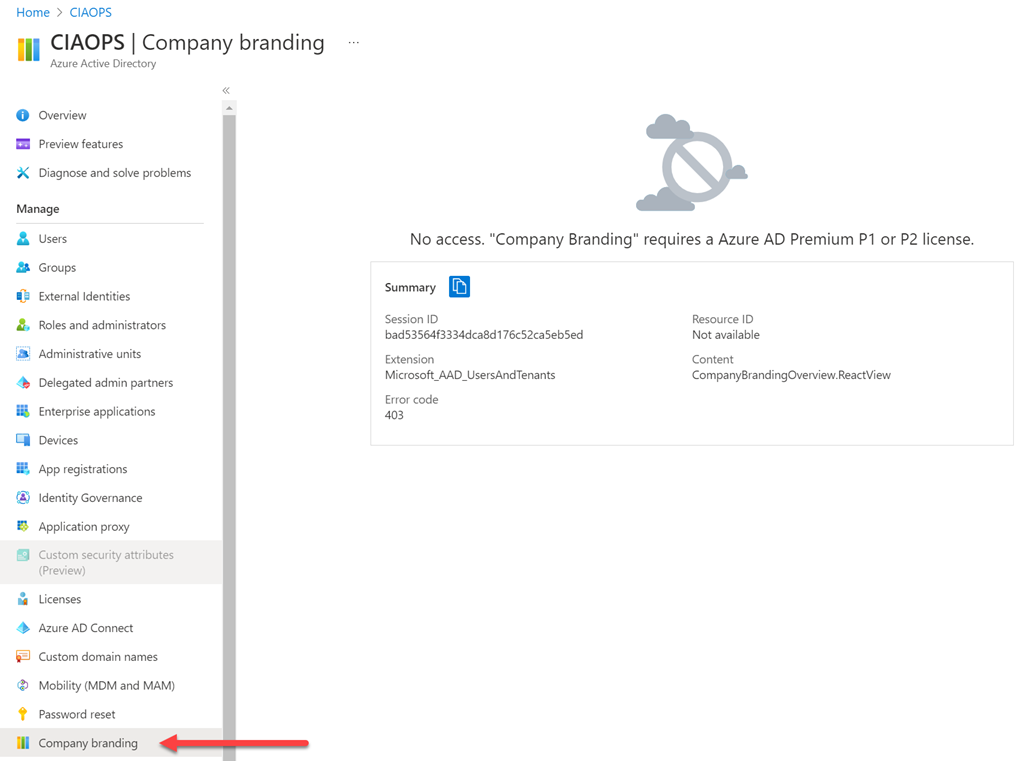
Office 365 company branding requirements have changed

*** Update ***

The issue with my tenant not displaying company branding as it used to was due to a bug in the interface. Microsoft have now rectified that and I have access to company branding as I once used to.


image

It seems that the requirements to configure Office 365 company branding have changed. The official documentation is here:

https://learn.microsoft.com/en-us/azure/active-directory/fundamentals/customize-branding#license-requirements

which says:

License requirements

Adding custom branding requires one of the following licenses:

  • Azure AD Premium 1

  • Azure AD Premium 2

  • Office 365 (for Office apps)

However, I definitely know this wasn’t the case until very recently, because a tenant I have without Azure AD P1 or P2 that allowed company branding configuration and now does not. So, something has indeed changed recently and I can find no acknowledgement or documentation of that. The existing branding of the tenant remains unchanged but I can no longer make changes.

If you don’t have Azure AD P1 or P2 in your environment you can always sign up for a 30 day trial and make changes. However, after that 30 days ends you’ll need to buy a full Azure AD P1 or P2 license it seems, if you wish to modify the company branding it seems.

I would have thought that in a world where we want to make tenants more secure using something like branding to help reduce the risk of phishing attacks tricking users into putting their details into false portals, the ability to brand a tenant would be available to all licenses.

Hopefully, this is simply an over sight by Microsoft and the ability is returned. However, for now it appears they are fully enforcing the licensing when it comes to company branding and requiring an Azure AD P1 or P2 licenced user to make changes.

CIAOPS Need to Know Microsoft 365 Webinar – December

laptop-eyes-technology-computer

Join me for the free monthly CIAOPS Need to Know webinar. Along with all the Microsoft Cloud news we’ll be taking a look at Power Virtual Agents.

Shortly after registering you should receive an automated email from Microsoft Teams confirming your registration, including all the event details as well as a calendar invite.

You can register for the regular monthly webinar here:

December Webinar Registrations

(If you are having issues with the above link copy and paste – https://bit.ly/n2k2212

The details are:

CIAOPS Need to Know Webinar – December 2022
Friday 16th of December 2022
11.00am – 12.00am Sydney Time

All sessions are recorded and posted to the CIAOPS Academy.

The CIAOPS Need to Know Webinars are free to attend but if you want to receive the recording of the session you need to sign up as a CIAOPS patron which you can do here:

http://www.ciaopspatron.com

or purchase them individually at:

http://www.ciaopsacademy.com/

Also feel free at any stage to email me directly via director@ciaops.com with your webinar topic suggestions.

I’d also appreciate you sharing information about this webinar with anyone you feel may benefit from the session and I look forward to seeing you there.

Microsoft 365 incident response training

pexels-pixabay-69934

In early 2023 I’ll be running an incident response training course for Microsoft 365 environments. Training will held over four consecutive weeks. Each session will be two (2) hours and run from 9am Sydney time.The dates are:

Wednesday January 11th 2023 – Before an incident. What you need to do to prepare

Wednesday January 18th 2023 – During an incident. What you need to do when an incident occurs

Wednesday January 25th 2023 – After an incident. What needs to be done after an incident has occurred

Wednesday February 1st 2023 – Lab exercises and group best practice discussions

The sessions will be recorded and other materials from the sessions (checklists, etc) will be available to attendees afterwards.

This event will be conducted remotely via Microsoft Teams.

The aim of this training is to help you better prepare for a security incident inside the Microsoft 365 environment. You’ll learn what settings you should enable and what processes you should have in place before an incident occurs. The sessions will also take you through common examples of incidents and help you understand what needs to be done when they occur and how to minimise risk and impact to a business. The sessions will also take your through the post-incident process to build confidence with what information needs to be maintained and how to prevent similar incidents re-occurring. The final session will be a group hands on lab and discussion so you can put all the skills you have learned to the test.

The price for this event will be:

Gold Enterprise Patron = Free

Gold Patron = $33 inc GST

Silver Patron = $99 inc GST

Bronze Patron = $176 inc GST

Non Patron = $399 inc GST

You can learn more about the CIAOPS Patron community at www.ciaopspatron.com.

I hope that you’ll join me in January for this event as I believe it provides some much needed training in a very important aspect of managing and securing Microsoft 365. If you are serious about security for Microsoft 365, then you need a plan and this training will aim to give you just that plus some experience to boot!

You can register you interest in attending this course here – http://bit.ly/ciaopsroi after which I’ll be in contact with you to arrange payment and get you enrolled.

As always, if you have any questions about this training please email me on – director@ciaops.com.

I hope to see you there.