Why Microsoft Copilot Wins: Because Copy‑Paste Isn’t a Workflow

image

There’s a lot of noise right now about AI tools.

Everyone has one. Everyone claims theirs is “the best”. And on the surface, they all seem to do the same thing: you type a prompt, it spits out words, code, or ideas.

But after working with AI daily — and helping MSPs and businesses actually use it — I’ve come to a very clear conclusion:

Microsoft Copilot isn’t better because it’s smarter.
It’s better because it’s integrated.

And that changes everything.

The Copy‑Paste Tax No One Talks About

Most AI tools live in a browser tab.

You ask a question.
You get an answer.
Then you copy it.
Then you paste it somewhere else.

Word. Excel. Outlook. Teams. PowerPoint. CRM. Ticketing system.

That constant switching feels minor… until you add it up.

It’s mental context‑switching.
It’s broken flow.
It’s extra clicks.
It’s friction.

Over a day, a week, a month — it’s a tax on productivity that nobody puts in a pricing comparison.

AI that forces you to copy and paste is still making you do the hard work.

Copilot Lives Where the Work Happens

Copilot doesn’t sit off to the side like a clever intern waiting for instructions.

It’s embedded directly into the tools people already use:

  • Writing inside Word
  • Analysing data inside Excel
  • Responding inside Outlook
  • Summarising conversations inside Teams
  • Building decks inside PowerPoint

That matters more than most people realise.

Because the real value of AI isn’t generating content.
It’s reducing friction in the flow of work.

With Copilot, you’re not moving information between systems.
You’re working on the thing, while the AI works with you.

Context Is the Secret Sauce

Here’s the uncomfortable truth about most AI tools:

They only know what you tell them.

Every prompt starts from scratch unless you manually paste in context. Emails. Documents. Spreadsheets. Notes. Meeting transcripts.

That’s not intelligence. That’s busywork.

Copilot, on the other hand, is grounded in your Microsoft 365 data — respecting permissions, security, and compliance — and understands:

  • The document you’re editing

  • The email thread you’re replying to

  • The meeting you just came out of

  • The spreadsheet you’re staring at

  • The chat you missed yesterday

You don’t have to re‑explain your world every time.

That’s the difference between an AI toy and an AI assistant built for work.

Real Productivity Is Invisible

The biggest productivity gains don’t look impressive in a demo.

They look like:

  • Finishing an email in 30 seconds instead of 5 minutes

  • Turning meeting notes into actions without rewriting them

  • Asking “what changed?” instead of rereading 20 messages

  • Starting a document without staring at a blank page

Copilot excels here because it removes micro‑tasks you shouldn’t be doing in the first place.

You’re not “using AI”.
You’re just getting work done faster.

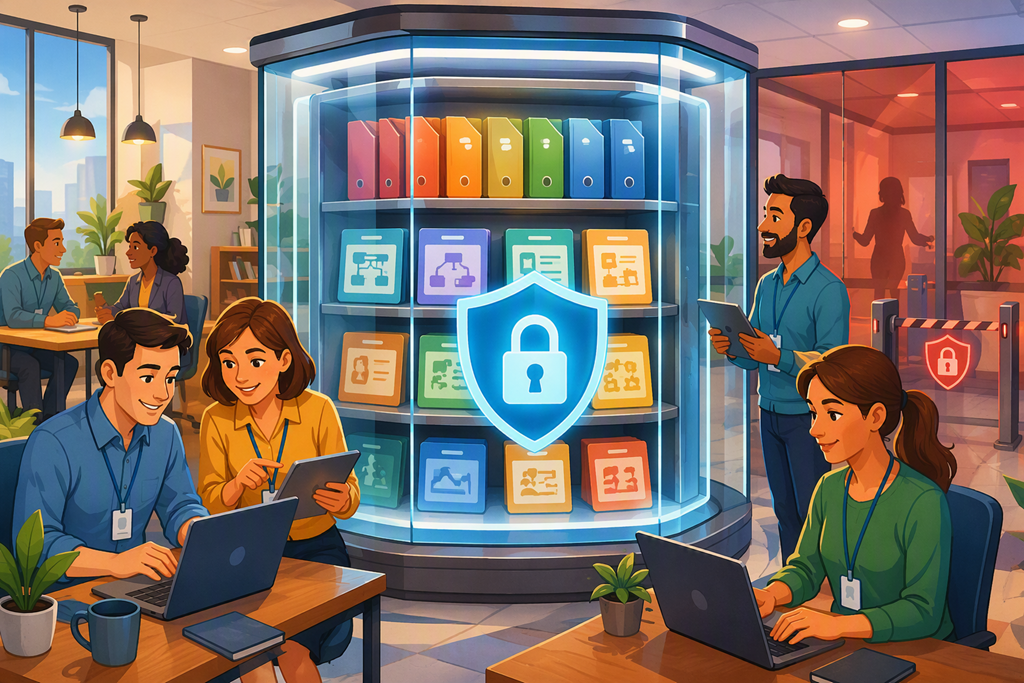
Security and Compliance Aren’t Optional

This is where a lot of organisations quietly get nervous.

Browser‑based AI tools are often disconnected from your identity, your data controls, and your compliance posture. People paste sensitive information in because they’re trying to be efficient — and suddenly governance is gone.

Copilot inherits your existing Microsoft 365 security model:

  • Identity

  • Permissions

  • Data boundaries

  • Compliance controls

It only shows users what they already have access to.

That’s not just a technical detail.
For MSPs and regulated businesses, it’s the difference between “we can use this” and “we can’t touch this”.

The Best AI Is the One People Actually Use

Here’s the final point — and it’s the one that matters most.

If AI requires:

  • Training people on a new interface

  • Convincing them to change tools

  • Forcing them to remember “where the AI lives”

…adoption will stall.

Copilot shows up inside the tools people already know.

No change management theatre.
No new browser tabs.
No “remember to use the AI”.

It’s just… there.

And that’s why it wins.

Not because it’s flashy.
Not because it’s louder.
But because it understands a simple truth:

AI only delivers value when it disappears into the workflow.

And right now, Copilot does that better than anything else on the market.

The AI Leverage Gap MSPs Can’t Ignore Anymore

image

There’s a gap opening up in the MSP market.
Not a skills gap. Not a pricing gap.
A leverage gap.

And it’s getting wider every month.

On one side are MSPs quietly using AI to move faster, operate leaner, and make better decisions with the same—or fewer—people.
On the other side are MSPs still doing things largely the way they did three years ago, just with more tools, more tickets, and more pressure.

The uncomfortable truth is this:
AI isn’t just improving productivity. It’s changing what efficient looks like.

And if you’re on the wrong side of that shift, the cost compounds quickly.

Leverage Is the New Competitive Advantage

Historically, MSPs scaled through people.
More clients meant more engineers, more service managers, more admin. Margins were protected by standardisation, process, and volume.

AI breaks that model.

The most significant change isn’t that AI can “do tasks”. It’s that it reduces the friction between thinking and doing. Documentation gets written faster. Analysis happens instantly. Repetitive decisions don’t require human attention anymore.

That creates leverage.

Two MSPs can charge similar prices, deliver similar services, and look identical on a website—yet one operates with dramatically lower internal effort.

That MSP doesn’t win because they’re smarter.
They win because they’re amplified.

Moving Slower Becomes a Hidden Tax

The first cost of being on the wrong side of the AI leverage gap isn’t obvious. It shows up quietly.

Quotes take longer to produce.
Client reports are delayed.
Internal documentation falls behind.
Staff burn time on tasks that don’t move the business forward.

None of this feels catastrophic in isolation. But it accumulates.

When one MSP can respond to a client request in minutes and another takes days, the slower business starts to feel “expensive”, even if their pricing hasn’t changed.

Speed becomes part of perceived value.

And once customers get used to faster responses, better insights, and more proactive communication, there’s no going back.

Costs Don’t Rise. They Just Stop Falling.

One of the least discussed impacts of AI adoption is cost avoidance.

The MSP using AI effectively doesn’t necessarily slash headcount. What they do is delay the next hire. They absorb growth without adding people. They reduce rework. They eliminate manual overhead that used to be “just part of the job”.

The MSP not using AI keeps adding bodies to handle complexity.

Over time, the cost structures diverge.

One business gains operating leverage.
The other keeps paying the human tax.

This matters because MSP pricing is under constant pressure. Clients expect more outcomes, more insight, and more value—without line‑item increases.

If your cost base can’t flex downward, margin erosion becomes inevitable.

The Competitive Gap Becomes Structural

At some point, this stops being about efficiency and becomes existential.

MSPs with AI leverage can:

  • Take on clients others can’t service profitably

  • Offer higher‑touch experiences without increasing cost

  • Invest more in sales, marketing, and productisation

  • Absorb shocks—staff loss, client churn, market changes—more easily

Meanwhile, slower MSPs are forced into defensive decisions:

  • Discounting to win deals

  • Stretching staff too thin

  • Avoiding growth because it “hurts too much”

  • Saying no to opportunities they can’t resource

The gap isn’t just operational. It becomes strategic.

This Isn’t About Tools. It’s About Intent

The AI leverage gap isn’t caused by not owning the right licence.

It’s caused by treating AI as a feature instead of a force multiplier.

MSPs who win here aren’t asking, “What can AI do?”
They’re asking, “Where am I still paying humans to do work a machine could amplify?”

They experiment internally first. They document better. They think in systems, not tasks. They accept that some roles will change—and design for it instead of resisting it.

Most importantly, they act before things are perfect.

The Gap Will Keep Widening

This isn’t a wave that crashes and recedes. It’s a rising baseline.

Every improvement in AI capability raises the minimum standard of what “good” looks like. Clients may not articulate it clearly, but they feel it. They notice responsiveness. They notice insight. They notice confidence.

And they notice when another provider seems to have momentum you don’t.

The AI leverage gap isn’t coming.
It’s already here.

The only real question for MSPs now is whether they’ll use it to pull ahead—or let it quietly push them behind.

AI Isn’t Killing Human Engagement. Lazy Humans Are.

image

There’s a growing narrative doing the rounds that AI is stripping the humanity out of business. That by automating answers, accelerating responses, and generating content at scale, we’re somehow eroding trust, relationships, and the very engagement that drives growth.

It sounds compelling. It’s also mostly wrong.

The real problem isn’t artificial intelligence. The problem is how people are choosing to use it.

Yes, AI is changing how work gets done. No argument there. But the idea that AI is inherently killing human engagement misunderstands both technology and people. Tools don’t destroy relationships. Behaviour does.

AI Doesn’t Remove the Human Layer — It Exposes It

When someone pastes a generic AI-generated answer into a forum and pretends it’s expertise, the issue isn’t that AI exists. The issue is that the person posting it had nothing to contribute in the first place.

Before AI, those same people were still present. They were just slower. They copied blog posts, paraphrased documentation, or regurgitated vendor marketing. AI hasn’t created impostors. It’s simply made them more obvious.

In fact, the faster and more polished low-effort content becomes, the more valuable genuine human contribution actually is.

When everyone can generate an answer in seconds, context, judgement, and experience become the differentiators. AI raises the bar. It doesn’t lower it.

People Don’t Buy From Paragraphs — But They Never Did

“People buy from people” gets repeated a lot, usually as a defence against change. But let’s be honest: people don’t buy from people because they typed every word themselves.

They buy from people who:

  • Understand their situation

  • Ask better questions

  • Explain trade-offs clearly

  • Stand behind their advice

  • Show up when things go wrong

None of that disappears because AI exists.

If your relationship with a client is so fragile that it collapses the moment you use Copilot to draft an email or summarise a proposal, then the relationship was transactional to begin with.

AI doesn’t replace trust. It reveals whether there was any there.

AI Used Properly Creates More Human Engagement, Not Less

Here’s the part critics consistently miss: AI removes friction. And friction is what stops people engaging properly in the first place.

Think about where MSPs actually struggle:

  • Keeping up with documentation

  • Responding quickly and clearly

  • Translating technical detail into business language

  • Being consistent across staff

  • Following up properly

AI helps with all of that.

When used well, AI:

  • Frees time for real conversations

  • Improves clarity and consistency

  • Reduces cognitive load

  • Helps junior staff communicate better

  • Allows senior staff to focus on judgement, not typing

That doesn’t reduce engagement. It improves it.

Clients don’t want to watch you struggle through a Word document to prove you’re “human”. They want outcomes, understanding, and confidence that you know what you’re doing.

The Relationship Layer Isn’t Being Killed — It’s Being Filtered

What is happening is that noise is being stripped away.

Communities, forums, and social platforms are getting flooded with low-effort content because the cost of producing it has dropped to near zero. That’s uncomfortable, especially for people who built reputations on being the fastest responder or the loudest voice.

But signal always reasserts itself.

People quickly learn who adds value and who doesn’t. They remember who explains why, not just what. They gravitate to those who share lived experience rather than polished output.

AI accelerates that sorting process.

If anything, it makes authenticity more important, not less.

MSPs Don’t Win by Rejecting Tools — They Win by Using Them Better

MSPs have always differentiated themselves by how they apply technology, not whether they avoid it.

We didn’t refuse automation because scripts looked impersonal.
We didn’t reject cloud because servers felt more “hands on”.
We didn’t avoid remote management because onsite felt more “real”.

AI is no different.

The MSPs who will win are the ones who:

  • Use AI to enhance communication, not replace thinking

  • Apply it with accountability and transparency

  • Combine AI speed with human judgement

  • Train staff to use it responsibly

  • Keep ownership of advice and outcomes

Those who don’t will still exist. They’ll just be slower, noisier, and increasingly irrelevant.

The Real Risk Isn’t AI — It’s Abdicating Responsibility

If someone uses AI to speak on topics they don’t understand, that’s not a technology failure. That’s a professional one.

AI doesn’t force anyone to cosplay as an expert. It just removes the excuse of effort.

At the end of the day, trust still comes from ownership. From standing behind what you say. From being accountable when things don’t go to plan.

AI can help you communicate. It can help you think. It can help you scale.

What it can’t do is care.

And that’s exactly why the human layer isn’t disappearing any time soon.

It’s just being reserved for those who actually deserve it.

The Six Human Abilities That Matter Most in the Age of AI

image

Every time a new wave of AI tools lands, the same fear resurfaces: What happens to the humans?
The uncomfortable truth is that some work will disappear. But the more important question is this: what work becomes more valuable?

The image above nails it. In an age where machines can generate content, write code, analyse data, and automate workflows at scale, the differentiator isn’t technical capability alone. It’s the human abilities that sit around the technology.

These six skills aren’t soft. They’re not optional. And for MSPs and IT professionals, they may be the difference between being replaced… and being indispensable.

1. Questioning: The Skill AI Can’t Replace

AI is exceptional at answering questions.
It’s terrible at deciding which questions actually matter.

Most poor outcomes with AI don’t come from bad tools. They come from bad prompts, shallow thinking, or unchallenged assumptions. The real value comes from people who know how to ask:

  • What problem are we actually solving?
  • Who benefits from this answer?
  • What’s missing from this output?

In an MSP context, questioning is what separates “we deployed Copilot” from “we changed how the business operates”. It’s knowing when to push back on a client request, when to reframe the problem, and when the obvious solution isn’t the right one.

AI accelerates answers. Humans decide direction.

2. Taste: Knowing What “Good” Looks Like

AI can generate ten versions in seconds.
Taste is knowing which one to ship.

Whether it’s a policy document, a client report, a security recommendation, or a piece of marketing content, AI will happily give you something. What it won’t give you is judgement.

Taste is pattern recognition built over time. It’s experience. It’s knowing when something feels off, even if it technically works. It’s why two MSPs can use the same tools and produce vastly different outcomes.

In a world flooded with AI-generated noise, taste becomes a competitive advantage. Clients don’t pay for volume. They pay for discernment.

3. Iteration: Progress Beats Perfection

AI enables speed, but humans enable momentum.

One of the most overlooked skills in the AI era is the willingness to iterate in public. To test, refine, adjust, and improve without waiting for perfection. AI lowers the cost of iteration dramatically — but only if people are willing to use it that way.

MSPs who succeed with AI don’t roll out massive, once‑off transformations. They make small changes, learn quickly, and build confidence over time. Iteration is how ideas become systems, and experiments become offerings.

AI gives you the draft. Humans do the shaping.

4. Composition: Seeing the Whole, Not Just the Parts

AI is very good at isolated tasks.
Humans are still better at composition.

Composition is the ability to connect ideas, systems, and outcomes into something coherent. It’s understanding how security impacts productivity, how automation affects culture, and how tools interact across the Microsoft ecosystem.

For MSPs, composition is architectural thinking. It’s not just deploying solutions, but designing experiences. It’s knowing how Entra ID, Intune, Defender, Copilot, and business processes fit together — and explaining that clearly to non‑technical decision makers.

AI assists. Humans integrate.

5. Allocation: Deciding Where Effort Belongs

Time and attention are the new scarcity.

AI creates the illusion that everything can be done, all at once. Allocation is the skill of deciding what should be done — and what should be ignored.

Great operators know where human effort adds the most value, and where machines should take over. They know when to automate, when to delegate to AI, and when a human touch is non‑negotiable.

For MSPs under constant pressure, allocation is survival. It’s choosing focus over busyness, leverage over labour, and outcomes over activity.

6. Integrity: The Non‑Negotiable Advantage

This one matters more than most people realise.

As AI becomes capable of generating convincing outputs at scale, trust becomes the real currency. Integrity is what ensures AI is used responsibly, ethically, and transparently — especially when clients don’t fully understand what’s happening behind the scenes.

Integrity shows up in how data is handled, how recommendations are made, and how risks are communicated. It’s choosing long‑term trust over short‑term gains.

Technology changes fast. Reputation doesn’t.


The Bottom Line

AI isn’t replacing humans.
It’s exposing the difference between people who add judgement… and people who just follow instructions.

The future belongs to those who can question, curate, iterate, connect, prioritise, and act with integrity. Tools will come and go. These abilities compound.

And the MSPs who invest in them now won’t just survive the AI era — they’ll define it.

From Push to Pull–A more effective approach to prompting

Video URL = https://www.youtube.com/watch?v=xYCVKQwEFgY

In this video, I reveal the game-changing secret to getting incredible results from AI tools like Copilot. If you’ve ever spent ages crafting detailed prompts only to get disappointing answers, you’re not alone! I show you how to flip the script with a simple mindset shift—turning your AI from a passive tool into an active collaborator. Discover the difference between push prompting and pull prompting, and learn a proven formula that boosts accuracy and makes your AI do the heavy lifting. Watch as I demonstrate this method in real-world scenarios, including Microsoft Excel, and see how a conversational approach can transform your workflow. Get ready to unlock smarter, faster, and more useful AI results—starting today! You can find my full publication at – https://directorcia.gumroad.com/l/aaiprompt

I’m Watching Business Owners Work Harder Than Ever – and Get Less Done

image

I’m seeing something that would have been unthinkable a few years ago.

Business owners are working harder than ever and achieving less than they did before.

Sixty‑hour weeks. Back‑to‑back meetings. Calendars so full there’s no white space left to actually think. They’re always “on”, always responding, always busy. And yet, when you strip it back, progress feels slower, decisions take longer, and strategy keeps getting pushed to “next week”.

At the same time, there’s a smaller group of business owners who seem to be playing a completely different game.

Same market.
Same team size.
Same pressures.

But they’ve quietly bought back 20 or more hours every week.

Not by hiring armies of staff.
Not by working harder.
And not by finding some mythical work‑life balance hack.

They’ve done it by changing what they do versus what AI does.

And that’s the part most people still don’t want to hear.

The Old Rulebook Worked – Until It Didn’t

For the last 20 years, the advice for business owners was brutally simple:

Work harder.
Do more.
Hustle.

If you hit your limits, you hired more people.

And for a long time, that worked. There was a reasonably straight line between hours worked and output created. More effort generally meant more results. More people meant more capacity.

But that line has snapped.

Not bent. Not blurred. Broken.

What used to be a law of work no longer applies.

The Moment Everything Changed

Not long ago, AI crossed a line most people didn’t notice at the time.

AI agents arrived.

And suddenly, you could hand off what used to be an eight‑hour task and get something usable back in minutes. Research that once swallowed entire days now runs overnight. Analysis that used to be blocked out in your calendar is ready before your first coffee.

This wasn’t just another productivity tool.

It rewrote the productivity equation itself.

For the first time, the constraint on output wasn’t human effort. It was decision‑making. Knowing what to do with the output became more important than doing the work to create it.

And that’s where the gap started to open.

Work Has Split Into Two Types

What I see now is that work has quietly divided itself into two categories.

The first is execution work: drafting, researching, summarising, analysing, documenting, formatting, preparing. Necessary, but largely mechanical.

The second is judgement work: deciding what matters, setting direction, weighing trade‑offs, saying yes to the right things and no to the rest.

AI is eating the first category at an alarming rate.

And many business owners are still spending most of their week buried in it.

They’re writing the documents.
They’re doing the research.
They’re preparing the decks.
They’re stuck in the weeds.

Not because they need to be there, but because that’s how they’ve always worked.

The Business Owners Who “Get It” Look Very Different

The business owners who figured this out early don’t look busier. They look calmer.

They’re not in operations anymore. They’re in strategy.

They’re not executing tasks. They’re making decisions.

They’re not asking, “How do I get through more work today?”
They’re asking, “What work should I never be doing again?”

They’ve learned how to hand off the right work to AI and keep the work that only a human business owner can do. Not blindly. Not recklessly. But deliberately.

That shift alone frees up hours every single day.

And those hours compound.

This Is Why the Gap Is Growing So Fast

Here’s the uncomfortable truth.

The gap between these two groups of business owners isn’t linear. It’s exponential.

While one group is still spending their time producing outputs, the other is spending their time deciding where the business should go next. While one group is drowning in tasks, the other is looking for leverage.

AI doesn’t just save time. It reallocates attention.

And attention is now the scarcest resource in running a business.

The business owners who are winning aren’t smarter or more disciplined. They’ve simply stopped doing work that no longer requires a human.

Everyone else is still busy proving they can.

This Isn’t About Replacing People

Let’s be clear. This isn’t about replacing teams or stripping businesses back to the bone.

It’s about redeploying human effort where it actually creates value.

AI doesn’t remove the need for leadership. It exposes the absence of it.

If your day is filled with work AI could already handle, that’s not a badge of honour. It’s a signal. One that says your role hasn’t evolved as fast as the tools around you have.

The Question Every Business Owner Needs to Ask

The most important question right now isn’t, “How do I work harder?”

It’s this:

“What am I still doing that AI could do better, faster, or cheaper than me?”

Until that question is answered honestly, nothing changes.

Calendars stay full. Weeks stay long. Strategy stays theoretical.

The business owners who answer it decisively are already operating at a different level.

And the longer others wait, the harder it will be to catch up.

Because this shift isn’t coming.

It’s already here.

New Publication – Advanced AI Prompting Guide for Microsoft Copilot

blog

https://directorcia.gumroad.com/l/aaiprompt

Advanced AI Prompting Guide for Microsoft Copilot

Unlock the true power of Microsoft 365 Copilot with the definitive guide to advanced AI prompting. Written for experienced Copilot users, this publication transforms your approach from basic instructions to strategic, collaborative conversations that deliver more accurate, efficient, and tailored results across Word, Excel, Outlook, Teams, and PowerPoint.

Why Buy This Guide?
  • Go Beyond Basics: Move past simple prompts and discover the game-changing concept of pull prompting. Learn how to shift Copilot from a passive tool to an active collaborator, improving accuracy by up to 20% for complex tasks and reducing trial-and-error cycles.

  • Practical, Real-World Examples: Step-by-step methods and worked examples for business, education, and software development. Application-specific techniques help you get the most out of Copilot in every Microsoft 365 app.

  • Prompt Templates & Checklists: Access a comprehensive library of prompt templates, quick-reference checklists, and decision matrices to streamline your workflow and boost productivity.

  • Build Custom Copilot Agents: For administrators and developers, learn how to design and deploy custom Copilot agents using structured system instructions in Copilot Studio—perfect for recurring, organisation-wide workflows.

  • Grounded in Microsoft Guidance: All techniques are based on Microsoft’s official recommendations and real-world practice, ensuring you’re always aligned with best practices.

Who Should Buy?
  • Microsoft 365 Copilot users ready to advance beyond basic prompting

  • Business professionals, educators, and developers seeking more consistent and powerful AI interactions

  • IT administrators and Copilot Studio builders wanting to create custom agents for their organisation

Key Features
  • Clear explanations of push vs. pull prompting, with actionable strategies for each

  • Application-specific guidance for Word, Excel, Outlook, Teams, and PowerPoint

  • Best practices, common pitfalls, and troubleshooting tips

  • Licensing and usage terms for personal and organisational use (see publication for details)


Elevate your AI skills and productivity—purchase the Advanced AI Prompting Guide and become a leader in intelligent collaboration with Microsoft 365 Copilot.

See all the titles available at – https://directorcia.gumroad.com/

AI, Job Losses, and the Fear Narrative We Keep Getting Wrong

image

A recent news segment making the rounds warns of a “tsunami” of AI‑driven job losses and suggests many people fear their careers could disappear within the next five years. It’s a familiar storyline. AI is coming for your job. Whole industries are about to vanish. Panic now, adapt later. [youtube.com]

But if you’ve worked in IT for any length of time, this narrative should sound oddly familiar.

We’ve heard it before. Cloud was going to wipe out sysadmins. Virtualisation was going to end infrastructure roles. SaaS was going to remove the need for IT support altogether. Each time, the jobs didn’t disappear — they changed. And in many cases, they became more valuable, more strategic, and frankly more interesting.

The current AI fear cycle feels no different.

Fear Sells Headlines, Not Understanding

News segments like this aren’t wrong to highlight anxiety. People are worried. AI tools are improving quickly, and many white‑collar roles are seeing parts of their work automated or accelerated. That uncertainty is real, and dismissing it would be unhelpful.

What is unhelpful is framing AI as a sudden, unstoppable force that simply erases careers overnight. That framing ignores how work actually evolves in the real world. It also ignores a critical detail that rarely makes the headline: AI doesn’t remove jobs — it removes tasks.

And tasks have always been replaced.

Spreadsheets didn’t eliminate accountants. They eliminated manual ledger work. Email didn’t eliminate office workers. It eliminated memos and fax machines. Cloud services didn’t eliminate IT departments. They eliminated racking servers at 2am.

AI is doing the same thing, just faster and more visibly.

The Real Risk Isn’t AI — It’s Standing Still

If there’s a genuine risk highlighted by the video, it’s not mass unemployment caused by machines. It’s what happens when people — and organisations — refuse to adapt.

Roles that are heavily repetitive, process‑driven, and resistant to change will feel pressure first. Not because AI is “taking jobs”, but because AI exposes inefficiencies that were previously tolerated. When a tool can draft, summarise, analyse, or generate in seconds, it forces an uncomfortable question: Why were we doing this the slow way in the first place?

For MSPs and IT professionals, this should be a warning — but also an opportunity.

If your value proposition is built entirely on manual effort, reactive work, or time‑based billing, AI will challenge that model. If your value proposition is built on judgement, security, governance, architecture, and business outcomes, AI becomes leverage.

AI as an Amplifier, Not a Replacement

What the fear narrative consistently misses is that AI works best with context, accountability, and oversight — all things humans still provide.

Copilot doesn’t understand your client’s risk appetite. It doesn’t own compliance obligations. It doesn’t carry professional liability. And it certainly doesn’t sit in front of a board explaining why a decision was made.

What it does do is remove friction. It shortens the distance between intent and outcome. It allows skilled people to focus less on mechanics and more on meaning.

That’s not job destruction. That’s job elevation.

What This Means for MSPs and SMBs Right Now

For MSPs, the message shouldn’t be “AI is coming for your engineers”. It should be “AI is coming for your lowest‑value activities”.

Ticket triage, basic documentation, reporting, summarisation, first‑draft responses — these are exactly the areas where AI can help reduce noise and free up senior staff to do higher‑order work.

For SMB customers, the conversation shouldn’t start with fear. It should start with capability. AI isn’t about replacing staff; it’s about helping small teams punch above their weight without burning out.

The businesses that win won’t be the ones that adopt AI fastest. They’ll be the ones that adopt it thoughtfully, with clear governance, realistic expectations, and a focus on measurable outcomes.

The Question We Should Be Asking Instead

So instead of asking, “Will AI take my job?”, the better question is:

Which parts of my job shouldn’t I be doing anymore?

That’s a far more productive conversation — and one that leads to adaptation rather than paralysis.

AI will continue to change how work is done. Some roles will shrink. New ones will appear. Most will evolve. That’s not a crisis; it’s the normal cycle of technology.

The real danger isn’t AI. The real danger is believing the fear narrative and doing nothing.