
After hosting the recent Techwerks event in Melbourne, I go Copilot to put together this summary of the day as a reference to what the day is all about and hopefully demonstrate the value it provides by attending.
TechWerks 30 was a full-day, face-to-face Microsoft 365 deep-dive hosted by Robert Crane (CIAOPS) in Melbourne on 24 June 2026. This manual provides an in-depth recap of the major topics and hands-on sessions recorded during TechWerks 30, serving both as a post-event reference for attendees and a resource showcasing the unique value of these immersive training days to prospective participants. It synthesizes content from all four recorded sessions, focusing on key themes, tools, and takeaways while omitting any personal or sensitive information.
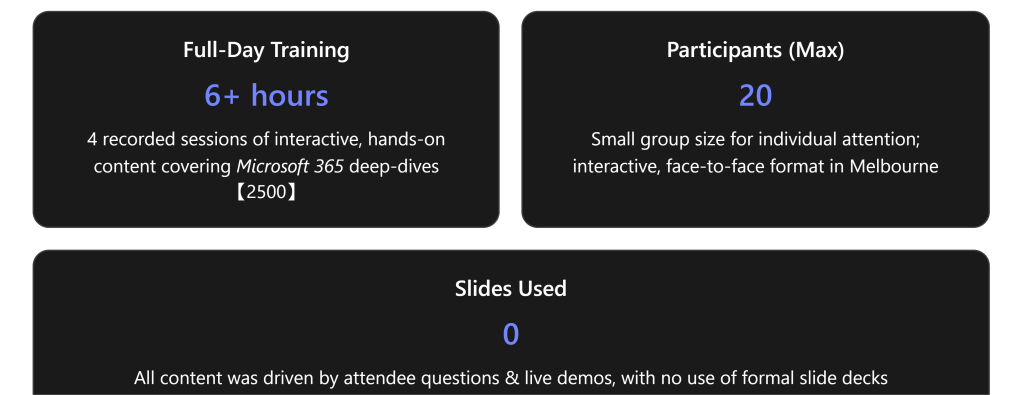
Executive Summary: TechWerks 30 offered a highly interactive, attendee-driven training experience in Microsoft 365 and related technologies. Instead of passively listening to pre-set slides, a small group of under 20 attendees actively shaped the agenda by voting on the topics they needed most. This approach ensured every session tackled real-world scenarios and pressing challenges that participants face in their day-to-day work, from managing cloud storage to bolstering security settings, and even exploring emerging features like Microsoft Copilot* and Copilot Co‑pilot’s new usage-based billing model. The event delivered practical demonstrations, live problem-solving, and best practices that participants could immediately apply in their own environments – producing numerous “Monday-morning” takeaways and clear business value.
Major Topics and Hands-On Activities
TechWerks 30 encompassed multiple major themes spanning the Microsoft 365 ecosystem, each addressed through interactive demonstrations and group discussions. Key topics included cloud collaboration best practices, security & identity management in M365, and the latest AI and product updates (with an emphasis on practical implications). Below we delve into each of these themes in detail, describing what was covered and highlighting the session’s live demos, best practices, and takeaways.
1. Collaboration & Cloud Data Management (OneDrive, SharePoint, & Teams)
OneDrive for Business & SharePoint Best Practices: A significant portion of the day was devoted to optimizing file storage and collaboration workflows in Microsoft 365, particularly OneDrive for Business (ODFB) and SharePoint Online. Many attendees still had questions on effectively using ODFB, highlighting that even seasoned users often seek clarity on fundamentals (a common scenario noted by the host).
- **“Add to OneDrive” vs Syncing Document Libraries: One best-practice discussed was the use of OneDrive Shortcuts (the “Add shortcut to OneDrive” feature) instead of syncing entire SharePoint libraries. This approach offers key benefits: it saves local disk space and reduces sync complexity by letting users pick specific folders or libraries to access via their OneDrive, rather than syncing large libraries in full. Shortcuts also streamline collaboration by ensuring a single source of truth (no duplicate copies) and improving users’ day-to-day workflows through easier access to shared content. Participants learned how to create and manage these shortcuts and how they appear in their OneDrive, avoiding common issues with oversynchronization and orphaned local copies.
- OneDrive Storage Management: The group addressed how to manage and increase OneDrive storage quotas. Attendees learned that Microsoft 365 tenants can raise the default ODFB storage from 1TB to 5TB per user for eligible plans. The manual review included step-by-step guidance (via the Microsoft 365 Admin Center and PowerShell commands) to adjust both default storage quotas and existing user quotas to 5 TB for all users – a valuable tip for growing businesses to avoid users hitting capacity limits. This discussion underscored the importance of proactive tenant capacity planning in cloud storage deployments.
- **OneDrive Offline Access and File Sync: The latest OneDrive enhancements were highlighted, including the new Offline Mode for OneDrive Web. This upcoming feature (an extension of the Files On-Demand concept) allows users to mark files/folders in OneDrive web as “always available offline” – so they can continue working on cloud files in the browser even without internet, with changes syncing once reconnected. While offline web access was still rolling out in 2026, attendees appreciated how it narrows the gap between local and cloud storage and ensures business continuity during internet outages. The trainer contrasted this with the existing OneDrive Sync client (OneDrive.exe), which has long provided offline access by syncing files to local drives. The combination of these capabilities – traditional Sync for robust offline use, and the new Web offline mode for added flexibility – was discussed as part of a holistic file access strategy.
- Real-World Troubleshooting Example – Excel & OneDrive: In the spirit of addressing real problems in real time, a participant’s recent issue was examined: Microsoft Excel crashing when saving files to a OneDrive Shared Library (via a shortcut). Rather than theoretical advice, the group diagnosed the issue interactively. Drawing on community and Microsoft knowledge, they discovered it was a known bug triggered by a recent patch (the May 2026 update) affecting Excel’s integration with OneDrive shortcuts. They discussed the official guidance that Microsoft provided (and any available workarounds), thereby reinforcing the day’s focus on immediate problem-solving. This example illustrated how TechWerks sessions deal with timely challenges and share the latest information on issues that matter to participants – in this case, confirming that Microsoft was aware of the bug and investigating, and that a fix or mitigation was on the way.
2. Security & Identity: Best Practices and Tools for Microsoft 365
Another core theme was securing Microsoft 365 environments. Attendees explored practical identity and access management strategies, with a particular focus on Conditional Access policies in Azure Active Directory (Entra ID) and baseline security configurations for small-to-medium businesses.
- Conditional Access (CA) Policies – Implementation & Avoiding Pitfalls: The group walked through the process of setting up Conditional Access policies that enforce modern zero-trust principles in Microsoft 365. This included real-time demonstrations of creating CA policies to require multi-factor authentication (MFA) for users, block legacy authentication, and restrict logins from risky locations. A key best practice highlighted was to configure “named locations” (trusted geographic locations or IP ranges) in advance before enabling broad location-based blocking policies. This prevents an*“accidental lockout”* of all users – an easy mistake if an admin, for example, enables a blanket “block all sign-ins outside country X” rule without first defining country X as a trusted location. By applying this lesson, attendees learned how to tighten security without cutting off legitimate access to their cloud services.
- Automating Best-Practice Security Setup: The session introduced tools to streamline the implementation of best-practice security baselines. Participants were shown a PowerShell-based “M365 Best Practice” script toolkit (commonly used by the CIAOPS community) that can automatically configure recommended security settings – including a baseline set of CA policies aligning with standards like the Australian Cyber Security Centre’s “Essential Eight” framework (ASD guidelines). Running these baseline scripts on a test tenant produced an immediate snapshot of the environment’s security posture, highlighting gaps and misconfigurations. Attendees were impressed by the results of a*“Tenant Posture”* script, which quickly identified areas for improvement (eliciting a “wow” from participants as it revealed areas of risk and potential enhancements).
- Advanced Security & Compliance Topics: The group further discussed emerging security features and strategies. This included an overview of recent additions like Microsoft Entra ID improvements (for identity protection), and the importance of routine secure score reviews and policy audits to keep up with evolving threats. The interactive format allowed participants to ask specific security scenario questions (for example, how to handle specialized cases in conditional access, or ensuring privileged accounts remain accessible during emergencies). The emphasis was on practical steps that small and midsize organizations can implement immediately – such as enabling MFA for all users, using Conditional Access templates or “baseline” policies provided by Microsoft, and leveraging monitoring tools (like Secure Score and sign-in logs) to continuously track and improve tenant security. Participants left with clearer guidance on prioritizing critical security measures and confidence to apply these in their own environments.
3. Emerging Technologies & Microsoft 365 Updates
Although the primary focus was on attendee-requested core topics, TechWerks 30 also touched on a few of the latest Microsoft 365 updates and emerging tools around the time of the event:
- Copilot Cowork & Usage-Based Billing: The event coincided with Microsoft’s general availability of Copilot Cowork – a new AI-driven**“agentic” assistant in Microsoft 365** capable of performing multi-step tasks, which was widely discussed at Microsoft Build 2026. The instructor provided an overview of Copilot Cowork’s capabilities and its new usage-based billing model, noting how this marks a shift in how AI features might be purchased. Attendees learned that beyond the standard M365 Copilot license (a flat per-user fee), using Cowork’s advanced autonomy features may incur consumption-based charges (“Copilot Credits”), and that IT admins must explicitly enable and configure Cowork’s pay-as-you-go billing by linking an Azure subscription to their tenant. It was noted that at launch, Cowork is opt-in (disabled by default) to prevent surprise costs, and that early access (Frontier program) participants have a grace period until July 1, 2026 before usage costs begin. This discussion prepared attendees for the practical and financial considerations of deploying advanced AI services in their organizations.
- Microsoft Scout and “Autopilot” Agents: The event also briefly mentioned “Microsoft Scout,” another new AI initiative unveiled at Build 2026, as part of looking at future trends. Scout is an always-on, autonomous AI “autopilot” agent that proactively assists users across Teams, Outlook, SharePoint, and more. Given the workshop’s focus was shaped by attendees and many were more interested in immediate productivity topics over speculative AI features, the discussion around Scout and similar advanced AI agents was kept high-level, with an emphasis on monitoring these developments. Attendees were encouraged to stay informed about how these technologies (like Scout and Copilot enhancements) could eventually be leveraged to increase productivity once they mature and align with business needs.
- Other Microsoft 365 Updates: The trainer and participants also reviewed a roundup of recent updates across the Microsoft 365 ecosystem. This likely included improvements from the 2026 roadmap and Microsoft Build announcements, such as:
- SharePoint & Teams: UI changes and new integrations (e.g., enhancements in Teams performance and architecture from the new “Teams 2.0” client).
- Windows & Endpoint: Possibly relevant news like Windows Autopatch or Intune updates for devices were noted if attendees raised them (especially given interest in Autopilot and device management in other events).
- Other: Additional Q&A on miscellaneous topics arose organically, reflecting the open format. For instance, participants asked about *license management and cost optimization (prompted by the Copilot discussion), and data backup/restore scenarios in M365 (how to recover deleted items or sites). The instructor addressed these with best-practice advice and references (sometimes with follow-up resource links provided).
Session-by-Session Highlights (Daily Schedule)
While the content was organized flexibly around attendees’ interests, the day’s four sessions can be summarized as follows:

Key Takeaways & Actionable Insights from TechWerks 30
The TechWerks 30 workshop delivered a rich collection of practical lessons for attendees. Each participant left with concrete knowledge and improvements to implement in their environments, underscoring the value of these deep-dive sessions. Some of the top key takeaways and actions were:
- Adopt “Add to OneDrive” for Shared Content: Rather than syncing entire document libraries, leverage OneDrive shortcuts to access shared folders/libraries. This approach saves local storage space, reduces sync errors, and simplifies user workflows. Participants were encouraged to audit their current SharePoint/OneDrive usage and train users on using**“Add shortcut to OneDrive”** for easier file access and collaboration.
- Optimize OneDrive Storage: Ensure your organization’s OneDrive for Business quotas are properly configured to avoid storage shortages. Increase default storage to 5 TB per user (for eligible Microsoft 365 plans) via the Admin Center or PowerShell (using
Set-SPOTenant OneDriveStorageQuotacommands). This proactive step is crucial for growing businesses. - Implement Conditional Access Baselines Safely: Put in place a strong set of baseline security policies (e.g., require MFA, block legacy auth, restrict risky locations) to protect user accounts. Use available tools (such as Microsoft’s built-in templates or community best-practice scripts) to quickly deploy these policies. However, always configure prerequisites (like named locations for trusted IP ranges or geographies) before enabling location-based blocks, to avoid inadvertently locking out admins or users.
- Leverage Automated Tenant Posture Assessments: Utilize scripts or tools that scan your Microsoft 365 tenant’s security posture to highlight areas needing improvement. One script demonstrated at TechWerks 30 provided a comprehensive “health check” of the tenant’s configurations, revealing misconfigurations and improvement opportunities (to the surprise of attendees). Regular posture assessments help ensure you keep up with best practices and address any gaps.
- Prepare for AI Integration: Keep an eye on new Microsoft 365 AI features like Copilot Cowork and Microsoft Scout that are on the horizon. Although many small businesses may not deploy these immediately, understanding their capabilities (e.g. Copilot’s usage-based billing and requirement for Azure subscription for cost control) helps in future-proofing your strategy. Plan ahead by considering how agentic AI tools could deliver value to your organization when you’re ready, and ensure your environment (licensing, governance, training) can support them.
Why Attend TechWerks Deep-Dive Sessions?
TechWerks events are not ordinary training days – they are a unique blend of community-driven agenda and practical immersion in Microsoft cloud technology. Key reasons why these sessions offer exceptional value include:
- Attendee-Led Content: You shape the day. Participants vote on the agenda beforehand, ensuring the workshop covers topics you want to learn about, rather than a generic preset syllabus. This targeted focus means each session is highly relevant to the challenges and interests of those in the room.
- Hands-On, Not “Death by PowerPoint”: TechWerks sessions are workshop-style, emphasizing live demos, real-time problem solving, and interactive labs over slide presentations. Every concept is illustrated in the context of actual real-world Microsoft 365 scenarios, making learning more engaging and practical. One attendee praised this*“interactive nature of the day” as “so much better than death by PowerPoint”*.
- Small Group, Big Impact: Capped at 20 attendees, these sessions provide an intimate setting for one-on-one interaction with the expert instructor and peers. Everyone’s questions get answered, and the peer discussions help participants learn from each other’s experiences. The face-to-face environment fosters networking and deeper engagement, adding value beyond what online training can offer.
- Immediate Best-Practice Takeaways: Each TechWerks event yields a wealth of actionable insights and best practices that attendees can implement right away in their businesses. As Mike H., a past participant, noted:“It is such a good format… the whole interactive nature of the day [is] so much better than death by PowerPoint.” Attendees leave with knowledge and tools that produce immediate improvements – from quick wins (like optimizing OneDrive usage) to strategic guidance (like strengthening your M365 security posture).
In summary, TechWerks 30 not only covered a variety of technical topics tailored to the audience’s needs, but also demonstrated the power of an open, hands-on format that transforms training into collaborative problem-solving. By emphasizing active learning, real-world practice, and participant-driven content, the session showcased why TechWerks’ full-day deep dives are invaluable for IT professionals seeking to stay ahead in the fast-moving world of Microsoft 365 and cloud services. Participants gained knowledge, confidence, and concrete best practices – making a strong case for the ROI of attending such face-to-face deep dive sessions.







 CIAOPS