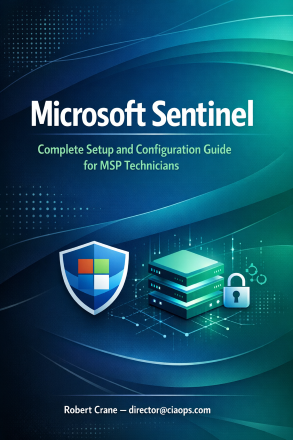
New Publication–Microsoft Sentinel: Complete Setup and Configuration Guide for MSP Technicians

blog

https://directorcia.gumroad.com/l/sentstart

Unlock the full power of Microsoft Sentinel for your MSP business with the most comprehensive, step-by-step deployment guide available for 2026!

Are you a Managed Service Provider (MSP) or IT professional looking to deliver world-class security operations for small and medium-sized businesses? This expertly crafted guide is your essential companion for deploying, configuring, and optimizing Microsoft Sentinel—the industry-leading cloud-native SIEM and SOAR platform.

Why This Guide Stands Out
  • Written for Real-World MSPs: Every step is documented in plain language, with nothing assumed. Whether you’re deploying Sentinel for the first time or streamlining repeat rollouts, you’ll find clear, actionable instructions.

  • Covers End-to-End Deployment: From Azure prerequisites and licensing to advanced analytics, cost management, and multi-tenant monitoring with Azure Lighthouse, every phase is covered in detail.

  • Cost Optimization & Best Practices: Learn how to maximize free data allowances, avoid common billing pitfalls, and implement proven strategies for cost control—critical for SMB environments.

  • Security-First Approach: Includes robust incident response runbooks, troubleshooting guides, and security hardening tips tailored for MSPs managing multiple customers.

  • Ready-to-Use Checklists & Templates: Accelerate onboarding with a 30-minute Quick Start Checklist, recommended analytics rules, and workbook templates for reporting and monitoring.

  • Up-to-Date for 2026: Reflects the latest Microsoft Sentinel features, pricing models, and compliance requirements—including Australian data residency and privacy law guidance.

Key Features
  • Audience: MSP tier-2/3 technicians, security analysts, and IT consultants

  • Licensing Focus: Microsoft 365 Business Premium (Defender for Business included)

  • Time to Deploy: 2–4 hours for initial setup; 30 minutes/week ongoing

  • Comprehensive Coverage: Prerequisites, infrastructure, connectors, analytics, workbooks, incident management, cost optimization, and more

  • Bonus Content: KQL query library, troubleshooting appendix, and compliance checklists

Who Should Buy This Guide?
  • MSPs seeking a repeatable, best-practice Sentinel deployment process

  • IT professionals responsible for SMB security operations

  • Consultants and trainers delivering Microsoft security solutions

  • Organizations wanting to reduce risk, improve detection, and control costs


Transform your MSP security practice and deliver true SIEM-as-a-Service with confidence. Get your copy of the Microsoft Sentinel Complete Setup and Configuration Guide today!

See all the titles available at – https://directorcia.gumroad.com/

CIAOPS Need to Know Microsoft 365 Webinar – April

laptop-eyes-technology-computer_thumb

Now in our tenth year!

Join me for the free monthly CIAOPS Need to Know webinar. Along with all the Microsoft Cloud news we’ll be taking a look at Data Posture Security Management (DSPM).

Shortly after registering you should receive an automated email from Microsoft Teams confirming your registration, including all the event details as well as a calendar invite.

You can register for the regular monthly webinar here:

April Registrations

(If you are having issues with the above link copy and paste – https://bit.ly/n2k2604 )

The details are:

CIAOPS Need to Know Webinar – April 2026
Thursday 30th of April 2026
11.00am – 12.00am Sydney Time

All sessions are recorded and posted to the CIAOPS Youtube channel.

Also feel free at any stage to email me directly via director@ciaops.com with your webinar topic suggestions.

I’d also appreciate you sharing information about this webinar with anyone you feel may benefit from the session and I look forward to seeing you there.

GRC in a Nutshell – And How Microsoft 365 Actually Makes It Practical

image

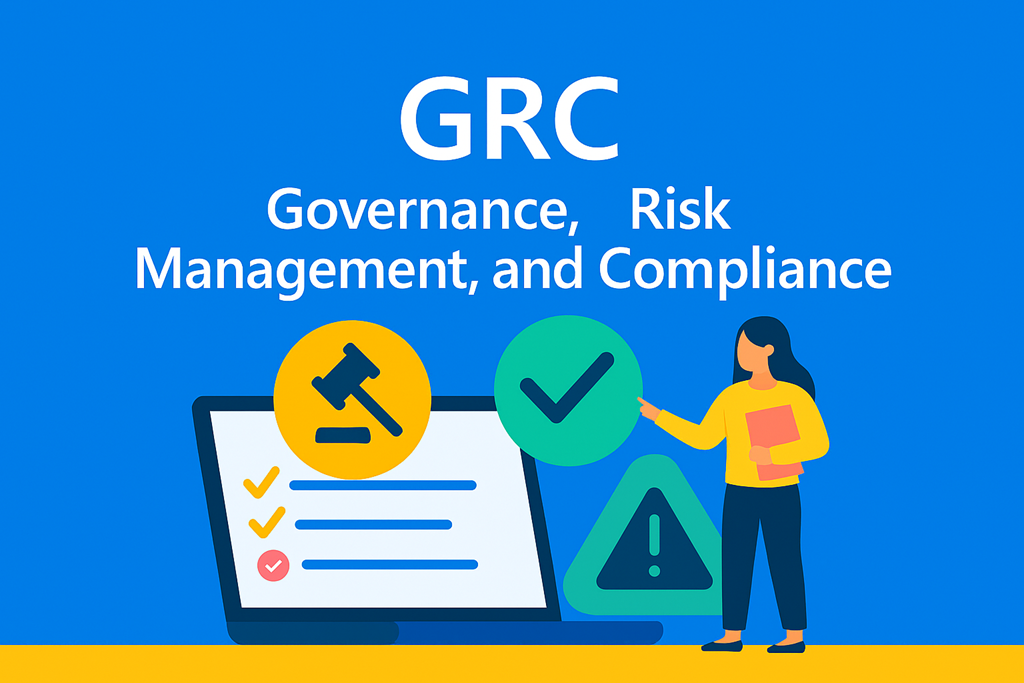
GRC is one of those acronyms that gets thrown around a lot, usually right before everyone in the room quietly switches off.

Governance, Risk Management, and Compliance sounds like paperwork, policy binders, and audit pain. But done properly, GRC is none of those things. It’s simply the mechanism that turns business intent into repeatable, defensible security outcomes.

And this is where Microsoft 365 quietly does a lot more heavy lifting than most organisations realise.

GRC isn’t about eliminating risk

Let’s get this out of the way early.

The goal of GRC is not to eliminate risk. That’s impossible. If your business uses email, cloud services, mobile devices, or people, risk exists.

What GRC is really about is:

  • Understanding what level of risk the business is willing to accept

  • Translating that appetite into practical controls

  • Measuring how well those controls are working

  • And getting explicit agreement on the residual risk that remains

That last point is critical. Security isn’t an IT problem — it’s a business decision. GRC gives the business a way to make that decision consciously, instead of by accident.

Governance: turning intent into guardrails

Governance is where most organisations stumble, because it’s often confused with documentation.

In reality, governance is simply the process of answering:

“How do we want things to work around here?”

In Microsoft 365, governance is expressed through configuration, not policy PDFs.

Examples:

  • Conditional Access defines who can access what, from where, and under what conditions
  • Intune defines how devices must be configured before they’re trusted

  • Sensitivity labels define how information is classified and handled

  • Retention policies define how long data should exist — and when it shouldn’t

This is governance as code. Once it’s configured, it applies consistently, silently, and at scale. No training session or reminder email can compete with that.

Risk management: making security measurable

Risk management is where GRC starts to pay for itself.

Instead of vague statements like “we take security seriously”, Microsoft 365 gives you evidence:

  • Secure Score shows how your tenant compares to recommended security baselines

  • Defender surfaces real‑world attack activity, not theoretical threats

  • Compliance Manager maps controls to recognised frameworks and highlights gaps

This matters because risk that isn’t measured can’t be discussed meaningfully with the business. Microsoft 365 turns risk into dashboards, trends, and improvement actions — which means security conversations can finally move beyond fear and anecdotes.

Compliance: a by‑product, not the goal

One of the biggest mistakes I see is organisations chasing compliance as the end goal.

Compliance should be the output of good governance and risk management, not the driver.

Microsoft 365 reflects this approach well. Whether you’re aligning to Essential Eight, ISO, or internal standards, the same core controls keep showing up:

  • Strong identity protection

  • Device compliance

  • Data classification and protection

  • Logging, auditing, and retention

When these are in place, compliance reporting becomes far less painful — because you’re proving what you already do, not scrambling to justify what you don’t.

Residual risk: the most important conversation

Here’s the part that rarely happens, but should.

After controls are implemented and compliance is measured, there will always be risk left over. Budget limits, usability trade‑offs, legacy requirements — they all create gaps.

GRC forces the right question:

“Are we comfortable accepting this remaining risk?”

Microsoft 365 makes that conversation possible because it provides clarity:

  • What’s protected

  • What isn’t

  • And what it would take to close the gap

That enables informed decisions instead of hand‑waving. Sometimes the answer is “yes, we accept that risk”. And that’s perfectly valid — as long as it’s a conscious choice.

Why this matters now

With Copilot, automation, and cloud‑first operations accelerating, risk is no longer something that can be managed annually or ad‑hoc.

Microsoft 365 gives organisations a living GRC platform:

  • Governance enforced through configuration

  • Risk surfaced through telemetry

  • Compliance evidenced continuously

The organisations that thrive won’t be the ones chasing perfect security. They’ll be the ones who understand their risk, manage it deliberately, and can explain — clearly — why they’ve made the choices they have.

And that, in a nutshell, is what GRC is supposed to do.

GRC mapped to Microsoft 365 (at a glance)

GRC Element What it means in plain English How Microsoft 365 supports it
Governance Define how the business wants security, access, and data handling to work. Conditional Access and identity controls set who can access what and under which conditions.
Intune enforces device standards. Sensitivity labels and retention policies define how data is
classified and handled across Exchange, SharePoint, OneDrive, and Teams.
Risk Management Identify, measure, and prioritise real security risks. Secure Score and Defender telemetry expose gaps and active threats. Intune and Entra ID reporting
provide visibility into configuration drift and access risk. Microsoft Sentinel and Defender XDR
(where used) correlate signals to show material risk rather than noise.
Compliance Demonstrate alignment to standards, regulations, or internal controls. Microsoft Purview Compliance Manager maps controls to frameworks and tracks implementation status.
Audit logs, eDiscovery, and retention provide evidence without manual data gathering. Built-in
compliance reporting supports regulatory and contractual requirements.
Residual Risk Explicitly accept what remains after controls are applied. Microsoft 365 reporting clarifies what is protected and what isn’t, allowing business leaders to
make informed trade-offs between usability, cost, and security.

New Publication–Microsoft Defender for Business Implementation Guide

blog

https://directorcia.gumroad.com/l/mdbig

Unlock Enterprise-Grade Security for Every Business—No Matter the Size

Are you ready to transform your security posture and deliver true peace of mind to your organization or clients? The Microsoft Defender for Business Implementation Guide (v8) is your definitive, step-by-step playbook for deploying, configuring, and mastering Microsoft’s most powerful endpoint protection platform—tailored specifically for small and medium-sized businesses (SMBs) and managed service providers (MSPs).

Why This Guide?
  • Comprehensive & Current: Authored and reviewed against Microsoft’s latest documentation (March 2026), this guide incorporates all the newest features, compliance frameworks, and product naming conventions—including Microsoft Entra ID and Security Copilot integration.

  • Role-Based Clarity: Whether you’re L1 helpdesk, L2 systems technician, or L3 security engineer, you’ll find clear responsibilities, escalation policies, and best practices for every technical level.

  • Seven-Phase Deployment Blueprint: Follow a proven, auditable process from pre-implementation planning and licensing, through device onboarding and advanced feature enablement, to post-deployment validation and compliance tracking.

  • Real-World, Actionable Steps: Includes quick-start checklists, decision tables, escalation criteria, and step-by-step procedures for Windows, macOS, iOS, Android, and Linux environments.

  • MSP-Ready: Features dedicated guidance for multi-tenant management, Microsoft 365 Lighthouse, and compliance with the latest GDAP requirements.

  • Security Without Compromise: Learn how to implement next-generation antimalware, firewall management, attack surface reduction, endpoint detection and response (EDR), vulnerability management, and automated investigation and remediation (AIR)—all in one unified platform.

  • Audit-Ready & Best Practice Driven: Ensure every deployment is systematic, documented, and compliant with SMB1001 and Microsoft’s own recommendations.

Who Should Buy This Guide?
  • IT Managers & Security Leads in SMBs seeking enterprise-grade protection without enterprise complexity.

  • MSPs looking to standardize and scale secure deployments across multiple clients.

  • Technicians at All Levels—from helpdesk to security architects—who need clear, actionable instructions and escalation paths.

  • Organizations Pursuing Compliance and audit-readiness in today’s evolving threat landscape.

What You’ll Achieve
  • Rapid, error-free deployments with minimal downtime.

  • Consistent, auditable security operations and compliance.

  • Reduced analyst workload through intelligent automation.

  • Confident, well-trained teams ready to respond to any incident.


Don’t leave your business or clients exposed. Equip your team with the only guide that delivers both the “how” and the “why” of Microsoft Defender for Business—backed by real-world expertise and the latest best practices.

See all the titles available at – https://directorcia.gumroad.com/

Why the Essential Eight Falls Short for Microsoft 365 Copilot

image

The Essential Eight has done a lot of good.

It’s helped lift the baseline security posture of thousands of Australian organisations. It’s given boards something concrete to point at. And it’s given MSPs a common language to talk about “doing security properly”.

But here’s the uncomfortable truth:

The Essential Eight is not a good security framework for working with Microsoft 365 Copilot.

That doesn’t mean it’s useless.
It means it was never designed for this problem.

And pretending otherwise is where things start to break.

The Essential Eight Was Built for a Different Era

At its core, the Essential Eight is a host‑centric, exploit‑reduction framework.

Patch your systems.
Lock down macros.
Control admin privileges.
Stop ransomware from ruining your week.

That mindset made perfect sense when the primary risks were:

  • Malware executing on endpoints

  • Credential theft via phishing

  • Lateral movement across on‑prem networks

Copilot changes the threat model completely.

Copilot doesn’t break in.
It doesn’t escalate privileges.
It doesn’t drop malware.

It uses the access you’ve already given people—and amplifies it.

That’s a fundamentally different class of risk.

Copilot Turns “Access” Into the Attack Surface

The Essential Eight assumes that if a user can access something, the risk has already been accepted.

Copilot doesn’t.

Copilot takes that access and:

  • Aggregates it

  • Summarises it

  • Correlates it

  • Surfaces it in seconds

A user who technically had access to 10,000 SharePoint files—but never opened them—now has an AI assistant that can reason over all of them at once.

Nothing in the Essential Eight meaningfully addresses:

  • Overshared SharePoint sites

  • Inherited permissions chaos

  • “Everyone except external users” links

  • Legacy Teams and Groups no one remembers creating

From an Essential Eight perspective, everything is fine.

From a Copilot perspective, the tenant is a loaded weapon.

“We’re Essential Eight Compliant” Is a False Sense of Safety

This is where I see organisations get caught out.

They’ve ticked the boxes:

✅ MFA enforced
✅ Devices compliant
✅ Admin roles restricted
✅ Patching up to date

Then they turn on Copilot and assume security is handled.

It isn’t.

Because Essential Eight compliance tells you almost nothing about:

  • Who can see sensitive data

  • Whether data is correctly classified

  • Whether information barriers exist

  • Whether users understand the impact of AI on data exposure

Copilot doesn’t care that your macros are locked down.

It cares about data sprawl.

The Essential Eight Doesn’t Model “Inference Risk”

This is the biggest gap.

Copilot introduces inference risk—the ability to derive sensitive insights from non-sensitive data.

Individually harmless documents can become highly sensitive when combined:

  • A pricing doc

  • A staff list

  • A project timeline

  • A financial forecast

Copilot can stitch those together in ways humans rarely do.

The Essential Eight has no control for:

  • Semantic aggregation

  • Contextual inference

  • AI‑assisted discovery

You can be perfectly compliant and still expose far more than you realise.

Copilot Needs a Data‑Centric Security Model

If you’re serious about Copilot, your security thinking has to shift.

From:

“Can this device run malicious code?”

To:

“Should this person ever see this information—at scale?”

That means frameworks and controls that focus on:

  • Information architecture

  • Permission hygiene

  • Data classification and sensitivity labels

  • SharePoint and Teams governance

  • Ongoing access reviews

  • User behaviour and intent

None of which are meaningfully addressed by the Essential Eight.

This Doesn’t Mean You Throw the Essential Eight Away

Let’s be clear.

The Essential Eight is still a solid baseline.

You absolutely should be doing it.

But treating it as sufficient for Copilot is a mistake.

It’s like saying:

“We’ve installed seatbelts, so autonomous driving is safe.”

Different problem. Different risk profile.

The Right Question to Ask

Instead of asking:

“Are we Essential Eight compliant?”

Copilot forces a better question:

“What could Copilot expose tomorrow that we’d be uncomfortable explaining to the board?”

If you can’t answer that confidently, the framework you’re using is the wrong one for the job.

Copilot doesn’t reward checkbox security.

It rewards intentional design, clean data, and disciplined governance.

And that’s a conversation the Essential Eight simply wasn’t built to have.

New Publication – Microsoft Intune: Complete Getting Started Guide for MSP Technicians

blog

https://directorcia.gumroad.com/l/intunegs

Unlock the Power of Modern Device Management with Microsoft Intune!

Are you ready to transform your IT operations and deliver seamless, secure device management for your clients or organization? This publication is your essential guide to mastering Microsoft Intune in small-to-medium business environments, packed with actionable insights, step-by-step instructions, and real-world best practices1.

Why Choose This Guide?
  • Comprehensive & Practical: Written as a hands-on runbook, this publication walks you through every critical step—from tenant setup and device enrollment to policy creation, app deployment, and troubleshooting. Each procedure is explained in clear, jargon-free language, so you know not just what to do, but why it matters1.

  • For All Skill Levels: Whether you’re a Level 1 technician new to device management or a seasoned MSP architect, you’ll find targeted sections for your needs. L1s get the basics and rollout checklists; L2/L3s get advanced automation, multi-tenant architecture, and the latest platform updates1.

  • Up-to-Date for 2026: Stay ahead of the curve with coverage of critical updates, new features, and evolving best practices—including Windows 10 end-of-life, Azure Front Door IP changes, Autopilot v2, AI-powered Intune Suite features, and expanded support for Linux and macOS1.

  • Troubleshooting & Optimization: Avoid common pitfalls with detailed troubleshooting guides, diagnostic tools, and security quick wins. Learn how to monitor, report, and remotely manage devices for maximum efficiency and compliance1.

  • Customer Communication Templates: Reduce helpdesk calls and boost user satisfaction with ready-to-use email templates, BYOD guides, and rollout communications1.

Who Should Buy This Guide?
  • Managed Service Providers (MSPs) seeking to scale operations and deliver consistent, high-quality Intune deployments.

  • IT professionals and consultants responsible for device management, security, and compliance in Microsoft 365 environments.

  • Organizations planning migrations, upgrades, or new deployments of Microsoft Intune.

What You’ll Achieve
  • Confidently build, operate, and troubleshoot Intune environments.

  • Streamline onboarding, policy rollout, and app deployment across Windows, macOS, iOS/iPadOS, and Android.

  • Implement best practices for security, compliance, and ongoing maintenance.

  • Communicate effectively with end users and stakeholders.

Don’t settle for guesswork—equip yourself with the definitive guide to Microsoft Intune and deliver results that delight your clients and users.

See all the titles available at – https://directorcia.gumroad.com/

New Publication – Achieving SMB1001:2026, M365 PowerShell Automation Guide

blog

https://directorcia.gumroad.com/l/smb1001-2006-ps

Achieving SMB1001:2026. Microsoft 365 PowerShell Automation Guide

Unlock the highest level of security, compliance, and operational efficiency with the definitive PowerShell automation guide for SMBs, MSPs, and IT professionals.

Why Choose This Guide?
  • Production-Ready Automation: Deploy fully-scripted, repeatable, and auditable solutions for every major security and compliance control in Microsoft 365 Business Premium—no more guesswork or manual errors.

  • Comprehensive Coverage: Includes 12 essential technology management controls (firewall, antivirus, patching, BitLocker, application allow-listing, EDR, and more) and 18 access management controls (account lifecycle, MFA, privileged access, email security, etc.), all mapped to the SMB1001:2026 standard.

  • Built for Professionals: Perfect for Managed Service Providers (MSPs), IT administrators, and security teams managing multiple tenants or seeking to implement infrastructure-as-code and configuration-as-code best practices.

  • Audit-Ready Evidence: Every script is designed to generate compliance evidence, validation reports, and audit artifacts—making regulatory audits and client reporting effortless.

  • Idempotent & Safe: All automation is designed to be safely re-run, ensuring consistent results and minimizing risk in live environments.

  • Best Practice Guidance: Each control includes not just scripts, but also implementation notes, validation steps, and operational best practices—so you’re never left wondering “what’s next?”

  • Legal & Licensing Clarity: Single-user, non-commercial license with clear terms; organizational and commercial use available by arrangement.

Key Benefits
  • Achieve and Maintain Compliance: Streamline your journey to SMB1001:2026 Level 5 (Diamond) compliance with proven, field-tested automation.

  • Reduce Risk: Enforce least-privilege, automate patching and security baselines, and block legacy threats—dramatically lowering your attack surface.

  • Save Time and Resources: Replace hours of manual configuration with one-click, script-driven deployments and validations.

  • Centralize and Standardize: Manage all tenants, devices, and users from a single, consistent playbook—ideal for MSPs and multi-tenant environments.

  • Stay Audit-Ready: Generate and maintain all the evidence you need for regulatory, insurance, or client audits—automatically.

Who Should Buy This Guide?
  • MSPs managing Microsoft 365 environments for multiple clients.

  • IT Administrators seeking robust, repeatable, and documented security/compliance deployments.

  • Security Teams needing automated compliance validation and evidence collection.

  • Organizations implementing infrastructure-as-code and aiming for best-in-class security posture.

What’s Inside?
  • Step-by-step PowerShell scripts for every control, with validation and compliance checks.

  • Modular structure for easy adoption—implement what you need, when you need it.

  • Quick reference tables, evidence checklists, and compliance calendars.

  • Guidance for integrating with HR, ITSM, Azure Key Vault, and Microsoft Graph APIs.

  • Best practices for onboarding, offboarding, privileged access, password management, backup, recovery, and more.


Don’t just meet compliance—automate it, prove it, and stay ahead of evolving threats.
Purchase the SMB1001:2026 PowerShell Automation Guide and transform your Microsoft 365 security and compliance operations today!

See all the titles available at – https://directorcia.gumroad.com/

New Publication – Achieving SMB1001:2026. Step by step GUI based instructions for MSPs and IT Professionals

blog

https://directorcia.gumroad.com/l/smb1001-2006-gui

Unlock the highest level of cybersecurity and compliance for your business with the definitive SMB1001:2026 Compliance Guide.

What Is It?

A comprehensive, step-by-step, GUI-based manual designed for Managed Service Providers (MSPs), IT professionals, and compliance officers. This guide demystifies the SMB1001:2026 Level 5 (Diamond) standard, providing clear instructions for implementing every required control using Microsoft 365 Business Premium and related Microsoft tools.


Key Features
  • Complete Coverage: All five domains—Technology Management, Access Management, Backup & Recovery, Policies & Plans, Education & Training—are mapped to actionable controls.

  • Stepwise Implementation: Each control includes requirements, GUI navigation, best practices, and links to official Microsoft documentation.

  • Audit-Ready Evidence: Guidance on collecting and maintaining evidence (screenshots, reports, policies) for every control, ensuring audit readiness.

  • Advanced Security: Includes new 2026 controls like Endpoint Detection & Response (EDR), SPF/DKIM/DMARC for email, and phishing-resistant MFA.

  • Vendor/Product Comparisons: Practical tables for backup, insurance, training, DMARC, vulnerability scanning, and password managers—helping you choose the right tools.


Benefits
  • Achieve SMB1001:2026 Level 5 Certification: Essential for regulatory compliance, cyber insurance, and client trust.

  • Reduce Audit Risk: Clear evidence requirements and troubleshooting guides minimize compliance gaps.

  • Streamline IT Operations: GUI-based instructions minimize reliance on PowerShell/CLI, making implementation accessible to Level 1 support staff.

  • Protect Against Modern Threats: Ransomware, phishing, credential compromise, and vendor risk are all addressed with layered security controls.

  • Save Time & Reduce Errors: Step-by-step guidance, best practices, and troubleshooting appendices ensure smooth rollout and rapid problem resolution.


Who Should Buy?
  • MSPs and IT professionals managing Microsoft 365 environments for SMBs.

  • Compliance officers and business managers seeking audit-ready, best-practice security.

  • Organizations aiming for SMB1001:2026 certification, improved cyber insurance premiums, and a mature security posture.


How It Solves Your Problems
  • Fragmented Compliance: Brings all controls together in one place, mapped to Microsoft 365 tools.

  • Audit Evidence Gaps: Provides templates and checklists for evidence collection and retention.

  • Risk of Misconfiguration: Stepwise, GUI-based instructions reduce errors and ensure correct implementation.

  • Backup & Recovery Weaknesses: Covers offsite, air-gapped, and immutable backup strategies, with vendor comparisons.

  • Human Error & Training: Includes security awareness, phishing simulation, and role-based IT/admin training modules.


Why Purchase?
  • Required for SMB1001:2026 Level 5 (Diamond) certification.

  • Simplifies complex compliance and security requirements.

  • Saves time and reduces operational risk.

  • Provides audit-ready documentation and evidence.

  • Aligns with Microsoft 365 tools for seamless integration.


Take the guesswork out of cybersecurity compliance. Invest in the SMB1001:2026 Compliance Guide and empower your business to achieve, maintain, and prove the highest standards of security and operational resilience.

Achieving SMB1001:2026 is available here – https://directorcia.gumroad.com/l/smb10012006

See all the titles available at – https://directorcia.gumroad.com/