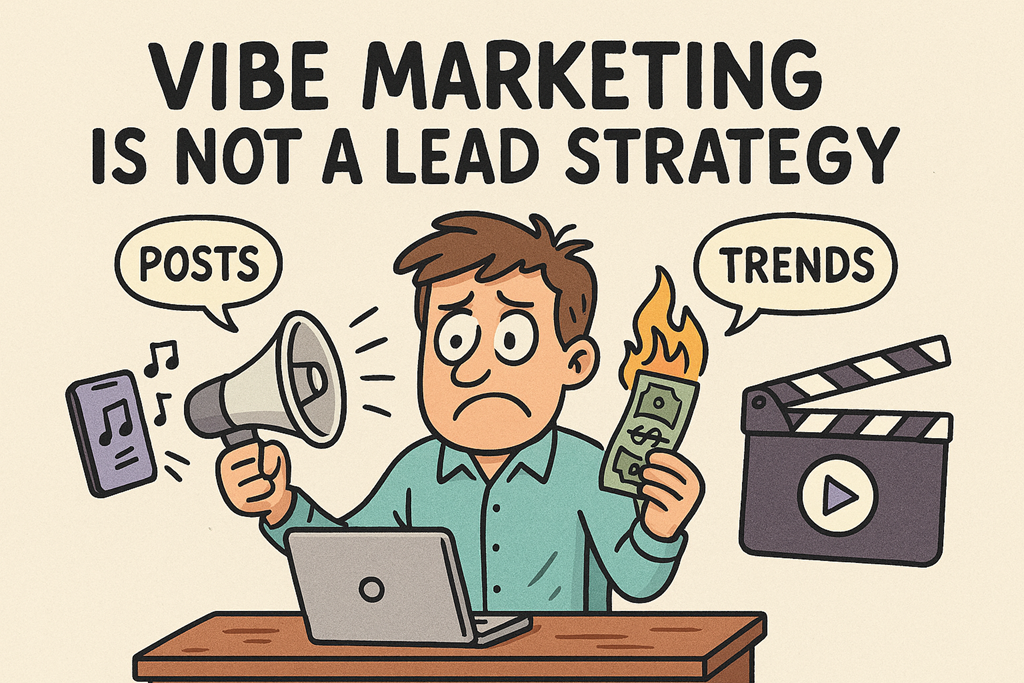
Vibe Marketing Is Not a Lead Strategy

image

They don’t have enough leads.

So they look around, see what the cool kids are doing…

…and start vibe marketing a solution built for the wrong problem.

More posts.
More ads.
More trends.
More “hooks”.

And nothing changes.

You post more, and nothing happens.
Like shouting into the void.

You spend more on ads, and nothing happens.
Like burning $100 bills.

You copy viral trends and obsess over their hooks.
Like an actor practising a script.

And maybe — maybe — you get more views.

But you don’t want views.

You want leads.
You want clients.
You want money.

And that’s where vibe marketing falls apart.

The Real Problem Isn’t Marketing

Most businesses don’t actually have a marketing problem.

They have a clarity problem.

Marketing amplifies what already exists. If what exists is vague, generic, or misaligned, all you’re doing is amplifying noise.

So instead of fixing the foundations, people chase activity:

  • “We need to post more”

  • “We need to be on TikTok”

  • “We need a personal brand”

  • “We need to go viral”

No.
You need to know who you are for, what painful problem you solve, and why someone should trust you with it.

Without that, marketing is just motion without traction.

Views Are a Vanity Metric

This is the part no one likes to hear.

Views don’t pay invoices.
Likes don’t sign contracts.
Followers don’t equal revenue.

You can have thousands of impressions and still have an empty pipeline.

Why?

Because attention without intent is worthless.

If your content is designed to be liked instead of useful, you’ll attract people who are entertained — not people who are ready to buy.

This is especially true in B2B and professional services. MSPs, consultants, advisors, agencies — your buyers aren’t impulse shopping. They’re looking for confidence, competence, and clarity.

They don’t want vibes.
They want answers.

Trend Chasing Is a Trap

When you copy what’s trending without understanding why it works, you end up performing instead of positioning.

You start sounding like everyone else.

Same phrases.
Same hooks.
Same recycled advice.

And when everyone sounds the same, price becomes the only differentiator.

That’s how you end up in a race to the bottom, competing with people who are cheaper, louder, or willing to promise more than you ever should.

Good marketing isn’t about being clever.

It’s about being clear.

The Question You Should Be Asking

Instead of asking:

“What should I post?”

Ask this:

“What does my ideal client need to understand before they’re ready to buy from me?”

That’s the content that converts.

Not motivational fluff.
Not generic tips.
Not trend-based noise.

But content that:

  • Names the real problem they’re avoiding

  • Explains the cost of not fixing it

  • Shows them a better way

  • Positions you as the guide, not the hero

That’s not sexy.
It’s effective.

Marketing That Actually Produces Leads

Lead-generating marketing does a few unglamorous things very well:

  • It speaks to a specific audience, not “everyone”

  • It addresses a specific problem, not a broad category

  • It offers a clear next step, not vague inspiration

  • It builds trust over time, not hype in a moment

That might look like fewer posts.
It might look like longer posts.
It might look like content that doesn’t “perform” on social.

But it performs where it matters — in conversations, enquiries, and signed agreements.

Stop Performing. Start Positioning.

If you’re posting constantly and nothing is happening, the answer isn’t “more”.

The answer is better alignment.

Marketing isn’t about shouting louder.

It’s about being heard by the right people — at the right moment — with the right message.

So before you jump on the next trend, platform, or tactic, ask yourself:

  • Do I actually understand my buyer?

  • Is this solving a real problem, or just filling a content calendar?

  • Would this make someone trust me enough to book a call?

If the answer is no, it’s not marketing.

It’s just vibes.

And vibes don’t close deals.

Build Content That Attracts the Right Clients (and Scares Off the Wrong Ones)

image

Most MSPs don’t have a content problem.

They have a courage problem.

They post safe, beige, “me too” content that tries to appeal to everyone — and ends up resonating with no one. If you want content that actually drives leads, conversations, and demand, you need to stop thinking like a marketer and start thinking like a signal flare.

Here’s how.


1. Nail your positioning (before you post a single word)

Content isn’t about volume. It’s about signal.

Your job isn’t to attract more people. It’s to attract the right people — and actively repel the ones who will never value what you do anyway.

That means finding ownable ideas. Topics you can talk about consistently, confidently, and with a point of view. Not “cybersecurity is important” — everyone says that. Instead:

  • “Security outcomes matter more than tools”

  • “Most MSP pricing models are broken”

  • “Compliance theatre is killing real security”

If you’re not willing to make some people uncomfortable, you’re not positioned. You’re just posting noise.

Strong positioning acts like a filter. The right people lean in. The wrong people scroll past or quietly unfollow. That’s a feature, not a bug.

If your content doesn’t cost you anything — lost followers, disagreement, friction — it probably isn’t doing anything useful.


2. Dial in your packaging (make it impossible to ignore)

Great ideas die every day because they’re badly packaged.

Your content doesn’t compete with other MSPs. It competes with everything else in the feed — outrage, memes, hot takes, AI hype, and doomscrolling.

That’s why you need what I call thought grenades.

Short, sharp posts that:

  1. Hook fast – a line that stops the scroll

  2. Build tension – challenge a belief they’re comfortable with

  3. Explode – a payoff that reframes the problem

  4. Point forward – a next step (comment, DM, click, think)

These aren’t fluffy posts. They’re spot on.

“Most MSPs don’t have a sales problem. They have a thinking problem.” “Buying another security tool won’t fix your risk.” “Being ‘nice’ in your content is costing you revenue.”

You’re not posting to inform. You’re posting to move people — emotionally and intellectually — closer to you.

If every post looks like documentation, nobody will read it. If every post sounds like marketing copy, nobody will trust it.


3. Streamline the process (so content becomes automatic)

The goal isn’t to “do content”.

The goal is to remove friction so content becomes a reflex.

When your positioning is clear and your packaging is repeatable, content ideas start showing up everywhere. A client call. A Teams message. A dumb vendor pitch. A security incident. A pricing conversation.

You just see something… and say something.

That’s how you build momentum — and eventually, a cult‑like following. Not because you’re louder, but because you’re clearer.

Stop over‑editing. Stop waiting for perfect. Stop turning every post into a project. Capture the thought while it’s fresh. Polish later if needed.

Consistency doesn’t come from discipline. It comes from simplicity.


The real payoff

This isn’t about likes.

It’s about becoming the obvious choice for the people you want to work with — before they ever talk to you.

Strong positioning attracts. Sharp packaging converts attention. A frictionless process compounds everything.

Do this well, and your content won’t just get seen.

It will pre‑sell, pre‑qualify, and pre‑frame every conversation that follows.

And that’s when content stops being “marketing” and starts becoming leverage.

Everyone Starts With a Tiny Audience. Interesting Thinking Is What Makes It Grow.

image

If you’re an MSP staring at your blog stats, LinkedIn impressions, or newsletter subscriber count and thinking “What’s the point? No one’s listening anyway”, here’s the uncomfortable truth:

Everyone starts with a tiny audience.

Every voice you admire. Every “industry thought leader”. Every MSP you think has cracked content marketing. At some point, they were talking into the void just like you are now.

The difference isn’t timing, algorithms, or luck.
It’s whether they had something worth thinking about.

Small Audiences Aren’t the Problem. Boring Content Is.

Most MSPs quit content creation way too early. Not because it doesn’t work — but because it doesn’t work instantly.

They write three posts that say:

  • “Here are 5 Microsoft 365 security tips”

  • “Why cybersecurity matters more than ever”

  • “Why your business should move to the cloud”

And when nothing happens, they decide content “doesn’t work for MSPs”.

The reality? That content doesn’t work for anyone.

It’s safe. It’s generic. It’s been said a thousand times before — often better, louder, and by Microsoft themselves.

People don’t follow MSPs for recycled documentation.
They follow voices.

People Follow Thinking, Not Topics

This is where most MSP content goes wrong.

They focus obsessively on topics:

  • Microsoft 365

  • Security

  • Copilot

  • Backups

  • Compliance

But topics don’t build audiences.
Thinking does.

Two MSPs can write about the same tool. One gets ignored. The other gets shared. The difference isn’t technical accuracy — it’s perspective.

Interesting content answers at least one of these questions:

  • “Why does this matter now?”

  • “What’s wrong with how everyone else thinks about this?”

  • “What should I stop doing?”

  • “What am I over‑engineering?”

  • “What outcome am I actually chasing?”

When you give people something to think about, you earn attention. When you give them another checklist, you don’t.

Your First 100 Followers Don’t Need Perfection

Another trap MSPs fall into is waiting until their content is “good enough”.

They want:

  • Perfect graphics

  • Perfect SEO

  • Perfect posting cadence

  • Perfect confidence

That’s backwards.

Your first audience isn’t judging you. They’re forgiving you.
They’re early because they’re curious, not because they expect polish.

Your job early on isn’t to impress — it’s to experiment.

Try ideas. Try opinions. Try analogies. Try saying the thing you usually only say on a call with a client after the third coffee.

The worst thing you can do is sound like a vendor brochure while waiting for permission to be interesting.

Consistency Builds Trust. Ideas Build Growth.

Posting once a quarter with “high quality content” is a great way to stay invisible.

Consistency does two important things:

  1. It teaches the algorithm you exist.

  2. It teaches humans what your voice sounds like.

But consistency alone won’t grow your audience.
Ideas do.

You don’t need to post daily. You need to post deliberately.

One strong idea a week — clearly stated, confidently owned, and consistently reinforced — will outperform daily noise every time.

Growth doesn’t come from volume. It comes from recognition:

“Oh, that’s the MSP who always challenges how we think about security.”

“That’s the one who explains AI in plain English.”

“That’s the guy who focuses on outcomes, not tools.”

That’s how audiences compound.

Stop Trying to Sound Big. Start Sounding Honest.

Early‑stage MSP content fails because it tries to sound important instead of useful.

Big audiences don’t follow certainty.
They follow clarity.

Say what you’ve learned the hard way. Say what you’d do differently. Say what you think MSPs are getting wrong. Say what clients actually care about — not what vendors want you to repeat.

You don’t need to be the loudest voice in the room.
You need to be the clearest.

The Point Isn’t Going Viral. It’s Being Remembered.

Most MSPs don’t need millions of views. They need:

  • The right prospects

  • The right conversations

  • The right reputation

That doesn’t come from chasing virality.
It comes from building a body of work that makes people think “These people get it.”

Everyone starts with a tiny audience.

The MSPs who grow it aren’t louder.
They’re more interesting.

And interesting doesn’t mean controversial for the sake of it — it means thoughtful, opinionated, and anchored in real experience.

If you give people something worth thinking about, they’ll come back for more.

Choose Your Game (So You Can Actually Win)

image

Most MSPs say they want to “do more content”.

What they really mean is: they want more leads without more effort.

The problem is that content isn’t a single game. And if you don’t deliberately choose which game you’re playing, you end up losing by default.

You can’t out‑publish the big vendors.
You can’t out‑SEO the marketing agencies.
And you definitely can’t out‑shout LinkedIn influencers who post ten times a day.

So stop trying.

Choose a game that suits your strengths, your time constraints, and your audience. For most MSPs, that means depth over volume, clarity over hype, and trust over tricks.

The goal isn’t to go viral.
The goal is to be obvious to the right people.


Find the Two Formats That Give You an Unfair Advantage

Here’s a hard truth: you don’t need to be everywhere.

In fact, being everywhere is usually the fastest way to burn out and produce forgettable content.

What you need are two formats that:

  • Feel natural for you to create

  • Translate your real-world experience well

  • Can be repeated without starting from scratch every time

For some MSPs, that’s:

  • A short weekly LinkedIn post + a longer blog

  • A quick Loom video + a written summary

  • A webinar + chopped-up clips and quotes

For others, it might be:

  • A checklist post

  • A contrarian opinion

  • A real client story (sanitised, of course)

The format matters less than the repeatability.

If creating content feels heavy every single time, your format is wrong.

When you find the right two formats, content stops being “a task” and starts being a by‑product of thinking.


Use Sharp, Contrarian Takes to Separate Yourself

Safe content is invisible content.

If your post could be written by any MSP, it will be remembered by no one.

This doesn’t mean being outrageous or deliberately offensive. It means being clear about what you believe and what you don’t.

For example:

  • “More tools won’t fix your security posture”

  • “Most MSP AI offerings are just PowerPoint”

  • “If you’re still selling M365 licences without governance, you’re creating risk”

These kinds of statements don’t repel good prospects.
They filter them.

The right clients lean in because they recognise experience.
The wrong ones self‑select out.

That’s not a bug. That’s the point.


Build a Simple Workflow That Makes Content Easier

Content feels hard when it’s treated as a separate activity.

The trick is to attach it to things you’re already doing.

Here’s a simple workflow that works:

  1. Capture ideas as you work
    A client question. A repeated mistake. A frustrated thought.

  2. Dump it into one place
    Notes app. Loop. OneNote. Doesn’t matter.

  3. Turn one idea into multiple outputs

    • A short post

    • A longer explanation

    • A slide or image
  4. Let AI help with structure, not thinking
    Use it to refine, summarise, or reframe — not to replace your opinion.

If content starts from lived experience instead of a blank page, it stops feeling like marketing and starts feeling like documentation.


Package It So It Pops (and Leads Somewhere)

Good content still dies if it’s badly packaged.

People don’t scroll looking for wisdom. They scroll looking for signals:

  • Is this relevant?

  • Is this worth my time?

  • Does this person know what they’re talking about?

That means:

  • Clear hooks

  • Strong opening lines

  • Simple visuals that stop the scroll

  • A single next step

Not ten CTAs.
Not a sales pitch.
Just one clear direction.

“Read more.”
“Join the session.”
“Grab the guide.”
“Start the conversation.”

Content that goes nowhere trains people to do nothing.


The Real Advantage MSPs Forget

You already have the biggest advantage most content creators don’t:

You’re in the trenches every day.

You see what breaks. You see what works. You see what clients misunderstand constantly.

That’s not boring. That’s gold.

Choose your game.
Double down on two formats.
Say something real.
Make it easy to repeat.
Package it properly.

Do that consistently and you won’t just create content.

You’ll create gravity.

From Promises to Proof: Why the Old MSP Sales Model Is Dead

image

For a long time, the MSP industry has run on promises.

“We’ll improve your security.”
“We’ll make you more productive.”
“We’ll reduce risk and save you money.”

And to be fair, those promises were often true. The problem is that customers were expected to believe us. They had to trust that the value would show up later, after the contract was signed, the project delivered, and the invoices paid.

That model is breaking down fast.

Not because MSPs suddenly became less trustworthy, but because buyers changed.

The old model: tease the value, explain later

The traditional MSP sales approach looks something like this:

  • Big claims about outcomes

  • Vendor slides full of features

  • A proposal full of future‑tense language

  • “Once this is in place, you’ll see the benefits”

It relies heavily on trust, authority, and reputation. It assumes the customer is willing to take a leap of faith.

That worked when:

  • IT was mysterious

  • The MSP was the only “expert” in the room

  • Customers had limited alternatives

  • The risk of switching providers felt high

Today, none of that is true.

Customers are more informed, more sceptical, and more overwhelmed than ever. They’ve heard the promises before. Often from you. Often from your competitors. Often from vendors themselves.

And here’s the uncomfortable truth: most MSPs sound exactly the same.

The new model: show me, don’t tell me

The new buying model is about proof, not promises.

Customers don’t want to hear what could happen. They want to see what is happening.

They want:

  • Evidence

  • Demonstrations

  • Baselines

  • Before‑and‑after comparisons

They want confidence that the value already exists, not faith that it might appear later.

This shift is subtle but profound. It changes how you market, how you sell, and how you deliver services.

Proof beats polish every time

A polished slide deck looks impressive. A live dashboard beats it every time.

A well‑written proposal sounds reassuring. A real report from their environment is far more convincing.

When you can say:

  • “Here’s your current security posture”

  • “Here’s where the risk actually is”

  • “Here’s what changed last month”

  • “Here’s the measurable improvement”

…you stop selling and start explaining.

That’s a very different conversation.

Why promises now feel risky

From the customer’s perspective, promises carry risk.

They’ve been burned before:

  • Projects that ran over time

  • Tools that were never fully used

  • Security solutions that looked good on paper but changed nothing day‑to‑day

Every promise sounds like another gamble.

Proof, on the other hand, reduces risk. It replaces hope with visibility.

And when buyers feel safer, they buy faster.

What proof looks like for MSPs

This doesn’t mean giving everything away for free. It means changing how value is presented.

Examples of proof‑based selling:

  • Security assessments that show real gaps, not generic scores

  • Baseline reports before a Copilot rollout

  • Demonstrating how many risky sign‑ins were blocked last week

  • Showing reduced phishing clicks month‑over‑month

  • Letting customers see usage data, not just licences assigned

In other words: make the invisible visible.

Copilot is a perfect example

AI has exposed this gap brutally.

MSPs who sell AI with promises struggle:

  • “It’ll transform productivity”

  • “It’ll change how your staff work”

  • “It’s the future”

MSPs who sell AI with proof win:

  • “Here’s how many hours were saved last week”

  • “Here’s where Copilot is actually being used”

  • “Here’s the document it helped write”

  • “Here’s the meeting recap it generated”

AI isn’t sold on potential. It’s sold on evidence.

This shift changes your MSP business model

When you move from promises to proof:

  • Sales cycles shorten

  • Price objections decrease

  • Trust increases faster

  • Conversations become more practical

You stop competing on who tells the best story and start competing on who shows the clearest reality.

That’s a much safer place to be.

The uncomfortable takeaway

If your sales process relies on teasing future value, you’re already behind.

The MSPs who will win over the next few years are the ones who can:

  • Measure outcomes

  • Demonstrate improvement

  • Prove ROI continuously

  • Make results visible, not theoretical

The old model asked customers to believe.

The new model lets them see.

And once they see it, they don’t need convincing.

Learning online advertising–Part 2

This is a follow on from the part one, which you can read here:

https://blog.ciaops.com/2017/01/learning-online-advertisingpart-1.html

Before investing another $100 in Facebook advertising I went away and “improved’ the destination site which is here:

Getting Started with SharePoint Online

I added a promo video and did some work on the text while focusing on answering the need of those who had clicked on the ad to come to this destination. I focused the text on being more “colloquial” and less clinical, more friendly and less technical. I also changed the secondary title to:

If you need to learn SharePoint and OneDrive for Business but don’t know where to start, this is the solution

i.e. need, problem, solution

The reasoning for all this was that the ads were generating clicks but theses were not converting. Thus, the destination was not compelling enough. Thus, make the destination more compelling should result is some conversion right?

clip_image001

Wrong! As you can see from the above results, after 7 days I received basically the same amount of clicks and reach (so that part is consistent) but after about 2,200 clicks now in total I’m still striking out. Here’s the complete results so far since day 1:

image

Ok, so what to try next?

I’m thinking that I will now take cost of the course out of the equation. What I’ll do is throw open the doors to the first two lessons for free. That should at least allow me to see whether people are interested in the content. I’ll be able to tell that by the time they spend on the site.

image

At the moment they are only spending about 30 seconds as you can see above. If this average increases I’ll get an indication that the content is appropriate, if it doesn’t then I might need to rethink what the course contains.

I’ll also change the price of the course to $69 but give a 40%+ immediate discount back to original price of $39. Thus, instead of:

image

people who click will see:

image

Where did I get the 40% discount figure? I had a look at a few other sites that are offering the same sort of ploy on their courses and the average discount was about 40%. So let’s see if an immediate discount incentivises purchases.

Let’s now see what happens after I make these changes and we throw another $100 of credits at Facebook ads.

So if you are keeping score, it’s $200 Facebook, $0 me and I’ about to throw another $100 at this.

Learning online advertising–Part 1

There are a lot of things in this world I have no real clue about. One of these is online advertising to grow your business via the likes of Google and Facebook ads. My plan therefore is to endeavour to make sense of these and share with you my journey. So, let the story begin.

There are lot of “so called” online advertising experts out there spruiking their wares. Others I have talked to failed to provide any really concrete or repeatable evidence of the successful way that they have used online advertising to boost their businesses. This to my mind is not a very satisfactory set of circumstances. This has therefore lead me to the reality that I need to dive deep and understand this for myself, in terms that make sense to me.

I think step one in this process is to actually define a tangible and profitable goal you are looking to achieve. Something that you can measure direct clicks from online advertising to profit, which seems to me few actually do definitively. You want to know that X amount of clicks will generate you, on average, Y amount of dollars. Otherwise you are simply wasting money in my books.

So, for the purposes of my adventures here and to make measurement easier, I am going to stick to one simple desired outcome which is:

I want to boost the number of paid subscriptions to my online Getting Started with SharePoint Online Course.  

That now gives me an endpoint to take people after they have clicked any online ad. See my ad. Like my ad. Click my ad. Pay for my product. Profit generated. Simple right?

Now the second thing I did was put a hard stop on the amount of money I was going to spend before making adjustments. The amount that I settled on was $100. Thus, each time a $100 threshold was crossed I would stop and review before continuing.

image

The above shows you my first attempt using just Facebook ads. For my $100 I received about 86,000 views and about 1,100 clicks. That is a conversion rate of about 1%, which is no unexpected from what I have determined. Now the big question, how many of these 1,100 or so clicks actually converted into dollars? Answer? Zero. Yup, zero. None of the 1,100 or so people who click actually signed up and pad for the course.

Disappointing based on pure numbers but let’s have a think about this. The Facebook online ads do appear to have been doing their work by bringing people to the online course. The problem appears to be actually converting them to buying customers. In that respect one would have to conclude that issues lie with the destination not the online ad. Something about the destination site is not resonating with people. In short, the destination is not making the value statement well enough.

Of course there could be other factors such as the online ads attracting the wrong demographic and so on. However, I need to pick something to focus on and adjust so, to me, the most obvious is that the destination is failing to convert.

Thus, the next step in this learning process is to revamp the destination and make it more appealing and more focused on conversion. I’ve got some ideas on some improvements that can be made and once these are done I’ll click off the next $100 spend with Facebook online ads and see what results that produces. I’ll also spend more time doing research about this whole online advertising process and report back my findings.

However, in summary I would suggest:

1. Start with a well defined goal you want your online advertising to achieve. Something that is measurable.

2. Aim to have a clear path from your online advertising to profit. Be very clear about how a click on an online ad is going to generate you profit.

3. Place a spending limit on your advertising at which point to can stop and review the success of your campaign.

4. Understand where issues lie. Getting people to click or converting them after they have clicked. The process is not just a single component, there are many moving parts here.

Finally, remember that no matter what anyone says, simply throwing up online advertising is no automatic guarantee of success. Although many claim to be doing it successfully most aren’t (from what I see) so always base decisions on hard evidence and past performance not the emotional promises of what the future ‘may” bring with some “special” method. Science is the foundation of any art. You need to get the basics right before you gain insight.