
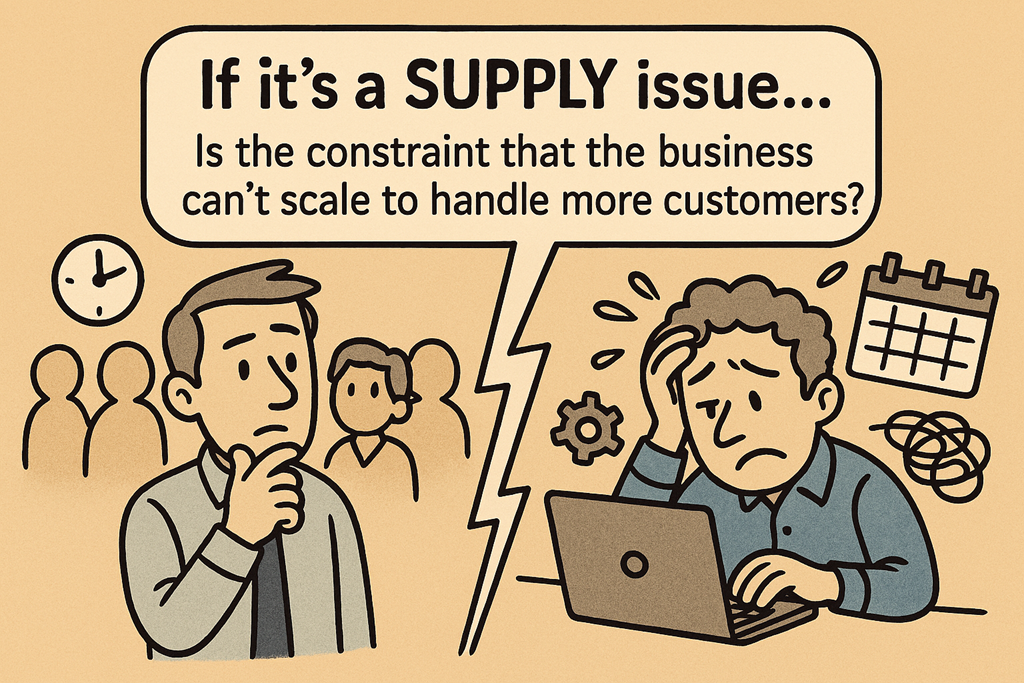
I hear this a lot from MSPs.
“We’ve got demand. Plenty of demand. The problem is supply.”
And on the surface, that sounds right. Phones ringing. Inbound leads. Existing customers wanting more. Projects stacking up. Everyone’s busy.
But here’s the question I think too few MSP owners are really asking:
If it’s a supply issue, what exactly is constrained?
Because most of the time, it’s not what you think.
It’s Rarely the Market
Let’s get this out of the way first. In most regions right now, MSPs don’t have a demand problem. If anything, the opposite is true.
Security requirements are increasing. Compliance expectations are rising. Clients are confused, under-skilled, and increasingly nervous. Microsoft keeps adding more knobs, dials, portals, and acronyms.
There’s work everywhere.
So if growth has stalled, it’s probably not because there aren’t enough customers willing to pay for help.
Which means the constraint is internal.
Frontstage vs Backstage
A useful way to think about this is frontstage versus backstage.
Frontstage is what clients see:
- Sales conversations
- Projects
- Tickets getting resolved
- New customers onboarding
Backstage is what actually makes all of that possible:
- Your time
- Your team’s capability
- Your systems and processes
- Your standardisation (or lack of it)
Most MSPs focus their energy on the frontstage. More leads. Better proposals. New offerings. Better marketing.
But when supply becomes the issue, the real bottleneck is almost always backstage.
The Three Real Constraints
In my experience, it usually comes down to one (or more) of these.
1. Your time
If you’re still the escalation point, the sales engineer, the architect, the quality control, and the business owner, then your business can’t scale past you.
That’s not a staffing issue. That’s a design issue.
If every complex decision, every quote, every “just check this” flows through you, then you are the constraint. Not demand.
2. Your team
Many MSPs hire reactively. Someone leaves. Work piles up. You hire to relieve pressure.
But scaling requires capability, not just headcount.
If only one or two people truly understand identity, security, or automation, then growth stalls the moment they’re fully utilised. Everyone else becomes dependent on them, and velocity drops.
A team that can’t operate independently can’t scale sustainably.
3. Your systems
This is the unsexy one. And the most ignored.
If every customer is “a little bit different”, every deployment is bespoke, and every technician does things “their way”, then you’re not running a scalable service business. You’re running a collection of individual heroics.
The more customers you add, the slower everything gets.
That’s not because you’re bad at MSPing. It’s because standardisation, documentation, and automation haven’t been treated as first‑class work.
The Uncomfortable Truth
When MSP owners say “we can’t scale because of supply”, what they often mean is:
“The way we currently operate doesn’t scale.”
And that’s actually good news.
Because markets are hard to fix. You can’t control demand.
But you can redesign how work flows through your business.
You can:
- Remove yourself as the bottleneck
- Build repeatable delivery models
- Train for depth, not just coverage
- Invest in systems that make average staff effective, not heroic staff exhausted
None of this is glamorous. None of it is quick.
But it’s the difference between being busy and being scalable.
So next time you think you’ve hit a supply ceiling, don’t just ask how do we get more capacity?
Ask the harder question:
What backstage constraint is actually stopping us from growing?
Because that’s where the real work is.

