The Skill That Matters Most in the Age of Copilot: Asking Better Questions

image

The people getting the most value from Microsoft 365 Copilot today aren’t necessarily the most technical. They’re not the fastest typists, the best PowerShell writers or the ones with the biggest AI budget.

They’re the people who ask better questions.

That might sound obvious, but I think it’s one of the biggest mindset shifts happening right now. For years, many of us have been trained to search for information using a few keywords. Type something into Google, scan the results, click a link, repeat. The skill was finding information.

With Copilot, the skill is becoming framing the problem.

I see this regularly when working with SMBs and MSPs. Two people sit in front of the same Microsoft 365 Copilot environment. One gets a generic answer that doesn’t really help. The other gets a detailed summary, actionable recommendations and a useful first draft. The difference is rarely the technology.

It’s the question.

Most People Stop Too Early

A common pattern I see is someone opening Copilot in Teams or Outlook and typing a very short request:

“Summarise this.”

“Write an email.”

“Analyse this document.”

Copilot will do something, but not necessarily something valuable.

The better approach is to provide context. Why do you need the information? Who is the audience? What decision are you trying to make? What concerns do you already have?

The quality of the answer often improves dramatically when the question becomes more specific.

Think about a conversation with a trusted employee. If you walked into their office and said, “Help me with sales”, you’d get a confused look. If you said, “Review the last quarter of sales reports and identify the three biggest opportunities in our existing customer base”, you’d be much closer to getting a useful result.

Copilot works in a similar way.

Copilot Rewards Curiosity

One of the biggest mistakes I see is treating Copilot like a command-line interface.

People issue instructions instead of having a conversation.

The real value appears when you start exploring.

For example, after Copilot produces a meeting summary in Teams, don’t stop there. Ask what wasn’t discussed. Ask what risks were mentioned only briefly. Ask which actions have no assigned owner. Ask which topics are likely to create issues next month.

Each follow-up question improves your understanding.

What fascinates me is that the process starts to resemble working with a highly capable colleague. The first answer is rarely the destination. It’s often the starting point.

The people who get the best outcomes are usually the people who are naturally curious. They’re willing to ask one more question.

Then another.

Then another.

This Changes How We Learn

I think we’re moving into a world where knowing everything becomes less important than knowing how to investigate effectively.

In the past, expertise often meant storing large amounts of information in your head. Today, much of that information can be surfaced instantly from SharePoint, OneDrive, Teams conversations and Outlook messages through Copilot.

The challenge becomes directing that capability effectively.

When I use Copilot in Word to help draft content or in Outlook to analyse a long email thread, I rarely accept the first result. I refine it. I challenge it. I ask for alternatives. I request different viewpoints.

In many cases, my role is becoming less about generating information and more about guiding the process that generates it.

That’s a different skill set altogether.

The Real Competitive Advantage

I don’t think the winners in the AI era will be the organisations with the most AI tools.

I think they’ll be the organisations that teach their people how to think clearly, define problems accurately and ask better questions.

Microsoft 365 Copilot is already showing us this reality. The technology is becoming easier to access every month. The differentiator isn’t the tool. It’s the person using it.

A poor question gives you a poor starting point.

A thoughtful question opens entirely different possibilities.

That’s why, when people ask me what skill they should develop to get more value from Copilot, my answer is increasingly simple:

Learn to ask better questions. Everything else gets easier from there.

Mail Security Is Easier to Understand When You Can See It

image

One of the recurring problems with Microsoft 365 mail security is that too many people treat it like a checklist. SPF. DKIM. DMARC. Spoof intelligence. Anti-phishing. Safe Links. Quarantine. Transport rules. Tick the boxes, move on, hope the tenant is safer than it was before.

I understand why that happens. Email security in Microsoft 365 has a lot of moving parts, and most of them are hidden until something goes wrong. A message lands in junk. A phishing email reaches a user. A legitimate invoice disappears into quarantine. Then everyone starts asking the same uncomfortable question: why did that happen?

That is why I like building simple simulation tools, like the one I just created here:

https://directorcia.github.io/Office365/m365-mail-security-sim.html

The value is not the button. It is the model.

The point of a mail security simulator is not to replace the Microsoft Defender portal. It is to help people build a clearer mental model before they start changing live settings.

When I work with SMBs and MSPs, I often see the same pattern. Someone knows one part of the stack very well, usually Exchange Online mail flow or DNS authentication, but they are less confident about how that choice affects the next decision. Enforcing DMARC sounds sensible. Tightening spoof handling sounds sensible. Adjusting user reporting sounds sensible. The problem is that sensible settings can still create poor outcomes if you do not understand how they interact.

A simulator gives you a low-risk way to explore that. Change the assumptions. Watch the likely outcome. Ask what would happen if the sender fails authentication, if the domain is aligned, if policy handling changes, or if the user has been trained to report suspicious mail through Outlook. You are not learning by breaking production. You are learning by testing the shape of the decision.

Copilot still needs clean security thinking.

This becomes even more important as Copilot becomes part of the working day. People are asking Copilot in Outlook to summarise long email threads, draft replies, and pull meaning from busy inboxes. That only works if the mailbox environment is trustworthy enough in the first place.

Copilot does not remove the need for Defender for Office 365, Exchange Online Protection, authentication alignment, or sensible quarantine handling. If anything, it raises the standard. The more value we expect people to get from their Microsoft 365 data, the more responsibility we have to make sure the signals around that data are well managed.

That is the message I want administrators and MSPs to take seriously. AI does not excuse messy security. It exposes it.

Training beats guessing.

Good security administration is not just knowing where the settings are. It is knowing what trade-offs you are making when you change them.

A tool like this can help an MSP have a better client conversation. Instead of saying, “we should improve your mail security,” you can show the client how different conditions affect message handling. Instead of turning a policy into an abstract recommendation, you can make the risk visible enough for a business owner to understand.

It also helps junior technicians. I would much rather see someone experiment with a simulation than make random changes inside the Defender portal because they found a setting that sounded important. Curiosity is good. Production tenants are a poor classroom.

Microsoft 365 security has become too important to be treated as a collection of isolated switches. Mail protection, user behaviour, reporting, policy tuning, and now Copilot readiness all sit together. If you cannot explain how the pieces connect, you are not really managing the system. You are just hoping the defaults are enough.

The next step for many organisations is not more noise, more dashboards, or more alerts. It is better understanding.

That starts by making the invisible parts of mail security visible enough to reason about.

You’ll find the simulation I just created here:

 https://directorcia.github.io/Office365/m365-mail-security-sim.html

it’s free to use but I’d always appreciate any support you can provide around this and upcoming simulation projects via – https://ko-fi.com/ciaops.

Screenshot 2026-08-03 093012

Also, feel free to provide me any feedback on the simulation so I can continue to improve it for all.

The Recurring Problem: A Managed Services Story–Chapter 9

Previously – https://blog.ciaops.com/2026/08/02/the-recurring-problem-a-managed-services-story-chapter-8/

image

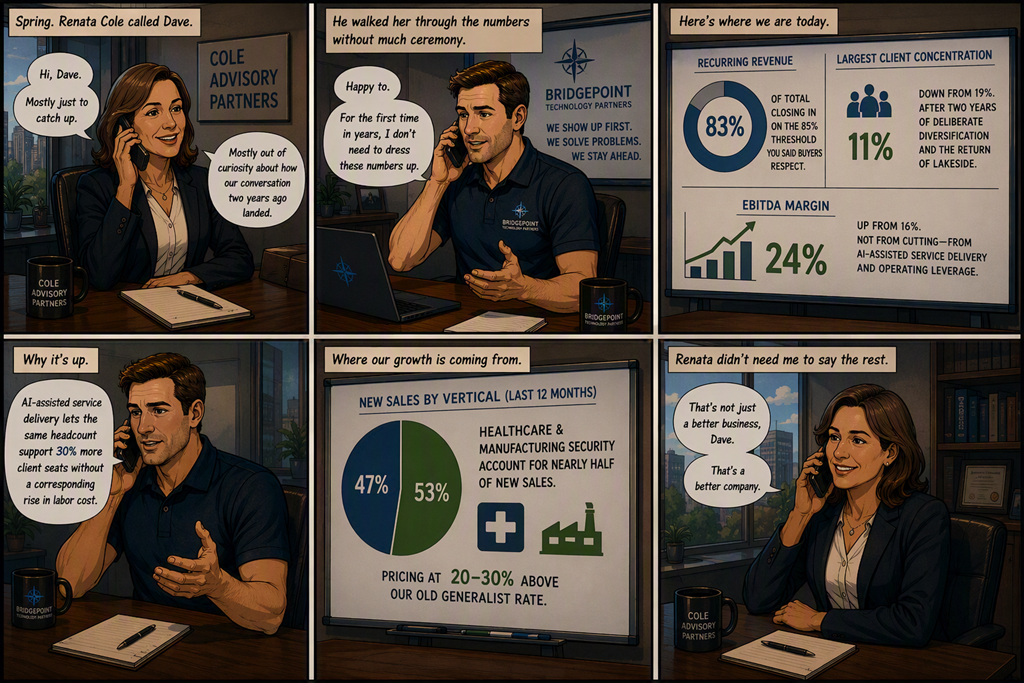
Renata Cole called Dave in the spring, mostly to catch up, mostly out of professional curiosity about how the conversation she’d had with him two years earlier had landed. He walked her through the numbers without much ceremony, because for the first time in years he didn’t need to dress them up. Recurring revenue: 83 percent of total, closing in on the threshold she’d once told him buyers actually respected. Largest client concentration: down to 11 percent, after two years of deliberate diversification and the return of Lakeside. EBITDA margin: up to 24 percent, not because Bridgepoint had cut anything, but because AI-assisted service delivery had let the same headcount support 30 percent more client seats without a corresponding rise in labor cost. Two new verticals — healthcare and manufacturing security — accounted for nearly half of new sales, at price points 20 to 30 percent above the old generalist rate.

image

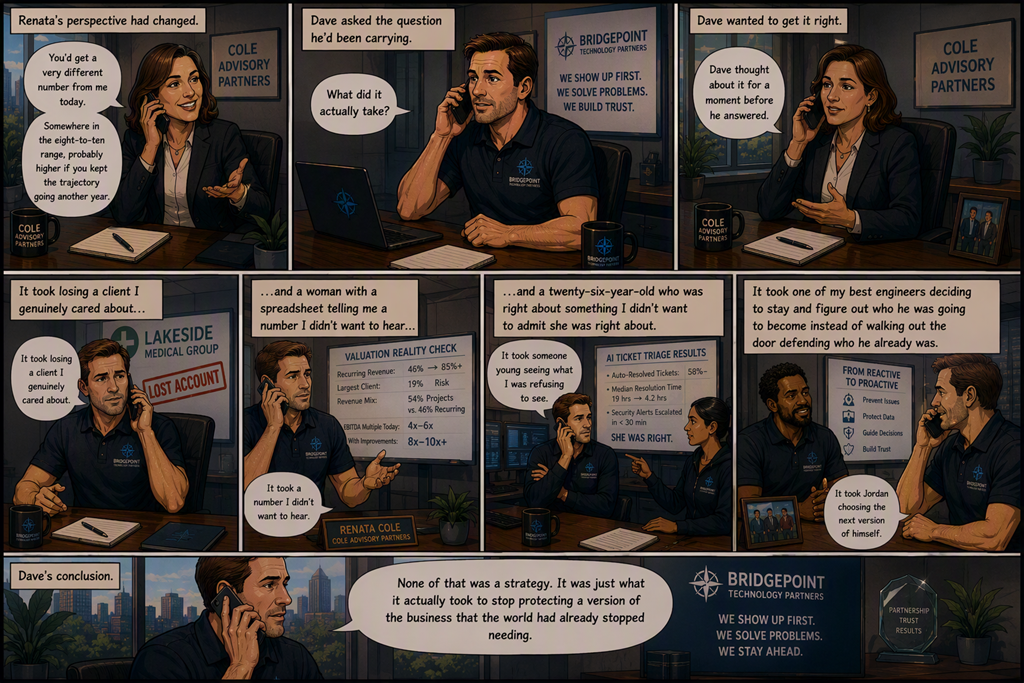
“You’d get a very different number from me today,” Renata said. “Somewhere in the eight-to-ten range, probably higher if you kept the trajectory going another year. What did it actually take?”

Dave thought about it for a moment before he answered, because he wanted to get it right, and because he’d had two years to think about what the honest answer actually was.

“It took losing a client I genuinely cared about,” he said, “and a woman with a spreadsheet telling me a number I didn’t want to hear, and a twenty-six-year-old who was right about something I didn’t want to admit she was right about. It took one of my best engineers deciding to stay and figure out who he was going to become instead of walking out the door defending who he already was. None of that was a strategy. It was just what it actually took to stop protecting a version of the business that the world had already stopped needing.”

image

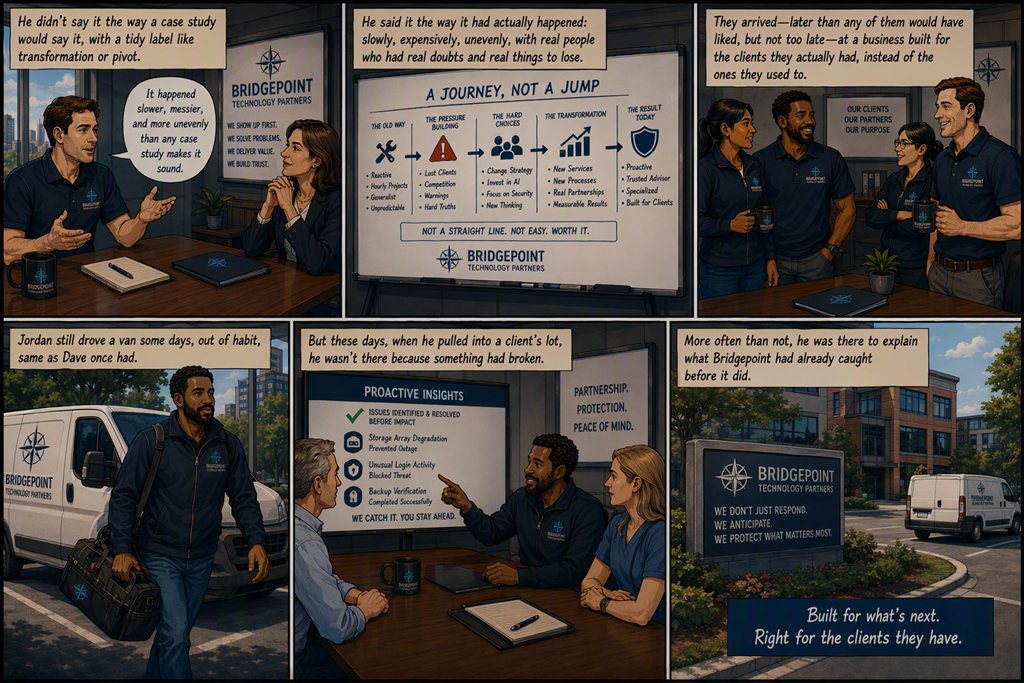
He didn’t say it the way a case study would say it, with a tidy label like transformation or pivot. He said it the way it had actually happened: slowly, expensively, unevenly, with real people who had real doubts and real things to lose, arriving — later than any of them would have liked, but not too late — at a business built for the clients they actually had, instead of the ones they used to.

Jordan still drove a van some days, out of habit, same as Dave once had. But these days, when he pulled into a client’s lot, he wasn’t there because something had broken. More often than not, he was there to explain what Bridgepoint had already caught before it did.

image

The MSP industry Bridgepoint operates in today looks little like the one Dave Kessler started in. Recurring revenue quality, not relationship goodwill, now determines what a services business is worth. Vertical depth, not generalist breadth, commands premium pricing. And the providers thriving in the AI era are not the ones that resisted automation to protect familiar work, but the ones that used it to free their most experienced people for the judgment only they could offer — becoming, in the process, less like vendors who show up after something breaks, and more like advisors clients call before it does.

Stop Feeding the Algorithm. Start Changing Minds.

image

I see a lot of businesses obsessing over content calendars.

They sit in meetings asking questions like: What should we post next week? Or How many videos do we need this month? Or Should we start a podcast?

In my experience, that’s usually the wrong conversation.

The better question is this:

What belief are you trying to create in the mind of your audience?

Because content by itself doesn’t do much. Anyone can produce content. AI has made that even easier. A few prompts and you’ve got articles, videos, social posts and newsletters ready to go.

The problem is that information is everywhere.

Attention isn’t.

Most Content Is Just Noise

An average marketer focuses on output.

More emails. More posts. More videos. More activity.

The assumption is that if you produce enough material, eventually customers will notice.

Sometimes they do. Most of the time they don’t.

What I’ve noticed when working with businesses is that content often becomes the goal rather than the vehicle. Teams celebrate publishing something without asking whether it changed how their audience thinks.

That’s a dangerous trap.

You can publish every day and still be invisible.

You can have thousands of followers and still struggle to generate sales.

Volume doesn’t create demand.

Changing beliefs does.

Leads Are Better. Beliefs Are Better Again.

A good marketer understands this and focuses on generating leads.

They want enquiries. Booked meetings. Website conversions. People entering the sales process.

That’s certainly an improvement.

But even then, many organisations are trying to persuade people who haven’t yet reached the point of wanting what they’re selling.

They are still fighting an uphill battle.

The strongest businesses I’ve observed create demand before the sales conversation even begins.

When a prospect turns up already convinced that a problem exists, already understands the cost of ignoring it, and already believes your approach is the right one, the sales process becomes dramatically easier.

The decision was largely made long before the sales call.

The content wasn’t there to inform.

It was there to shape perspective.

This Is Where Copilot Becomes Interesting

One of the reasons I’m paying close attention to Microsoft 365 Copilot isn’t because it helps create content faster.

Almost everyone talks about content production.

I think that’s the least interesting part.

The real opportunity is understanding what your audience already believes and what needs to change.

Imagine reviewing customer meeting notes stored in Teams, analysing recurring themes from emails in Outlook, and asking Copilot to identify the assumptions that repeatedly appear across conversations.

You might discover that clients believe AI is too expensive. Or too risky. Or only suitable for large enterprises.

Suddenly your next article isn’t chosen because somebody needed something to post on Tuesday.

It’s chosen because there’s a specific belief that needs challenging.

That’s a much more strategic use of both content and AI.

The Businesses Winning Attention Know Exactly What They’re Installing

The organisations that consistently attract customers don’t just share information.

They repeat ideas.

They reinforce viewpoints.

They help their audience see the world differently.

Over time those ideas compound.

Eventually prospects begin repeating those beliefs back to their colleagues, managers and peers.

That’s when demand starts appearing.

Not because your content reached more people.

Because it changed the way people think.

That’s a very different outcome.

The next time you’re planning content, I’d suggest stepping back from the calendar, the platform and the format.

Don’t start with the post.

Start with the belief.

Because when you know what belief you’re trying to create, the content becomes obvious.

And when enough people share that belief, demand tends to take care of itself.

The Recurring Problem: A Managed Services Story–Chapter 8

image

Previously – https://blog.ciaops.com/2026/08/01/the-recurring-problem-a-managed-services-story-chapter-7/

Denise Okafor called again in October, fourteen months after she’d left. Meridian Health IT, the healthcare specialist she’d switched to, had been acquired by a larger regional platform in the interim, and the transition had gone badly: her dedicated account team had been reassigned twice in five months, her monthly reporting had become generic boilerplate, and a recent phishing-simulation failure across two of her nine locations had gone unaddressed for three weeks.

image

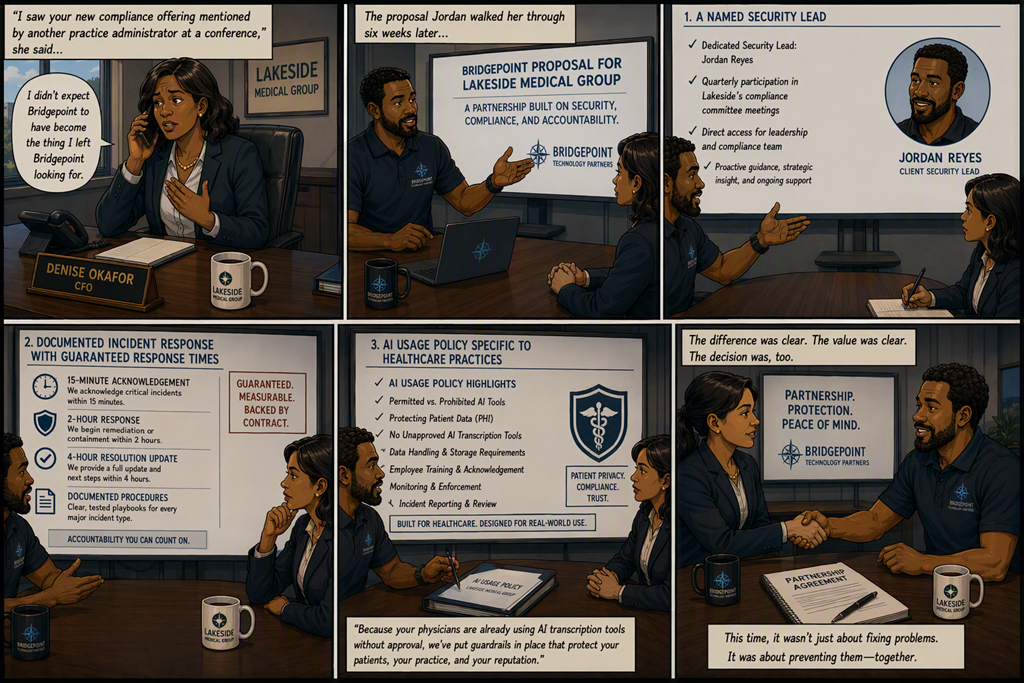
“I saw your new compliance offering mentioned by another practice administrator at a conference,” she said, sounding almost embarrassed to be making the call. “I didn’t expect Bridgepoint to have become the thing I left Bridgepoint looking for.”

The proposal Jordan walked her through six weeks later bore almost no resemblance to the flat monthly bundle Lakeside had once had. It included a named security lead who would sit in on Lakeside’s own compliance committee meetings quarterly; documented incident-response procedures with contractual response-time guarantees, backed, for the first time in Bridgepoint’s history, by a real penalty clause; and an AI usage policy specifically written for a healthcare practice where several physicians had already started experimenting with AI transcription tools without anyone’s approval.

image

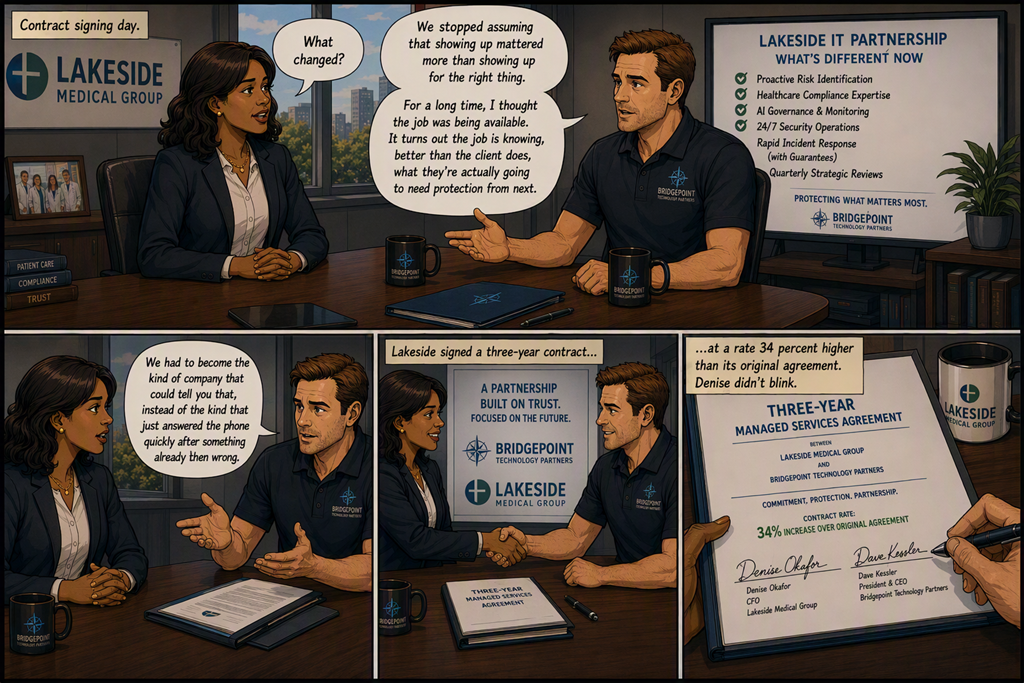
“What changed?” Denise asked Dave directly, at the contract signing.

“We stopped assuming that showing up mattered more than showing up for the right thing,” Dave said. “For a long time, I thought the job was being available. It turns out the job is knowing, better than the client does, what they’re actually going to need protection from next. We had to become the kind of company that could tell you that, instead of the kind that just answered the phone quickly after something already went wrong.”

Lakeside signed a three-year contract at a rate 34 percent higher than its original agreement. Denise didn’t blink.

image

CIA Brief 20260802

image

Microsoft 365 Copilot & AI Transformation

  • The Next Measure of AI Momentum is Work Transformed
    Microsoft argues that AI success should be measured by business outcomes and work transformation rather than raw adoption numbers. The article highlights how organisations are moving beyond experimentation and beginning to redesign business processes around AI capabilities.
    Link: View Article
  • Looking Back on Microsoft’s FY26: From AI Experimentation to Frontier Transformation
    Microsoft reflects on FY26 and positions the year as a turning point from AI pilots and experimentation toward larger-scale organisational transformation. The article highlights customer adoption patterns and the evolving role of AI across Microsoft platforms.
    Link: View Article
  • What’s New in Microsoft 365 Copilot – June 2026
    A roundup of the latest Microsoft 365 Copilot enhancements, including new features, platform improvements, and expanded experiences across Microsoft applications. The update provides insight into Microsoft’s ongoing Copilot roadmap and investment areas.
    Link: View Article
  • More Control Over Web Grounding with Domain Exclusion for Microsoft 365 Copilot
    Microsoft announced Domain Exclusion capabilities that allow administrators to limit which public web domains can be used during Copilot web-grounded responses. The feature aims to provide greater governance and control over AI-generated content.
    Link: View Article


Security & Compliance

  • CaptiveCrunch: Midnight Blizzard Targets Travellers Worldwide
    Microsoft detailed a new campaign by the Midnight Blizzard threat actor that targets travellers with malware delivery and credential theft techniques. The report outlines the threat activity and provides guidance to help organisations reduce exposure.
    Link: View Article
  • Rethinking Security for the Age of AI
    Microsoft outlines how security strategies must evolve as AI becomes embedded within business operations. The article discusses emerging risks, governance considerations, and the increasing importance of securing AI systems and data.
    Link: View Article
  • Introducing Project Perception: The Next Evolution of Agentic Security
    Microsoft introduced Project Perception, focusing on the development of more autonomous and intelligent security capabilities. The announcement explores how agents and AI-based systems may assist security operations in identifying and responding to threats.
    Link: Watch Video


Financial Results & Industry Signals

  • Microsoft Earnings Release FY26 Q4
    Microsoft reported FY26 Q4 revenue of $90 billion, operating income of $40.6 billion, and net income of $35.8 billion. The results highlighted continued strength across the Microsoft cloud and AI portfolio, with Copilot growth receiving significant attention.
    Link: View Earnings Release

After hours

Gemini Robotics 2 brings whole body intelligence to robots

https://www.youtube.com/watch?v=4lSQnrMC6nY

Editorial

If you found this valuable, the I’d appreciate a ‘like’ or perhaps a donation at https://ko-fi.com/ciaops. This helps me know that people enjoy what I have created and provides resources to allow me to create more content. If you have any feedback or suggestions around this, I’m all ears. You can also find me via email director@ciaops.com and on X (Twitter) at https://www.twitter.com/directorcia.

If you want to be part of a dedicated Microsoft Cloud community with information and interactions daily, then consider becoming a CIAOPS Patron – www.ciaopspatron.com.

Watch out for the next CIA Brief next week

AI Is Helping People Solve the Wrong Problem Faster

image

There’s something I’m seeing more and more as AI becomes embedded into everyday business processes.

People are getting dramatically faster.

The problem is that many of them are getting faster at solving the wrong problem.

Microsoft 365 Copilot can help create documents in minutes, analyse data in seconds and summarise information almost instantly. That’s impressive. But if the question you start with is flawed, all you’ve done is accelerate yourself in the wrong direction.

In my experience working with MSPs and SMBs, the biggest challenge isn’t usually a lack of answers.

It’s a lack of asking the right questions.

The Bottleneck Is Rarely Where You Think It Is

As service providers, we’re often called in to solve what a client thinks is the issue.

Their help desk is overloaded.

Sales aren’t growing.

Projects are delayed.

Customer enquiries aren’t being answered quickly enough.

The temptation is to jump straight into fixing the symptom.

Now AI makes that even easier.

A client says they need faster reporting. Copilot helps generate reports in minutes.

A manager says they need more customer communications. AI drafts them in seconds.

A business owner says they need more leads. AI builds marketing content all day long.

But what if none of those things are actually the constraint?

I’ve seen businesses spend months optimising processes that had almost no impact on growth because they were focused on the visible problem rather than the real one.

AI simply helped them arrive at the wrong destination faster.

Better Questions Create Better Outcomes

One of the most valuable uses of Microsoft 365 Copilot isn’t generating content.

It’s helping people think.

The organisations getting the most value aren’t treating Copilot as a faster keyboard. They’re using it as a tool to challenge assumptions and examine the business from different angles.

When someone tells me they have a problem, I often start with three simple questions:

  • Where are you now?

  • Where do you want to go?

  • What do you believe is stopping you?

Those questions sound basic, but they’re surprisingly revealing.

Recently I spoke with a business that was convinced slow customer response times were hurting growth. Their team wanted AI to automate messaging and increase communication volume.

After stepping back and examining the process, the real constraint wasn’t messages.

It was capacity.

There simply weren’t enough qualified people available to deliver the service being sold.

Automating communications would have made customers happier for a short period while simultaneously increasing pressure on an already constrained delivery team.

The wrong problem.

Another business owner believed lead generation was the issue. They wanted AI-generated marketing campaigns, social media content and automated outreach.

The reality?

Their existing funnel already produced enough opportunities.

The bottleneck was conversion.

Improving close rates by a small percentage would have generated far greater revenue than doubling marketing activity.

Again, the wrong problem.

Copilot Should Challenge Thinking, Not Replace It

This is where I believe many MSPs have an opportunity.

Too many AI conversations revolve around features, prompts and automation.

Those things matter, but they’re not the real value.

The real value comes from helping clients identify what actually constrains growth, profitability or productivity.

Copilot gives us the ability to analyse information faster than ever before. It can surface patterns, summarise discussions and identify trends that would otherwise take hours to uncover.

But someone still needs to ask the right question.

As MSPs, that’s where our experience becomes critical.

The businesses that will benefit most from AI won’t necessarily be the ones with the most advanced technology. They’ll be the ones with the clearest understanding of their business challenges.

AI can provide answers almost instantly.

What it can’t do is determine whether you’re asking the right question in the first place.

The Real Opportunity

Before using Copilot to generate another report, automate another workflow or create another piece of content, take a step back.

Define where you are.

Define where you want to go.

Identify what you genuinely believe is standing in the way.

Then challenge that assumption.

Because in many cases, the biggest business breakthrough doesn’t come from getting a better answer.

It comes from discovering you’ve been asking the wrong question all along.

And that’s a mistake AI can help you make much, much faster.


The Recurring Problem: A Managed Services Story–Chapter 7

Previously – https://blog.ciaops.com/2026/07/31/the-recurring-problem-a-managed-services-story-chapter-6/

image

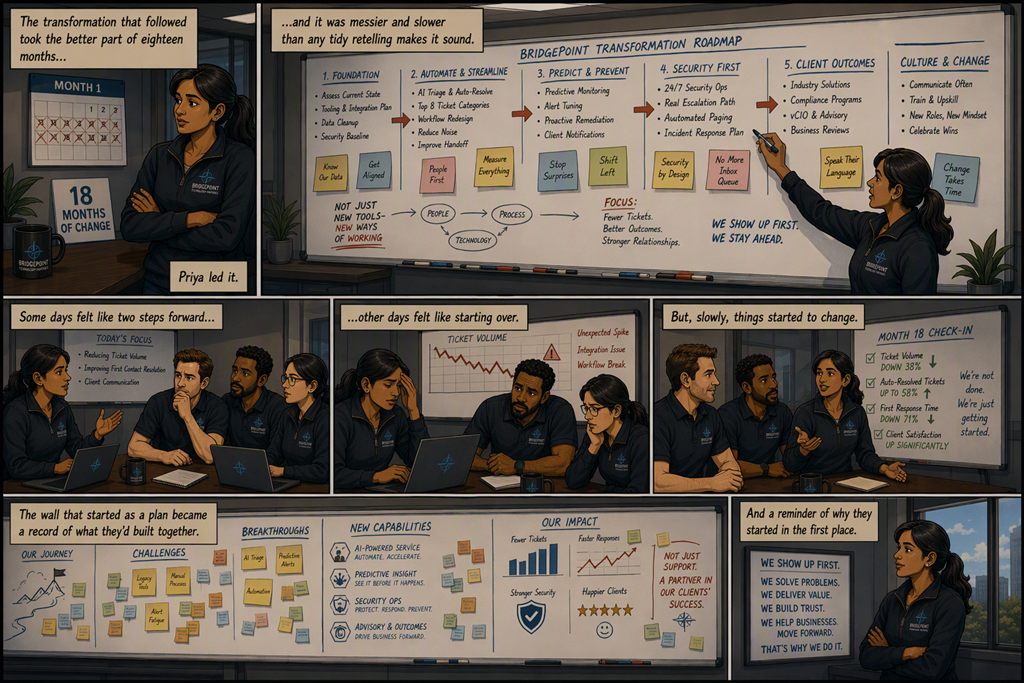
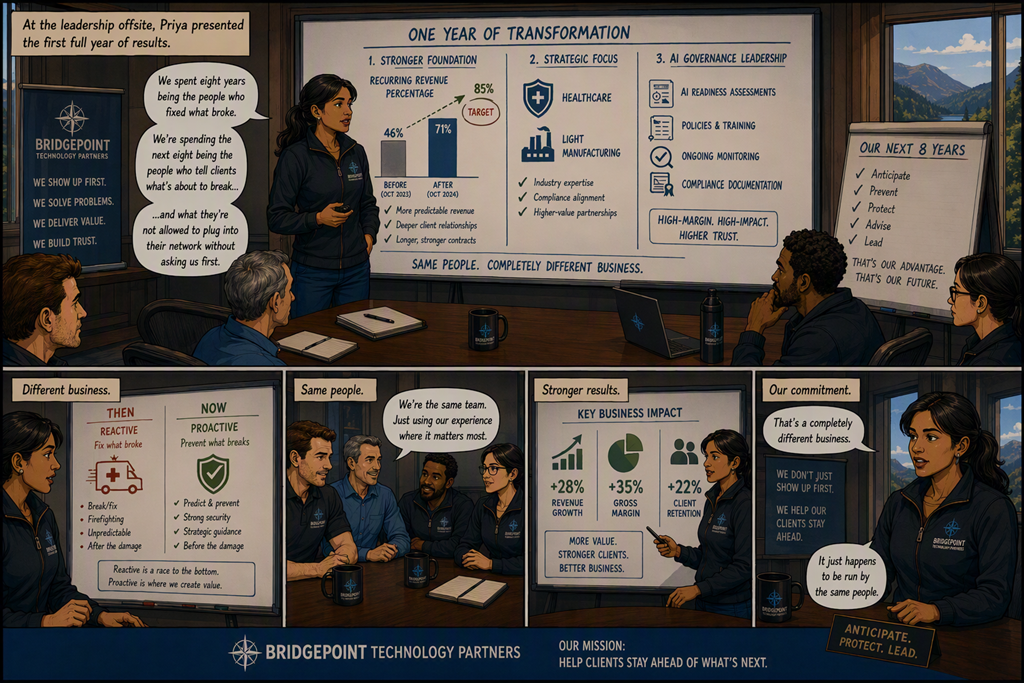
The transformation that followed took the better part of eighteen months, and it was messier and slower than any tidy retelling makes it sound. Priya led it, with a whiteboard in her office that eventually filled an entire wall.

image

The first and hardest change was financial. Bridgepoint stopped selling hourly project work as its default and began requiring every new client, and every renewing one, to move onto a tiered managed-services contract with a three-year term — not because Priya loved locking clients in, but because Renata’s numbers had made the logic unavoidable: longer, deeper contracts weren’t just more predictable, they were worth measurably more, and clients who wouldn’t commit to a real partnership usually weren’t clients worth keeping anyway. It cost Bridgepoint two accounts that flatly refused the new terms. It gained the company, within a year, a recurring-revenue base that had climbed from 46 percent to 71 percent of total revenue, on its way toward the 85-percent target Priya had written at the top of the whiteboard and circled twice.

image

The second change was strategic focus. Rather than continuing to be everything to everyone, Bridgepoint made a deliberate bet on two verticals where it already had real experience: healthcare and light manufacturing. It hired a part-time compliance consultant with a HIPAA background, built a documented incident-response playbook mapped explicitly to healthcare regulatory requirements, and began marketing itself, for the first time in its history, as something other than a friendly generalist. The pitch decks stopped saying “we support any business” and started saying “we understand what a HIPAA auditor is going to ask you, because we’ve already answered it forty times.” Pricing for the healthcare tier came in meaningfully higher than the old flat rate — clients paid it without much argument, because for the first time, the price reflected expertise they could see, not just hours they were trusting someone to bill honestly.

image

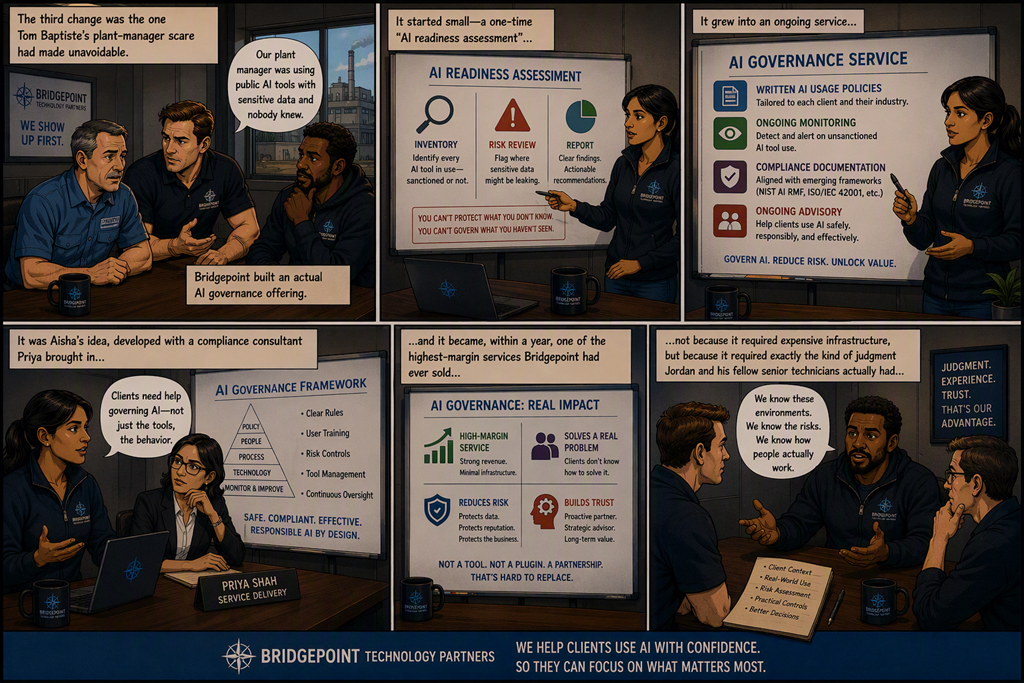
The third change was the one Tom Baptiste’s plant-manager scare had made unavoidable: Bridgepoint built an actual AI governance offering, something that hadn’t existed anywhere in its service catalog eighteen months earlier. It started small — a one-time “AI readiness assessment” that inventoried every AI tool a client’s employees were already using, sanctioned or not, and flagged where sensitive data might be leaking to public tools nobody in leadership had approved. It grew into an ongoing service: written AI usage policies tailored to each client, ongoing monitoring for unsanctioned tool use, and, for the healthcare and finance clients who needed it, documentation aligned with emerging frameworks their own auditors were starting to ask about. It was Aisha’s idea, developed with a compliance consultant Priya brought in, and it became, within a year, one of the highest-margin services Bridgepoint had ever sold — not because it required expensive infrastructure, but because it required exactly the kind of judgment Jordan and his fellow senior technicians actually had, applied to a problem clients didn’t know how to solve themselves.

image

“We spent eight years being the people who fixed what broke,” Priya said, at the leadership offsite where she presented the first full year of results. “We’re spending the next eight being the people who tell clients what’s about to break, and what they’re not allowed to plug into their network without asking us first. That’s a completely different business. It just happens to be run by the same people.”

image