
Previously – https://blog.ciaops.com/2026/08/02/the-recurring-problem-a-managed-services-story-chapter-8/

Renata Cole called Dave in the spring, mostly to catch up, mostly out of professional curiosity about how the conversation she’d had with him two years earlier had landed. He walked her through the numbers without much ceremony, because for the first time in years he didn’t need to dress them up. Recurring revenue: 83 percent of total, closing in on the threshold she’d once told him buyers actually respected. Largest client concentration: down to 11 percent, after two years of deliberate diversification and the return of Lakeside. EBITDA margin: up to 24 percent, not because Bridgepoint had cut anything, but because AI-assisted service delivery had let the same headcount support 30 percent more client seats without a corresponding rise in labor cost. Two new verticals — healthcare and manufacturing security — accounted for nearly half of new sales, at price points 20 to 30 percent above the old generalist rate.
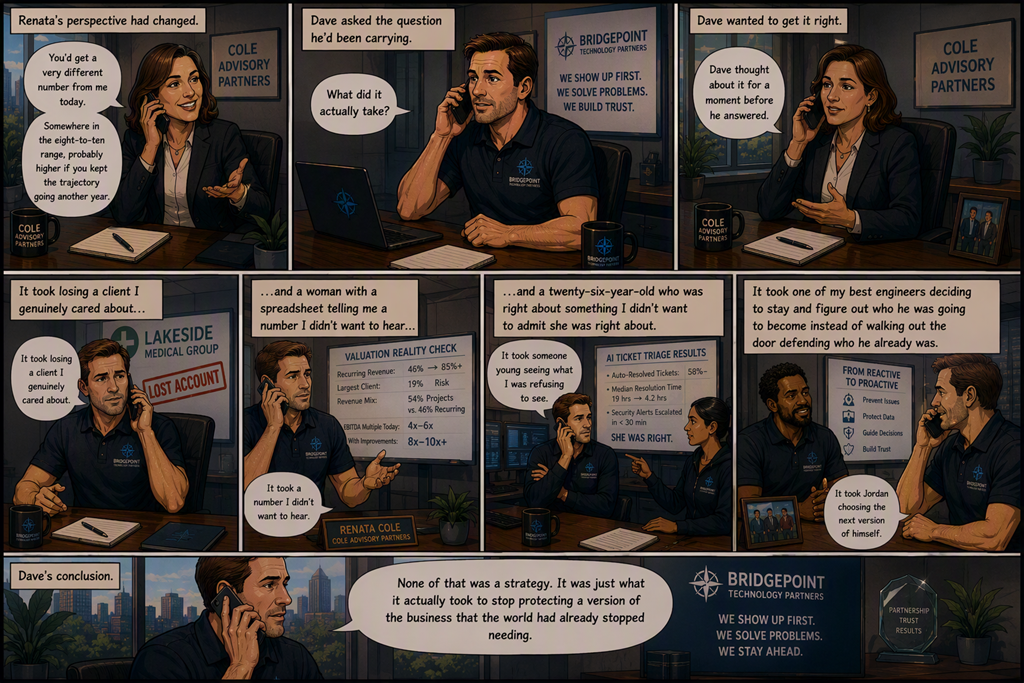
“You’d get a very different number from me today,” Renata said. “Somewhere in the eight-to-ten range, probably higher if you kept the trajectory going another year. What did it actually take?”
Dave thought about it for a moment before he answered, because he wanted to get it right, and because he’d had two years to think about what the honest answer actually was.
“It took losing a client I genuinely cared about,” he said, “and a woman with a spreadsheet telling me a number I didn’t want to hear, and a twenty-six-year-old who was right about something I didn’t want to admit she was right about. It took one of my best engineers deciding to stay and figure out who he was going to become instead of walking out the door defending who he already was. None of that was a strategy. It was just what it actually took to stop protecting a version of the business that the world had already stopped needing.”

He didn’t say it the way a case study would say it, with a tidy label like transformation or pivot. He said it the way it had actually happened: slowly, expensively, unevenly, with real people who had real doubts and real things to lose, arriving — later than any of them would have liked, but not too late — at a business built for the clients they actually had, instead of the ones they used to.
Jordan still drove a van some days, out of habit, same as Dave once had. But these days, when he pulled into a client’s lot, he wasn’t there because something had broken. More often than not, he was there to explain what Bridgepoint had already caught before it did.

The MSP industry Bridgepoint operates in today looks little like the one Dave Kessler started in. Recurring revenue quality, not relationship goodwill, now determines what a services business is worth. Vertical depth, not generalist breadth, commands premium pricing. And the providers thriving in the AI era are not the ones that resisted automation to protect familiar work, but the ones that used it to free their most experienced people for the judgment only they could offer — becoming, in the process, less like vendors who show up after something breaks, and more like advisors clients call before it does.

