
Previously – https://blog.ciaops.com/2026/07/29/the-recurring-problem-a-managed-services-story-chapter-4/
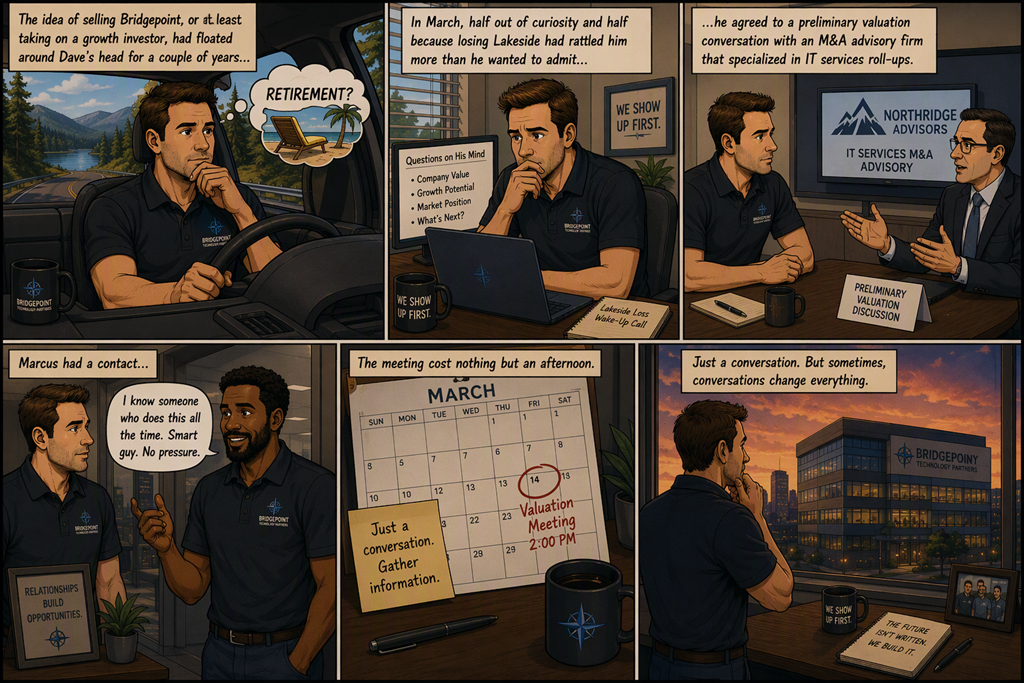
The idea of selling Bridgepoint, or at least taking on a growth investor, had floated around Dave’s head for a couple of years, mostly as a retirement fantasy he indulged on long drives. In March, half out of curiosity and half because losing Lakeside had rattled him more than he wanted to admit, he agreed to a preliminary valuation conversation with an M&A advisory firm that specialized in IT services roll-ups. Marcus had a contact; the meeting cost nothing but an afternoon.
The advisor, a clipped, unsentimental woman named Renata Cole, walked Dave and Priya through Bridgepoint’s financials with the emotional affect of someone reading a weather report. Revenue: $9.4 million. EBITDA: roughly $1.6 million, a healthy-looking 17 percent margin. Dave had always been quietly proud of that number.
“Your EBITDA is fine,” Renata said. “Your multiple is going to be a problem.”
“Explain that to me,” Dave said.
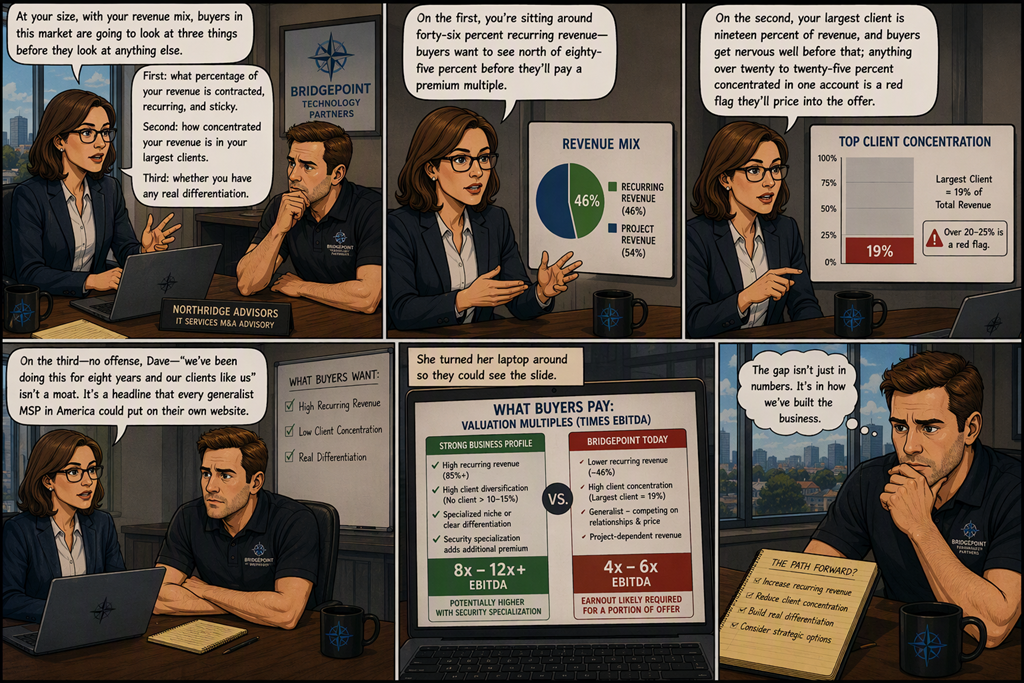
“At your size, with your revenue mix, buyers in this market are going to look at three things before they look at anything else,” she said, ticking them off on her fingers. “First: what percentage of your revenue is contracted, recurring, and sticky, versus one-off project work that could evaporate next quarter. Second: how concentrated your revenue is in your largest clients. Third: whether you have any real differentiation, or whether you’re a generalist competing on relationships and price. On the first, you’re sitting around forty-six percent recurring revenue — buyers want to see north of eighty-five percent before they’ll pay a premium multiple. On the second, your largest client is nineteen percent of revenue, and buyers get nervous well before that; anything over twenty to twenty-five percent concentrated in one account is a red flag they’ll price into the offer. On the third — no offense, Dave — ‘we’ve been doing this for eight years and our clients like us’ isn’t a moat. It’s a headline that every generalist MSP could put on their own website.”
She turned her laptop around so they could see the slide. A business with Bridgepoint’s EBITDA and a strong recurring-revenue base, high client diversification, and a specialized niche could reasonably expect eight to twelve times EBITDA, even higher with a security specialization. A business that looked like Bridgepoint currently looked — generalist, project-dependent, concentrated — was more realistically priced at four to six times, and buyers would likely structure a meaningful chunk of even that as an earnout contingent on retaining the client base through the transition.
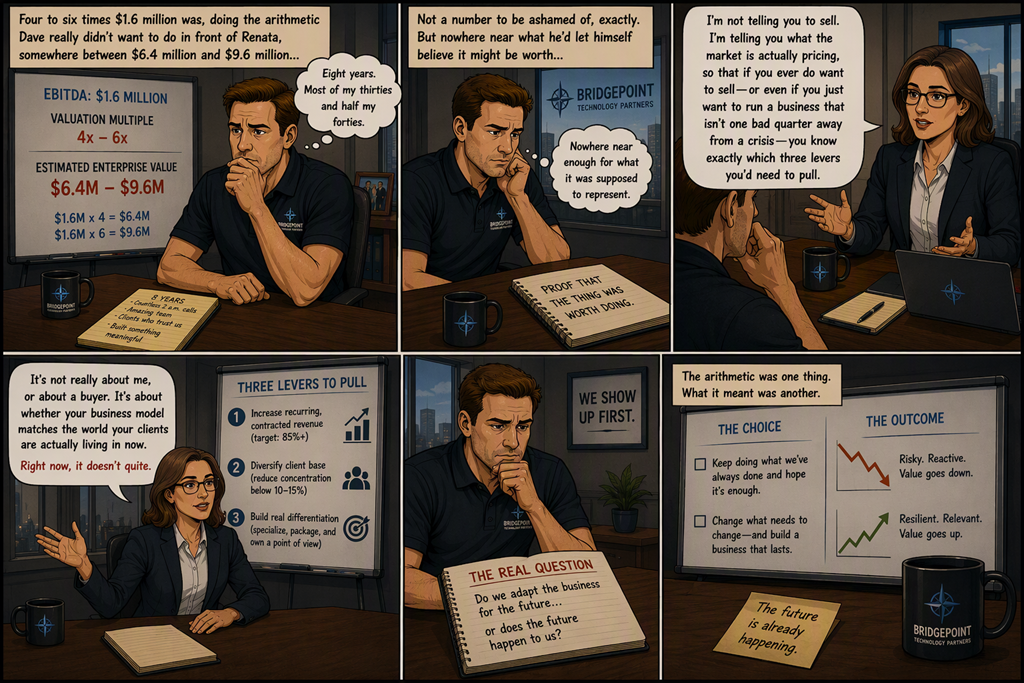
Four to six times $1.6 million was, doing the arithmetic Dave really didn’t want to do in front of Renata, somewhere between $6.4 million and $9.6 million — for a company he’d spent eight years and, by his own private accounting, most of his thirties and half his forties building. Not a number to be ashamed of, exactly. But nowhere near what he’d let himself believe it might be worth, and nowhere near enough for the number to represent what it was supposed to represent: proof that the thing had been worth doing.
“I’m not telling you to sell,” Renata said, more gently, watching his face. “I’m telling you what the market is actually pricing, so that if you ever do want to sell — or even if you just want to run a business that isn’t one bad quarter away from a crisis — you know exactly which three levers you’d need to pull. It’s not really about me, or about a buyer. It’s about whether your business model matches the world your clients are actually living in now. Right now, it doesn’t quite.”
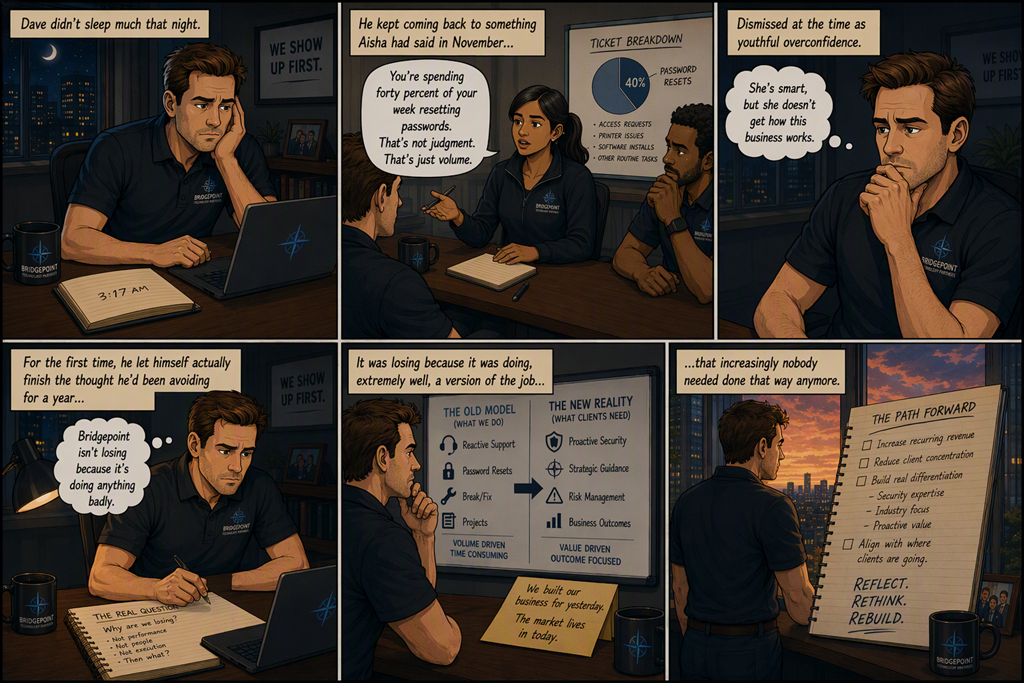
Dave didn’t sleep much that night. He kept coming back to something Aisha had said in November, dismissed at the time as youthful overconfidence: You’re spending forty percent of your week resetting passwords. That’s not judgment. That’s just volume.
For the first time, he let himself actually finish the thought he’d been avoiding for a year: Bridgepoint wasn’t losing because it was doing anything badly. It was losing because it was doing, extremely well, a version of the job that increasingly nobody needed done that way anymore.



One thought on “The Recurring Problem: A Managed Services Story–Chapter 5”