Disabling Office Macros via ASR to Meet Essential Eight Requirements

Using M365 Business Premium

The Essential Eight Mitigation Strategy #3 – Configure Microsoft Office Macro Settings requires organizations to disable Office macros by default for users without a demonstrated business need.1In cloud-only environments using Microsoft 365 Business Premium and Microsoft Intune, this can be achieved through multiple complementary approaches: 

  1. Configuration Profiles (Settings Catalog or Imported Administrative Templates) 
  1. Attack Surface Reduction (ASR) Rules 
  1. Microsoft Defender for Endpoint capabilities (included in Business Premium) 

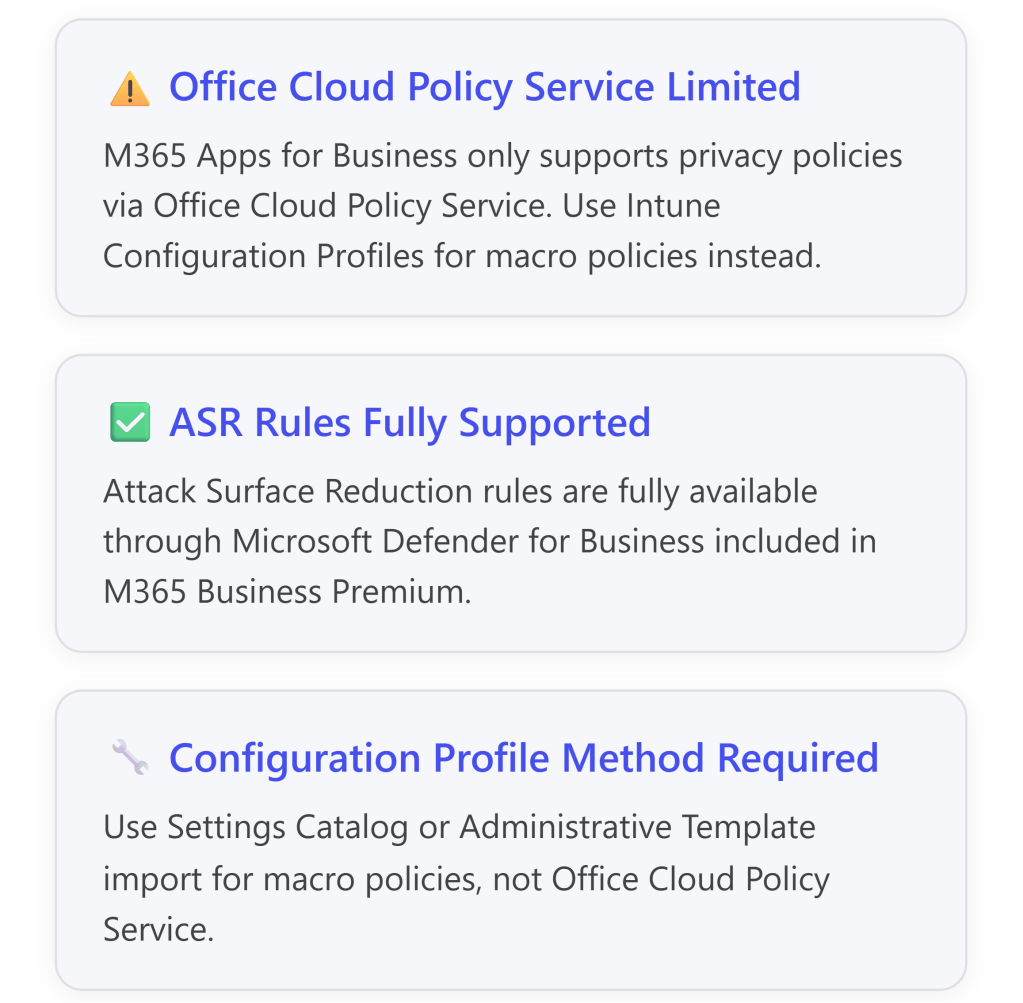
However, there is an important limitation: Microsoft 365 Business Premium includes Microsoft 365 Apps for Business, which has limited support for the Office Cloud Policy Service—only privacy-related policies are supported.2For full macro control policies, you must use Configuration Profiles in Intune instead.3 


Understanding Essential Eight Macro Security Requirements 

Essential Eight Maturity Level Requirements 

The Australian Cyber Security Centre (ACSC) Essential Eight framework defines specific controls for Microsoft Office macro security:4 
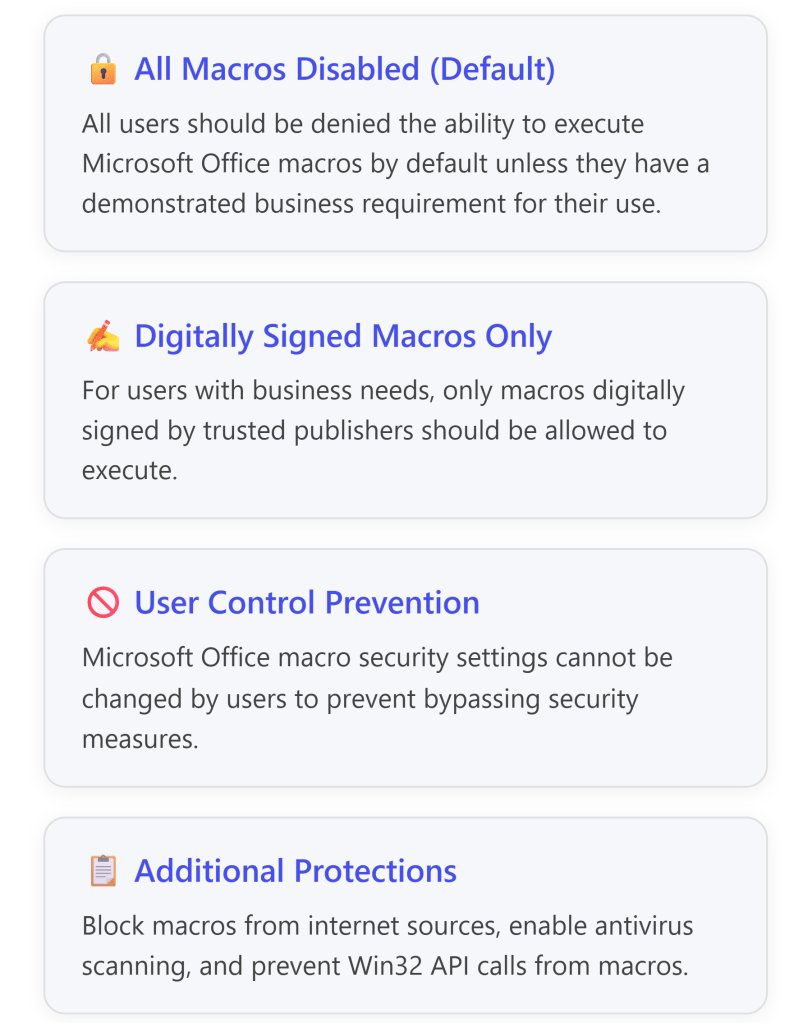
Key ISM Controls (March 2025) 

The Essential Eight implementation addresses multiple Information Security Manual (ISM) controls:5 

ISM Control Requirement Implementation Method 
ISM-1671 Macros disabled for users without business requirement Configure “Disable VBA for Office applications” policy 
ISM-1488 Block macros from internet sources Enable “Block macros from running in Office files from the internet” 
ISM-1675 Disable Trust Bar for unsigned macros Configure “Disable Trust Bar Notification for unsigned applications” 
ISM-1672 Enable macro antivirus scanning Set “Macro Runtime Scan Scope” to “Enable for all documents” 
ISM-1673 Block Win32 API calls from macros Deploy ASR rule 92E97FA1-2EDF-4476-BDD6-9DD0B4DDDC7B 
ISM-1489 Prevent users from changing macro settings Deploy policies via Intune (users cannot modify) 

Microsoft 365 Business Premium Capabilities for Macro Control 

What’s Included in Business Premium 

Microsoft 365 Business Premium includes: 

  • Microsoft Intune for device management 
  • Microsoft Defender for Business (includes Attack Surface Reduction) 
  • Microsoft 365 Apps for Business (desktop applications) 

Important Licensing Limitations 

⚠️ Critical Consideration: The Office Cloud Policy Service (config.office.com) has limited functionality with Microsoft 365 Apps for Business: 

  • Only privacy control policies are supported6 
  • Full macro security policies are NOT supported via Office Cloud Policy Service for Business licenses7 
  • You must use Intune Configuration Profiles (Settings Catalog or Administrative Templates) instead 

For full Office Cloud Policy Service support, you would need Microsoft 365 Apps for Enterprise licenses.8 


Implementation Approach: Configuration Profiles in Intune 

Method 1: Import Pre-Built ACSC Hardening Policy (Recommended) 

Microsoft provides pre-built configuration profiles aligned with ACSC guidance. This is the fastest and most reliable method for Essential Eight compliance. 

Step-by-Step: Import ACSC Office Hardening Policy 

Detailed Steps:9 

  1. Create Target User Group 
  • Create an Azure AD security group for “All Office Users” 
  • This group will receive Office apps and hardening policies 
  1. Download ACSC Policy Template 
  • Download the ACSC Office Hardening Guidelines JSON file10 
  1. Import to Intune 
  • Sign in to Microsoft Intune admin center: https://intune.microsoft.com[^1] 
  • Navigate to: Devices > Windows > Configuration profiles > Create 
  • Select: Import Policy 
  • Name: “ACSC Office Hardening – All Macros Disabled” 
  • Browse for the downloaded JSON file 
  • Click Save11 
  1. Import OLE Prevention Script 
  • Navigate to: Devices > Scripts > Add > Windows 10 and later 
  • Name: “OLE Package Prevention” 
  • Configure: 
  • Run script using logged-on credentials: Yes 
  • Enforce script signature check: No 
  • Run in 64-bit PowerShell: No12 
  • Assign to: All Office Users group13 
  1. Assign the Policy 
  • In the imported policy, go to Assignments 
  • Included groups: Select “All Office Users” 
  • Review + Save 

Method 2: Manual Configuration Using Settings Catalog 

If you prefer granular control, you can manually configure macro policies using Intune’s Settings Catalog. 

Step-by-Step: Create Custom Macro Blocking Policy 

  1. Create New Settings Catalog Policy 
  • Navigate to: Microsoft Intune admin center (intune.microsoft.com) 
  • Go to: Devices > Configuration policies > Create > New Policy 
  • Platform: Windows 10 and later 
  • Profile type: Settings catalog 
  • Name: “Office Macro Security – Disable All Macros” 
  1. Configure Settings for Each Office Application 

The following settings must be configured for each Office application (Word, Excel, PowerPoint, Access, Outlook):14 15 

Microsoft Office 2016 (Global Settings) 

Setting Path Configuration 
Microsoft Office 2016 > Security Settings  
Automation Security Enabled 
– Set Automation Security level Disable macros by default 
Disable VBA for Office applications Enabled 
Security Settings > Trust Center  
Allow mix of policy and user locations Disabled 

Microsoft Excel 2016 

Setting Path Configuration 
Excel Options > Security > Trust Center  
VBA Macro Notification Settings Enabled 
– VBA Macro Notification Disable all without notification 
Block macros from running in Office files from the Internet Enabled 
Trust access to Visual Basic Project Disabled 
Turn off trusted documents Enabled 
Turn off Trusted Documents on the network Enabled 
Excel Options > Security > Trust Center > Trusted Locations  
Allow Trusted Locations on the network Disabled 
Disable all trusted locations Enabled 

Microsoft Word 2016 

Setting Path Configuration 
Word Options > Security > Trust Center  
VBA Macro Notification Settings Enabled 
– VBA Macro Notification Disable all without notification 
Block macros from running in Office files from the Internet Enabled 
Trust access to Visual Basic Project Disabled 
Turn off trusted documents Enabled 
Turn off Trusted Documents on the network Enabled 
Word Options > Security > Trust Center > Trusted Locations  
Allow Trusted Locations on the network Disabled 
Disable all trusted locations Enabled 

Microsoft PowerPoint 2016 

Setting Path Configuration 
PowerPoint Options > Security > Trust Center  
VBA Macro Notification Settings Enabled 
– VBA Macro Notification Disable all without notification 
Block macros from running in Office files from the Internet Enabled 
Trust access to Visual Basic Project Disabled 
Turn off trusted documents Enabled 
Turn off Trusted Documents on the network Enabled 
PowerPoint Options > Security > Trust Center > Trusted Locations  
Allow Trusted Locations on the network Disabled 
Disable all trusted locations Enabled 

Microsoft Access 2016 

Setting Path Configuration 
Application Settings > Security > Trust Center  
VBA Macro Notification Settings Enabled 
– VBA Macro Notification Disable all without notification 
Block macros from running in Office files from the Internet Enabled 
Turn off trusted documents Enabled 
Turn off Trusted Documents on the network Enabled 
Application Settings > Security > Trust Center > Trusted Locations  
Allow Trusted Locations on the network Disabled 
Disable all trusted locations Enabled 

Microsoft Outlook 2016 

Setting Path Configuration 
Security > Trust Center  
Apply macro security settings to macros, add-ins and additional actions Enabled 
Security settings for macros Enabled 
– Security Level Never warn, disable all 
  1. Assign the Policy 
  • Assignments: Select your target user or device groups 
  • Review + Create 

Attack Surface Reduction (ASR) Rules for Essential Eight Compliance 

Can ASR Rules Meet Essential Eight Requirements? 

Yes, partially. Windows Attack Surface Reduction rules provide critical additional protections that complement macro blocking policies and help meet Essential Eight requirements.16 17 

ASR rules are included with Microsoft 365 Business Premium via Microsoft Defender for Business and can be deployed through Intune.18 

Essential Eight-Relevant ASR Rules 

The following ASR rules directly support Essential Eight mitigation strategies:19 20 
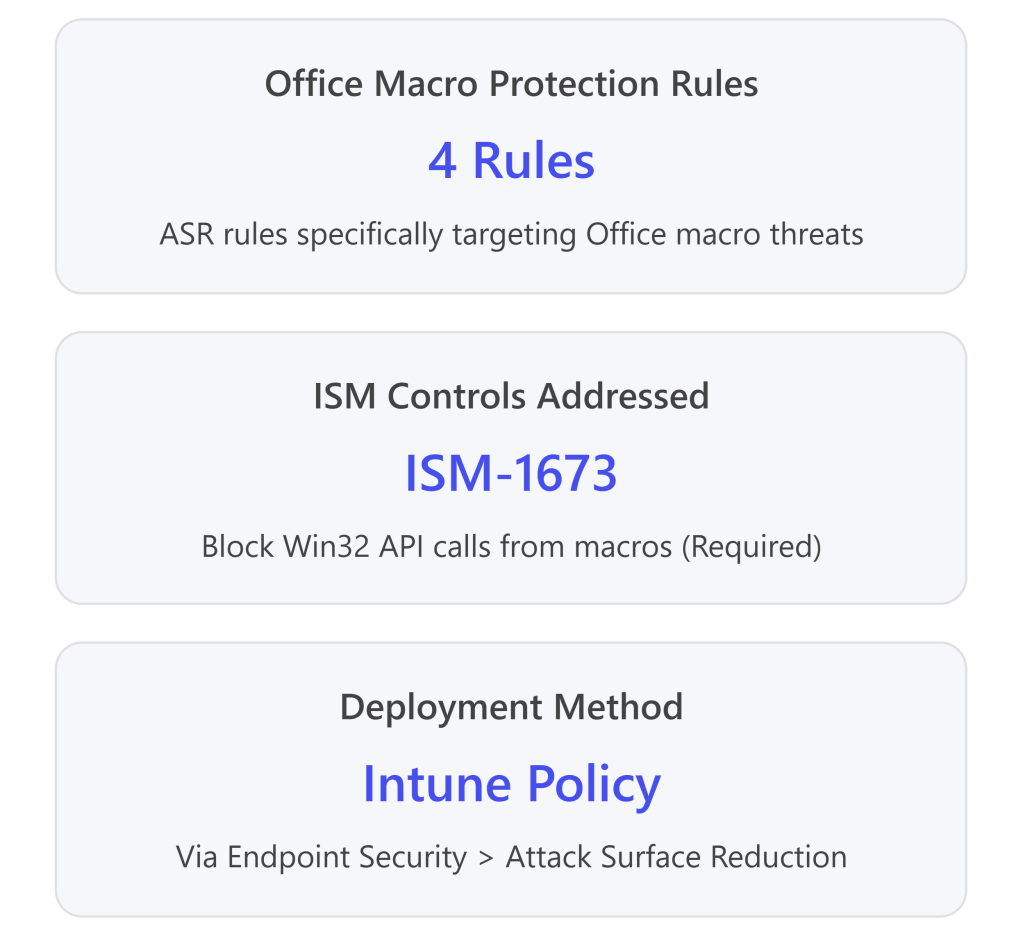
ASR Rules for Office Macro Security 

ASR Rule Name GUID Essential Eight Alignment ISM Control 
Block Win32 API calls from Office macros 92e97fa1-2edf-4476-bdd6-9dd0b4dddc7b ✅ Required – Prevents macros from making dangerous system calls ISM-1673 
Block Office applications from creating child processes d4f940ab-401b-4efc-aadc-ad5f3c50688a ✅ Recommended – Prevents macro-launched executables User App Hardening 
Block Office applications from creating executable content 3b576869-a4ec-4529-8536-b80a7769e899 ✅ Recommended – Prevents macros from creating .exe files User App Hardening 
Block Office applications from injecting code into other processes 75668c1f-73b5-4cf0-bb93-3ecf5cb7cc84 ✅ Recommended – Prevents code injection attacks User App Hardening 
Block Office communication applications from creating child processes 26190899-1602-49e8-8b27-eb1d0a1ce869 ✅ Recommended – Protects Outlook from exploitation User App Hardening 

Step-by-Step: Deploy ASR Rules via Intune 
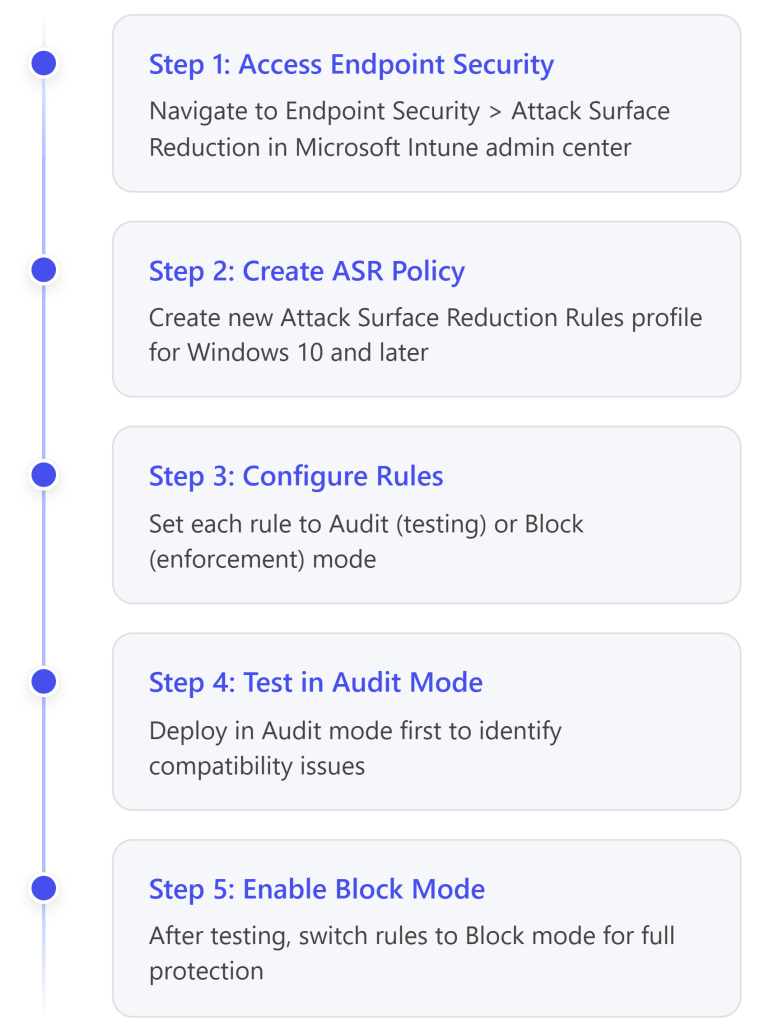
Detailed Implementation Steps:21 

  1. Navigate to ASR Policy Creation 
  • Go to: Endpoint security > Attack surface reduction 
  • Click: Create Policy22 
  1. Configure Policy Basics 
  • Platform: Windows 10, Windows 11, and Windows Server 
  • Profile: Attack Surface Reduction Rules 
  • Name: “Essential Eight – Office ASR Rules” 
  • Description: “ASR rules aligned with ACSC Essential Eight requirements” 
  1. Configure ASR Rules 

For each of the Essential Eight-relevant rules, configure the mode:23 

ASR Rule Initial Mode Production Mode 
Block Win32 API calls from Office macros Audit Block (Required for ISM-1673) 
Block Office applications from creating child processes Audit Block 
Block Office applications from creating executable content Audit Block 
Block Office applications from injecting code into other processes Audit Block 
Block Office communication applications from creating child processes Audit Block 

Mode Definitions: 

  • Not Configured (0): Rule is disabled 
  • Block (1): Rule is enforced 
  • Audit (2): Rule logs events but doesn’t block 
  • Warn (6): User receives warning but can bypass24 
  1. Assign the Policy 
  • Assignments
  • Included groups: “All Windows Devices” or specific pilot groups 
  • Excluded groups: Any test or exception groups 
  • Click Next and Create 
  1. Testing and Deployment Strategy 

⚠️ Important: ASR rules should be thoroughly tested before full enforcement:25 

  • Week 1-2: Deploy all rules in Audit mode 
  • Week 3-4: Review Microsoft Defender for Endpoint logs for blocked activity 
  • Week 5+: Switch rules to Block mode for full enforcement 
  • Monitor for false positives and create exclusions as needed 

Alternative: Manual ASR Deployment via Graph API 

For advanced deployments, you can use Microsoft Graph API to deploy ASR policies programmatically:26 

Step-by-Step: 

  1. Navigate to Graph Explorer 
  • Sign in with administrator credentials 
  • Grant necessary permissions 
  1. Create POST Request 
  • Method: POST 
  • Schema: Beta 
  1. Use ACSC Windows Hardening JSON 
  • Copy the JSON content and paste into the request body 
  • Modify the policy name if needed 
  • Execute the POST request 
  1. Assign Policy 
  • Use Graph API or Intune portal to assign the created policy to your device groups 

Monitoring and Validation 

Verifying Policy Application 

After deploying policies, verify they’re working correctly: 

  1. Check Policy Status in Intune 
  • Navigate to: Devices > Monitor > Device configuration 
  • Review deployment status for your macro policies 
  • Check for any errors or conflicts28 
  1. Test on End-User Device 
  • Have a test user attempt to open a macro-enabled Office file 
  • Verify that macros are blocked and no prompt appears 
  • Check that Trust Center settings are grayed out (not user-modifiable) 
  1. Review Microsoft Defender for Endpoint 

If you have Defender for Endpoint (included in Business Premium), monitor for macro-related events:29 

  • Endpoint behavioral sensors collect macro execution attempts 
  • Cloud security analytics translate signals into insights 
  • Threat intelligence identifies attacker techniques 
  • Review alerts in the Microsoft 365 Defender portal (security.microsoft.com) 
  1. Validate ASR Rule Effectiveness 
  • Navigate to: Microsoft 365 Defender portal > Reports > Attack surface reduction rules 
  • Review triggered events for each ASR rule 
  • Identify false positives and create exclusions if needed 

Exception Management: Allowing Trusted Macros 

Some users may have legitimate business requirements for macros. The Essential Eight framework accommodates this through Trusted Publishers or Trusted Locations.30 

Option 1: Trusted Publishers (Recommended) 

Trusted Publishers use digital signatures to verify macro authenticity. This is the preferred method for Essential Eight compliance.31 

Step-by-Step: Enable Trusted Publishers 

  1. Create Exception Group 
  • Create Azure AD group: “Office Macro Users – Trusted Publishers” 
  • Add users with legitimate macro needs32 
  1. Download Trusted Publisher Policy 
  1. Import to Intune 
  • Navigate to: Devices > Configuration profiles > Import Policy 
  • Browse for downloaded JSON file 
  • Name: “ACSC Office – Trusted Publishers Enabled” 
  • Assign to: “Office Macro Users – Trusted Publishers” group33 
  1. Exclude from Macro Blocking Policy 
  • Edit your “All Macros Disabled” policy 
  • Go to Assignments 
  • Excluded groups: Add “Office Macro Users – Trusted Publishers”34 
  1. Deploy Trusted Publisher Certificates 

For each approved macro publisher:35 

  • Navigate to: Devices > Configuration profiles > Create 
  • Profile type: Trusted certificate 
  • Upload the publisher’s code-signing certificate 
  • Assign to: “Office Macro Users – Trusted Publishers” group 

Certificate Requirements:36 

  • Must use V3 signature scheme (more secure) 
  • Certificate must be from a trusted Certificate Authority 
  • Each publisher should have a separate policy for easier management 
  1. Macro Vetting Process 

Before signing any macros:37 

  • Execute macros on an isolated test device with ACSC hardening applied 
  • Verify no malicious behavior 
  • Use Microsoft Defender Antivirus scanning (automatic with ACSC policies) 
  • Consider third-party macro scanning tools for additional validation 

Comprehensive Policy Summary Table 

Configuration Profile Settings 

Policy Category Setting Configuration Purpose 
VBA Macro Execution Disable VBA for Office applications Enabled Disables VBA engine globally38 
 VBA Macro Notification Settings Disable all without notification Blocks all macros silently39 
Internet Macros Block macros from Internet sources Enabled Prevents macros from untrusted sources40 
Automation Security Automation Security Level Disable macros by default Prevents COM automation attacks41 
Trust Center Turn off trusted documents Enabled Prevents trust bypass via document trust42 
 Turn off Trusted Documents on network Enabled Prevents network trust bypass43 
 Disable all trusted locations Enabled Blocks trusted location bypass44 
 Allow mix of policy and user locations Disabled Prevents user-defined trust45 
 Trust access to VBA Project Disabled Blocks programmatic VBA access46 
Macro Scanning Macro Runtime Scan Scope Enable for all documents Enables Defender AV scanning47 

Attack Surface Reduction Rules 

ASR Rule GUID Mode Purpose 
Block Win32 API calls from Office macros 92e97fa1-2edf-4476-bdd6-9dd0b4dddc7b Block Prevents dangerous API calls (ISM-1673)48 
Block Office apps creating child processes d4f940ab-401b-4efc-aadc-ad5f3c50688a Block Prevents macro-launched executables49 
Block Office apps creating executable content 3b576869-a4ec-4529-8536-b80a7769e899 Block Prevents .exe creation50 
Block Office apps injecting code 75668c1f-73b5-4cf0-bb93-3ecf5cb7cc84 Block Prevents process injection51 
Block Outlook creating child processes 26190899-1602-49e8-8b27-eb1d0a1ce869 Block Protects email client52 

Key Limitations and Considerations 

Microsoft 365 Business Premium Constraints 
Testing Recommendations 

  1. Pilot Deployment: Test policies with a small group before organization-wide rollout53 
  1. Audit Mode First: Deploy ASR rules in Audit mode for 2-4 weeks before enforcement54 
  1. User Communication: Notify users about macro blocking to reduce helpdesk calls 
  1. Exception Process: Establish clear process for macro exception requests 
  1. Regular Review: Validate Trusted Publisher certificates annually55 

Complete Implementation Checklist 

  • Phase 1: Preparation 
  • Create Azure AD security groups (“All Office Users”, “Macro Exception Users”) 
  • Document current macro usage across organization 
  • Establish exception approval process 
  • Communicate changes to end users 
  • Phase 2: Baseline Policy Deployment 
  • Download ACSC Office Hardening policy from GitHub 
  • Import policy to Intune Configuration Profiles 
  • Download and import OLE prevention PowerShell script 
  • Assign policies to pilot group 
  • Test policy application on pilot devices 
  • Phase 3: ASR Rule Deployment 
  • Create ASR policy in Endpoint Security 
  • Configure 5 Office-related ASR rules in Audit mode 
  • Assign to pilot group 
  • Monitor events in Microsoft 365 Defender for 2-4 weeks 
  • Phase 4: Production Rollout 
  • Review audit logs for false positives 
  • Create ASR exclusions if needed 
  • Switch ASR rules to Block mode 
  • Expand deployment to all users 
  • Configure Trusted Publisher policies for exception users 
  • Phase 5: Ongoing Management 
  • Monitor Defender for Endpoint alerts 
  • Review exception requests quarterly 
  • Validate Trusted Publisher certificates annually 
  • Update policies as new ISM controls are released 

Conclusion 

Meeting the Essential Eight requirements for disabling Office macros in a cloud-only environment with Microsoft 365 Business Premium is achievable through: 

  1. Intune Configuration Profiles: Disable macros at the Office application level using Settings Catalog or imported administrative templates 
  1. Attack Surface Reduction Rules: Deploy complementary ASR rules to block macro-related attack behaviors 
  1. Exception Management: Use Trusted Publishers for users with legitimate macro needs 
  1. Continuous Monitoring: Leverage Microsoft Defender for Endpoint for visibility and alerting 

While Office Cloud Policy Service has limitations with Business Premium, Intune Configuration Profiles provide full macro control capabilities needed for Essential Eight compliance. ASR rules successfully accommodate Essential Eight requirements by providing the necessary technical controls, particularly ISM-1673 (blocking Win32 API calls from macros). 

The combination of these approaches provides defense-in-depth aligned with ACSC guidance and enables organizations to achieve Essential Eight Maturity Level 3 for macro security. 


References 

Microsoft Official Documentation 

Microsoft Learn – Essential Eight Guidance 

  • Essential Eight configure Microsoft Office macro settings 
  • Site: Microsoft Learn 

Microsoft Learn – Essential Eight User Application Hardening 

  • Essential Eight user application hardening 
  • Site: Microsoft Learn 

Microsoft Learn – Intune Office Policies 

  • Policies for Microsoft 365 Apps – Microsoft Intune 
  • Site: Microsoft Learn 

Microsoft Learn – Office Cloud Policy Service Overview 

  • Overview of Cloud Policy service for Microsoft 365 
  • Site: Microsoft Learn 

Microsoft Learn – Attack Surface Reduction Rules Reference 

  • Attack surface reduction rules reference – Microsoft Defender for Endpoint 
  • Site: Microsoft Learn 

Microsoft Learn – Manage ASR with Intune 

  • Manage attack surface reduction settings with Microsoft Intune 
  • Site: Microsoft Learn 

Microsoft Intune Admin Center 

  • Microsoft Intune admin center 
  • Site: Microsoft Intune 

Australian Cyber Security Centre (ACSC) Guidance 

Cyber.gov.au – Restricting Microsoft Office Macros 

  • Restricting Microsoft Office macros 
  • Site: Australian Cyber Security Centre (ACSC) 

Cyber.gov.au – Guidelines for System Hardening 

  • Guidelines for System Hardening 
  • Site: Australian Cyber Security Centre (ACSC) 

Cyber.gov.au – Hardening Microsoft 365 and Office 

  • Hardening Microsoft 365, Office 2021, Office 2019, and Office 2016 
  • Site: Australian Cyber Security Centre (ACSC) 

Cyber.gov.au – Microsoft Office Macro Security 

  • Microsoft Office Macro Security 
  • Site: Australian Cyber Security Centre (ACSC) 

Cyber.gov.au – Essential Eight Assessment Process Guide 

  • Essential Eight assessment process guide 
  • Site: Australian Cyber Security Centre (ACSC) 

Cyber.gov.au – Technical Example: Configure Macro Settings 

  • Technical example: Configure macro settings 
  • Site: Australian Cyber Security Centre (ACSC) 

ASD Blueprint for Secure Cloud 

ASD Blueprint – Office Hardening All Macros Disabled 

  • ASD Office hardening – all macros disabled 
  • Site: ASD’s Blueprint for Secure Cloud 

ASD Blueprint – Microsoft Office Macro Hardening Design 

  • Microsoft Office macro hardening 
  • Site: ASD’s Blueprint for Secure Cloud 

ASD Blueprint – Restrict Microsoft Office Macros 

  • Restrict Microsoft Office macros 
  • Site: ASD’s Blueprint for Secure Cloud 

GitHub Repositories and Templates 

Microsoft GitHub – ACSC Office Hardening Guidelines 

  • ACSC Office Hardening Guidelines (JSON) 
  • Site: GitHub – Microsoft 

Microsoft GitHub – OLE Prevention PowerShell Script 

  • OfficeMacroHardening-PreventActivationofOLE.ps1 
  • Site: GitHub – Microsoft 

Microsoft GitHub – ACSC Windows Hardening ASR Policy 

  • ACSC Windows Hardening Guidelines – Attack Surface Reduction policy (JSON) 
  • Site: GitHub – Microsoft 

GitHub – ACSC Essential 8 Office Hardening Module 

  • benjamin-robertson/acsc_e8_office_hardening 
  • Site: GitHub – Community 

Community and Technical Resources 

Reddit – Office 365 Community Discussion 

  • 365 Business Premium – GPO or config.office.com 
  • Site: Reddit – r/Office365 

Practical365 – Office Cloud Policy Service 

  • Block Macro Execution with Office Cloud Policy Service (OCPS) 
  • Site: Practical365 

Mr T-Bone’s Blog – Intune Office Policies 

  • How to use policies for Office apps in Intune 
  • Site: Mr T-Bone´s Blog 

Helge Klein – Blocking Office Macros 

  • Blocking Office Macros, Managing Windows & macOS via Intune 
  • Site: Helge Klein 

T-Minus365 – Deploy ASR Rules 

  • Deploy Attack Surface Reduction Rules from Microsoft Intune 
  • Site: T-Minus365 

Azure with Tom – Implementing ASR Policies 

  • Implementing Attack Surface Reduction Policies 
  • Site: Azure with Tom 

Additional Resources 

Microsoft Graph API – Graph Explorer 

  • Graph Explorer for API Testing 
  • Site: Microsoft Developer 

Microsoft 365 Defender Portal 

  • Microsoft 365 Defender Security Portal 
  • Site: Microsoft 365 Defender 

CISA – Disable VBA Macros Guidance 

  • Disable Visual Basic for Applications (VBA) Macros (CM0056) 
  • Site: Cybersecurity and Infrastructure Security Agency (CISA) 
Comprehensive Guide to Microsoft Autopilot v2 Deployment in Microsoft 365 Business

Microsoft’s Windows Autopilot is a cloud-based suite of technologies designed to streamline the deployment and configuration of new Windows devices for organizations[1]. This guide provides a detailed look at the latest updates to Windows Autopilot – specifically the new Autopilot v2 (officially called Windows Autopilot Device Preparation) – and offers step-by-step instructions for implementing it in a Microsoft 365 Business environment. We will cover the core concepts, new features in Autopilot v2, benefits for businesses, the implementation process (from prerequisites to deployment), troubleshooting tips, and best practices for managing devices with Autopilot v2.

1. Overview of Microsoft Autopilot and Its Purpose

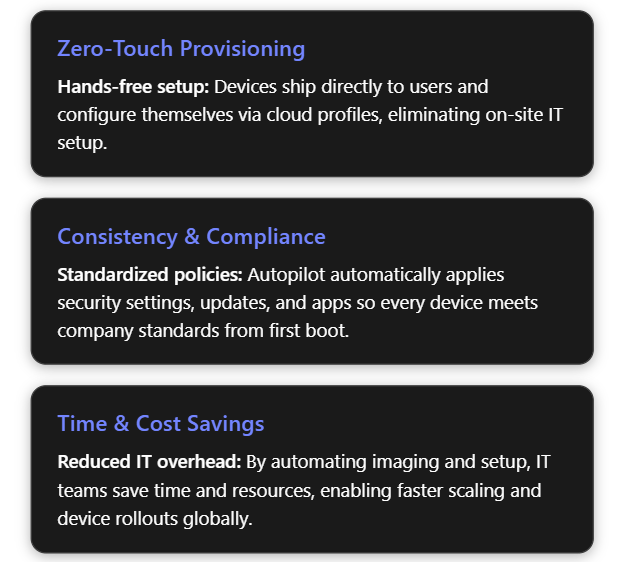
Windows Autopilot simplifies the Windows device lifecycle from initial deployment through end-of-life. It leverages cloud services (like Microsoft Intune and Microsoft Entra ID) to pre-configure devices out-of-box without traditional imaging. When a user unboxes a new Windows 10/11 device and connects to the internet, Autopilot can automatically join it to Azure/Microsoft Entra ID, enroll it in Intune (MDM), apply corporate policies, install required apps, and tailor the out-of-box experience (OOBE) to the organization[1][1]. This zero-touch deployment means IT personnel no longer need to manually image or set up each PC, drastically reducing deployment time and IT overhead[2]. In short, Autopilot’s purpose is to get new devices “business-ready” with minimal effort, offering benefits such as:

  • Reduced IT Effort – No need to maintain custom images for every model; devices use the OEM’s factory image and are configured via cloud policies[1][1].
  • Faster Deployment – Users only perform a few quick steps (like network connection and sign-in), and everything else is automated, so employees can start working sooner[1].
  • Consistency & Compliance – Ensures each device receives standard configurations, security policies, and applications, so they immediately meet organizational standards upon first use[2].
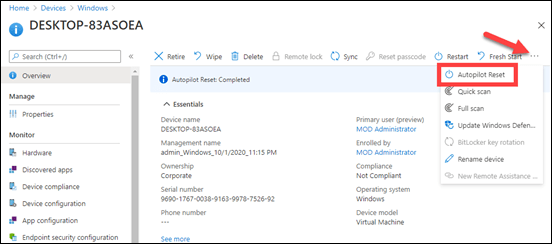
  • Lifecycle Management – Autopilot can also streamline device resets, repurposing for new users, or recovery scenarios (for example, using Autopilot Reset to wipe and redeploy a device)[1].

2. Latest Updates: Introduction of Autopilot v2 (Device Preparation)

Microsoft has recently introduced a next-generation Autopilot deployment experience called Windows Autopilot Device Preparation (commonly referred to as Autopilot v2). This new version is essentially a re-architected Autopilot aimed at simplifying and improving deployments based on customer feedback[3]. Autopilot v2 offers new capabilities and architectural changes that enhance consistency, speed, and reliability of device provisioning. Below is an overview of what’s new in Autopilot v2:

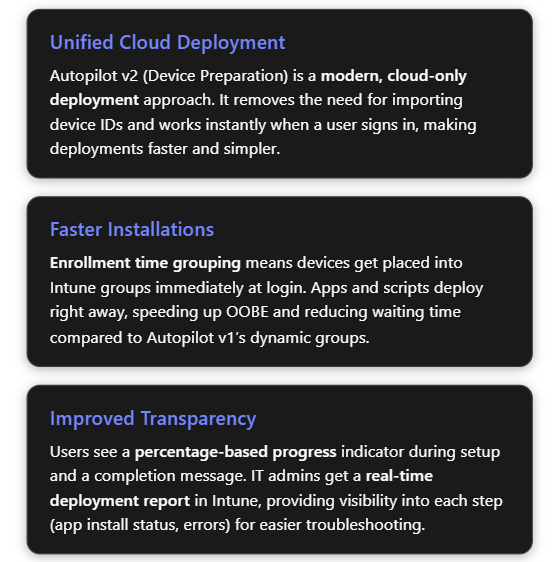
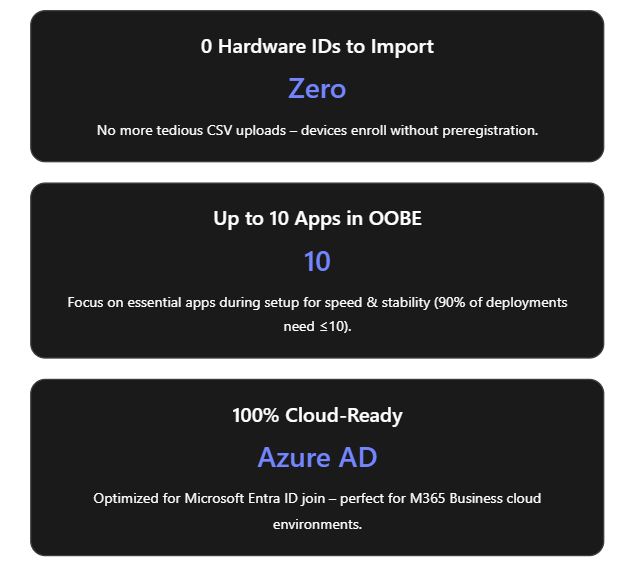
  • No Hardware Hash Import Required: Unlike the classic Autopilot (v1) which required IT admins or OEMs to register devices in Autopilot (upload device IDs/hardware hashes) beforehand, Autopilot v2 eliminates this step[4]. Devices do not need to be pre-registered in Intune; instead, enrollment can be triggered simply by the user logging in with their work account. This streamlines onboarding by removing the tedious hardware hash import process[3]. (If a device is already registered in the old Autopilot, the classic profile will take precedence – so using v2 means not importing the device beforehand[5].)
  • Cloud-Only (Entra ID) Join: Autopilot v2 currently supports Microsoft Entra ID (Azure AD) join only – it’s designed for cloud-based identity scenarios. Hybrid Azure AD Join (on-prem AD) is not supported in v2 at this time[3]. This focus on cloud join aligns with modern, cloud-first management in Microsoft 365 Business environments.
  • Single Unified Deployment Profile: The new Autopilot Device Preparation uses a single profile to define all deployment settings and OOBE customization, rather than separate “Deployment” and “ESP” profiles as in legacy Autopilot[3]. This unified profile encapsulates join type, user account type, and OOBE preferences, plus it lets you directly select which apps and scripts should install during the setup phase.
  • Enrollment Time Grouping: Autopilot v2 introduces an “Enrollment Time Grouping” mechanism. When a user signs in during OOBE, the device is automatically added to a specified Azure AD group on the fly, and any applications or configurations assigned to that group are immediately applied[5][5]. This replaces the old dependence on dynamic device groups (which could introduce delays while membership queries run). Result: faster and more predictable delivery of apps/policies during provisioning[5].
  • Selective App Installation (OOBE): With Autopilot v1, all targeted device apps would try to install during the initial device setup, possibly slowing things down. In Autopilot v2, the admin can pick up to 10 essential apps (Win32, MSI, Store apps, etc.) to install during OOBE; any apps not selected will be deferred until after the user reaches the desktop[3][6]. By limiting to 10 critical apps, Microsoft aimed to increase success rates and speed (as their telemetry showed ~90% of deployments use 10 or fewer apps initially)[6].
  • PowerShell Scripts Support in ESP: Autopilot v2 can also execute PowerShell scripts during the Enrollment Status Page (ESP) phase of setup[3]. This means custom configuration scripts can run as part of provisioning before the device is handed to the user – a capability that simplifies advanced setup tasks (like configuring registry settings, installing agent software, etc., via script).
  • Improved Progress & UX: The OOBE experience is updated – Autopilot v2 provides a simplified progress display (percentage complete) during provisioning[6]. Users can clearly see that the device is installing apps/configurations. Once the critical steps are done, it informs the user that setup is complete and they can start using the device[6][6]. (Because the device isn’t identified as Autopilot-managed until after the user sign-in, some initial Windows setup screens like EULA or privacy settings may appear in Autopilot v2 that were hidden in v1[3]. These are automatically suppressed only after the Autopilot policy arrives during login.)
  • Near Real-Time Deployment Reporting: Autopilot v2 greatly enhances monitoring. Intune now offers an Autopilot deployment report that shows status per device in near real time[6]. Administrators can see which devices have completed Autopilot, which stage they’re in, and detailed results for each selected app and script (success/failure), as well as overall deployment duration[5][5]. This granular reporting makes troubleshooting easier, as you can immediately identify if (for example) a particular app failed to install during OOBE[5][5].
  • Availability in Government Clouds: The new Device Preparation approach is available in GCC High and DoD government cloud environments[6][5], which was not possible with Autopilot previously. This broadens Autopilot use to more regulated customers and is one reason Microsoft undertook this redesign (Autopilot v2 originated as a project to meet government cloud requirements and then expanded to all customers)[7].

The table below summarizes key differences between Autopilot v1 (classic) and Autopilot v2:

Feature/CapabilityAutopilot v1 (Classic)Autopilot v2 (Device Preparation)
Device preregistration (Hardware hash upload)Required (devices must be registered in Autopilot device list before use)[4]Not required (user can enroll device directly; device should not be pre-added, or v2 profile won’t apply)[5]
Supported join typesAzure AD Join; Hybrid Azure AD Join (with Intune Connector)[3]Azure/Microsoft Entra ID Join only (no on-prem AD support yet)[3]
Self-Deploying / Pre-provisioning (White Glove)Supported (TPM attestation-based self-deploy; technician pre-provision mode available)Not supported in initial release[3] (future support is planned for these scenarios)
Deployment profilesSeparate Deployment Profile + ESP Profile (configuration split)Single Device Preparation Policy (one profile for all settings: join, account type, OOBE, app selection)[3]
App installation during OOBEInstalls all required apps targeted to device (could be many; admin chooses which are “blocking”)Installs selected apps only (up to 10) during OOBE; non-selected apps wait until after OOBE[3][6]
PowerShell scripts in OOBENot natively supported in ESP (workarounds needed)Supported – can run PowerShell scripts during provisioning (via device prep profile)[3]
Policy application in OOBESome device policies (Wi-Fi, certs, etc.) could block in ESP; user-targeted configs had limited supportDevice policies synced at OOBE (not blocking)[3]; user-targeted policies/apps install after user reaches desktop[3]
Out-of-Box experience (UI)Branding and many Windows setup screens are skipped (when profile is applied from the start of OOBE)Some Windows setup screens appear by default (since no profile until sign-in)[3]; afterwards, shows new progress bar and completion summary[6]
Reporting & MonitoringBasic tracking via Enrollment Status Page; limited real-time infoDetailed deployment report in Intune with near real-time status of apps, scripts, and device info[5]

Why these updates? The changes in Autopilot v2 address common pain points from Autopilot v1. By removing the dependency on upfront registration and dynamic groups, Microsoft has made provisioning more robust and “hands-off”. The new architecture “locks in” the admin’s intended config at enrollment time and provides better error handling and reporting[6][6]. In summary, Autopilot v2 is simpler, faster, more observable, and more reliable – the guiding principles of its design[5] – making device onboarding easier for both IT admins and end-users.

3. Benefits of Using Autopilot v2 in a Microsoft 365 Business Environment

Implementing Autopilot v2 brings significant advantages, especially for organizations using Microsoft 365 Business or Business Premium (which include Intune for device management). Here are the key benefits:

  • Ease of Deployment – Less IT Effort: Autopilot v2’s no-registration model is ideal for businesses that procure devices ad-hoc or in small batches. IT admins no longer need to collect hardware hashes or coordinate with OEMs to register devices. A user can unbox a new Windows 11 device, connect to the internet, and sign in with their work account to trigger enrollment. This self-service enrollment reduces the workload on IT staff, which is especially valuable for small IT teams.
  • Faster Device Setup: By limiting installation to essential apps during OOBE and using enrollment time grouping, Autopilot v2 gets devices ready more quickly. End-users see a shorter setup time before reaching the desktop. They can start working sooner with all critical tools in place (e.g. Office apps, security software, etc. installed during setup)[7][7]. Non-critical apps or large software can install in the background later, avoiding long waits up-front.
  • Improved Reliability and Fewer Errors: The new deployment process is designed to “fail fast” with better error details[6]. If something is going to go wrong (for example, an app that fails to install), Autopilot v2 surfaces that information quickly in the Intune report and does not leave the user guessing. The enrollment time grouping also avoids timing issues that could occur with dynamic Azure AD groups. Overall, this means higher success rates for device provisioning and less troubleshooting compared to the old Autopilot. In addition, by standardizing on cloud join only, many potential complexities (like on-prem domain connectivity during OOBE) are removed.
  • Enhanced User Experience: Autopilot v2 provides a more transparent and reassuring experience to employees receiving new devices. The OOBE progress bar with a percentage complete indicator lets users know that the device is configuring (rather than appearing to be stuck). Once the critical setup is done, Autopilot informs the user that the device is ready to go[6]. This clarity can reduce helpdesk calls from users unsure if they should wait or reboot during setup. Also, because devices are delivered pre-configured with corporate settings and apps, users can be productive on Day 1 without needing IT to personally assist.
  • Better Monitoring for IT: In Microsoft 365 Business environments, often a single admin oversees device management. The Autopilot deployment report in Intune gives that admin a real-time dashboard to monitor deployments. They can see if a new laptop issued to an employee enrolled successfully, which apps/scripts ran, and if any step failed[5][5]. For any errors, the admin can drill down immediately and troubleshoot (for instance, if an app didn’t install, they know to check that installer or assign it differently). This reduces guesswork and allows proactive support, contributing to a smoother deployment process across the organization.
  • Security and Control: Autopilot v2 includes support for corporate device identification. By uploading known device identifiers (e.g., serial numbers) into Intune and enabling enrollment restrictions, a business can ensure only company-owned devices enroll via Autopilot[4][4]. This prevents personal or unauthorized devices from accidentally being enrolled. Although this requires a bit of setup (covered below), it gives small organizations an easy way to enforce that Autopilot v2 is used only for approved hardware, adding an extra layer of security and compliance. Furthermore, Autopilot v2 automatically makes the Azure AD account a standard user by default (not local admin), which improves security on the endpoint[5].

In summary, Autopilot v2 is well-suited for Microsoft 365 Business scenarios: it’s cloud-first and user-driven, aligning with the needs of modern SMBs that may not have complex on-prem infrastructure. It lowers the barrier to deploying new devices (no imaging or device ID admin work) while improving the speed, consistency, and security of device provisioning.

4. Implementing Autopilot v2: Step-by-Step Guide

In this section, we’ll walk through how to implement Windows Autopilot Device Preparation (Autopilot v2) in your Microsoft 365 Business/Intune environment. The process involves: verifying prerequisites, configuring Intune with the new profile and required settings, and then enrolling devices. Each step is detailed below.

4.1 Prerequisites and Initial Setup

Before enabling Autopilot v2, ensure the following prerequisites are met:

  1. Windows Version Requirements: Autopilot v2 requires Windows 11. Supported versions are Windows 11 22H2 or 23H2 with the latest updates (specifically, installing KB5035942 or later)[3][5], or any later version (Windows 11 24H2+). New devices should be shipped with a compatible Windows 11 build (or be updated to one) to use Autopilot v2. Windows 10 devices cannot use Autopilot v2; they would fall back to the classic Autopilot method.
  2. Microsoft Intune: You need an Intune subscription (Microsoft Endpoint Manager) as part of your M365 Business. Intune will serve as the Mobile Device Management (MDM) service to manage Autopilot profiles and device enrollment.
  3. Azure AD/Microsoft Entra ID: Devices will be Azure AD joined. Ensure your users have Microsoft Entra ID accounts with appropriate Intune licenses (e.g., Microsoft 365 Business Premium includes Intune licensing) and that automatic MDM enrollment is enabled for Azure AD join. In Azure AD, under Mobility (MDM/MAM), Microsoft Intune should be set to Automatically enroll corporate devices for your users.
  4. No Pre-Registration of Devices: Do not import the device hardware IDs into the Intune Autopilot devices list for devices you plan to enroll with v2. If you previously obtained a hardware hash (.CSV) from your device or your hardware vendor registered the device to your tenant, you should deregister those devices to allow Autopilot v2 to take over[5]. (Autopilot v2 will not apply if an Autopilot deployment profile from v1 is already assigned to the device.)
  5. Intune Connector (If Hybrid not needed): Since Autopilot v2 doesn’t support Hybrid AD join, you do not need the Intune Connector for Active Directory for these devices. (If you have the connector running for other hybrid-join Autopilot scenarios, that’s fine; it simply won’t be used for v2 deployments.)
  6. Network and Access: New devices must have internet connectivity during OOBE (Ethernet or Wi-Fi accessible from the initial setup). Ensure that the network allows connection to Azure AD and Intune endpoints. If using Wi-Fi, users will need to join a Wi-Fi network in the first OOBE steps. (Consider using a provisioning SSID or instructing users to connect to an available network.)
  7. Plan for Device Identification (Optional but Recommended): Decide if you will restrict Autopilot enrollment to corporate-owned devices only. For better control (and to prevent personal device enrollment), it’s best practice to use Intune’s enrollment restrictions to block personal Windows enrollments and use Corporate device identifiers to flag your devices. We will cover how to set this up in the steps below. If you plan to use this, gather a list of device serial numbers (and manufacturers/models) for the PCs you intend to enroll.

4.2 Configuring the Autopilot v2 (Device Preparation) Profile in Intune

Once prerequisites are in place, the core setup work is done in Microsoft Intune. This involves creating Azure AD groups and then creating a Device Preparation profile (Autopilot v2 profile) and configuring it. Follow these steps:

1. Create Azure AD Groups for Autopilot: We need two security groups to manage Autopilot v2 deployment:

  • User Group – contains the users who will be enrolling devices via Autopilot v2.
  • Device Group – will dynamically receive devices at enrollment time and be used to assign apps/policies.

In the Azure AD or Intune portal, navigate to “Groups” and create a new group for users. For example, “Autopilot Device Preparation – Users”. Add all relevant user accounts (e.g., all employees or the subset who will use Autopilot) to this group[4]. Use Assigned membership for explicit control.

Next, create another security group for devices, e.g., “Autopilot Device Preparation – Devices”. Set this as a Dynamic Device group if possible, or Assigned (we will be adding devices automatically via the profile). An interesting detail: Intune’s Autopilot v2 mechanism uses an application identity called “Intune Provisioning Client” to add devices to this group during enrollment[4]. You can assign that as the owner of the group (though Intune may handle this automatically when the profile is used).

2. Create the Device Preparation (Autopilot v2) Profile: In the Intune admin center, go to Devices > Windows > Windows Enrollment (or Endpoint Management > Enrollment). There should be a section for “Windows Autopilot Device Preparation (Preview)” or “Device Preparation Policies”. Choose to Create a new profile/policy[4].

  • Name and Group Assignment: Give the profile a clear name (e.g., “Autopilot Device Prep Policy – Cloud PCs”). For the target group, select the Device group created in step 1 as the group to assign devices to at enrollment[4]. (In some interfaces, you might first choose the device group in the profile so the system knows where to add devices.)
  • Deployment Mode: Choose User-Driven (since user-driven Azure AD join is the scenario for M365 Business). Autopilot v2 also has an “Automatic” mode intended for Windows 365 Cloud PCs or scenarios without user interaction, but for physical devices in a business, user-driven is typical.
  • Join Type: Select Azure AD (Microsoft Entra ID) join. (This is the only option in v2 currently – Hybrid AD join is not available).
  • User Account Type: Choose whether the end user should be a standard user or local admin on the device. Best practice is to select Standard (non-admin) to enforce least privilege[5]. (In classic Autopilot, this was an option in the deployment profile as well. Autopilot v2 defaults to standard user by design, but confirm the setting if presented.)
  • Out-of-box Experience (OOBE) Settings: Configure the OOBE customization settings as desired:
    • You can typically configure Language/Region (or set to default to device’s settings), Privacy settings, End-User License Agreement (EULA) acceptance, and whether users see the option to configure for personal use vs. organization. Note: In Autopilot v2, some of these screens may not be fully suppressible as they are in v1, but set your preferences here. For instance, you might hide the privacy settings screen and accept EULA automatically to streamline user experience.

    • If the profile interface allows it, enable “Skip user enrollment if device is known corporate” or similar, to avoid the personal/work question (this ties in with using corporate identifiers).
    • Optionally, set a device naming template if available. However, Autopilot v2 may not support custom naming at this stage (and users can be given the ability to name the device during setup)[3]. Check Intune’s settings; if not present, plan to rename devices via Intune policy later if needed.
  • Applications & Scripts (Device Preparation): Select the apps and PowerShell scripts that you want to be installed during the device provisioning (OOBE) phase[4]. Intune will present a list of existing apps and scripts you’ve added to Intune. Here, pick only your critical or required applications – remember the limit is 10 apps max for the OOBE phase. Common choices are:

    • Company Portal (for user self-service and additional app access)[4].
    • Microsoft 365 Apps (Office suite)[4].
    • Endpoint protection software (antivirus/EDR agent, if not already part of Windows).
    • Any other crucial line-of-business app that the user needs immediately. Also select any PowerShell onboarding scripts you want to run (for example, a script to set a custom registry or install a specific agent that’s not packaged as an app). These selected items will be tracked in the deployment. (Make sure any app you select is assigned in Intune to the device group we created, or available for all devices – more on app assignment in the next step.)
  • Assign the Profile: Finally, assign the Device Preparation profile to the User group created in step 1[4]. This targeting means any user in that group who signs into a Windows 11 device during OOBE will trigger this Autopilot profile. (The device will get added to the specified device group, and the selected apps will install.)

Save/create the profile. At this point, Intune has the Autopilot v2 policy in place, waiting to apply at next enrollment for your user group.

3. Assign Required Applications to Device Group: Creating the profile in step 2 defines which apps should install, but Intune still needs those apps to be deployed as “Required” to the device group for them to actually push down. In Intune:

  • Go to Apps > Windows (or Apps section in MEM portal).
  • For each critical app you included in the profile (Company Portal, Office, etc.), check its Properties > Assignments. Make sure to assign the app to the Autopilot Devices group (as Required installation)[4]. For example, set Company Portal – Required for [Autopilot Device Preparation – Devices][4].
  • Repeat for Microsoft 365 Apps and any other selected application[4]. If you created a PowerShell script configuration in Intune, ensure that script is assigned to the device group as well.

Essentially, this step ensures Intune knows to push those apps to any device that appears in the devices group. Autopilot v2 will add the new device to the group during enrollment, and Intune will then immediately start installing those required apps. (Without this step, the profile alone wouldn’t install apps, since the profile itself only “flags” which apps to wait for but the apps still need to be assigned to devices.)

4. Configure Enrollment Restrictions (Optional – Corporate-only): If you want to block personal devices from enrolling (so that only corporately owned devices can use Autopilot), set up an enrollment restriction in Intune:

  • In Intune portal, navigate to Devices > Enrollment restrictions.
  • Create a new Device Type or Platform restriction policy (or edit the existing default one) for Windows. Under Personal device enrollment, set Personally owned Windows enrollment to Blocked[4].
  • Assign this restriction to All Users (or at least all users in the Autopilot user group)[4].

This means if a user tries to Azure AD join a device that Intune doesn’t recognize as corporate, the enrollment will be refused. This is a good security measure, but it requires the next step (uploading corporate identifiers) to work smoothly with Autopilot v2.

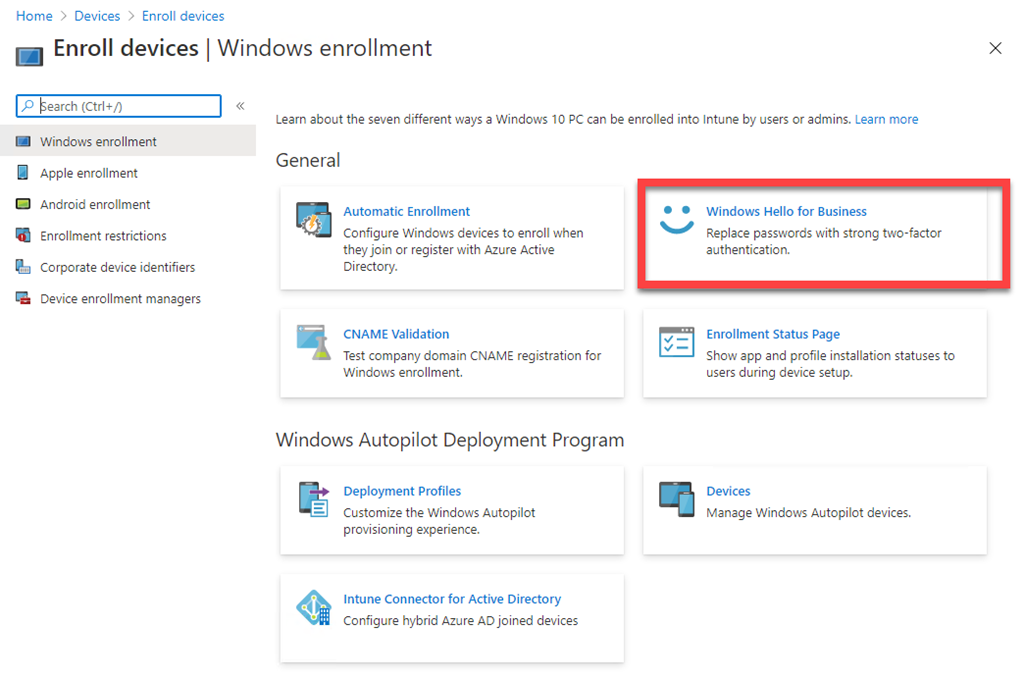
5. Upload Corporate Device Identifiers: With personal devices blocked, you must tell Intune which devices are corporate. Since we are not pre-registering the full Autopilot hardware hash, Intune can rely on manufacturer, model, and serial number to recognize a device as corporate-owned during Autopilot v2 enrollment. To upload these identifiers:

  • Gather device info: For each new device, obtain the serial number, plus the manufacturer and model strings. You can get this from order information or by running a command on the device (e.g., on an example device, run wmic csproduct get vendor,name,identifyingnumber to output vendor (manufacturer), name (model), and identifying number (serial)[4]). Many OEMs provide this info in packing lists or you can scan a barcode from the box.
  • Prepare CSV: Create a CSV file with columns for Manufacturer, Model, Serial Number. List each device’s information on a separate line[4]. For example:\ Dell Inc.,Latitude 7440,ABCDEFG1234\ Microsoft Corporation,Surface Pro 9,1234567890\ (Use the exact strings as reported by the device/OEM to avoid mismatches.)
  • Upload in Intune: In the Intune admin center, go to Devices > Enrollment > Corporate device identifiers. Choose Add then Upload CSV. Select the format “Manufacturer, model, and serial number (Windows only)”[4] and upload your CSV file. Once processed, Intune will list those identifiers as corporate.

With this in place, when a user signs in on a device, Intune checks the device’s hardware info. If it matches one of these entries, it’s flagged as corporate-owned and allowed to enroll despite the personal device block[4][4]. If it’s not in the list, the enrollment will be blocked (the user will get a message that enrolling personal devices is not allowed). Important: Until you have corporate identifiers set up, do not enable the personal device block, or Autopilot device preparation will fail for new devices[6][6]. Always upload the identifiers first or simultaneously.

At this stage, you have completed the Intune configuration for Autopilot v2. You have:

  • A user group allowed to use Autopilot.
  • A device preparation profile linking that user group to a device group, with chosen settings and apps.
  • Required apps assigned to deploy.
  • Optional restrictions in place to ensure only known devices will enroll.

4.3 Enrollment and Device Setup Process (Using Autopilot v2)

With the above configuration done, the actual device enrollment process is straightforward for the end-user. Here’s what to expect when adding a new device to your Microsoft 365 environment via Autopilot v2:

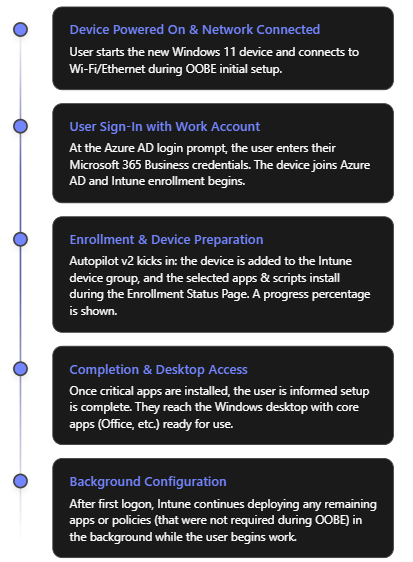
  1. Out-of-Box Experience (Initial Screens): When the device is turned on for the first time (or after a factory reset), the Windows OOBE begins. The user will select their region and keyboard (unless the profile pre-configured these). The device will prompt for a network connection. The user should connect to the internet (Ethernet or Wi-Fi). Once connected, the device might check for updates briefly, then reach the “Sign in” screen.
  2. User Sign-In (Azure AD): The user enters their work or school (Microsoft Entra ID/Azure AD) credentials – i.e., their Microsoft 365 Business account email and password. This is the trigger for Autopilot Device Preparation. Upon signing in, the device joins your organization’s Azure AD. Because the user is in the “Autopilot Users” group and an Autopilot Device Preparation profile is active, Intune will now kick off the device preparation process in the background.
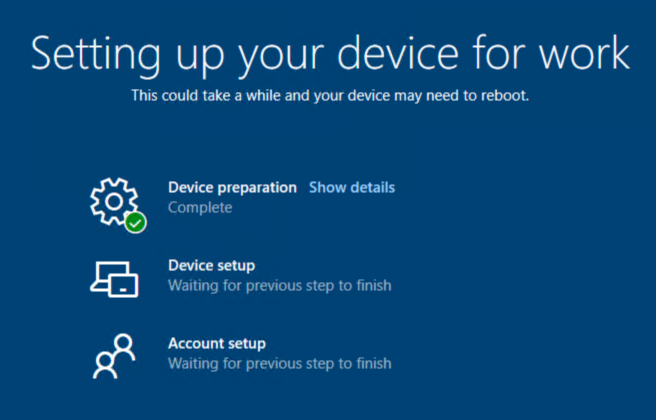
  3. Device Preparation Phase (ESP): After credentials are verified, the user sees the Enrollment Status Page (ESP) which now reflects “Device preparation” steps. In Autopilot v2, the ESP will show the progress of the configuration. A key difference in v2 is the presence of a percentage progress indicator that gives a clearer idea of progress[6]. Behind the scenes, several things happen:
    • The device is automatically added to the specified Device group (“Autopilot Device Preparation – Devices”) in Azure AD[5]. The “Intune Provisioning Agent” does this within seconds of the user signing in.
    • Intune immediately starts deploying the selected applications and PowerShell scripts to the device (those that were marked for installation during OOBE). The ESP screen will typically list the device setup steps, which may include device configuration, app installation, etc. The apps you marked as required (Company Portal, Office, etc.) will download and install one by one. Their status can often be viewed on the screen (e.g., “Installing Office 365… 50%”).
    • Any device configuration policies assigned to the device group (e.g., configuration profiles or compliance policies you set to target that group) will also begin to apply. Note: Autopilot v2 does not pause for all policies to complete; it mainly ensures the selected apps and scripts complete. Policies will apply in parallel or afterwards without blocking the ESP[3].
    • If you enabled BitLocker or other encryption policies, those might kick off during this phase as well (depending on your Intune configuration for encryption on Azure AD join).
    • The user remains at the ESP screen until the critical steps finish. With the 10-app limit and no dynamic group delay, this phase should complete relatively quickly (typically a few minutes to perhaps an hour for large Office downloads on slower connections). The progress bar will reach 100%.
  4. Completion and First Desktop Launch: Once the selected apps and scripts have finished deploying, Autopilot signals that device setup is complete. The ESP will indicate it’s done, and the user will be allowed to proceed to log on to Windows (or it may automatically log them in if credentials were cached from step 2). In Autopilot v2, a final screen can notify the user that critical setup is finished and they can start using the device[6]. The user then arrives at the Windows desktop.
  5. Post-Enrolment (Background tasks): Now the device is fully Azure AD joined and enrolled in Intune as a managed device. Any remaining apps or policies that were not part of the initial device preparation will continue to install in the background. For example, if you targeted some less critical user-specific apps (say, OneDrive client or Webex) via user groups, those will download via Intune management without interrupting the user. The user can begin working, and they’ll likely see additional apps appearing or software finishing installations within the first hour of use.
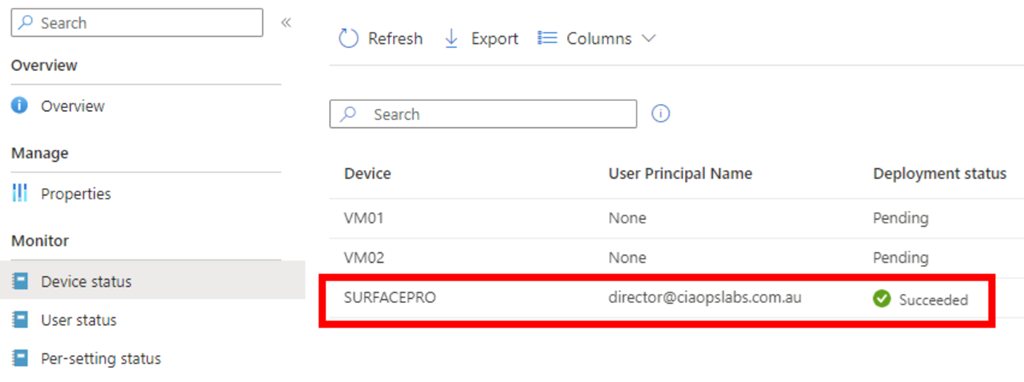
  6. Verification: The IT admin can verify the device in the Intune portal. It should appear under Devices with the user assigned, and compliance/policies applying. The Autopilot deployment report in Intune will show this device’s status as successful if all selected apps/scripts succeeded, or flagged if any failures occurred[5]. The user should see applications like Office, Teams, Outlook, and the Company Portal already installed on the Start Menu[4]. If all looks good, the device is effectively ready and managed.

4.4 Troubleshooting Common Issues in Autopilot v2

While Autopilot v2 is designed to be simpler and more reliable, you may encounter some issues during setup. Here are common issues and how to address them:

  • Device is blocked as “personal” during enrollment: If you enabled the enrollment restriction to block personal devices, a new device might fail to enroll at user sign-in with a message that personal devices are not allowed. This typically means Intune did not recognize the device as corporate. Ensure you have uploaded the correct device serial, model, and manufacturer under corporate identifiers before the user attempts enrollment[4]. Typos or mismatches (e.g., “HP Inc.” vs “Hewlett-Packard”) can cause the check to fail. If an expected corporate device was blocked, double-check its identifier in Intune and re-upload if needed, then have the user try again (after a reset). If you cannot get the identifiers loaded in time, you may temporarily toggle the restriction to allow personal Windows enrollments to let the device through, then re-enable once fixed.
  • Autopilot profile not applying (device does standard Azure AD join without ESP): This can happen if the user is not in the group assigned to the Autopilot Device Prep profile, or if the device was already registered with a classic Autopilot profile. To troubleshoot:
    • Verify that the user who is signing in is indeed a member of the Autopilot Users group that you targeted. If not, add them and try again.
    • Check Intune’s Autopilot devices list. If the device’s hardware hash was previously imported and has an old deployment profile assigned, the device might be using Autopilot v1 behavior (which could skip the ESP or conflict). Solution: Remove the device from the Autopilot devices list (deregister it) so that v2 can proceed[5].
    • Also ensure the device meets OS requirements. If someone somehow tried with an out-of-date Windows 10, the new profile wouldn’t apply.
  • One of the apps failed to install during OOBE: If an app (or script) that was selected in the profile fails, the Autopilot ESP might show an error or might eventually time out. Autopilot v2 doesn’t explicitly block on policies, but it does expect the chosen apps to install. If an app installation fails (perhaps due to an MSI error or content download issue), the user may eventually be allowed to log in, but Intune’s deployment report will mark the deployment as failed for that device[5]. Use the Autopilot deployment report in Intune to see which app or step failed[5]. Then:
    • Check the Intune app assignment for that app. For instance, was the app installer file reachable and valid? Did it have correct detection rules? Remedy any packaging error.
    • If the issue was network (e.g., large app timed out), consider not deploying that app during OOBE (remove it from the profile’s selected apps so it installs later instead).
    • The user can still proceed to work after skipping the failed step (in many cases), but you’ll want to push the necessary app afterward or instruct the user to install via Company Portal if possible.
  • User sees unexpected OOBE screens (e.g., personal vs organization choice): As noted, Autopilot v2 can show some default Windows setup prompts that classic Autopilot hid. For example, early in OOBE the user might be asked “Is this a personal or work device?” If they see this, they should select Work/School (which leads to the Azure AD sign-in). Similarly, the user might have to accept the Windows 11 license agreement. To avoid confusion, prepare users with guidance that they may see a couple of extra screens and how to proceed. Once the user signs in, the rest will be automated. In future, after the device prep profile applies, those screens might not appear on subsequent resets, but on first run they can. This is expected behavior, not a failure.
  • Autopilot deployment hangs or takes too long: If the process seems stuck on the ESP for an inordinate time:
    • Check if it’s downloading a large update or app. Sometimes Windows might be applying a critical update in the background. If internet is slow, Office download (which can be ~2GB) might simply be taking time. If possible, ensure a faster connection or use Ethernet for initial setup.
    • If it’s truly hung (no progress increase for a long period), you may need to power cycle. The good news is Autopilot v2 is resilient – it has more retry logic for applying the profile[8]. On reboot, it often picks up where it left off, or attempts the step again. Frequent hanging might indicate a problematic step (again, refer to Intune’s report).
    • Ensure the device’s time and region were set correctly; incorrect time can cause Azure AD token issues. Autopilot v2 does try to sync time more reliably during ESP[8].
  • Post-enrollment policy issues: Because Autopilot v2 doesn’t wait for all policies, you might notice things like BitLocker taking place only after login, or certain configurations applying slightly later. This is normal. However, if certain device configurations never apply, verify that those policies are targeted correctly (likely to the device group). If they were user-targeted, they should apply after the user logs in. If something isn’t applying at all, treat it as a standard Intune troubleshooting case (e.g., check for scope tags, licensing, or conflicts).

Overall, many issues can be avoided by testing Autopilot v2 on a pilot device before mass rollout. Run through the deployment yourself with a test user and device to catch any application installation failures or unexpected prompts, and adjust your profile or process accordingly.

5. Best Practices for Maintaining and Managing Autopilot v2 Devices

After deploying devices with Windows Autopilot Device Preparation, your work isn’t done – you’ll want to manage and maintain those devices for the long term. Here are some best practices to ensure ongoing success:

  • Establish Clear Autopilot Processes: Because Autopilot v2 and v1 may coexist (for different use cases), document your process. For example, decide: will all new devices use Autopilot v2 going forward, or only certain ones? Communicate to your procurement and IT teams that new devices should not be registered via the old process. If you buy through an OEM with Autopilot registration service, pause that for devices you’ll enroll via v2 to avoid conflicts.
  • Keep Windows and Intune Updated: Autopilot v2 capabilities may expand with new Windows releases and Intune updates. Ensure devices get Windows quality updates regularly (this keeps the Autopilot agent up-to-date and compatible). Watch Microsoft Intune release notes for any Autopilot-related improvements or changes. For instance, if/when Microsoft enables features like self-deploying or hybrid join in Autopilot v2, it will likely come via an update[6] – staying current allows you to take advantage.
  • Limit and Optimize Apps in the Profile: Be strategic about the apps you include during the autopilot phase. The 10-app limit forces some discipline – include only truly essential software that users need immediately or that is required for security/compliance. Everything else can install later via normal Intune assignment or be made available in Company Portal. This ensures the provisioning is quick and has fewer chances to fail. Also prefer Win32 packaged apps for reliability and to avoid Windows Store dependencies during OOBE[2]. In general, simpler is better for the OOBE phase.
  • Use Device Categories/Tags if Needed: Intune supports tagging devices during enrollment (in classic Autopilot, there was “Convert all targeted devices to Autopilot” and grouping by order ID). In Autopilot v2, since devices aren’t pre-registered, you might use dynamic groups or naming conventions post-enrollment to organize devices (e.g., by department or location). Consider leveraging Azure AD group rules or Intune filters if you need to deploy different apps to different sets of devices after enrollment.
  • Monitor Deployment Reports and Logs: Take advantage of the new Autopilot deployment report in Intune for each rollout[5]. After onboarding a batch of new devices, review the report to see if any had issues (e.g., maybe one device’s Office install failed due to a network glitch). Address any failures proactively (rerun a script, push a missed app, etc.). Additionally, know that users or IT can export Autopilot logs easily from the device if needed[5] (there’s a troubleshooting option during the OOBE or via pressing certain key combos). Collecting logs can help Microsoft support or your IT team diagnose deeper issues.
  • Maintain Corporate Identifier Lists: If you’re using the corporate device identifiers method, keep your Azure AD device inventory synchronized with Intune’s list. For every new device coming in, add its identifiers. For devices being retired or sold, you might remove their identifiers. Also, coordinate this with the enrollment restriction – e.g., if a top executive wants to enroll their personal device and you have blocking enabled, you’d need to explicitly allow or bypass that (possibly by not applying the restriction to that user or by adding the device as corporate through some means). Regularly update the CSV as you purchase hardware to avoid last-minute scrambling when a user is setting up a new PC.
  • Plan for Feature Gaps: Recognize the current limitations of Autopilot v2 and plan accordingly:
    • If you require Hybrid AD Join (joining on-prem AD) for certain devices, those devices should continue using the classic Autopilot (with hardware hash and Intune Connector) for now, since v2 can’t do it[3].
    • If you utilize Autopilot Pre-Provisioning (White Glove) via IT staff or partner to pre-setup devices before handing to users (common for larger orgs or complex setups), note that Autopilot v2 doesn’t support that yet[3]. You might use Autopilot v1 for those scenarios until Microsoft adds it to v2.
    • Self-Deploying Mode (for kiosks or shared devices that enroll without user credentials) is also not in v2 presently[3]. Continue using classic Autopilot with TPM attestation for kiosk devices as needed. It’s perfectly fine to run both Autopilot methods side-by-side; just carefully target which devices or user groups use which method. Microsoft is likely to close these gaps in future updates, so keep an eye on announcements.
  • End-User Training and Communication: Even though Autopilot is automated, let your end-users know what to expect. Provide a one-page instruction with their new laptop: e.g., “1) Connect to Wi-Fi, 2) Log in with your work account, 3) Wait while we set up your device (about 15-30 minutes), 4) You’ll see a screen telling you when it’s ready.” Setting expectations helps reduce support tickets. Also inform them that the device will be managed by the company (which is standard, but transparency helps trust).
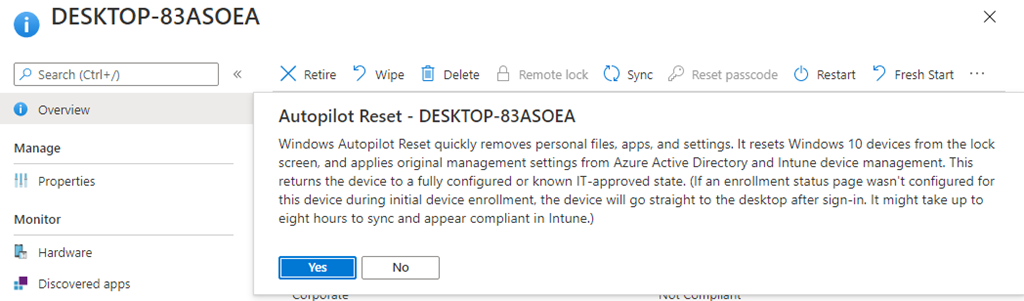
  • Device Management Post-Deployment: After Autopilot enrollment, manage the devices like any Intune-managed endpoints. Set up compliance policies (for OS version, AV status, etc.), Windows Update rings or feature update policies to keep them up-to-date, and use Intune’s Endpoint analytics or Windows Update for Business reports to track device health. Autopilot has done the job of onboarding; from then on, treat the devices as part of your standard device management lifecycle. For instance, if a device is reassigned to a new user, you can invoke Autopilot Reset via Intune to wipe user data and redo the OOBE for the new user—Autopilot v2 will once again apply (just ensure the new user is in the correct group).
  • Continuous Improvement: Gather feedback from users about the Autopilot process. If many report that a certain app wasn’t ready or some setting was missing on first login, adjust your Autopilot profile or Intune assignments. Autopilot v2’s flexibility allows you to tweak which apps/scripts are in the initial provision vs. post-login. Aim to find the right balance where devices are secure and usable as soon as possible, without overloading the provisioning. Also consider pilot testing Windows 11 feature updates early, since Autopilot behavior can change or improve with new releases (for example, a future Windows 11 update might reduce the appearance of some initial screens in Autopilot v2, etc.).

By following these best practices, you’ll ensure that your organization continues to benefit from Autopilot v2’s efficiencies long after the initial setup. The result is a modern device deployment strategy with minimal hassle, aligned to the cloud-first, zero-touch ethos of Microsoft 365.


Conclusion: Microsoft Autopilot v2 (Windows Autopilot Device Preparation) represents a significant step forward in simplifying device onboarding. By leveraging it in your Microsoft 365 Business environment, you can add new Windows 11 devices with ease – end-users take them out of the box, log in, and within minutes have a fully configured, policy-compliant workstation. The latest updates bring more reliability, insight, and speed to this process, making life easier for IT admins and employees alike. By understanding the new features, following the implementation steps, and adhering to best practices outlined in this guide, you can successfully deploy Autopilot v2 and streamline your device deployment workflow[4][5]. Happy deploying!

References

[1] Overview of Windows Autopilot | Microsoft Learn

[2] Windows Autopilot Best Practices: 2025 Updated

[3] Intune Autopilot V1 vs Intune Autopilot V2- What is changing?

[4] How to Set Up Autopilot Device Preparation in Microsoft Intune

[5] Overview of Windows Autopilot device preparation

[6] Announcing new Windows Autopilot onboarding experience for government …

[7] What’s new in Microsoft Intune: January 2025

[8] What’s new in Windows Autopilot | Microsoft Learn

Troubleshooting Microsoft Defender for Business: Step-by-Step Guide

Microsoft Defender for Business is a security solution designed for small and medium businesses to protect against cyber threats. When issues arise, a systematic troubleshooting approach helps identify root causes and resolve problems efficiently. This guide provides a step-by-step process to troubleshoot common Defender for Business issues, highlights where to find relevant logs and alerts, and suggests advanced techniques for complex situations. All steps are factual and based on Microsoft’s latest guidance as of 2025.

Table of Contents

  • common-issues-and-symptoms
  • key-locations-for-logs-and-alerts
  • step-by-step-troubleshooting-process
    1. identify-the-issue-and-gather-information
    2. check-the-microsoft-365-defender-portal-for-alerts
    3. verify-device-status-and-protection-settings
    4. examine-device-logs-event-viewer
    5. resolve-configuration-or-policy-issues
    6. verify-issue-resolution
    7. escalate-to-advanced-troubleshooting-if-needed
  • advanced-troubleshooting-techniques
  • best-practices-to-prevent-future-issues
  • additional-resources-and-support

Common Issues and Symptoms

These are some typical problems administrators encounter with Defender for Business:

  • Setup and Onboarding Failures: The initial setup or device onboarding process fails. An error like “Something went wrong, and we couldn’t complete your setup” may appear, indicating a configuration channel or integration issue (often with Intune)[1]. Devices that should be onboarded don’t show up in the portal.
  • Devices Showing As Unprotected: In the Microsoft Defender portal, you might see notifications that certain devices are not protected even though they were onboarded[1]. This often happens when real-time protection is turned off (for instance, if a non-Microsoft antivirus is running, it may disable Microsoft Defender’s real-time protection).
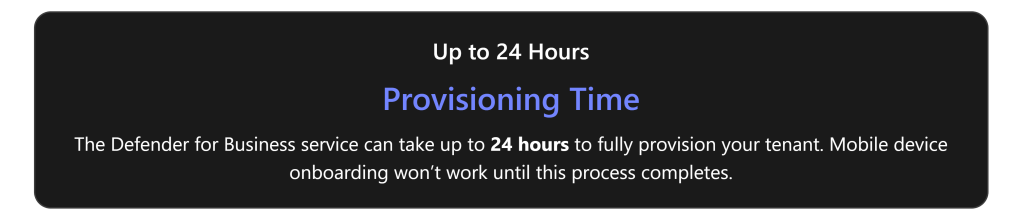
  • Mobile Device Onboarding Issues: Users cannot onboard their iOS or Android devices using the Microsoft Defender app. A symptom is that mobile enrollment doesn’t complete, possibly due to provisioning not finished on the backend[1]. For example, if the portal shows a message “Hang on! We’re preparing new spaces for your data…”, it means the Defender for Business service is still provisioning mobile support (which can take up to 24 hours) and devices cannot be added until provisioning is complete[1].
  • Defender App Errors on Mobile: The Microsoft Defender app on mobile devices may crash or show errors. Users report issues like app not updating threats or not connecting. (Microsoft provides separate troubleshooting guides for the mobile Defender for Endpoint app on Android/iOS in such cases[1].)
  • Policy Conflicts: If you have multiple security management tools, you might see conflicting policies. For instance, an admin who was managing devices via Intune and then enabled Defender for Business’s simplified configuration could encounter conflicts where settings in Intune and Defender for Business overlap or contradict[1]. This can result in devices flipping between policy states or compliance errors.
  • Intune Integration Errors: During the setup process, an error indicating an integration issue between Defender for Business and Microsoft Intune might occur[1]. This often requires enabling certain settings (detailed in Step 5 below) to establish a proper configuration channel.
  • Onboarding or Reporting Delays: A device appears to onboard successfully but doesn’t show up in the portal or is missing from the device list even after some time. This could indicate a communication issue where the device is not reporting in. It might be caused by connectivity problems or by an issue with the Microsoft Defender for Endpoint service (sensor) on the device.
  • Performance or Scan Issues: (Less common with Defender for Business, but possible) – Devices might experience high CPU or scans get stuck, which could indicate an issue with Defender Antivirus on the endpoint that needs further diagnosis (this overlaps with Defender for Endpoint troubleshooting).

Understanding which of these scenarios matches your situation will guide where to look first. Next, we’ll cover where to find the logs and alerts that contain clues for diagnosis.


Key Locations for Logs and Alerts

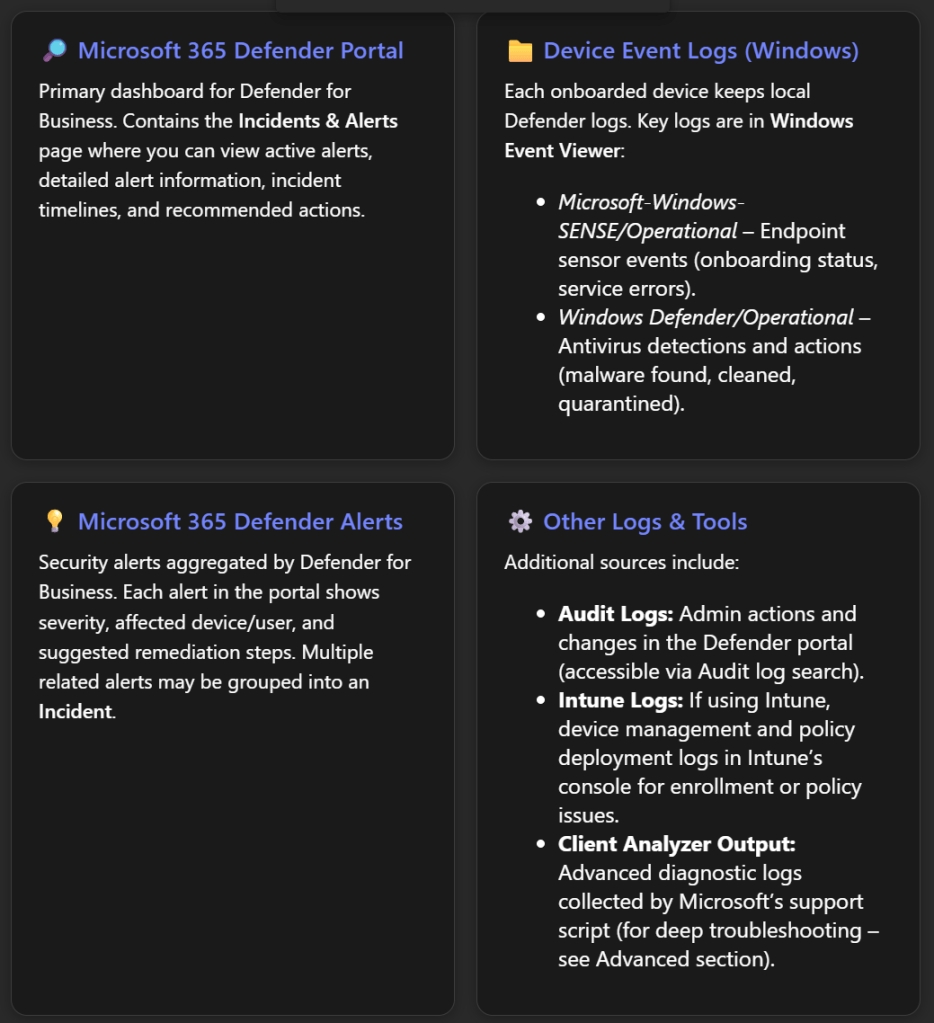
Effective troubleshooting relies on checking both cloud portal alerts and on-device logs. Microsoft Defender for Business provides information in multiple places:

Microsoft 365 Defender Portal (security.microsoft.com): This is the cloud portal where Defender for Business is managed. The Incidents & alerts section is especially important. Here you can monitor all security incidents and alerts in one place[2]. For each alert, you can click to see details in a flyout pane – including the alert title, severity, affected assets (devices or users), and timestamps[2]. The portal often provides recommended actions or one-click remediation for certain alerts[2]. It’s the first place to check if you suspect Defender is detecting threats or if something triggered an alert that correlates with the issue.

Device Logs via Windows Event Viewer: On each Windows device protected by Defender for Business, Windows keeps local event logs for Defender components. Access these by opening Event Viewer (Start > eventvwr.msc). Key logs include:

  • Microsoft-Windows-SENSE/Operational – This log records events from the Defender for Endpoint sensor (“SENSE” is the internal code name for the sensor)[3]. If a device isn’t showing up in the portal or has onboarding issues, this log is crucial. It contains events for service start/stop, onboarding success/failure, and connectivity to the cloud. For example, Event ID 6 means the service isn’t onboarded (no onboarding info found), which indicates the device failed to onboard and needs the onboarding script rerun[3]. Event ID 3 means the service failed to start entirely[3], and Event ID 5 means it couldn’t connect to the cloud (network issue)[3]. We will discuss how to interpret and act on these later.
  • Windows Defender/Operational – This is the standard Windows Defender Antivirus log under Applications and Services Logs > Microsoft > Windows > Windows Defender > Operational. It logs malware detections and actions taken on the device[4]. For troubleshooting, this log is helpful if you suspect Defender’s real-time protection or scans are causing an issue or to confirm if a threat was detected on a device. You might see events like “Malware detected” (Event ID 1116) or “Malware action taken” (Event ID 1117) which correspond to threats found and actions (like quarantine) taken[4]. This can explain, for instance, if a file was blocked and that’s impacting a user’s work.
  • Other system logs: Standard Windows logs (System, Application) might also record errors (for example, if a service fails or crashes, or if there are network connectivity issues that could affect Defender).

Alerts in Microsoft 365 Defender: Defender for Business surfaces alerts in the portal for various issues, not only malware. For example, if real-time protection is turned off on a device, the portal will flag that device as not fully protected[1]. If a device hasn’t reported in for a long time, it might show in the device inventory with a stale last-seen timestamp. Additionally, if an advanced attack is detected, multiple alerts will be correlated as an incident; an incident might be tagged with “Attack disruption” if Defender automatically contained devices to stop the spread[2] – such context can validate if an ongoing security issue is causing what you’re observing.

Intune or Endpoint Manager (if applicable): Since Defender for Business can integrate with Intune (Endpoint Manager) for device management and policy deployment, some issues (especially around onboarding and policy conflicts) may require checking Intune logs:

  • In Intune admin center, review the device’s Enrollment status and Device configuration profiles (for instance, if a security profile failed to apply, it could cause Defender settings to not take effect).
  • Intune’s Troubleshooting + support blade for a device can show error codes if a policy (like onboarding profile) failed.
  • If there’s a known integration issue (like the one mentioned earlier), ensure the Intune connection and settings are enabled as described in the next sections.

Advanced Hunting and Audit (for advanced users): If you have access to Microsoft 365 Defender’s advanced hunting (which might require an upgraded license beyond Defender for Business’s standard features), you could query logs (e.g., DeviceEvents, AlertEvents) for deeper investigation. Also, the Audit Logs in the Defender portal record configuration changes (useful to see if someone changed a policy right before issues started).

Now, with an understanding of where to get information, let’s proceed with a systematic troubleshooting process.


Step-by-Step Troubleshooting Process

The following steps outline a logical process to troubleshoot issues in Microsoft Defender for Business. Adjust the steps as needed based on the specific symptoms you are encountering.

Step 1: Identify the Issue and Gather Information

Before jumping into configuration changes, clearly define the problem. Understanding the nature of the issue will focus your investigation:

  • What are the symptoms? For example, “Device X is not appearing in the Defender portal”, “Users are getting no protection on their phones”, or “We see an alert that one device isn’t protected”, etc.
  • When did it start? Did it coincide with any changes (onboarding new devices, changing policies, installing another antivirus, etc.)?
  • Who or what is affected? A single device, multiple devices, all mobile devices, a specific user?
  • Any error messages? Note any message in the portal or on the device. For instance, an error code during setup, or the portal banner saying “some devices aren’t protected”[1]. These messages often hint at the cause.

Gathering this context will guide you on where to look first. For example, an issue with one device might mean checking that device’s status and logs, whereas a widespread issue might suggest a configuration problem affecting many devices.

Step 2: Check the Microsoft 365 Defender Portal for Alerts

Log in to the Microsoft 365 Defender portal (https://security.microsoft.com) with appropriate admin credentials. This centralized portal often surfaces the problem:

  1. Go to Incidents & alerts: In the left navigation pane, click “Incidents & alerts”, then select “Alerts” (or “Incidents” for grouped alerts)[2]. Look for any recent alerts that correspond to your issue. For example, if a device isn’t protected or hasn’t reported, there may be an alert about that device.
  2. Review alert details: If you see relevant alerts, click on one to open the details flyout. Check the alert title and description – these describe what triggered it (e.g. “Real-time protection disabled on Device123” or “Malware detected and quarantined”). Note the severity (Informational, Low, Medium, High) and the affected device or user[2]. The portal will list the device name and perhaps the user associated with it.
  3. Take recommended actions: The alert flyout often includes recommended actions or a direct link to “Open incident page” or “Take action”. For instance, for a malware alert, it may suggest running a scan or isolating the device. For a configuration alert (like real-time protection off), it might recommend turning it back on. Make note of these suggestions as they directly address the issue described[2].
  4. Check the device inventory: Still in the Defender portal, navigate to Devices (under Assets). Find the device in question. The device page can show its onboarding status, last seen time, OS, and any outstanding issues. If the device is missing entirely, that confirms an onboarding problem – skip to Step 4 to troubleshoot that.
  5. **Inspect *Incidents***: If multiple alerts have been triggered around the same time or on the same device, the portal might have grouped them into an *Incident* (visible under the Incidents tab). Open the incident to see a timeline of what happened. This can give a broader context especially if a security threat is involved (e.g. an incident might show that a malware was detected and then real-time protection was turned off – indicating the malware might have attempted to disable Defender).

Example: Suppose the portal shows an alert “Real-time protection was turned off on DeviceXYZ”. This is a clear indicator – the device is onboarded but not actively protecting in real-time[1]. The recommended action would likely be to turn real-time protection back on. Alternatively, if an alert says “New malware found on DeviceXYZ”, you’d know the issue is a threat detection, and the portal might guide you to remediate or confirm that malware was handled. In both cases, you’ve gathered an essential clue before even touching the device.

If you do not see any alert or indicator in the portal related to your problem, the issue might not be something Defender is reporting on (for example, if the problem is an onboarding failure, there may not be an alert – the device just isn’t present at all). In such cases, proceed to the next steps.

Step 3: Verify Device Status and Protection Settings

Next, ensure that the devices in question are configured correctly and not in a state that would cause issues:

  1. Confirm onboarding completion: If a device doesn’t appear in the portal’s device list, ensure that the onboarding process was done on that device. Re-run the onboarding script or package on the device if needed. (Defender for Business devices are typically onboarded via the local script, Intune, Group Policy, etc. If this step wasn’t done or failed, the device won’t show up in the portal.)
  2. Check provisioning status for mobile: If the issue is with mobile devices (Android/iOS) not onboarding, verify that Defender for Business provisioning is complete. As mentioned, the portal (under Devices) might show a message “preparing new spaces for your data” if the service setup is still ongoing[1]. Provisioning can take up to 24 hours for a new tenant. If you see that message, the best course is to wait until it disappears (i.e., until provisioning finishes) before troubleshooting further. Once provisioning is done, the portal will prompt to onboard devices, and then users should be able to add their mobile devices normally[1].
  1. Verify real-time protection setting: On any Windows device showing “not protected” in the portal, log onto that device and open Windows Security > Virus & threat protection. Check if Real-time protection is on. If it’s off and cannot be turned on, check if another antivirus is installed. By design, onboarding a device running a third-party AV can cause Defender’s real-time protection to be automatically disabled to avoid conflict[1]. In Defender for Business, Microsoft expects Defender Antivirus to be active alongside the service for best protection (“better together” scenario)[1]. If a third-party AV is present, decide if you will remove it or live with Defender in passive mode (which reduces protection and triggers those alerts). Ideally, ensure Microsoft Defender Antivirus is enabled.
  2. Policy configuration review: If you suspect a policy conflict or misconfiguration, review the policies applied:
    • In the Microsoft 365 Defender portal, go to Endpoints > Settings > Rules & policies (or in Intune’s Endpoint security if that’s used). Ensure that you haven’t defined contradictory policies in multiple places. For example, if Intune had a policy disabling something but Defender for Business’s simplified setup has another setting, prefer one system. In a known scenario, an admin had Intune policies and then used the simplified Defender for Business policies concurrently, leading to conflicts[1]. The resolution was to delete or turn off the redundant policies in Intune and let Defender for Business policies take precedence (or vice versa) to eliminate conflicts[1].
    • Also verify tamper protection status – by default, tamper protection is on (preventing unauthorized changes to Defender settings). If someone turned it off for troubleshooting and forgot to re-enable, settings could be changed without notice.
  3. Intune onboarding profile (if applicable): If devices were onboarded via Intune (which should be the case if you connected Defender for Business with Intune), check the Endpoint security > Microsoft Defender for Endpoint section in Intune. Ensure there’s an onboarding profile and that those devices show as onboarded. If a device is stuck in a pending state, you may need to re-enroll or manually onboard.

By verifying these settings, you either fix simple oversights (like turning real-time protection back on) or gather evidence of a deeper issue (for example, confirming a device is properly onboarded, yet still not visible, implying a reporting issue, or confirming there’s a policy conflict that needs resolution in the next step).

Step 4: Examine Device Logs (Event Viewer)

If the issue is not yet resolved by the above steps, or if you need more insight into why something is wrong, dive into the device’s event logs for Microsoft Defender. Perform these checks on an affected device (or a sample of affected devices if multiple):

  1. Open Event Viewer (Local logs): On the Windows device, press Win + R, type eventvwr.msc and hit Enter. Navigate to Applications and Services Logs > Microsoft > Windows and scroll through the sub-folders.
  2. Check “SENSE” Operational log: Locate Microsoft > Windows > SENSE > Operational and click it to open the Microsoft Defender for Endpoint service log[3]. Look for recent Error or Warning events in the list:
    • Event ID 3: “Microsoft Defender for Endpoint service failed to start.” This means the sensor service didn’t fully start on boot[3]. Check if the Sense service is running (in Services.msc). If not, an OS issue or missing prerequisites might be at fault.
    • Event ID 5: “Failed to connect to the server at \.” This indicates the endpoint could not reach the Defender cloud service URLs[3]. This can be a network or proxy issue – ensure the device has internet access and that security.microsoft.com and related endpoints are not blocked by firewall or proxy.
    • Event ID 6: “Service isn’t onboarded and no onboarding parameters were found.” This tells us the device never got the onboarding info – effectively it’s not onboarded in the service[3]. Possibly the onboarding script never ran successfully. Solution: rerun onboarding and ensure it completes (the event will change to ID 11 on success).
    • Event ID 7: “Service failed to read onboarding parameters”[3] – similar to ID 6, means something went wrong reading the config. Redeploy the onboarding package.
    • Other SENSE events might point to registry permission issues or feature missing (e.g., Event ID 15 could mean the SENSE service couldn’t start due to ELAM driver off or missing components – those cases are rare on modern systems, but the event description will usually suggest enabling a feature or a Windows update[5][5]).
    Each event has a description. Compare the event’s description against Microsoft’s documentation for Defender for Endpoint event IDs to get specific guidance[3][3]. Many event descriptions (like examples above) already hint at the resolution (e.g., check connectivity, redeploy scripts, etc.).
  3. Check “Windows Defender” Operational log: Next, open Microsoft > Windows > Windows Defender > Operational. Look for recent entries, especially around the time the issue occurred:
    • If the issue is related to threat detection or a failed update, you might see events in the 1000-2000 range (these correspond to malware detection events and update events).
    • For example, Event ID 1116 (MALWAREPROTECTION_STATE_MALWARE_DETECTED) means malware was detected, and ID 1117 means an action was taken on malware[4]. These confirm whether Defender actually caught something malicious, which might have triggered further issues.
    • You might also see events indicating if the user or admin turned settings off. Event ID 5001-5004 range often relates to settings changes (like if real-time protection was disabled, it might log an event).
    The Windows Defender log is more about security events than errors; if your problem is purely a configuration or onboarding issue, this log might not show anything unusual. But it’s useful to confirm if, say, Defender is working up to the point of detecting threats or if it’s completely silent (which could mean it’s not running at all on that device).
  4. Additional log locations: If troubleshooting a device connectivity or performance issue, also check the System log in Event Viewer for any relevant entries (e.g., Service Control Manager errors if the Defender service failed repeatedly). Also, the Security log might show Audit failures if, for example, Defender attempted an action.
  5. Analyze patterns: If multiple devices have issues, compare logs. Are they all failing to contact the service (Event ID 5)? That could point to a common network issue. Are they all showing not onboarded (ID 6/7)? Maybe the onboarding instruction wasn’t applied to that group of devices or a script was misconfigured.

By scrutinizing Event Viewer, you gather concrete evidence of what’s happening at the device level. For instance, you might confirm “Device A isn’t in the portal because it has been failing to reach the Defender service due to proxy errors – as Event ID 5 shows.” Or “Device B had an event indicating onboarding never completed (Event 6), explaining why it’s missing from portal – need to re-onboard.” This will directly inform the fix.

Step 5: Resolve Configuration or Policy Issues

Armed with the information from the portal (Step 2), settings review (Step 3), and device logs (Step 4), you can now take targeted actions to fix the issue.

Depending on what you found, apply the relevant resolution below:

  • If Real-Time Protection Was Off: Re-enable it. In the Defender portal, ensure that your Next-generation protection policy has Real-time protection set to On. If a third-party antivirus is present and you want Defender active, consider uninstalling the third-party AV or check if it’s possible to run them side by side. Microsoft recommends using Defender AV alongside Defender for Business for optimal protection[1]. Once real-time protection is on, the portal should update and the “not protected” alert will clear.
  • If Devices Weren’t Onboarded Successfully: Re-initiate the onboarding:
    • For devices managed by Intune, you can trigger a re-enrollment or use the onboarding package again via a script/live response.
    • If using local scripts, run the onboarding script as Administrator on the PC. After running, check Event Viewer again for Event ID 11 (“Onboarding completed”)[3].
    • For any devices still not appearing, consider running the Microsoft Defender for Endpoint Client Analyzer on those machines – it’s a diagnostic tool that can identify issues (discussed in Advanced section).
  • If Event Logs Show Connectivity Errors (ID 5, 15): Ensure the device has internet access to Defender endpoints. Make sure no firewall is blocking:
    • URLs like *.security.microsoft.com, *windows.com related to Defender cloud. Proxy settings might need to allow the Defender service through. See Microsoft’s documentation on Defender for Endpoint network connections for required URLs.
    • After adjusting network settings, force the device to check in (you can reboot the device or restart the Sense service and watch Event Viewer to see if it connects successfully).
  • If Policy Conflicts are Detected: Decide on one policy source:
    • Option 1: Use Defender for Business’s simplified configuration exclusively. This means removing or disabling parallel Intune endpoint security policies that configure AV or Firewall or Device Security, to avoid overlap[1].
    • Option 2: Use Intune (Endpoint Manager) for all device security policies and avoid using the simplified settings in Defender for Business. In this case, go to the Defender portal settings and turn off the features you are managing elsewhere.
    • In practice, if you saw conflicts, a quick remedy is to delete duplicate policies. For example, if Intune had an Antivirus policy and Defender for Business also has one, pick one to keep. Microsoft’s guidance for a situation where an admin uses both was to delete existing Intune policies to resolve conflicts[1].
    • After aligning policies, give it some time for devices to update their policy and then check if the conflict alerts disappear.
  • If Integration with Intune Failed (Setup Error): Follow Microsoft’s recommended fix which involves three steps[1][1]:
    1. In the Defender for Business portal, go to Settings > Endpoints > Advanced Features and ensure Microsoft Intune connection is toggled On[1].
    2. Still under Settings > Endpoints, find Configuration management > Enforcement scope. Make sure Windows devices are selected to be managed by Defender for Endpoint (Defender for Business)[1]. This allows Defender to actually enforce policies on Windows clients.
    3. In the Intune (Microsoft Endpoint Manager) portal, navigate to Endpoint security > Microsoft Defender for Endpoint. Enable the setting “Allow Microsoft Defender for Endpoint to enforce Endpoint Security Configurations” (set to On)[1]. This allows Intune to hand off certain security configuration enforcement to Defender for Business’s authority. These steps establish the necessary channels so that Defender for Business and Intune work in harmony. After doing this, retry the setup or onboarding that failed. The previous error message about the configuration channel should not recur.
  • If Onboarding Still Fails or Device Shows Errors: If after trying to onboard, the device still logs errors like Event 7 or 15 indicating issues, consider these:
    • Run the onboarding with local admin rights (ensure no permission issues).
    • Update the device’s Windows to latest patches (sometimes older Windows builds have known issues resolved in updates).
    • As a last resort, you can try an alternate onboarding method (e.g., if script fails, try via Group Policy or vice versa).
    • Microsoft also suggests if Security Management (the feature that allows Defender for Business to manage devices without full Intune enrollment) is causing trouble, you can temporarily manually onboard the device to the full Defender for Endpoint service using a local script as a workaround[1]. Then offboard and try again once conditions are corrected.
  • If a Threat Was Detected (Malware Incident): Ensure it’s fully remediated:
    • In the portal, check the Action Center (there is an Action center in Defender portal under “Actions & submissions”) to see if there are pending remediation actions (like undo quarantine, etc.).
    • Run a full scan on the device through the portal or locally.
    • Once threats are removed, verify if any residual impact remains (e.g., sometimes malware can turn off services – ensure the Windows Security app shows all green).

Perform the relevant fixes and monitor the outcome. Many changes (policy changes, enabling features) may take effect within minutes, but some might take an hour or more to propagate to all devices. You can speed up policy application by instructing devices to sync with Intune (if managed) or simply rebooting them.

Step 6: Verify Issue Resolution

After applying fixes, confirm that the issue is resolved:

  • Check the portal again: Go back to the Microsoft 365 Defender portal’s Incidents & alerts and Devices pages.
    • If there was an alert (e.g., device not protected), it should now clear or show as Resolved. Many alerts auto-resolve once the condition is fixed (for instance, turning real-time protection on will clear that alert after the next device check-in).
    • If you removed conflicts or fixed onboarding, any incident or alert about those should disappear. The device should now appear in the Devices list if it was missing, and its status should be healthy (no warnings).
    • If a malware incident was being shown, ensure it’s marked Remediated or Mitigated. You might need to mark it as resolved if it doesn’t automatically.
  • Confirm on the device: For device-specific issues, physically check the device:
    • Open Windows Security and verify no warning icons are present.
    • In Event Viewer, see if new events are positive. For example, Event ID 11 in SENSE log (“Onboarding completed”) confirms success[3]. Or Event ID 1122 in Windows Defender log might show a threat was removed.
    • If you restarted services or the system, ensure they stay running (the Sense service should be running and set to automatic).
  • Test functionality: Perform a quick test relevant to the issue:
    • If mobile devices couldn’t onboard, try onboarding one now that provisioning is fixed.
    • If real-time protection was off, intentionally place a test EICAR anti-malware file on the machine to see if Defender catches it (it should, if real-time protection is truly working).
    • If devices were not reporting, force a machine to check in (by running MpCmdRun -SignatureUpdate to also check connectivity).
    • These tests confirm that not only is the specific symptom gone, but the underlying protection is functioning as expected.

If everything looks good, congratulations – the immediate issue is resolved. Make sure to document what the cause was and how it was fixed, for future reference.

Step 7: Escalate to Advanced Troubleshooting if Needed

If the problem persists despite the above steps, or if logs are pointing to something unclear, it may require advanced troubleshooting:

  • Multiple attempts failed? For example, if a device still won’t onboard after trying everything, or an alert keeps returning with no obvious cause, then it’s time to dig deeper.
  • Use the Microsoft Defender Client Analyzer: Microsoft provides a Client Analyzer tool for Defender for Endpoint that collects extensive logs and configurations. In a Defender for Business context, you can run this tool via a Live Response session. Live Response is a feature that lets you run commands on a remote device from the Defender portal (available if the device is onboarded). You can upload the Client Analyzer scripts and execute them to gather a diagnostic package[6][6]. This package can highlight misconfigurations or environmental issues. For Windows, the script MDELiveAnalyzer.ps1 (and related modules like MDELiveAnalyzerAV.ps1 for AV-specific logs) will produce a zip file with results[6][6]. Review its findings for any errors (or provide it to Microsoft support).
  • Enable Troubleshooting Mode (if performance issue): If the issue is performance-related (e.g., you suspect Defender’s antivirus is causing an application to crash or high CPU), Microsoft Defender for Endpoint has a Troubleshooting mode that can temporarily relax certain protections for testing. This is more applicable to Defender for Endpoint P2, but if accessible, enabling troubleshooting mode on a device allows you to see if the problem still occurs without certain protections, thereby identifying if Defender was the culprit. Remember to turn it off afterwards.
  • Consult Microsoft Documentation: Sometimes a specific error or event ID might be documented in Microsoft’s knowledge base. For instance, Microsoft has a page listing Defender Antivirus event IDs and common error codes – check those if you have a particular code.
  • Community and Support Forums: It can be useful to see if others have hit the same issue. The Microsoft Tech Community forums or sites like Reddit (e.g., r/DefenderATP) might have threads. (For example, missing incidents/alerts were discussed on forums and might simply be a UI issue or permission issue in some cases.)
  • Open a Support Case: When all else fails, engage Microsoft Support. Defender for Business is a paid service; you can open a ticket through your Microsoft 365 admin portal. Provide them with:
    • A description of the issue and steps you’ve taken.
    • Logs (Event Viewer exports, the Client Analyzer output).
    • Tenant ID and device details, if requested. Microsoft’s support can analyze backend data and guide further. They may identify if it’s a known bug or something environment-specific.

Escalating ensures that more complex or rare issues (like a service bug, or a weird compatibility issue) are handled by those with deeper insight or patching ability.


Advanced Troubleshooting Techniques

For administrators comfortable with deeper analysis, here are a few advanced techniques and tools to troubleshoot Defender for Business issues:

Advanced Hunting: This is a query-based hunting tool available in Microsoft 365 Defender. If your tenant has it, you can run Kusto-style queries to search for events. For example, to find all devices that had real-time protection off, you could query the DeviceHealthStatus table for that signal. Or search DeviceTimeline for specific event IDs across machines. It’s powerful for finding hidden patterns (like if a certain update caused multiple devices to onboard late or if a specific error code appears on many machines).

Audit Logs: Especially useful if the issue might be due to an admin change. The audit log will show events like policy changes, onboarding package generated, settings toggled, who did it and when. It helps answer “did anything change right before this issue?” For instance, if an admin offboarded devices by mistake, the audit log would show that.

Integrations and Log Forwarding: Many enterprises use a SIEM for unified logging. While Defender for Business is a more streamlined product, its data can be integrated into solutions like Sentinel (with some licensing caveats)[7]. Even without Sentinel, you could use Windows Event Forwarding to send important Defender events to a central server. That way, you can spot if all devices are throwing error X in their logs. This is beyond immediate troubleshooting, but helps in ongoing monitoring and advanced analysis.

Deep Configuration Checks: Sometimes group policies or registry values can interfere. Ensure no Group Policy is disabling Windows Defender (check Turn off Windows Defender Antivirus policy). Verify that the device’s time and region settings are correct (an odd one, but significant time skew can cause cloud communication issues).

Use Troubleshooting Mode: Microsoft introduced a troubleshooting mode for Defender which, when enabled on a device, disables certain protections for a short window so you can, for example, install software that was being blocked or see if performance improves. After testing, it auto-resets. This is advanced and should be used carefully, but it’s another tool in the toolbox.

Using these advanced techniques can provide deeper insights or confirm whether the issue lies within Defender for Business or outside of it (for example, a network device blocking traffic). Always ensure that after advanced troubleshooting, you return the system to a fully secured state (re-enable anything you turned off, etc.).


Best Practices to Prevent Future Issues

Prevention and proper management can reduce the likelihood of Defender for Business issues:

  • Keep Defender Components Updated: Microsoft Defender AV updates its engine and intelligence regularly (multiple times a day for threat definitions). Ensure your devices are getting these updates automatically (they usually do via Windows Update or Microsoft Update service). Also, keep the OS patched so that the Defender for Endpoint agent (built into Windows 10/11) is up-to-date. New updates often fix known bugs or improve stability.
  • Use a Single Source for Policy: Avoid mixing multiple security management platforms for the same settings. If you’re using Defender for Business’s built-in policies, try not to also set those via Intune or Group Policy. Conversely, if you require the advanced control of Intune, consider using Microsoft Defender for Endpoint Plan 1 or 2 with Intune instead of Defender for Business’s simplified model. Consistency prevents conflicts.
  • Monitor the Portal Regularly: Make it a routine to check the Defender portal’s dashboard or set up email notifications for high-severity alerts. Early detection of an issue (like devices being marked unhealthy or a series of failed updates) can let you address it before it becomes a larger problem.
  • Educate Users on Defender Apps: If your users install the Defender app on mobile, ensure they know how to keep it updated and what it should do. Sometimes user confusion (like ignoring the onboarding prompt or not granting the app permissions) can look like a “technical issue”. Provide a simple guide for them if needed.
  • Test Changes in a Pilot: If you plan to change configurations (e.g., enable a new attack surface reduction rule, or integrate with a new management tool), test with a small set of devices/users first. Make sure those pilot devices don’t report new issues before rolling out more broadly.
  • Use “Better Together” Features: Microsoft often touts “better together” benefits – for example, using Defender Antivirus with Defender for Business for coordinated protection[1]. Embrace these recommendations. Features like Automatic Attack Disruption will contain devices during a detected attack[2], but only if all parts of the stack are active. Understand what features are available in your SKU and use them; missing out on a feature could mean missing a warning sign that something’s wrong.
  • Maintain Proper Licensing: Defender for Business is targeted for up to 300 users. If your org grows or needs more advanced features, consider upgrading to Microsoft Defender for Endpoint plans. This ensures you’re not hitting any platform limits and you get features like advanced hunting, threat analytics, etc., which can actually make troubleshooting easier by providing more data.
  • Document and Share Knowledge: Keep an internal wiki or document for your IT team about past issues and fixes. For example, note down “In Aug 2025, devices had conflict because both Intune and Defender portal policies were applied – resolved by turning off Intune policy X.” This way, if something similar recurs or a new team member encounters it, the solution is readily available.

By following best practices, you reduce misconfigurations and are quicker to catch problems, making the overall experience with Microsoft Defender for Business smoother and more reliable.


Additional Resources and Support

For further information and help on Microsoft Defender for Business:

  • Official Microsoft Learn Documentation: Microsoft’s docs are very useful. The page “Microsoft Defender for Business troubleshooting” on Microsoft Learn covers many of the issues we discussed (setup failures, device protection, mobile onboarding, policy conflicts) with step-by-step guidance[1][1]. The “View and manage incidents in Defender for Business” page explains how to use the portal to handle alerts and incidents[2]. These should be your first reference for any new or unclear issues.
  • Microsoft Tech Community & Forums: The Defender for Business community forum is a great place to see if others have similar questions. Microsoft MVPs and engineers often post walkthroughs and answer questions. For example, blogs like Jeffrey Appel’s have detailed guides on Defender for Endpoint/Business features and troubleshooting (common deployment mistakes, troubleshooting modes, etc.)[8].
  • Support Tickets: As mentioned, don’t hesitate to use your support contract. Through the Microsoft 365 admin center, you can start a service request. Provide detailed info and severity (e.g., if a security feature is non-functional, treat it with high importance).
  • Training and Workshops: Microsoft occasionally offers workshops or webinars on their security products. These can provide deeper insight into using the product effectively (e.g., a session on “Managing alerts and incidents” or “Endpoint protection best practices”). Keep an eye on the Microsoft Security community for such opportunities.
  • Up-to-date Security Blog: Microsoft’s Security blog and announcements (for example, on the TechCommunity) can have news of new features or known issues. A recent blog might announce a new logging improvement or a known issue being fixed in the next update – which could be directly relevant to troubleshooting.

In summary, Microsoft Defender for Business is a powerful solution, and with the step-by-step approach above, you can systematically troubleshoot issues that come up. Starting from the portal’s alerts, verifying configurations, checking device logs, and then applying fixes will resolve most common problems. And for more complex cases, Microsoft’s support and documentation ecosystem is there to assist. By understanding where to find information (both in the product and in documentation), you’ll be well-equipped to keep your business devices secure and healthy.

References

[1] Microsoft Defender for Business troubleshooting

[2] View and manage incidents in Microsoft Defender for Business

[3] Review events and errors using Event Viewer

[4] windows 10 – How to find specifics of what Defender detected in real …

[5] Troubleshoot Microsoft Defender for Endpoint onboarding issues

[6] Collect support logs in Microsoft Defender for Endpoint using live …

[7] Microsoft 365 Defender for Business logs into Microsoft Sentinel

[8] Common mistakes during Microsoft Defender for Endpoint deployments

Onboarding Checklist for BYOD Windows Devices (Microsoft 365 Business Premium)

bp1

Introduction

Bring Your Own Device (BYOD) programs allow employees to use personal Windows laptops for work, but this flexibility demands strict security measures to protect company data. Microsoft 365 Business Premium provides integrated tools like Azure AD (for identity), Intune (Microsoft Endpoint Manager for device management), and Microsoft Defender for Business to secure both managed and unmanaged devices[1]. A comprehensive onboarding checklist helps IT departments ensure that every personal Windows device meets the organization’s security requirements and compliance standards before accessing corporate resources. This report outlines key steps and best practices for onboarding BYOD Windows 10/11 devices under M365 Business Premium, including installing security software, configuring security policies, and protecting company information at all stages.

Key Objectives: By following this checklist, organizations can: (1) Standardize the BYOD setup process to cover all critical security configurations, (2) Enforce best practices like encryption, up-to-date antivirus, and multi-factor authentication, and (3) Ensure ongoing compliance and support, including handling lost devices and user training. Adopting these measures helps maintain data integrity and regulatory compliance while enabling employees to work productively on their own devices[2][2].


Step-by-Step BYOD Onboarding Checklist

Below is an ordered checklist of steps to onboard a personal Windows device under M365 Business Premium. Each step is crucial to safeguard corporate information on that device from the start:

  1. Verify Device Requirements and Update OS: Ensure the personal PC meets minimum security requirements before enrollment. Check that the device is running a supported version of Windows 10 or 11, and install the latest system updates and patches. If the PC is on Windows Home edition, upgrade it to Windows 10/11 Pro because advanced security features like BitLocker encryption require Pro or Enterprise editions[1]. (M365 Business Premium includes upgrade rights from Windows 7/8/8.1 Pro to 10/11 Pro at no extra cost[1].) Confirm that Windows Update is enabled so the device continues to receive security patches regularly.

  2. Enable Multi-Factor Authentication (MFA) for User Accounts: Secure user identity before granting access to company data. Require all BYOD users to set up MFA on their Microsoft 365 accounts before or during device enrollment. Microsoft 365 Business Premium supports strong authentication policies – for example, using the Microsoft Authenticator mobile app for OTP codes or push notifications[1]. Helping every user enable MFA is one of the first and most important steps[3], as it significantly reduces the risk of account breaches by adding a verification step beyond just passwords. Administrators can enforce MFA through Azure AD Conditional Access or Security Defaults. Ensure users have registered at least two MFA methods (such as authenticator app and phone) and have tested that they can log in with MFA. This guarantees that even if a password is compromised, attackers cannot easily access corporate apps.

  3. Install Microsoft 365 Apps and Company Portal: Set up work applications and tools needed for a managed, secure experience. Instruct the user to install the latest Microsoft 365 Apps (Office suite including Outlook, Word, Excel, Teams, OneDrive, etc.) on the personal device[3]. These official apps are designed to work with M365 security controls. Additionally, have the user install the Intune Company Portal app (for Windows, it’s available from the Microsoft Store or as part of Windows settings) – this app will facilitate device enrollment in Microsoft Intune (Endpoint Manager) and allow the device to receive security policies. Using the Company Portal, the employee should sign in with their work account and register/enroll the device in Intune. This enrollment marks the device as known to the organization and allows IT to apply required configurations (while respecting privacy on personal data). If full enrollment is not desired for BYOD, consider using Windows device registration (Azure AD register instead of join) along with app protection policies; however, full Intune enrollment is recommended for comprehensive policy enforcement.

  4. Enroll the Device in Azure AD and Intune: Connect the device to the company’s Azure AD for identity and enable mobile device management. During or after Company Portal installation, guide the user to join or register the device to Azure AD (work account) and complete Intune enrollment. This process may involve navigating to Settings > Accounts > Access work or school on Windows and clicking “Connect” to add the work/school account. The user will authenticate (using MFA as set up earlier) and the device will become Azure AD joined or registered, and automatically enroll in Intune MDM if configured. Once enrolled, Intune will push down the organization’s security configurations and compliance policies to the BYOD device[1][1]. Tip: Have clear instructions or an enrollment wizard for users – possibly leverage Microsoft Autopilot for a smoother experience if the device is being set up from scratch[1]. Successful enrollment allows the device to be monitored and managed remotely by IT.

  5. Apply Security Configuration and Compliance Policies: Configure the device with all required security settings via Intune or guided manual steps. After enrollment, the device should receive Intune policies that enforce the organization’s security standards. Key security policies to configure include:

    • Device Encryption: Require full-disk encryption (BitLocker) on the BYOD Windows device. Intune compliance policy can mark a device non-compliant if BitLocker is not enabled. For devices that support device encryption (a lighter form available on some Windows Home/modern devices), ensure it’s turned on[4]. BitLocker (or Device Encryption) ensures that if the laptop is lost or stolen, data on the drive cannot be accessed without proper credentials. (Note: BitLocker requires Windows Pro or higher; this is why upgrading Home editions is necessary.)
    • Antivirus and Anti-malware: Ensure that Microsoft Defender Antivirus (Windows Security) is active and up-to-date on the device[4]. Intune’s Endpoint Security policies or Microsoft Defender for Business can enforce real-time protection and signature updates. Users should be prevented from disabling antivirus. If the organization opts for a third-party security suite, that should be installed at this stage. M365 Business Premium includes Microsoft Defender for Business, an endpoint protection platform with advanced threat detection; devices can be onboarded to this service for enhanced protection against malware, ransomware, and phishing[1].

    • Firewall: Verify that the Windows Defender Firewall is enabled on all network profiles[4]. Intune can configure firewall settings or a baseline security policy. A firewall helps block unauthorized network access, and it should remain on even if an alternative firewall is in use[4].

    • Device Access Requirements: Enforce a secure lock screen and sign-in policy. Intune configuration can require a strong PIN/password or Windows Hello for Business (biometric or PIN) for device login. This ensures the device is inaccessible to others if left unattended. Also configure idle timeouts (auto lock after a period of inactivity).

    • OS and App Updates: Use Intune policies or Windows Update for Business settings to force automatic updates for Windows OS and Microsoft 365 Apps. Keeping the system updated patches vulnerabilities regularly[1]. Enable Microsoft Store auto-updates as well, so other apps (like Company Portal) stay updated.

    • Application Protection: Optionally deploy App Protection Policies (MAM-WE) for sensitive apps. For example, require that company Outlook and OneDrive apps have additional PIN or only allow saving files to company-approved locations. This can contain corporate data within managed apps even on a personal device, adding a layer of data loss prevention.

    • Conditional Access Policies: Configure Azure AD Conditional Access to complement device policies. For BYOD scenarios, set policies that allow access to company cloud resources only if the device is marked compliant with Intune or if accessing via approved client apps. Also require MFA on unmanaged or new devices. Conditional Access ensures that devices not meeting security criteria (or unknown devices) are blocked from company email, SharePoint, Teams, etc., thereby protecting data.

    By applying these policies, the BYOD PC is transformed into a trusted device: it has encryption enabled, a firewall up, active malware protection, and adherence to password/MFA rules. Intune’s compliance reports will show if any device falls out of line (e.g., encryption turned off or OS outdated), enabling IT to take action[1].

  6. Install and Verify Security Software: Deploy and confirm all necessary security software is running correctly on the device. This includes:

    • Microsoft Defender Antivirus & Firewall: As noted, ensure the built-in Windows Security suite (Defender AV and Firewall) is enabled. No separate installation is needed on Windows 10/11 because these come pre-installed, but verify real-time protection is on and virus definitions are current[4]. In the Windows Security settings, check for any alerts or needed actions (update definitions, run an initial scan, etc.).

    • Microsoft Defender for Business (Endpoint): Since M365 Business Premium includes this advanced security, onboard the device to Defender for Business if not done via Intune. This can be achieved through Intune onboarding policies or via the Microsoft 365 Defender portal by downloading an onboarding script. Onboarding allows the device to report threats and be monitored for sophisticated attacks in the Defender portal[1]. Once onboarded, verify in the Microsoft 365 Defender Security Center that the device status is healthy (showing as onboarded/active) and that no threats are detected[1][1].

    • Additional Security Tools: If your organization uses additional security software (such as a VPN client for secure remote access, endpoint DLP agents, or device management agents), install those as part of onboarding. For example, install a corporate VPN and test that it connects successfully. Ensure any browser security extensions or configurations (like enabling SmartScreen filter in Edge or Chrome) are in place as required.

    • Verify Security Settings: After installation, run a security health check on the device. This could include verifying BitLocker status (e.g., using manage-bde -status command or via Windows settings), running a test malware scan with Defender, and confirming that firewall rules/policies have applied. Many of these can be reviewed in the Intune device record (which will list compliance with each setting) or directly on the PC.

    Document that security software is in place (via screenshots or compliance reports) for auditing. This step ensures the device is not only configured to be secure but actively running protections against threats on an ongoing basis.

  7. Test Access to Company Resources Securely: Before declaring the onboarding complete, verify that the user can access work resources under the new security constraints. For example, sign into Office 365 (Outlook, Teams, SharePoint) from the device. The login should prompt MFA if not already remembered (testing that MFA is working). Access email and ensure that any email security features (like Outlook’s phishing protection or Safe Links, if configured under Defender for Office 365) are active. Try opening a company document from OneDrive/SharePoint and ensure it opens in the managed Office app. If you have set up conditional access such that only compliant devices can download certain content, confirm that this device is allowed. Conversely, attempt an action that should be blocked (for instance, downloading a sensitive file to an unapproved location or using a non-managed app to access a secure file) to verify policies are effective. This practical test ensures that all configuration from previous steps is correctly enforced and the device is ready for productive use without exposing data.

  8. Communicate Usage Guidelines to the Employee: As the final onboarding step, educate the device owner on their responsibilities and how to stay within compliance. Review the BYOD policy and security best practices with the user as part of the hand-off. Key points to cover include: keeping the device password private, not disabling security settings (e.g., not turning off the firewall or antivirus), recognizing company data vs personal data on the device, and how to report issues or lost devices. Provide the employee with support resources (like IT helpdesk contact, or a quick-start guide) for using corporate apps on their Windows PC. Emphasize that while IT has enrolled and secured their laptop, the user plays a crucial role in maintaining security—through safe browsing habits, avoiding suspicious email links, and complying with all policies. Regular training and awareness are essential, since even the best technical measures can be undermined by user actions[2]. The user should feel confident about what is expected and what steps to take in various scenarios (e.g., if they see an unfamiliar device warning or if they need to install updates). This wraps up the onboarding, ensuring the employee is ready to work securely on their BYOD laptop.


Post-Onboarding Security Practices and Policies

Onboarding is just the beginning; maintaining security for BYOD devices is an ongoing process. After the initial setup, IT departments should enforce additional measures and be prepared for the full device lifecycle. Below are key practices and policy considerations to ensure company information remains protected on BYOD Windows devices:

  • Continuous Compliance Monitoring: Once devices are enrolled and in use, IT must continuously monitor their compliance and health status. Leverage the Microsoft 365 Defender portal and Intune for visibility[1][1]. Set up alerts or periodic reports for non-compliance (e.g., a device that falls out of encryption or misses updates). Microsoft Intune provides compliance dashboards showing which devices comply with policies and which don’t. Only compliant devices should retain access to sensitive resources – use Conditional Access rules so that if a device becomes non-compliant (say antivirus turns off or OS updates lapse), the device’s access is restricted until issues are resolved. Regularly review devices’ threat status in Defender for Business; if malware was detected on a BYOD machine, ensure it was successfully remediated and investigate if any data was compromised. Monitoring tools allow administrators to run remote antivirus scans or even isolate a device if a serious threat is detected[1].

  • Security Policy Updates and Patching: Threats evolve, and so should your policies. Periodically re-evaluate security policies in Intune/Endpoint Manager to incorporate new best practices or address any gaps. For instance, if a new Windows 11 security feature becomes available (such as improved ransomware protection or driver block rules), update your configuration profiles or baselines to enable it on BYOD devices. Ensure that patch management remains enforced – devices should be getting Windows security updates at least monthly. Intune can be configured to force updates outside active hours and even auto-reboot if needed (with user warnings). The organization should also push updates for Microsoft 365 Apps and any other managed applications. Keep all software (including third-party apps) up to date to reduce vulnerabilities[1]. This may involve user education for apps not managed by Intune, reminding them to update browsers, PDF readers, etc., which could pose risks if outdated.

  • Handling Lost or Stolen Devices: Despite precaution, a BYOD laptop might be lost or stolen – swift action is vital to protect data. Prepare a clear procedure for such incidents as part of the BYOD policy. Usually, the employee must report the loss to IT immediately. IT can then remotely wipe corporate data from the lost device using Intune’s “Retire” or “Selective Wipe” function, which removes company apps, email, and data without erasing personal files. In more severe cases or if the device is fully managed, a full remote wipe/reset might be executed to factory settings. Also, revoke the device’s access in Azure AD (mark it as lost, disable it, or remove it from the list of trusted devices). Because BitLocker encryption was enforced, data on the device’s drive remains inaccessible to unauthorized parties[4]. Nonetheless, monitor the Azure AD sign-in logs or Defender alerts for any unusual attempts from that device. Document the incident, and if appropriate, have the user file a police report. The key is to ensure that a lost BYOD machine cannot be a gateway to company information, thanks to the layered protections in place.

  • Secure Data Removal and Offboarding: When an employee leaves the company or a personal device is no longer used for work, securely remove all corporate information from that BYOD device. Intune provides a Retirement option which will scrub organization data: it removes managed email profiles, de-registers the device from Azure AD, and deletes any locally cached corporate files (for instance, it can wipe the work OneDrive folder if it was marked for enterprise wipe). In addition, ensure that any company licenses or access tokens are invalidated on that device: sign the user out of Office 365 apps (you can expire user sessions from the Microsoft 365 admin center or Azure AD). If BitLocker was used and the recovery key was escrowed to Azure AD, verify that key is revoked from user’s account. Have a checklist for employee exit that includes confirming all their BYOD devices are either wiped or returned to personal-only use. Instruct the user on how to uninstall Company Portal and any work apps if necessary. The goal is to prevent any residual corporate data from remaining on a personal device once it’s out of the BYOD program. This protects company information and also respects the employee’s device ownership going forward.

  • User Education and Training: A strong BYOD security posture combines technology with informed users. Regular security awareness training is crucial, because users who understand the importance of policies are less likely to violate them inadvertently[2]. Conduct periodic training sessions or send out tips covering topics like: how to spot phishing emails, safe internet habits on a work device, proper use of VPNs, and what to do if they suspect a security issue. Also, educate users on acceptable use policies – for instance, discourage storing work files on unapproved personal cloud services or sharing work data via personal email. Make sure employees know the boundaries of IT’s access to their BYOD device (for transparency and trust, clarify that IT manages only corporate data/configuration, and personal files/apps remain private). Provide a BYOD handbook or quick-reference guide that summarizes do’s and don’ts, security steps, and contact information for support. When users understand the “why” behind each security measure, they are more likely to cooperate and less likely to attempt workarounds[2][2].

  • Clear BYOD Policies and Compliance Requirements: Develop a formal BYOD policy document that employees must read and sign. This should outline security requirements (like those in this checklist), acceptable use guidelines, and consequences for non-compliance. From a compliance standpoint, the policy helps ensure the company meets legal and regulatory obligations by extending them to personal devices. Consider data protection laws relevant to your industry – for example, if subject to GDPR or other privacy regulations, the policy should mandate encryption and access controls on any device processing personal data, even if owned by employees. Many regulations (HIPAA for healthcare, PCI-DSS for payment data, etc.) require demonstrable protection of sensitive information; extending those controls to BYOD is essential to stay compliant. Make sure the BYOD program is vetted by the compliance and legal teams so that it aligns with any certifications or standards the company adheres to. In practice, this means personal devices must meet the same security bars as corporate devices – e.g., encryption, audit logging (where feasible), secure user authentication – to protect confidential information[2][2]. Regular audits or reviews of BYOD devices can be done to ensure compliance (with the user’s knowledge and consent as per the policy). Non-compliant devices should be compelled to comply or be blocked from access. This proactive stance and clear documentation help mitigate legal risks and demonstrate due diligence in protecting data.

  • Staying Updated on Threats and Best Practices: Technology and cyber threats evolve rapidly. IT departments should stay informed about the latest security advisories, updates, and best practices, especially related to Windows and Microsoft 365. Subscribe to official Microsoft security blogs or newsletters for updates on new features in Intune, Defender, Windows, etc. Leverage the Microsoft 365 Secure Score tool – it provides suggestions to improve security posture which can highlight areas to tighten in your BYOD policy. Attend webinars or training offered by Microsoft (or reputable security organizations) to continuously improve your BYOD management strategy. It’s also wise to periodically revisit this checklist and policy: at least annually, update it to include new controls or to address any incidents that occurred. For example, if there’s news of a particular type of attack targeting BYOD scenarios, ensure your defenses cover it (perhaps by adding a new rule or user training point). By keeping both IT staff and employees up-to-date on security knowledge, the organization creates a culture of security that extends to all devices. In summary, continuous improvement and vigilance are part of the BYOD security lifecycle – the checklist is a living document that should adapt to emerging risks and technological advancements.


Conclusion

Implementing a robust onboarding checklist for BYOD Windows devices ensures that personal devices meet corporate security standards from day one. Through Microsoft 365 Business Premium’s capabilities like Intune device management, Defender for Business, and Azure AD Conditional Access, organizations can achieve a balance where employees enjoy the convenience of using their own laptops while the company’s information remains well-protected. By following the steps outlined – from enforcing MFA and installing security software to enabling encryption and configuring policies – IT administrators can significantly reduce the risk of data breaches on personal machines. Equally important are the post-onboarding practices: continuous monitoring, user training, and clear policies will maintain security over time and address challenges such as lost devices or evolving compliance requirements.

In essence, securing BYOD is a shared responsibility[2]: IT provides the tools and guidance, and employees uphold the required practices. When done right, a BYOD program with a thorough security checklist can enhance productivity without compromising on security. This report and checklist serve as a comprehensive guide for IT departments to onboard and manage personal Windows devices confidently, ensuring that sensitive company data stays safe on any device, anywhere.。[2][4]

References

[1] Secure managed and unmanaged devices – Microsoft 365 Business Premium

[2] Securing BYOD with Microsoft Intune – A Practical Approach

[3] Set up unmanaged devices with Microsoft 365 Business Premium …

[4] Protect unmanaged devices with Microsoft 365 Business Premium

Controlling local admin with LAPS and Intune

I recently suggested that Compliance policies were the place to start with Intune device management.

Start with Intune policies

From there, I would suggest that configuring the Local Administrator Password (LAPS) policy is a good follow on option. This will automatically rotate the password for the Windows local device administrator accounts.

image

In the Intune console select Endpoint Security and then Account protection. Create a new policy for Windows 10 and later and select Local admin password solution (Windows LAPS) as shown above.

Give the policy a meaning name and description.

image

Make the appropriate settings as shown above. You want to ensure that the Backup directory is set to Backup the password to Azure AD only.

Assign the policy and save it.

image

Once the policy has been assigned to the device a random password, to specifications set in the policy will be applied and a copy will be saved into the device details in the location shown above within Intune

In general it is best practice to have no other local admin accounts on devices except the default one provided by Windows that cannot be removed. Per the FAQs, LAPS supports only one account on a device. You can specify that account but it is best practice to not specify a name on the policy configuration and allow Intune to manage the default built-in administrator account.

image

Once the LAPS policy has been applied you will see the following for the Windows devices as shown above.

image

Selecting the Show local administrator password hyperlink will display a blade with the above information. Selecting the Show button here will display the current password and allow you to take a copy.

Best practice is to take control of the default local admin account using the LAPS policy deployed via Intune as shown. The next step would then to be to eliminate any other local admin account from the devices so the only ne left is the default which has its password rotated regularly thanks to LAPS.

Further information on LAPS with Intune can be found here:

Microsoft Intune support for Windows LAPS


Blocking Registry edits on Windows with an Intune Device Configuration profile

This article shows you how to use Intune to block Registry editing on Windows devices using a Configuration profile.

Navigate to https://endpoint.microsoft.com and select Device from the menu on the left as shown above.

Then, select Windows on the right.

Select Configuration profiles from the menu on the left as shown.

image

Select Create profile.

Then select the Platform as Windows 10 and later.

Select the Profile type as Templates.

From the list of templates select Custom.

Select Create in the bottom right.

image

Give the policy a name and select Next to continue.

image

Select Add.

image

In the OMA-URI settings enter the following as shown above:

Name = Block Registry

Description = Block Registry

OMA-URI = ./user/vendor/MSFT/Policy/Config/ADMX_ShellCommandpromptRegeditTools/DisableRegedit

Data type = String

Value =
<enabled/>
<data id=”DisableRegeditMode” value=”2″/>

Ensure you enter these exactly as shown, anything else will prevent the policy working as expected.

Press Save.

image

You should now see the item you just entered displayed as shown above.

Select Next to continue.

Assign the policy to a group. Here it is being assigned to all Windows devices.

Select Next to continue.

image

You will now see a summary. Ensure the Configuration settings has the above set before selecting the Create button to complete the policy.

image

You should now see that the policy has been created and listed with all other Configuration profile policies as shown above.

You can edit this policy at any stage simply by selecting it.

image

You now need to wait until the policy is deployed successfully to devices. You can check the status of this by viewing the Device status for the policy as shown above.

Capture1

If you now try and make a change to the registry on a device where the policy is deployed you will see the following message.

Modern Device Management with Microsoft 365 Business Premium–Part 8

Office 365 Mobile MDM – Modern Device Management with Microsoft 365 Business Premium–Part 1

Intune MDM – Modern Device Management with Microsoft 365 Business Premium – Part 2

Intune MAM – Modern Device Management with Microsoft 365 Business premium – Part 3

Endpoint Manager – Modern Device Management with Microsoft 365 Business Premium – Part 4

Baselines – Modern Device Management with Microsoft 365 Business Premium – Part 5

Deployment – Modern Device Management with Microsoft 365 Business Premium – Part 6

Autopilot admin – Modern Dev Management with Microsoft 365 Business Premium – Part 7

In the previous post I detailed Windows Autopilot from the administrator’s point of view. What does it look on the device side?

image

Just before the Autopilot Reset is selected in the EndPoint Manager portal as shown above, let me show you one quick configuration I’ve also done in Windows Hello for Business to make life that little bit easier.

image

In Devices | Enroll Devices | Windows enrollment select Windows Hello for Business as shown above.

SNAGHTMLf86d2ee

I have set the Configure Windows Hello for Business to be Disabled. Because I’m using a machine WITHOUT a TPM chip here (i.e. a Virtual Machine), it means that if Windows Hello for Business is enabled I’m going to need to go through the process of registering a device PIN. For now, to keep it as simple as possible, I want that Disabled.

Of course, I have also completed the Autopilot enrolment process and created an Autopilot device policy as detailed in the previous part in the series. Note, that a user has also already been assigned to this device. This means that the machine will be joined to Azure AD using this assigned user. That means they will not need to input their credentials during the process.

image

After selecting Autopilot Reset in Endpoint Manager I am asked to confirm the process as shown above. Take careful note here of what Autopilot does to that machine.

Select Yes to continue.

image

Once I select Autopilot Reset in Endpoint Manager, any active user will receive the above message that they have 45 minutes before the targeted machine is forcibly rebooted. I will fast track that process by manually rebooting the workstation to commence the Autopilot reset process.

image

If the devices is at the lock screen you will see the above message when the Autopilot process commences.

image

The workstation will then reboot and commence a Windows ‘refresh’ of the device, effectively doing a clean installation of Windows 10.

image

image

image

image

image

image

image

image

It will then complete the Autopilot configuration as seen above. You will note here that no user input is required. The reason for this is in Endpoint Manager a user has already been assigned to the device.

image

Not long after, you’ll will then end up with the ability to login to the workstation, as shown above.

image

image

When you do, you’ll be taken through the normal first run Windows experience as shown above.

image

The standard desktop should appears and all the device policies, Intune, Endpoint Security, etc will commence application to the device. Thus, it is just like you did a manual device join to Azure AD but you DIDN’T! Autopilot did all the hard work for you!

This is an example of how easy modern device management cam make your life once you set it up. If there is a problem with a machine, don’t waste long hours troubleshooting! Do an Autopilot reset to get a fresh version with everything deployed and accessible from the cloud. Easy! Need to reprovision an existing machine for a new user? Autopilot Reset again. Easy! the list goes on and on for the benefits of Windows Autopilot.

Although not yet available, what would you say if the same Autopilot concept was coming to both iOS and Android? Roll on modern device management is what I would say.

Modern Device Management with Microsoft 365 Business Premium – Part 9