

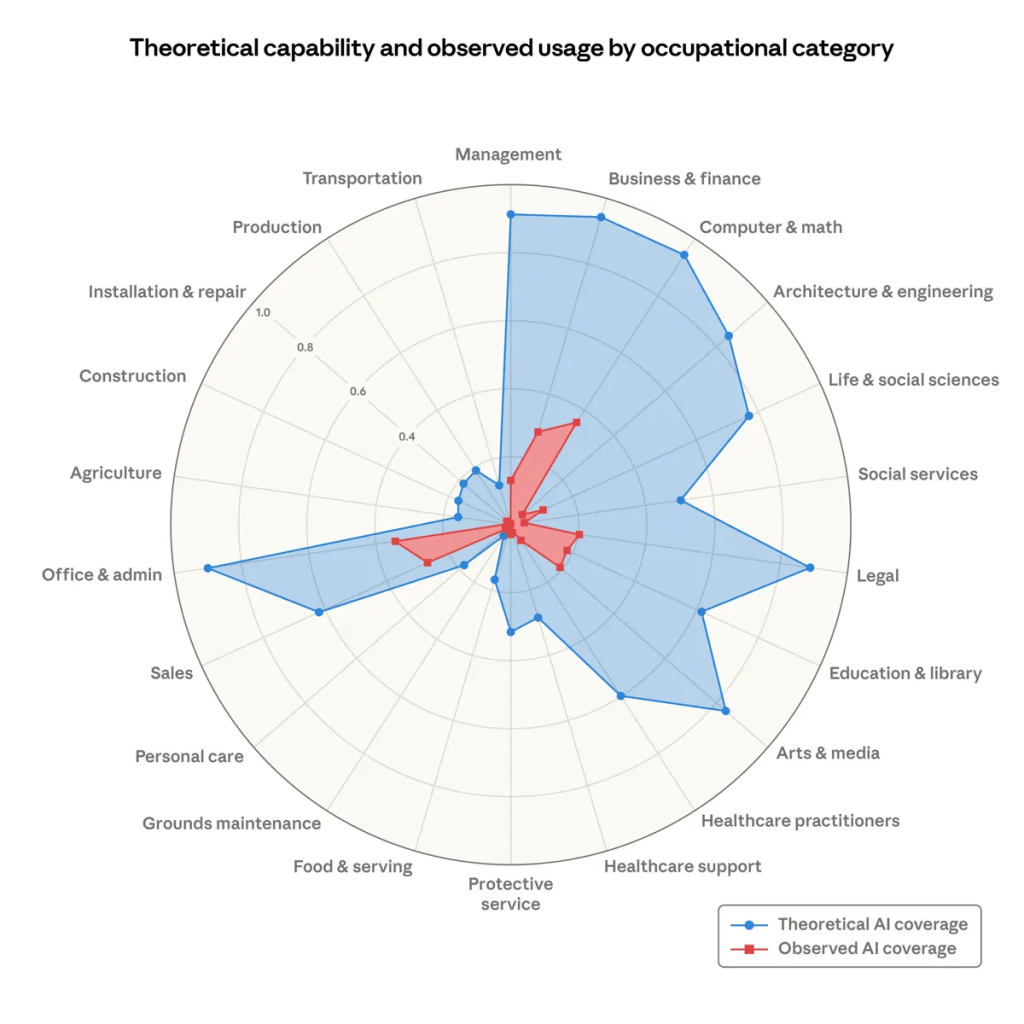
Anthropic published an Anthropic research paper on the labour market impacts of AI in March 2026, and one chart in it should be on every MSP owner’s radar. It compares what AI could theoretically do in each occupational category with what it is actually being used for. The gap is huge.
Before I go on, two caveats. The data is from the United States, and the “observed” side comes from usage of Anthropic’s own Claude. The paper does not study MSPs, and it does not study Australia. What follows is my reading of what it means for our market, not a finding from the paper.
The gap between capability and adoption
The authors combine task data for around 800 US occupations with real usage data to build a measure they call observed exposure. They report that the theoretical measure shows scope for LLMs in the majority of tasks in Computer & Math occupations (94%) and Office & Admin (90%). Yet Claude currently covers just 33% of tasks in Computer & Math. In their words, AI is far from reaching its theoretical capabilities.
Why the gap? The paper points to model limitations, legal constraints, specific software requirements and human verification steps. Look at that list again. Software integration, verification and rules are the daily bread of an MSP. The gap is not only a risk. It is where the work is.
Who is exposed
The most exposed occupations in the paper are Computer Programmers at 75% coverage, then Customer Service Representatives, then Data Entry Keyers at 67%. Financial analysts are also named among the most exposed. Customer service and data entry might sound unlike an MSP, but an MSP service desk spends much of its day on similar work: triaging requests, answering repeat questions, entering and updating records.
Our clients are exposed too. Office and admin work is everywhere in the small businesses we serve, and so is the kind of work that sits in Outlook, Excel and Teams every day.
Now the part that stops me panicking. The authors find no systematic increase in unemployment for highly exposed workers since late 2022. They do see tentative evidence that hiring of workers aged 22 to 25 into exposed occupations has slowed, with job finding rates about 14% lower than in 2022, but they call it barely statistically significant and list other explanations. They also find a slight link between exposure and weaker projected job growth: for every 10 percentage point increase in coverage, the US Bureau of Labor Statistics projection drops by 0.6 percentage points. Early signals, not a verdict.
What it means for MSP services and staffing
The one signal I would watch is the junior pipeline. Many MSP technicians started on the service desk doing exactly the repetitive tasks AI tackles first. If entry-level work shrinks, we need a new way to grow people. I made a related point in With AI, You Need to Be a Manager: your technicians are about to manage digital workers, so teach judgement and review, not just ticket handling.
On the services side, selling hours of routine support looks riskier than selling outcomes. The paper’s own list of barriers suggests where value moves: connecting Copilot and agents to the right data, setting permissions, adding approval steps, and checking the output. I covered the wider idea in AI Doesn’t Take Your Job, It Extends Your Wingspan.
Practical next steps
- Map your own service desk. List which tasks are repetitive, rules-based and text-heavy, and test Copilot or a Teams-based agent on them.
- Measure before you change anything: tickets per week, time to resolve, first-time fix.
- Redefine the entry-level role around review, escalation and customer communication.
- Package governance as a service: data access, permissions, approvals and monitoring for clients rolling out Copilot.
- Start the conversation with clients about their own office and admin work. They are exposed, and they need a guide.
- Re-read the research when Anthropic updates it. The authors say they intend to revisit the analysis periodically.
The takeaway
The chart says AI can do far more than it is being asked to do. For MSPs, that is a window. The businesses that spend it learning, measuring and redesigning their services will be in a much better position than the ones waiting for the gap to close on its own.
Sources (checked 29 November 2026)
- Labor market impacts of AI: A new measure and early evidence, Maxim Massenkoff and Peter McCrory, Anthropic, 5 March 2026

