
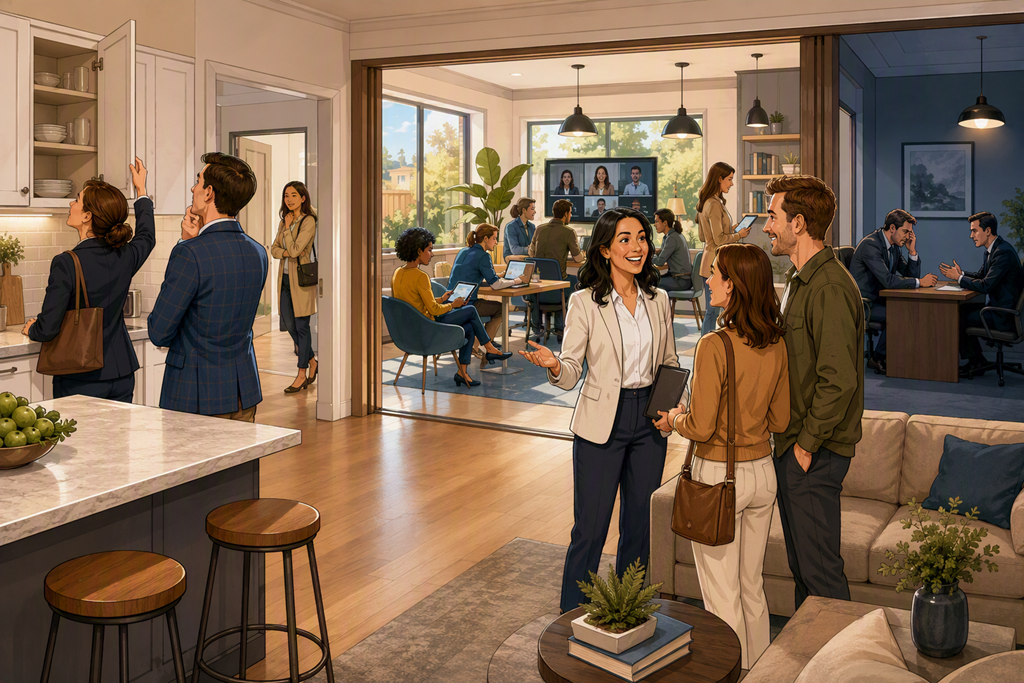
Nobody wants to sit across a desk from a real estate agent for a private appointment.
The reason is obvious. You know what they want. They know you know what they want. Every question feels like it has a destination, and that destination is a contract.
Now compare that with an open home. Same agent. Same property. Same commercial objective. Completely different experience.
You can walk in without committing to anything. Other people are moving through the rooms. You can inspect the kitchen, look inside a cupboard, ask about the neighbourhood, or simply nod politely and leave. The buyer has control.
That difference matters well beyond real estate.
People resist pressure, not information
Many businesses still design customer engagement like a private sales appointment. Book a discovery call. Sit through a presentation. Explain your budget. Tell us who makes the decision. Agree to the next meeting before this one ends.
The business calls it a process. The customer experiences it as pressure.
Most buyers are not avoiding information. They are avoiding a situation in which every question becomes a buying signal. They want room to learn without being chased.
An open home works because participation can be light. Someone can be curious without declaring intent. They can observe other people asking questions. They can discover what matters to them while they are there. Most importantly, leaving is easy.
Low-friction exits create higher-confidence entrances.
Build the digital equivalent of an open home
I think this is a useful way to rethink how we use Microsoft 365 and Copilot with prospects and clients.
Instead of making every interested person book an appointment, create a place where they can explore. A well-structured Microsoft Teams webinar can let people listen, ask a question in chat, or remain quiet. A SharePoint site can hold practical guides, short demonstrations and answers to common concerns. A Copilot Studio agent can help visitors navigate approved information without forcing them into a sales conversation.
The point is not to remove people from the process. It is to let the customer decide when a person should enter it.
Imagine an MSP running a monthly Microsoft 365 security clinic. There is a short demonstration, a few common configuration mistakes, and an open question period. Attendees are not pushed into individual assessments. Afterward, the presentation and supporting material are available through SharePoint, and questions can be submitted through Teams.
Some people will ask something immediately. Some will return to the material a week later. Some will never make contact. That is fine. The environment still creates value, trust and familiarity.
Give people something to inspect
An open home is useful because there is something tangible to explore. You can test the doors, gauge the room size and notice details that no brochure would reveal.
Business content should work the same way.
Do not just tell people you understand Copilot adoption. Give them a readiness checklist. Show them an anonymised governance example. Let them ask Copilot to summarise a sample policy in Word, then explain what good source material looks like. Make the expertise visible before asking for a commitment.
This also changes the sales conversation. When someone eventually requests a private meeting, they arrive with context. They know how you think. They have already examined the cupboards.
The best customer experiences do not trap people in a funnel. They create a useful space, make exploration safe and allow curiosity to do some of the work.
That is what I would build: fewer forced appointments, more open doors.

