
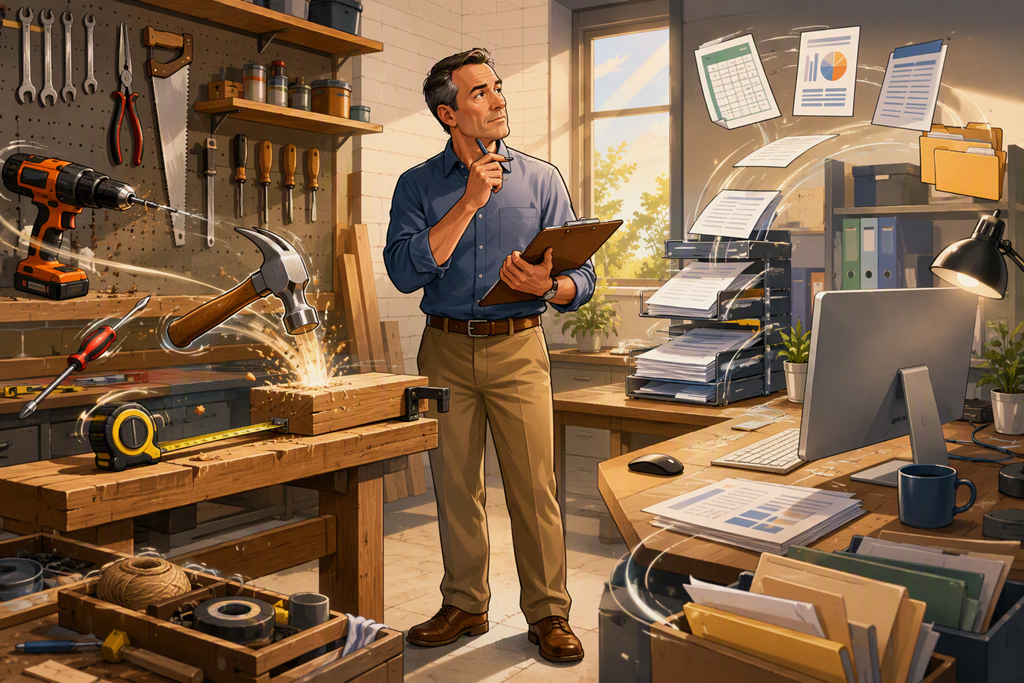
I was holding a hammer recently and caught myself thinking about how little it has changed. A handle. A weighted head. A simple tool that turns a human movement into a useful result. Email feels more sophisticated, but the basic relationship is similar. I decide what I want to do, then I operate the tool.
I am starting to wonder whether that relationship is about to reverse.
The tool may stay while the user changes
I do not think hammers, spreadsheets, inboxes or project boards are disappearing. I think the interesting possibility is that humans may stop being their main operators.
A robot on a building site may still use something recognisable as a drill because the drill is already an efficient way to apply rotational force. An AI agent may still use email because email remains a widely accepted way for organisations to exchange requests, approvals and records. The tool survives because the surrounding world already understands it.
What changes is who, or what, sits at the controls.
That matters because many of our tools were designed around human limitations. Email gives me time to compose a thought, send it, wait and respond later. A spreadsheet lets me arrange information into rows and columns because that is a structure I can inspect. Menus, buttons, folders and dashboards exist partly because I need visible handles for complicated systems.
AI does not necessarily need those handles. It may use the underlying service directly, faster and more consistently than I can. Yet it may continue producing emails, documents and spreadsheets because people, businesses and compliance processes still expect them.
Outlook may become a machine workspace
I can already see the early shape of this in Microsoft 365 Copilot. Today, I might ask Copilot in Outlook to summarise a long thread and draft a reply. I am still the operator. I read the summary, check the wording and press Send.
The next step is not difficult to imagine. An agent monitors the inbox, recognises a routine supplier request, checks the relevant SharePoint record, prepares the response and routes only the exception to me. Email remains. Outlook remains. SharePoint remains. But my role moves from operating every tool to supervising the work performed through them.
For me, this is a more useful way to think about AI than asking whether it will replace a particular application. A familiar tool can remain everywhere while becoming almost invisible to its former human users.
Efficiency is not the only measure
I do not believe the most efficient operator should automatically make every decision. A machine may swing a hammer more accurately or process an inbox more quickly, but speed is not judgement. Context, responsibility and consequences still matter.
If an AI sends the wrong email, approves the wrong variation or updates the wrong customer record, someone still owns the outcome. That means I expect the valuable human skill to shift. Knowing where to click will matter less. Knowing what should happen, what must never happen and when an exception needs attention will matter more.
The practical question for every business is not simply, “Which tools can AI use?” I think it is, “What authority are we prepared to give it, and how will we know when it is wrong?”
I suspect many tools I love will survive for decades. I may just use them less directly. The hammer, inbox and spreadsheet could become part of a machine-operated layer beneath my work.
I will not miss every click. But I do want to remain accountable for where the work lands.
 CIAOPS