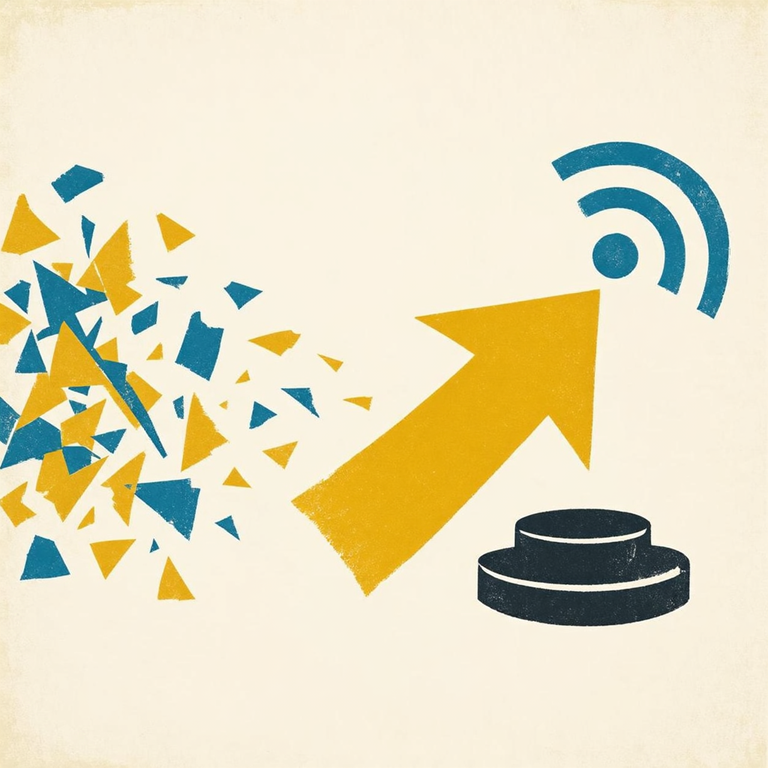
The Season Before the Leap

MAI_36600715f9d74cea

There’s a pattern I’ve noticed in almost every business that makes it through a genuine rough patch. It doesn’t show up on a spreadsheet or in a quarterly review. It shows up in the moments just before things turn — when most people would have stepped back and waited.

The hard season doesn’t announce itself as preparation. It just feels like pressure.

I’ve had stretches in my own work where the effort seemed disproportionate to the outcome. Clients weren’t growing as fast as I’d hoped. The pipeline felt thin. Tools I’d invested time in weren’t paying off yet. That combination — sustained effort, visible slowness, creeping doubt — is the exact moment most people quietly pull back and start looking for a simpler path.

But here’s what I’ve come to believe: the difficulty is often the signal, not the obstacle.


Reframing Isn’t Wishful Thinking

There’s an important difference between telling yourself “this will be fine” and actually changing what a challenge means to you. The first is denial. The second is something closer to strategic clarity.

When I hit a difficult period, I’ve started using Copilot in Microsoft 365 not just to triage my inbox or summarise a meeting, but to think through the problem itself. I’ll take a messy situation — a stalled project, a client relationship that feels off-track — and ask Copilot in Teams to reflect it back to me plainly. What’s the actual constraint? What am I not asking? What would this look like from the other side?

When you’re inside a problem, having something surface a different angle can shift your perspective faster than another hour of turning it over yourself. That’s reframing in practice. Not pretending things are easier than they are. Finding the angle you couldn’t see while standing too close to it.


Most People Opt Out Early

The reason hard seasons tend to precede the big leaps isn’t some hidden law of the universe. It’s selection.

When conditions get difficult, people and businesses that don’t have a genuine reason to push through — or haven’t built the habits that carry them when motivation fades — tend to step back. They wait for things to improve before committing again, before investing again, before showing up with full energy again.

That sorting is exactly why the ones who lean in come out with an advantage that simply wasn’t available during easier conditions. The competition thins. The clarity sharpens. Decisions made under real pressure tend to be more durable than the ones made when everything is comfortable.

I use Copilot in Outlook to stay on top of client communication even when my capacity feels stretched — a quick thread summary, a draft response I can refine rather than build from scratch. That keeps me present in conversations I’d otherwise let slip during a hard stretch. Not automation for its own sake. Staying in the game when it would be easy to go quiet.


What You Actually Build

The leap doesn’t come from surviving the difficulty. It comes from what you construct while you’re in it.

The habits, the thinking, the client relationships you kept up, the decisions you made with less certainty than you’d have liked — those compound. They show up later as capability that wasn’t there before, because it couldn’t have been developed any other way.

I don’t look back on the hard stretches as things I got through. I look at them as where most of the real work happened.

If you’re in one of those seasons right now, lean into it. Not because it’s comfortable — it isn’t. But because most people won’t. And that gap is exactly where your next leap begins.

You Don’t Have a Business Problem. You Have an Owner Problem.

MAI_8c81adcd47935876

I’ve watched a lot of MSP owners over the years, and the pattern is almost always the same. They tell me their business runs on hard work. Long days, early starts, the willingness to do whatever it takes. And for a while, that’s exactly what built the thing.

But here’s the uncomfortable bit. All that effort didn’t make them an owner. It made them the best technician in the building — the one person who can’t leave the room.

The tell-tale signs aren’t technical

You know the feeling. The phone buzzes and your stomach tightens before you’ve even looked at it. You’re “on holiday”, but you’re really just answering tickets from a nicer chair. The people at home get whatever’s left after the business has taken the good hours.

I used to think those were signs of a busy business. They’re not. They’re signs of an owner who has wired the whole operation around themselves. Every approval, every escalation, every “let me just check that” runs through one person. That’s not a scaling problem. That’s an identity problem.

A business is a mirror. It reflects whoever built it — their habits, their fears, their inability to let go. If you can’t step away, it’s usually because, somewhere along the line, you decided being needed was the same as being valuable.

Hard work hides the real bottleneck

The reason this is so hard to see is that effort feels like progress. You’re busy, so you must be building. But more hours rarely fix a business that depends on your hours.

What actually moves the needle is taking the knowledge living in your head and putting it somewhere the team can reach without you. This is where the tools earn their keep. When a senior tech finishes a tricky onboarding, Copilot in Teams can pull a clean summary of what was decided and who owns what, so the next person isn’t starting from your memory. Ask Copilot in Word to turn that into a repeatable runbook, drop it into a SharePoint site, and suddenly the process belongs to the business, not to you.

Same with the inbox that owns your attention. Instead of being the human router for every client question, let Copilot in Outlook draft the first reply and surface what genuinely needs your judgement. The goal isn’t to answer faster. It’s to stop being the only one who can answer at all.

Build the owner first

This is the shift I keep coming back to. You don’t escape the trap by working less or hiring more. You escape it by changing who you are inside the business — from the person who does the work to the person who builds the thing that does the work.

That means writing down how decisions get made, not just making them. It means letting Planner and Loop hold the to-do list so it isn’t all in your head at 11pm. It means being okay with the team doing it 80% your way instead of 100% your way and the work never getting done without you.

I’ve seen owners break through a ceiling they’d been stuck under for years, and it almost never starts with the business. It starts with them deciding to stop being indispensable.

Your business will only ever grow to the size of the owner behind it. So the real question isn’t how to work harder. It’s who you’d need to become for the business to run beautifully on a day you don’t show up.

CIA Brief 20260718

image

CIA Brief – Weekly News Digest

Here’s a quick roundup of the Microsoft, security and AI news worth tracking this week. As always, I’ve skipped the noise and focused on what actually matters for MSPs and SMBs.

Security
Microsoft 365 & Windows
Cloud & AI

As always, the challenge isn’t finding information — it’s focusing on what actually matters.

After hours

I Only Made $50 Training Robots – https://www.youtube.com/watch?v=yfZhpEupz5M

Editorial

If you found this valuable, the I’d appreciate a ‘like’ or perhaps a donation at https://ko-fi.com/ciaops. This helps me know that people enjoy what I have created and provides resources to allow me to create more content. If you have any feedback or suggestions around this, I’m all ears. You can also find me via email director@ciaops.com and on X (Twitter) at https://www.twitter.com/directorcia.

If you want to be part of a dedicated Microsoft Cloud community with information and interactions daily, then consider becoming a CIAOPS Patron – www.ciaopspatron.com.

Watch out for the next CIA Brief next week

Stop Collecting Tactics. Fix the Three Things That Actually Matter.

MAI_adc1af56fb45057b

I had a coffee recently with an MSP owner who pulled out his phone and showed me his “growth list.” Forty-three items. Webinars, a TikTok plan, a referral scheme, a rebrand, three new service bundles, a partnership he’d been chasing for a year. He was exhausted just reading it to me. And his revenue had barely moved in eighteen months.

I told him I’d happily help him cross off forty of those. Because in my experience, almost every stuck MSP is stuck on the same three things, and the rest is just noise dressed up as activity.

You’re Easy to Overlook

The first problem is that nobody can quickly say what you do or why they’d pick you. Walk into most MSP websites and you’ll find “managed IT solutions for growing businesses.” That sentence could belong to ten thousand others. If a prospect can’t repeat your offer back to a colleague in one breath, you don’t have an offer — you have a category.

This is the part I’d fix first, and it’s the part owners avoid because it forces a decision. Open a blank document and ask Copilot in Word to help you rewrite your core offer five different ways for a specific type of client — say, a 30-seat accounting firm worried about email fraud. Then read each one out loud. The version that sounds like a real person warning a real business is the one you keep. Specific beats clever every single time.

You’re Invisible Because You’re Inconsistent

The second problem isn’t that your marketing is bad. It’s that it shows up once a quarter, when you remember, when things are quiet. Then a big project lands, you go heads-down, and the market forgets you exist. Invisibility isn’t a talent problem. It’s a rhythm problem.

The MSPs who get noticed aren’t louder — they’re just regular. One short, useful thing a week beats a brilliant campaign you run twice a year and abandon. Build the rhythm into the tools you already live in. Draft a month of client-facing tips in a SharePoint document, drop the publishing dates into Planner, and let a scheduled Outlook reminder nudge you every Monday morning. The point isn’t sophistication. It’s that the thing keeps happening whether you feel inspired or not.

Sales Feels Awkward, So You Undercharge

The third one is the quiet killer. Plenty of capable owners walk into a sales conversation, sense the tension when price comes up, and instinctively shave the number to make the discomfort go away. Then they wonder why they’re working flat out and still underpaid.

Awkwardness usually comes from walking in unprepared and hoping to wing it. Before your next prospect call, ask Copilot to pull together what you already know — recent emails with that contact, notes from earlier meetings, the brief from your discovery call — into a one-page summary of what they actually care about. When you walk in knowing their world, you’re not selling. You’re advising. And advisors don’t apologise for their price.

The Real Work Is Subtraction

What struck me about that coffee was how relieved the owner looked when I told him to bin most of the list. We’re trained to believe progress means adding more. With this stuff, it’s almost always the opposite.

Get your offer clear, show up consistently, and stop flinching on price. Do those three, and you can ignore nearly everything else. The forty-three-item list was never the path forward. It was just a very busy way of avoiding the three things that mattered.

The Content That Changes What You Want

MAI_65487d8c9a3c1631

For years I measured a good session by how much I crammed into it. Steps, screenshots, settings, the lot. If someone walked out with a longer to-do list than they arrived with, I’d done my job. I don’t see it that way anymore.

The shift happened quietly. I started noticing that the sessions people remembered weren’t the ones where I taught the most. They were the ones where something clicked and a person suddenly wanted to work differently. The instruction was almost beside the point. What stuck was the wanting.

Knowing how isn’t the same as wanting to

You can show someone exactly how to do a thing and watch them never do it. We’ve all run that webinar. The hands-on steps are perfect, the recording goes up, and three weeks later nothing has changed in their business. The knowledge landed. The desire never did.

I see this constantly with Microsoft 365 Copilot. I can demonstrate how to summarise a long thread in Outlook, how to pull the action items out of a Teams meeting, how to draft a first version of a proposal in Word. People nod. They get it. But the ones who actually change are the ones who leave thinking, “I never want to scroll through forty unread emails by hand again.” That sentence isn’t instruction. It’s appetite. And appetite is what does the work after the session ends.

The job is to make the better way feel obvious

So now, when I’m putting together a workshop or a video or even a short email to a client, I’m not really asking what I should teach. I’m asking what I want them to start wanting once it’s over.

That changes how I build the thing. Instead of opening with a feature, I open with a moment they recognise — the Friday afternoon spent rebuilding a status report they’ve already written four times this month. Then I show Copilot pulling that report together from the documents already sitting in their SharePoint, in about a minute. I’m not listing what it can do. I’m letting them feel the gap between how they work now and how they could. Close that gap in front of someone and they don’t need convincing. They’ve already decided.

The same logic runs through everything I put out. A YouTube clip, a Loop page I share with a patron group, a single line in a newsletter — they all work better when they leave a person slightly dissatisfied with their current way of doing things, in the best possible sense.

What I’m watching now

The tooling has never been easier to demonstrate. Copilot will happily show off. The harder, more interesting question is whether the content around it makes anyone actually want a different working life.

That’s the part I keep returning to. Teaching the steps is the easy half. Teaching someone to want the outcome — that’s where the real change starts, and it’s the bit I’m still learning to do better.

MVP 2026-27

Most Valuable Professionals

I am happy to confirm that I have been renewed as a Microsoft MVP for 2026-27 and have also been recognised in both the Microsoft 365 and Microsoft 365 Copilot categories, which was a pleasant surprise. This marks my 16th year in the MVP programme.

As always, many thanks to Microsoft and the Microsoft 365 and Copilot teams for this recognition. I am proud and honoured to be part of the unique global community of Microsoft MVPs and humbled to now be recognised in two categories.

MVPs serve their communities, and I would like to take this opportunity to thank everyone who takes the time to consume the content I create. Nothing makes me happier than hearing from people I have never met who tell me that something I shared has helped them get more value from their Microsoft environment. That feedback is what motivates me to continue creating and sharing content.

Copilot has become a significant part of what I do. It helps me run my business, create content, and deliver more value to the community. The pace of change continues to accelerate, so much so that even I sometimes struggle to keep up. I suspect that won’t slow down any time soon. If anything, the next twelve months are likely to bring even more innovation and opportunity. That means there will be a whole lot more to learn, test and share as I continue my journey with Copilot. It’s both exciting and challenging to once again be part of a major technology shift, and I look forward to sharing that experience with the community.

As technology continues to evolve, it creates more opportunities for me to dive deeper into understanding what is happening and, more importantly, how those changes affect my community, especially in the SMB space. We are still in the early stages of understanding what AI will ultimately deliver, and it is exciting to be part of that journey. Being recognised in the Microsoft 365 Copilot category is greatly appreciated, and I will work hard to continue earning that trust and recognition.

As always, a big thank you to Microsoft and everyone who has made this possible. I look forward to another year as a Microsoft MVP and to continuing to produce the best content I can for the community.

Thank you to everyone for your support.

The AI question worth sitting with

MAI_0e92852ba5b3a913

A while back, over coffee, someone asked me which clever AI trick had impressed me most this year. I disappointed them. The thing that stuck with me wasn’t a trick at all. It was a question I now ask myself most afternoons: of everything I did today, how much of it didn’t actually need me?

It’s an uncomfortable question, and it should be. Sit with it long enough and you start noticing how much of your week is just movement — chasing the same status update, rewriting the same kind of email, copying numbers from one place to another. Honest work, sure. But not the work only you can do.

The instinct to hold on

Most people, when they feel AI getting close to their job, pull their work in tighter. They guard it. They want to prove the human bit still matters. I understand the reflex, but I think it’s backwards. The value was never in the doing. It was in knowing what was worth doing in the first place.

The people I admire most are doing the opposite. They’re hunting for things to hand over. They treat every repetitive task as a candidate for handover, not a badge of how busy they are. When a reply lands that says the same thing they’ve written forty times, they don’t write it again — they ask Copilot in Outlook to draft it and spend their attention on the one paragraph that’s genuinely new. When a long Teams thread needs catching up on, they let Copilot summarise it and read the summary, not the forty messages.

That’s not laziness. That’s deciding where your judgement is actually worth spending. Every hour you claw back from the routine is an hour you can point at something that actually moves the business.

Hand it over once, properly

Here’s the part most people miss, though. Handing a task to AI once is a parlour trick. The real shift happens when you stop doing the task and start building the thing that does the task.

I’ve watched a business owner take the monthly client report — the one that ate a Friday afternoon every month — and rebuild it as a flow. Power Automate pulls the numbers, Copilot drafts the commentary in the same tone she’d use, and the whole thing lands in a SharePoint folder before she’s had her second coffee. She doesn’t make the report any more. She looks after the thing that makes the report.

And that’s the bit worth understanding. Once the work runs on its own, your job changes. You’re no longer the one producing the output — you’re the one watching the machine that produces it, and adjusting it when it drifts. When the tone goes a bit flat, you fix the instructions, not the document. When the numbers look off, you check the flow, not the spreadsheet. Your effort moves up a level.

That’s where the real return sits. Not in doing the task faster. In stepping back from the task entirely and tending the system instead.

What I’m watching now

None of this happens by accident. It takes a deliberate habit of asking, over and over, what you did yesterday that you shouldn’t be doing tomorrow. Most people never ask. They’re too busy doing. And the irony is the busier you are, the more of your day is probably the kind of work you could give away.

So I’ll leave you with the same uncomfortable question. Look back at yesterday. Find the hour a machine could have run without you. Then go and build the thing that runs it — and free yourself up for the work that actually needs a human in the chair.

Stop Holding People Accountable. Start Building Momentum.

MAI_3380a38ad87345f1

There’s a conversation I’ve watched play out a hundred times, and it always goes the same way. Someone agreed last week to get a thing done. This week, they didn’t. So the check-in begins. Did you finish it? No. Why not? And then comes the explanation — the kids were sick, a client blew up, the week got away from them. By the end they feel small, the task gets shuffled forward, and everyone agrees to try again next time.

Then we run it back. Same script, same shrinking feeling. And here’s the part nobody admits out loud: the simplest way to make that bad feeling stop is to walk away from the whole arrangement entirely. People don’t quit because they’ve failed. They quit because the relationship has quietly become a source of guilt.

I see this with MSP owners constantly. They build accountability structures for their teams, their clients, even themselves — weekly stand-ups, status trackers, a long list of overdue commitments staring back at them. And the structure, the thing meant to drive progress, becomes the thing people learn to dread.

Accountability is a low ceiling

The uncomfortable truth is that accountability only works on people who don’t really need it — and even then, only for a while. It’s a tool built around the assumption that someone has to be watched or they’ll drift. Chase the high performers in your business with that energy and watch how fast they disengage. The good ones already hold themselves to a higher standard than you ever could. They don’t want a minder checking their homework. They want to get somewhere, faster.

So I stopped asking whether things got done. When I sit down with someone now — whether it’s a one-week review or a full six-week stretch — I ask two questions only. What went well? And what did this teach you? That’s it. Everything else from the past is noise. The misses, the excuses, the guilt — none of it moves you an inch forward. The wins tell you what to repeat. The lessons tell you what to change. The rest is dead weight you’re dragging into next week for no reason.

From rear-view to road ahead

Once those two things are on the table, the conversation flips direction. We’re no longer auditing the past — we’re using it. We find the one obstacle actually slowing the person down, we clear it out of the path, and we decide the very next move. Look back only long enough to learn, then point everything forward.

This is where the tooling matters more than people expect, because most of the friction that kills momentum is small, dumb, and repeatable. Someone “forgot” to follow up because the note lived in their head instead of anywhere useful. A commitment vanished because it was never written down where the team could see it. That’s not a discipline problem. That’s a system problem, and systems are fixable.

Inside Microsoft 365, this gets a lot easier. When I close out a planning session in Teams, I’ll ask Copilot to pull the wins and the agreed next moves straight out of the meeting transcript, so nobody’s relying on memory by Friday. The actual commitments go into Planner as real tasks with owners and dates — visible, shared, alive — not buried in someone’s inbox. A Loop component pinned in the channel becomes the running scoreboard the whole team can glance at. And first thing in the morning, Copilot in Outlook surfaces what’s drifted and what’s due, so the next move is obvious before the day even starts. None of that is about catching people out. It’s about removing the friction that quietly steals forward motion.

Speed, not surveillance

This is the shift I’d put to any MSP leader still running their team on guilt. The higher someone performs, the less they need policing and the more they crave progress. So give them progress. Clear the road, name the next step, and get out of the way. Momentum compounds — one clean win makes the next one easier, and before long the person isn’t being pushed at all. They’re pulling.

If what you want is someone standing over your shoulder reminding you of everything you haven’t done yet, I’m honestly not the right person for that. But if you want the obstacles gone, the path clear, and the next move obvious so you can win quicker — that’s the whole job. Stop counting what’s overdue. Start building what’s next.