Determining legacy authentication usage

I’ve spoken previously about the need to eliminate basic authentication from your environment:

Disable basic auth to improve Office 365 security

The unfortunate reality is that some legacy applications could be using and can ONLY use legacy auth! So, you don’t want to necessarily disable it across your tenant without first understand who or what maybe using legacy auth.

image

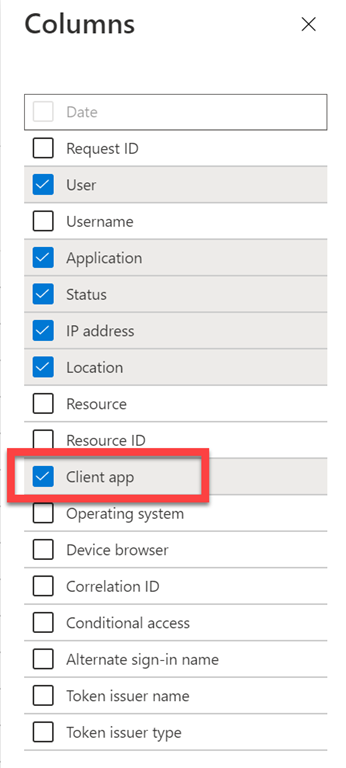
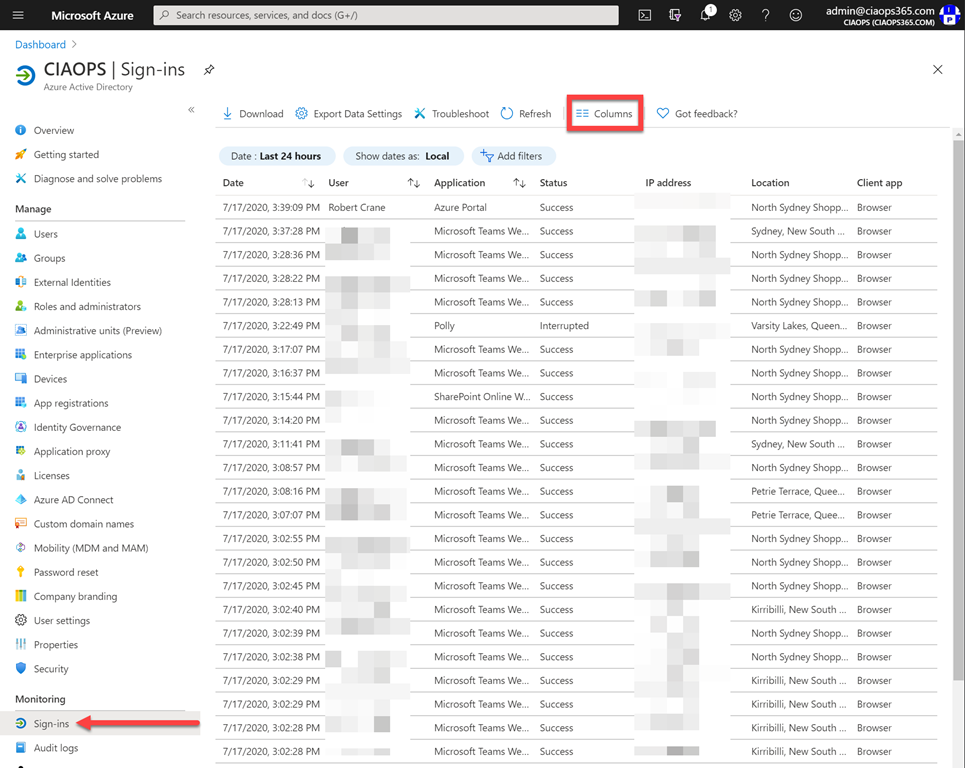
One way you can see this is by navigating to your Azure Active Directory in the Azure portal for your tenant. You then need to select the Sign-ins options on the left under the Monitoring heading towards the bottom as shown above. You should then see a list of events display on the right. At the top of this pane select the Columns menu item.

image

From the pane that appears from the right ensure you have the option Client app selected, as shown above.

image

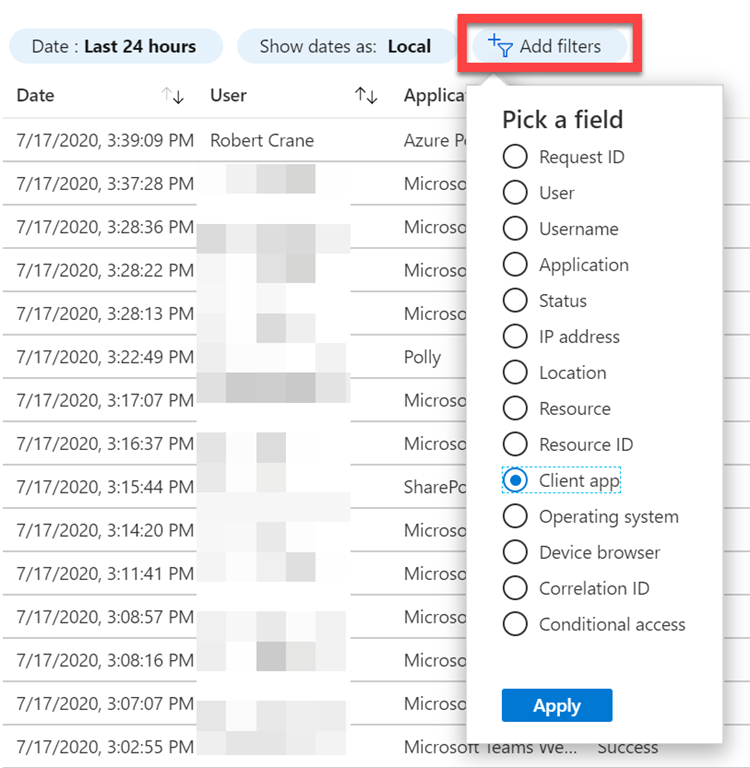
Next, select the Add filters button at the top of the list of events as shown above. From the list that appears select Client app and then the Apply button at the bottom.

image

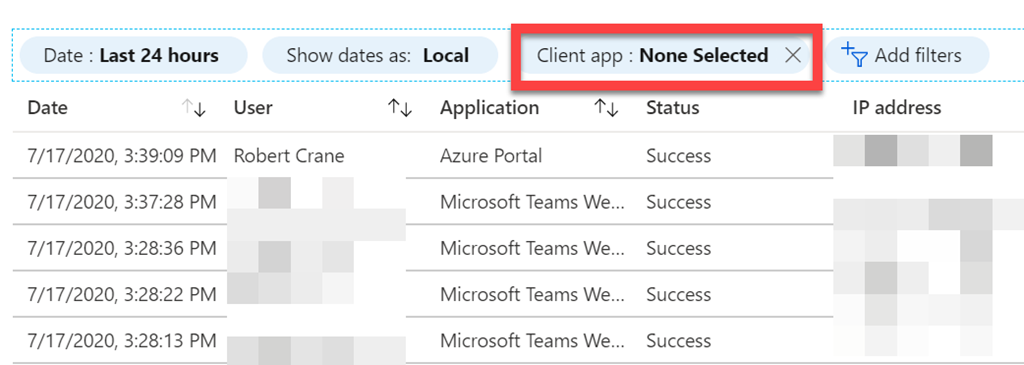
A Client app option should now appear at the top of the list as shown. It will typically show None Selected.

image

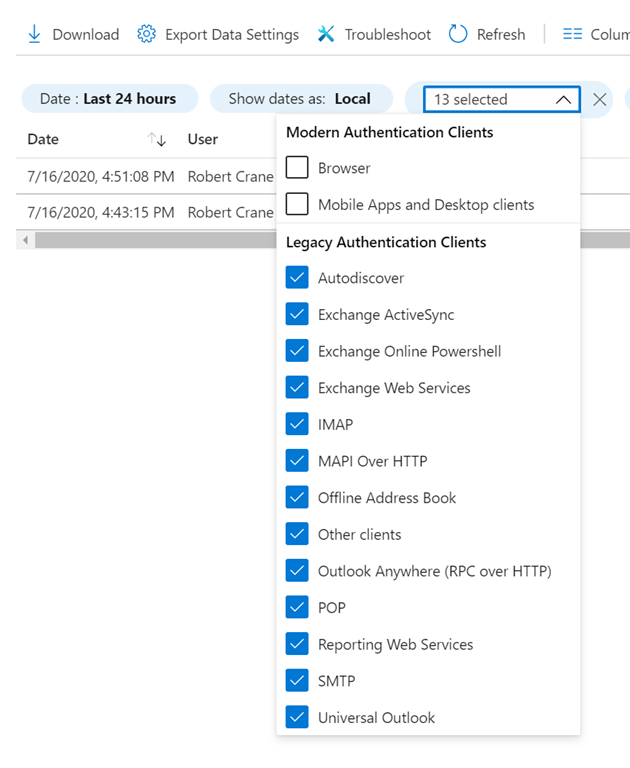
Select the new Client app button and a list of items will be displayed as shown above. From this list, select all the items under the Legacy Authentication Clients heading.

image

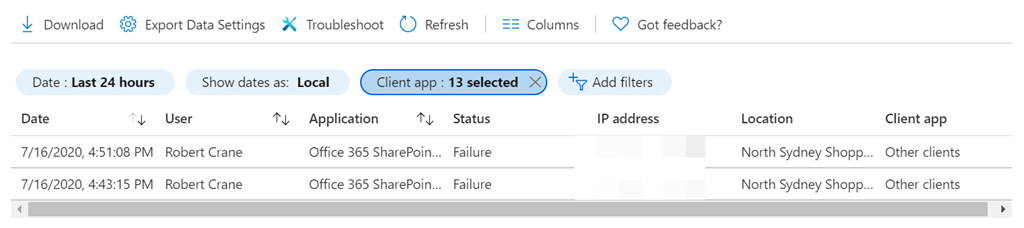
When you now click away, the list of events should be filtered to only those events that match the use of Legacy Authentication. You can select any of these to get more information about the event including who or what generated this.

Armed with this knowledge you can now start working whether upgrades or additional configuration is required in your environment to minimise the attack surface area of Legacy Authentication in your environment.

Protecting your Microsoft 365 environment using Azure AD Privileged Identity Management (PIM)

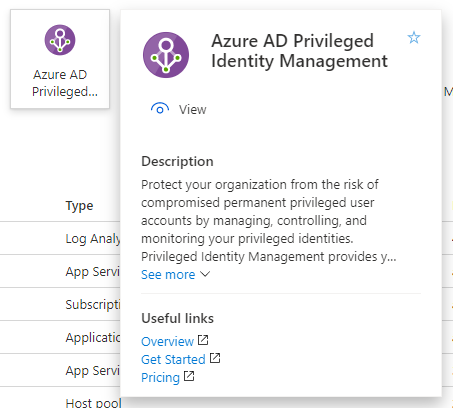
If you are managing a Microsoft 365 environment my recommendation is to do so using a Microsoft 365 E5 SKU, no matter what else in in that tenant. The reason for having at least one Microsoft 365 E5 SKU in your environment is that it provides a wealth of additional features that directly benefit administrators. One of these is Azure AD Privileged Identity Management (PIM).
image

In a nutshell, PIM allows you to do just-in-time (JIT) role escalation. This means that users can be given the permissions they need to do things, only when the need them. It means that you don’t need to have users with standing global administrator access, they can be escalated only when they actually need those privileges. Standing elevated privileges is something that you should be looking to minimise or eliminate in your environment so that if an account does get compromised it won’t have access to the ‘family jewels’. PIM is also a way to potentially minimise the threat of a ‘rogue administrator’ given that it can have an approval process tied to it as well. Most important, all PIM actions are audited in detail which is always handy to have.

PIM is a feature of Azure AD P2 and as mentioned, included in Microsoft 365 E5. Best practice is to ensure you have an ‘emergency break-glass’ administration account tucked away as a backup before you start restricting existing administrators with PIM. Once you have both the license and a ‘get out of jail’ account you are ready to use PIM.

A good example to help you understand the benefits of PIM is to illustrate how I use it myself in my own production environment. The account that I use for my day to day work used to be a global administrator but best practices dictates that it really shouldn’t be. However, given the number of browser sessions I have open already I didn’t want to add yet another one to be checking administrative tenant level ‘stuff’. PIM to rescue! With PIM, my account can stay as a member account by default and I can escalate it to be a global administrator as needed.
image

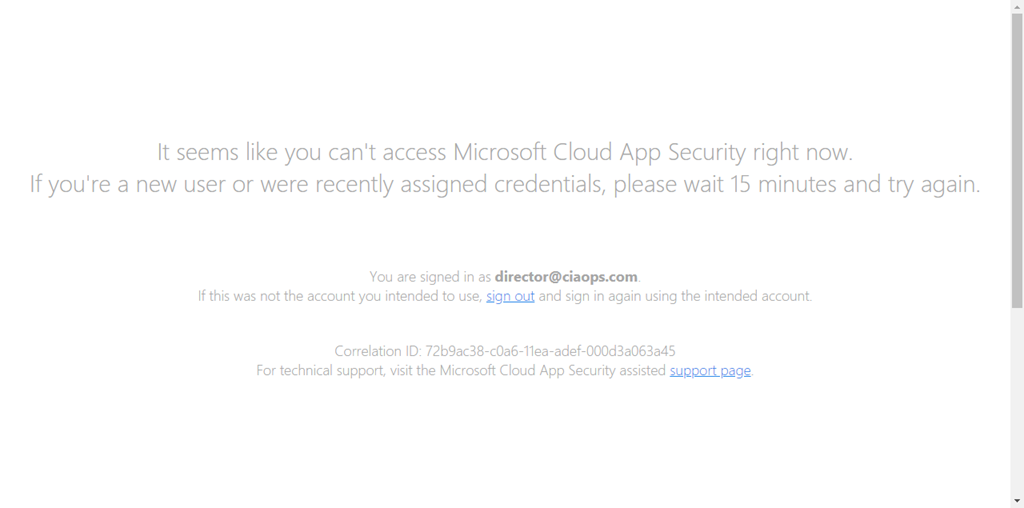
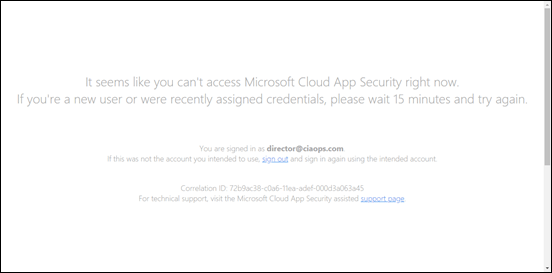
One of the things I like to check is Microsoft Cloud App Security for my tenant. As you can see above, by default, I now have no privileges.

To elevate my privileges I follow this process:

Activate my Azure resource roles in Privileged Identity Management
 image

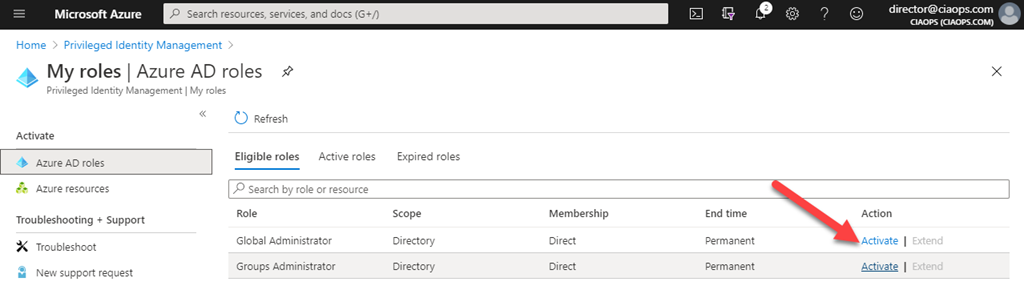
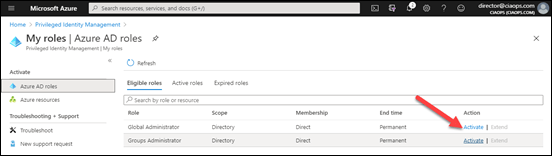
This means that I login to the Azure Portal and then navigate to Azure AD roles in PIM as shown above. Here I can see that I can activate the Global administrator role by selecting the Activate link as shown.
image

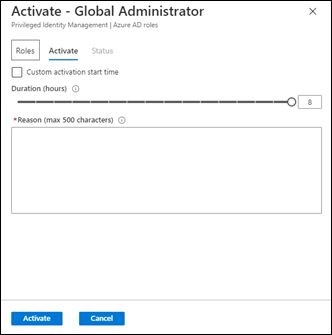
When I do this a dialog box appears and my credentials are verified. You can enable the requirement to again prompt for MFA during this validation process if you wish. That means, even if I am already logged in successfully, I need to complete an MFA challenge again to proceed.

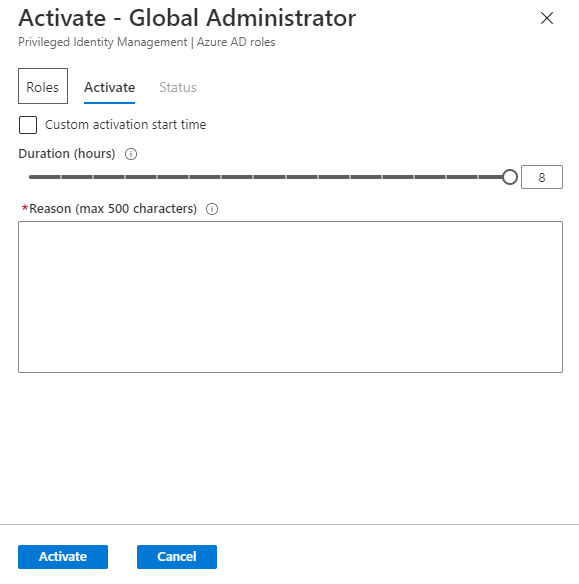
I can now select the time required to complete my work up to a pre-defined Duration limit. Here I’m going to select the full 8 hours for a full work day at my desk. I also need to provide a Reason for elevation. This information will be recorded and held with the auditing information. This means I can track when and why I elevated.

When complete, I press the Activate button at the bottom of the page to continue.
image

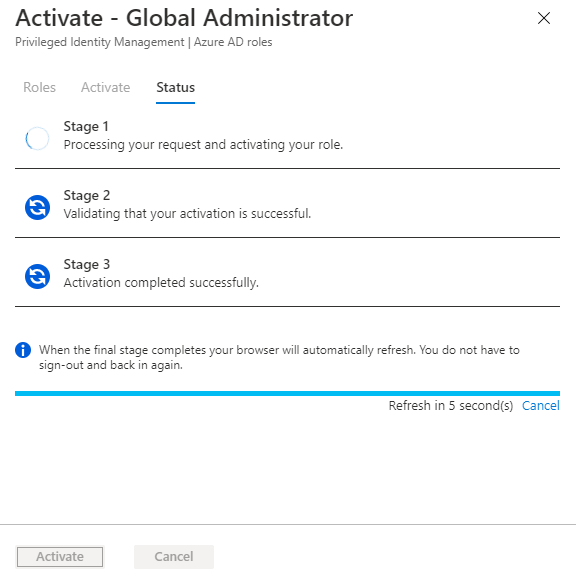
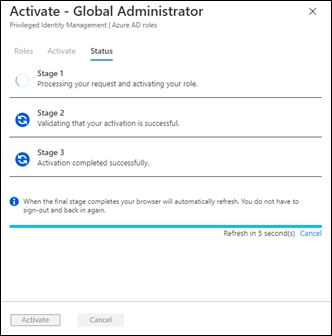
The activation request is then processed according to pre-define rules. In my case, I have elected to have automatic approvals but you can refer approvals to a third party if you wish for greater protection.
image

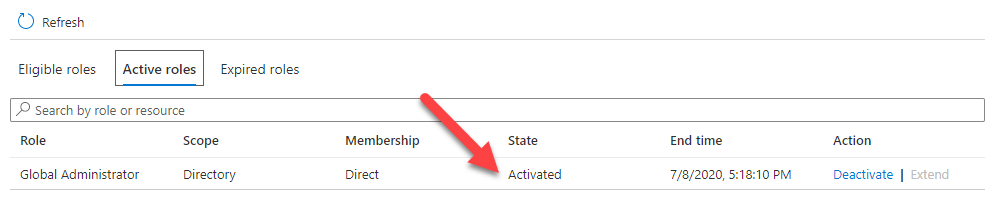
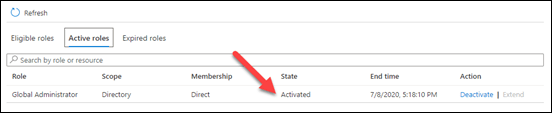
In about 30 seconds my activation is complete and if I now look in the Active roles area of the console I see that I am indeed a global administrator.
image

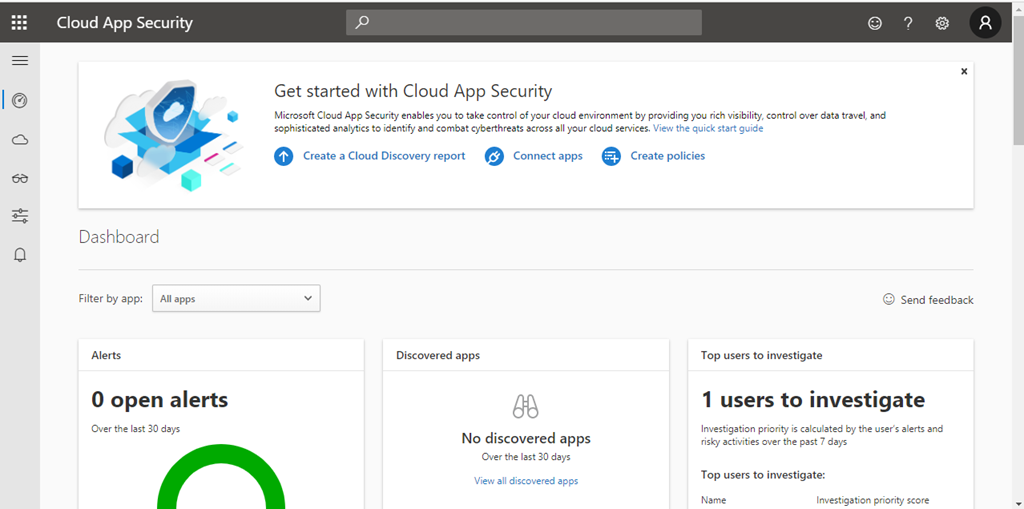
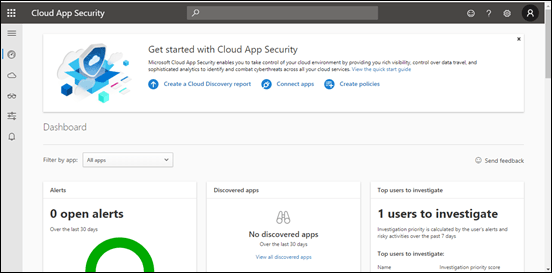
If I now refresh my Microsoft Cloud App Security page, you see that I can get access as a normal administrator. This is also the same with all the other administrator areas in the tenant thanks to undergoing the elevation to a Global Administrator thanks to PIM.

The good thing is now I can work using my normal account, check and monitor what I need to without using a different account. I can also rest easy that after the 8 hour time limit my account will again be de-activated back to being a member user. Thus, at the end of the day, I simply shut down and the account will automatically be de-activated for me without me needing to remember to do it. I can of course, manually de-activate the account at any time if I wish, say if I needed to go out somewhere. It is also easy enough for me to re-activate again if I need to do any additional work.
image

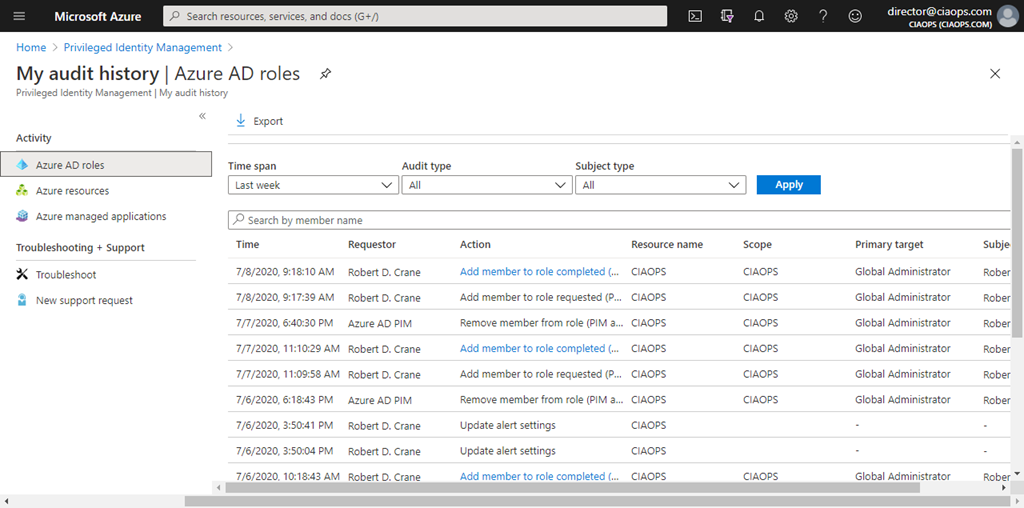
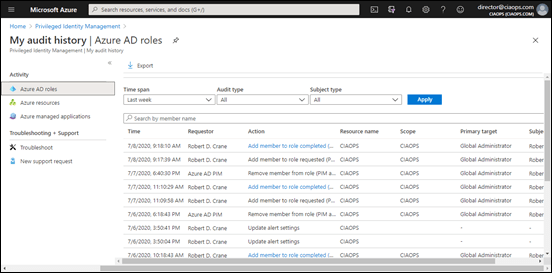
What I also like is the audit logging as shown above. Having it all in one place in the PIM console makes it easy for me to verify what has been happening with the process over time.

So in summary, I am using PIM to elevate my normal work account to an escalated level as needed during the day. This means that I don’t have to maintain standing administrator access for the account but I still have the convenience of using it to perform administrator roles as needed.

To set this up for yourself, you’ll need M365 E5 or Azure AD P2 as well as a ‘break-glass’ account. Then you’ll need to configure the roles you wish to escalate to via:

Configure Azure resource role settings in PIM

You can get quite granular here if you wish, but my advice is that you keep it simple to start with and go from there. For me, I just wanted the simple process of becoming a ‘normal’ global administrator.

You can have multiple roles, with different access for different users if you wish. In my case, I’m just focusing on the role of the tenant administrator. As I said, you can also have approvals sent to a third party or parties if you want for an extra level of protection if desired. There lots of settings you can customise with PIM.

Using PIM now gives me extra level of protection when it comes to administration rights. It means my production user isn’t a global administrator by default. I can however, use that same account as a global administrator, by going through a simple automated escalation process that requires MFA for greater security. Additional benefits include that I get great auditing and tracking, I can manually de-activate those rights at any point and those rights will also be automatically de-activated for me after a specified time limit and I also get alerting.

If you want to make your Microsoft 365 environment, especially you administrator logins, more secure then I suggest you take a look at PIM. Even for a small environment like mine, it is great value.

Need to Know podcast–Episode 245


FAQ podcasts are shorter and more focused on a particular topic. In this episode I speak about what Office 365 Alerts is and provide some best practice suggestions.

This episode was recorded using Microsoft Teams and produced with Camtasia 2020

Take a listen and let us know what you think – feedback@needtoknow.cloud

You can listen directly to this episode at:

https://ciaops.podbean.com/e/episode-245-alerts/

Subscribe via iTunes at:

https://itunes.apple.com/au/podcast/ciaops-need-to-know-podcasts/id406891445?mt=2

The podcast is also available on Stitcher at:

http://www.stitcher.com/podcast/ciaops/need-to-know-podcast?refid=stpr

Don’t forget to give the show a rating as well as send us any feedback or suggestions you may have for the show.

Resources

CIAOPS Patron Community

Office 365 Alerts

@directorcia

Need to Know podcast–Episode 244

Sarah Young from Microsoft joins us again to talk about Azure Sentinel. We run through what it is and why you should be using it to protect your IT environments. Brenton joins us as well to cover off the latest news and certifications he has achieved. Listen in for all the details.

This episode was recorded using Microsoft Teams and produced with Camtasia 2020

Take a listen and let us know what you think – feedback@needtoknow.cloud

You can listen directly to this episode at:

https://ciaops.podbean.com/e/episode-244-sarah-young/

Subscribe via iTunes at:

https://itunes.apple.com/au/podcast/ciaops-need-to-know-podcasts/id406891445?mt=2

The podcast is also available on Stitcher at:

http://www.stitcher.com/podcast/ciaops/need-to-know-podcast?refid=stpr

Don’t forget to give the show a rating as well as send us any feedback or suggestions you may have for the show.

Resources

Sarah Young

@contactbrenton

@directorcia

L400 Sentinel Ninja Training

MS Tech Community Sentinel blog

Sentinel GitHub repo

Sentinel documentation

MS Security Community webinars

Defender ATP for Linux now GA

Defender ATP for Android

OneDrive Roadmap Roundup – May 2020

PowerPoint Live is now generally available

What’s New: Livestream for Azure Sentinel is now released for General Availability

Azure responds to COVID-19

20 updates for Microsoft Teams for Education, including 7×7 video and Breakout Rooms

Outlook for Windows: Signature cloud settings

Exchange Online mailbox check script update

I have just updated another of the free PowerShell scripts I provide on Github. This time o365-mx-check.ps1 has been given an update. You will find it here:

https://github.com/directorcia/Office365/blob/master/o365-mx-check.ps1

1. Prior to running the script you will have needed to install the Exchange Online PowerShell module. To set up your PowerShell environment I suggest you check out:

2. Connect to Exchange Online with PowerShell. For that I recommend you use my script:

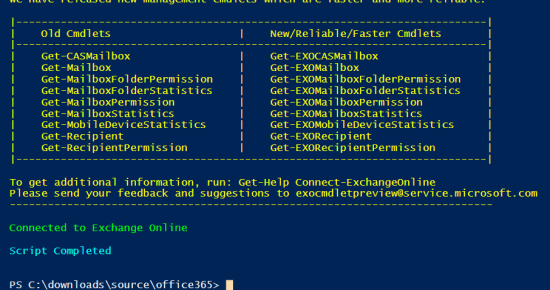
That should result in you being connected to Exchange Online PowerShell as shown above.

Once you have your PowerShell environment setup, you simply run the o365-mx-check.ps1 script at the PowerShell prompt.

image

After checking that the Exchange Online PowerShell module is loaded and connected, the script will loop through all the mailboxes in your tenant.

image

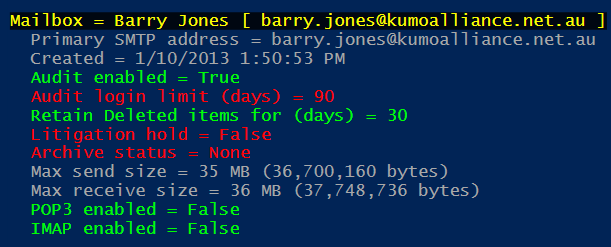
For each mailbox it will check and display a number of settings as shown above including:

  • Users Display name and principal name
  • The primary outbound email address the mailbox uses
  • When the mailbox was created
  • Whether auditing is enabled for the mailbox
  • What the maximum age limit of audit log entries for the mailbox
  • Deleted items retention period
  • If Litigation Hold is enabled
  • If mailbox archiving is enabled
  • The maximum message send size
  • The maximum message receive size
  • If POP3 is enabled for the mailbox
  • If IMAP is enabled for the mailbox

Items that are not best practices will be highlighted in red for your attention as shown above.

By default, these results will only display on the screen, however if you specify the optional –CSV parameter when you run the script like:

.\o365-mx-alert –csv

A CSV file with the output will be created in the parent directory.

image

You will see the name of the CSV created at the end of the script as shown above.

image

Each CSV file is timestamped to ensure that a unique file will be created each time the script is run.

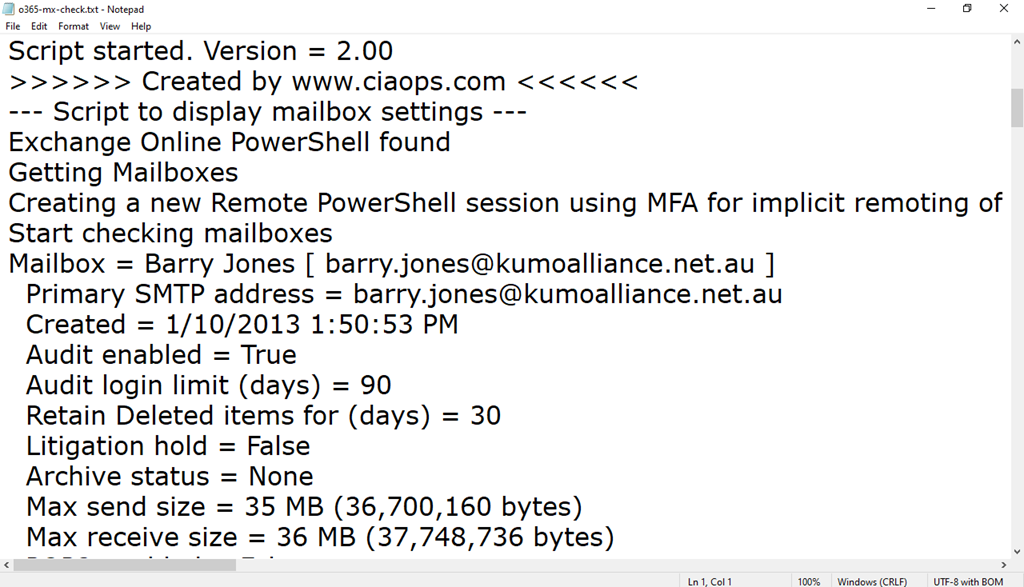
A log file, o365-mx-alert.txt is also created in the parent directory as well on each run.

image

The log file will be overwritten each time the script is run.

Thus, the o365-mx-check.ps1 script has 1 optional parameter, that can be used:

-csv = output all logs for period to a CSV file in the parent directory. A new CSV file is created for each script execution

The script will also produce a log file (o365-mx-check.txt) in the parent directory, that is overwritten on the each run of the script.

You will find this script and all my publicly available scripts at:

http://github.com/directorcia

Don’t forget to check back there regularly for updates. Also, if you have any feedback or suggestion on this script or what you’d like to see me create, please let me know. I also maintain a large array of additional scripts via a paid subscription. More details of that can be found at www.ciaopspatron.com.

Need to Know podcast–Episode 243

FAQ podcasts are shorter and more focused on a particular topic. In this episode I speak about what Office 365 ATP is and provide some best practice suggestions.

This episode was recorded using Microsoft Teams and produced with Camtasia 2020

Take a listen and let us know what you think – feedback@needtoknow.cloud

You can listen directly to this episode at:

https://ciaops.podbean.com/e/episode-243-office-365-atp/

Subscribe via iTunes at:

https://itunes.apple.com/au/podcast/ciaops-need-to-know-podcasts/id406891445?mt=2

The podcast is also available on Stitcher at:

http://www.stitcher.com/podcast/ciaops/need-to-know-podcast?refid=stpr

Don’t forget to give the show a rating as well as send us any feedback or suggestions you may have for the show.

Resources

CIAOPS Patron Community

Office 365 ATP

@directorcia

All the Defenders

knight

Microsoft unfortunately has quite a few products under the ‘Defender’ banner that I see causing confusion out there. Most believe that ‘Defender’ is only an anti-virus solution, but that could not be further from the case. Hopefully, I can show you here how broad the ‘Defender’ brand is here and hopefully give you a basic idea of what each ‘Defender’ product is.

To start off with there are products that are considered ‘Window Defender’ products, although I see the Windows and Microsoft brand intermingled regularly. Here is a list of specific ‘Windows Defender’ products:

Windows Defender Application Control – WDAC was introduced with Windows 10 and allows organizations to control what drivers and applications are allowed to run on their Windows 10 clients.

Windows Defender Firewall – By providing host-based, two-way network traffic filtering for a device, Windows Defender Firewall blocks unauthorized network traffic flowing into or out of the local device.

Windows Defender Exploit Guard – Exploit protection automatically applies a number of exploit mitigation techniques to operating system processes and apps.

Windows Defender Credential Guard –  Windows Defender Credential Guard uses virtualization-based security to isolate secrets so that only privileged system software can access them.

In contrast, here are the ‘Microsoft Defender’ products :

Microsoft Defender Smart screen – Microsoft Defender SmartScreen protects against phishing or malware websites and applications, and the downloading of potentially malicious files.

Microsoft Defender Antivirus – Brings together machine learning, big-data analysis, in-depth threat resistance research, and the Microsoft cloud infrastructure to protect devices in your organization.

Microsoft Defender Application Guard – helps to isolate enterprise-defined untrusted sites, protecting your company while your employees browse the Internet.

Microsoft Defender Security Center – is the portal where you can access Microsoft Defender Advanced Threat Protection capabilities. It gives enterprise security operations teams a single pane of glass experience to help secure networks.

Microsoft Defender Advanced Threat Protection – is an enterprise endpoint security platform designed to help enterprise networks prevent, detect, investigate, and respond to advanced threats.

Microsoft Defender Browser Protection –  a non Microsoft browser extension helps protect you against online threats, such as links in phishing emails and websites designed to trick you into downloading and installing malicious software that can harm your computer.

So, as you can see, there are quite a lot of ‘Defender’ products out there from Microsoft. How and when you get each of these varies greatly as well as their capabilities, since most will integrate together. That however, is beyond the scope of this article but maybe something I explore in upcoming articles.

For now, just be careful to investigate what is actually meant when it says ‘Defender’ in the Microsoft space!