Microsoft Purview Communication Compliance is an insider risk and compliance solution that helps organisations detect and remediate problematic communications within Microsoft 365[1]. It evaluates text and images in employee communications across email (Exchange Online), chat (Microsoft Teams), communities (Viva Engage/Yammer), and even supported third-party platforms (like WhatsApp or others via connectors)[2]. The goal is to foster a safe, compliant workplace by automatically flagging messages that violate internal policies or regulatory requirements – for example, harassing or threatening language, the sharing of sensitive confidential information, or communications that suggest regulatory breaches[1].
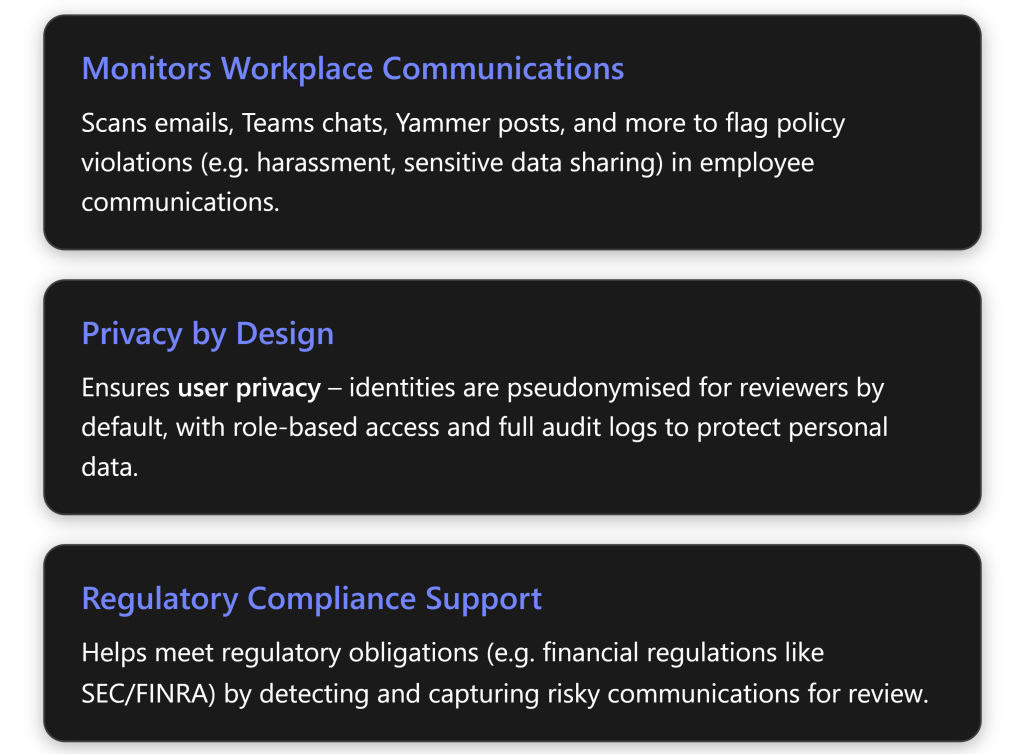
Key features: Communication Compliance uses a combination of machine learning classifiers and keyword matching to identify potential issues in messages[2]. It comes with built-in policy templates (for common scenarios like harassment, sensitive data leaks, etc.) and can also be customised to an organisation’s needs. Notably, the solution is “privacy by design” – user identities are hidden (pseudonymised) from compliance reviewers by default, and strict role-based access controls ensure only authorised investigators can review flagged content[1][3]. All reviewer actions (like reading a message or removing it) are logged in audit trails for accountability[1]. If a policy violation is confirmed, authorized reviewers can take remediation actions directly, such as removing an inappropriate message from Teams or notifying the sender’s manager about the misconduct[2]. Overall, the tool helps SMBs enforce their code of conduct and prevent small issues from growing into serious legal or compliance problems[3].
In the sections below, we’ll cover how to set up Communication Compliance in a Microsoft 365 environment step by step, outline common policies and effective usage tips (with examples like detecting harassment and data leaks), compare licensing options and costs in AUD for SMBs, and provide best practices for configuring policies and managing the review process.
Step-by-Step Setup in an SMB Environment
Setting up Communication Compliance in Microsoft 365 involves preparing your environment with the right licenses and permissions, then creating policies in the Purview compliance portal. The following steps assume you are an IT administrator or compliance officer for an SMB using Microsoft 365:
Tip: Before deploying company-wide, consider testing your policy on a small group. For example, create a pilot policy for the IT department to ensure the settings catch the intended content without overwhelming reviewers with false positives. You can refine dictionaries or severity thresholds, then expand the policy’s scope to all users.
By the end of this setup, you will have Communication Compliance actively monitoring the chosen communications in your SMB tenant. Next, we’ll look at how to use and manage these policies effectively on an ongoing basis.
Using Communication Compliance Effectively
Once policies are in place, the day-to-day value comes from how well the organisation manages the alerts and acts on them. Here’s how to use Communication Compliance in practice, along with common policy examples and use cases relevant to SMBs:
Alert Review and Remediation Workflow
When a message (or series of messages) triggers a Communication Compliance policy, it generates an alert in the Purview Compliance portal. Reviewers (the persons assigned in the policy) will be able to see these alerts in the Communication Compliance dashboard. Key aspects of the review process:
Alert details: An alert will show the policy that was triggered, the number of message hits, the severity, and other metadata. Reviewers can drill into the alert to see the actual content that was flagged. User identities in the content are masked by default (you might see usernames as “User1,” “User2,” etc.) to reduce bias[3]. A reviewer with sufficient privilege can de-pseudonymise the usernames if needed (typically after determining the issue is real and needs escalation).
Reviewing content: The reviewer reads the flagged communication in its context. For example, if an alert flagged a Teams chat message with a certain offensive phrase, the system will show a snippet of that chat conversation. This helps the reviewer understand the context (was it truly harmful or just joking banter, etc.). The system may also indicate which condition was matched – e.g. it might tag that a message matched the “Harassing language” classifier or contained a credit card number, etc., to help the reviewer understand why it was flagged.
Decision and action: The reviewer must then decide what to do:
If the content is a false positive or benign, they can mark the alert as “Resolved – no issues”. (They would typically add a note, e.g. “Flagged phrase was used out of context, not a policy violation.”)
If the content violates policy, the reviewer takes appropriate action. Communication Compliance provides built-in remediation actions:
Remove message: For Microsoft Teams chats or Yammer posts, the reviewer can delete the offending message from the user chat/channel directly from the interface[2]. (The user is notified that their message was removed due to a policy).
Notify user or manager: The reviewer can send a notification email to the person who sent the message, and/or that person’s manager, describing that the message was found to violate policy and what next steps are (this notice can be a gentle warning for first-time minor offenses, for example).
Escalate: If the issue is serious, the reviewer might escalate the case – for example, forwarding details to HR or legal department. If your organisation also uses Insider Risk Management, the reviewer can flag the user or incident for further investigation under that system (Communication Compliance can integrate with Insider Risk Management to share signals)[4].
Resolve with other remediation: Sometimes the action is outside the tool – e.g., a coaching conversation with the employee. The reviewer can still mark the alert as “Resolved” and note that HR will follow up offline.
Case management: Communication Compliance allows the reviewer to group related items into a case if needed (especially in regulated scenarios where a formal case file is needed, similar to eDiscovery cases). For SMB use, you might not need formal cases for each alert, but the option is there to bundle multiple related messages or continue tracking an ongoing investigation.
Continuous Improvement: As reviewers resolve alerts, they should flag if a particular policy is generating too many false positives or if users find creative ways to circumvent detection. For example, if employees start using code words to harass each other (to evade known keywords), the compliance team might need to add those to keyword dictionaries. Conversely, if harmless messages are frequently flagged, adjust the policy to be less sensitive (or refine the keyword list).
Common Policy Scenarios and Examples
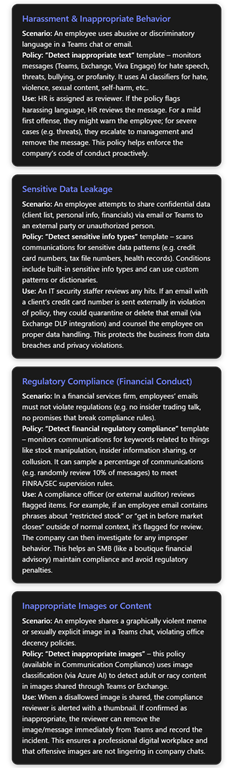
Communication Compliance can address a variety of communication risks. Here are some common policies – likely relevant to SMBs – and how they work in practice:
Other scenarios: Microsoft also provides a “Conflict of interest” policy template aimed at preventing communication between two groups that should stay separate (for example, to enforce information barriers between a sales team and a procurement team during a tender). This template typically flags communications if members of Group A and Group B are in the same thread[4]. However, note that for strict separation, Information Barriers (a separate feature) can be configured to technically block such communications outright[5]. Communication Compliance in this case acts as a backstop or monitoring tool in case some channels aren’t covered by information barriers.
Additionally, a new capability in Teams and Viva Engage allows users to report messages they find inappropriate. When enabled, users can click “Report inappropriate content” on a Teams message, which submits it to Communication Compliance for review[4]. These user-reported incidents are collected under a special policy in Communication Compliance (with AI classifiers helping to categorise the reported content)[4]. This feature can greatly augment automated policies – especially in SMBs where the volume of messages is lower, empowering employees to flag issues helps the compliance team catch things that automated policies might miss (like subtle context or new slang). We recommend training your staff on how to use the Teams “report” feature and fostering a culture where people are comfortable reporting misconduct.
Ongoing Management
To use Communication Compliance effectively, treat it as an ongoing program, not a “set and forget” tool. Some tips for SMBs:
Regularly check the Compliance dashboard – Ensure assigned reviewers have a schedule (daily or weekly, depending on alert volume) to review new alerts promptly. Delayed responses diminish the value of catching issues early.
Leverage the reports – The Purview Compliance portal provides overview dashboards and detailed reports of policy matches over time[1]. These can highlight trends, like a spike in attempts to send sensitive data, or recurring harassment issues in a particular team, etc. Use these insights to inform management – e.g., maybe the company needs a reminder training on harassment if there are many instances being flagged.
Adjust policies as needed – As your business grows or regulations change, you may need to update who is covered by policies or add new ones. For instance, if your SMB enters a new industry or starts handling health data, you might introduce a HIPAA-related communication compliance policy. Microsoft continually updates classifiers (and adds new sensitive info types or AI models), so keep an eye on the Communication Compliance release notes for improvements that you can take advantage of.
Next, we will look at the licensing requirements for Communication Compliance and how SMBs can obtain these capabilities in a cost-effective way, including a comparison of Microsoft 365 plans.
Licensing and Pricing (AUD) for SMBs
Because Communication Compliance is an advanced feature, it’s only included in certain Microsoft 365 plans or add-ons. SMBs have a few options to license it. Below is a comparison of plans relevant to small and mid-sized businesses, their capabilities with respect to Purview compliance, and approximate pricing in Australian dollars (AUD):
Available Licensing Options:
Microsoft 365 Business Premium – Aimed at SMBs (up to 300 users). This plan includes all Office apps and many security features, and some baseline compliance features (like Office 365 DLP, information protection labels, and basic eDiscovery)[6]. However, it does not include Microsoft Purview Communication Compliance or other advanced Purview solutions by default[6]. Business Premium users can add certain functionality via add-ons (see below).
Microsoft 365 E3 – An enterprise plan (no user limit) that includes Office apps and standard enterprise security/compliance features. Like Business Premium, E3 on its own does not include Communication Compliance – it provides core compliance (DLP, retention, eDiscovery Standard, etc.) but not the Insider Risk solutions[6]. To get Communication Compliance, an E3 customer would need to purchase an add-on such as “E5 Compliance” or “Insider Risk Management” for the relevant users.
Microsoft 365 E5 – The top-tier Microsoft 365 plan. E5 includes Communication Compliance natively, along with the full suite of Purview compliance features (Insider Risk Management, Advanced eDiscovery, Audit (Premium), Records Management, etc.) and all advanced security features. Essentially, E5 gives you everything – but at a higher cost. Many larger organisations choose E5 for its breadth. SMBs may consider it if they have high compliance requirements and budget.
Purview Add-ons – Microsoft offers add-on licenses that extend the capabilities of lower-tier plans without requiring a full upgrade to E5. Key add-ons:
Microsoft 365 E5 Compliance – This add-on includes the entire set of E5 compliance features (Information Protection & Governance, Communication Compliance/Insider Risk, eDiscovery & Audit) for a user. It can be added to Business Premium, E3, or even Office 365 plans. If an SMB only needs the compliance features (and not the E5 security features), this is a cost-effective route. Pricing: roughly A$18 per user/month (≈A$216 per user/year) for this add-on in Australia[5].
Microsoft 365 E5 Insider Risk Management – a more focused (and slightly cheaper) add-on that specifically includes Insider Risk Management and Communication Compliance features[7][7]. This could be an option if you don’t need the full compliance suite. (For example, you might pair this with Business Premium to get just the insider risk solutions).
Microsoft 365 E5 Information Protection & Governance – includes labeling, encryption, DLP, records management (but not Communication Compliance, since that falls under the Insider Risk category). This is more for advanced data protection without the comm surveillance piece.
It’s important to note that any user whose communications are being monitored, or who is performing reviews, must be licensed for the feature[8]. In practice, this means if you apply a Communication Compliance policy to all employees, all those employees need a license that covers it (either via E5 or an add-on). If only a subset of users are monitored (say, just the finance department), only those users need the advanced compliance license. Reviewers also need a license. You don’t have to license users who are completely outside the scope of any Communication Compliance policies.
Below is a summary table comparing the plans:
Plan / Add-on
Purview Compliance Features
Includes Comm. Compliance?
Price (AUD)
Microsoft 365 Business Premium
– Office apps, EMS security (Defender for Business, etc.) – Basic compliance: data classification, DLP (Office 365), retention, eDiscovery (standard).
No. Lacks advanced Purview solutions like Communication Compliance, Insider Risk, Advanced Audit.
~A$36.19 per user/month
Microsoft 365 E3
– Office apps, EMS (Azure AD P1, etc.) – Compliance: Includes all Business Premium features plus mail archiving, legal hold, SharePoint and Teams audit/search, etc. – Lacks advanced AI-driven compliance tools.
No. (Requires add-on for Comm. Compliance).
~A$58.63 per user/month
Microsoft 365 E5
– All E3 features plus: Advanced Compliance: Communication Compliance, Insider Risk Mgmt, Advanced eDiscovery, Audit (1yr retention), Records Mgmt. Advanced Security: Defender for Endpoint, Defender for O365 P2, Azure AD P2, etc. Phone System, Audio Conferencing.
Yes. Fully included (Communication Compliance and all Purview features are active).
~A$90.09 per user/month
M365 E5 Compliance Add-on
– Adds all E5 Compliance suite to lower plans: Communication Compliance, Insider Risk Advanced eDiscovery, Audit (Premium) Records management, Information Protection (auto-labeling, etc.) (Does not include E5 security features)
Yes. (When combined with, e.g., E3 or Biz Premium, it lights up Comm. Compliance features).
~A$18.00 per user/month
1Approximate per-user monthly price, based on Australian commercial pricing (annual commitment). Actual prices may vary slightly by provider; e.g., one Australian partner lists Business Premium at A$36.19 and E5 at A$90.09[2]. These may be ex-GST.\ 2A$216 per user/year, as listed for an annual license[5].
In summary, SMBs with Business Premium can access Communication Compliance by either upgrading specific users to an E5 plan or more economically by adding the E5 Compliance add-on for those users. For instance, a 100-person company might license 5 HR and IT staff with E5 Compliance add-ons (so they can monitor all communications) and the rest remain on Business Premium. SMBs with E3 (perhaps those who’ve outgrown the 300 user cap of Business Premium) can do similarly – purchase E5 Compliance add-ons for the users that need these capabilities, or consider full E5 for broadest coverage.
If you are unsure, Microsoft does offer a 90-day trial of Purview Compliance features for up to 25 users[1]. This is a great way for an SMB to pilot Communication Compliance (and other features like Insider Risk Management) to assess its value before committing to the additional licensing cost.
Best Practices for Configuration and Review Workflows
Implementing Communication Compliance effectively requires more than just technology – it involves process and policy decisions. Here are some best practices for SMBs to get the most value while respecting employee trust:
Align Policies with Company Culture and Risk: Tailor your communication compliance policies to the actual risks and culture of your organisation. For example, if your company has a zero-tolerance stance on harassment, ensure your policies for offensive language are comprehensive. If you handle sensitive client data, focus on data leakage policies. Avoid overly broad surveillance that isn’t warranted – monitor what matters most to your business’s compliance and ethical requirements.
Be Transparent with Employees: It’s generally advisable (and legally prudent in many jurisdictions, including Australia) to have an acceptable use policy that notifies employees that their communications may be monitored for compliance purposes. Transparency helps maintain trust. Emphasise that these tools exist to protect the company and employees from risks (like a hostile work environment or inadvertent data breaches), not to snoop on personal matters. In an Australian context, employee privacy laws allow monitoring with proper purpose and employee notification, so make sure to document this in your employee handbook or IT policy.
Limit Access – Need to Know: Only a small, designated team should have access to Communication Compliance results. Typically, this might be HR and a compliance officer, or an IT security lead. Because the content can be sensitive (personal conversations, etc.), minimise the number of eyes on it. Use the role-based access controls – e.g., only members of the “Compliance Investigators” role group can review messages[1]. Having too many people with access could both violate privacy principles and increase the risk of internal leaks or gossip. Always uphold the principle that privacy is protected except when a genuine compliance concern justifies escalation.
Tune for Signal over Noise: When first enabling a policy, you might get a lot of alerts – not all will be true issues. It’s important to fine-tune policies to reduce false positives. Leverage the classifier confidence levels (if available) or add exclusion keywords if needed. For example, innocent phrases can sometimes trigger a harassment policy (e.g., the word “shoot” in “shoot me an email” could technically trigger a violence classifier). If you see these patterns, update the policy to refine the logic (such as excluding certain contexts or words). Microsoft’s AI models will also learn and improve – you can provide feedback by marking things as false positives which helps the system adapt over time.
Regular Reviewer Training: Ensure the people reviewing the alerts know how to interpret and handle them. They should be familiar with company policies (HR and compliance guidelines) so they can judge whether something truly constitutes a violation. For instance, distinguishing between a joke and harassment can be subtle – context is key. Reviewers should also know the remediation steps: e.g., how to remove a Teams message, how to notify a user properly, and when to involve higher authorities. Microsoft provides documentation and even certification training for compliance features, which can be useful if the stakes are high (though in a small business, on-the-job training and clear internal procedures may suffice).
Workflow Integration: Define what happens after a reviewer flags something as a real issue. Do they notify HR formally? Do they create a case file? SMBs might not have a formal compliance committee, but you should decide, for example: “If a serious harassment incident is detected, HR will handle disciplinary action as per our policies. If a data leak is detected, IT will immediately contain it (like blocking that email) and we’ll inform the client if required by law.” Having these procedures in place ensures that the tool actually triggers effective responses and isn’t just generating alerts that no one follows up on.
Balance Monitoring with Trust: Communication Compliance is a powerful tool – but use it responsibly. Avoid the temptation to over-monitor. For example, it’s usually not productive to flag every instance of casual swearing between teammates as an “HR incident” if that’s part of the office culture in harmless ways. You might set the harassment policy to catch direct insults or slurs rather than every profanity. This way, employees don’t feel overly policed for minor things, and when an alert does come, it’s taken seriously. In short, calibrate the policies so that they catch truly problematic behavior and ignore the trivial.
Periodic Policy Reviews and Audits: Schedule a regular review (say, every quarter) of your Communication Compliance setup:
Check if the policies are still aligned with any new regulations or internal policy changes.
Review metrics: How many alerts per policy? False positive rate? Use these to adjust thresholds.
Ensure all licensed users still need to be covered – e.g., if someone left the company or changed roles, update your scopes.
Consider if new communication channels being adopted (maybe your org starts using a new third-party app – you might ingest that via a connector into Purview so it’s also monitored).
Combine with Other Purview Solutions: Communication Compliance is one piece of a broader compliance strategy. SMBs should also take advantage of related tools:
Data Loss Prevention (DLP): While Communication Compliance can catch data leaks after the fact, DLP policies (in Exchange, Teams, etc.) can prevent or block sensitive info from being sent in the first place. Use DLP and Communication Compliance together – DLP to block obvious policy violations in real-time, and Communication Compliance to review more nuanced or contextual issues that slip past DLP.
Insider Risk Management: If you have E5 add-ons, Insider Risk Management can correlate communication signals with other signals (like file downloads, odd user activity) to flag high-risk patterns (e.g., an employee who is about to quit and is behaving suspiciously). A Communication Compliance alert (like someone emailing themselves a client list) can increase an insider risk score. For an SMB, this might be overkill, but for those dealing with very sensitive data, it’s worth exploring.
Compliance Manager & Audit: Use Compliance Manager to track your overall compliance posture and improvement actions. Use Audit (Standard/Premium) to search log data if you need to investigate how a particular incident happened beyond the communication itself.
Document and Communicate Outcomes: When Communication Compliance does surface a real issue and it’s dealt with, consider if there’s a lesson for the wider organisation. For instance, if several people were flagged for discussing confidential project details in a public Teams channel, maybe send a gentle company-wide reminder about information handling guidelines (without naming anyone, of course). The tool’s purpose is partly preventive – but educating users will amplify its effectiveness by reducing incidents in the first place.
By following these best practices, an SMB can effectively use Microsoft Purview Communication Compliance to maintain a professional and secure communications environment. The end result is a workplace where employees are protected from harassment, sensitive data is protected from slipping out, and the organisation stays on the right side of compliance requirements – all without unduly infringing on privacy or trust. With the right licensing in place[6] and a thoughtful implementation, even a smaller organisation can benefit from the same level of oversight and protection that large enterprises enjoy with Microsoft’s compliance solutions.
References: All information in this report was gathered from Microsoft’s official documentation and licensing guides, as well as industry sources, to ensure accuracy and relevance for an Australian SMB context. Microsoft Learn documentation on Communication Compliance[1][4], Microsoft’s service descriptions and licensing FAQs[2][6], and expert commentary were used throughout to provide a comprehensive overview. Pricing information was referenced from Australian Microsoft 365 partners and Microsoft’s own pricing disclosures[2][5] (all prices are in AUD). Please consult with a Microsoft licensing specialist for the latest pricing and compliance requirements, as these can change over time.
Microsoft Purview Insider Risk Management (IRM) is a solution in the Microsoft Purview compliance suite designed to help organisations proactively identify and mitigate internal threats. This report provides an overview of IRM, guidance on deploying it in a small or medium-sized business (SMB) environment, best practices for effective use (including privacy and integration considerations), licensing/cost details in Australian dollars (AUD), and a summary of recent enhancements relevant to SMBs.
1. Overview: What is Microsoft Purview Insider Risk Management?
Microsoft Purview Insider Risk Management (IRM) is a cloud-based insider threat detection and mitigation solution within Microsoft 365’s Purview (compliance) suite. Its purpose is to help organisations minimise internal risks by detecting, investigating, and acting on potentially malicious or inadvertent activities performed by users[1]. IRM addresses modern workplace risks such as data leaks, intellectual property (IP) theft, confidentiality or policy violations, insider trading, fraud, and other inappropriate internal actions[1]. Unlike perimeter security tools, IRM focuses on authorised insiders (employees or contractors) whose behaviour might pose a threat, whether intentionally or by accident.
Key Features and Capabilities: Microsoft Purview IRM provides a rich set of features to monitor and manage insider risks:
Machine-Learning-Driven Signals: IRM correlates a broad range of user activity signals across Microsoft 365 and Windows endpoints (and even some third-party platforms) to identify suspicious patterns[1]. For example, it can track file downloads from SharePoint, unusual email forwarding, mass file deletions, copying of files to USB devices, or abnormal Teams communications. These signals are analysed to generate risk indicators (such as “download of sensitive files” or “mass deletion”) and are evaluated by built-in analytics to determine if they deviate from normal behaviour[2][1].
Risk Policies with Templates: Administrators can create insider risk policies using a set of predefined templates that target common scenarios[1]. There are over 10 ready-to-use policy templates covering cases like Data theft by departing users, Data leaks (general or by privileged users), Security policy violations, and specialised cases (e.g. “Risky AI usage” and “Patient data misuse”)[1]. Each policy defines the conditions (triggering events and risk indicators) to watch for – for instance, a “Departing user” policy might trigger when an employee is added to an HR exit list and starts downloading large amounts of confidential data. Policies also define which users or groups are in scope, which services/locations to prioritise (SharePoint, Exchange, endpoint, etc.), and the time window to observe. These templates enable quick deployment of industry-standard detection rules, which can then be customised to the organisation’s needs.
Risk Scores, Alerts and Dashboards: When user activities match a policy’s conditions, IRM will generate an alert. The alert includes a risk score/severity (low, medium, high) calculated based on the frequency and criticality of the activities[1]. All active alerts are visible in the Insider Risk Management dashboard in the Purview compliance portal, where a risk analyst can triage them. The dashboard provides an overview of alerts by status, severity, time detected, and indicates any associated risk factors[1] (e.g. if the user has a history of prior incidents). This allows the organisation’s designated reviewers to quickly identify and prioritise alerts that need investigation. Alerts can be filtered and sorted to focus on those needing immediate attention (for example, all “High severity” alerts in the last 24 hours)[1].
Case Management and Investigation Tools: For each alert (or group of related alerts) that warrants deeper investigation, IRM allows creation of a case. A case in IRM is a container that holds all information and evidence related to a particular insider risk incident. The Cases dashboard shows all ongoing cases, trends over time, and stats like average time to closure[1][3]. Inside a case, investigators have a rich toolkit:
A user activity timeline that charts the sequence of risk events by date and risk level[1]. Investigators can interactively explore what the user did (e.g. accessed 50 files, attempted to print a confidential document, etc.) before and after the alert, helping identify patterns or escalation.
Content explorer that automatically collects copies of files, emails, or messages related to the policy violation[1]. For example, if the alert was triggered by file downloads, the actual files or filenames can be reviewed; if it was an email-forwarding incident, the email content can be inspected. This provides crucial evidence in context.
Built-in workflow actions, such as the ability to dismiss benign activities, add notes, or escalate the case to eDiscovery (now called Advanced eDiscovery) for further legal hold and forensic investigation[1]. Escalation to eDiscovery (Premium) is useful if the incident might lead to legal action or requires broader content search beyond what IRM automatically collected.
User Privacy and Role Separation: A fundamental principle of IRM is privacy by design. By default, usernames are pseudonymised in the IRM dashboard (e.g. shown as “User1”, “User2”) so that risk investigators focus on the behaviours first, reducing potential bias[1]. Investigators cannot see the actual user identity until they explicitly “Unlock” it (which is an auditable action) or if they have appropriate permissions to de-anonymise. Additionally, only users in specific Purview role groups (such as “Insider Risk Management Admin” or “Insider Risk Analyst”) can access IRM data[4][4]. This role-based access control ensures that insider risk investigations are handled by authorised personnel (for example, a security officer or HR investigator) and not visible to those who shouldn’t see sensitive details. All actions in IRM (viewing an alert, resolving a case, etc.) are logged for audit purposes to ensure accountability[1]. This privacy-focused design helps organisations implement insider monitoring ethically and in compliance with privacy laws, which is especially important in regions (like the EU or Australia) that have strict regulations on employee monitoring.
Integration with Other Purview and Security Solutions: IRM does not operate in isolation; it benefits from and contributes to other Microsoft 365 security and compliance tools:
It leverages Microsoft 365 audit logs and other services as inputs. IRM uses the logs and events from Exchange, SharePoint, OneDrive, Teams, Windows, and even Defender for Cloud Apps to gather the signals it needs[1]. For instance, if you have Microsoft Purview Data Loss Prevention (DLP) policies, an act that triggers a DLP alert (like an attempt to email out a credit card number) can be consumed as a signal in IRM as well. In this way, IRM correlates with DLP – DLP might block or warn on a specific activity, while IRM looks at the pattern of activities around it to gauge user risk.
IRM is closely related to Communication Compliance, another Purview feature that scans communications (email, Teams chats) for policy violations like harassment or sensitive data sharing. While Communication Compliance focuses on reviewing message content, IRM focuses on user behaviour patterns. They complement each other: for example, if Communication Compliance flags a user for attempting to share confidential info via Teams, IRM can take that into account as a risk indicator. Microsoft even provides a combined workflow (via Microsoft Mechanics) to show how these solutions work together[1].
For serious incidents, IRM cases can be escalated to eDiscovery (Premium) as mentioned. This integration ensures that if legal investigation is required, all data collected by IRM flows into the eDiscovery workflow seamlessly[1].
Adaptive Protection: A newer capability in Purview allows dynamic adjustment of DLP or other controls based on IRM’s risk score for a user. For example, if IRM deems a user “high risk” (perhaps they have multiple serious alerts), the system can automatically impose stricter DLP rules on that user (like blocking any external sharing of files) via Adaptive Protection policies[3][3]. This showcases a powerful integration where IRM’s analytics inform preventative controls in real time.
Microsoft Defender Integration: In a security operations centre (SOC) scenario, insider incidents can appear similar to external attacks. IRM now integrates with Microsoft Defender XDR (Extended Detection & Response) tools used by SOC analysts. IRM’s insights (like the user’s risk level or history of data downloads) are surfaced in Defender’s incident pages[2][2]. This helps the SOC distinguish between a compromised account vs. a malicious insider. (We discuss this more under recent enhancements.) In short, IRM is part of the broader Microsoft 365 “inside-out” defence strategy, working hand-in-hand with other tools to provide a 360-degree view of risks.
In summary, Microsoft Purview Insider Risk Management serves as a centralized internal risk management hub – it enables SMBs to spot risky user behaviour early, investigate incidents thoroughly (with minimal privacy intrusion until necessary), and respond decisively (either by corrective action, enforcement through other tools, or involving HR/legal teams). It fits within the Microsoft Purview compliance suite as the solution focused specifically on people-centric risks inside the organisation, complementing other solutions that focus on data protection and external threats.
2. Step-by-Step Deployment Guide for an SMB
Deploying Insider Risk Management in an SMB environment involves preparing the tenant, configuring the tool, and tuning it to your organisation’s needs. Below is a step-by-step guide covering prerequisites, setup, and initial policy configuration.
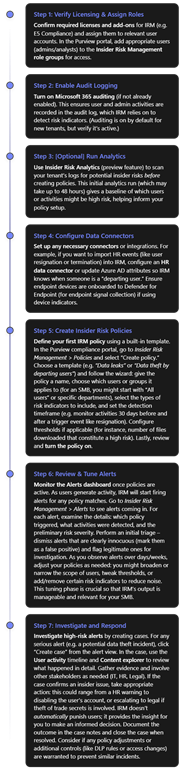
Step 1: Licensing and Permissions. Before anything else, ensure your organisation’s Microsoft 365 subscription includes Insider Risk Management. IRM is considered an advanced compliance feature and is not included in the base SMB plans by default (for example, it’s not part of Microsoft 365 Business Premium)[5]. The section on Licensing and Costs later in this report details the options; commonly, SMBs will either utilize a Microsoft 365 E5 plan or a Microsoft 365 E5 Compliance add-on to get IRM. If you don’t yet have the licenses, Microsoft offers a 90-day trial for Purview solutions which could be used to pilot IRM at no cost[4]. Once licensing is in place, assign the IRM licenses to the user accounts that will be monitored and to the admins who will manage the system (typically you’d license all users for compliance features like IRM to be safe). Next, set up permissions: in the Microsoft Purview compliance portal, navigate to Roles and add the appropriate people to Insider Risk Management roles (e.g. “Insider Risk Management Admin” for those who configure policies, and “Insider Risk Management Analysts” for those who will review alerts)[4]. By design, Global Admins do not automatically see IRM—you must be in one of these IRM-specific role groups to access the insider risk dashboards.
Step 2: Turn on Audit Logging. IRM draws on M365’s unified audit log to get much of its signal data. For IRM to function, audit logging must be enabled for your tenant[4]. Most tenants have this on by default (and any Microsoft 365 Business Premium or E3/E5 tenant will have basic audit capabilities), but verify by going to the Audit section in the compliance portal. If it’s off, turn it on (note: after enabling, it may take a few hours to start recording events)[4]. Without audit logs, IRM policies won’t trigger because they have no data to analyze. Also ensure that users and administrators are aware that audit logging is active (for transparency).
Step 3: Optional – Insider Risk Analytics. Microsoft Purview IRM includes an Analytics feature that can be run in “analysis mode” without any active policies. This is optional but highly recommended, especially for first-time setup. The analytics scan combs through your existing audit logs to identify any activities or users that appear risky before you even configure formal policies[4]. Think of it as a baseline risk assessment. For example, analytics might surface that a particular user has been mass downloading files or that there’s an unusual spike in permission changes in SharePoint. Running this can help you pinpoint where to focus your policies (perhaps your organisation has more of a data leakage issue vs. HR-related issues, for instance). You can start an analytics scan from the IRM Overview page in the Purview portal by enabling “Insider risk analytics”. Give it at least a day or two (up to 48 hours) to complete the scan and generate the analytics report[4]. The output will highlight top risk factors and potentially recommend policy templates to implement. This step is particularly useful for an SMB to right-size their approach and not enable every policy blindly. (It’s worth noting that the analytics feature might require the higher-tier license as well, since it’s part of the IRM solution.)
Step 4: Configure Connectors & Indicators (if needed). Out-of-the-box, IRM will already use many internal signals from M365 workloads. However, you should consider if you need to configure any connectors for additional signals:
HR Connector for Departing Users: If you plan to use policies related to employees leaving the company, you should feed IRM with information about separations. In an enterprise, this is often done via an HR system connector (e.g. connecting Workday or SAP SuccessFactors into Azure AD or directly into Purview). In an SMB, you might not have a fancy HR system – but you can still inform IRM of departure events by using the “User resignation” data connector in Purview or simply by updating the user’s profile in Azure AD with a termination date. Microsoft Purview can import a CSV or use Azure AD attributes to mark someone as scheduled to leave[6], which triggers the “departing user” condition in relevant IRM policies. Configuring this ensures that when someone is put on notice or given their resignation, IRM policies for departing users will properly scope that person and apply heightened monitoring during the critical window around their exit.
Endpoint and Cloud App Indicators: If your organisation wants to monitor actions like files being copied to USB drives, printed, or uploaded to cloud services like Dropbox, ensure that Microsoft Defender for Endpoint (if available via your license) is deployed on your user devices. For SMBs using Microsoft 365 Business Premium, Defender for Business provides some endpoint DLP capabilities that integrate with Purview. Check that devices are onboarded in the Microsoft 365 Defender portal so that endpoint signal (like device file events) flow into IRM. Similarly, if you want multi-cloud visibility (e.g., to get alerts when someone moves files to an unsanctioned cloud service), you might have had to enable a preview connector. As of late 2024, IRM introduced multi-cloud indicators (for Box, Dropbox, Google Drive, AWS, etc.) that can be toggled on, provided you link an Azure subscription for billing (more on this in Recent Updates)[7][7]. Decide which of these indicators are relevant to your SMB and enable them in Insider Risk Management > Settings if needed. Many SMBs may primarily focus on the core Microsoft 365 signals, but it’s good to know the system can extend to other cloud sources if your users commonly use them (for example, if some departments still use Dropbox for file sharing, you’d want IRM to catch risky moves there as well).
Step 5: Create and Customise Policies. With groundwork laid, proceed to create your insider risk policies:
Navigate to the Insider Risk Management section in the compliance portal and select “Policies”. Click “+ Create policy”. A wizard will guide you.
Choose a Template: Pick a template that aligns with a risk you’re concerned about. For an SMB just starting, two common ones are “Data leaks” (to catch general exfiltration of sensitive info) and “Data theft by departing users” (to monitor users who leave). The template will pre-select a set of indicators and a trigger. For example, Data leaks might look at things like mass file downloads, sharing files externally, etc., without needing a specific trigger event. Departing users template, on the other hand, will focus on users flagged as leaving.
Name and Description: Give the policy a meaningful name (e.g. “Contoso – Departing User Data Theft Policy”) and description so others know its purpose.
Scope (Users/Groups): Decide which users the policy will apply to. You can include or exclude users or Azure AD groups. In SMBs, it might be fine to include everyone initially. Alternatively, you might exclude executive accounts at first if you’re concerned about privacy, or vice versa mark only a certain group as “priority users.” (IRM has a concept of priority users for heightened monitoring of key roles – you can configure a list of priority users in the settings. There are also separate template variants for priority users[1]).
Indicators and Triggering Events: Depending on the template, you may have options to refine what activities to watch. For example, in a Data leaks policy you can choose to monitor only files with certain sensitivity labels or only activities in specific SharePoint sites. In a Departing user policy, you will confirm what constitutes the “flight risk” trigger (usually it’s when the user is added to the HR departure list or disabled account). Ensure the indicators (like file downloads, printing, emailing attachments, etc.) make sense for your environment. Microsoft’s defaults are usually a good start, covering a broad range of risky actions.
Timeframe: Set how far back and forward to look around a trigger event (for policies that have one). For instance, watch 30 days before and 30 days after a user’s termination date. For continuous policies (like Data leaks), you’ll set a monitoring interval (e.g. alert on risky activities within a 7-day window).
Thresholds and Alerting: Some policies let you adjust thresholds – e.g., only alert if more than 100 files are downloaded in a day. Initially, you might keep the default values until you gather some data on what’s normal. Templates often come with research-based defaults. You can also set whether to alert on every event or only if a certain combination of events occur. Keep in mind SMBs might have fewer events overall, so you might lower certain thresholds (e.g., 20 files downloaded by one user might already be unusual in a 10-person company, whereas in a 1000-person company it’s not).
Review and Create: Finish the wizard to create the policy, and make sure to turn it from “Test” mode to “Active” if you want real alerts. (There is a mode where you can simulate policies without generating alerts, but in SMBs it’s usually fine to go live, especially after doing an Analytics scan).
Repeat the above to create multiple policies if needed. A cautious approach for SMBs is to start with one or two policies that address your top concerns rather than enabling everything at once – this prevents overwhelming your team with alerts. Over time, you can add more policies (for different scenarios) as you become comfortable managing them.
Step 6: Monitoring Alerts and Tuning Policies. Once policies are active, IRM will begin monitoring user activities. Alerts will appear on the IRM Alerts page. At this stage:
Establish a routine for alert review. For example, your IT manager or security officer might check the IRM dashboard daily or get email notifications (you can configure alert digest emails) if something triggers. In a small business, the person in charge of IT or compliance often takes on this role.
When an alert comes in, click into it to see details: which user (pseudonymised as UserX until you reveal), what activities triggered it, and why it was flagged (e.g. “User downloaded 50 confidential files and uploaded 10 files to a personal Dropbox” might be listed under activities). Each alert shows the severity (low, medium, high) and the status (e.g. “Needs review”)[1].
Triage the alert: Determine if it’s a true risk or a false positive. For example, maybe an employee legitimately moved documents to a SharePoint site but IRM flagged it as unusual – upon checking, you realise it’s part of their job. You can then resolve the alert as benign (dismiss it). If it’s potentially concerning (not obviously benign), leave it open for deeper investigation (or immediately escalate to a case if it looks very serious).
As you handle alerts, you’ll learn whether your policies are too sensitive or not sensitive enough. Adjust the policies accordingly in the Purview portal. This might include: changing thresholds (maybe require 200 files downloaded before alert to cut down noise), adding an exclusion (e.g. exclude the Finance group from a particular policy if their large data exports are always causing alerts but are expected), or including additional indicators to catch missed incidents. Policy tuning is an iterative process. The goal is to reach a point where when an IRM alert fires, it is something truly worth looking at. Microsoft provides guidance in the dashboard via the Analytics feature which can suggest threshold changes (if you enabled Analytics, it can recommend tuning adjustments in real-time)[3].
Step 7: Investigating Incidents and Taking Action. For alerts that are confirmed as actual issues, use IRM’s case management to dig deeper:
Create a Case from the alert (or add the alert to an existing case if it’s related to an ongoing investigation). In SMBs, it’s unlikely you have too many simultaneous cases, but using the case feature helps keep a record of what’s been investigated.
In the case view, examine the User Activity timeline to reconstruct the user’s sequence of actions[1]. For example, you might see the user signed into their account at 8 AM from a new location, then at 9 AM downloaded a customer list from SharePoint, at 9:30 AM copied that to a USB drive, and at 10 AM attempted to delete a bunch of files. Plotting this out can tell a story – maybe they were preparing to leave and tried covering tracks, or maybe their account was compromised by an attacker (compare with their usual pattern).
Use the Content Explorer to open or download copies of the files in question[1]. Check if the content is indeed sensitive. Sometimes IRM might flag a bulk action that isn’t actually harmful if the files are benign. Conversely, it might find the user also emailed those files out – the content explorer would show the email.
Document findings in the case notes. If multiple people are involved in response (maybe an external IT consultant or a manager), you can share the case report with them (there’s an option to email a link to the case or export a summary).
Decide on the response: Since SMBs may not have dedicated HR or security investigators, this likely involves leadership. You might have a conversation with the user to get an explanation, or you might immediately revoke their access if malfeasance is evident. IRM itself can’t automatically punish a user, but you can integrate it with other tools for response. For example, if you confirm that a user is leaking data intentionally, you could create a Power Automate flow that, when an IRM alert is tagged high severity, it alerts management and locks the user’s account. In smaller setups, manual action (disabling account, asking the user’s manager to follow up, etc.) is more likely.
If the incident could have legal implications (e.g. theft of intellectual property), escalate the case to eDiscovery (Premium). With a click, IRM can send all its collected data to an eDiscovery case where legal teams can do a broader content search, preserve data (legal hold), and eventually export data for legal proceedings[1]. This is more relevant if you plan to pursue the matter legally or need to provide evidence to authorities.
Completing these steps sets up Microsoft Purview IRM in your SMB environment and initiates an ongoing cycle of monitoring and improvement. Remember that insider risk management is not a “set and forget” tool – it requires active management and periodic reassessment of policies as your business evolves. That said, after the initial heavy lift of configuration and tuning, many SMBs find that only a modest amount of time each week is needed to review IRM alerts once the system is calibrated to your normal operations.
3. Best Practices for Effective Use in SMBs
Implementing Insider Risk Management is not just a technical exercise – it also involves process and culture. Here are recommendations and best practices tailored for SMBs to use IRM effectively:
Target the Most Relevant Risks: Align IRM with your specific business context. For example, if you’re a software development startup, source code leakage might be your top concern – focus on policies that watch for large code repository downloads or sharing code outside approved channels. If you’re a professional services firm, client data confidentiality would be key – a policy for detecting bulk client file downloads or unusual email forwarding might be priority. Start with 1-3 core policies that cover your greatest “insider worry” scenarios rather than enabling all templates. This keeps management manageable and addresses the issues you care about most. You can always broaden coverage later as needed.
Tune Noise Down, Signal Up: In a smaller organisation, certain defaults may be too broad or trigger too often. Don’t hesitate to adjust sensitivity. For instance, a template might consider 5 deleted files as a risk – but if every employee typically deletes dozens of files (like cleaning up folders), that threshold is too low for you. Increase it to something more meaningful. Conversely, if something is very sensitive in your context (say any email sent to a personal address should be flagged), you might tighten a rule. Take advantage of IRM’s analytics recommendations if available – the system can suggest threshold changes to reduce unnecessary alerts[3]. The end goal is that when an alert comes through, it truly requires attention. During initial rollout, plan to spend a few weeks refining the policies. This investment will pay off by saving you time later and avoiding “alert fatigue”.
Regular Alert Triage and Response: For IRM to be effective, you need a consistent process to handle its output. Define who will review alerts and how often. In an SMB, this could be a role for the IT administrator, security officer if you have one, or a managed service provider (MSP) if you use one. Treat it similarly to how you handle antivirus or firewall alerts – it’s part of the security monitoring routine. We recommend checking the IRM dashboard at least once a day or set up email notifications for new High severity alerts, so you don’t miss something critical. When reviewing:
Document decisions: If you dismiss an alert as false positive, add a note why (IRM allows notes on alerts/cases). This builds a knowledge base, so if another admin steps in, they understand the history. It also helps if you later need to explain your monitoring actions (for audit or compliance).
Use the case management even for moderate incidents. It keeps things organised. For example, if User A triggers small alerts that on their own aren’t alarming but collectively seem suspicious, open a case to tie them together. You can keep that case open and see if a pattern emerges.
Follow through on remediation: An alert that turned out valid should result in an action. That action might be as light as a coaching conversation with the employee or as heavy as termination or legal action, depending on severity. Make sure there’s a feedback loop – if an incident occurs, assess if additional controls are needed to prevent it in future (more training for staff, new DLP rule, etc.). IRM’s job is to shine a light on risky behaviour; it’s up to the organisation to remedy the root cause.
Privacy, Ethics, and Communication: SMBs often have close-knit teams, and introducing insider monitoring can raise trust concerns. While IRM is designed with privacy features (e.g. pseudonymisation) to mitigate this, it’s wise to be transparent with your employees to the extent possible. Best practice is to include a section in your employee handbook or IT policy stating that “the company may monitor user activities and communications for security and compliance purposes.” Emphasise that this is to protect the business and employees from risks, not because of lack of trust. In some jurisdictions (like certain Australian states, EU countries, etc.), employee monitoring requires consent or at least notification – make sure you comply with any such requirements. Avoid over-monitoring: use IRM to address genuine risks and not to spy on trivial matters. For example, do not use it punitively to track minor policy infractions unrelated to security (like using office internet for personal browsing – that’s not what IRM is for). Maintaining professionalism and respecting privacy will help ensure that IRM does not erode workplace morale. Only a very small group (maybe just one person in IT plus a manager or HR partner) should have access to IRM data. This prevents gossip or misuse of the sensitive information that could come up during an investigation. All these measures build an environment where employees can accept the idea of monitoring as a safety net rather than feeling constantly surveilled.
Leverage Integration with Other Tools: Use IRM in concert with the rest of your Microsoft 365 security stack:
If you have Microsoft Defender for Endpoint (part of Business Premium or as an add-on), ensure its features like endpoint DLP are enabled. This will feed IRM with rich device-level events (e.g. copying to USB, printing docs) that purely cloud-based monitoring might miss. It also allows you to take device-focused actions if needed (like isolating a machine).
Consider enabling Microsoft Purview Communication Compliance (if licensed) for things like acceptable use monitoring (e.g. detecting harassment in Teams or inappropriate sharing of data in chat). While communication compliance is separate, any serious findings there (like someone repeatedly trying to share confidential info via chat) can inform your insider risk picture. In fact, Microsoft has enabled certain Communication Compliance signals to flow into IRM as of recent updates[3]. For example, if a user is warned by a communication policy for attempting to share sensitive info, IRM can treat that as an indicator of potential risk.
Use Azure AD (Entra ID) risk signals in conjunction: If Azure AD Identity Protection flags a user as high risk (say their credentials were detected in a leak), be extra vigilant with their insider risk alerts – it could mean an external actor is using an insider’s account. Interestingly, IRM now shows Entra ID compromised user alerts within its dashboard for enriched context[3]. So a best practice is to monitor those correlations; a user with both an IRM alert and an Identity Protection alert might point to account compromise rather than malicious intent.
If you have Microsoft Teams or email flows set up for IT, you might integrate IRM alerts there for quicker response. For instance, you could use Power Automate to post a message in a private IT Teams channel whenever a high-severity IRM alert occurs, ensuring it’s seen promptly even if admins are not watching the portal.
Respond holistically: IRM might highlight a problem that requires changes elsewhere. If, for example, IRM alerts show a user accessing a confidential SharePoint site they shouldn’t, the fix might be to adjust SharePoint permissions for that site (a preventive measure), not just to chastise the user. Similarly, frequent near-miss incidents (where IRM catches risky behaviour) might signal a need for employee training on security policies. Use IRM as feedback to improve your overall security posture.
Periodically Review and Update IRM Configuration: At least twice a year (or whenever major changes happen in your org), review your IRM settings:
Are the right people in the IRM roles? (E.g., if an admin left the company, remove their access.)
Do the policies still align with current business priorities and threats? You might add new ones as new risks emerge (for example, if you adopt a new tool or if there’s a rise in a certain risky behaviour industry-wide).
Check Microsoft’s updates to IRM (see next section) – new features or policy templates might be available that could benefit your SMB. Incorporating new capabilities (like the new “Risky browser usage” template or improved analytics) can increase the effectiveness of your insider risk program.
Overall, effective insider risk management in an SMB boils down to focus, balance, and follow-through: focus on the biggest risks, balance security with privacy and culture, and follow through on alerts with consistent action. When implemented with care, IRM becomes a valuable early-warning system for internal issues and fosters a security-conscious workplace.
4. Licensing and Cost Considerations (AUD) for SMBs
Microsoft Purview Insider Risk Management is available to SMBs, but it typically requires premium licensing. This section outlines the licensing options and costs, with prices in Australian dollars (AUD). All prices are per user, per month (excluding GST unless stated otherwise).
License Options for IRM in SMB:
License Plan or Add-on
Insider Risk Management Availability?
Approx. Price (AUD) per user/month (ex. GST)
Microsoft 365 Business Premium (SMB)
Not included (no IRM by default)
A$36.19 (inc GST) ~ A$33 ex GST
Microsoft 365 E5 Compliance Add-on
Yes – adds IRM + other compliance features to Business Premium or E3
~A$18 ex GST (≈ A$19.80 inc)
Microsoft 365 E5 (Full suite, Enterprise)
Yes – IRM included out-of-the-box
A$81.90 ex GST (A$90.09 inc GST)
Table: Licensing tiers for Insider Risk Management and their approximate costs in Australia. Business Premium (the common SMB Microsoft 365 plan) does not include IRM; an add-on or upgrade is required.
Microsoft 365 Business Premium: This is the typical Microsoft 365 subscription for SMBs (up to 300 users), and it costs around A$36.19 per user per month in Australia (including GST)[8]. However, Business Premium does not include Insider Risk Management or other advanced Purview compliance features by default. It provides core security/compliance like basic DLP and sensitivity labels, but Insider Risk Management is absent in this plan. To get IRM, you have two choices: either purchase an add-on for the needed features or switch to an enterprise license tier.
Microsoft 365 E5 Compliance Add-on: Microsoft offers add-on licenses that SMBs can attach to their Business Premium (or E3) subscriptions to unlock E5-level capabilities without a full E5 upgrade. The M365 E5 Compliance add-on includes the advanced compliance suite – which covers Insider Risk Management, Advanced Auditing, eDiscovery (Premium), Communication Compliance, Advanced DLP, etc. Essentially, it brings your compliance features to E5 parity[5]. For an SMB on Business Premium, this is a popular route to get IRM. In Australia, the E5 Compliance add-on is roughly A$18 per user/month (about A$216 per user per year)[9], though prices can vary slightly by provider and whether you have annual commitments. This add-on requires that the user already has a base license like Business Premium or E3; it can’t be used alone. One nice aspect is that you can choose to buy it just for specific users who you want to monitor, but beware: if you only license some employees for IRM, officially you are only supposed to apply IRM policies to those licensed users. (In practice, many orgs will simply license everyone who has access to sensitive data, to cover their bases.)
Microsoft 365 E5 (Enterprise): This is Microsoft’s top-tier enterprise plan and includes all IRM capabilities natively (no add-on needed). It also includes a host of other advanced security tools (Defender for Endpoint P2, Defender for Office P2, etc.). SMBs (even with under 300 seats) can purchase E5, though it’s often more than what a small business needs or budgets for. The cost is approximately A$81.90 per user/month (annual commitment, excluding GST)[10] – around A$90/user/month including GST[8]. This is significantly higher than Business Premium’s cost, so most SMBs won’t go full E5 just for insider risk features. However, for a growing company that foresees needing multiple advanced security and compliance features, moving up to E5 can sometimes be justified. Microsoft also occasionally runs promotions (for example, a 50% off for certain compliance add-ons if you’re also trying their new services like Copilot – these come and go).
Other Add-ons and Plans: Microsoft also has a standalone “Insider Risk Management” add-on and an “Information Protection & Governance” add-on. These were mentioned in some licensing guides, aimed at flexibility (for instance, you could add just the Insider Risk component without the full E5 Compliance suite). In practice, the E5 Compliance bundle is more common and covers everything. If an SMB works with a Microsoft licensing partner, they can price out the option of the “Microsoft 365 E5 Insider Risk Management” add-on specifically – it would likely be slightly cheaper than the full compliance bundle, but note it only gives IRM (and possibly a couple of related pieces) without things like Advanced eDiscovery. The combination of “E5 Information Protection & Governance” + “E5 Insider Risk Management” add-ons together essentially equals the E5 Compliance features[6]. Licensing can be complex, so consulting with a Microsoft provider to find the most cost-effective option is advisable.
Education and Nonprofit Plans: (Not the focus here, but for completeness) – If you are an educational institution using A5 or a nonprofit, similar IRM rights come with those top-tier plans. For SMB corporate usage, those don’t apply, but it’s worth noting in case an organisation mistakenly thinks E5 is only for huge enterprises – it’s also used in large schools (A5) and can be scaled down to small seat counts if needed.
Cost Considerations: From a budget perspective, SMBs should weigh the cost vs. benefit. Adding IRM (via an add-on or E5) will increase your Microsoft 365 subscription costs. For example, Business Premium at ~$33 ex GST + E5 Compliance add-on ~$18 means about ~A$51 per user/month for those users to have IRM and all other compliance features. That is roughly half the price of full E5 (which is ~$82 ex). If you don’t need the security parts of E5 (since Business Premium already has many security features, just not the advanced compliance ones), the add-on route is cost-efficient.
The good news is you don’t have to license all users if you have some that truly don’t create any risk (although strictly speaking, any user could potentially cause an incident). Microsoft’s licensing guidance is that any user being monitored by an insider risk policy should be licensed. In a small company, it might be simplest (and fairest) to license everyone who uses a company device or data. But if budget is tight, you could decide to license only certain roles (for instance, only the executives and people in sensitive roles like finance or engineering). Keep in mind though, an unlicensed user won’t show up in IRM and could theoretically be an blind spot.
Trials and Scaling: Microsoft Purview IRM can be tried for free via the Purview trial program (90 days)[4], which is a smart way for an SMB to test the waters and see value before buying. If you anticipate only needing IRM for a short-term project or during a particular high-risk period, that trial might even cover your needs in the short run. Just remember to either remove the policies or get proper licenses after the trial to stay in compliance.
Finally, from a cost perspective, consider the potential cost of insider incidents. While IRM has a direct licensing cost, it may prevent expensive incidents (data breaches can cost organisations hundreds of thousands of dollars or more, and even a small breach can have outsized impact on a small business). Seen in that light, the licensing fee can be a prudent investment. Of course, every business needs to balance this with other priorities; many SMBs start with more pressing security needs like phishing protection and basic backups, then layer in insider risk management once they have the fundamentals and as they grow or handle more sensitive data.
5. Recent Updates and Enhancements Relevant to SMBs
Microsoft is continually improving Purview Insider Risk Management. In the last year or two (2024–2025), several new features and enhancements have been introduced. Here we highlight the most noteworthy updates, particularly those that could be useful for small and mid-sized organisations:
New Policy Templates (AI and Browser Risk): As work patterns evolve, Microsoft has added policy templates to address emerging risks. In late 2024, “Risky AI usage” and “Risky browser usage” templates were introduced (initially in preview)[1]. The Risky AI usage policy is designed to detect when users might be entering sensitive information into generative AI tools (like Microsoft 365 Copilot or even external ones like ChatGPT) or when AI outputs contain sensitive data[3][3]. With the surge in AI tool adoption, this helps organisations prevent accidental leaks via AI platforms. The policy includes indicators such as “Copilot prompts containing sensitive info” or “GPT responses with sensitive data”[3][3]. Similarly, the Risky browser usage template focuses on activities like using unmanaged or unapproved browsers to handle sensitive info, possibly indicating attempts to bypass security. For an SMB, these templates can be very useful if you allow use of AI or bring-your-own devices. For example, an employee trying out ChatGPT might unknowingly paste client data – IRM can flag that now. These templates are available alongside the standard ones, ready to be enabled if relevant.
Integration with Microsoft Defender XDR (SOC Integration): In October 2024, Microsoft announced a significant integration: Insider Risk Management alerts and insights are now integrated into Microsoft Defender XDR (the extended detection and response suite that combines signals from endpoints, identities, etc.)[2][3]. What this means: if you or your managed service provider uses Defender XDR to manage security incidents, insider risk alerts will show up in the same incident queue with your other security alerts. The Defender XDR user page for an account now can show the IRM risk level and recent insider risk activities for that user[2]. This helps a SOC analyst to determine if an alert (like data exfiltration from a device) is due to an insider acting maliciously or an external attacker who compromised the account[2][2]. For SMBs that might use a unified security operations console (perhaps via Microsoft 365 Defender portal or an MSP’s tools), this integration brings insider risk into the central security workflow. It can improve response times and ensure nothing falls through the cracks. Even if you don’t have a formal SOC, this integration shows Microsoft’s focus on breaking down silos between compliance and security – useful if in the future you ramp up your security operations.
Advanced Sequence Detection and Fewer False Positives: Microsoft has improved IRM’s analytics models over time to better catch complex sequences of behaviour and reduce noisy alerts. For instance, IRM can now recognize multi-step patterns (like a user who downloads files, then emails them to personal email, then deletes the originals) as a single incident rather than three separate alerts. The integration of multiple signals into single “alerts” and the correlation logic have improved, meaning you are more likely to see one comprehensive alert with a higher severity than many minor alerts. Additionally, features like “alert triage assistant” (in preview) give a quick summary of why an alert was triggered and suggest next steps, which can aid admins in SMBs who may not be insider risk experts.
Improved Analytics & Reporting: In late 2024, Microsoft enhanced the reporting capabilities for IRM. The new operational reports provide insights into alert trends over time, breakdown by departments, and average time to resolve cases[3]. For example, you can see if November saw a spike in alerts compared to October, or if a particular department (say IT or Sales) is triggering the most incidents. This is useful for SMB leadership to track the effectiveness of their insider risk program and identify if additional training or controls are needed in certain areas. Also, the IRM Analytics dashboard now highlights top emerging risks (including the aforementioned AI usage) directly and can even recommend creating a policy if it detects a pattern with no policy covering it[3].
Risky Users and Adaptive Protection: Another enhancement beneficial to SMBs is how IRM works with Adaptive Protection (which automatically adjusts DLP policies based on user risk levels). As of early 2025, IRM risk scores can directly feed into Adaptive Protection in general availability. For example, if IRM classifies a user as “high risk,” you can have a rule that automatically tightens that user’s DLP policy (perhaps blocking all downloads to USB for 30 days for that user)[3][3]. This dynamic response can be powerful for a small IT team – it’s like having the system automatically put a user on a “watch list” and restrict certain actions until they are back to normal. It’s an advanced feature (requires the full compliance suite and possibly Defender integration), but noteworthy as it brings enterprise-grade adaptive security to organisations of all sizes.
Multi-Cloud and Third-Party Support (Pay-as-you-go model): Recognising that not all data resides in Microsoft 365, IRM introduced multicloud support in preview, with the ability to monitor activities in third-party services like Box, Dropbox, Google Drive, and even AWS cloud services and Power BI[7]. In 2024, this feature moved to a pay-as-you-go model[7]. For SMBs, this is actually good news: you don’t have to purchase an expensive license to cover these, you can simply pay per activity monitored if you opt in. To use it, an admin links an Azure subscription to Purview for billing, and then you opt-in to whichever third-party indicators you need (say your company uses Box, you toggle on the Box indicators). From November 2024, Microsoft charges based on the volume of events it processes for those connectors[7][7]. The cost is generally low for small volumes (and if no one uses Dropbox in a month, you pay nothing that month, for example). This flexibility is great for SMBs who might have a few users on non-Microsoft platforms – you can still include their activities in IRM’s purview without licensing your whole organisation for an expensive third-party archiving solution. Keep an eye on the Azure bill if you enable this, but typically the costs for occasional usage are minimal. Microsoft has not published the exact per-action cost publicly in those announcements, but it’s designed to be consumption-based.
Entra ID (Azure AD) Compromised User Signals: A recent addition is that IRM now can show if a user was flagged by Microsoft Entra ID Identity Protection as compromised. If one of your users had their password leaked or was behaving like a breached account, Identity Protection generates an alert. IRM will display that info in the user’s risk profile[3]. For a small business, this is super useful – it connects the dots between external threat and insider threat. You might see that a user’s account is acting risky in IRM and also see a compromised indicator – telling you this might not be the employee acting maliciously but rather a hacker using their account. This helps you respond correctly (you’d reset their credentials and investigate the external breach, rather than, say, disciplining the employee).
Case Management and Multi-Tenant Support: Microsoft has improved the case management experience, for example by allowing easier export of case data and (for those who manage multiple tenants, like service providers) the ability to manage cases across tenants in the Defender portal was announced. For an individual SMB, multi-tenant isn’t likely applicable, but if you’re a partner managing security for multiple clients, this is handy.
User Activity Reports (Preview): Another feature in preview is User Activity Reports[1]. This lets an investigator generate an on-demand report of all activities by a specific user over a time period, even if that user isn’t currently triggering a policy. It’s useful if, say, you get a tip about a user and want to proactively see if they’ve done anything risky without making a formal policy for them. It’s currently a preview tool, but it can save time by giving a quick snapshot of a user’s recent file, email, and chat activities in one place.
In summary, Microsoft Purview IRM is becoming more powerful and versatile. Features that might have been considered “enterprise-only” – like AI monitoring or multi-cloud signals – are now accessible to smaller organisations with the proper licensing, often on flexible terms. Microsoft’s ongoing enhancements (especially those around automation and integration) mean that an SMB using IRM can benefit from state-of-the-art technology with relatively low administrative overhead. It’s wise to stay updated via Microsoft’s documentation or blog announcements for Purview (for instance, Microsoft’s “What’s New in Purview” page or the Tech Community blogs), as new improvements roll out frequently (monthly, in some cases).
By leveraging these updates, SMBs can continually strengthen their insider risk posture – keeping the organisation’s data secure while enabling employees to work productively and confidently.
Sources: The information in this report is based on Microsoft’s official documentation, blog announcements, and licensing guides, including Microsoft Learn content on Purview IRM[1][1], Microsoft Tech Community blogs (Oct & Nov 2024) for feature updates[2][3], and Microsoft licensing literature and partner pricing for cost details[5][10]. These references are cited throughout the report to provide further reading and verification of the details provided.
This report examines each setting in the provided Intune Windows 10/11 compliance policy JSON and evaluates whether it represents best practice for strong security on a Windows device. For each setting, we explain its purpose, configuration options, and why the chosen value helps ensure maximum security.
Device Health Requirements (Boot Security & Encryption)
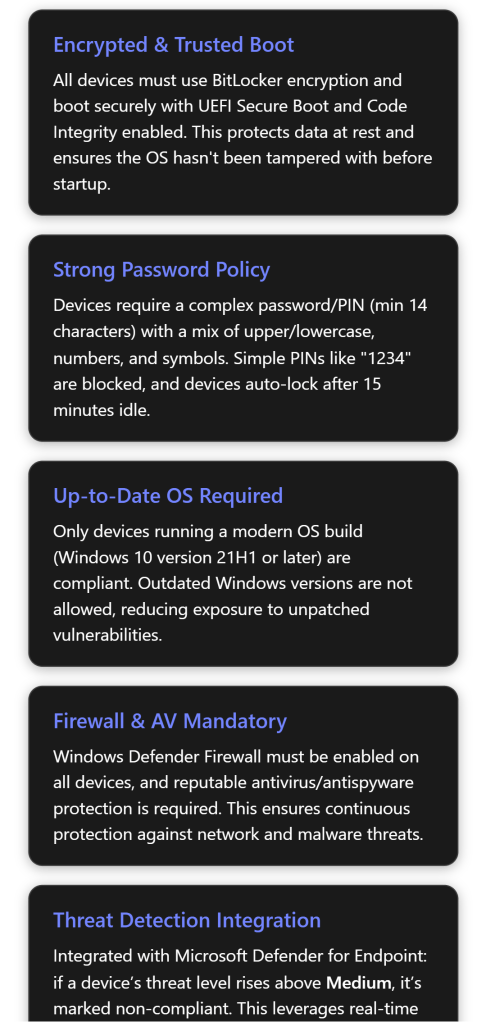
Require BitLocker – BitLocker Drive Encryption is mandated on the OS drive (Require BitLocker: Yes). BitLocker uses the system’s TPM to encrypt all data on disk and locks encryption keys unless the system’s integrity is verified at boot[1]. The policy setting “Require BitLocker” ensures that data at rest is protected – if a laptop is lost or stolen, an unauthorized person cannot read the disk contents without proper authorization[1]. Options:Not configured (default, don’t check encryption) or Require (device must be encrypted with BitLocker)[1]. Setting this to “Require” is considered best practice for strong security, as unencrypted devices pose a high data breach risk[1]. In our policy JSON, BitLocker is indeed required[2], aligning with industry recommendations to encrypt all sensitive devices.
Require Secure Boot – This ensures the PC is using UEFI Secure Boot (Require Secure Boot: Yes). Secure Boot forces the system to boot only trusted, signed bootloaders. During startup, the UEFI firmware will verify that bootloader and critical kernel files are signed by a trusted authority and have not been modified[1]. If any boot file is tampered with (e.g. by a bootkit or rootkit malware), Secure Boot will prevent the OS from booting[1]. Options: Not configured (don’t enforce) or Require (must boot in secure mode)[1]. The policy requires Secure Boot[2], which is a best-practice security measure to maintain boot-time integrity. This setting helps ensure the device boots to a trusted state and is not running malicious firmware or bootloaders[1]. Requiring Secure Boot is recommended in frameworks like Microsoft’s security baselines and the CIS benchmarks for Windows, provided the hardware supports it (most modern PCs do)[1].
Require Code Integrity – Code integrity (a Device Health Attestation setting) validates the integrity of Windows system binaries and drivers each time they are loaded into memory. Enforcing this (Require code integrity: Yes) means that if any system file or driver is unsigned or has been altered by malware, the device will be reported as non-compliant[1]. Essentially, it helps detect kernel-level rootkits or unauthorized modifications to critical system components. Options: Not configured or Require (must enforce code integrity)[1]. The policy requires code integrity to be enabled[2], which is a strong security practice. This setting complements Secure Boot by continuously verifying system integrity at runtime, not just at boot. Together, Secure Boot and Code Integrity reduce the risk of persistent malware or unauthorized OS tweaks going undetected[1].
By enabling BitLocker, Secure Boot, and Code Integrity, the compliance policy ensures devices have a trusted startup environment and encrypted storage – foundational elements of a secure endpoint. These Device Health requirements align with best practices like Microsoft’s recommended security baselines (which also require BitLocker and Secure Boot) and are critical to protect against firmware malware, bootkits, and data theft[1][1]. Note: Devices that lack a TPM or do not support Secure Boot will be marked noncompliant, meaning this policy effectively excludes older, less secure hardware from the compliant device pool – which is intentional for a high-security stance.
Device OS Version Requirements
Minimum OS version – This policy defines the oldest Windows OS build allowed on a device. In the JSON, the Minimum OS version is set to 10.0.19043.10000 (which corresponds roughly to Windows 10 21H1 with a certain patch level)[2]. Any Windows device reporting an OS version lower than this (e.g. 20H2 or an unpatched 21H1) will be marked non-compliant. The purpose is to block outdated Windows versions that lack recent security fixes. End users on older builds will be prompted to upgrade to regain compliance[1]. Options: admin can specify any version string; leaving it blank means no minimum enforcement[1]. Requiring a minimum OS version is a best practice to ensure devices have received important security patches and are not running end-of-life releases[1]. The chosen minimum (10.0.19043) suggests that Windows 10 versions older than 21H1 are not allowed, which is reasonable for strong security since Microsoft no longer supports very old builds. This helps reduce vulnerabilities – for example, a device stuck on an early 2019 build would miss years of defenses (like improved ransomware protection in later releases). The policy’s min OS requirement aligns with guidance to keep devices updated to at least the N-1 Windows version or newer.
Maximum OS version – In this policy, no maximum OS version is configured (set to “Not configured”)[2]. That means devices running newer OS versions than the admin initially tested are not automatically flagged noncompliant. This is usually best, because setting a max OS version is typically used only to temporarily block very new OS upgrades that might be unapproved. Leaving it not configured (no upper limit) is often a best practice unless there’s a known issue with a future Windows release[1]. In terms of strong security, not restricting the maximum OS allows devices to update to the latest Windows 10/11 feature releases, which usually improves security. (If an organization wanted to pause Windows 11 adoption, they might set a max version to 10.x temporarily, but that’s a business decision, not a security improvement.) So the policy’s approach – no max version limit – is fine and does align with security best practice in most cases, as it encourages up-to-date systems rather than preventing them.
Why enforce OS versions? Keeping OS versions current ensures known vulnerabilities are patched. For example, requiring at least build 19043 means any device on 19042 or earlier (which have known exposures fixed in 19043+) will be blocked until updated[1]. This reduces the attack surface. The compliance policy will show a noncompliant device “OS version too low” with guidance to upgrade[1], helping users self-remediate. Overall, the OS version rules in this policy push endpoints to stay on supported, secure Windows builds, which is a cornerstone of strong device security.
*(The policy also lists “Minimum/Maximum OS version for *mobile devices” with the same values (10.0.19043.10000 / Not configured)[2]. This likely refers to Windows 10 Mobile or Holographic devices. It’s largely moot since Windows 10 Mobile is deprecated, but having the same minimum for “mobile” ensures something like a HoloLens or Surface Hub also requires an up-to-date OS. In our case, both fields mirror the desktop OS requirement, which is fine.)
Configuration Manager Compliance (Co-Management)
Require device compliance from Configuration Manager – This setting is Not configured in the JSON (i.e. it’s left at default)[2]. It applies only if the Windows device is co-managed with Microsoft Endpoint Configuration Manager (ConfigMgr/SCCM) in addition to Intune. Options: Not configured (Intune ignores ConfigMgr’s compliance state) or Require (device must also meet all ConfigMgr compliance policies)[1].
In our policy, leaving it not configured means Intune will not check ConfigMgr status – effectively the device only has to satisfy the Intune rules to be marked compliant. Is this best practice? For purely Intune-managed environments, yes – if you aren’t using SCCM baselines, there’s no need to require this. If an organization is co-managed and has on-premises compliance settings in SCCM (like additional security baselines or antivirus status monitored by SCCM), a strong security stance might enable this to ensure those are met too[1]. However, enabling it without having ConfigMgr compliance policies could needlessly mark devices noncompliant as “not reporting” (Intune would wait for a ConfigMgr compliance signal that might not exist).
So, the best practice depends on context: In a cloud-only or lightly co-managed setup, leaving this off (Not Configured) is correct[1]. If the organization heavily uses Configuration Manager to enforce other critical security settings, then best practice would be to turn this on so Intune treats any SCCM failure as noncompliance. Since this policy likely assumes modern management primarily through Intune, Not configured is appropriate and not a security gap. (Admins should ensure that either Intune covers all needed checks, or if not, integrate ConfigMgr compliance by requiring it. Here Intune’s own checks are quite comprehensive.)
System Security: Password Requirements
A very important part of device security is controlling access with strong credentials. This policy enforces a strict device password/PIN policy under the “System Security” category:
Require a password to unlock – Yes (Required). This means the device cannot be unlocked without a password or PIN. Users must authenticate on wake or login[1]. Options: Not configured (no compliance check on whether a device has a lock PIN/password set) or Require (device must have a lock screen password/PIN)[1]. Requiring a password is absolutely a baseline security requirement – a device with no lock screen PIN is extremely vulnerable (anyone with physical access could get in). The policy correctly sets this to Require[2]. Intune will flag any device without a password as noncompliant, likely forcing the user to set a Windows Hello PIN or password. This is undeniably best practice; all enterprise devices should be password/PIN protected.
Block simple passwords – Yes (Block). “Simple passwords” refers to very easy PINs like 0000 or 1234 or repeating characters. The setting is Simple passwords: Block[1]. When enabled, Intune will require that the user’s PIN/passcode is not one of those trivial patterns. Options: Not configured (allow any PIN) or Block (disallow common simple PINs)[1]. Best practice is to block simple PINs because those are easily guessable if someone steals the device. This policy does so[2], meaning a PIN like “1111” or “12345” would not be considered compliant. Instead, users must choose less predictable codes. This is a straightforward security best practice (also recommended by Microsoft’s baseline and many standards) to defeat casual guessing attacks.
Password type – Alphanumeric. This setting specifies what kinds of credentials are acceptable. “Alphanumeric” in Intune means the user must set a password or PIN that includes a mix of letters and numbers (not just digits)[1]. The other options are “Device default” (which on Windows typically allows a PIN of just numbers) or explicitly Numeric (only numbers allowed)[1]. Requiring Alphanumeric effectively forces a stronger Windows Hello PIN – it must include at least one letter or symbol in addition to digits. The policy sets this to Alphanumeric[2], which is a stronger stance than a simple numeric PIN. It expands the space of possible combinations, making it much harder for an attacker to brute-force or guess a PIN. This is aligned with best practice especially if using shorter PIN lengths – requiring letters and numbers significantly increases PIN entropy. (If a device only allows numeric PINs, a 6-digit PIN has a million possibilities; an alphanumeric 6-character PIN has far more.) By choosing Alphanumeric, the admin is opting for maximum complexity in credentials.
Note: When Alphanumeric is required, Intune enables additional complexity rules (next setting) like requiring symbols, etc. If instead it was set to “Numeric”, those complexity sub-settings would not apply. So this choice unlocks the strongest password policy options[1].
Password complexity requirements – Require digits, lowercase, uppercase, and special characters. This policy is using the most stringent complexity rule available. Under Intune, for alphanumeric passwords/PINs you can require various combinations: the default is “digits & lowercase letters”; but here it’s set to “require digits, lowercase, uppercase, and special characters”[1]. That means the user’s password (or PIN, if using Windows Hello PIN as an alphanumeric PIN) must include at least one lowercase letter, one uppercase letter, one number, and one symbol. This is essentially a classic complex password policy. Options: a range from requiring just some character types up to all four categories[1]. Requiring all four types is generally seen as a strict best practice for high security (it aligns with many compliance standards that mandate a mix of character types in passwords). The idea is to prevent users from choosing, say, all letters or all numbers; a mix of character types increases password strength. Our policy indeed sets the highest complexity level[2]. This ensures credentials are harder to crack via brute force or dictionary attacks, albeit at the cost of memorability. It’s worth noting modern NIST guidance allows passphrases (which might not have all char types) as an alternative, but in many organizations, this “at least one of each” rule remains a common security practice for device passwords.
Minimum password length – 14 characters. This defines the shortest password or PIN allowed. The compliance policy requires the device’s unlock PIN/password to be 14 or more characters long[1]. Fourteen is a relatively high minimum; by comparison, many enterprise policies set min length 8 or 10. By enforcing 14, this policy is going for very strong password length, which is consistent with guidance for high-security environments (some standards suggest 12+ or 14+ characters for administrative or highly sensitive accounts). Options: 1–16 characters can be set (the admin chooses a number)[1]. Longer is stronger – increasing length exponentially strengthens resistance to brute-force cracking. At 14 characters with the complexity rules above, the space of possible passwords is enormous, making targeted cracking virtually infeasible. This is absolutely a best practice for strong security, though 14 might be considered slightly beyond typical user-friendly lengths. It aligns with guidance like using passphrases or very long PINs for device unlock. Our policy’s 14-char minimum[2] indicates a high level of security assurance (for context, the U.S. DoD STIGs often require 15 character passwords on Windows – 14 is on par with such strict standards).
Maximum minutes of inactivity before password is required – 15 minutes. This controls the device’s idle timeout, i.e. how long a device can sit idle before it auto-locks and requires re-authentication. The policy sets 15 minutes[2]. Options: The admin can define a number of minutes; when not set, Intune doesn’t enforce an inactivity lock (though Windows may have its own default)[1]. Requiring a password after 15 minutes of inactivity is a common security practice to balance security with usability. It means if a user steps away, at most 15 minutes can pass before the device locks itself and demands a password again. Shorter timers (5 or 10 min) are more secure (less window for an attacker to sit at a logged-in machine), whereas longer (30+ min) are more convenient but risk someone opportunistically using an unlocked machine. 15 minutes is a reasonable best-practice value for enterprises – it’s short enough to limit unauthorized access, yet not so short that it frustrates users excessively. Many security frameworks recommend 15 minutes or less for session locks. This policy’s 15-minute setting is in line with those recommendations and thus supports a strong security posture. It ensures a lost or unattended laptop will lock itself in a timely manner, reducing the chance for misuse.
Password expiration (days) – 365 days. This setting forces users to change their device password after a set period. Here it is one year[2]. Options: 1–730 days or not configured[1]. Requiring password change every 365 days is a moderate approach to password aging. Traditional policies often used 90 days, but that can lead to “password fatigue.” Modern NIST guidelines actually discourage frequent forced changes (unless there’s evidence of compromise) because overly frequent changes can cause users to choose weaker passwords or cycle old ones. However, annual expiration (365 days) is relatively relaxed and can be seen as a best practice in some environments to ensure stale credentials eventually get refreshed[1]. It’s basically saying “change your password once a year.” Many organizations still enforce yearly or biannual password changes as a precaution. In terms of strong security, this setting provides some safety net (in case a password was compromised without the user knowing, it won’t work indefinitely). It’s not as critical as the other settings; one could argue that with a 14-char complex password, forced expiration isn’t strictly necessary. But since it’s set, it reflects a security mindset of not letting any password live forever. Overall, 365 days is a reasonable compromise – it’s long enough that users can memorize a strong password, and short enough to ensure a refresh if by chance a password leaked over time. This is largely aligned with best practice, though some newer advice would allow no expiration if other controls (like multifactor auth) are in place. In a high-security context, annual changes remain common policy.
Number of previous passwords to prevent reuse – 5. This means when a password is changed (due to expiration or manual change), the user cannot reuse any of their last 5 passwords[1]. Options: Typically can set a value like 1–50 previous passwords to disallow. The policy chose 5[2]. This is a standard part of password policy – preventing reuse of recent passwords helps ensure that when users do change their password, they don’t just alternate between a couple of favorites. A history of 5 is pretty typical in best practices (common ranges are 5–10) to enforce genuine password updates. This setting is definitely a best practice in any environment with password expiration – otherwise users might just swap back and forth between two passwords. By disallowing the last 5, it will take at least 6 cycles (in this case 6 years, given 365-day expiry) before one could reuse an old password, by which time it’s hoped that password would have lost any exposure or the user comes up with a new one entirely. The policy’s value of 5 is fine and commonly recommended.
Require password when device returns from idle state – Yes (Required). This particularly applies to mobile or Holographic devices, but effectively it means a password is required upon device wake from an idle or sleep state[1]. On Windows PCs, this corresponds to the “require sign-in on wake” setting. Since our idle timeout is 15 minutes, this ensures that when the device is resumed (after sleeping or being idle past that threshold), the user must sign in again. Options: Not configured or Require[1]. The policy sets it to Require[2], which is certainly what we want – it’d be nonsensical to have all the above password rules but then not actually lock on wake! In short, this enforces that the password/PIN prompt appears after the idle period or sleep, which is absolutely a best practice. (Without this, a device could potentially wake up without a login prompt, which would undermine the idle timeout.) Windows desktop devices are indeed impacted by this on next sign-in after an idle, as noted in docs[1]. So this setting ties the loop on the secure password policy: not only must devices have strong credentials, but those credentials must be re-entered after a period of inactivity, ensuring continuous protection.
Summary of Password Policy: The compliance policy highly prioritizes strong access control. It mandates a login on every device (no password = noncompliant), and that login must be complex (not guessable, not short, contains diverse characters). The combination of Alphanumeric, 14+ chars, all character types, no simple PINs is about as strict as Windows Intune allows for user sign-in credentials[1][2]. This definitely meets the definition of best practice for strong security – it aligns with standards like CIS benchmarks which also suggest enforcing password complexity and length. Users might need to use passphrases or a mix of PIN with letters to meet this, but that is intended. The idle lock at 15 minutes and requirement to re-authenticate on wake ensure that even an authorized session can’t be casually accessed if left alone for long. The annual expiration and password history add an extra layer to prevent long-term use of any single password or recycling of old credentials, which is a common corporate security requirement.
One could consider slight adjustments: e.g., some security frameworks (like NIST SP 800-63) would possibly allow no expiration if the password is sufficiently long and unique (to avoid users writing it down or making minor changes). However, given this is a “strong security” profile, the chosen settings err on the side of caution, which is acceptable. Another improvement for extreme security could be shorter idle time (like 5 minutes) to lock down faster, but 15 minutes is generally acceptable and strikes a balance. Overall, these password settings significantly harden the device against unauthorized access and are consistent with best practices.
Encryption of Data Storage on Device
Require encryption of data storage on device – Yes (Required). Separate from the BitLocker requirement in Device Health, Intune also has a general encryption compliance rule. Enabling this means the device’s drives must be encrypted (with BitLocker, in the case of Windows) or else it’s noncompliant[1]. In our policy, “Encryption: Require” is set[2]. Options: Not configured or Require[1]. This is effectively a redundant safety net given BitLocker is also specifically required. According to Microsoft, the “Encryption of data storage” check looks for any encryption present (on the OS drive), and specifically on Windows it checks BitLocker status via a device report[1]. It’s slightly less robust than the Device Health attestation for BitLocker (which needs a reboot to register, etc.), but it covers the scenario generally[1].
From a security perspective, requiring device encryption is unquestionably best practice. It ensures that if a device’s drive isn’t encrypted (for example, BitLocker not enabled or turned off), the device will be flagged. This duplicates the BitLocker rule; having both doesn’t hurt – in fact, Microsoft documentation suggests the simpler encryption compliance might catch the state even if attestation hasn’t updated (though the BitLocker attestation is more reliable for TPM verification of encryption)[1].
In practice, an admin could use one or the other. This policy enables both, which indicates a belt-and-suspenders approach: either way, an unencrypted device will not slip through. This is absolutely aligned with strong security – all endpoints must have storage encryption, mitigating the risk of data exposure from lost or stolen hardware. Modern best practices (e.g. CIS, regulatory requirements like GDPR for laptops with personal data) often mandate full-disk encryption; here it’s enforced twice. The documentation even notes that relying on the BitLocker-specific attestation is more robust (it checks at the TPM level and knows the device booted with BitLocker enabled)[1][1]. The generic encryption check is a bit more broad but for Windows equates to BitLocker anyway. The key point is the policy requires encryption, which we already confirmed is a must-have security control. If BitLocker was somehow not supported on a device (very rare on Windows 10/11, since even Home edition has device encryption now), that device would simply fail compliance – again, meaning only devices capable of encryption and actually encrypted are allowed, which is appropriate for a secure environment.
(Note: Since both “Require BitLocker” and “Require encryption” are turned on, an Intune admin should be aware that a device might show two noncompliance messages for essentially the same issue if BitLocker is off. Users would see that they need to turn on encryption to comply. Once BitLocker is enabled and the device rebooted, both checks will pass[1][1]. The rationale for using both might be to ensure that even if the more advanced attestation didn’t report, the simpler check would catch it.)
This section of the policy ensures that essential security features of Windows are active:
Firewall – Require. The policy mandates that the Windows Defender Firewall is enabled on the device (Firewall: Require)[1]. This means Intune will mark the device noncompliant if the firewall is turned off or if a user/app tries to disable it. Options: Not configured (do not check firewall status) or Require (firewall must be on)[1]. Requiring the firewall is definitely best practice – a host-based firewall is a critical first line of defense against network-based attacks. The Windows Firewall helps block unwanted inbound connections and can enforce outbound rules as well. By ensuring it’s always on (and preventing users from turning it off), the policy guards against scenarios where an employee might disable the firewall and expose the machine to threats[1]. This setting aligns with Microsoft recommendations and CIS Benchmarks, which also advise that Windows Firewall be enabled on all profiles. Our policy sets it to Require[2], which is correct for strong security. (One thing to note: if there were any conflicting GPO or config that turns the firewall off or allows all traffic, Intune would consider that noncompliant even if Intune’s own config profile tries to enable it[1] – essentially, Intune checks the effective state. Best practice is to avoid conflicts and keep the firewall defaults to block inbound unless necessary[1].)
Trusted Platform Module (TPM) – Require. This check ensures the device has a TPM chip present and enabled (TPM: Require)[1]. Intune will look for a TPM security chip and mark the device noncompliant if none is found or it’s not active. Options: Not configured (don’t verify TPM) or Require (TPM must exist)[1]. TPM is a hardware security module used for storing cryptographic keys (like BitLocker keys) and for platform integrity (measured boot). Requiring a TPM is a strong security stance because it effectively disallows devices that lack modern hardware security support. Most Windows 10/11 PCs do have TPM 2.0 (Windows 11 even requires it), so this is feasible and aligns with best practices. It ensures features like BitLocker are using TPM protection and that the device can do hardware attestation. The policy sets TPM to required[2], which is a best practice consistent with Microsoft’s own baseline (they recommend excluding non-TPM machines, as those are typically older or less secure). By enforcing this, you guarantee that keys and sensitive operations can be hardware-isolated. A device without TPM could potentially store BitLocker keys in software (less secure) or not support advanced security like Windows Hello with hardware-backed credentials. So from a security viewpoint, this is the right call. Any device without a TPM (or with it disabled) will need remediation or replacement, which is acceptable in a high-security environment. This reflects a zero-trust hardware approach: only modern, TPM-equipped devices can be trusted fully[1].
Antivirus – Require. The compliance policy requires that antivirus protection is active and up-to-date on the device (Antivirus: Require)[1]. Intune checks the Windows Security Center status for antivirus. If no antivirus is registered, or if the AV is present but disabled/out-of-date, the device is noncompliant[1]. Options: Not configured (don’t check AV) or Require (must have AV on and updated)[1]. It’s hard to overstate the importance of this: running a reputable, active antivirus/antimalware is absolutely best practice on Windows. The policy’s requirement means every device must have an antivirus engine running and not report any “at risk” state. Windows Defender Antivirus or a third-party AV that registers with Security Center will satisfy this. If a user has accidentally turned off real-time protection or if the AV signatures are old, Intune will flag it[1]. Enforcing AV is a no-brainer for strong security. This matches all industry guidance (e.g., CIS Controls highlight the need for anti-malware on all endpoints). Our policy does enforce it[2].
Antispyware – Require. Similar to antivirus, this ensures anti-spyware (malware protection) is on and healthy (Antispyware: Require)[1]. In modern Windows terms, “antispyware” is essentially covered by Microsoft Defender Antivirus as well (Defender handles viruses, spyware, all malware). But Intune treats it as a separate compliance item to check in Security Center. This setting being required means the anti-malware software’s spyware detection component (like Defender’s real-time protection for spyware/PUPs) must also be enabled and not outdated[1]. Options: Not configured or Require, analogous to antivirus[1]. The policy sets it to Require[2]. This is again best practice – it ensures comprehensive malware protection is in place. In effect, having both AV and antispyware required just double-checks that the endpoint’s security suite is fully active. If using Defender, it covers both; if using a third-party suite, as long as it reports to Windows Security Center for both AV and antispyware status, it will count. This redundancy helps catch any scenario where maybe virus scanning is on but spyware definitions are off (though that’s rare with unified products). For our purposes, requiring antispyware is simply reinforcing the “must have anti-malware” rule – clearly aligned with strong security standards.
Collectively, these Device Security settings (Firewall, TPM, AV, antispyware) ensure that critical protective technologies are in place on every device:
The firewall requirement guards against network attacks and unauthorized connections[1].
The TPM requirement ensures hardware-based security for encryption and identity[1].
The AV/antispyware requirements ensure continuous malware defense and that no device is left unprotected against viruses or spyware[1].
All are definitely considered best practices. In fact, running without any of these (no firewall, no AV, etc.) would be considered a serious security misconfiguration. This policy wisely enforces all of them. Any device not meeting these (e.g., someone attempts to disable Defender Firewall or uninstall AV) will get swiftly flagged, which is exactly what we want in a secure environment.
*(Side note: The policy’s reliance on Windows Security Center means it’s vendor-agnostic; e.g., if an organization uses Symantec or another AV, as long as that product reports a good status to Security Center, Intune will see the device as compliant for AV/antispyware. If a third-party AV is used that *disables* Windows Defender, that’s fine because Security Center will show another AV is active. The compliance rule will still require that one of them is active. So this is a flexible but strict enforcement of “you must have one”.)*
Microsoft Defender Anti-malware Requirements
The policy further specifies settings under Defender (Microsoft Defender Antivirus) to tighten control of the built-in anti-malware solution:
Microsoft Defender Antimalware – Require. This means the Microsoft Defender Antivirus service must be running and cannot be turned off by the user[1]. If the device’s primary AV is Defender (as is default on Windows 10/11 when no other AV is installed), this ensures it stays on. Options: Not configured (Intune doesn’t ensure Defender is on) or Require (Defender AV must be enabled)[1]. Our policy sets it to Require[2], which is a strong choice. If a third-party AV is present, how does this behave? Typically, when a third-party AV is active, Defender goes into a passive mode but is still not “disabled” in Security Center terms – or it might hand over status. This setting primarily aims to prevent someone from turning off Defender without another AV in place. Requiring Defender antivirus to be on is a best practice if your organization relies on Defender as the standard AV. It ensures no one (intentionally or accidentally) shuts off Windows’ built-in protection[1]. It essentially overlaps with the “Antivirus: Require” setting, but is more specific. The fact that both are set implies this environment expects to use Microsoft Defender on all machines (which is common for many businesses). In a scenario where a user installed a 3rd party AV that doesn’t properly report to Security Center, having this required might actually conflict (because Defender might register as off due to third-party takeover, thus Intune might mark noncompliant). But assuming standard behavior, if third-party AV is present and reporting, Security Center usually shows “Another AV is active” – Intune might consider the AV check passed but the “Defender Antimalware” specifically could possibly see Defender as not the active engine and flag it. In any case, for strong security, the ideal is to have a consistent AV (Defender) across all devices. So requiring Defender is a fine security best practice, and our policy reflects that intention. It aligns with Microsoft’s own baseline for Intune when organizations standardize on Defender. If you weren’t standardized on Defender, you might leave this not configured and just rely on the generic AV requirement. Here it’s set, indicating a Defender-first strategy for antimalware.
Microsoft Defender Antimalware minimum version – 4.18.0.0. This setting specifies the lowest acceptable version of the Defender Anti-Malware client. The policy has defined 4.18.0.0 as the minimum[2]. Effect: If a device has an older Defender engine below that version, it’s noncompliant. Version 4.18.x is basically the Defender client that ships with Windows 10 and above (Defender’s engine is updated through Windows Update periodically, but the major/minor version has been 4.18 for a long time). By setting 4.18.0.0, essentially any Windows 10/11 with Defender should meet it (since 4.18 was introduced years ago). This catches only truly outdated Defender installations (perhaps if a machine had not updated its Defender platform in a very long time, or is running Windows 8.1/7, which had older Defender versions – though those OS wouldn’t be in a Win10 policy anyway). Options: Admin can input a specific version string, or leave blank (no version enforcement)[1]. The policy chose 4.18.0.0, presumably because that covers all modern Windows builds (for example, Windows 10 21H2 uses Defender engine 4.18.x). Requiring a minimum Defender version is a good practice to ensure the anti-malware engine itself isn’t outdated. Microsoft occasionally releases new engine versions with improved capabilities; if a machine somehow fell way behind (e.g., an offline machine that missed engine updates), it could have known issues or be missing detection techniques. By enforcing a minimum, you compel those devices to update their Defender platform. Version 4.18.0.0 is effectively the baseline for Windows 10, so this is a reasonable choice. It’s likely every device will already have a later version (like 4.18.210 or similar). As a best practice, some organizations might set this to an even more recent build number if they want to ensure a certain monthly platform update is installed. In any case, including this setting in the policy shows thoroughness – it’s making sure Defender isn’t an old build. This contributes to security by catching devices that might have the Defender service but not the latest engine improvements. Since the policy’s value is low (4.18.0.0), practically all supported Windows 10/11 devices comply, but it sets a floor that excludes any unsupported OS or really old install. This aligns with best practice: keep security software up-to-date, both signatures and the engine. (The admin should update this minimum version over time if needed – e.g., if Microsoft releases Defender 4.19 or 5.x in the future, they might raise the bar.)
Microsoft Defender security intelligence up-to-date – Require. This is basically ensuring Defender’s virus definitions (security intelligence) are current (Security intelligence up-to-date: Yes)[1]. If Defender’s definitions are out of date, Intune will mark noncompliant. “Up-to-date” typically means the signature is not older than a certain threshold (usually a few days, defined by Windows Security Center’s criteria). Options: Not configured (don’t check definitions currency) or Require (must have latest definitions)[1]. It’s set to Require in our policy[2]. This is clearly a best practice – an antivirus is only as good as its latest definitions. Ensuring that the AV has the latest threat intelligence is critical. This setting will catch devices that, for instance, haven’t gone online in a while or are failing to update Defender signatures. Those devices would be at risk from newer malware until they update. By marking them noncompliant, it forces an admin/user to take action (e.g. connect to the internet to get updates)[1]. This contributes directly to security, keeping anti-malware defenses sharp. It aligns with common security guidelines that AV should be kept current. Since Windows usually updates Defender signatures daily (or more), this compliance rule likely treats a device as noncompliant if signatures are older than ~3 days (Security Center flag). This policy absolutely should have this on, and it does – another check in the box for strong security practice.
Real-time protection – Require. This ensures that Defender’s real-time protection is enabled (Realtime protection: Require)[1]. Real-time protection means the antivirus actively scans files and processes as they are accessed, rather than only running periodic scans. If a user had manually turned off real-time protection (which Windows allows for troubleshooting, or sometimes malware tries to disable it), this compliance rule would flag the device. Options: Not configured or Require[1]. Our policy requires it[2]. This is a crucial setting: real-time protection is a must for proactive malware defense. Without it, viruses or spyware could execute without immediate detection, and you’d only catch them on the next scan (if at all). Best practice is to never leave real-time protection off except perhaps briefly to install certain software, and even then, compliance would catch that and mark the device not compliant with policy. So turning this on is definitely part of a strong security posture. The policy correctly enforces it. It matches Microsoft’s baseline and any sane security policy – you want continuous scanning for threats in real time. The Intune CSP for this ensures that the toggle in Windows Security (“Real-time protection”) stays on[1]. Even if a user is local admin, turning it off will flip the device to noncompliant (and possibly trigger Conditional Access to cut off corporate resource access), strongly incentivizing them not to do that. Good move.
In summary, the Defender-specific settings in this policy double-down on malware protection:
The Defender AV engine must be active (and presumably they expect to use Defender on all devices)[1].
Defender must stay updated – both engine version and malware definitions[1][1].
These are all clearly best practices for endpoint security. They ensure the built-in Windows security is fully utilized. The overlap with the general “Antivirus/Antenna” checks means there’s comprehensive coverage. Essentially, if a device doesn’t have Defender, the general AV required check would catch it; if it does have Defender, these specific settings enforce its quality and operation. No device should be running with outdated or disabled Defender in a secure environment, and this compliance policy guarantees that.
(If an organization did use a third-party AV instead of Defender, they might not use these Defender-specific settings. The presence of these in the JSON indicates alignment with using Microsoft Defender as the standard. That is indeed a good practice nowadays, as Defender has top-tier ratings and seamless integration. Many “best practice” guides, including government blueprints, now assume Defender is the AV to use, due to its strong performance and integration with Defender for Endpoint.)
Microsoft Defender for Endpoint (MDE) – Device Threat Risk Level
Finally, the policy integrates with Microsoft Defender for Endpoint (MDE) by using the setting:
Require the device to be at or under the machine risk score – Medium. This ties into MDE’s threat intelligence, which assesses each managed device’s risk level (based on detected threats on that endpoint). The compliance policy is requiring that a device’s risk level be Medium or lower to be considered compliant[1]. If MDE flags a device as High risk, Intune will mark it noncompliant and can trigger protections (like Conditional Access blocking that device). Options: Not configured (don’t use MDE risk in compliance) or one of Clear, Low, Medium, High as the maximum allowed threat level[1]. The chosen value “Medium” means: any device with a threat rated High is noncompliant, while devices with Low or Medium threats are still compliant[1]. (Clear would be the most strict – requiring absolutely no threats; High would be least strict – tolerating even high threats)[1].
Setting this to Medium is a somewhat balanced security stance. Let’s interpret it: MDE categorizes threats on devices (malware, suspicious activity) into risk levels. By allowing up to Medium, the policy is saying if a device has only low or medium-level threats, we still consider it compliant; but if it has any high-level threat, that’s unacceptable. High usually indicates serious malware outbreaks or multiple alerts, whereas low may indicate minimal or contained threats. From a security best-practice perspective, using MDE’s risk as a compliance criterion is definitely recommended – it adds an active threat-aware dimension to compliance. The choice of Medium as the cutoff is probably to avoid overly frequent lockouts for minor issues, while still reacting to major incidents.
Many security experts would advocate for even stricter: e.g. require Low or Clear (meaning even medium threats would cause noncompliance), especially in highly secure environments where any malware is concerning. In fact, Microsoft’s documentation notes “Clear is the most secure, as the device can’t have any threats”[1]. Medium is a reasonable compromise – it will catch machines with serious infections but not penalize ones that had a low-severity event that might have already been remediated. For example, if a single low-level adware was detected and quarantined, risk might be low and the device remains compliant; but if ransomware or multiple high-severity alerts are active, risk goes high and the device is blocked until cleaned[1].
In our policy JSON, it’s set to Medium[2], which is in line with many best practice guides (some Microsoft baseline recommendations also use Medium as the default, to balance security and usability). This is still considered a strong security practice because any device under an active high threat will immediately be barred. It leverages real-time threat intelligence from Defender for Endpoint to enhance compliance beyond just configuration. That means even if a device meets all the config settings above, it could still be blocked if it’s actively compromised – which is exactly what we want. It’s an important part of a Zero Trust approach: continuously monitor device health and risk, not just initial compliance.
One could tighten this to Low for maximum security (meaning even medium threats cause noncompliance). If an organization has low tolerance for any malware, they might do that. However, Medium is often chosen to avoid too many disruptions. For our evaluation: The inclusion of this setting at all is a best practice (many might forget to use it). The threshold of Medium is acceptable for strong security, catching big problems while allowing IT some leeway to investigate mediums without immediate lockout. And importantly, if set to Medium, only devices with severe threats (like active malware not neutralized) will be cut off, which likely correlates with devices that indeed should be isolated until fixed.
To summarize, the Defender for Endpoint integration means this compliance policy isn’t just checking the device’s configuration, but also its security posture in real-time. This is a modern best practice: compliance isn’t static. The policy ensures that if a device is under attack or compromised (per MDE signals), it will lose its compliant status and thus can be auto-remediated or blocked from sensitive resources[1]. This greatly strengthens the security model. Medium risk tolerance is a balanced choice – it’s not the absolute strictest, but it is still a solid security stance and likely appropriate to avoid false positives blocking users unnecessarily.
(Note: Organizations must have Microsoft Defender for Endpoint properly set up and the devices onboarded for this to work. Given it’s in the policy, we assume that’s the case, which is itself a security best practice – having EDR (Endpoint Detection & Response) on all endpoints.)
Actions for Noncompliance and Additional Considerations
The JSON policy likely includes Actions for noncompliance (the blueprint shows an action “Mark device noncompliant (1)” meaning immediate)[2]. By default, Intune always marks a device as noncompliant if it fails a setting – which is what triggers Conditional Access or other responses. The policy can also be configured to send email notifications, or after X days perform device retire/wipe, etc. The snippet indicates the default action to mark noncompliant is at day 1 (immediately)[2]. This is standard and aligns with security best practice – you want noncompliant devices to be marked as such right away. Additional actions (like notifying user, or disabling the device) could be considered but are not listed.
It’s worth noting a few maintenance and dependency points:
Updating the Policy: As new Windows versions release, the admin should review the Minimum OS version field and advance it when appropriate (for example, when Windows 10 21H1 becomes too old, they might raise the minimum to 21H2 or Windows 11). Similarly, the Defender minimum version can be updated over time. Best practice is to review compliance policies at least annually (or along with major new OS updates)[1][1] to keep them effective.
Device Support: Some settings have hardware prerequisites (TPM, Secure Boot, etc.). In a strong security posture, devices that don’t meet these (older hardware) should ideally be phased out. This policy enforces that by design. If an organization still has a few legacy devices without TPM, they might temporarily drop the TPM requirement or grant an exception group – but from a pure security standpoint, it’s better to upgrade those devices.
User Impact and Change Management: Enforcing these settings can pose adoption challenges. For example, requiring a 14-character complex password might generate more IT support queries or user friction initially. It is best practice to accompany such policy with user education and perhaps rollout in stages. The policy as given is quite strict, so ensuring leadership backing and possibly implementing self-service password reset (to handle expiry) would be wise. These aren’t policy settings per se, but operational best practices.
Complementary Policies: A compliance policy like this ensures baseline security configuration, but it doesn’t directly configure the settings on the device (except for password requirement which the user is prompted to set). It checks and reports compliance. To actually turn on things like BitLocker or firewall if they’re off, one uses Configuration Profiles or Endpoint Security policies in Intune. Best practice is to pair compliance policies with configuration profiles that enable the desired settings. For instance, enabling BitLocker via an Endpoint Security policy and then compliance verifies it’s on. The question focuses on compliance policy, so our scope is those checks, but it’s assumed the organization will also deploy policies to turn on BitLocker, firewall, Defender, etc., making it easy for devices to become compliant.
Protected Characteristics: Every setting here targets technical security and does not discriminate or involve user personal data, so no concerns there. From a privacy perspective, the compliance data is standard device security posture info.
Conclusion
Overall, each setting in this Windows compliance policy aligns with best practices for securing Windows 10/11 devices. The policy requires strong encryption, up-to-date and secure OS versions, robust password/PIN policies, active firewall and anti-malware, and even ties into advanced threat detection (Defender for Endpoint)[2][2]. These controls collectively harden the devices against unauthorized access, data loss, malware infections, and unpatched vulnerabilities.
Almost all configurations are set to their most secure option (e.g., requiring vs not, or maximum complexity) as one would expect in a high-security baseline:
Data protection is ensured by BitLocker encryption on disk[1].
Boot integrity is assured via Secure Boot and Code Integrity[1].
Users must adhere to a strict password policy (complex, long, regularly changed)[1].
Critical security features (firewall, AV, antispyware, TPM) must be in place[1][1].
Endpoint Defender is kept running in real-time and up-to-date[1].
Devices under serious threat are quarantined via noncompliance[1].
All these are considered best practices by standards such as the CIS Benchmark for Windows and government cybersecurity guidelines (for example, the ASD Essential Eight in Australia, which this policy closely mirrors, calls for application control, patching, and admin privilege restriction – many of which this policy supports by ensuring fundamental security hygiene on devices).
Are there any settings that might not align with best practice? Perhaps the only debatable one is the 365-day password expiration – modern NIST guidelines suggest you don’t force changes on a schedule unless needed. However, many organizations still view an annual password change as reasonable policy in a defense-in-depth approach. It’s a mild requirement and not draconian, so it doesn’t significantly detract from security; if anything, it adds a periodic refresh which can be seen as positive (with the understanding that user education is needed to avoid predictable changes). Thus, we wouldn’t call it a wrong practice – it’s an accepted practice in many “strong security” environments, even if some experts might opt not to expire passwords arbitrarily. Everything else is straightforwardly as per best practice or even exceeding typical baseline requirements (e.g., 14 char min is quite strong).
Improvements or additions: The policy as given is already thorough. An organization could consider tightening the Defender for Endpoint risk level to Low (meaning only absolutely clean devices are compliant) if they wanted to be extra careful – but that could increase operational noise if minor issues trigger noncompliance too often[1]. They could also reduce the idle timeout to, say, 5 or 10 minutes for devices in very sensitive environments (15 minutes is standard, though stricter is always an option). Another possible addition: enabling Jailbreak detection – not applicable for Windows (it’s more for mobile OS), Windows doesn’t have a jailbreak setting beyond what we covered (DHA covers some integrity). Everything major in Windows compliance is covered here.
One more setting outside of this device policy that’s a tenant-wide setting is “Mark devices with no compliance policy as noncompliant”, which we would assume is enabled at the Intune tenant level for strong security (so that any device that somehow doesn’t get this policy is still not trusted)[3]. The question didn’t include that, but it’s a part of best practices – likely the organization would have set it to Not compliant at the tenant setting to avoid unmanaged devices slipping through[3].
In conclusion, each listed setting is configured in line with strong security best practices for Windows devices. The policy reflects an aggressive security posture: it imposes strict requirements that greatly reduce the risk of compromise. Devices that meet all these conditions will be quite well-hardened against common threats. Conversely, any device failing these checks is rightfully flagged for remediation, which helps the IT team maintain a secure fleet. This compliance policy, especially when combined with Conditional Access (to prevent noncompliant devices from accessing corporate data) and proper configuration policies (to push these settings onto devices), provides an effective enforcement of security standards across the Windows estate[3][3]. It aligns with industry guidelines and should substantially mitigate risks such as data breaches, malware incidents, and unauthorized access. Each setting plays a role: from protecting data encryption and boot process to enforcing user credentials and system health – together forming a comprehensive security baseline that is indeed consistent with best practices.
Microsoft 365 Business Premium (an SMB-focused plan) includes many core compliance features also found in Enterprise plans like Office 365 E3. However, there are key differences when compared to Enterprise E3 and especially the advanced capabilities in E5. This report compares eDiscovery, retention policies, and audit logging across these plans, with step-by-step guidance, illustrations of key concepts, real-world scenarios, best practices, and pitfalls to avoid.
Feature Area
Business Premium (≈ E3 Standard)
Office 365 E3 (Standard)
Microsoft 365 E5 (Advanced)
eDiscovery
Core eDiscovery (Standard) – includes content search, export, cases, basic holds1. No Advanced eDiscovery features.
Core eDiscovery (Standard) – same as BP (full search, hold, export)1.
Retention Policies for Exchange, SharePoint, OneDrive, Teams – basic org or location-wide retention available3. Lacks some advanced records management.
Retention Policies – same core retention across workloads.
Advanced Retention – e.g. auto-classification, event-based retention, regulatory record (with E5 Compliance add-on).
Audit Premium: Longer retention (1 year by default)24, audit retention policies, high-value events, faster API access.
Note: Business Premium includes Exchange Online Plan 1 (50 GB mailbox) plus archiving, and SharePoint Plan 1, whereas E3 has Exchange Plan 2 (100 GB mailbox + archive) and SharePoint Plan 2. These underlying service differences influence compliance features like holds and storage[5][5].
eDiscovery: Standard vs. Premium
eDiscovery in Microsoft 365 helps identify and collect content for legal or compliance investigations. Business Premium and Office 365 E3 support Core eDiscovery (Standard) functionality, while Microsoft 365 E5 provides Advanced eDiscovery (Premium) with enhanced capabilities.
eDiscovery (Standard) in Business Premium and E3
Scope & Capabilities: eDiscovery (Standard) allows you to create cases, search for content across Exchange Online mailboxes, SharePoint sites, OneDrive, Teams, and more, place content on hold, and export results[1]. Key features of Standard eDiscovery include:
Content Search across mailboxes, SharePoint/OneDrive, Teams chats, Groups, etc., with keyword queries and conditions[1]. (For example, you can search all user mailboxes and Teams messages for specific keywords in a case of suspected data leakage.)
Legal Hold (litigation hold) to preserve content in-place. In E3, you can place mailboxes or sites on hold (so content is retained even if deleted)[1]. In Business Premium, mailbox hold is supported (Exchange Plan 1 with archiving allows litigation hold on mailboxes), but SharePoint Online Plan 1 lacks In-Place Hold capability[5]. This means to preserve SharePoint/OneDrive content on Business Premium, you would use retention policies rather than legacy hold features.
Case Management: You can create eDiscovery Cases to organize searches, holds, and exports related to a specific investigation[1]. Each case can have multiple members (managers) and holds.
Export Results: You can export search results (emails, documents, etc.) from a case. Exports are typically in PST format for emails or as native files with a load file for documents[6]. (E.g., export all emails from a custodian’s mailbox relevant to a lawsuit).
Permissions: Role-Based Access Control allows only authorized eDiscovery Managers to access case data[1]. (Ensure users performing eDiscovery are added to the eDiscovery Manager role group in the Compliance portal[6].)
How to Use eDiscovery (Standard):
Assign eDiscovery Permissions: In the Purview Compliance Portal (compliance.microsoft.com) under Permissions, add users to the eDiscovery Manager role group (or create a custom role group)[6]. This allows access to eDiscovery tools.
Create a Case: Go to eDiscovery (Standard) in the Compliance portal (under “Solutions”). Click “+ Create case”, provide a name and description, and save[6]. (For example, create a case named “Project Phoenix Investigation”.)
Add Members: Open the case, go to Case Settings > Members, and add any additional eDiscovery Managers or reviewers who should access this case.
Place Content on Hold (if needed): In the case, navigate to the Hold tab. Create a hold, specifying content locations and conditions. For instance, to preserve an ex-employee’s mailbox and Teams chats, select their Exchange mailbox and Teams conversations[6]. This ensures content is preserved (copied to hidden folders) and cannot be permanently deleted by users.
Search for Content: In the case, go to the Search tab. Configure a new search query – specify keywords or conditions (e.g., date ranges, authors) and choose locations (specific mailboxes, sites, Teams)[7][7]. For example, search all content in Alice’s mailbox and OneDrive for the past 1 year with keyword “Project Phoenix”.
Review and Export: Run the search and preview results. You can select items to Preview their content. Once satisfied, click Export to download results. You’ll typically get a PST for emails or a zip of documents. Use the eDiscovery Export Tool if prompted to download large results.
Screenshot – Compliance Portal eDiscovery: Below is an illustration of the eDiscovery (Standard) interface in Microsoft Purview Compliance portal, showing a list of content searches in a case:
(Figure: Purview eDiscovery (Standard) case with search results listed. Investigators can create multiple searches, apply filters, and export data.)
Limitations of Standard eDiscovery: Core eDiscovery does not provide advanced analytics or review capabilities. There’s no built-in way to de-duplicate results or perform complex data analysis – the results must be reviewed manually (often outside the system, e.g. by opening PST in Outlook). Also, SharePoint Online Plan 1 limitation: Business Premium cannot use the older SharePoint “In-Place Hold” feature[5]; you must rely on retention policies for SharePoint content preservation (discussed later).
Real-World Scenario (Standard eDiscovery): A small business using Business Premium needs to respond to a legal request for all communications involving a specific client. The IT admin creates an eDiscovery (Standard) case, adds the HR manager as a viewer, places the mailboxes of the employees involved on hold, searches emails and Teams chats for the client’s name, and exports the results to provide to legal counsel. This meets the needs without additional licensing. Best Practice: Use targeted keyword searches to reduce volume, and always test search criteria on a small date range first to verify relevancy. Also, inform users (if appropriate) that their data is on legal hold to prevent accidental deletions.
eDiscovery (Premium) in E5 (Advanced eDiscovery)
Scope & Capabilities: Microsoft Purview eDiscovery (Premium) – formerly Advanced eDiscovery – is available in E5 (or as an E5 Compliance add-on) and builds on core eDiscovery with powerful data analytics and workflow tools[1][1]. Key features exclusive to eDiscovery (Premium) include:
Custodian Management: Ability to designate custodians (users of interest) and automatically collect their data sources (Exchange mailboxes, OneDrives, Teams, SharePoint sites) in a case. You can track custodian status and send legal hold notifications to custodians (with an email workflow to inform them of hold obligations)[1].
Advanced Indexing & Search: Enhanced indexing that can OCR scan images or process non-Microsoft file types. This ensures more content is discoverable (like text in PDFs or images)[8].
Review Sets: After searching, you can add content to a Review Set – an online review interface. Within a review set, investigators can view, search within results, tag documents, annotate, and redact data[8]. This is a big improvement over Standard, which has no review interface.
Analytics & Filtering: eDiscovery Premium provides analytics to help cull data:
Near-Duplicate Detection: Identify and group very similar documents to reduce review effort[8].
Email Threading: Reconstruct email threads and identify unique versus redundant messages[8].
Themes analysis: Discover topics or themes in the documents.
Relevance/Predictive Coding: You can train a machine learning model (predictive coding) to rank documents by relevance. The system learns from sample taggings (relevant or non-relevant) to prioritize important items[8].
De-duplication: When adding to review sets or exporting, the system can eliminate duplicate content, which saves review time and export size.
Export Options: Advanced export with options like including load files for document review platforms, or exporting only unique content with metadata, etc.[8]. You can even export results directly to another review set or to external formats suitable for litigation databases.
Non-Microsoft Data Import: Ability to ingest non-Office 365 data (from outside sources) into eDiscovery for analysis[8]. For example, you could import data from a third-party system via Data Connectors so it can be reviewed alongside Office 365 content.
With E5’s advanced eDiscovery, the entire EDRM (Electronic Discovery Reference Model) workflow can be managed within Microsoft 365 – from identification and preservation to review, analysis, and export.
Using eDiscovery (Premium): The overall workflow is similar (create case, add custodians, search, etc.) but with additional steps:
Create an eDiscovery (Premium) Case: In Compliance portal, go to eDiscovery > Premium, click “+ Create case”, and fill in case details (name, description, etc.)[9]. Ensure the case format is “New” (the modern experience).
Add Custodians: Inside the case, use the “Custodians” or “Data Sources” section to add people. For each custodian (user), their Exchange mailbox, OneDrive, Teams chats, etc., can be automatically mapped and searched. The system will collect and index data from these sources.
Send Hold Notifications (Optional): If legal policy requires, use the Communications feature to send notification emails to custodians informing them of the hold and their responsibilities.
Define Searches & Add to Review Set: Perform initial searches on custodian data (or other locations) and add the results directly into a Review Set for analysis. For example, search all custodians’ data for “Project X” and add those 5,000 items into a review set.
Review & Tag Data: In the review set, multiple reviewers can preview documents and emails in-browser. Apply tags (e.g., Responsive, Privileged, Irrelevant) to each item[8]. Use filtering (by date, sender, tags, etc.) to systematically work through the content.
Apply Analytics: Run the “Analyze” function to detect near-duplicates and email threads[8]. The interface will group related items, so you can, for example, review one representative from each near-duplicate group, or skip emails that are contained in longer threads.
Train Predictive Coding (Optional): To expedite large reviews, tag a sample set of documents as Relevant/Not Relevant and train the model. The system will predict relevance for the remaining documents (assigning a relevance score). High-score items can be prioritized for review, possibly allowing you to skip low-score items after validation.
Export Final Data: Once review is complete (or data set narrowed sufficiently), export the documents. You can export with a review tag filter (e.g., only “Responsive” items, excluding “Privileged”). The export can be in PST, or a load file format (like EDRM XML or CSV with metadata, plus native files) for use in external review platforms[8].
Diagram – Advanced eDiscovery Workflow:(The eDiscovery (Premium) process aligns with standard eDiscovery phases: collecting custodial data, processing it into a review set, filtering and analysis (near-duplicates, threads), review and tagging, then export). The diagram below (from Microsoft Purview documentation) illustrates this workflow:
(Figure: eDiscovery (Premium) workflow showing steps from data identification through analysis and export, based on the Electronic Discovery Reference Model.)
Real-World Scenario (Advanced eDiscovery): A large enterprise faces litigation requiring review of 50,000 emails and documents from 10 employees over 5 years. With E5’s eDiscovery Premium, the legal team adds those employees as custodians in a case. All their data is indexed; the team searches for relevant keywords and narrows to ~8,000 items. During review, they use email threading to skip redundant emails and near-duplicate detection to handle repeated copies of documents. The team tags documents as Responsive or Privileged. They then export only the responsive, non-privileged data for outside counsel. Outcome: Without E5, exporting and manually sifting through 50k items would be immensely time-consuming. Advanced eDiscovery saved time by culling data (e.g., removing ~30% duplicates) and focusing review on what matters[6][6].
Best Practices (Advanced eDiscovery): Enable and train analytics features early – for example, run the threading and near-duplicate analysis as soon as data is in the review set, so reviewers can take advantage of it. Utilize tags and saved searches to organize review batches (e.g., assign different reviewers subsets of data by date or custodian). Always coordinate with legal counsel on search terms and tagging criteria to ensure nothing is missed. Keep an eye on export size limits – large exports might need splitting or use of Azure Blob export option for extremely big data sets.
Potential Pitfalls:
Licensing: Attempting to use Advanced eDiscovery features without proper licenses – the Premium features require that each user whose content is being analyzed has an E5 or eDiscovery & Audit add-on license[4]. If a custodian isn’t licensed, certain data (like longer audit retention or premium features) may not apply. Tip: For a one-off case, consider acquiring E5 Compliance add-ons for involved users or use Microsoft’s 90-day Purview trial[2].
Permissions: Not assigning the eDiscovery Administrator role for large cases. Standard eDiscovery Managers might not see all content if scoped. Also, failing to give yourself access to the review set data by not being a case member. Troubleshooting: If you cannot find content that should be there, verify role group membership and that content locations are correctly added as custodians or non-custodial sources.
Data Volume & Index Limits: Extremely large tenant data might hit index limits – e.g., if a custodian has 1 million emails, some items might be unindexed (too large, etc.). eDiscovery (Premium) will flag unindexed items; you may need to include those with broad searches (there’s an option to search unindexed items). Always check the Statistics section in a case for any unindexed item counts and include them in searches if necessary.
Export Issues: Exports over the download size limit (around 100 GB per export in the UI) might fail. In such cases, use smaller date ranges or specific queries to break into multiple exports, or use the Azure export option. If the eDiscovery Export Tool fails to launch, ensure you’re using a compatible browser (Edge/IE for older portal, or the new Export in Purview uses a click-to-download approach).
References for eDiscovery: For further details, refer to Microsoft’s official documentation on eDiscovery solutions in Microsoft Purview[1] and the step-by-step Guide to eDiscovery in Office 365 which illustrates the process with examples[6]. Microsoft’s Tech Community blogs also provide screenshots of the new Purview eDiscovery (E3) interface and how to leverage its features[7].
Retention Policies: Mailbox, SharePoint, OneDrive, Teams
Retention policies in Microsoft 365 (part of Purview’s Data Lifecycle Management) help organizations retain information for a period or delete it when no longer needed. Both Business Premium and E3 include the ability to create and apply retention policies across Exchange email, SharePoint sites, OneDrive accounts, and Microsoft Teams content. Higher-tier licenses (E5) add advanced retention features and more automation, but the core retention capabilities are similar in Business Premium vs E3.
Capabilities in Business Premium/E3
In Business Premium (and E3), you can configure retention policies to retain data (prevent deletion) and/or delete data after a timeframe for compliance. Key points:
Mailbox (Exchange) Retention: You can retain emails indefinitely or for a set years. For example, an “All Mailboxes – 7 year retain” policy will ensure any email younger than 7 years cannot be permanently deleted (if a user deletes it, a copy is preserved in the Recoverable Items folder)[10]. After 7 years, the email can be deleted by the policy. Business Premium supports this tenant-wide or for selected mailboxes[3][3]. If you want to retain all emails forever, you could simply not set an expiration, effectively placing mailboxes in permanent hold. (Note: Exchange Online Plan 1 in Business Premium supports Litigation Hold when an archive mailbox is enabled, allowing indefinite retention of mailbox data[5].)
SharePoint/OneDrive Retention: You can create policies for SharePoint sites (including Teams’ underlying SharePoint for files) and OneDrive accounts. For instance, retain all SharePoint site content for 5 years. If a user deletes a file, a preservation copy goes to the hidden Preservation Hold Library of that site[10]. Business Premium’s SharePoint Plan 1 does not have the older eDiscovery in-place hold, but retention policies still function for SharePoint/OneDrive content, as they are a Purview feature independent of SharePoint plan level[3]. The main limitation is no SharePoint DLP on Plan 1 (unrelated to retention) and possibly fewer “enhanced search” capabilities, but retention coverage is available.
Teams Retention: Teams chats and channel messages can be retained or deleted via retention policies. Historically, Teams retention required E3 or higher, but Microsoft expanded this to all paid plans in 2021. Now, Business Premium can also apply Teams retention policies. These policies actually target the data in Exchange (for chats) and SharePoint (for channel files), but Purview abstracts that. For example, you might set a policy: “Delete Teams chat messages after 2 years” for all users – this will purge chat messages older than 2 years from Teams (by deleting them from the hidden mailboxes where they reside).
Retention vs. Litigation Hold: E3/BP can accomplish most retention needs either via retention policies or using litigation hold on mailboxes. Litigation Hold (or placing a mailbox on indefinite hold) is essentially a way to retain all mailbox content indefinitely. Business Premium users have the ability to enable a mailbox Litigation Hold or In-Place Hold for Exchange (since archiving is available, as shown by the archive storage quota being provided)[5]. However, for SharePoint/Teams, litigation hold is not a concept – you use retention policies instead. In short, retention policies are the unified way to manage retention across all workloads in modern Microsoft 365.
Setting Up a Retention Policy (Step-by-Step):
Plan Your Policy: Determine what content and retention period. (E.g., “All financial data must be retained for 7 years.”) Identify the workloads (Exchange email, SharePoint sites for finance, etc.).
Navigate to Retention: In the Purview Compliance Portal, go to “Data Lifecycle Management” (or “Records Management” depending on UI) > Retention Policies. Click “+ New retention policy”.
Name and Description: Give the policy a clear name (e.g., “Corp Email 7yr Retention”) and description.
Choose Retention Settings: Decide if you want to Retain content, Delete content, or both:
For example, choose “Retain items for 7 years” and do not tick “delete after 7 years” if you only want to preserve (you could later clean up manually). Or choose “Retain for 7 years, then delete” to automate cleanup[10].
If retaining, you can specify retention period starts from when content was created or last modified.
If deleting, you can have a shortest retention first then deletion.
Choose Locations: Select which data locations this policy applies to:
Exchange Email: You can apply to all mailboxes or select specific users’ mailboxes (the UI allows including/excluding specific users or groups).
SharePoint sites and OneDrive: You can choose all or specific sites. (For OneDrive, selecting users will target their OneDrive by URL or name.)
Teams: For Teams, there are two categories – Teams chats (1:1 or group chats) and Teams channel messages. In the UI these appear as “Teams conversations” and “Teams channel messages”. You can apply to all Teams or filter by specific users or Teams as needed.
Exchange Public Folders: (If your org uses those, retention can cover them as well.)
(Business Premium tip: since it’s SMB, usually you’ll apply retention broadly to all content of a type, rather than managing dozens of individual policies.)
Review and Create: Once configured, create the policy. It will start applying (may take up to 1 day to fully take effect across all content, as the system has to apply markers to existing data).
Illustration – Retention Policy Creation:Below is a screenshot of the retention policy setup wizard in Microsoft Purview:
(Figure: Setting retention policy options – in this example, retaining content forever and never deleting, appropriate for an “indefinite hold” policy on certain data.)
What happens behind the scenes: If you configure a policy to retain data, whenever a user edits or deletes an item that is still within the retention period, M365 will keep a copy in a secure location (Recoverable Items for mail, Preservation Hold library for SharePoint)[10]. Users generally don’t see any difference in day-to-day work; the retention happens in the background. If a policy is set to delete after X days/years, when content exceeds that age, it will be automatically removed (permanently deleted) by the system (assuming no other hold or retention policy keeps it).
Limitations in Business Premium vs E3: Business Premium and E3 both support up to unlimited number of retention policies (technically up to 1,000 policies in a tenant) and the same locations. However, SharePoint Plan 1 vs Plan 2 difference means Business Premium lacks the older “In-Place Records Management” feature and eDiscovery hold in SharePoint[5]. Practically, this means all SharePoint retention must be via retention policies (which is the modern best practice anyway). E3’s SharePoint Plan 2 would have allowed an administrator to do an eDiscovery hold on a site (via Core eDiscovery case) – but retention policy achieves the same outcome of preserving data.
Another limitation: auto-apply of retention labels based on sensitive info or queries requires E5 (this is an advanced feature outside of standard retention policies). On Business Premium/E3, you can still use retention labels but users must manually apply them or default label on locations; auto-classification of content for retention labeling is E5 only. Basic retention policies don’t require labeling and are fully supported.
Real-World Use Cases:
Compliance Retention: A Business Premium customer in a regulated industry sets an Exchange Online retention policy of 10 years for all email to meet regulatory requirements (e.g., finance or healthcare). Even though users have 50 GB mailboxes, enabling archiving (up to 1.5 TB) ensures capacity for retained email[5]. After 10 years, older emails are purged automatically. In the event of litigation, any deleted emails from the last 10 years are available in eDiscovery searches thanks to the policy preserving them.
Data Lifecycle Management: A company might want to delete old data to reduce risk. For example, a Teams retention policy that deletes chat messages older than 2 years – this can prevent buildup of unnecessary data and limit exposure of old sensitive info. Business Premium can implement that now that Teams retention isn’t limited to E3/E5.
Event-specific hold: If facing a legal case, an admin might opt for a litigation hold on specific mailboxes (a feature akin to retention but applied per mailbox). In Business Premium, you can do this by either enabling a retention policy targeting just those mailboxes or using the Exchange admin center to enable Litigation Hold (since BP includes that Exchange feature). This hold will keep all items indefinitely until removed[1]. E3/E5 can do the same, though often eDiscovery cases with legal hold are used instead of blanket litigation hold.
Best Practices for Retention:
Use Descriptive Names: Clearly name policies (include content type and duration in the name) so it’s easy to manage multiple policies.
Avoid Conflicting Policies: Understand that if an item is subject to multiple retention policies, the most protective outcome applies – i.e., it won’t be deleted until all retention periods expire, and it will be retained if any policy says to retain[10]. This is usually good (no data loss), but be mindful: e.g., don’t accidentally leave an old test policy that retains “All SharePoint forever” active while you intended to only retain 5 years.
Test on a Smaller Scope: If possible, test a new policy on a small set of data (e.g., one site or one mailbox) to see its effect, especially if using the delete function. Once confident, expand to all users.
Communicate to Users if Needed: Generally retention is transparent, but if you implement a policy that, say, deletes Teams messages after 2 years, it’s wise to inform users that older chats will disappear as a matter of policy (so they aren’t surprised).
Review Preservation Holds: Remember that retained data still counts against storage quotas (for SharePoint, the Preservation Hold library consumes site storage)[10]. Monitor storage impacts – you may need to allocate more storage if, for example, you retain all OneDrive files for all users.
Leverage Labels for Granular Retention: Even without E5 auto-labeling, you can use retention labels in E3/BP. For instance, create a label “Record – 10yr” and publish it to sites so users can tag specific documents that should be kept 10 years. This allows item-level retention alongside broad policies.
Pitfalls and Troubleshooting:
“Why isn’t my data deleting?”: A common issue is an admin sets a policy to delete content after X days, but content persists. This is usually because another retention policy or hold is keeping it. Use the Retention label/policy conflicts report in Compliance Center to identify conflicts. Also, remember policies don’t delete content currently under hold (eDiscovery hold wins over deletion).
Retention Policy not applying: If a new policy seems not to work, give it time (up to 24 hours). Also check that locations were correctly configured – e.g., a user’s OneDrive might not get covered if they left the company and their account wasn’t included or if OneDrive URL wasn’t auto-added. You might need to explicitly add or exclude certain sites/users.
Storage growth: As noted, if you retain everything, your hidden preservation hold libraries and mail Recoverable Items can grow large. Exchange Online has a 100 GB Recoverable Items quota (on Plan 2) or 30 GB (Plan 1) by default, but Business Premium’s inclusion of archiving gives 100 GB + auto-expanding archive for Recoverable Items as well[5]. Monitor mailbox sizes – a user who deletes a lot of mail but everything is retained will have that data moved to Recoverable Items, consuming the archive. The LazyAdmin comparison noted Business Premium archive “1.5 TB” which implies auto-expanding up to that limit[5]. If you see “mailbox on hold full” warnings, you may need to free up or ensure archiving is enabled.
Advanced (E5) Retention Features: While not required for basic retention, E5 adds Records Management capabilities:
Declare items as Records (with immutability) or Regulatory Records (which even admins cannot undeclare without special process).
Disposition Reviews: where, after retention period, content isn’t auto-deleted but flagged for a person to review and approve deletion.
Adaptive scopes: dynamic retention targeting (e.g., “all SharePoint sites with label Finance” auto-included in a policy) — requires E5.
If your organization grows in compliance complexity, these E5 features might be worth evaluating (Microsoft offers trial licenses to experience them[2]).
References for Retention: Microsoft’s documentation on Retention policies and labels provides a comprehensive overview[10]. The Microsoft Q&A thread confirming retention in Business Premium is available for reassurance (Yes, Business Premium does include Exchange retention capabilities)[3]. For practical advice, see community content like the SysCloud guide on https://www.syscloud.com/blogs/microsoft-365-retention-policy-and-label. Microsoft’s release notes (May 2021) announced expanded Teams retention support to all licenses – ensuring Business Premium users can manage Teams data lifecycle just like enterprises.
Audit Logging: Access and Analysis
Microsoft 365’s Unified Audit Log records user and administrator activities across Exchange, SharePoint, OneDrive, Teams, Azure AD, and many other services[11]. It is a crucial tool for compliance audits, security investigations, and troubleshooting. The level of audit logging and retention differs by license:
Business Premium / Office 365 E3: Include Audit (Standard) – audit logging is enabled by default and retains logs for 180 days (about 6 months)[2][4]. This was increased from 90 days effective Oct 2023 (older logs prior to that stayed at 90-day retention)[4].
Microsoft 365 E5: Includes Audit (Premium) – which extends retention to 1 year for activities of E5-licensed users[4], and even up to 10 years with an add-on. It also provides additional log data (such as deeper mailbox access events) and the ability to create custom audit log retention policies for specific activities or users[2].
Audit Log Features by Plan
Audit (Standard) – BP/E3: Captures thousands of events – e.g., user mailbox operations (send, move, delete messages), SharePoint file access (view, download, share), Teams actions (user added, channel messages posted), admin actions (creating new user, changing a group, mailbox exports, etc.)[2][2]. All these events are searchable for 6 months. The log is unified, meaning a single search can query across all services. Administrators can access logs via:
Purview Compliance Portal (GUI): Simple interface to search by user, activity, date range.
PowerShell (Search-UnifiedAuditLog cmdlet): For more complex queries or automation.
Management API / SIEM integration: To pull logs into third-party tools (Standard allows API access but at a lower bandwidth; Premium increases the API throughput)[2].
Audit (Premium) – E5: In addition to longer retention, it logs some high-value events that standard might not. For example, Mailbox read events (Record of when an email was read/opened, which can be important in forensic cases) are available only with advanced audit enabled. It also allows creating Audit log retention policies – you can specify certain activities to keep for longer or shorter within the 1-year range[2]. And as noted, E5 has a higher API throttle, which matters if pulling large volumes programmatically[2].
Note: If an org has some E5 and some E3 users, only activities performed by E5-licensed users get the 1-year retention; others default to 180 days[4][4]. (However, activities like admin actions in Exchange or SharePoint might be tied to the performer’s license.)
Accessing & Searching Audit Logs (Step-by-Step)
Ensure Permissions: By default, global admins can search the audit log, but it’s best practice to use the Compliance Administrator or a specific Audit Reader role. In Compliance Portal, under Permissions > Roles, ensure your account is in a role group with View-Only Audit Logs or Audit Logs role[4]. (If not, you’ll get an access denied when trying to search.)
Verify Auditing is On: For newer tenants it’s on by default. To double-check, you can run a PowerShell cmdlet or simply attempt a search. In Exchange Online PowerShell, run: Get-AdminAuditLogConfig | FL UnifiedAuditLogIngestionEnabled – it should be True[4]. If it was off (older tenants might be off), you can turn it on in the Compliance Center (there’s usually a banner or a toggle in Audit section to enable).
Navigate to Audit in Compliance Center: Go to https://compliance.microsoft.com and select Audit from the left navigation (under Solutions). You will see the Audit log search page[11].
Configure Search Criteria: Choose a Date range for the activity (up to last 180 days for Standard, or last year for Premium users). You can filter by:
Users: input one or more usernames or email addresses to filter events performed by those users.
Activities: you can select from a dropdown of operations (like “File Deleted”, “Mailbox Logged in”, “SharingSetPermission”, etc.) or leave it as “All activities” to get everything.
File or Folder: (Optional) If looking for actions on a specific file, you can specify its name or URL.
Site or Folder: For SharePoint/OneDrive events, you can specify the site URL to scope.
Keyword: Some activities allow keyword filtering (for example, search terms used).
Run Search: Click Search. The query will run – it may take several seconds, especially if broad. The results will appear in a table below with columns like Date, User, Activity, Item (target item), Detail.
View Details: Clicking an event record will show a detailed pane with info about that action. For example, a SharePoint file download event’s detail includes the file path, user’s IP address, and other properties.
Analyze Results: You can sort or filter results in the UI. For deeper analysis:
Use the Export feature: above the results, click Export results. It generates a CSV file of all results in the query[11]. The CSV includes a column with a JSON blob of detailed properties (“AuditData” column). You can open in Excel and use filters, or parse the JSON for advanced analysis.
If results exceed 50,000 (UI limit)[11], the export will still contain all events up to 50k. For more, refine the query by smaller date ranges and combine exports, or use PowerShell.
For regular investigations, you can save time by re-using searches: the portal allows you to Save search or copy a previous search criteria[11].
Advanced Analysis: For large datasets or repeated needs, consider:
PowerShell: Search-UnifiedAuditLog cmdlet can retrieve up to 50k events per call (and you can script to iterate over time slices). This is useful for pulling logs for a particular user over a whole year by automating month-by-month queries.
Feeds to SIEM: If you have E5 (with higher API bandwidth) and a SIEM tool, set up the Office 365 Management Activity API to continuously dump audit logs, so security analysts can run complex queries (beyond the scope of this question, but worth noting as best practice for big orgs).
Alerts: In addition to searching, you can create Alert policies (in the Compliance portal) to notify you when certain audit events occur (e.g., “Mass download from SharePoint” or “Mailbox export performed”). This proactive approach complements reactive searching.
(Figure: Microsoft Purview Audit Search interface – administrators can specify time range, users, activities and run queries. The results list shows each audited event, which can be exported for analysis.)
Interpreting Audit Data: Each record has fields like User, Activity (action performed), Item (object affected, e.g., file name or mailbox item), Location (service), and a detailed JSON. For example, a file deletion event’s JSON will show the exact file URL, deletion type (user deletion or system purge), correlation ID, etc. Understanding these details can be crucial during forensic investigations.
Audit Log Retention and Premium Features
As mentioned, Standard audit retains 180 days[2][4]. If you query outside that range, you won’t get results. For example, if today is June 1, 2025, Business Premium/E3 can retrieve events back to early December 2024. E5 can retrieve to June 2024. If you need longer history on a lower plan, you must have exported or stored logs externally.
Premium (E5) capabilities:
Longer Retention: By default, one year for E5-user activities[4]. You can also selectively retain certain logs longer by creating an Audit Retention Policy. For instance, you might keep all Exchange mailbox audit records for 1 year, but keep Azure AD sign-in events for 6 months (default) to save space.
Audit Log Retention Policies: This E5 feature lets you set rules like “Keep SharePoint file access records for X days”. It’s managed in the Purview portal under Audit -> Retention policies. Note that the maximum retention in Premium is 1 year, unless you have the special 10-Year Audit Log add-on for specific users[2].
Additional Events: With Advanced Audit, certain events are logged that are not in Standard. One notable example is MailItemsAccessed (when someone opens or reads an email). This event is extremely useful in insider threat investigations (e.g., did a user read confidential emails). In Standard, such fine-grained events may not be recorded due to volume.
Higher bandwidth: If you use the Management API, premium allows a higher throttle (so you can pull more events per minute). Useful for enterprise SIEM integration where you ingest massive logs.
Intelligent Insights: Microsoft is introducing some insight capabilities (mentioned in docs as “anomaly detection” or similar) which come with advanced audit – for instance, detecting unusual download patterns. These are evolving features to surface interesting events automatically[2].
Real-World Scenario (Audit Log Use): An IT admin receives reports of a suspicious activity – say, a user’s OneDrive files were all deleted. With Business Premium (Audit Standard), the admin goes to Audit search, filters by that user and the activity “FileDeleted” over the past week. The log shows that at 3:00 AM on Sunday, the user’s account (or an attacker using it) deleted 500 files. The admin checks the IP address in the log details and sees an unfamiliar foreign IP. This information is critical for the security team to respond (they now know it was malicious and can restore content, block that IP, etc.). Without the audit log, they would have had little evidence. Pitfall: If more than 6 months had passed since that incident, and no export was done, the logs would be gone on a Standard plan. For high-risk scenarios, consider E5 or ensure logs are exported to a secure archive regularly.
Another example: The organization suspects a departed employee exfiltrated emails. Using audit search, they look at that user’s mailbox activities (Send, MailboxLogin, etc.) and discover the user had used eDiscovery or Content Search to export data before leaving (yes, even compliance actions are audited!). They see a “ExportResults” activity in the log by that user or an accomplice admin. This can inform legal action. (In fact, the unified audit log logs eDiscovery search and export events as well, so you have oversight on who is doing compliance searches[11].)
Best Practices (Audit Logs):
Regular Auditing & Alerting: Don’t wait for an incident. Set up alert policies for key events (e.g., multiple failed logins, mass file deletions, mailbox permission changes). This way, you use audit data proactively.
Export / Backup Logs: If you are on Standard audit and cannot get E5, consider scheduling a script to export important logs (for critical accounts or all admin activities) every 3 or 6 months, so you have historical data beyond 180 days. Alternatively, use a third-party tool or Azure Sentinel (now Microsoft Sentinel) to archive logs.
Leverage Search Tools: The Compliance Center also provides pre-built “Audit Search” for common scenarios – e.g., there are guides for investigating SharePoint file deletions, or mail forwarding rules, etc. Use Microsoft’s documentation (“Search the audit log to troubleshoot common scenarios”) as a recipe book for typical investigations.
Know your retention: Keep in mind the 180-day vs 1-year difference. If your organization has E5 only for certain users, be aware of who they are when investigating. For instance, if you search for events by an E3 user from 8 months ago, you will find none (because their events were only kept 6 months).
Pitfalls:
Audit not enabled: Rare today, but if your tenant was created some years ago and audit log search was never enabled, you might find no results. Always ensure it’s turned on (it is on by default for newer tenants)[4].
Permission Denied: If you get an error accessing audit search, double-check your role. This often hits auditors who aren’t Global Admins – make sure to specifically add them to the Audit roles as described earlier[4].
Too Broad Queries: If you search “all activities, all users, 6 months” you might hit the 50k display limit and just get a huge CSV. It can be overwhelming. Try to narrow down by specific activity or user if possible. Use date slicing (one month at a time) for better focus.
Time zone consideration: Audit search times are in UTC. Be mindful when specifying date/time ranges; convert from local time to UTC to ensure you cover the period of interest.
Interpreting JSON: The exported AuditData JSON can be confusing. Microsoft document “Audit log activities” lists the schema for each activity type. Refer to it if you need to parse out fields (e.g., what “ResultStatus”: “True” means on a login event – it actually means success).
References for Audit Logging: Microsoft’s official page “Learn about auditing solutions in Purview” gives a comparison table of Audit Standard vs Premium[2][2]. The “Search the audit log” documentation provides stepwise instructions and notes on retention[4][4]. For a deeper dive into using PowerShell and practical tips, see the Blumira blog on Navigating M365 Audit Logs[11] or Microsoft’s TechCommunity post on searching audit logs for specific scenarios. These resources, along with Microsoft’s Audit log activities reference, will help you maximize the insights from your audit data.
Conclusion
In summary, Microsoft 365 Business Premium provides robust baseline compliance features on par with Office 365 E3, including content search/eDiscovery, retention policies across services, and audit logging for monitoring user activities. The key differences are that Enterprise E5 unlocks advanced capabilities – eDiscovery (Premium) for deep legal investigations and Audit (Premium) for extended logging and analysis, as well as more sophisticated retention and records management tools.
For many organizations, Business Premium (or E3) is sufficient: you can perform legal holds, respond to basic eDiscovery requests, enforce data retention policies, and track activities for security and compliance. However, if your organization faces frequent litigation, large-scale investigations, or strict regulatory audits, the E5 features like advanced eDiscovery analytics and one-year audit log retention can significantly improve efficiency and outcomes.
Real-World Best Practice: Often a mix of licenses is used – e.g., keep most users on Business Premium or E3, but assign a few E5 Compliance licenses to key individuals (like those likely to be involved in legal cases, or executives whose audit logs you want 1-year retention for). This way, you get targeted advanced coverage without full E5 cost.
Next Steps: Ensure you familiarize with the Compliance Center (Purview) – many improvements (like the new Content Search and eDiscovery UI) are rolling out[7]. Leverage Microsoft’s official documentation and training for each feature:
Microsoft Learn modules on eDiscovery for step-by-step labs,
Purview compliance documentation on configuring retention,
Security guidances on using audit logs for incident response.
By understanding the capabilities and limitations of your SKU, you can implement governance policies effectively and upgrade strategically if/when advanced features are needed. Compliance is an ongoing process, so regularly review your organization’s settings against requirements, and utilize the rich toolset available in Microsoft 365 to stay ahead of legal and regulatory demands.
Azure Information Protection (AIP) is a Microsoft cloud service that allows organizations to classify data with labels and control access to that data[1]. In Microsoft 365 Business Premium (an SMB-focused Microsoft 365 plan), AIP’s capabilities are built-in as part of the information protection features. In fact, Microsoft 365 Business Premium includes an AIP Premium P1 license, which provides sensitivity labeling and protection features[1][2]. This integration enables businesses to classify and protect documents and emails using sensitivity labels, helping keep company and customer information secure[2].
In this report, we will explain how AIP’s sensitivity labels work with Microsoft 365 Business Premium for data classification and labeling. We will cover how sensitivity labels enable encryption, visual markings, and access control, the different methods of applying labels (automatic, recommended, and manual), and the client-side vs. service-side implications of using AIP. Step-by-step instructions are included for setting up and using labels, along with screenshots/diagrams references to illustrate key concepts. We also present real-world usage scenarios, best practices, common pitfalls, and troubleshooting tips for a successful deployment of AIP in your organization.
Overview of AIP in Microsoft 365 Business Premium
Microsoft 365 Business Premium is more than just Office apps—it includes enterprise-grade security and compliance tools. Azure Information Protection integration is provided through Microsoft Purview Information Protection’s sensitivity labels, which are part of the Business Premium subscription[2]. This means as an admin you can create sensitivity labels in the Microsoft Purview compliance portal and publish them to users, and users can apply those labels directly in Office apps (Word, Excel, PowerPoint, Outlook, etc.) to classify and protect information.
Key points about AIP in Business Premium:
Built-in Sensitivity Labels: Users have access to sensitivity labels (e.g., Public, Private, Confidential, etc., or any custom labels you define) directly in their Office 365 apps[2]. For example, a user can open a document in Word and select a label from the Sensitivity button on the Home ribbon or the new sensitivity bar in the title area to classify the document. (See Figure: Sensitivity label selector in an Office app.)
No Additional Client Required (Modern Approach): Newer versions of Office have labeling functionality built-in. If your users have Office apps updated to the Microsoft 365 Apps (Office 365 ProPlus) version, they can apply labels natively. In the past, a separate AIP client application was used (often called the AIP add-in), but today the “unified labeling” platform means the same labels work in Office apps without a separate plugin[3]. (Note: If needed, the AIP Unified Labeling client can still be installed on Windows for additional capabilities like Windows File Explorer integration or labeling non-Office file types, but it’s optional. Both the client-based solution and the built-in labeling use the same unified labels[3].)
Sensitivity Labels in Cloud Services: The labels you configure apply not only in Office desktop apps, but across Microsoft 365 services. For instance, you can protect documents stored in SharePoint/OneDrive, classify emails in Exchange Online, and even apply labels to Teams meetings or Teams chat messages. This unified approach ensures consistent data classification across your cloud environment[4].
Compliance and Protection: Using AIP in Business Premium allows you to meet compliance requirements by protecting sensitive data. Labeled content can be tracked for auditing, included in eDiscovery searches by label, and protected against unauthorized access through encryption. Business Premium’s inclusion of AIP P1 means you get strong protection features (manual labeling, encryption, etc.), while some advanced automation features might require higher-tier add-ons (more on that later in the Automatic Labeling section).
Real-World Context: For a small business, this integration is powerful. For example, a law firm on Business Premium can create labels like “Client Confidential” to classify legal documents. An attorney can apply the Client Confidential label to a Word document, which will automatically encrypt the file so only the firm’s employees can open it, and stamp a watermark on each page indicating it’s confidential. If that document is accidentally emailed outside the firm, the encryption will prevent the external recipient from opening it, thereby avoiding a potential data leak[5]. This level of protection is available out-of-the-box with Business Premium, with no need for a separate AIP subscription.
Sensitivity labels are the core of AIP. A sensitivity label is essentially a tag that users or admins can apply to emails, documents, and other files to classify how sensitive the content is, and optionally to enforce protection like encryption and markings[6]. Labels can represent categories such as “Public,” “Internal,” “Confidential,” “Highly Confidential,” etc., customized to your organization’s needs. When a sensitivity label is applied to a piece of content, it can embed metadata in the file/email and trigger protection mechanisms.
Key capabilities of sensitivity labels include:
Encryption & Access Control: Labels can encrypt content so that only authorized individuals or groups can access it, and they can enforce restrictions on what those users can do with the content[4]. For example, you might configure a “Confidential” label such that any document or email with that label is encrypted: only users inside your organization can open it, and even within the org it might allow read-only access without the ability to copy or forward the content[5]. Encryption is powered by the Azure Rights Management Service (Azure RMS) under the hood. Once a document/email is labeled and encrypted, it remains protected no matter where it goes – it’s encrypted at rest (stored on disk or in cloud) and in transit (if emailed or shared)[5]. Only users who have been granted access (by the label’s policy) can decrypt and read it. You can define permissions in the label (e.g., “Only members of Finance group can Open/Edit, others cannot open” or “All employees can view, but cannot print or forward”)[5]. You can even set expirations (e.g., content becomes unreadable after a certain date) or offline access time limits. For instance, using a label, you could ensure that a file shared with a business partner can only be opened for the next 30 days, and after that it’s inaccessible[5]. (This is great for time-bound projects or externals – after the project ends, the files can’t be opened even if someone still has a copy.) The encryption and rights travel with the file – if someone tries to open a protected document, the system will check their credentials and permissions first. Access control is thus inherent in the label: a sensitivity label can enforce who can access the information and what they can do with it (view, edit, copy, print, forward, etc.)[5]. All of this is seamless to the user applying the label – they just select the label; the underlying encryption and permission assignment happen automatically via the AIP service. (Under the covers, Azure RMS uses the organization’s Azure AD identities to grant/decrypt content. Administrators can always recover data through a special super-user feature if needed, which we’ll discuss later.)
Visual Markings (Headers, Footers, Watermarks): Labels can also add visual markings to content to indicate its classification. This includes adding text in headers or footers of documents or emails and watermarking documents[4]. For example, a “Confidential” label might automatically insert a header or footer on every page of a Word document saying “Confidential – Internal Use Only,” and put a diagonal watermark reading “CONFIDENTIAL” across each page[4]. Visual markings act as a clear indicator to viewers that the content is sensitive. They are fully customizable when you configure the label policy (you can include variables like the document owner’s name, or the label name itself in the marking text)[4]. Visual markings are applied by Office apps when the document is labeled – e.g., if a user labels a document in Word, Word will add the specified header/footer text immediately. This helps prevent accidental mishandling (someone printing a confidential doc will see the watermark, reminding them it’s sensitive). (There are some limits to header/footer lengths depending on application, but generally plenty for typical notices[4].)
Content Classification (Metadata Tagging): Even if you choose not to apply encryption or visual markings, simply applying a label acts as a classification tag for the content. The label information is embedded in the file metadata (and in emails, it’s in message headers and attached to the item). This means the content is marked with its sensitivity level. This can later be used for tracking and auditing – for example, you can run reports to see how many documents are labeled “Confidential” versus “Public.” Data classification in Microsoft 365 (via the Compliance portal’s Content Explorer) can detect and show labeled items across your organization. Additionally, other services like eDiscovery and Data Loss Prevention (DLP) can read the labels. For instance, eDiscovery searches can be filtered by sensitivity label (e.g., find all items that have the “Highly Confidential” label)[4]. So, labeling helps not just in protecting data but also in identifying it. If a label is configured with no protection (no encryption/markings), it still provides value by informing users of sensitivity and allowing you to track that data’s presence[4]. Some organizations choose to start with “labeling only” (just classifying) to understand their data, and then later turn on encryption in those labels once they see how data flows – this is a valid approach in a phased deployment[4].
Integration with M365 Ecosystem: Labeled content works throughout Microsoft 365. For example, if you download a labeled file from a SharePoint library, the label and protection persist. In fact, you can configure a SharePoint document library to have a default sensitivity label applied to all files in it (or unlabeled files upon download)[4]. If you enable the option to “extend protection” for SharePoint, then any file that was not labeled in the library will be automatically labeled (and encrypted if the label has encryption) when someone downloads it[4]. This ensures that files don’t “leave” SharePoint without protection. In Microsoft Teams or M365 Groups, you can also use container labels to protect the entire group or site (such labels control the privacy of the team, external sharing settings, etc., rather than encrypt individual files)[4]. And for Outlook email, when a user applies a label to an email, it can automatically enforce encryption of the email message and even invoke special protections like disabling forwarding. For example, a label might be configured such that any email with that label cannot be forwarded or printed, and any attachments get encrypted too. All Office apps (Windows, Mac, mobile, web) support sensitivity labels for documents and emails[4], meaning users can apply and see labels on any device. This broad integration ensures that once you set up labels, they become a universal classification system across your data.
In summary, sensitivity labels classify data and can enforce protection through encryption and markings. A single label can apply multiple actions. For instance, applying a “Highly Confidential” label might do all of the following: encrypt the document so that only the executive team can open it; add a header “Highly Confidential – Company Proprietary”; watermark each page; and prevent printing or forwarding. Meanwhile, a lower sensitivity label like “Public” might do nothing other than tag the file as Public (no encryption or marks). You have full control over what each label does.
(Diagram: The typical workflow is that an admin creates labels and policies in the compliance portal, users apply the labels in their everyday tools, and then Office apps and M365 services enforce the protection associated with those labels. The label travels with the content, ensuring persistent protection[7].)
Applying Sensitivity Labels: Manual, Automatic, and Recommended Methods
Not all labeling has to be done by the end-user alone. Microsoft provides flexible ways to apply labels to content: users can do it manually, or labels can be applied (or suggested) automatically based on content conditions. We’ll discuss the three methods and how they work together:
1. Manual Labeling (User-Driven)
With manual labeling, end-users decide which sensitivity label to apply to their content, typically at the time of creation or before sharing the content. This is the most straightforward approach and is always available. Users are empowered (and/or instructed) to classify documents and emails themselves.
How to Manually Apply a Label (Step-by-Step for Users): Applying a sensitivity label in Office apps is simple:
Open the document or email you want to classify in an Office application (e.g., Word, Excel, PowerPoint, Outlook).
Locate the Sensitivity menu: On desktop Office apps for Windows, you’ll find a Sensitivity button on the Home tab of the Ribbon (in Outlook, when composing a new email, the Sensitivity button appears on the Message tab)[8]. In newer Office versions, you might also see a Sensitivity bar at the top of the window (on the title bar next to the filename) where the current label is displayed and can be changed.
Select a Label: Click the Sensitivity button (or bar), and you’ll see a drop-down list of labels published to you (for example: Public, Internal, Confidential, Highly Confidential – or whatever your organization’s custom labels are). Choose the appropriate sensitivity label that applies to your file or email[8]. (If you’re not sure which to pick, hovering over each label may show a tooltip/description that your admin provided – e.g., “Confidential: For sensitive internal data like financial records” – to guide you.)
Confirmation: Once selected, the label is immediately applied. You might notice visual changes if the label adds headers, footers, or watermarks. If the label enforces encryption, the content is now encrypted according to the label’s settings. For emails, the selection might trigger a note like “This email is encrypted. Recipients will need to authenticate to read it.”
Save the document (if it’s a file) after labeling to ensure the label metadata and any protection are embedded in the file. (In Office, labeling can happen even before saving, but it’s good practice to save changes).
Removing or Changing a Label: If you applied the wrong label or the sensitivity changes, you can change the label by selecting a different one from the Sensitivity menu. To remove a label entirely, select “No Label” (if available) or a designated lower classification label. Note that your organization may require every document to have a label, in which case removing might not be allowed (the UI will prevent having no label)[8]. Also, if a label applied encryption, only authorized users (or admins) can remove that label’s protection. So, while a user can downgrade a label if policy permits (e.g., from Confidential down to Internal), they might be prompted to provide justification for the change if the policy is set to require that (common in stricter environments).
Screenshot:Below is an example (illustrative) of the sensitivity label picker in an Office app. In this example, a user editing a Word document has clicked Sensitivity on the Home ribbon and sees labels such as Public, General, Confidential, Highly Confidential in the drop-down. The currently applied label “Confidential” is also shown on the top bar of the window.[4]
(By manually labeling content, users play a critical role in data protection. It’s important that organizations train employees on when and how to use each label—more on best practices for that later. Manual labeling is often the first phase of rolling out AIP: you might start by asking users to label things themselves to build a culture of security awareness.)
2. Automatic Labeling (Policy-Driven, can be applied without user action)
Automatic labeling uses predefined rules and conditions to apply labels to content without the user needing to manually choose the label. This helps ensure consistency and relieves users from the burden of always making the correct decision. There are two modes of automatic labeling in the Microsoft 365/AIP ecosystem:
Client-Side Auto-Labeling (Real-time in Office apps): This occurs in Office applications as the user is working. When an admin configures a sensitivity label with auto-labeling conditions (for example, “apply this label if the document contains a credit card number”), and that label is published to users, the Office apps will actively monitor content for those conditions. If a user is editing a file and the condition is met (e.g., they type in what looks like a credit card or social security number), the app can automatically apply the label or recommend the label in real-time[9][9]. In practice, what the user sees depends on configuration: it might automatically tag the document with the label, or it might pop up a suggestion (a policy tip) saying “We’ve detected sensitive info, you should label this file as Confidential” with a one-click option to apply the label. Notably, even in automatic mode, the user typically has the option to override – in the client-side method, Microsoft gives the user final control to ensure the label is appropriate[10]. For example, Word might auto-apply a label, but the user could remove or change it if it was a false positive (though admins can get reports on such overrides). This approach requires Office apps that support the auto-labeling feature and a license that enables it. Client-side auto-labeling has very minimal delay – the content can get labeled almost instantly as it’s typed or pasted, before the file is even saved[10]. (For instance, the moment you type “Project X Confidential” into an email, Outlook could tag it with the Confidential label.) This is excellent for proactive protection on the fly.
Service-Side Auto-Labeling (Data at rest or in transit): This occurs via backend services in Microsoft 365 – it does not require the user’s app to do anything. Admins set up Auto-labeling policies in the Purview Compliance portal targeting locations like SharePoint sites, OneDrive accounts, or Exchange mail flow. These policies run a scan (using Microsoft’s cloud) on existing content in those repositories and apply labels to items that match the conditions. You might use this to retroactively label all documents in OneDrive that contain sensitive info, or to automatically label incoming emails that have certain types of attachments, etc. Because this is done by services, it does not involve the user’s interaction – the user doesn’t get a prompt; the label is applied by the system after detecting a match[10]. This method is ideal for bulk classification of existing data (data at rest) or for when you want to ensure anything that slips past client-side gets caught server-side. For example, an auto-labeling policy could scan all documents in a Finance Team site and automatically label any docs containing >100 customer records as “Highly Confidential”. Service-side labeling works at scale but is not instantaneous – these policies run periodically and have some throughput limits. Currently, the service can label up to 100,000 files per day in a tenant with auto-label policies[10], so very large volumes of data might take days to fully label. Additionally, because there’s no user interaction, service-side auto-labeling does not do “recommendations” (since no user to prompt) – it only auto-applies labels determined in the policy[10]. Microsoft provides a “simulation mode” for these policies so you can test them first (they will report what they would label, without actually applying labels) – this is very useful to fine-tune the conditions before truly applying them[9].
Automatic Labeling Setup: To configure auto-labeling, you have two places to configure:
In the label definition: When creating or editing a sensitivity label in the compliance portal, you can specify conditions under “Auto-labeling for Office files and emails.” Here you choose the sensitive info types or patterns (e.g., credit card numbers, specific keywords, etc.) that should trigger the label, and whether to auto-apply or just recommend[9][9]. Once this label is published in a label policy, the Office apps will enforce those rules on the client side.
In auto-labeling policies: Separately, under Information Protection > Auto-labeling (in Purview portal), you can create an auto-labeling policy for SharePoint, OneDrive, and Exchange. In that policy, you choose existing label(s) to auto-apply, define the content locations to scan, and set the detection rules (also based on sensitive info types, dictionaries, or trainable classifiers). You then run it in simulation, review the results, and if all looks good, turn on the policy to start labeling the content in those locations[9].
Example: Suppose you want all content containing personally identifiable information (PII) like Social Security numbers to be labeled “Sensitive”. You could configure the “Sensitive” label with an auto-label condition: “If content contains a U.S. Social Security Number, recommend this label.” When a user in Word or Excel types a 9-digit number that matches the Social Security pattern, the app will detect it and immediately show a suggestion bar: “This looks like sensitive info. Recommended label: Sensitive” (with an Apply button)[4]. If the user agrees, one click applies the label and thus encrypts the file and adds markings as per that label’s settings. If the user ignores it, the content might remain unlabeled on save – but you as an admin will see that in logs, and you could also have a service-side policy as a safety net. Now on the service side, you also create an auto-labeling policy that scans all files across OneDrive for Business for that same SSN pattern, applying the “Sensitive” label. This will catch any files that were already stored in OneDrive (or ones where users dismissed the client prompt). The combination ensures strong coverage: client-side auto-labeling catches it immediately during authoring (so protection is in place early) and service-side labeling sweeps up anything missed or older files.
Licensing note: In Microsoft 365 Business Premium (AIP P1), users can manually apply labels and see recommendations in Office. However, fully automatic labeling (especially service-side, and even client-side auto-apply) is generally an AIP P2 (E5 Compliance) feature[6]. That means you might need an add-on or trial to use the auto-apply without user interaction. However, even without P2, you can still use recommended labeling in the client (which is often enough to guide users) and then manually classify, or use scripts. Business Premium admins can consider using the 90-day Purview trial to test auto-label policies if needed[5].
In summary, automatic labeling is a huge boon for compliance: it ensures that sensitive information does not go unlabeled or unprotected due to human error. It works in tandem with manual labeling – it’s not “either/or”. A best practice is to start with educating users (manual labeling) and maybe recommended prompts, then enabling auto-labeling for critical info types as you get comfortable, to silently enforce where needed.
3. Recommended Labeling (User Prompt)
Recommended labeling is essentially a subset of the automatic labeling capability, where the system suggests a sensitivity label but leaves the final decision to the user. In the Office apps, this appears as a policy tip or notification. For example, a yellow bar might appear in Word saying: “This document might contain credit card information. We recommend applying the Confidential label.” with an option to “Apply now” or “X” to dismiss. The user can click apply, which then instantly labels and protects the document, or they can dismiss it if they believe it’s not actually sensitive.
Recommended labeling is configured the same way as auto-labeling in the client-side label settings[4]. When editing a label in the compliance portal, if you choose to “Recommend a label” based on some condition, the Office apps will use that logic to prompt the user rather than auto-applying outright[4]. This is useful in a culture where you want users to stay in control but be nudged towards the right decision. It’s also useful during a rollout/pilot – you might first run a label in recommended mode to see how often it’s triggered and how users respond, before deciding to force auto-apply.
Key points about recommended labeling:
The prompt text can be customized by the admin, but if you don’t customize it, the system generates a default message as shown in the example above[4].
The user’s choice is logged (audit logs will show if a user applied a recommended label or ignored it). This can help admins gauge adoption or adjust rules if there are too many dismissals (maybe the rule is too sensitive and causing false positives).
Recommended labeling is only available in client-side scenarios (because it requires user interaction). There is no recommended option in the service-side auto-label policies (those just label automatically since they run in the background with no user UI)[10].
If multiple labels could be recommended or auto-applied (for example, two different labels each have conditions that match the content), the system will pick the more specific or higher priority one. Admins should design rules to avoid conflicts, or use sub-labels (nested labels) with exclusive conditions. The system tends to favor auto-apply rules over recommend rules if both trigger, to ensure protection is not left just suggested[4].
Example: A recommended labeling scenario in action – A user is writing an email that contains what looks like a bank account number and some client personal data. As they finish composing, Outlook (with sensitivity labels enabled) detects this content. Instead of automatically labeling (perhaps because the admin was cautious and set it to recommend), the top of the email draft shows: “Sensitivity recommendation: This email appears to contain confidential information. Recommended label: Confidential.” The user can click “Confidential” right from that bar to apply it. If they do, the email will be labeled Confidential, which might encrypt it (ensuring only internal recipients can read it) and add a footer, etc., before it’s sent. If they ignore it and try to send without labeling, Outlook will ask one more time “Are you sure you want to send without applying the recommended label?” (This behavior can be configured). This gentle push can greatly increase the proportion of sensitive content that gets protected, even if it’s technically “manual” at the final step.
In practice, recommended labeling often serves as a training tool for users – it raises awareness (“Oh, this content is sensitive, I should label it”) and over time users might start proactively labeling similar content themselves. It also provides a safety net in case they forget.
Setting Up AIP Sensitivity Labels in M365 Business Premium (Step-by-Step Guide)
Now that we’ve covered what labels do and how they can be applied, let’s go through the practical steps to set up and use sensitivity labels in your Microsoft 365 Business Premium environment. This includes the admin configuration steps as well as how users work with the labels.
A. Admin Configuration – Creating and Publishing Sensitivity Labels
To deploy Azure Information Protection in your org, you (as an administrator) will perform these general steps:
1. Activate Rights Management (if not already active): Before using encryption features of AIP, the Azure Rights Management Service needs to be active for your tenant[5]. In most new tenants this is automatically enabled, but if you have an older tenant or it’s not already on, you should activate it. You can do this in the Purview compliance portal under Information Protection > Encryption, or via PowerShell (Enable-AipService cmdlet). This service is what actually issues the encryption keys and licenses for protected content, so it must be on.
2. Access the Microsoft Purview Compliance Portal: Log in to the Microsoft 365 Purview compliance portal (https://compliance.microsoft.com or https://purview.microsoft.com) with an account that has the necessary permissions (e.g., Compliance Administrator or Security Administrator roles)[2]. In the left navigation, expand “Solutions” and select “Information Protection”, then choose “Sensitivity Labels.”[11] This is where you manage AIP sensitivity labels.
3. Create a New Sensitivity Label: On the Sensitivity Labels page, click the “+ Create a label” button[11]. This starts a wizard for configuring your new label. You will need to:
Name the label and add a description: Provide a clear name (e.g., “Confidential”, “Highly Confidential – All Employees”, “Public”, etc.) and a tooltip/description that will help users understand when to use this label. For example: Name: Confidential. Description (for users): For internal use only. Encrypts content, adds watermark, and restricts sharing to company staff. Keep names short but clear, and descriptions concise[7].
Define the label scope: You’ll be asked which scopes the label applies to: Files & Emails, Groups & Sites, and/or Schematized data. For most labeling of documents and emails, you select Files & Emails (this is the default)[11]. If you also want this label to be used to classify Teams, SharePoint sites, or M365 groups (container labeling), you would include the Groups & Sites scope – typically that’s for separate labels meant for container settings. You can enable multiple scopes if needed. (For example, you could use one label name for both files and for a Team’s privacy setting). For this guide, assume we’re focusing on Files & Emails.
Configure protection settings: This is the core of label settings. Go through each setting category:
Encryption: Decide if this label should apply encryption. If yes, turn it on and configure who should be able to access content with this label. You have options like “assign permissions now” vs “let users assign permissions”[5]. If you choose to assign now, you’ll specify users or groups (or “All members of the organization”, or “Any authenticated user” for external sharing scenarios[3]) and what rights they have (Viewer, Editor, etc.). For example, for an “Internal-Only” label you might add All company users with Viewer rights and allow them to also print but not forward. Or for a highly confidential label, you might list a specific security group (e.g., Executives) as having access. If you choose to let users assign permissions at time of use, then when a user applies this label, they will be prompted to specify who can access (this is useful for an “Encrypt and choose recipients” type of label). Also configure advanced encryption settings like whether content expires, offline access duration, etc., as needed[3].
Content Marking: If you want headers/footers or watermarks, enable content marking. You can then enter the text for header, footer, and/or watermark. For example, enable a watermark and type “CONFIDENTIAL” (you can also adjust font size, etc.), and enable a footer that says “Contoso Confidential – Internal Use Only”. The wizard provides preview for some of these.
Conditions (Auto-labeling): Optionally, configure auto-labeling or recommended label conditions. This might be labeled in the interface as “Auto-labeling for files and emails.” Here you can add a condition, choose the type of sensitive information (e.g., built-in info types like Credit Card Number, ABA Routing Number, etc., or keywords), and then choose whether to automatically apply the label or recommend it[4]. For instance, you might choose “U.S. Social Security Number – Recommend to user.” If you don’t want any automatic conditions, you can skip this; the label can still be applied manually by users.
Endpoint data (optional): In some advanced scenarios, you can also link labels to endpoint DLP policies, but that’s beyond our scope here.
Groups & Sites (if scope included): If you selected the Groups & Sites scope, you’ll have settings related to privacy (Private/Public team), external user access (allow or not), and unmanaged device access for SharePoint/Teams with this label[4]. Configure those if applicable.
Preview and Finish: Review the settings you’ve chosen for the label, then create it.
Tip: Start by creating a few core labels reflecting your classification scheme (such as Public, General, Confidential, Highly Confidential). You don’t need to create dozens at first. Keep it simple so users aren’t overwhelmed[7]. You can always add more or adjust later. Perhaps begin with 3-5 labels in a hierarchy of sensitivity.
Repeat the creation steps for each label you need. You might also create sublabels (for example under “Confidential” you might have sublabels like “Confidential – Finance” and “Confidential – HR” that have slightly different permissions). Sublabels let you group related labels; just be aware users will see them nested in the UI.
4. Publish the labels via a Label Policy: Creating labels alone isn’t enough – you must publish them to users (or locations) using a label policy so that they appear in user apps. After creating the labels, in the compliance portal go to the Label Policies tab under Information Protection (or the wizard might prompt you to create a policy for your new labels). Click “+ Publish labels” to create a new policy. In the policy settings:
Choose labels to include: Select one or more of the sensitivity labels you created that you want to deploy in this policy. You can include all labels in one policy or make different policies for different subsets. For example, you might initially just publish the lower sensitivity labels broadly, and hold back a highly confidential label for a specific group via a separate policy.
Choose target users/groups: Specify which users or groups will receive these labels. You can select All Users or specific Azure AD groups. (In many cases, “All Users” is appropriate for a baseline set of labels that everyone should have. You might create specialized policies if certain labels are only relevant to certain departments.)
Policy settings: Configure any global policy settings. Key options include:
Default label: You can choose a label to be automatically applied by default to new documents and emails for users in this policy. For example, you might set the default to “General” or “Public” – meaning if a user doesn’t manually label something, it will get that default label. This is useful to ensure everything at least has a baseline label, but think carefully, as it could result in a lot of content being labeled even if not sensitive.
Required labeling: You can require users to have to assign a label to all files and emails. If enabled, users won’t be able to save a document or send an email without choosing a label. (They’ll be prompted if they try with none.) This can be good for strict compliance, but you should accompany it with a sensible default label to reduce frustration.
Mandatory label justifications: If you want to audit changes, you can require that if a user lowers a classification label (e.g., from Confidential down to Public), they have to provide a justification note. This is an option in the policy settings that can be toggled. The justifications are logged.
Outlook settings: There are some email-specific settings, like whether to apply labels or footer on email threads or attachments, etc. For example, you can choose to have Outlook apply a label to an email if any attachment has a higher classification.
Hide label bar: (A newer setting) You could minimize the sensitivity bar UI if desired, but generally leave it visible.
Finalize policy: Name the policy (e.g., “Company-wide Sensitivity Labels”) and finish.
Once you publish, the labels become visible to the chosen users in their apps[11]. It may take some time (usually within a few minutes to an hour, but allow up to 24 hours for full replication) for labels to appear in all clients[11]. Users might need to restart their Office apps to fetch the latest policy.
5. (Optional) Configure auto-labeling policies: If you plan to use service-side auto-labeling (and have the appropriate licensing or trial enabled), you would set up those policies separately in the Compliance portal under Information Protection > Auto-labeling. The portal will guide you through selecting a data type, locations, and a label. Because Business Premium doesn’t include this by default, you might skip this for now unless you’re evaluating the E5 Compliance trial.
Now your sensitivity labels are live and distributed. You should communicate to your users about the new labels – provide documentation or training on what the labels mean and how to apply them (though the system is quite intuitive with the built-in button, users still benefit from examples and guidelines).
B. End-User Experience – Using Sensitivity Labels in Practice
Once the above configuration is done, end-users in your organization can start labeling content. Here’s what that looks like (much of this we touched on in the Manual Labeling section, but we’ll summarize the key points as a guide):
Viewing Available Labels: In any Office app, when a user goes to the Sensitivity menu, they will see the labels that the admin published to them. If you scoped certain labels to certain people, users may see a different set than their colleagues[8] (for instance, HR might see an extra “HR-Only” label that others do not). This is normal as policies can be targeted by group[8].
Applying Labels: Users select the label appropriate for the content. For example, if writing an email containing internal strategy, they might choose the Confidential label before sending. If saving a document with customer data, apply Confidential or Highly Confidential as per policy.
Effect of Label Application: Immediately upon labeling, if that label has protection, the content is protected. Users might notice slight changes:
In Word/Excel/PPT, a banner or watermark might appear. In Outlook, the subject line might show a padlock icon or a note that the message is encrypted.
If a user tries to do something not allowed (e.g., they applied a label that disallows copying text, and then they try to copy-paste from the document), the app will block it, showing a message like “This action is not allowed by your organization’s policy.”
If an email is labeled and encrypted for internal recipients only, and the user tries to add an external recipient, Outlook will warn that the external recipient won’t be able to decrypt the email. The user then must remove the external address or change the label to one that permits external access. This is how labels enforce access control at the client side.
Automatic/Recommended Prompts: Users may see recommendations as discussed. For example, after typing sensitive info, a recommendation bar might appear prompting a label[4]. Users should be encouraged to pay attention to these and accept them unless they have a good reason not to. If they ignore them, the content might still get labeled later by the system (or the send could be blocked if you require a label).
Using labeled content: If a file is labeled and protected, an authorized user can open it normally in their Office app (after signing in). If an unauthorized person somehow gets the file, they will see a message that they don’t have permission to open it – effectively the content is safe. Within the organization, co-authoring and sharing still work on protected docs (for supported scenarios) because Office and the cloud handle the key exchanges needed silently. But be aware of some limitations (for instance, two people co-authoring an encrypted Excel file on the web might not be as smooth as an unlabeled file, depending on the exact permissions set – e.g., if no one except the owner has edit rights, others can only read). Generally, for internal scenarios, labels are configured so that all necessary people (like a group or “all employees”) have rights, enabling collaboration to continue with minimal interference beyond restricting outsiders.
Mobile and other apps: Users can also apply labels on mobile Office apps (Word/Excel/PowerPoint for iOS/Android have the labeling feature in the menu, Outlook mobile can apply labels to emails as well). The experience is similar – for instance, in Office mobile you might tap the “…” menu to find Sensitivity labels. Also, if a user opens a protected file on mobile, they’ll be prompted to sign in with their org credentials to access it (ensuring they are authorized).
Screenshots/Diagram References:
An example from Excel (desktop): The title bar of the window shows “Confidential” as the label applied to the current workbook, and there’s a Sensitivity button in the ribbon. If the user clicks it, they see other label options like Public, General, etc. (This illustrates how easy it is for users to identify and change labels.)[4]
Example of a recommended label prompt: In a Word document, a policy tip appears below the ribbon stating “This document might contain sensitive info. Recommended label: Confidential.” with a button to apply. The user can click to accept, and the label is applied. (This is the kind of interface users will see with recommended labeling.)
By following these steps and understanding the behaviors, your organization’s users will start classifying documents and emails, and AIP will automatically protect content according to the label rules, reducing the risk of accidental data leaks.
Client-Side vs. Service-Side Implications of AIP
Azure Information Protection operates at different levels of the ecosystem – on the client side (user devices and apps) and on the service side (cloud services and servers). Understanding the implications of each helps in planning deployment and troubleshooting.
Client-Side (Device/App) Labeling and Protection:
Implementation: When a user applies a sensitivity label in an Office application, the actual work of classification and protection is largely done by the client application. For instance, if you label a Word document as Confidential (with encryption), Word (with help from the AIP client libraries) will contact the Azure Rights Management service to get the encryption keys/templates and then encrypt the file locally before saving[5]. The encryption happens on the client side using the policies retrieved from the cloud. Visual markings are inserted by the app on the client side as well. This means the user’s device/software enforces the label’s rules as the first line of defense.
Unified Labeling Client: In scenarios where Office doesn’t natively support something (like labeling a .PDF or .TXT file), the AIP Unified Labeling client (if installed on Windows) acts on the client side to provide that functionality (for example, via a right-click context menu “Classify and protect” option in File Explorer, or an AIP Viewer app to open protected files). This client runs locally and uses the same labeling engine. The implication is you might need to deploy this client to endpoints if you have a need to protect non-Office files or if some users don’t have the latest Office apps. For most Business Premium customers using Office 365 apps, the built-in labeling in Office will suffice and no extra client software is required[3].
User Experience: Client-side labeling is interactive and immediate. Users get quick feedback (like seeing a watermark appear, or a pop-up for a recommended label). It can work offline to some extent as well: If a user is offline, they can still apply a label that doesn’t require immediate cloud lookup (like one without encryption). If encryption is involved, the client might need to have cached the policy and a use license for that label earlier. Generally, first-time use of a label needs internet connectivity to fetch the policy and encryption keys from Azure. After that, it can sometimes apply from cache if offline (with some time limits). However, opening protected content offline may fail if the user has never obtained the license for that content – so being online initially is important.
System Requirements: Ensure that users have Office apps that support sensitivity labels. Office 365 ProPlus (Microsoft 365 Apps) versions in the last couple of years all support it[8]. If someone is on an older MSI-based Office 2016, they might need to install the AIP Client add-in to get labeling. On Mac, they need Office for Mac v16.21 or later for built-in labeling. Mobile apps should be kept updated from the app store. In short, up-to-date Office = ready for AIP labeling.
Performance: There is minimal performance overhead for labeling on the client. Scanning for sensitive info (for auto-label triggers) is optimized and usually not noticeable. In very large documents, there might be a slight lag when the system scans for patterns, but it’s generally quick and happens asynchronously while the user is typing or on saving.
Service-Side (Cloud) Labeling and Protection:
Implementation: On the service side, Microsoft 365 services (Exchange, SharePoint, OneDrive, Teams) are aware of sensitivity labels. For example, Exchange Online can apply a label to outgoing mail via a transport rule or auto-label policy. SharePoint and OneDrive host files that may be labeled; the services don’t remove labels — they respect them. When a labeled file is stored in SharePoint, the service knows it’s protected. If the file is encrypted with Azure RMS, search indexing and eDiscovery in Microsoft 365 can still work – behind the scenes, there is a compliance pipeline that can decrypt content using a service key (since Microsoft is the cloud provider and if you use Microsoft-managed encryption keys, the system can access the content for compliance reasons)[5]. This is important: even though your file is encrypted to outsiders, Microsoft’s compliance functions (Content Search, DLP scanning, etc.) can still scan it to enforce policies, as long as you have not disabled that or using customer-managed double encryption. The “super user” feature of AIP, when enabled, allows the compliance system or a designated account to decrypt all content for compliance purposes[5]. If you choose to use BYOK or Double Key Encryption for extra security, then Microsoft cannot decrypt content and some features (like search) won’t see inside those files – but that’s an advanced scenario beyond Business Premium’s default.
Auto-Labeling Services: As discussed, you might have the Purview scanner and auto-label policies running. Those are purely service-side. They have their own schedule and performance characteristics. For example, the cloud auto-labeler scanning SharePoint is limited in how many files it can label per day (to avoid overwhelming the tenant)[10]. Admins should be aware of these limits – if you have millions of files, it could take a while to label all automatically. Also, service-side classification might not catch content the moment it’s created – possibly a delay until the scan runs. This means newly created sensitive documents might sit unlabeled for a few hours or a day until the policy picks them up (unless the client side already labeled it). That’s why, as Microsoft’s guidance suggests, using both methods in tandem is ideal: client-side for real-time, service-side for backlog and assurance[9].
Storage and File Compatibility: When files are labeled and encrypted, they are still stored in SharePoint/OneDrive in that protected form. Most Office files can be opened in Office Online directly even if protected (the web apps will ask you to authenticate and will honor the permissions). However, some features like document preview in browser might not work for protected PDFs or images since the browser viewer might not handle the encryption – users would need to download and open in a compatible app (which requires permission). There is also a feature where SharePoint can automatically apply a preset label to all files in a library (so new files get labeled on upload) – this is a nice service-side feature to ensure content gets classified, as mentioned earlier[4].
Email and External Access: On the service side, consider how Exchange handles labeled emails. If an email is labeled (and encrypted by that label), Exchange Online will deliver it normally to internal recipients (who can decrypt with their Azure AD credentials). If there are external recipients and the label policy allowed external access (say “All authenticated users” or specific external domains), those externals will get an email with an encryption wrapper (they might get a link to read it via Office 365 Message Encryption portal, or if their email server supports it, it might pass through). If the label did not allow external users, then external recipients will simply not be able to decrypt the email – effectively unreadable. In such cases, Exchange could give the sender a warning NDR (non-delivery report) that the message couldn’t be delivered to some recipients due to protection. Typically, though, users are warned in Outlook at compose time, so it rarely reaches that point.
Teams and Chat: If you enable sensitivity labels for Teams (this is a setting where Teams and M365 Groups can be governed by labels), note that these labels do not encrypt chat messages, but they control things like whether a team is public or private, and whether guest users can be added, etc.[4]. AIP’s role here is more about access control at the container level rather than encrypting each message. (Teams does have meeting label options that can encrypt meeting invites, but that’s a newer feature.)
On-Premises (AIP Scanner): Though primarily a cloud discussion, if your organization also has on-prem file shares, AIP provides a Scanner that you can install on a Windows server to scan on-prem files for labeling. This scanner is essentially a service-side component running in your environment (connected to Azure). It will crawl file shares or SharePoint on-prem and apply labels to files (similar to auto-labeling in cloud). It uses the AIP client under the hood. This is typically available with AIP P2. In Business Premium context, you’d likely not use it unless you purchase an add-on, but it’s good to know it exists if you still keep local data.
Implications Summary:
Consistency: Because the same labels are used on client and service side, a document labeled on one user’s PC is recognized by the cloud and vice versa. The encryption is transparent across services in your tenant (with proper configuration). This unified approach is powerful – a file protected by AIP on a laptop can be safely emailed or uploaded; the cloud will still keep it encrypted.
User Training vs Automation: Client-side labeling relies on user awareness (without auto rules, a user must remember to label). Service-side can catch things users forget. But service-side alone wouldn’t label until after content is saved, so there’s a window of risk. Combining them mitigates each other’s gaps[9].
Performance and Limits: Client-side is essentially instantaneous and scales with your number of users (each PC labels its own files). Service-side is centralized and has Microsoft-imposed limits (100k items/day per tenant for auto-label, etc.)[10]. For a small business, those limits are usually not an issue, but it’s good to know for larger scale or future growth.
Compliance Access: As mentioned, service-side “Super User” allows admins or compliance officers (with permission) to decrypt content if needed (for example, during an investigation, or if an employee leaves and their files were encrypted). In AIP configuration, you should enable and designate a Super User (which could be a special account or eDiscovery process)[6]. On client-side, an admin couldn’t just open an encrypted file unless they are in the access list or use the super user feature which effectively is honored by the service when content is accessed through compliance tools.
External Collaboration: On the client side, a user can label a document and even choose to share it with externals by specifying their emails (if the label is configured for user-defined permissions). The service side (Azure RMS) will then include those external accounts in the encryption access list. On the service side, there’s an option “Add any authenticated users” which is a broad external access option (any Microsoft account)[3]. The implication of using that is you cannot restrict which external user – anyone who can authenticate with Microsoft (like any personal MSA or any Azure AD) could open it. That’s useful for say a widely distributed document where identity isn’t specific, but you still want to prevent anonymous access or tracking of who opens. It’s less secure on the identity restriction side (since it could be anyone), but still allows you to enforce read-only, no copy, etc., on the content[3]. Many SMBs choose simpler approaches: either no external access for confidential stuff or a separate file-share method. But AIP does offer ways to include external collaborators by either listing them or using that broad option.
In essence, client-side AIP ensures protection is applied as close to content creation as possible and provides a user-facing experience, while service-side AIP provides backstop and bulk enforcement across your data estate. Both work together under the hood with the same labeling schema. For the best outcome, use client-side labeling for real-time classification (with user awareness and auto suggestions) and service-side for after-the-fact scanning, broader governance, and special cases (like protecting data in third-party apps via Defender for Cloud Apps integration, etc.[4]).
Real-World Scenarios and Best Practices
Implementing AIP with sensitivity labels can greatly enhance your data protection, but success often depends on using it effectively. Here are some real-world scenario examples illustrating how AIP might be used in practice, followed by best practices to keep in mind:
Real-World Scenario Examples
Scenario 1: Protecting Internal Financial Documents Contoso Ltd. is preparing quarterly financial statements. These documents are highly sensitive until publicly released. The finance team uses a “Confidential – Finance” label on draft financial reports in Excel. This label is configured to encrypt the file so that only members of the Finance AD group have access, and it adds a watermark “Confidential – Finance Team Only” on each page. A finance officer saves the Excel file to a SharePoint site. Even if someone outside Finance stumbles on that file, they cannot open it because they aren’t in the permitted group – the encryption enforced by AIP locks them out[5]. When it comes time to share a summary with the executive board, they use another label “Confidential – All Employees” which allows all internal staff to read but still not forward outside. The executives can open it from email, but if someone attempted to forward that email to an outsider, that outsider would not be able to view the contents. This scenario shows how sensitive internal docs can be confined to intended audiences only, reducing risk.
Scenario 2: Secure External Collaboration with a Partner A marketing team needs to work with an outside design agency on a new product launch, sharing some pre-release product information. They create a label “Confidential – External Collaboration” that is set to encrypt content but with permissions set to “All authenticated users” with view-only rights[3]. They apply this label to documents and emails shared with the agency. What this means is any user who receives the file and logs in with a Microsoft account can open it, but they can only view – they cannot copy text or print the document[3]. This is useful because the marketing team doesn’t know exactly which individuals at the agency will need access (hence using the broad any authenticated user option), but they still ensure the documents cannot be altered or easily leaked. Additionally, they set the label to expire access after 60 days, so once the project is over, those files essentially self-revoke. If the documents are overshared beyond the agency (say someone tries to post it publicly), it won’t matter because only authenticated users (not anonymous) can open, and after 60 days no one can open at all[3]. This scenario highlights using AIP for controlled external sharing without having to manually add every external user – a balanced approach between security and practicality.
Scenario 3: Automatic Labeling of Personal Data A mid-sized healthcare clinic uses Business Premium and wants to ensure any document containing patient health information (PHI) is protected. They configure an auto-label policy: any Word document or email that contains the clinic’s patient ID format or certain health terms will be automatically labeled “HC Confidential”. A doctor types up a patient report in Word; as soon as they type a patient ID or the word “Diagnosis”, Word detects it and auto-applies the HC Confidential label (with a subtle notification). The document is now encrypted to be accessible only by the clinic’s staff. The doctor doesn’t have to remember to classify – it happened for them[10]. Later, an administrator bulk uploads some legacy documents to SharePoint – the service-side auto-label policy scans them and any file with patient info also gets labeled within a day of upload. This scenario shows automation reducing dependence on individual diligence and catching things consistently.
Scenario 4: Labeled Email to Clients with User-Defined Permissions An attorney at a law firm needs to email some legal documents to a client, which contain sensitive data. The firm’s labels include one called “Encrypt – Custom Recipients” which is configured to let the user assign permissions when applying it. The attorney composes an email, attaches the documents, and applies this label. Immediately a dialog pops up (from the AIP client) asking which users should have access and what permissions. The attorney types the client’s email address and selects “View and Edit” permission for them. The email and attachments are then encrypted such that only that client (and the attorney’s organization by default) can open them[3]. The client receives the email; when trying to open the document, they are prompted to sign in with the email address the attorney specified. After authentication, they can open and edit the document but they still cannot save it forward to others or print (depending on what rights were given). This scenario demonstrates a more ad-hoc but secure way of sharing – the user sending the info can make case-by-case decisions with a protective label template.
Scenario 5: Teams and Sites Classification (Briefly) A company labels all their Teams and SharePoint sites that contain customer data as “Restricted” using sensitivity labels for containers. One team site is labeled Restricted which is configured such that external sharing is disabled and access from unmanaged (non-company) devices is blocked[4]. Users see a label tag on the site that indicates its sensitivity. While this doesn’t encrypt every file, it systematically ensures the content in that site stays internal and is not accessible on personal devices. This scenario shows how AIP labels extend beyond files to container-level governance.
These scenarios show just a few ways AIP can be used. You can mix and match capabilities of labels to fit your needs – it’s a flexible framework.
Best Practices for Deploying and Using AIP Labels
To get the most out of Azure Information Protection and avoid common pitfalls, consider the following best practices:
Design a Clear Classification Taxonomy: Before creating labels, spend time to define what your classification levels will be (e.g., Public, Internal, Confidential, Highly Confidential). Aim for a balance – not so many labels that users are confused, but enough to cover your data types. Many organizations start with 3-5 labels[7]. Use intuitive names and provide guidance/examples in the label description. For instance, “Confidential – for sensitive internal data like financial, HR, legal documents.” A clear policy helps user adoption.
Pilot and Gather Feedback: Don’t roll out to everyone at once if you’re unsure of the impact. Start with a pilot group (maybe the IT team or a willing department) to test the labels. Get their feedback on whether the labels and descriptions make sense, if the process is user-friendly, etc.[7]. You might discover you need to adjust a description or add another label before company-wide deployment. Testing also ensures the labels do what you expect (e.g., check that encryption settings are correct – have pilot users apply labels and verify that only intended people can open the files).
Educate and Train Users:User awareness is crucial. Conduct short training sessions or send out reference materials about the new sensitivity labels. Explain each label’s purpose, when to use them, and how to apply them[6]. Emphasize that this is not just an IT rule but a tool to protect everyone and the business. If users understand why “Confidential” matters and see it’s easy to do, they are far more likely to comply. Provide examples: e.g., “Before sending out client data, make sure to label it Confidential – this will automatically encrypt it so only our company and the client can see it.” Consider making an internal wiki or quick cheat sheet for labeling. Additionally, leverage the Policy Tip feature (recommended labels) as a teaching tool – it gently corrects users in real time, which is often the best learning moment.
Start with Defaults and Simple Settings: Microsoft Purview can even create some default labels for you (like a baseline set)[6]. If you’re not sure, you might use those defaults as a starting point. In many cases, “Public, General, Confidential, Highly Confidential” with progressively stricter settings is a proven model. Use default label for most content (maybe General), so that unlabeled content is minimized. Initially, you might not want to force encryption on everything – perhaps only on the top-secret label – until you see how it affects workflow. You can ramp up protection gradually.
Use Recommended Labeling Before Auto-Applying (for sensitive conditions): If you are considering automatic labeling for some sensitive info types, it might be wise to first deploy it in recommend mode. This way, users get prompted and you can monitor how often it triggers and whether users agree. Review the logs to see false positives/negatives. Once you’re confident the rule is accurate and not overly intrusive, you can switch it to auto-apply for stronger enforcement. Also use simulation mode for service-side auto-label policies to test rules on real data without impacting it[9]. Fine-tune the policy based on simulation results (e.g., adjust a keyword list or threshold if you saw too many hits that weren’t truly sensitive).
Monitor Label Usage and Adjust: After deployment, regularly check the Microsoft Purview compliance portal’s reports (under Data Classification) to see how labels are being used. You can see things like how many items are labeled with each label, and if auto-label policies are hitting content. This can inform if users are using the labels correctly. For instance, if you find that almost everything is being labeled “Confidential” by users (perhaps out of caution or misunderstanding), maybe your definitions need clarifying, or you need to counsel users on using lower classifications when appropriate. Or if certain sensitive content remains mostly unlabeled, that might reveal either a training gap or a need to adjust auto-label rules.
Integrate with DLP and Other Policies: Sensitivity labels can work in concert with Data Loss Prevention (DLP) policies. For example, you can create a DLP rule that says “if someone tries to email a document labeled Highly Confidential to an external address, block it or warn them.” Leverage these integrations for an extra layer of safety. Also, labels appear in audit logs, so you can set up alerts if someone removes a Highly Confidential label from a document, for instance.
Be Cautious with “All External Blocked” Scenarios: If you use labels that completely prevent external access (like encrypting to internal only), be aware of business needs. Sometimes users do need to share externally. Provide a mechanism for that – whether it’s a different label for external sharing (with say user-defined permissions) or a process to request a temporary exemption. Otherwise, users might resort to unsafe workarounds (like using personal email to send a file because the system wouldn’t let them share through proper channels – we want to avoid that). One best practice is to have an “External Collaboration” label as in the scenario above, which still protects the data but is intended for sharing outside with some controls. That way users have an approved path for external sharing that’s protected, rather than going around AIP.
Enable AIP Super User (for Admin Access Recovery): Assign a highly privileged “Super User” for Azure Information Protection in your tenant[6]. This is usually a role an admin can activate (preferably via Privileged Identity Management so it’s audited). The Super User can decrypt files protected by AIP regardless of the label permissions. This is a safety net for scenario like an employee leaves the company and had encrypted files that nobody else can open – the Super User can access those for recovery. Use this carefully and secure that account (since it can open anything). If you use eDiscovery or Content Search in compliance portal, behind the scenes it uses a service super user to index/decrypt content – ensure that’s functioning by having Azure RMS activated and not disabling default features.
Test across Platforms: Try labeling and accessing content on different devices: Windows PC, Mac, mobile, web, etc., especially if your org uses a mix. Ensure that the experience is acceptable on each. For example, a file with a watermark: on a mobile viewer, is it readable? Or an encrypted email: can a user on a phone read it (maybe via Outlook mobile or the viewer portal)? Address any gaps by guiding users (e.g., “to open protected mail on mobile, you must use the Outlook app, not the native mail app”).
Keep Software Updated: Encourage users to update their Office apps to the latest versions. Microsoft is continually improving sensitivity label features (for example, the new sensitivity bar UI in Office came in 2022/2023 to make it more prominent). Latest versions also have better performance and fewer bugs. The same goes for the AIP unified labeling client if you deploy it – update it regularly (Microsoft updates that client roughly bi-monthly with fixes and features).
Avoid Over-Classification: A pitfall is everyone labels everything as “Highly Confidential” because they think it’s safer. Over-classification can impede collaboration unnecessarily and dilute the meaning of labeling. Try to cultivate a mindset of labeling accurately, not just maximalist. Part of this is accomplished by the above: clear guidelines and not making lower labels seem “unimportant.” Public or General labels should be acceptable for non-sensitive info. If everything ends up locked down, users might get frustrated or find the system not credible. So periodically review if the classification levels are being used in a balanced way.
Document and Publish Label Policies: Internally, have a document or intranet page that defines each label’s intent and handling rules. For instance, clearly state “What is allowed with a Confidential document and what is not.” e.g., “May be shared internally, not to be shared externally. If you need to share externally, use [External] label or get approval.” These become part of your company’s data handling guidelines. Sensitivity labeling works best when it’s part of a broader information governance practice that people know.
Leverage Official Microsoft Documentation and Community: Microsoft’s docs (as referenced throughout) are very helpful for specific configurations and up-to-date capabilities (since AIP features evolve). Refer users to Microsoft’s end-user guides if needed, and refer your IT staff to admin guides for advanced scenarios. The Microsoft Tech Community forums are also a great place to see real-world Q&A (many examples cited above came from such forums) – you can learn tips or common gotchas from others’ experiences.
By following these best practices, you can ensure a smoother rollout of AIP in Microsoft 365 Business Premium, with higher user adoption and robust protection for your sensitive data.
Potential Pitfalls and Troubleshooting Tips
Even with good planning, you may encounter some challenges when implementing Azure Information Protection. Here are some common pitfalls and issues, along with tips to troubleshoot or avoid them:
Labels not showing up in Office apps for some users: If users report they don’t see the Sensitivity labels in their Office applications, check a few things:
Licensing/Version: Ensure the user is using a supported Office version (Microsoft 365 Apps or at least Office 2019+ for sensitivity labeling). Also verify that their account has the proper license (Business Premium) and the AIP service is enabled. Without a supported version, the Sensitivity button may not appear[8].
Policy Deployment: Confirm that the user is included in the label policy you created. It’s easy to accidentally scope a policy only to certain groups and miss some users. If the user is not in any published label policy, they won’t see any labels. Adjust the policy to include them (or create a new one) and have them restart Office.
Network connectivity: The initial retrieval of labels policy by the client requires connecting to the compliance portal endpoints. If the user is offline or behind a firewall that blocks Microsoft 365, they might not download the policy. Once connected, it should sync.
Client cache: Sometimes Office apps cache label info. If a user had an older config cached, they might need to restart the app (or sign out/in) to fetch the new labels. In some cases, a reboot or using the “Reset Settings” in the AIP client (if installed) helps.
If none of that works, try logging in as that user in a browser to the compliance portal to ensure their account can see the labels there. Also ensure Azure RMS is activated if labels with encryption are failing to show – if RMS wasn’t active, encryption labels might not function properly[5].
User can’t open an encrypted document/email (access denied): This happens when the user isn’t included in the label’s permissions or is using the wrong account:
Wrong account: Check that they are signed into Office with their organization credentials. Sometimes if a user is logged in with a personal account, Office might try that and fail. The user should add or switch to their work account in the Office account settings.
External recipient issues: If you sent a protected document to an external user, confirm that the label was configured to allow external access (either via “authenticated users” or specifically added that user’s email). If not, that external will indeed be unable to open. The solution is to use a different label or method for that scenario. If it was configured properly, guide the external user to use the correct sign-in (e.g., maybe they need to use a one-time passcode or a specific email domain account).
No rights: If an internal user who should have access cannot open, something’s off. Check the label’s configured permissions – perhaps the user’s group wasn’t included as intended. Also, consider if the content was labeled with user-defined permissions by someone – the user who set it might have accidentally not included all necessary people. In such a case, an admin (with super user privileges) might need to revoke and re-protect it correctly.
Expired content: If the label had an expiration (e.g., “do not allow opening after 30 days”) and that time passed, even authorized users will be locked out. In that case, an admin would have to remove or extend protection (again via a super user or by re-labeling the document with a new policy).
Automatic labeling not working as expected:
If you set up a label to auto apply or recommend in client and it’s not triggering, ensure that the sensitive info type or pattern you chose actually matches the content. Test the pattern separately (Microsoft provides a sensitive info type testing tool in the compliance portal). Perhaps the content format was slightly different. Adjust the rule or add keywords if needed.
If you expected a recommendation and got none, make sure the user’s Office app supports that (most do now) and that the document was saved or enough content was present to trigger it. Also check if multiple rules conflicted – maybe another auto-label took precedence.
For service-side, if your simulation found matches but after turning it on nothing is labeled, keep in mind it might take hours to process. If nothing happens even after 24 hours, double-check that the policy is enabled (and not still in simulation mode) and that content exists in the targeted locations. Also verify the license requirement: service-side auto-label requires an appropriate license (E5). Without it, the policy might not actually apply labels even though you can configure it. The M365 compliance portal often warns if you lack a license, but not always obvious.
If auto-label is only labeling some but not all expected files, remember the 100k files/day limit[10]. It might just be queuing. It will catch up next day. You can see progress in the policy status in Purview portal.
Performance or usability issues on endpoints:
If users report Office apps slowing down, particularly while editing large docs with many numbers (for example), it could be the auto-label scanning for sensitive info. This is usually negligible in modern versions, but if it’s a problem, consider simplifying the auto-label rules or scoping them. Alternatively, ensure users have updated clients, as performance has improved over time.
The sensitivity bar introduced in newer Office versions places the label name in the title bar. Some users found it took space or were confused by it. If needed, know that you (admin) can configure a policy setting to hide or minimize that bar. But use that only if users strongly prefer the older way (the button on Home tab). The bar actually encourages usage by being visible.
Conflicts with other add-ins or protections: If you previously used another protection scheme (like old AD RMS on-prem, or a third-party DLP agent), there could be interactions. AIP (Azure RMS) might conflict with legacy RMS if both are enabled on a document. It’s best to migrate fully to the unified labeling solution. If you had manual AD RMS templates, consider migrating them to AIP labels.
Label priority issues: If a file somehow got two labels (shouldn’t happen normally – only one sensitivity label at a time), it might cause confusion. Typically, the last set label wins and overrides prior. Office will only show one label. But say you had a sublabel and parent label scenario and the wrong one applied automatically, check the “label priority” ordering in your label list. You can reorder labels in the portal; higher priority labels can override lower ones in some auto scenarios[11]. Make sure the order reflects sensitivity (Highly Confidential at top, Public at bottom, etc., usually). This ensures that if two rules apply, the higher priority (usually more sensitive) label sticks.
Users removing labels to bypass restrictions: If you did not require mandatory labeling, a savvy (or malicious) user could potentially remove a label from a document to remove protection. The system can audit this – if you enabled justification on removal, you’ll have a record. To prevent misuse, you might indeed enforce mandatory labeling for highly confidential content and train that removing labels without proper reason is against policy. In extreme cases, you could employ DLP rules that detect sensitive content that is unlabeled and take action.
Printing or screenshot leaks: Note that AIP can prevent printing (if configured), but if you allow viewing, someone could still potentially take a screenshot or photo of the screen. This is an inherent limitation – no digital solution can 100% stop a determined insider from capturing info (short of hardcore DRM like screenshot blockers, which Windows IRM can attempt but not foolproof). So remind users that labels are a deterrent and protection, but not an excuse to be careless. Also, watermarks help because even if someone screenshots a document, the watermark can show its classified, discouraging sharing. But for ultra-sensitive, you may still want policies about not allowing any digital sharing at all.
OneDrive/SharePoint sync issues: In a few cases, the desktop OneDrive sync client had issues with files that have labels, especially if multiple people edited them in quick succession. Usually it’s fine, but if you ever see duplicate files with names like “filename-conflict” it might be because one user without access tried to edit and it created a conflict copy. To mitigate, ensure everyone collaborating on a file has the label permissions. That way no one is locked out and the normal co-authoring/sync works.
Troubleshooting Tools: If something isn’t working, remember:
The Azure Information Protection logs – you can enable logging on the AIP client or Office (via registry or settings) to see detail of what’s happening on a client.
Microsoft Support and Community: Don’t hesitate to check Microsoft’s documentation or ask on forums if a scenario is tricky. The Tech Community has many Q&As on labeling quirks – chances are someone has hit the same issue (for example, “why isn’t my label applying on PDFs” or “how to get label to apply in Outlook mobile”). The answers often lie in a small detail (like a certain feature not supported on that platform yet, etc.).
Test as another user: Create a test account and assign it various policies to simulate what your end users see. This can isolate if an issue is widespread or just one user’s environment.
Pitfall: Not revisiting your labels over time: Over months or years, your business might evolve, or new regulatory requirements might come in (for example, you might need a label for GDPR-related data). Periodically review your label set to see if it still makes sense. Also keep an eye on new features – Microsoft might introduce, say, the ability to automatically encrypt Teams chats, etc., with labels. Staying informed will let you leverage those.
By anticipating these issues and using the above tips, you can troubleshoot effectively. Most organizations find that after an initial learning curve, AIP with sensitivity labels runs relatively smoothly as part of their routine, and the benefits far outweigh the hiccups. You’ll soon have a more secure information environment where both technology and users are actively protecting data.
References: The information and recommendations above are based on Microsoft’s official documentation and guidance on Azure Information Protection and sensitivity labels, including Microsoft Learn articles[2][4][10][4], Microsoft Tech Community discussions and expert blog posts[9][3][6], and real-world best practices observed in organizations. For further reading and latest updates, consult the Microsoft Purview Information Protection documentation on Microsoft Learn, especially the sections on configuring sensitivity labels, applying encryption[5], and auto-labeling[10]. Microsoft’s support site also offers end-user tutorials for applying labels in Office apps[8]. By staying up-to-date with official docs, you can continue to enhance your data protection strategy with AIP and Microsoft 365.
What are the best ways to monitor and audit permissions across a SharePoint environment in Microsoft 365. There isn’t one single “magic button,” but rather a combination of tools and practices that form the most effective approach.
The “best” way depends on your specific needs (scale, complexity, budget, compliance requirements), but generally involves a multi-layered strategy:
1. Leveraging Built-in Microsoft 365 Tools:
Microsoft Purview Compliance Portal (Audit Log):
What it does: Records actions related to permissions and sharing. This includes granting access, changing permissions, creating sharing links, accepting/revoking sharing invitations, adding/removing users from groups, etc.
Pros: Centralized logging across M365 services (not just SharePoint). Captures who did what, when. Essential for forensic auditing and tracking changes over time. Can set up alerts for specific activities.
Cons: Reports events, not the current state of permissions easily. Can generate a large volume of data, requiring effective filtering and analysis. Default retention might be limited (90 days for E3, 1 year for E5/add-ons, up to 10 years with specific licenses). Doesn’t give you a simple snapshot of “who has access to Site X right now“.
Best for: Auditing changes to permissions, investigating specific incidents, monitoring for policy violations (e.g., excessive external sharing).
SharePoint Site Permissions & Advanced Permissions:
What it does: The standard SharePoint interface (Site Settings > Site Permissions and Advanced permission settings) allows site owners and administrators to view current permissions on a specific site, list, or library. The “Check Permissions” feature is useful for specific users/groups.
Pros: Direct view of current permissions for a specific location. No extra tools needed. Good for spot checks by site owners or admins.
Cons: Entirely manual, site-by-site. Not feasible for auditing across the entire tenant. Doesn’t scale. Doesn’t show how permissions were granted (direct vs. group) easily in aggregate. Doesn’t provide historical data.
Site Usage Reports (Sharing Links):
What it does: Found under Site Settings > Site Usage, this includes reports on externally shared files and sharing links (Anyone, Specific People).
Pros: Quick overview of sharing activity for a specific site, particularly external sharing links.
Cons: Limited scope (focuses on sharing links, not inherited or direct permissions). Site-by-site basis.
What it does: Allows administrators to scriptmatically query and report on permissions across multiple sites, lists, libraries, and even items (though item-level reporting can be slow). PnP PowerShell is often preferred for its richer feature set.
Pros: Highly flexible and powerful. Can automate the generation of comprehensive current state permission reports across the tenant. Can export data to CSV for analysis. Can identify broken inheritance, unique permissions, group memberships, etc. Free (part of M365).
Cons: Requires scripting knowledge. Can be slow to run across very large environments, especially if checking item-level permissions. Scripts need to be developed and maintained. Requires appropriate administrative privileges.
Best for: Periodic, deep audits of the current permission state across the environment. Generating custom reports. Automating permission inventory.
Azure AD Access Reviews (Requires Azure AD Premium P2):
What it does: Automates the review process where group owners or designated reviewers must attest to whether users still need access via Microsoft 365 Groups or Security Groups that grant access to SharePoint sites (often via the Owners, Members, Visitors groups).
Pros: Proactive governance. Engages business users/owners in the review process. Reduces permission creep over time. Creates an audit trail of reviews.
Cons: Requires Azure AD P2 license. Primarily focuses on group memberships, not direct permissions or SharePoint groups (though M365 groups are the modern standard). Requires setup and configuration.
Best for: Implementing regular, automated reviews of group-based access to ensure continued need.
2. Third-Party Tools:
What they do: Numerous vendors offer specialized SharePoint/Microsoft 365 administration, governance, and auditing tools (e.g., ShareGate, AvePoint, Quest, SysKit, CoreView, etc.).
Pros: Often provide user-friendly dashboards and pre-built reports for permissions auditing. Can simplify complex reporting tasks compared to PowerShell. May offer advanced features like alerting, automated remediation workflows, comparison reporting (permissions changes over time), and broader M365 governance capabilities. Can often combine state reporting and change auditing.
Cons: Cost (licensing fees). Can have their own learning curve. Reliance on a vendor for updates and support. Need to grant the tool potentially high privileges.
Best for: Organizations needing comprehensive, user-friendly reporting and management without extensive PowerShell expertise, or those requiring advanced features and workflows not available natively. Often essential for large, complex environments or those with stringent compliance needs.
Recommended Strategy (The “Best Way”):
For most organizations, the most effective approach is a combination:
Configure & Monitor the Purview Audit Log: Ensure auditing is enabled and understand how to search/filter logs. Set up alerts for critical permission changes or sharing events (e.g., creation of “Anyone” links if disallowed, granting owner permissions). This covers ongoing change monitoring.
Perform Regular Audits using PowerShell or a Third-Party Tool: Schedule periodic (e.g., quarterly, semi-annually) comprehensive audits to capture the current state of permissions across all relevant sites. Focus on:
Sites with broken inheritance.
Direct user permissions (should be minimized).
Membership of Owners groups.
External sharing status.
Usage of SharePoint Groups vs M365/Security Groups.
Implement Azure AD Access Reviews (if licensed): Use this for regular recertification of access granted via M365 and Security groups, especially for sensitive sites.
Establish Clear Governance Policies: Define who can share, what can be shared externally, how permissions should be managed (use groups!), and the responsibilities of Site Owners.
Train Site Owners: Ensure they understand the principle of least privilege and how to manage permissions correctly within their sites using M365 groups primarily.
Use Built-in UI for Spot Checks: Empower admins and site owners to use the standard SharePoint UI for quick checks on individual sites as needed.
By combining proactive monitoring (Purview), periodic deep audits (PowerShell/Third-Party), automated reviews (Access Reviews), and clear governance, you create a robust system for managing and auditing SharePoint permissions effectively.
Here’s the best way to leverage M365 Business Premium for AI governance, covering both Microsoft’s AI (like Copilot) and third-party services:
Core Principle: Governance relies on controlling Access, protecting Data, managing Endpoints, and Monitoring activity, layered with clear Policies and user Training.
1. Establish Clear AI Usage Policies & Training (Foundation)
What: Define acceptable use policies for AI. Specify:
Which AI tools are approved (if any beyond Microsoft’s).
What types of company data (if any) are permissible to input into any AI tool (especially public/third-party ones). Prohibit inputting sensitive, confidential, or PII data into non-approved or public AI.
Guidelines for verifying AI output accuracy and avoiding plagiarism.
Ethical considerations and bias awareness.
Consequences for policy violations.
How (M365 Support):
Use SharePoint to host and distribute the official AI policy documents.
Use Microsoft Teams channels for discussion, Q&A, and announcements regarding AI policies.
Utilize tools like Microsoft Forms or integrate with Learning Management Systems (LMS) for tracking policy acknowledgment and training completion.
2. Control Access to AI Services
Microsoft AI (Copilot for Microsoft 365):
What: Control who gets access to Copilot features within M365 apps.
How:
Licensing: Copilot for M365 is an add-on license. Assign licenses only to approved users or groups via the Microsoft 365 Admin Center or Microsoft Entra ID (formerly Azure AD) group-based licensing. This is your primary control gate.
Third-Party AI Services (e.g., ChatGPT, Midjourney, niche AI tools):
What: Limit or block access to unapproved external AI websites and applications.
How (M365 BP Tools):
Microsoft Defender for Business: Use its Web Content Filtering capabilities. Create policies to block categories (like “Artificial Intelligence” if available) or specific URLs of unapproved AI services accessed via web browsers on managed devices.
Microsoft Intune:
For company-managed devices (MDM): You can configure browser policies or potentially deploy endpoint protection configurations that restrict access to certain sites.
If third-party AI tools have installable applications, use Intune to block their installation on managed devices.
Microsoft Entra Conditional Access (Requires Entra ID P1 – included in M365 BP):
If a third-party AI service integrates with Entra ID for Single Sign-On (SSO), you can create Conditional Access policies to block or limit access based on user, group, device compliance, location, etc.
Limitation: This primarily works for AI services using Entra ID for authentication. It won’t block access to public web AI services that don’t require organizational login.
3. Protect Data Used With or Generated By AI
What: Prevent sensitive company data from being leaked into AI models (especially public ones) and ensure data handled by approved AI (like Copilot) remains secure.
How (M365 BP Tools):
Microsoft Purview Information Protection (Sensitivity Labels):
Classify Data: Implement sensitivity labels (e.g., Public, General, Confidential, Highly Confidential). Train users to apply labels correctly to documents and emails.
Apply Protection: Configure labels to apply encryption and access restrictions. Encrypted content generally cannot be processed by external AI tools if pasted. Copilot for M365 respects these labels and permissions.
Microsoft Purview Data Loss Prevention (DLP):
Define Policies: Create DLP policies to detect sensitive information types (credit card numbers, PII, custom sensitive data based on keywords or patterns) within M365 services (Exchange, SharePoint, OneDrive, Teams) and on endpoints.
Endpoint DLP (Crucial for Third-Party AI): Configure Endpoint DLP policies to monitor and block actions like copying sensitive content to USB drives, network shares, cloud services, or pasting into web browsers accessing specific non-allowed domains (like public AI websites). You can set policies to block, warn, or just audit.
Copilot Context: Copilot for M365 operates within your M365 tenant boundary and respects existing DLP policies and permissions. Data isn’t used to train public models.
Microsoft Intune App Protection Policies (MAM – for Mobile/BYOD):
Control Data Flow: If users access M365 data on personal devices (BYOD), use Intune MAM policies to prevent copy/pasting data from managed apps (like Outlook, OneDrive) into unmanaged apps (like a personal browser accessing a public AI tool).
4. Manage Endpoints
What: Ensure devices accessing company data and potentially AI tools are secure and compliant.
How (M365 BP Tools):
Microsoft Intune (MDM/MAM): Enroll devices (Windows, macOS, iOS, Android) for management. Enforce security baselines, require endpoint protection (Defender), encryption, and patching. Non-compliant devices can be blocked from accessing corporate resources via Conditional Access.
Microsoft Defender for Business: Provides endpoint security (Antivirus, Attack Surface Reduction, Endpoint Detection & Response). Helps protect against malware or compromised endpoints that could exfiltrate data used with AI.
5. Monitor and Audit AI-Related Activity
What: Track usage patterns, potential policy violations, and data access related to AI.
How (M365 BP Tools):
Microsoft Purview Audit Log: Search for activities related to file access, sensitivity label application/changes, and DLP policy matches (including Endpoint DLP events showing attempts to paste sensitive data into blocked sites). While it won’t show what was typed into an external AI, it shows attempts to move sensitive data towards it.
Microsoft Defender for Business Reports: Review web filtering reports to see attempts to access blocked AI sites.
Entra ID Sign-in Logs: Monitor logins to any Entra ID-integrated AI applications.
Copilot Usage Reports (via M365 Admin Center): Track adoption and usage patterns for Microsoft Copilot across different apps.
Summary: The “Best Way” using M365 Business Premium
Foundation: Start with clear Policies and Training. This is non-negotiable.
Control Access: Use Licensing for Copilot. Use Defender Web Filtering and potentially Intune/Conditional Access to restrict access to unapproved third-party AI.
Protect Data: Implement Sensitivity Labels to classify and protect data at rest. Use Endpoint DLP aggressively to block sensitive data from being pasted into browsers/unapproved apps. Use Intune MAM for BYOD data leakage prevention.
Secure Endpoints: Ensure devices are managed and secured via Intune and Defender for Business.
Monitor: Regularly review Purview Audit Logs, DLP Reports, and Defender Reports for policy violations and risky behavior.
Limitations to Consider:
No foolproof blocking: Highly determined users might find ways around web filtering (e.g., personal devices not managed, VPNs not routed through corporate controls).
Limited insight into third-party AI: M365 tools can block access and prevent data input but cannot see what users do inside an allowed third-party AI tool or analyze its output directly.
Requires Configuration: These tools are powerful but require proper setup, configuration, and ongoing management.
By implementing these layers using the tools within Microsoft 365 Business Premium, you can establish robust governance over AI usage, balancing productivity benefits with security and compliance needs.
Join me for the free monthly CIAOPS Need to Know webinar. Along with all the Microsoft Cloud news we’ll be taking a look at Purview (aka Compliance) in Microsoft 365.
Shortly after registering you should receive an automated email from Microsoft Teams confirming your registration, including all the event details as well as a calendar invite.
You can register for the regular monthly webinar here:
CIAOPS Need to Know Webinar – March 2025 Friday 28th of March 2025 11.00am – 12.00am Sydney Time
All sessions are recorded and posted to the CIAOPS Academy.
The CIAOPS Need to Know Webinars are free to attend but if you want to receive the recording of the session you need to sign up as a CIAOPS patron which you can do here:
Also feel free at any stage to email me directly via director@ciaops.com with your webinar topic suggestions.
I’d also appreciate you sharing information about this webinar with anyone you feel may benefit from the session and I look forward to seeing you there.