Modern Device Management with Microsoft 365 Business Premium–Part 7

Office 365 Mobile MDM – Modern Device Management with Microsoft 365 Business Premium–Part 1

Intune MDM – Modern Device Management with Microsoft 365 Business Premium – Part 2

Intune MAM – Modern Device Management with Microsoft 365 Business premium – Part 3

Endpoint Manager – Modern Device Management with Microsoft 365 Business Premium – Part 4

Baselines – Modern Device Management with Microsoft 365 Business Premium – Part 5

Deployment – Modern Device Management with Microsoft 365 Business Premium – Part 6

So far the discussions in this series has focused largely around security and configuration. However, modern device management also brings with it a new way to deploy devices and applications. It provides the ability to do this in a completely hands off approach. That means, that it is now possible to purchase the device, deploy the device, manage and maintain the devices and retire that device without every having to physically touch the device.

A great example of this is Windows Autopilot. This is a services, surfaced through the Endpoint Manager console, that allows you to set deployment policies for device initial set up, automatically from the cloud. The end user is largely shielded from the initial Windows OEM on boarding experience and are typically only required to provide their credentials to configure the device.

Initially, Windows Autopilot was designed as a service largely available with the purchase of a new device. However, importantly, it is now something that can be, and should be, applied to all Windows 10 devices in your environment going forward.

The first requirement to take advantage of Windows Autopilot is that the user requires a license that supports it. The good news is that Microsoft 365 Business Premium includes a license for Windows Autopilot.

Next, unique information about the devices needs to be obtained and uploaded into the Endpoint Manager console. If the devices is a new purchase, this will be available from the distributor. However, if the device already exists then it will need to be ‘harvested’ using a simply PowerShell script. You can read more about this here:

Adding devices to Windows Autopilot

The script that you use is here:

get-windowsautpilotinfo

and the commands are:

Install-Script -Name Get-WindowsAutoPilotInfo
Get-WindowsAutoPilotInfo.ps1 -OutputFile AutoPilotHWID.csv

just make sure you run PowerShell as an administrator so the Autopilot module can be installed.

When you run this script it will create a CSV output file that looks like:

image

Basically the file contains the device serial number, Windows product id and a hardware hash. In essence, file allows that machine to be uniquely identified.

SNAGHTML15108d68

The next step in the process is to upload the machine CSV file into the Endpoint Manager console. To do this, navigate to Devices, then Enroll devices as shown above.
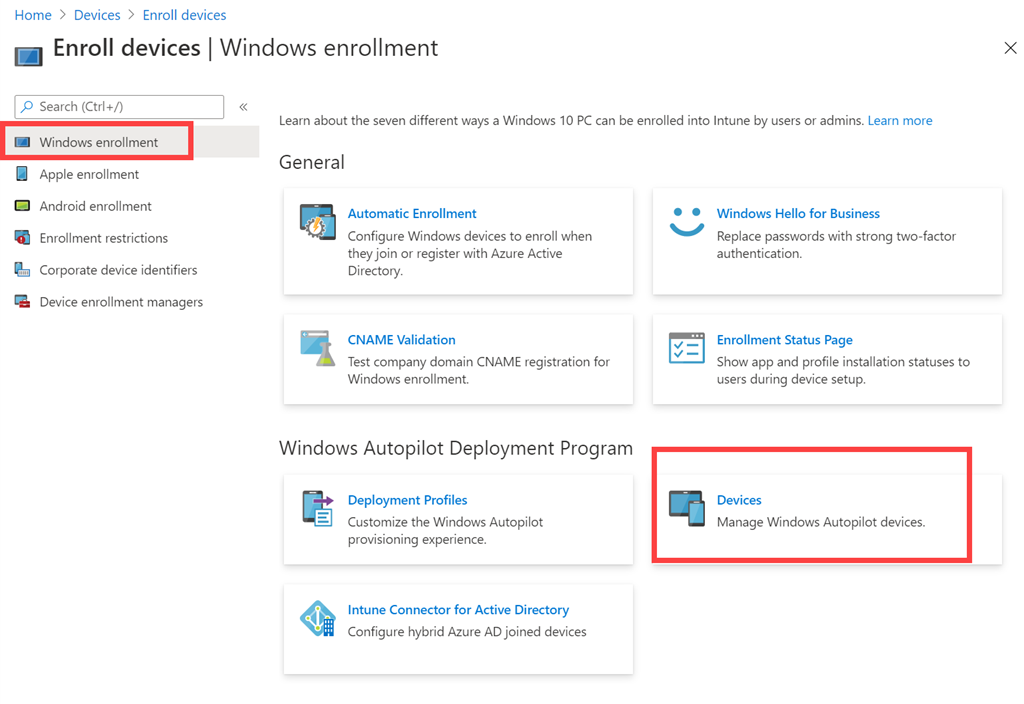
SNAGHTML1511efe6

You’ll then need to select Windows enrollment  and Devices as shown above.
image

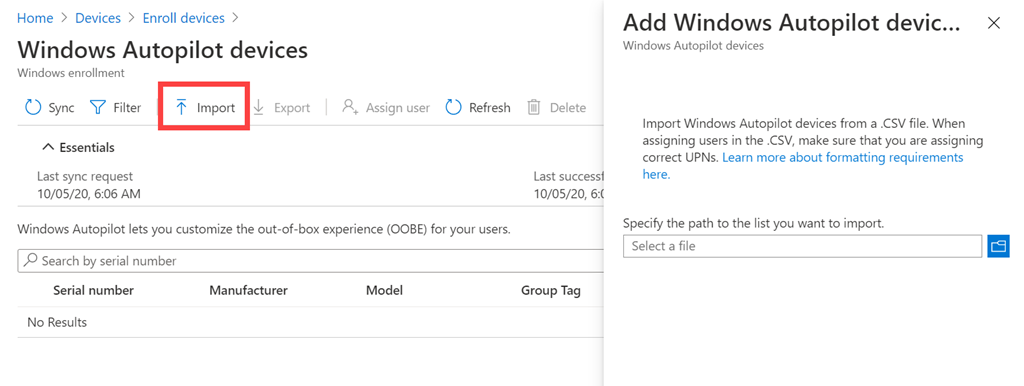
You’ll then need to select the Import button from the menu at the top. You’ll then see a dialog for where you can upload the machine CSV file as shown above.

When you upload the file will be checked for integrity.
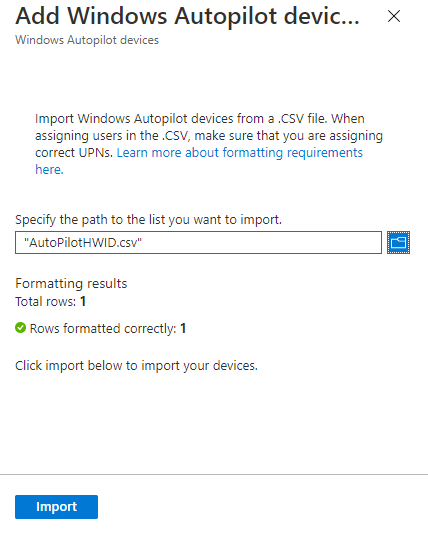
image

You will the result as shown above. You can also have multiple devices in this CSV file and that number will also be reflected here.

When ready, select the Import button.
image

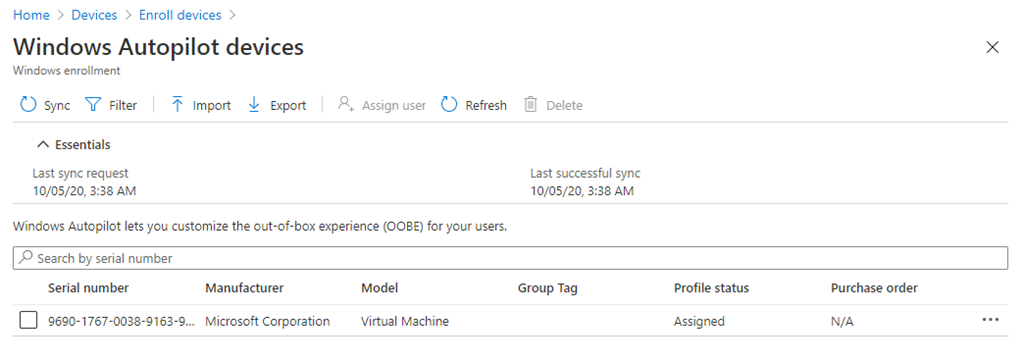
The import process will take a few minutes per device to digest but after that you should see the machine you imported as shown above.

What will also happen now is that Endpoint Manager will look for a match between the devices you imported and any machine that may already be enrolled in the environment. This is why it is important to all any existing Windows 10 machine here, even if they didn’t have Autopilot applied to them initially.
image

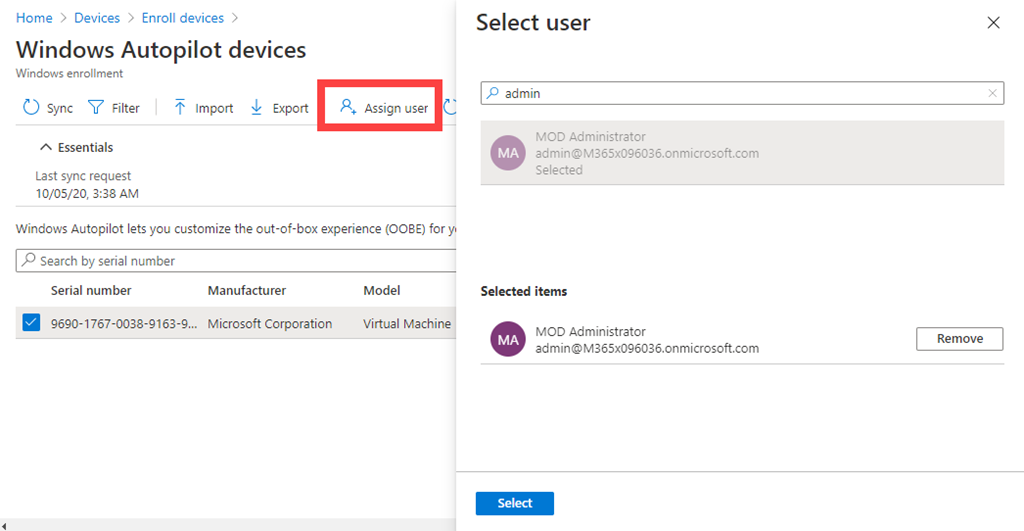
You’ll also note that you can assign a user to the device, as shown above. Doing so will mean that upon completing Autopilot it will be ready for that user, without the need for them having to log in during the Autopilot process. This allows device enrolment WITHOUT the need for a user on the device!
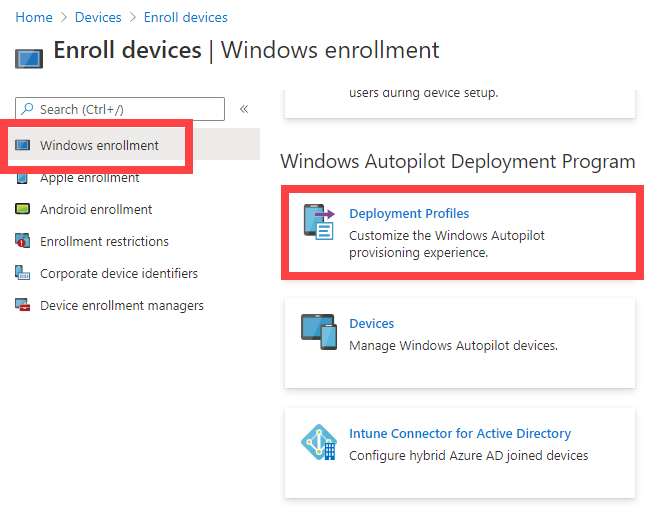
SNAGHTML155f6752

Now that Endpoint Manager can recognise the devices as they boot up, the next step is to set the process through which these devices will run during that initial boot phase. This is set via Deployment Policies as shown above, in the Windows Autopilot Deployment Program area of Enroll devices in Endpoint Manager..
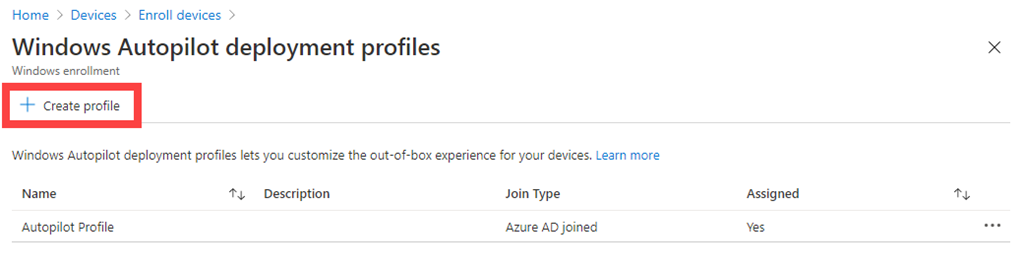
image

Here, select the option to Create profile, as shown above
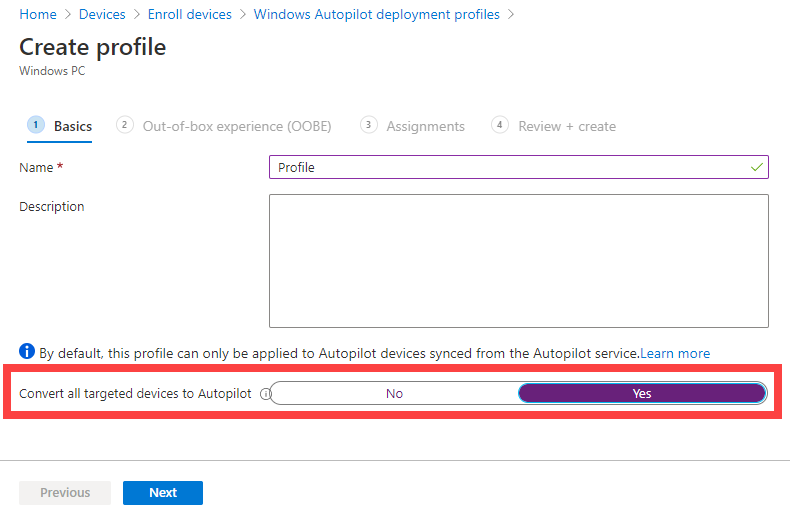
image

Give the new policy a name and generally set the Convert all targeted devices to Autopilot as Yes.
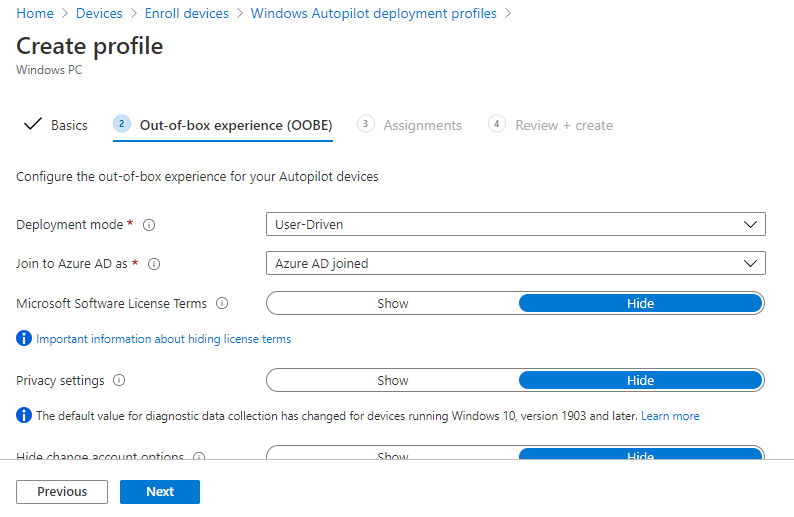
image

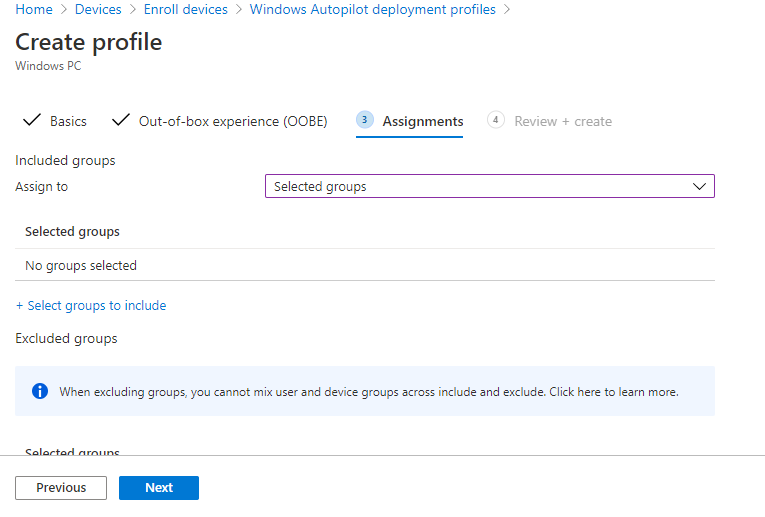
The next stage is where you set the the Out Of the Box Experience (OOBE) for the user. For example, you can hide the Microsoft Software License Terms, Privacy settings, etc. Generally here, you want to minimise what the user is presented with as the machine boots.
image

You then assign the policy as you would any other in Endpoint Manager and complete  the process.

The policy should now be displayed in the list of deployment profiles. You can edit the existing profile or create new ones if you wish.
image

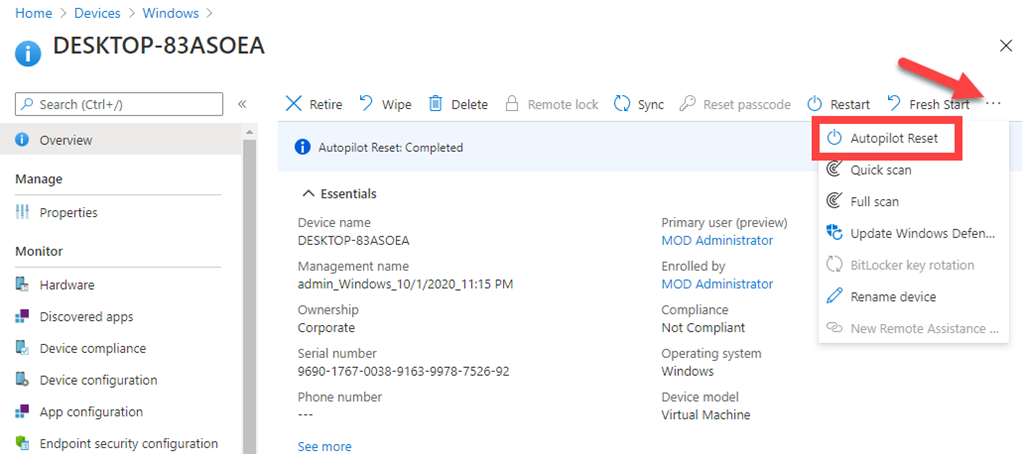
Now that Endpoint Manager can identify devices as they boot and apply a deployment profile to them as well, you can target these devices for an Autopilot Reset as shown above.

To do this, simply navigate to the device in Endpoint Manager, select the ellipse (three dots) in the top right, and from the menu that appears select Autopilot reset.
image

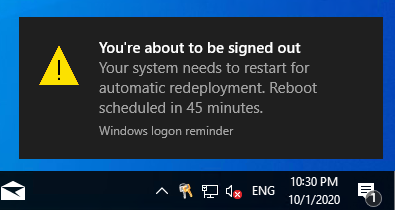
The device will receive a warning as shown above, indicating the process will start in 45 minutes. If however, the machine is rebooted prior to this, the Autopilot process will commence.

When the Autopilot process does commence, the device will re-initialise Windows to being ‘Out Of the Box’. If a user has been assigned to that device, it will used to join to Azure AD and enrol in Endpoint manager automatically, without user interaction. When complete, the device will be ready for the user to access the new clean environment.

In summary then, Windows Autopilot is part of Endpoint Manager and allows you to provide an ‘Out Of the Box Experience’ (OOBE) for users and automatically enrol the device in your environment. You can do this with new devices shipped to the user directly from a distributor and you can also incorporate any existing Windows 10 device in your environment by harvesting the unique device information and then uploading that into the Endpoint Manager console.

Once a machine appears under Autopilot in the Endpoint Manager console, it means you can fully manage and redeploy that device if you need to, without ever having to touch that machine. That is what modern device management is all about!

Modern Device Management with Microsoft 365 Business Premium – Part 8
Modern Device Management with Microsoft 365 Business Premium–Part 6

Previous parts in this series are:

Office 365 Mobile MDM – Modern Device Management with Microsoft 365 Business Premium–Part 1

Intune MDM – Modern Device Management with Microsoft 365 Business Premium – Part 2

Intune MAM – Modern Device Management with Microsoft 365 Business premium – Part 3

Endpoint Manager – Modern Device Management with Microsoft 365 Business Premium – Part 4

Baselines – Modern Device Management with Microsoft 365 Business Premium – Part 5

All the articles so far have focused on the technical implementation of device management, however these are all effectively subservient to real need of allowing users to get their work done. Security that gets in the way of what people need to do will simply result in them bypassing it and opting for solutions that are less secure and less controllable, aka shadow IT. Thus, when implementing successful device management, you keep in mind the end game here which is, allowing users to get done what they need to, securely.

Deploying all the options that are available with device management is daunting given the sheer number of settings, across multiple operating systems via multiple services like Intune and Endpoint security. Thus, even before you start implementation you should ensure that you have a good documentation regime in place to keep track of what you implement and what changes you make over times. There are going to be circumstances when you need to track down a specific setting in a specific policy and having good documentation is going to save you boatloads of time. It is also going to save you going round and round in circles making changes that have unexpected consequences. Thus,

Rule number 1 = maintain good documentation

With a plethora of policies and settings to configure having a define naming convention is going to make troubleshooting far easier. I have seen all sorts of policy names that bear no relevancy to the actual settings it implements. Remember, you can end up with multiple policies for multiple device operating systems, for multiple audiences across multiple services. Using something like MAM iOS Sales team or MDM Windows Executives or ES Antivirus Field Staff is going to allow people to quickly understand what these policies are for, where they come from and who they apply to. Good naming conventions are defined prior to implementation and applied consistently (which is why they are called conventions after all!). So,

Rule number 2 = define a naming convention upfront and apply it consistently

All users are not created the same. Thus, you’ll need to consider dividing up your policies into deployment rings, much like what Microsoft does with Windows I suggest. You’ll probably need a test or canary ring, and early adopters ring and an everyone else ring.

The canary ring is basically test devices and users to determine the effects of applying policies. This will give you early warning as to what impact settings actually have in your environment. This will be 1 – 2% of your population.

The early adopters ring is targeted at those users who like to be first and are prepared to ride out and bumps along the way by providing constructive feedback on the impacts of settings to them. This will probably be 10 – 15% of your population. Users in this ring should ‘opt in’ and understand the ramifications of getting things that may still be testing.

You may need to have multiple rings for different locations, devices or audiences. This is again where good documentation and naming conventions are critical. It is therefore recommended that:

Rule 3 = apply policies and updates to policies in rings to the environment

Not everything goes to plan. Sometimes setting and policy changes can have unexpected consequences on devices. Sometimes, these unexpected changes can prevent you from doing something you need to do. As with setting up conditional access, don’t lock yourself out:

Rule 4 = ensure you have an admin user that is not subject to any policy in case of emergency

Device management is typically never a world of all green check marks (and rainbows and unicorns). It is typically a world with setting conflicts, non compliance and strange impacts. Bulk policy implementations and/or changes are a recipe for never ending frustration. Start small and grow. Don’t turn everything on to the max out of the box. My advice is to start with one baseline at a time and get that all green, then move to individual Endpoint security policies and get that all green, then compliance and get that all green and so on. Thus,

Rule 5 = grow into your settings and policies

Some other recommendations for those that are actually tasked with deploying device management:

A. Have at least one physical test device for each operating systems. That means having a test iOS, Android and Windows 10 device at your disposal. It is easy enough to pick up a cheap or second hand device you can use. Nothing beats seeing exactly what happens on a physical device when policies are applied. It will also allow you to better understand the process of wiping and re-purposing devices.

B. Use a demo tenant first time out. Don’t learn this stuff on your customer’s dime. Don’t learn on your own production tenant. Sign up for a free demo Microsoft 365 demo tenant at https://cdx.transform.microsoft.com/ and do your learning there. There is nothing worse than test policies and configurations continuing to show up in production environments.

C. Fully implement device management in your own production tenant. Don’t forget that if you look after other customers, YOU are also a target of the bad actors. Your environment is an Aladdin’s cave full of passwords, logins and confidential information for many others. In short you hold the crown jewels for many businesses. Don’t think it can’t happen to you. Over prepare. Over secure your environment. Doing so will also help you more fully appreciate the impact that device and security settings will have on your customers and deployments as well as keeping their treasures secure.

D. Configuration is never complete. New devices, enhanced baselines, new policy options will all emerge over time. Security is a journey, not a destination as they say. You will need to monitor, review and adjust what you have implemented over time. You will need to evaluate what works, what doesn’t and what additional security you can apply to the environment. It will never be a ‘set and forget’ situation. Security is a service not a product.

E. Leverage the power of automation. Baselines are a great starting point and reduce much of the need for individual settings. However, technologies like PowerShell and the Microsoft Graph give you the ability to automate much. An example of this that I have detailed is here:

Automating the deployment of an Attack Surface Reduction policy across multiple tenants

The great things about these device management services from Microsoft is that they are consistent for everyone that has them. Thus, the same script will work across every customer that has those services. With so many settings available to you in device manage these days, it makes sense to invest your time in become more ‘code centric’ (DevOps anyone?) and adding those skills to your quiver.

In summary then, successful device deployment is all about people. It should be focused on delivering secure productivity without mindless obstruction, which being carried out in a systematic and consistent manner. You can have all the greatest deployment tools at your beckoned call, but if they are implemented incorrectly, the end result is far worse for end users and administrators than it would have been without device management. So, don’t make the mistake of seeing device management as a purely technical challenge, It ain’t!

Modern Device Management with Microsoft 365 Business Premium – Part 7

Modern Device Management with Microsoft 365 Business Premium–Part 5

Previous parts in this series are:

Office 365 Mobile MDM – Modern Device Management with Microsoft 365 Business Premium–Part 1

Intune MDM – Modern Device Management with Microsoft 365 Business Premium – Part 2

Intune MAM – Modern Device Management with Microsoft 365 Business premium – Part 3

Endpoint Manager – Modern Device Management with Microsoft 365 Business Premium – Part 4

One of the biggest challenges with the availability of all these policies via Intune MDM and MAM as well as Endpoint security is getting to a ‘best practices’ state.

image

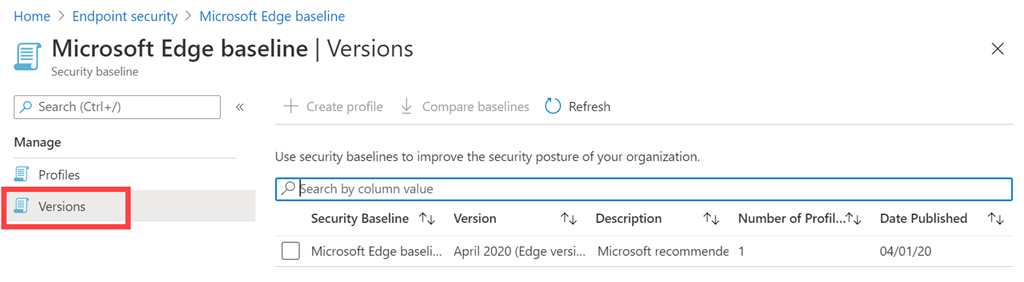
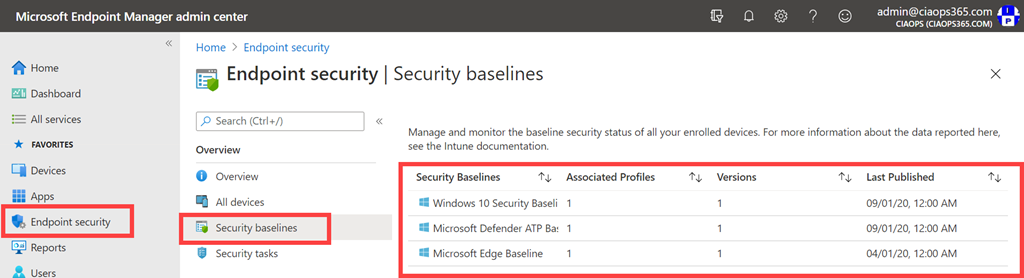
One of the benefits that Endpoint security provides is the ability to implement Security baselines as shown above. There is a baseline for Windows 10 security, Microsoft Defender ATP and Microsoft Edge already. Microsoft recently announced that an Office baseline will soon be available.

image

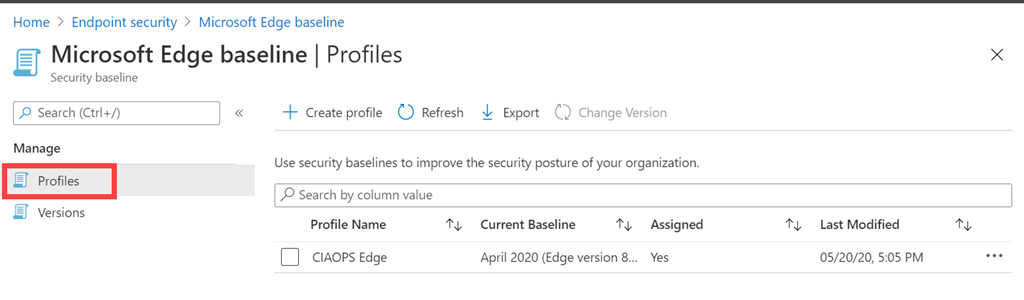
The idea is that Microsoft will publish a ‘best practices’ baseline, as shown above for Edge, and that you can create a policy or ‘profile’ as it is called here, from this to use across your environment just like any other policy we have already spoken about.

image

The idea is that, rather than you having to work out and apply a range of best practice settings across all the individual policies, you can simply implement these baseline policies from Microsoft as a starting point.

Another benefit is, as updated baselines are released by Microsoft, you can simply update any existing ‘profile’ you have created with these baselines to incorporate these updated settings.

image

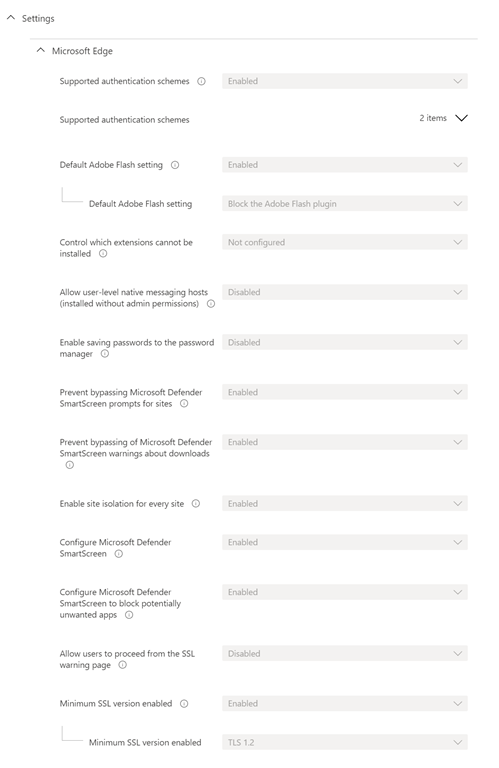
When you look at the settings available in these baselines, as shown above for Edge, you’ll notice that they basically contain many of the same settings available to you in individual Endpoint security policies. Thus, setting once via a baseline ‘profile’ is a much faster method of implement these settings. Otherwise, you’d probably have to create multiple individual policies to achieve the same level of protection.

You can, of course, adjust any baseline ‘profile’ that you create and when a new baseline is available it can be applied to existing ‘profile’ you have created while maintaining any custom settings you have made in that ‘profile’. You can also create a range of different ‘profiles’ from baselines and target them to different audiences in your environment just as you can with other individual policies from Intune MDM, MAM and Endpoint security.

If you already have individual Endpoint security and Intune policies deployed you will need to be careful if you then start to deploy baseline policies. If there are differences in the settings between the baseline policies and those configured in Intune MDM, MAM and Endpoint security you’ll end up with a conflict. Thus, you will either need to make sure that the settings are identical between all the policies that you use or stop using some of the conflicting policies. Generally, I would suggest that just using the baseline policy for the setting is a best practice approach.

Why do I believe this? If you look at the volume of policy settings that can be made across all options like Intune MDM, MAM and Endpoint security, it makes more sense to me to start with what Microsoft believes is best practice first and adjust from there. Doing so is going to:

1. Reduce the amount of individual settings in individual policies that you need to make.

2. Reduce setting conflicts across all your policies.

3. Allow you to more easily to update to new best practices when they become available.

With this in mind and looking back across what we have talked about so far with MDM and MAM, Intune and Endpoint security, I would suggest this as a new best practice approach to configuring device security is, in order:

1. Implement all Microsoft baseline security policies.

2. Make any required customisations to the deployed baseline ‘profiles’ in your environment.

3. Implement individual Endpoint security policies for additional settings not covered by the baselines.

4. Implement MDM compliance policies for additional settings not covered by baselines or individual Endpoint security policies.

5. Implement MDM configuration policies for additional settings not covered by baselines, individual Endpoint security and MDM compliance policies.

6. Implement MAM application protection polices for additional settings not covered by baselines, individual Endpoint security, MDM compliance and MDM configuration policies.

7. Implement MAM configuration policies for additional settings not covered by baselines, individual Endpoint security, MDM compliance, MDM configuration policies and MAM application protection policies.

in short, start with baselines, then implement individual Endpoint security policies, then Intune MDM policies, then Intune MAM policies.

At this stage, no single policy is going to provide all the protection required. Thus, you need to use a mix of policies across baseline, Endpoint security and Intune to suit your needs. However, in the long run, I see baselines and Endpoint security policies as being the future and suggest you start there rather than the traditional approach that was to start with Intune. If you already have Intune in place, for example, then you’ll need to think about migrating to baselines and Endpoint security policies as I am currently doing. It will be frustrating at times tracking down the duplicates at times, but I suggest doing so will position you better for future improvements in the device management space.

Success with device management is not merely about select the right setting in a policy, it is also about deploying it effectively into your organisation. That’s what I’ll take a look at in the next article.

As something else to consider, I’d suggest you have a read of my article:

The changing security environment with Microsoft 365

In light of the recommendation to apply Microsoft baselines. The questions to think about are – in the future why can’t Microsoft simply apply these baseline policies automatically and use AI to fill the gaps with additional settings? Where does that then leave those who are setting device polices today?

Modern Device Management with Microsoft 365 Business Premium – Part 6

Modern Device Management with Microsoft 365 Business Premium–Part 4

In the previous parts of this series I have covered:

Office 365 Mobile MDM – Modern Device Management with Microsoft 365 Business Premium–Part 1

Intune MDM – Modern Device Management with Microsoft 365 Business Premium – Part 2

Intune MAM – Modern device Management with Microsoft 365 Business premium – Part 3

We still have some additional device configuration options available to us thanks now to Microsoft Endpoint Manager.

image

As well as Intune MDM and MAM policies we now have extra Endpoint security policies.

image

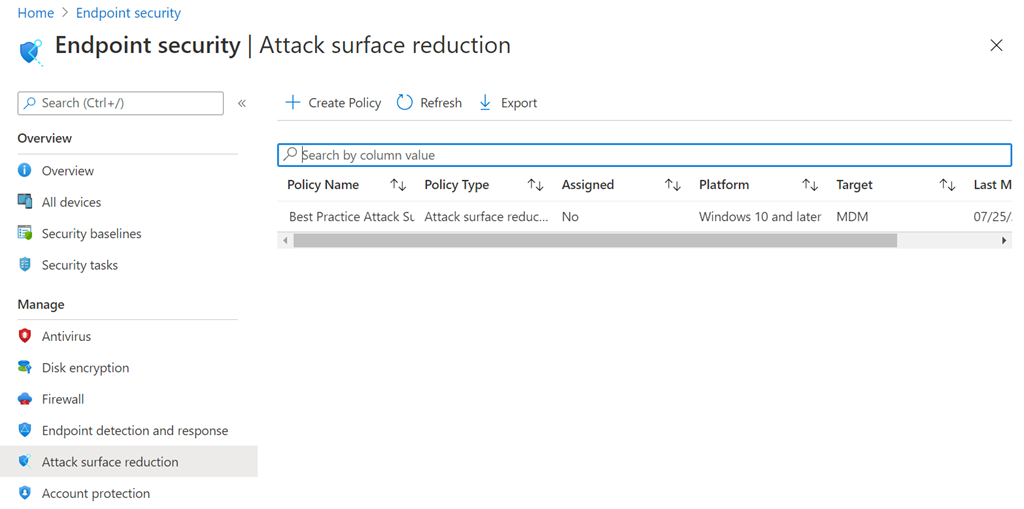
You’ll find these under the Endpoint security menu item on the left and then under the Manage heading as shown above. In there you will find the following options that you can go and configured policies:

– Antivirus

– Disk encryption

– Firewall

– Endpoint detection and response

– Attack surface reduction

– Account protection

image

If look inside any of these Endpoint option, here Attack surface reduction, you see that you can set policies just like what has already been covered around Intune device and application policies.

image

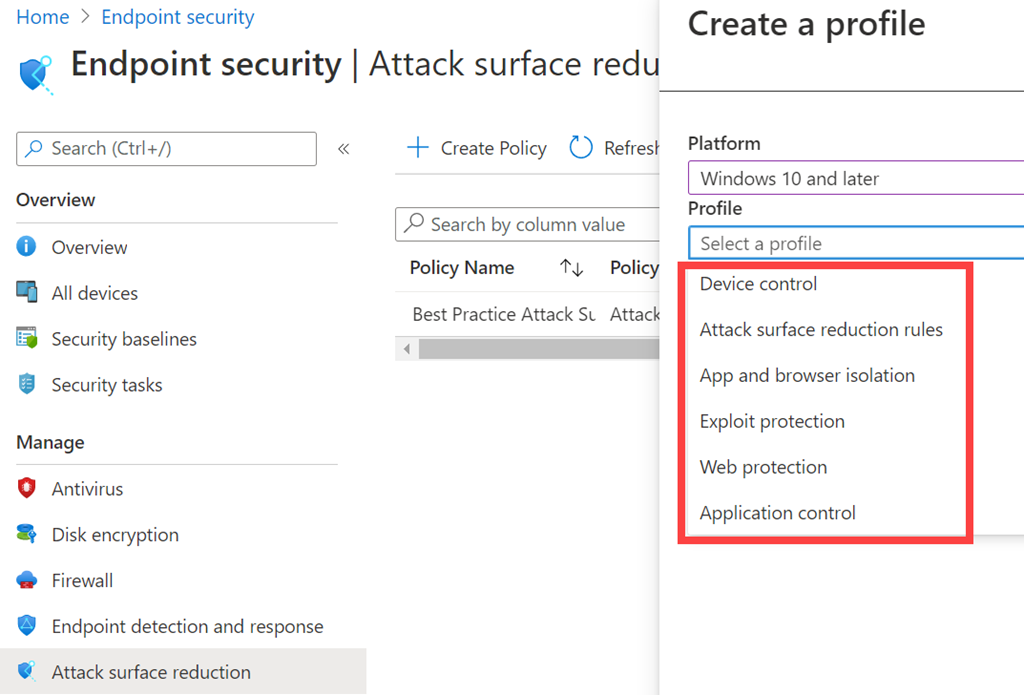
When you do create an Attack surface reduction policy, for example, you’ll get the option to target device control, attack surface reduction rules, app and browser isolation and so on, as shown above.

image

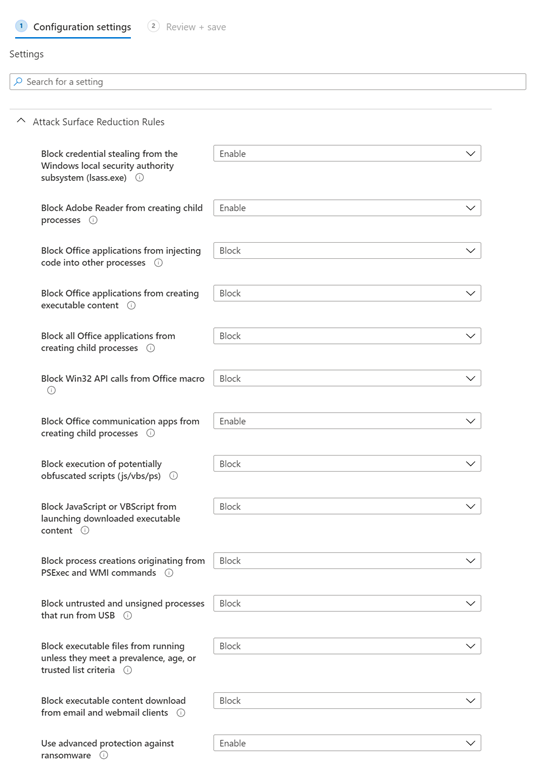
If you configure the attack surface reduction rules, as shown above, you’ll see the now familiar configuration settings that you choose from and then save to the policy. You then finally target the policy that you create to a user and/or a device, again just like Intune.

In essence, you now have a number of additional policies, largely focused on Windows 10 device security for now, that can also be applied to your environment.

The challenge here becomes, some of these Endpoint Manager policy settings are unique and some overlap with existing Intune policies that you may have set. If there is a mismatch in the policy settings you have between Endpoint Manager and Intune, these will report as conflicts in the Endpoint Manager portal. So, the trick is to either use the duplicate Endpoint Manager policy settings BUT ensure they are the SAME as what is set in Intune or only have one set of policies (Endpoint Manager or Intune) for the desired option. My opinion would be that if the desired setting option is available in Endpoint Manager policies, set it there and don’t set it in any Intune policy. It is my understanding, that in the long run, Endpoint Manager policies are were Microsoft is investing the most in currently.

In summary then, it is possible to use three sets of policies for your devices:

1. Intune device policies

2. Intune application policies

3. Endpoint Manager policies

You can set any combination of the three, but be careful about creating conflicts as they can be challenging to track down as some settings overlap.

All of these policies can be implemented and accessed with PowerShell, however I would suggest not ‘basic’ PowerShell like you might be used to with Exchange Online for example. Think more of accessing the settings via the Microsoft Graph with PowerShell, which is a little more complex than ‘standard’ Microsoft 365 PowerShell with commands like get-msoluser for example.

There are still more considerations with device management that will be covered in the next article. Hopefully, by now you are beginning to appreciate the power and granularity that is possible with device management from Microsoft 365. However, as they say, “With great power comes great responsibility” (and I would add a lot more complexity).

Modern device Management with Microsoft 365 Business Premium – Part 5

Modern Device Management with Microsoft 365 Business Premium–Part 3

In the previous parts of this series I have covered:

Office 365 Mobile MDM – Modern Device Management with Microsoft 365 Business Premium–Part 1

Intune MDM – Modern Device Management with Microsoft 365 Business Premium – Part 2

The next step in the step in the process of securing and managing devices with Microsoft 365 Business Premium is Mobile Application Management (MAM) which we’ll look at now.

MAM allows the ability to fully manage select applications, typically business applications like Outlook Mobile, Word Mobile, etc on any device. MAM is handy because it doesn’t require device management (MDM). This makes especially handy when users bring their own personal devices and want access to business data like emails but don’t want the organisation having fully control of their device. Thus, MAM is prefect for the Bring Your Own Device (BYOD) scenario.

image

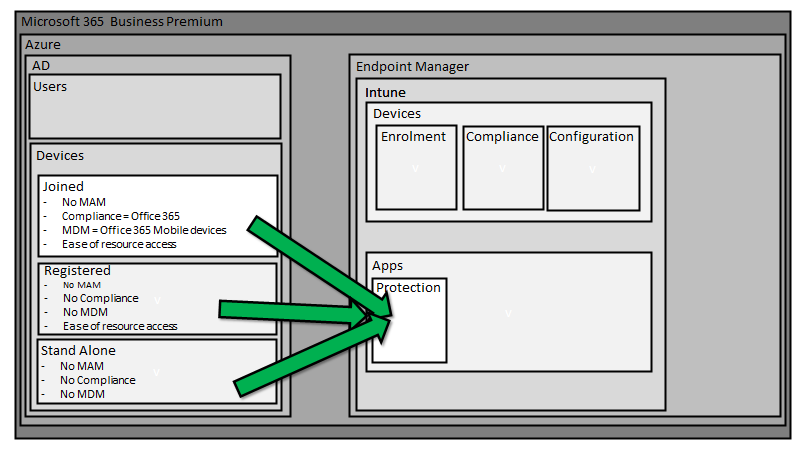
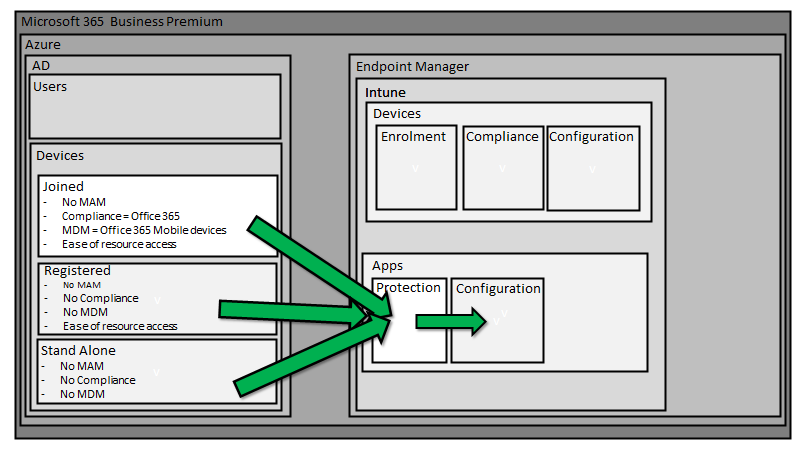
We can thus use MAM on any device, independent of whether it is Azure AD joined, registered or stand alone.

The Intune service inside Endpoint Manager is typically what is used for MAM. Application control is once again managed by policies that are pushed down to the individual applications on the device. The first of these policies is known as App Protection policies which is focused on application security.

SNAGHTML2087555d

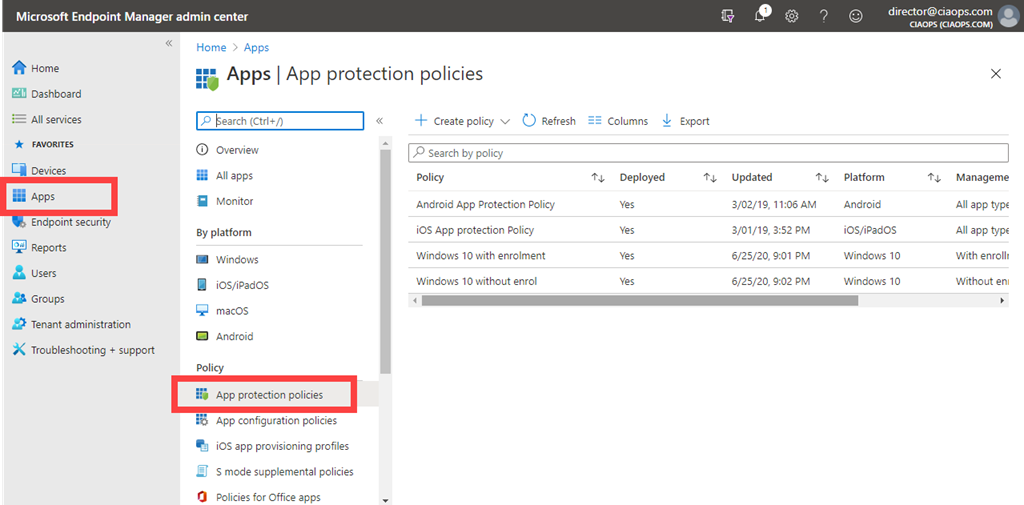
These policies are located in the Endpoint Manager portal under Apps and then App protection policies as shown above.

You can target policies to different device OS versions and here you typically define ‘targeted apps’ (i.e. corporate apps) as well any apps you want exempted from protection policies. Anything not defined by either of these is considered a non-corporate app. In here you also define corporate data locations, which will typically be Microsoft 365 services like OneDrive, SharePoint, etc but may also include on premises and third party cloud based services (say Salesforce). Now with both corporate apps and corporate data locations defined you can set policies around how data is to be stored and managed. For example, you may want to only allow corporate data to be saved to corporate locations or maybe you only want to store corporate data onto ‘secure’ devices. App protection policies allow these configurations and definitions.

App protection policies also give you the ability to selectively wipe data from corporate managed apps. MDM gives you the ability to wipe the WHOLE device remotely, both corporate and personal apps and data. MAM however, gives you the ability to just wipe the data inside Outlook mobile for example. This is why MAM is generally the best option for BYOD devices where the device owner don’t want the business to have access to anything but corporate data on the device.

image

You then have Application Configuration policies as shown above which are also part of Intune MAM. These policies target the options you want configured for applications on devices.

image

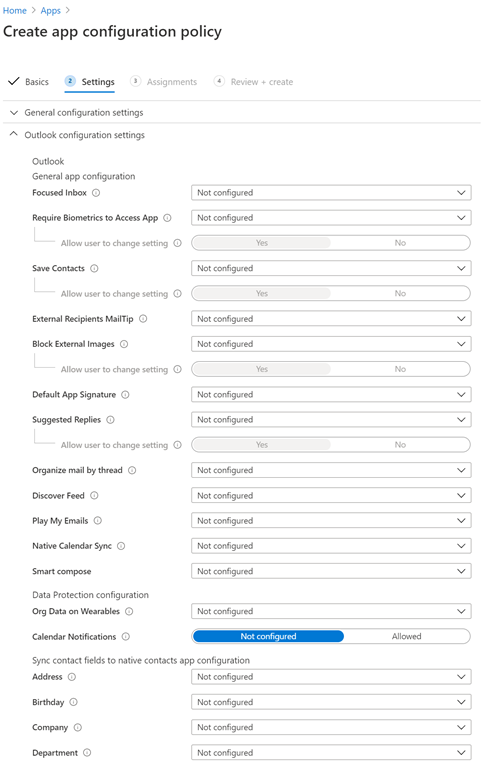
This is again controlled by policy which can be targeted at the device OS. The above is taken from the configuration policy for Outlook for iOS and illustrates the level of detail you can go down to when configuring. You can ensure that suitably configured apps are made available to user and devices optionally or as a requirement. There is a lot that can be done here to allow you to deploy and manage applications on mobile devices.

image

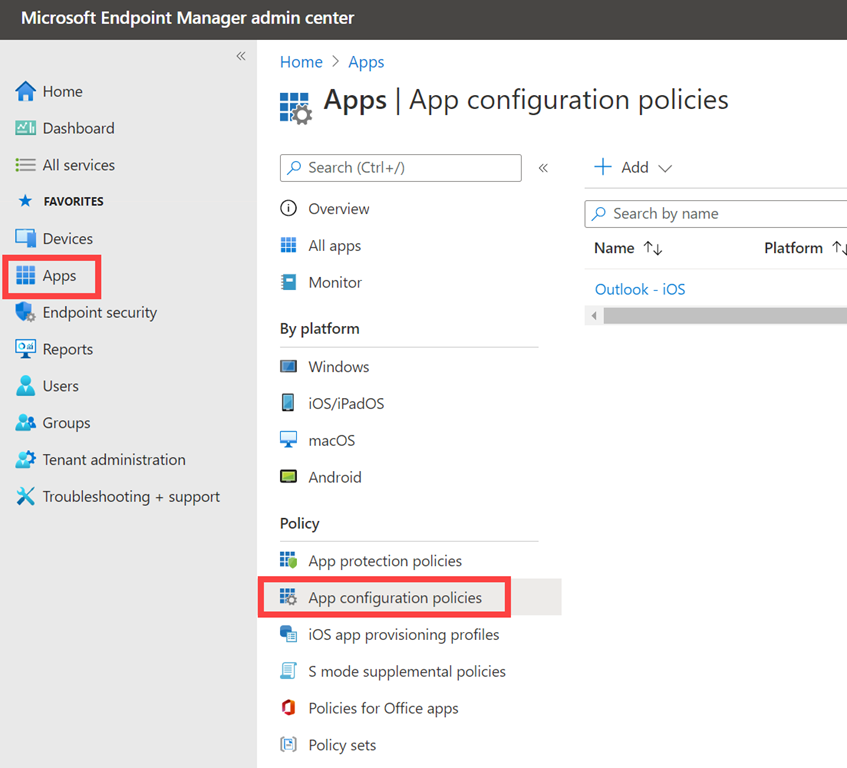
You get to these policies via the Apps option in Endpoint Manager and then App configuration policies as shown above.

Many people ask the question about whether you should or can use MDM and MAM together? The answer is most certainly, Yes. The reason you would choose to do that is to provide extra security and convenience. MDM means for example I can ensure that my device storage is encrypted while MAM will prompt me for a pin number when I actually use a corporate app. That makes my data more secure. Do you need to use both MDM and MAM? It all depends on your security and deployment requirements. If you mainly have BYOD devices that don’t want to be device managed then MAM will be your only option. The main thing is that it provides flexibility when it comes to both security and configuration of your devices. The best strategy is defence in depth. The more layers of protection you have the lower your risk.

Given all the options that have been covered in both MDM and MAM so far, hopefully you can now see the huge amount of options available to you when it comes to managing devices. The tricks is to firstly get the device enrolled, apply MDM and then MAM policies.

Don’t think however this is the end of device options available to you. Oh no, Endpoint Manager has a many additional configuration options you can implement to make your devices EVEN more secure. Stay tuned for that upcoming article.

MOdern device Management with Microsoft 365 Business Premium – Part 4

Modern Device Management with Microsoft 365 Business Premium–Part 2

In

Modern Device Management with Microsoft 365 Business Premium–Part 1

I covered the basic overview and out of the box device management you get with pure Office 365. In this article I want to start digging into the more advanced features you get by using Intune which is part of Microsoft 365 Business Premium.

image

Microsoft has a service called Endpoint Manager that allows advanced device configuration and management. You access this via:

https://endpoint.microsoft.com/

image

Intune is now part of Endpoint Manager, so you use that to gain access to the Intune configuration.

image

Part of the Intune configuration capability is device management, this is more advanced than the basic options in pure Office 365 that were detailed in the previous article.

image

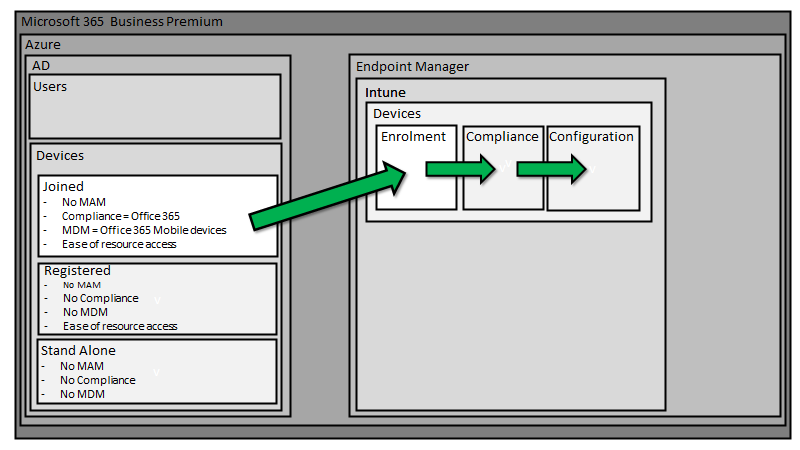
To have devices managed by Intune they first need to go through a specific Intune enrolment process.

image

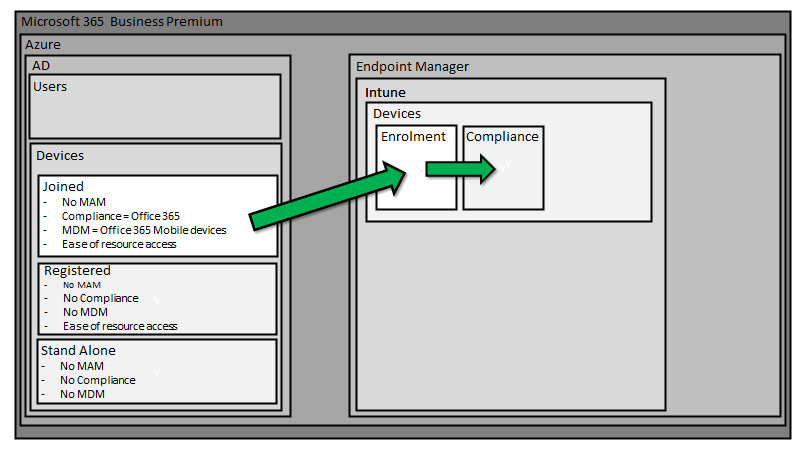
Intune device enrolment can only be achieved once devices have been joined to Azure AD. Both registered and stand alone devices cannot be managed at a device level via Intune, only those devices that have been fully joined to Azure AD can be enrolled in Intune for device management.

image

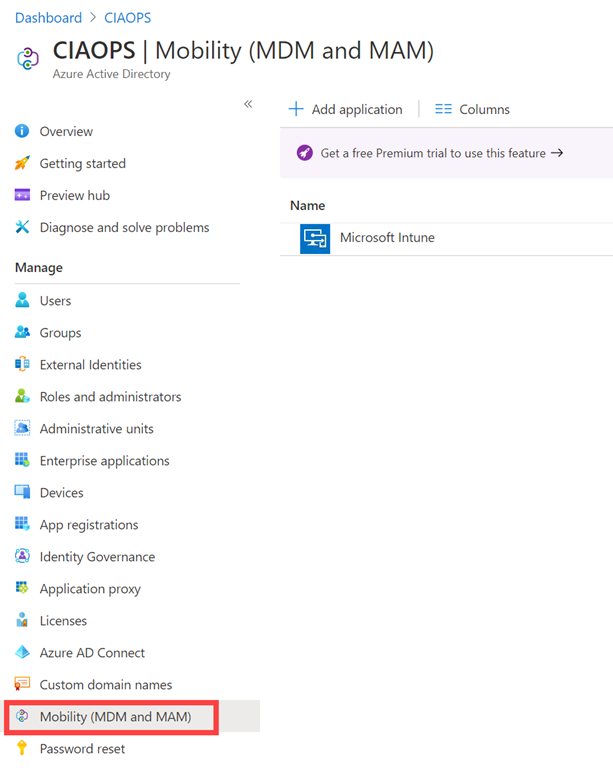
If you look at your Azure AD in the Azure portal you’ll see the option Mobility (MDM and MAM). If you select that, you’ll probably see a Microsoft Intune option on the right as shown above.

image

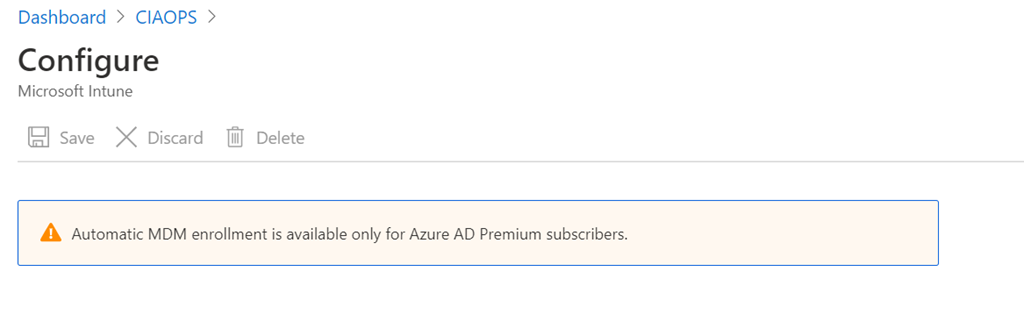
If you select that Intune option and you don’t have a license for Intune you’ll be greeted with something like the above. What this is telling you is that automatic enrolment of device requires an Intune license.

image

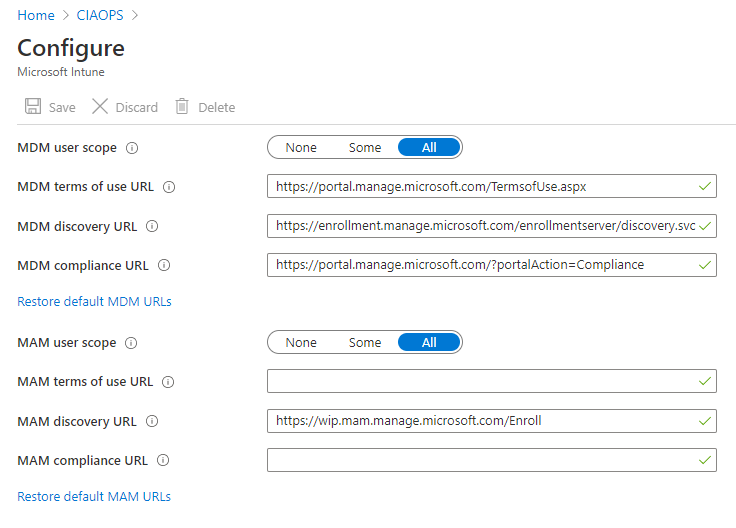
If you do however have a license for Intune you’ll see the above instead. This allows you to select which groups (None, Some, All) that will automatically be enrolled in both device management (MDM) and application management (MAM). You could still of course, manually enrol if you wished but by adding an Intune license you now get the ability to automatically enrol devices into Intune management once you have joined these devices to Azure AD.

So the, typical steps so far have been:

1. Join device to Azure AD

2. Have it automatically commence device enrolment in Intune

You will find the configuration for Intune enrolment by navigating to Endpoint Manager:

https://endpoint.microsoft.com/

SNAGHTML14ccbdd9[4]

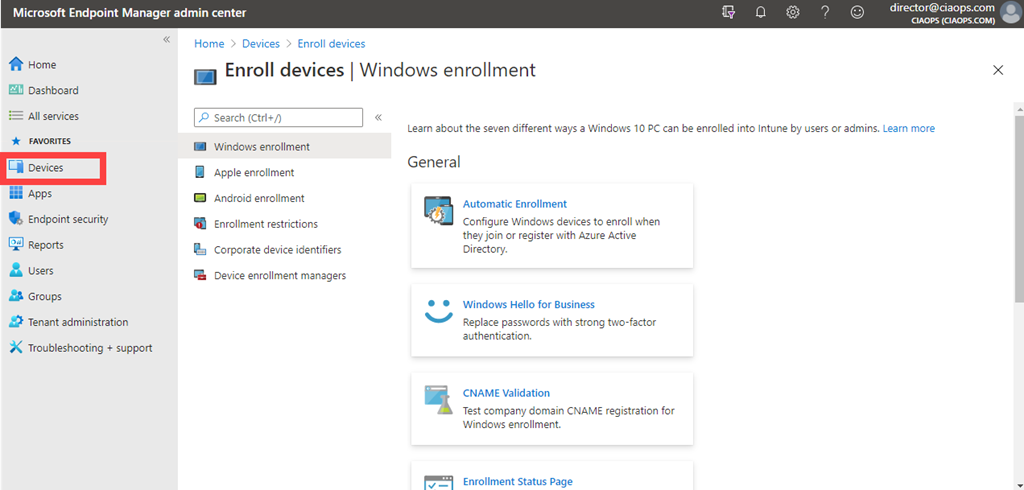
and then go to the Devices option from the menu on the left then Enroll devices as shown above.

SNAGHTML1487c6b2

The first major difference you’ll now see is that you have enrolment options for Windows, Apple and Android as well as the ability to enforce restrictions and allocate managers. Each operating system will have it’s own enrolment capabilities and options. For example, it is here that you configure Windows Autopilot and Windows Hello for Business if you wanted, as they are considered potentially part of any advanced device enrolment.

I’ll look at covering off many of these different enrolment options in future articles, however I do want to call your attention that to enrol Apple devices you will need to set up a free Apple certificate beforehand. I have detailed that process previously here:

Adding an Apple Certificate to Intune

SNAGHTML14b17f9b

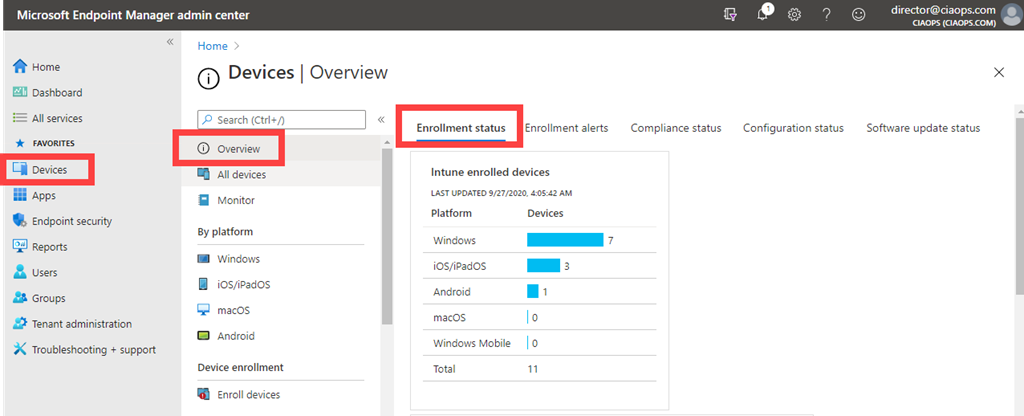
You can get an overview of the device enrolment status in your environment (i.e. successes and failures) via Endpoint Manager | Devices | Overview | Enrollment status as shown above. You’ll also see any Enrollment alerts on the very next tab to the right.

image

Once devices have successfully completed enrolment, they will commence device compliance.

SNAGHTML14a1feac

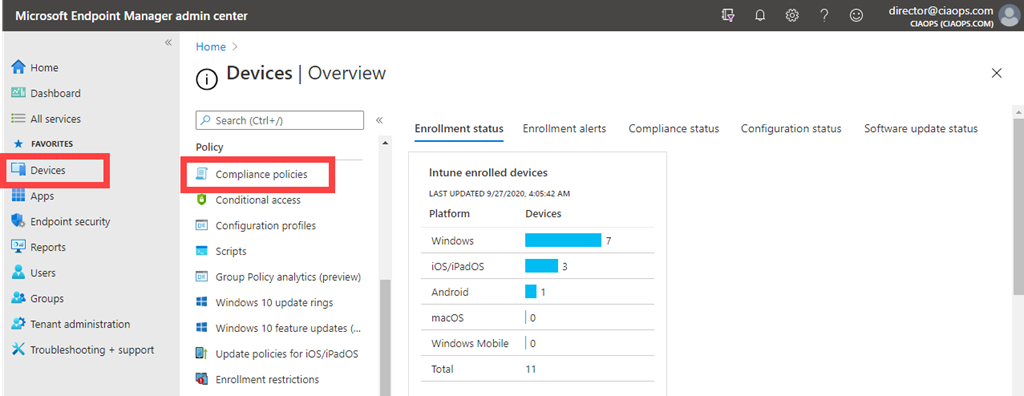
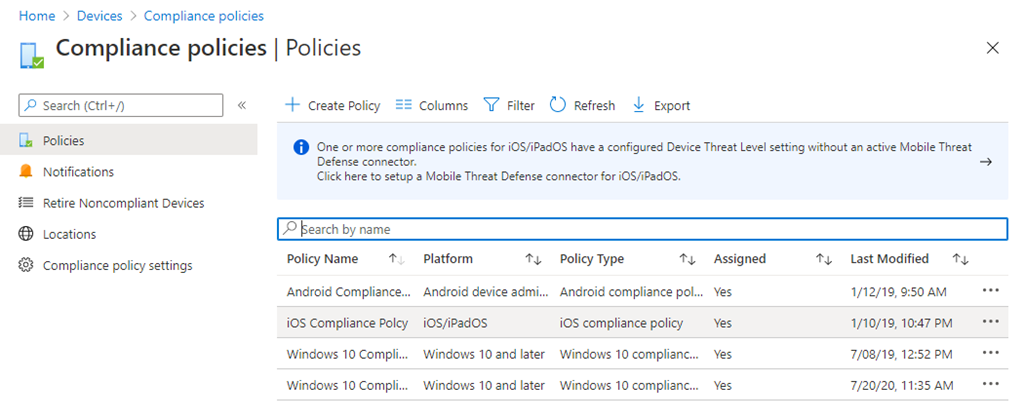
You can configure device compliance policies via Endpoint Manager | Devices | Compliance policies as shown above.

image

Here you create as many different Compliance policies as you wish. Typically, you have one per device operating system, however you can have more if you wish. A good example of why you might have two Windows 10 policies is to handle machines that have and those than don’t have TPM capabilities. Disk encryption is a compliance setting you can check for and enforce. However, you may not want to enforce full disk encryption via BitLocker for machines that don’t have inbuilt TPM chips for example. Thus, two separate compliance policies would be required. One to check machines with a TPM capability and one for those without.

image

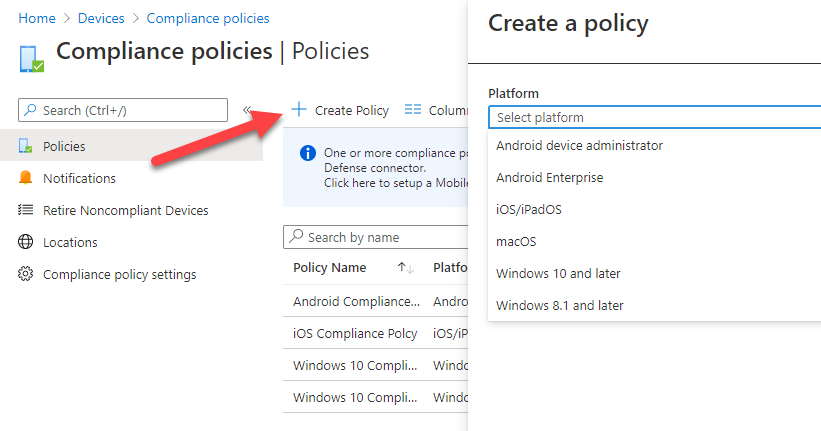
If you select the Create Policy option, as shown above, you’ll be able to select from a range of platforms (OS’s).

image

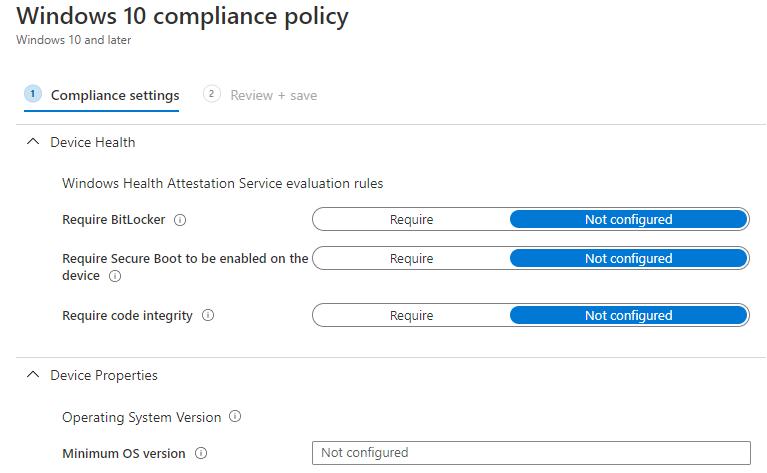
The compliance options available will vary by device operating system, but an example of some of the Windows 10 options you can configure in the policy are shown above.

The main idea here is to configure appropriate checks via policies for each device operating system. Devices that fail these checks are considered and marked as ‘non-compliant’ and further action can then be taken. An example of an action that can be taken on a device that is ‘non-compliant’ is to exclude it from accessing Microsoft 365 information. A good example of this is a policy that prevents devices that have been jailbroken or have unsupported operating systems from being able to access corporate data.

SNAGHTML14b4bded

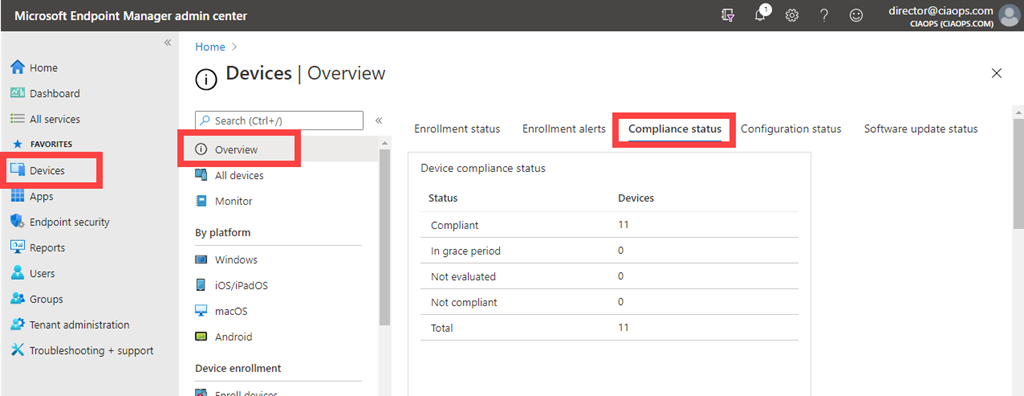
You can get an overview of the device compliance status in your environment by navigating to Endpoint Manager | Devices | Overview | Compliance status as shown above.

image

Once compliance policies have been applied to a device, the final part of adding devices to Intune device management is the application of configuration policies.

SNAGHTML14b99b3a

These policies are found by navigating to Endpoint Manager | Devices | Configuration policies as shown above.

image

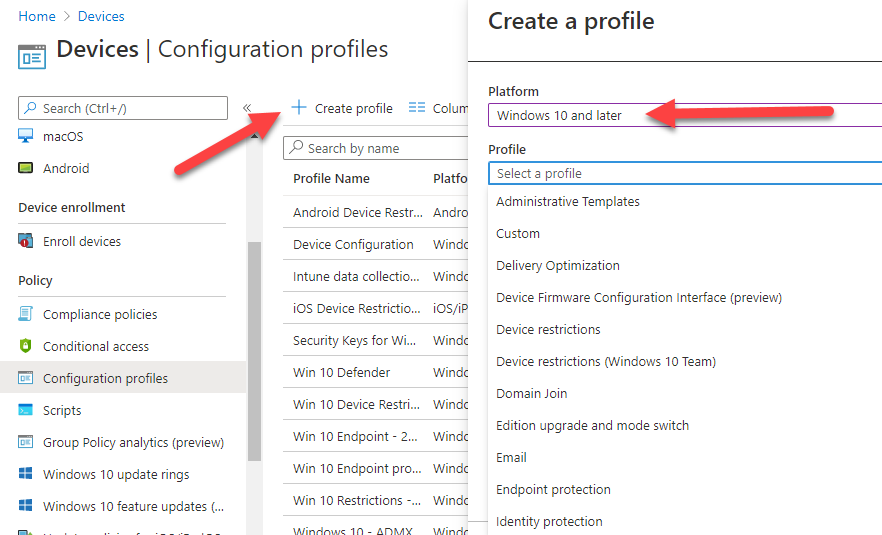
When you create a new policy via the Create profile button from the menu as shown above you again need to select the device operating system and then the profile. The number, types and content of these profile will vary by operating system but for example allow to to do things like control when anti virus scans run, control photo uploads, enforce pin locks and so much more.

Here you will typically have lots of policies including different policies for different groups of users, different operating systems and so on.

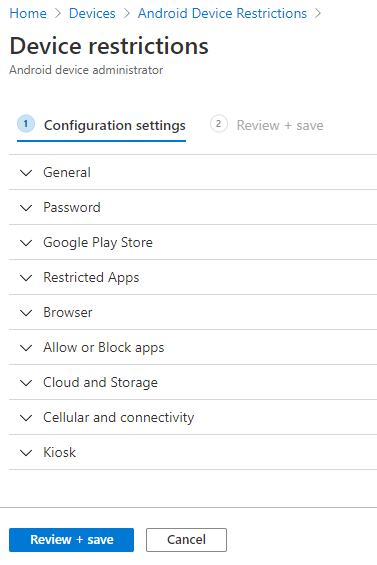
image

Above is an example of the options that are available in an Android Device Restriction configuration policy.

In summary, this article has covered the process of enrolling in advanced device management (MDM) using Intune. The process is:

1. Join devices to Azure AD

2. Devices complete Intune enrolment

3. Devices have Intune compliance policies applied

4. Devices have Intune configuration policies applied

After this process, devices are considered to fully ‘device’ managed by Intune. That is MDM is now done via Intune.

Note, MDM is for devices that are Azure AD joined and require full control of the device down to the operating system. This means the business has full control of the device. That may not be desired for users who bring their own devices (BYOD). Such devices can be managed by application management (MAM) which will be the focus of the next article.

Modern Device Management with Microsoft 365 Business premium – Part 3

Modern Device Management with Microsoft 365 Business Premium–Part 1

The way that devices running Windows 10, iOS, Android and MacOS get managed with Microsoft 365 Business Premium can be daunting to those who aren’t familiar with it. The common way that it is explained is from the inside out, that is via policies in Intune first, rather than starting with the big picture and working in.

I therefore thought that I’d do my best to explain it from what I see is a more logical way to understand what is going on.

image

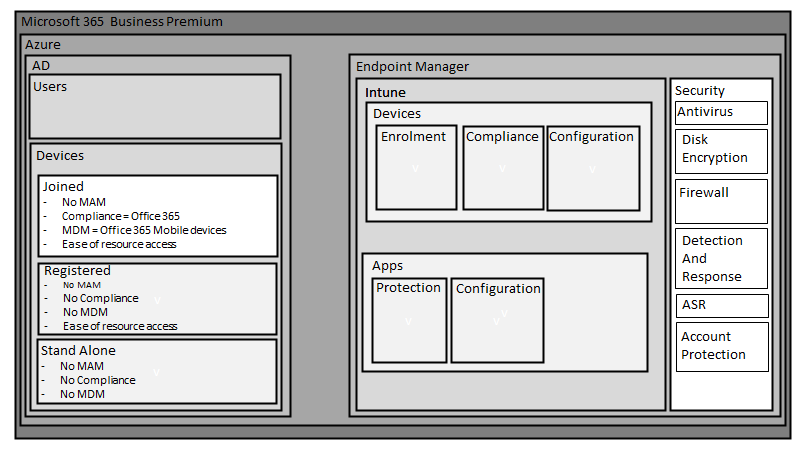
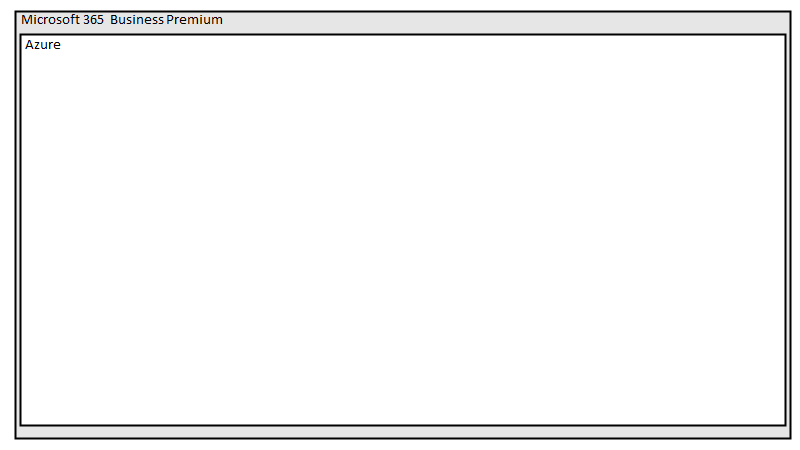
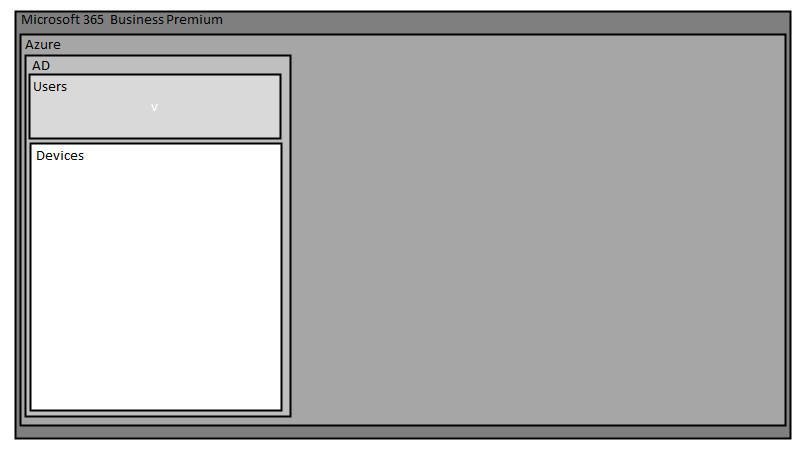
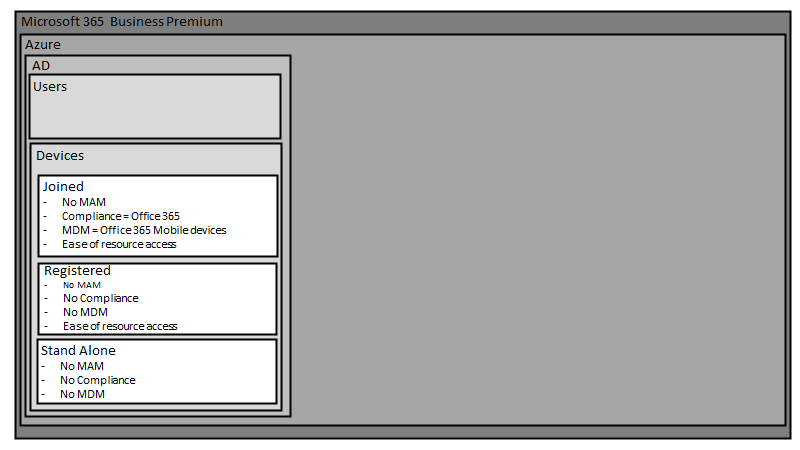
The starting point is the Microsoft 365 Business Premium tenant in which everything lives.

image

Inside a Microsoft 365 Business Premium tenant is an Azure AD tenant. See my article:

Deploy Office 365 and Azure together

for more information.

image

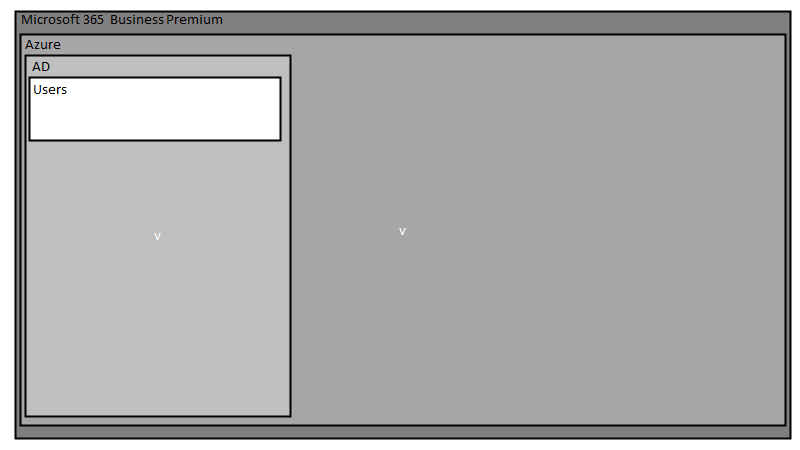
Inside the Azure AD tenant is Active Directory (AD) (i.e. Azure AD).

image

Inside Azure AD are user identities (i.e. login credentials).

image

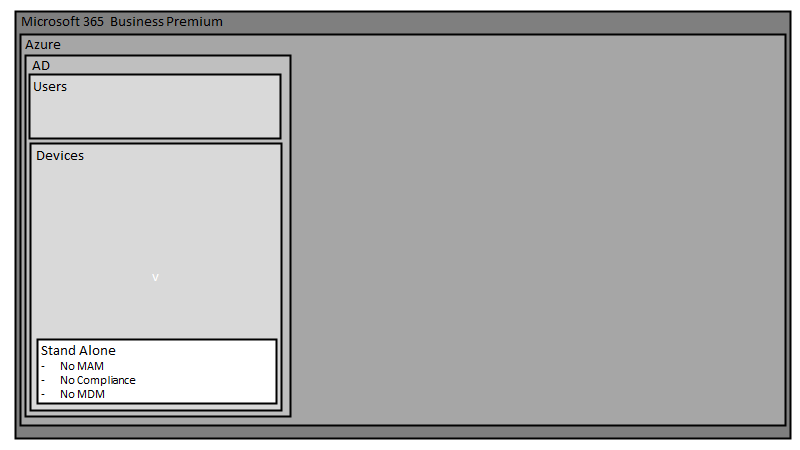
Also inside Azure AD are devices.

image

The first type of device that can be used, are devices that are totally stand alone. They have no connection to the tenant or are joined in any way. Given a larger canvas, these would live outside the tenant, however for convenience and space, I’ll simply represent them where they are.

If you want to access Microsoft 365 Business Premium services on such devices, you typically do so just using a browser. There is no device (MDM) or application management (MAM) of these devices as well as no compliance to ensure they meet requirements like an up to date operating system.

image

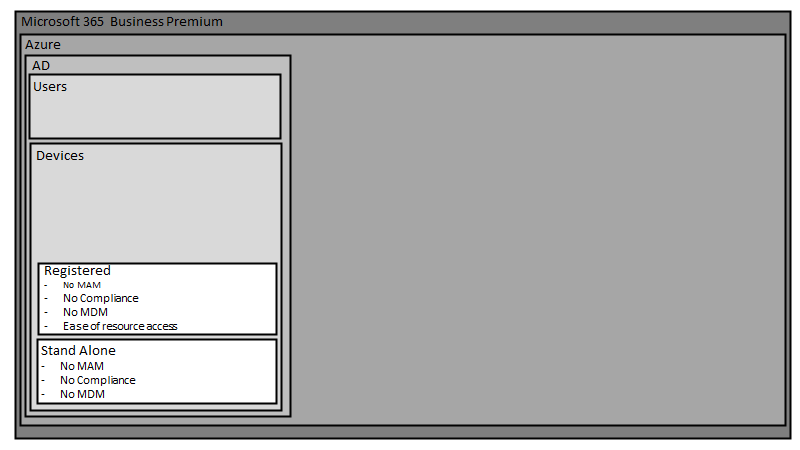
The next set of devices are those that are simply ‘registered’ with Azure AD. You do this by following these steps:

Register your personal device on your organization’s network

for more information see:

Azure AD registered devices

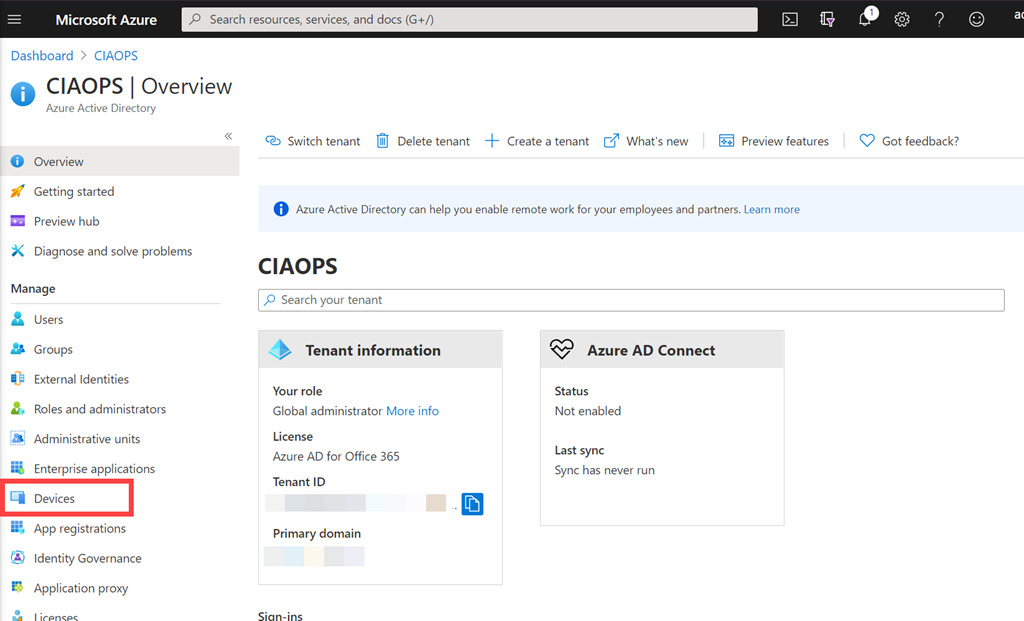
Once a device is registered it will appear in Azure AD.

image

You typically find that in the Azure Portal under the Azure Active Directory service and then selecting Devices as shown above.

image

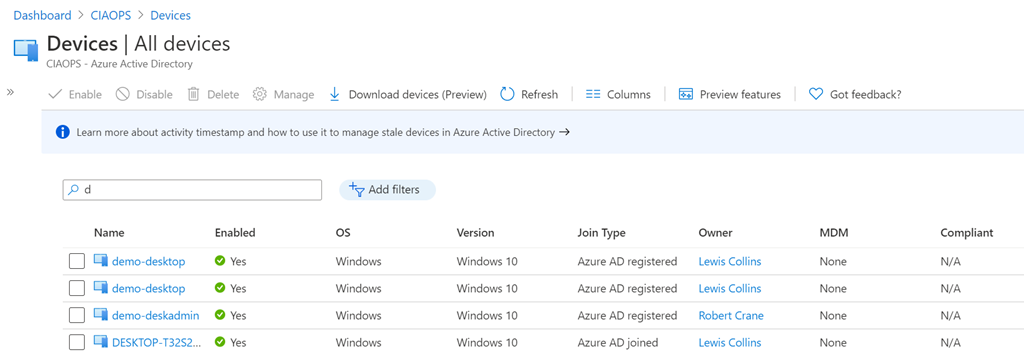
You will see that registered devices are displayed as Azure AD registered as shown above.

Azure AD registered devices typically have no application control (MAM), no device management (MDM) or compliance. The one advantage you do get over stand alone devices is that access to Microsoft 365 resources, like files, is easier and subject to less prompts to enter credentials.

Registered Azure AD devices are a typical scenario you see for BYOD in a pure Office 365 environment. That is, environments WITHOUT Intune.

image

The final type of devices are Azure AD Joined devices. The way that you join a device to Azure AD is covered here:

Join your work device to your organization’s network

and for more information about Azure AD joined devices see:

Azure AD joined devices

image

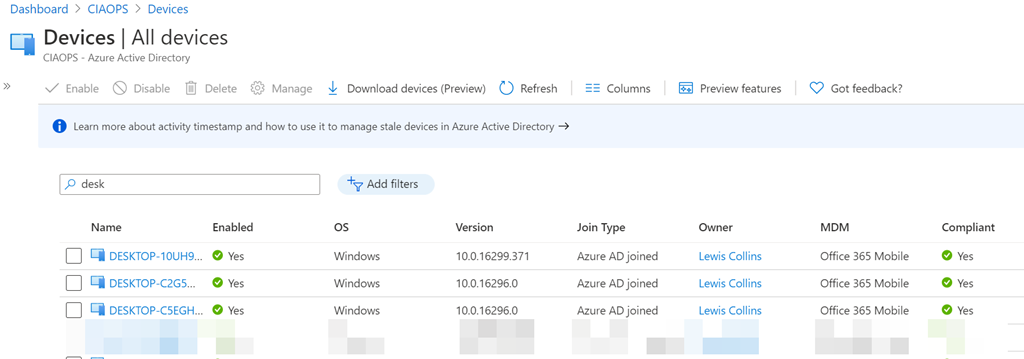
Azure AD joined devices will be shown as above with the join type as Azure AD joined. You will also note that these devices have MDM (device) management being Office 365 Mobile and a field for whether they are Compliant.

image

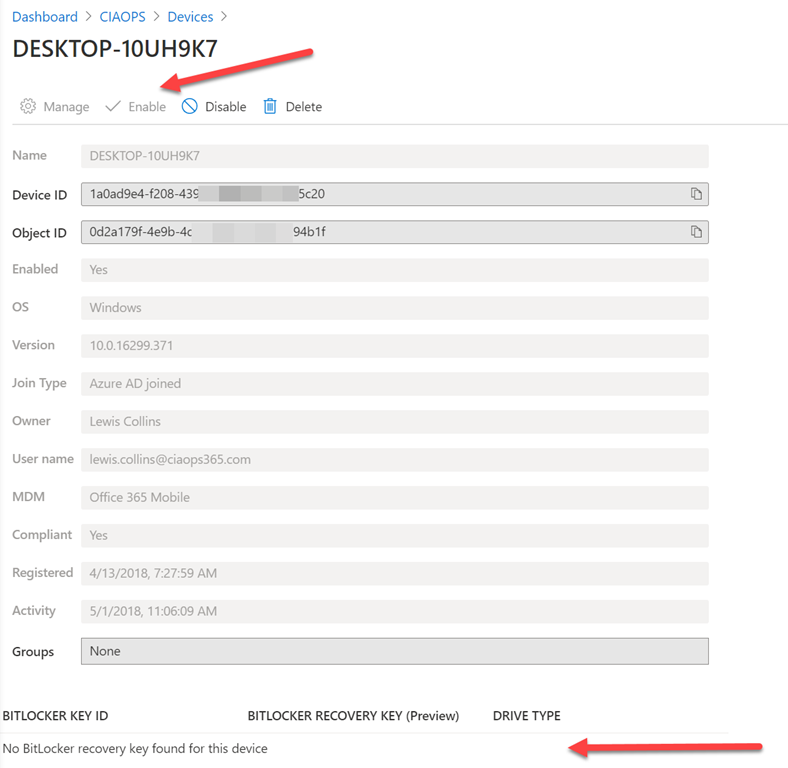
If you select an Azure AD joined device you largely get an inventory, as shown above, of that device, plus the ability to Enable, Disable and Delete the device via the top menu. Another benefit is the ability to capture BitLocker keys as well, which are shown at the bottom of the device if BitLocker is configured on the device.

Thus, the benefits of Azure AD joined devices is that they have some basic device management (via Office 365 mobile) as well as ability to be check for compliance. You can also, for example, do a device level wipe (i.e. factory reset) which you can’t do with the prior device connection methods. Azure AD Joined devices are also able to have easier access to Microsoft 365 services as with the previous two device connection methods.

Azure AD joined devices are a typical scenario you see for company issued devices in a pure Office 365 environment. That is, environments WITHOUT Intune where the company provides the device to employees.

Thus, Office 365 has a basic MDM and compliance capability which is detailed here:

Set Up Basic Mobility and Security

How you configure the Office 365 Mobile policies is found here:

Create device security policies in Basic Mobility and Security

You may need to use the direct URL:

https://protection.office.com/devicev2

to see these.

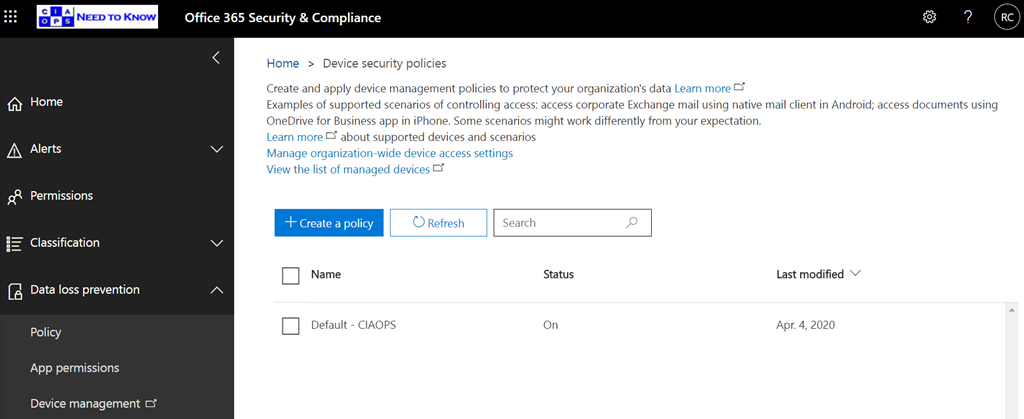
image

If you look at what these policies provide you see

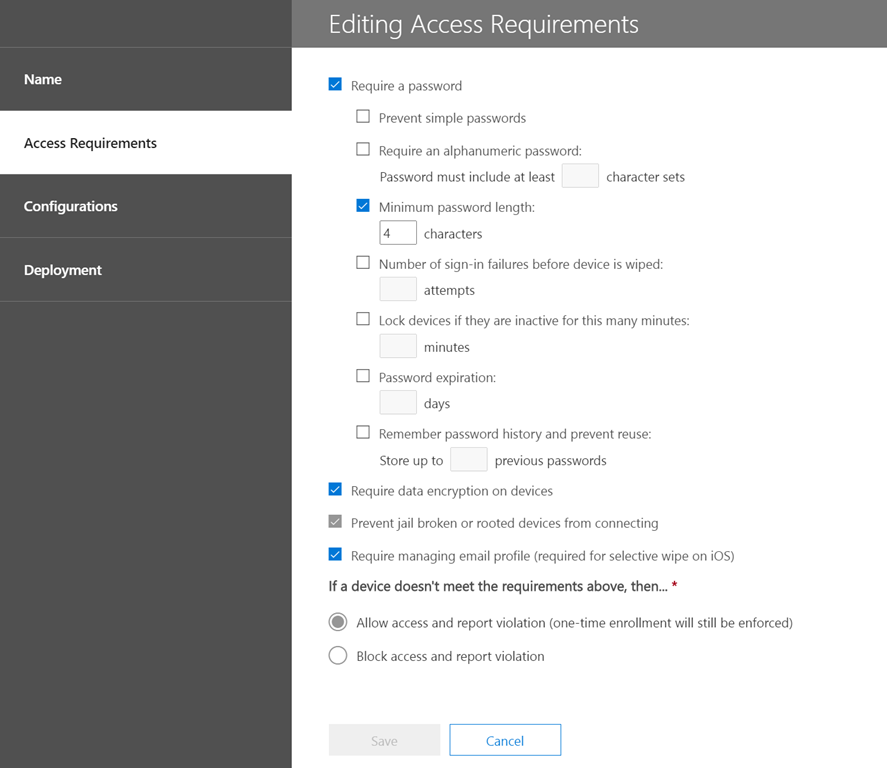
image

for Access Requirements and

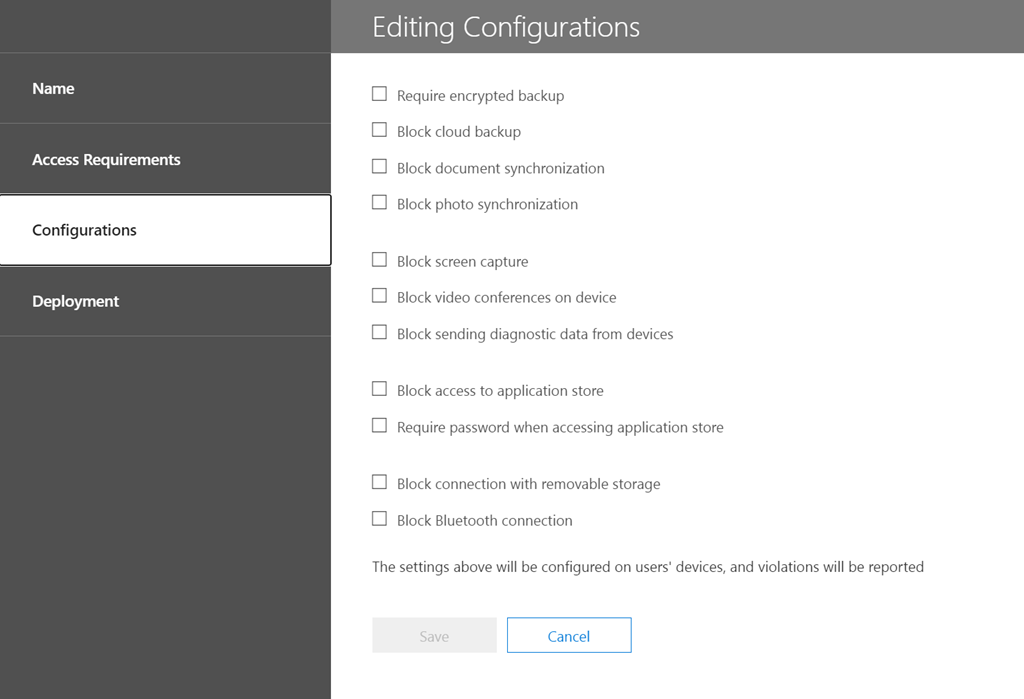
image

for Configurations.

Both of these options are quite limited and don’t provide any specific device OS/type targeting. They also roll compliance (Access requirements) and configuration together into a single policy, which lacks a certain amount of flexibility. In essence then, this is why the out of the box device management that comes with Office 365, known as Office 365 Mobile is ‘basic’. This is why something with more power and granularity is required if you are serious about device management.

You will note that, Office 365 Mobile management does not provide any real application management (MAM). This prevents doing things like push install to devices.

In summary, what has been covered so far is the out of the box device management capabilities you get with all Office 365 tenants. We can extend this much further using Microsoft 365 Business Premium and the power of Intune to manage devices. However, I’ll save that for an upcoming article as I want to break these concepts up into digestible chunks for people. So next we’ll take a look at how we can extend this basic device configuration using Intune.

Modern Device Management with Microsoft 365 Business Premium–Part 2