
The Golden Years
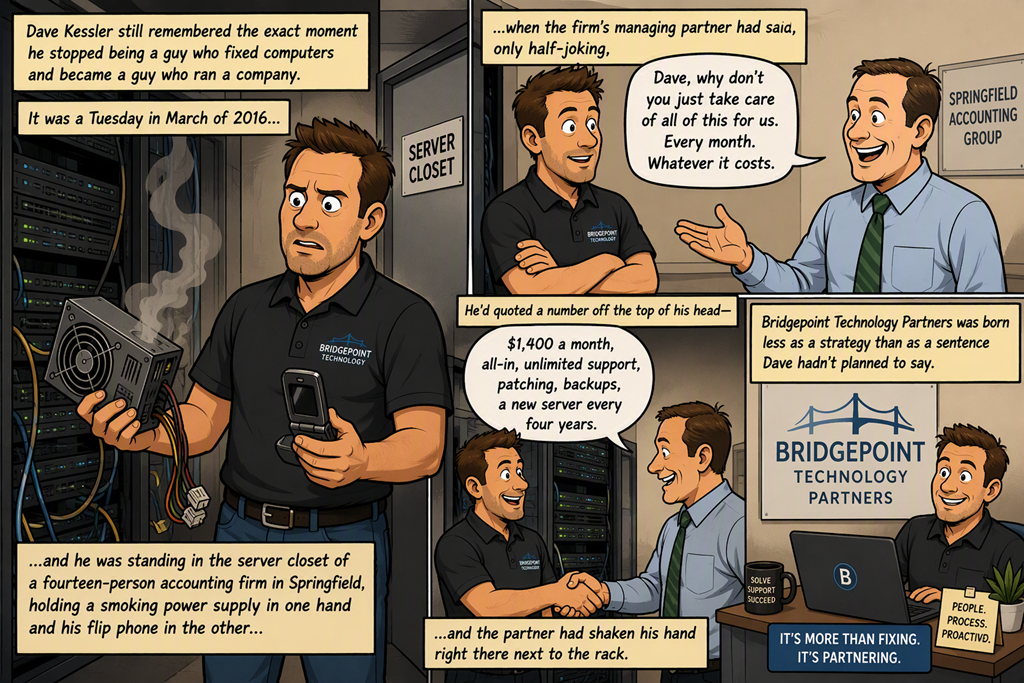
Dave Kessler still remembered the exact moment he stopped being a guy who fixed computers and became a guy who ran a company. It was a Tuesday in March of 2016, and he was standing in the server closet of a fourteen-person accounting firm in Springfield, holding a smoking power supply in one hand and his flip phone in the other, when the firm’s managing partner had said, only half-joking, “Dave, why don’t you just take care of all of this for us. Every month. Whatever it costs.”
He’d quoted a number off the top of his head — $1,400 a month, all-in, unlimited support, patching, backups, a new server every four years — and the partner had shaken his hand right there next to the rack. Bridgepoint Technology Partners was born less as a strategy than as a sentence Dave hadn’t planned to say.

Eight years later, Bridgepoint occupied the second floor of a converted mill building on the edge of downtown, with forty-one employees, eleven service vans with the company’s blue compass logo on the doors, and a client roster of 140 small and mid-sized businesses across three states. Dave had built the business the way most of his generation of MSP owners had: one relationship at a time, one saved server at a time, one 2 a.m. phone call answered personally at a time. He believed, and would say so at every company meeting, that Bridgepoint’s entire value proposition could be summarized in four words: “We show up first.”
For a long time, that was enough.
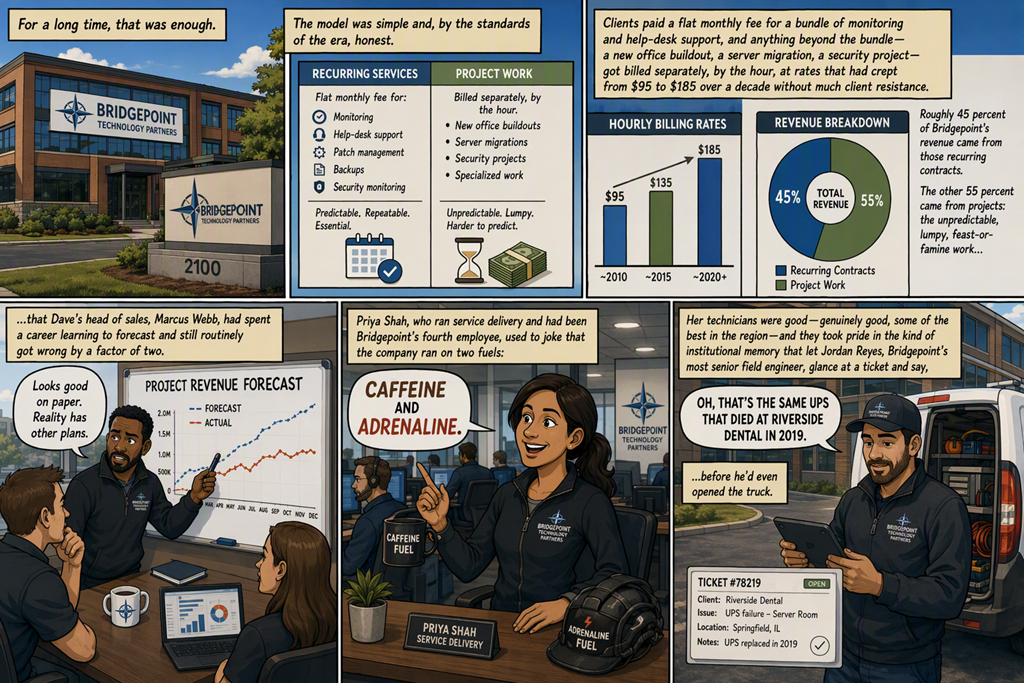
The model was simple and, by the standards of the era, honest. Clients paid a flat monthly fee for a bundle of monitoring and help-desk support, and anything beyond the bundle — a new office buildout, a server migration, a security project — got billed separately, by the hour, at rates that had crept from $95 to $185 over a decade without much client resistance. Roughly 45 percent of Bridgepoint’s revenue came from those recurring contracts. The other 55 percent came from projects: the unpredictable, lumpy, feast-or-famine work that Dave’s head of sales, Marcus Webb, had spent a career learning to forecast and still routinely got wrong by a factor of two.
Priya Shah, who ran service delivery and had been Bridgepoint’s fourth employee, used to joke that the company ran on two fuels: caffeine and adrenaline. Her technicians were good — genuinely good, some of the best in the region — and they took pride in the kind of institutional memory that let Jordan Reyes, Bridgepoint’s most senior field engineer, glance at a ticket and say, “Oh, that’s the same UPS that died at Riverside Dental in 2019,” before he’d even opened the truck.

That memory, that hard-won particularity about each client’s network, each client’s quirks, each client’s forgotten VPN password from a router installed under a desk in 2014 — that was the product. Clients didn’t pay Bridgepoint for infrastructure. They paid for Jordan knowing where the bodies were buried.
It was a good business. Revenue had grown from $2.1 million to $9.4 million in eight years. Dave drove a truck he didn’t need to drive anymore and kept driving it anyway, partly out of habit and partly because pulling into a client’s parking lot in a company vehicle still felt, to him, like proof that the whole thing was real.
None of them — not Dave, not Priya, not Marcus — spent much time in 2021 or 2022 wondering what might come next. Why would they? The phone kept ringing. The renewals kept renewing. Every year the number got bigger, and every year Dave told the staff at the holiday party that they were the best team in the industry, and every year, for a while, that felt like it was probably true.


One thought on “The Recurring Problem: A Managed Services Story–Chapter 1”