
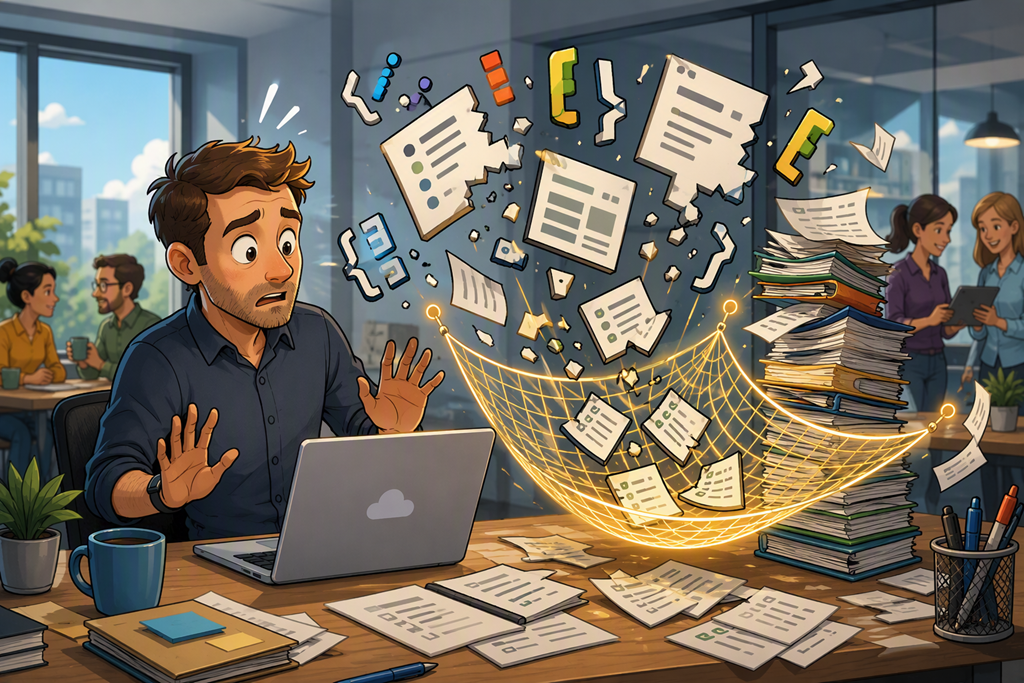
There is a special kind of fear that only appears after you press save on a Markdown file and the entire publishing pipeline falls over.
Not a dramatic fear. Not screaming in the street. More the quiet, professional terror of staring at a screen thinking, “I only changed one line.”
That is the funny thing about modern work. We talk about transformation, automation and AI as if the future is floating gracefully above us. Then a missing bracket, a badly indented bullet, or one heroic colon in the wrong place reminds everyone that civilisation is still held together by plain text and hope.
The smallest change can have the loudest voice
I like Markdown. It is simple. It is readable. It keeps content close to the person writing it rather than burying it under layers of formatting gymnastics. A good Markdown file feels honest. What you see is almost what you get.
Almost.
Because one tiny edit can turn a neat document into a crime scene. A table stops rendering. A link eats the next paragraph. A heading becomes normal text. Suddenly the document that looked perfectly sensible in your editor appears in SharePoint like it has had a hard weekend.
This is where a lot of organisations get caught. They assume simple files mean simple risk. They do not. A Markdown file can be part of a blog, a knowledge base, a GitHub repository, an internal procedure, a training handout, or a client-facing instruction set. If that file drives a process, then the little typo is no longer little. It has been promoted.
Copilot is useful, but it is not a seatbelt for carelessness
This is also where Copilot changes the conversation in a useful way. I can paste a Markdown section into Copilot in Word or ask Copilot in Teams to review a draft before I send it around. I can ask it to spot broken structure, unclear steps, inconsistent headings, or a table that looks ready to start a small fire.
That does not remove responsibility. It just gives me another set of eyes before I publish something that makes future me question past me’s life choices.
The real benefit is not that Copilot makes the edit for me. The benefit is that it slows the moment down just enough for me to think. Is this still clear? Did I break the flow? Does the document still say what I intended? Have I just created a support ticket disguised as punctuation?
That last one matters.
Version history is cheaper than regret
The sensible answer is boring, which is usually how you know it works. Keep important files in SharePoint or OneDrive so version history is available. Use Teams to discuss changes where the people affected can see the conversation. If the document matters, do not treat it like a disposable note on the side of your monitor.
For MSPs and small businesses, this is not academic. Your documentation is part of your service delivery. A password reset process, onboarding checklist, security exception register, or client build guide can all live as ordinary files. If someone “just fixes a sentence” and breaks the meaning, the cost may not appear until someone follows the bad instruction perfectly.
That is how documentation gets dangerous. It does not need to be malicious. It just needs to be confidently wrong.
So yes, we may all be one edit away from Markdown oblivion. But we are also one review, one version history check, one Copilot pass, or one quick peer glance away from avoiding it.
The lesson is simple. Respect the little files. They know where the bodies are buried.

