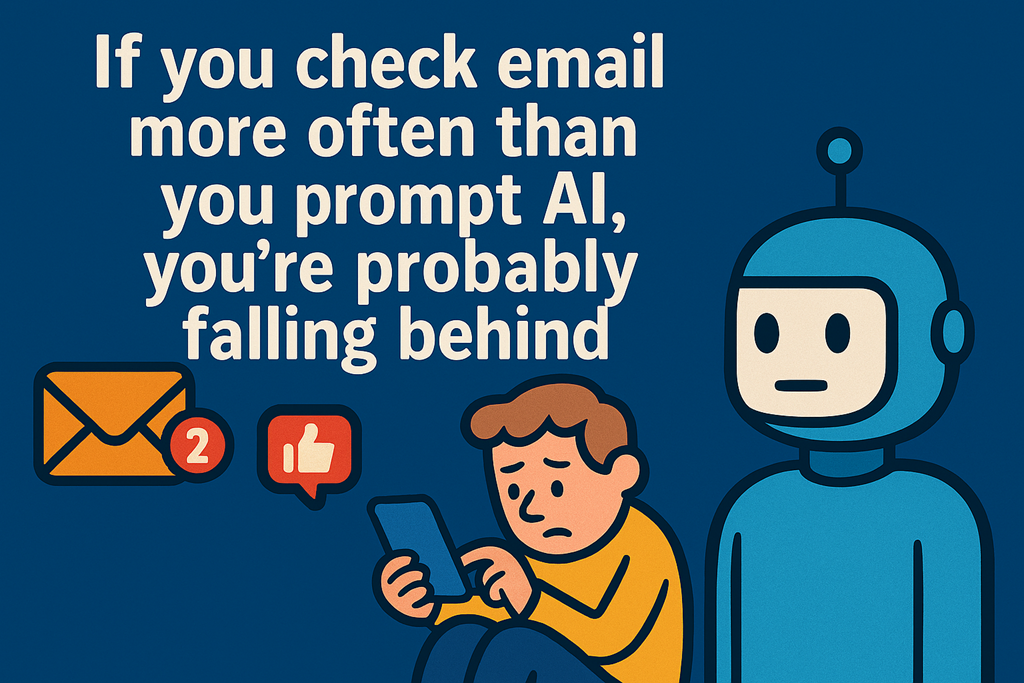
If You Check Email More Often Than You Prompt AI, You’re Probably Falling Behind

image

Here’s a simple, uncomfortable question.

How many times today have you checked your email or scrolled social media…
versus how many times you’ve deliberately prompted AI?

If the answer is “a lot more email”, you’re probably not just distracted.
You’re likely falling behind.

Not because email is evil.
Not because LinkedIn is a waste of time.
But because the way work gets done has fundamentally shifted — and many people haven’t adjusted their habits yet.

Attention Is No Longer the Bottleneck

For years, productivity advice focused on managing attention:

  • Inbox zero

  • Notification control

  • Time blocking

  • Focus modes

All useful. All still relevant.

But AI changes the equation.

The real bottleneck now isn’t attention — it’s leverage.

AI tools like Microsoft 365 Copilot don’t just save time.
They compress thinking, drafting, analysing, summarising, and planning into minutes instead of hours.

Every time you don’t use them for a task they’re good at, you’re choosing a slower path by default.

And speed compounds.

Email Is Reactive. AI Is Generative.

Checking email is reactive work.

You’re responding to other people’s priorities, context, and framing. Even when it’s important, it’s rarely leverage-heavy.

Prompting AI is generative work.

You’re:

  • Creating first drafts instead of staring at blank pages

  • Summarising weeks of emails instead of rereading them

  • Turning messy thoughts into structured plans

  • Extracting actions instead of manually parsing information

One creates momentum.
The other mostly maintains motion.

If you’re opening Outlook out of habit but only opening Copilot when you “have time”, you’ve inverted the value equation.

The New Baseline Is “AI-First” Thinking

High performers aren’t using AI as a novelty anymore. They’re using it as a default interface to work.

Before they:

  • Write a document

  • Respond to a complex email

  • Prepare for a meeting

  • Analyse data

  • Draft a proposal

They ask AI first.

Not for the final answer — but for acceleration.

This isn’t about replacing thinking.
It’s about removing friction from thinking.

The same way calculators didn’t make accountants dumb, AI won’t make professionals lazy. But refusing to use it will make you slow.

MSPs: This Gap Is Already Showing

In the MSP world, this gap is becoming obvious.

Some teams are:

  • Using Copilot to generate SOPs

  • Summarising tickets and incidents automatically

  • Creating customer-ready reports in minutes

  • Turning compliance frameworks into action plans quickly

Others are still:

  • Manually writing everything

  • Copying and pasting between tools

  • “Getting to it later”

  • Complaining they’re too busy to learn AI

The irony?
The people “too busy” to prompt AI are usually the ones who need it the most.

Prompting Is a Skill — and It Needs Reps

Here’s the part many miss.

Prompting AI isn’t magic.
It’s a skill.

And like any skill, it improves with repetition.

If you only prompt AI once or twice a day, you’ll never build fluency.
If you prompt it dozens of times, it becomes second nature.

You stop thinking:

“Should I use AI for this?”

And start thinking:

“How should I ask AI to help with this?”

That mental shift is where the real productivity gains live.

A Simple Rule of Thumb

Try this for a week.

Every time you feel the urge to:

  • Check email

  • Refresh Teams

  • Scroll LinkedIn

Ask yourself one question first:

“Is there something I could prompt AI to move forward right now?”

Draft. Summarise. Plan. Refine. Analyse.

You don’t need perfect prompts.
You just need to start.

Because the real risk isn’t AI getting things wrong.

It’s you not using it at all while others quietly build an advantage.

Falling Behind Is Quiet — Until It Isn’t

Nobody sends an alert saying:

“You’re now less productive than your peers.”

It happens gradually.

Others deliver faster.
They think clearer.
They respond sharper.
They scale themselves.

And one day, it’s obvious.

So if you’re checking your inbox twenty times a day but only prompting AI once or twice…

That’s not a productivity strategy.

That’s a warning sign.
You Already Have Copilot. You’re Just Not Using It (Yet)

image

One of the biggest blockers I see with Copilot adoption isn’t cost.
It’s confusion.

Too many organisations think Copilot is something you buy, flip a switch on, and magically productivity goes up. Then they see the Microsoft 365 Copilot licence price and either panic… or over‑hype it internally and guarantee disappointment.

Here’s the part most people miss:

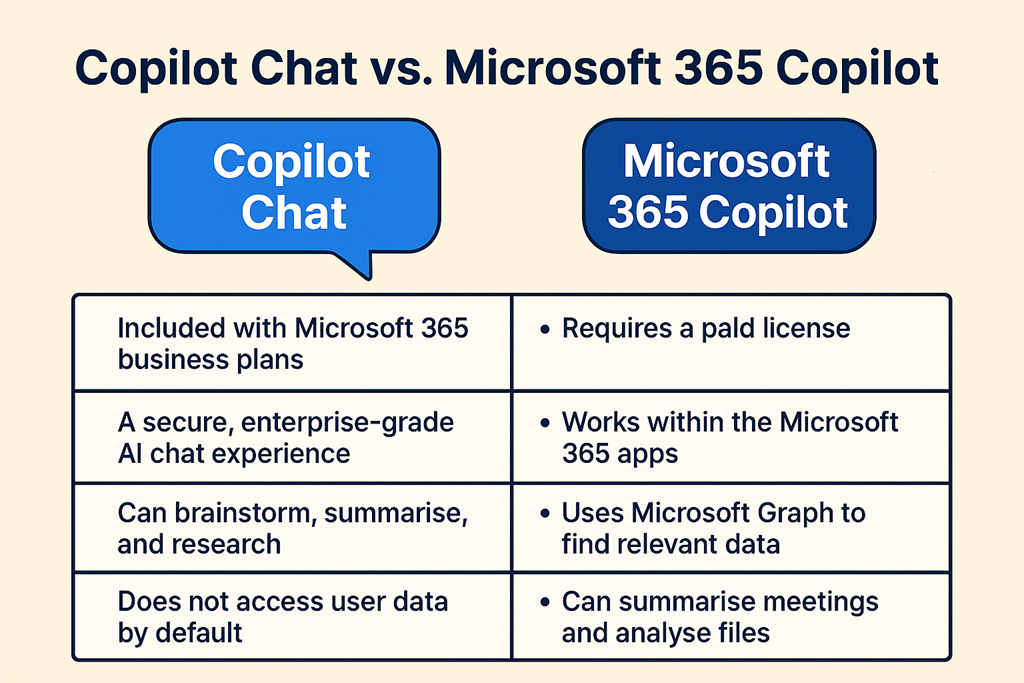
Copilot Chat is already included with Microsoft 365.
No extra licence. No commitment. No risk.
[support.mi…rosoft.com]

And it’s the best place to start evaluating Copilot—as long as you set the right expectations.


What Copilot Chat Actually Is

Copilot Chat is a secure, enterprise-grade AI chat experience that comes with eligible Microsoft 365 business plans. It’s available through the Copilot app, browser, and inside Microsoft 365 surfaces. [support.mi…rosoft.com]

Think of it as:

  • A safe, work-friendly alternative to public AI tools

  • A place to learn how to prompt properly

  • A way to introduce AI thinking without touching business data

It’s excellent for:

  • Brainstorming

  • Drafting content

  • Summarising uploaded documents

  • Research and idea validation

  • Learning how AI responds to different prompts

What it doesn’t do is magically understand your tenant.

And that’s where expectations matter.


What Copilot Chat Does Not Do

Copilot Chat does not have access to your Microsoft 365 data by default.

That means:

  • It can’t see your emails

  • It can’t summarise your Teams meetings

  • It can’t analyse your SharePoint files

  • It can’t act inside Word, Excel, Outlook or Teams using live context

Those capabilities require a Microsoft 365 Copilot licence. [support.mi…rosoft.com]

This is the mistake I see over and over again:

“We tried Copilot and it wasn’t very impressive.”

No—you tried Copilot Chat and expected Microsoft 365 Copilot.

They are related, but they are not the same thing.


Why Copilot Chat Is Still the Right Starting Point

Even with those limitations, Copilot Chat is a brilliant on‑ramp to AI adoption.

Why?

Because Copilot success has very little to do with licences—and everything to do with behaviour.

Copilot Chat lets organisations:

  • Learn how to ask better questions

  • Understand AI strengths and limitations

  • Build internal confidence with generative AI

  • Establish safe usage patterns and governance conversations

All before spending a dollar on add‑on licensing.

For MSPs, this is gold. You can:

  • Run Copilot Chat workshops

  • Teach prompt engineering fundamentals

  • Identify which roles would actually benefit from full Copilot

  • Reduce the risk of failed rollouts later


What Changes When You Buy Microsoft 365 Copilot

Microsoft 365 Copilot is where AI stops being a chat tool and becomes a workflow tool.

With the paid licence, Copilot:

  • Works directly inside Word, Excel, PowerPoint, Outlook and Teams

  • Understands emails, meetings, chats, files and calendars

  • Uses Microsoft Graph to reason across your tenant

  • Can summarise meetings, draft replies, analyse spreadsheets and build decks

In short:
Copilot Chat helps you think.
Microsoft 365 Copilot helps you do.
[support.mi…rosoft.com]

But that power only delivers value if users already know how to work with AI.


Set Expectations First. Licence Later.

The smartest Copilot projects I’ve seen all follow the same path:

  1. Start with Copilot Chat

  2. Train people how to prompt and think with AI

  3. Identify high‑value roles and use cases

  4. Then—and only then—license Microsoft 365 Copilot

Copilot Chat isn’t a “cut‑down demo”.
It’s a training ground.

Use it properly, and when you do buy licences, Copilot won’t feel expensive—it’ll feel obvious.

And that’s how Copilot adoption should work.

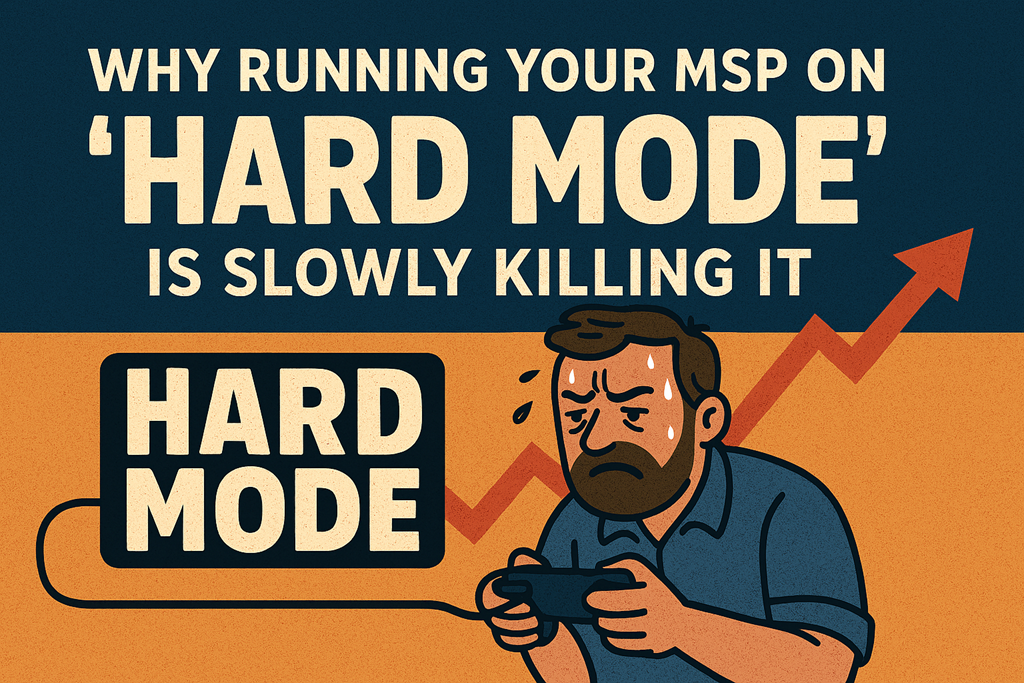
Why Running Your MSP on “Hard Mode” Is Slowly Killing It

image

Let’s get something uncomfortable out of the way.

If your MSP feels hard…
If growth feels heavy…
If the thought of “scaling” makes you tired rather than excited…

The problem probably isn’t your tools, your stack, or your tactics.

It’s that your business is out of alignment with you.

For years, MSPs have been fed the same lie:
If it’s not hard, you’re not doing it properly.

Long hours.
Always-on availability.
Endless meetings.
Constant pressure to sell, hire, scale, document, standardise, repeat.

Congratulations — you’ve built yourself a prison. And you’re the warden.

The MSP “Pain Line”

Most MSPs eventually hit what I call the pain line.

That point where:

  • You’re busy, but not growing

  • You’re profitable, but not happy

  • You know what to do tactically… but still feel stuck

You don’t quit, because the business “works”.
You don’t change, because change feels risky.
So you push harder.

That’s when MSP owners burn out — not because they’re weak, but because they’re misaligned.

And here’s the key insight most MSPs miss:

You will never deliberately grow into pain.

If growth feels like more stress, more chaos, more pressure… you’ll subconsciously cap your own business. You’ll stall, plateau, or self‑sabotage — and then blame the market.

What Works vs What Works For You

There’s a massive difference between:

  • What works
  • And what works for you

Just because:

  • Quarterly sales pushes work for other MSPs

  • Big teams work for other MSPs

  • Back‑to‑back meetings work for other MSPs

…doesn’t mean they should work for you.

MSPs are notorious for copying business models without asking a basic question:

“Would I still want to run this business in 10 or 20 years?”

If the answer is “not like this”… then something needs to change.

Your MSP Is the Product You Forgot to Design

Most MSPs obsess over:

  • The services they sell

  • The technology they deliver

  • The experience their clients have

Almost none spend serious time designing the business they work in every day.

That’s the real product.

Your MSP should fit you like a glove — your personality, your strengths, your energy, your season of life.

If you’re an introvert forced into constant sales calls, that’s friction.
If you hate meetings but built a meeting‑heavy culture, that’s friction.
If you love deep technical work but spend all day managing people, that’s friction.

Friction is expensive. Not just financially — emotionally.

MSPs Aren’t Broken — They’re Misaligned

Here’s the good news:
There’s probably nothing wrong with your MSP.

It’s just built for a version of you that no longer exists.

Your life changes.
Your energy changes.
Your priorities change.

But most MSPs never update the business model — they just keep tolerating it.

And tolerance is dangerous. It turns into resentment. Then burnout.

The Alignment Test

Try this brutally honest exercise:

Make two lists.

List 1: The parts of your MSP you genuinely love
The work that energises you
The days where work feels like play

List 2: The parts you hate
The things you tolerate
The work that drains you but “has to be done”

Now ask yourself:

Why does my calendar still contain so much of List 2?

This isn’t about doing less work.
It’s about doing the right work.

Easy Mode Isn’t Lazy Mode

Let’s be clear: “easy” doesn’t mean small, lazy, or unambitious.

It means:

  • Work that suits how you’re wired

  • A delivery model that energises you

  • A sales model you don’t dread

  • A team structure that doesn’t suffocate you

When your MSP is aligned, effort feels lighter — not because you’re doing less, but because you’re not fighting yourself.

That’s when growth accelerates. That’s when creativity returns. That’s when clients feel the difference.

People follow energy. They buy from clarity. They trust alignment.

The Real Challenge for MSPs

So here’s the uncomfortable challenge:

Stop asking, “How do I scale this?”
Start asking, “Do I even want to scale it this way?”

Because building an MSP that fits everyone else’s idea of success — but not yours — is the fastest way to hate the thing you worked so hard to build.

You don’t need another framework.
You don’t need another tool.
You don’t need to push harder.

You need alignment.

And once you have that, growth stops feeling like punishment — and starts feeling inevitable.