New Defender for Office 365 Dashboard

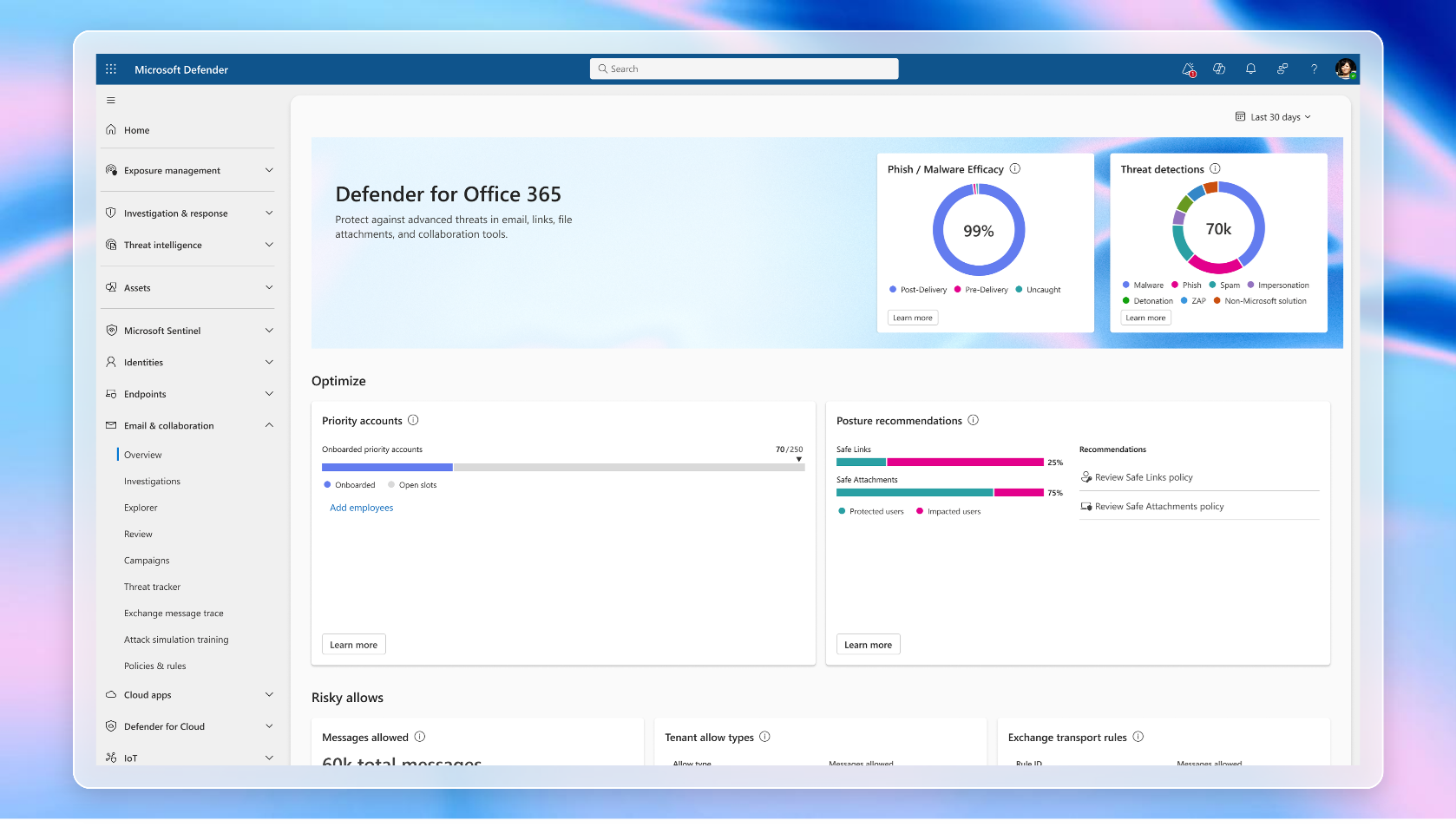
A screenshot of the new Defender for Office 365 overview dashboard.

The new customer overview dashboard allows security teams to track efficacy across cyberthreats blocked pre-delivery, threats mitigated post-delivery, and even “missed” threats. It includes details on how Microsoft Defender for Office 365 capabilities like Safe link, Safe attachments, and Zero-hour Auto Purge contribute to threat protection across an organization. Our goal is simple: to help you confidently answer the question “How are my organization’s users being protected from malicious content and cyberattacks when using email and other collaboration surfaces like Microsoft Teams?”

Transparency on Microsoft Defender for Office 365 email security effectiveness

View it now – https://security.microsoft.com | Email & Collaboration | Overview

Troubleshooting Email Delivery Failures in Exchange Online (Internal to External)

Troubleshooting Email Delivery Failures in Exchange Online

bp1

When an internal user’s email to an external recipient fails to deliver, Exchange Online will usually return a Non-Delivery Report (NDR) (also called a bounce message) to the sender. This guide provides an easy step-by-step approach to identify common causes of such failures and resolve them. It includes troubleshooting steps for both users and administrators, as well as a reference of common NDR error codes and their meanings.

Common Causes of Email Delivery Failures

1. Incorrect Recipient Address: Typos or outdated email addresses are a frequent cause.

2. Mailbox/Server Issues

Full mailbox or server issues: The recipient’s mailbox might be full, or their mail server is temporarily unreachable.

3. Policy or Security Blocks

Blocked by rules or spam filters: Messages can be rejected due to sending limits, spam protection, or permission settings (e.g. not authorized to send to a group).

Common Reasons for Exchange Online Email Delivery Failures

    • Incorrect or Non-Existent Email Address: A simple typo or an address that doesn’t exist will cause a bounce. Exchange Online will report a bad destination mailbox address error if the address is incorrect. Always double-check that the recipient’s email is spelled correctly and is up-to-date.
    • Recipient’s Mailbox is Unavailable: If the external recipient’s mailbox is full, disabled, or non-operational, the message might not be delivered. A full mailbox or temporarily offline server causes a soft bounce, meaning the delivery failed temporarily. In such cases, you might receive an NDR indicating the mailbox can’t accept the message (e.g., mailbox quota exceeded).
    • External Server or DNS Issues: Sometimes the recipient’s email server isn’t reachable or their domain’s DNS records are misconfigured. Exchange Online could try resending for a period and eventually give up with an NDR like “Message expired” (after 24-48 hours) if the destination never responded. This often points to an issue on the receiving side (server down, incorrect MX records, etc.).
    • Sending Limits or Security Policies Triggered: Office 365 has sending limits and security measures. For example, if an account sends an unusually high volume of emails, it might be temporarily blocked for suspected spam (to protect the service). Also, if your organization or the recipient’s organization has policies (transport rules) restricting who can send to certain addresses (like distribution lists that only accept internal emails), your message can be rejected with an “authorized sender” error.
    • Spam or Filter Rejection: The email could be blocked by spam filters on either side. Exchange Online’s outbound filter might block content deemed spam or malicious, or the recipient’s email system might reject the message due to sender reputation, SPF/DKIM failures, or content. For example, an NDR with error code 5.7.23 indicates the recipient’s server rejected the mail because of an SPF check failure (your organization’s SPF record might be misconfigured). Similarly, the recipient’s server might block your organization’s email domain or IP if it’s on a blocklist.
    • Attachment Size or Type Issues: Sending very large attachments can lead to a bounce if the message exceeds size limits on the recipient’s end. Many email providers reject emails over a certain size. In such cases, you’d see an NDR indicating the message is too large. (For instance, a “552 5.3.4 message size limit exceeded” error). Likewise, certain attachment types might be blocked by security policies.

Understanding the reason behind the failure is key to resolution. The NDR received usually contains a status code and a brief explanation. Next, we’ll cover what steps an email sender (user) can take, followed by administrator-level diagnostics and fixes.


Step-by-Step Troubleshooting for Users

    • Step 1: Review the NDR (Bounce Message)

      When you receive a bounce email, read the User Information section. It often states what went wrong in plain language. For example, it might say “The email address you entered couldn’t be found” or “Message size exceeds limit.” Note any error codes (like 5.1.1 or 5.7.1) mentioned.

      Step 2: Verify the Recipient’s Email Address

      One of the first things to check is the recipient’s address. Make sure there are no typos and that the address is current. An NDR with code 5.1.1 or 5.1.10 usually means the address was not recognized by the destination server. If the address is incorrect, fix it and try sending again.

    • Step 3: Check for Attachment or Size Issues

      If your email had a large attachment or many recipients, consider the possibility that it was rejected due to size or distribution. Try sending a simpler email (e.g., just text, no attachments) to the same recipient. If that goes through, the original message may have been too large or triggered a limit. In case of large files, use a cloud sharing link instead of attachment.

    • Step 4: Read the NDR for Guidance

      NDR messages often include a “How to fix it” section with suggestions. For example, if the error was “recipient’s mailbox full,” the suggestion might be to wait until the recipient frees up space. If it says you’re not allowed to send to the recipient, it could be a policy issue (the recipient’s system rejects outside emails) – in that case, you may need to contact the recipient by other means to let them know, or have your administrator reach out to theirs.

    • Step 5: Try Sending Again or Later

      For transient problems (like a busy server or DNS issue), you might receive a delayed delivery notice first. If the NDR indicates a timeout or “message expired” (4.4.7), it suggests the recipient’s server couldn’t be reached in time. You can simply wait and try to resend later. Temporary glitches often get resolved, allowing a future attempt to succeed.

    • Step 6: Contact Your Administrator if It Persists

      If you’ve verified the address and retried, but the email still bounces (or the NDR suggests something you can’t fix, like “Access denied, bad outbound sender”), it’s time to involve your mail administrator or IT support. Provide them with the exact error message and code from the NDR – this information is crucial for deeper troubleshooting.

Tips for Users:

    • Use Outlook on the Web (OWA) for comparison: If you normally send email via Outlook desktop and suspect a client issue, try sending the email through Outlook on the Web. This helps rule out local configuration problems. (If it works on OWA, your Outlook app might need troubleshooting.)
    • Check Sent Items and Drafts: Ensure the message actually left your outbox. If it’s sitting in Drafts or Outbox, it may not have been sent at all (due to client-side issues). An NDR confirms the message did leave your mailbox but bounced back.
    • Look at NDR Details: In the bounce email, there is often a section “Diagnostic information for administrators” with technical details. While this is intended for IT staff, you can sometimes glean info like which server rejected the email and why. For instance, it may show the external server’s response like “550 5.7.1 SPF check failed” or “550 5.2.2 Mailbox full”. Don’t worry if it’s too technical – pass it to your admin.
    • Spam Content Check: If your email was bounced due to content (though rarely is it explicitly stated), consider if your message might have looked like spam (certain phrases or links). Adjusting the wording or removing suspicious attachments and trying again could help. (Your admin can confirm if your account was blocked for sending spam, which can happen if a mailbox is compromised.)

By following the above steps, many user-side issues can be resolved (especially address errors or message content issues). If not, the administrator will need to investigate further using admin tools.


Step-by-Step Troubleshooting for Administrators

Check Microsoft 365 Service Health: Before deep diving, ensure there isn’t a broad email service issue. Go to the Microsoft 365 Admin Center and check Service Health for Exchange Online. If there’s a known service degradation or outage affecting mail flow, Microsoft would be working on it, and that could explain external delivery issues. In such cases, advise users that service is degraded and monitor the health status.

    1. Use the Exchange Online Troubleshooter: Microsoft 365 provides an automated Email Delivery Troubleshooter for admins. In the Microsoft 365 Admin Center, navigate to the Troubleshooting or Support section and look for “Troubleshoot Email Delivery”. Enter the sender’s and recipient’s email addresses and run the tests. This diagnostic can catch common problems and misconfigurations and suggest fixes automatically.
    2. Run a Message Trace: The message trace tool is one of the most powerful ways to investigate mail flow. In the Exchange Admin Center (under Mail flow > Message trace), run a trace for the specific message or sender/recipient around the time of the issue. Look for the problematic message in the results:
      – If the trace shows the message was “Delivered” to the external party, then technically Exchange Online handed it off successfully. A delivered status means the issue might be on the recipient’s side (perhaps delivered to their spam folder or dropped by their server).
      – If the trace shows “Failed” or “Pending/Deferred”, examine the details. By selecting the message, you can see an explanation of what happened and a suggested “How to fix it” in many cases. The trace detail will include the SMTP status code and error text that the system encountered.
      – If no trace result is found, ensure you search the correct timeframe and that the email was sent as reported. (Trace by default covers the last 48 hours, but you can extend the range or run an extended trace for up to 90 days of history, though older traces come as a downloadable CSV.)
    3. Interpret the Error and NDR Code: Using the information from the message trace or the NDR (which the user hopefully provided), identify the error code and message. Refer to the Common NDR Error Codes section in this guide for quick insight. For a deep dive, Microsoft’s documentation lists many specific SMTP codes and their causes in Exchange Online. For example:
      Bad address (5.1.1): Likely user error – verify if the address exists.
      Relay or DNS failure (5.4.1, 4.4.7): Could be an external domain issue – you might need to check DNS or contact the recipient’s admin.
      Spam-related or blocked (5.1.8, 5.7.50x): The sending account might be compromised or was sending bulk mail. If so, Microsoft may have temporarily blocked the account from external sending. You should scan the user’s system for malware, reset their password (in case of compromise), and then use the Exchange admin center or Microsoft 365 security portal to remove any sending block on the account. Microsoft might require you to contact support to re-enable a banned sender.
      Not authorized (5.7.1, 5.7.133-134): This indicates the recipient’s side is rejecting the mail due to policy (maybe the recipient is a group that only accepts internal emails). In such cases, the solution lies with the recipient’s email administrator to allow external senders. As the sending admin, you may need to inform your user that the recipient must adjust their settings or provide an alternate contact method.
      Use Microsoft’s NDR diagnostic tool if needed: In the Microsoft 365 Admin Center, there’s a feature to input the NDR code for more info. It can give tailored guidance on that specific error (for instance, it might direct you to a knowledge article like “Fix error code 5.4.1” with detailed steps).
    4. Verify Your Organization’s Mail Settings: If many users experience external delivery issues, check if there’s any configuration on your side:
      Outbound Connectors: In Exchange Online, no connector is needed for general external sending (it uses Microsoft’s default route). However, if you have a Hybrid setup or use a third-party email gateway, an improperly configured Send Connector or partner connector could cause external delivery to fail. Validate connectors using the built-in tool or PowerShell. A misconfigured connector can result in “Relay Access Denied” errors or mail loops.
      Transport Rules: Review your mail flow rules to ensure none are unintentionally blocking or redirecting external emails. For instance, a rule that restricts external forwarding or adds headers shouldn’t stop delivery outright (unless misconfigured).
      DNS Records: Confirm that your organization’s DNS settings (MX, SPF, DKIM) are correct. While these primarily affect inbound mail and recipient-side processing, an incorrect SPF record can lead to external servers rejecting your messages (SPF hard fail). Make sure SPF includes all your sending IPs (Microsoft 365 and any other mail sources). An up-to-date SPF/DKIM/DMARC setup improves your chances of delivery and prevents rejections due to authentication failures.
    5. Check Sender’s Account Status: If the NDR or trace suggests the sender was blocked (for example, 5.1.8 Access denied, bad outbound sender or any 5.7.50x spam errors), go to the Security & Compliance Center (or Exchange admin security settings) and check for alerts about that mailbox. Microsoft 365 might have flagged the account for sending outbound spam. Remove any user from blocked senders list if present, after ensuring the account is secure. Also verify the user hasn’t hit any legitimate sending limits (e.g., trial tenants have low external recipient limits).
    6. Test and Follow Up: After any fixes (correcting addresses, adjusting configurations, unblocking accounts, etc.), have the user resend the email. Monitor the message trace again or ask the user to confirm if the email goes through. If the problem persists with a specific external domain despite everything on your side being normal, consider reaching out to the recipient’s mail administrator – their server may be rejecting your mails (the reason should be in the NDR). You can also attempt to send a test message from a different internal account to the same recipient to see if it’s a sender-specific issue or affects all senders in your org.
    7. Utilize Support Resources if Needed: If you’ve exhausted your troubleshooting and can’t identify the cause, you may open a support case with Microsoft. Provide them with message trace results and NDR details. Microsoft can help if it’s an issue on the Exchange Online side or give insight if your domain/IP is on any of their internal block lists beyond your control.

Common NDR Error Codes and What They Mean

When an email bounces, the NDR will include an SMTP status code (also known as an enhanced delivery status code). Below is a list of some common NDR codes in Exchange Online and their typical meaning:

NDR Code Description Meaning / Possible Cause
550 5.1.1 Bad destination mailbox address The recipient’s email address is invalid or not found. Often caused by typos or an address that no longer exists on the destination server. The sender should verify the address and try again.
550 5.1.10 Recipient not found Similar to 5.1.1 – the specified recipient’s address (particularly the domain) doesn’t exist in the recipient’s system. This can happen if the email was correct before but the external account was removed or changed. Double-check the address spelling and existence.
550 5.1.8 Access denied, bad outbound sender Exchange Online blocked the sender’s account from sending externally. This typically happens if the account was detected sending spam (possibly due to a compromised account). Admin intervention is required to secure and unblock the account.
550 5.2.2 Submission quota exceeded The sender has exceeded sending limits. Office 365 throttles users who send an unusually large number of messages or recipients in a short time. This is often a sign of a compromised account or an automated sending gone awry. The user should reduce sending volume and an admin may need to confirm the account’s security.
450 4.4.7 Message expired (Deferred) The message stayed in queue too long and timed out without reaching the recipient’s server. This is usually due to issues on the receiving side (server down, network issues, or misconfigured DNS). The sender can retry later; the admin should check that the target domain is reachable (DNS MX record, etc.).
550 5.4.1 Relay access denied / Domain not found The sending server wasn’t allowed to relay the message, or the recipient domain isn’t accepting mail. In Office 365, this can happen in hybrid setups or if the recipient’s domain has no valid mail exchanger. It may indicate a configuration issue either in connectors or on the recipient’s side (e.g., an MX record problem).
550 5.7.1 Delivery not authorized, message refused General unauthorized – The sender is not allowed to send to the recipient. Common causes: the recipient might be a distribution list or address restricted to internal senders, or a transport rule is blocking the message. For example, if you send to an external mailing list that only accepts members, you’ll get this error. Only the recipient’s admin can change this, or the sender must obtain permission.
550 5.7.1 (variant) Unable to relay Relay attempt failed – This occurs when a server tries to forward a message to another server and is not permitted. In a pure Exchange Online scenario, end-users shouldn’t normally see this unless an application or device is misconfigured. In hybrid scenarios, it can mean the on-premises server is not allowed to route outbound via Office 365 without authentication.
530 5.7.57 Client not authenticated The sending client/server did not authenticate where expected. This often appears when using SMTP submission (smtp.office365.com) from a device or app that didn’t properly authenticate. For user-sent mail via Exchange Online, this should not occur unless a connector is set incorrectly. The solution is to configure authentication or use the proper SMTP settings.
550 5.7.23 SPF validation failed The recipient’s email system rejected the message because it failed the SPF check. In other words, the sender’s domain isn’t authorized in DNS to send mail from the originating server. The admin should verify the SPF record for the sending domain includes all legitimate sending services and IPs.
550 5.7.501 (or 502/503) Access denied, spam abuse – banned sender Office 365 has banned the sender due to suspected spam. The account was likely sending out bulk or malicious emails. An admin needs to confirm the account is secure (change password, scan for malware) and then contact Microsoft support to re-enable sending.
550 5.7.506 Access Denied, Bad HELO The sending server introduced itself with an invalid HELO (typically by identifying as the recipient’s server). This is often seen as a spam characteristic. If your organization runs its own SMTP server or device, ensure its HELO/EHLO is properly configured to use its own domain name.
550 5.7.508 Rejected by recipient (IP blocked) The recipient’s organization blocked the sending IP address. This means your mail might be on a blocklist or the recipient explicitly blacklisted your domain/IP. The sender or admin would need to contact the recipient to get unblocked or request removal from blocklists.
552 5.3.4 Message size limit exceeded The email was too large for one of the mail systems. This error is often returned by the recipient’s server if the message size (including attachments) is over their limit. The solution is to reduce the size (compress files or use cloud sharing) and resend.


Note: The first digit of the status code indicates the type of failure. 4.x.x codes (e.g., 4.4.7) are temporary failures (the service will usually keep trying for some time), whereas 5.x.x codes (e.g., 5.1.1, 5.7.1) are permanent failures that require changes before reattempting. The examples above are some of the most encountered codes for internal-to-external mail issues. For a full list, see Microsoft’s documentation or use the admin center’s NDR diagnostic tool.


Tools and Best Practices for Preventing Delivery Issues

Maintaining smooth email delivery in Exchange Online involves proactive monitoring and configuration. Both users and admins can take preventive steps:

    • Keep Address Books Updated: Users should update contacts when people change addresses. Auto-complete (Outlook cache) can retain outdated addresses; removing old entries avoids misdirected emails.
    • Monitor Sending Limits: Educate users about sending limits (for example, Office 365 may limit an account to send to a large number of external recipients per day). Sudden need to email thousands of people can trigger throttling. Use distribution lists or third-party mailing services for bulk email to avoid hitting these limits.
    • Enable Authentication Protocols: Admins should ensure SPF, DKIM, and DMARC are properly set for the domain. These help recipient servers trust your emails and reduce bounces due to authentication failures. An SPF misconfiguration can lead to many bounces (5.7.23 errors) until fixed.
    • Regularly Check Blocked Senders: In the Exchange Admin Center, keep an eye on restricted users (accounts automatically blocked for sending spam). Microsoft 365 will list these in the Security portal. If an account is compromised, follow procedure to secure it and remove the block. This prevents a situation where a user is unaware their account was blocked (they’d get 5.1.8 NDRs until unblocked).
    • Use Message Encryption or Alternatives for Large Files: Instead of sending very large attachments, users can use OneDrive or SharePoint links. This avoids bouncing on size grounds and is more reliable. Also, if sending sensitive content, using Office 365 Message Encryption or a secure link can sometimes avoid content-based rejections by external filters.
    • Test DNS Changes: If you change your DNS records (like MX or SPF), test email flow. Admins can use tools like the Microsoft Remote Connectivity Analyzer to send test emails or verify DNS and mail flow between your org and the outside world. This can catch issues (e.g., missing MX or incorrect SPF) before they impact users.
    • Stay Informed on Service Status: Admins should subscribe to Office 365 Service Health alerts. In the Admin Center, the Service Health dashboard provides up-to-date info on any email service problems. Microsoft also posts alerts in the Message Center for configuration changes or known issues that could affect mail flow. Being aware early can save time troubleshooting something that is a broader cloud issue.
    • Educate Users on NDRs: Make sure end-users know that when they get a bounce message, they should read it and share it with IT if needed. NDRs are helpful – they often contain the reason for failure and sometimes even how to resolve it. Users should not ignore these or just repeatedly resend without addressing the error.
    • Maintain Good Sending Reputation: Avoid practices that can get your domain flagged as spam (like users sending phishing or too much marketing email from their regular accounts). If your organization needs to send bulk emails (newsletters, etc.), consider using dedicated services or distinct IP pools. A good reputation means external servers won’t block you as often, resulting in fewer bounces (less “550 5.7.508 rejected by recipient” situations).

Additional Resources and Support

If you need more help, here are resources and next steps:

    • Microsoft Support and Recovery Assistant (SaRA): Microsoft offers a Support and Recovery Assistant tool that end-users can run for Outlook and email issues. While it’s more often used for client issues (like not receiving emails in Outlook), it’s a good first step for a user to self-diagnose common problems.
    • Office 365 Community and Q&A: You can ask questions on Microsoft Q&A forums or the Tech Community for Exchange. Often, other admins have encountered similar issues (for example, specific NDR codes in hybrid setups) and can offer guidance.
    • Contacting Microsoft Support: For persistent or unclear issues, don’t hesitate to reach out to Microsoft 365 Support. Provide them with the NDR details, message trace results, and what troubleshooting you have done so far. They have deeper tools to investigate mail flow logs and can determine if the issue lies within Exchange Online or advise on external causes.
    • Staying Updated: Keep an eye on the Message Center in your M365 Admin portal for any updates related to mail flow, spam filtering changes, or new features that could affect how emails are delivered. Microsoft regularly updates Exchange Online, and new security features (like enhanced spam protections or stricter compliance rules) can sometimes lead to delivery questions – announcements in Message Center will prepare you for these.

By systematically following the steps in this guide, most internal-to-external email delivery problems can be identified and resolved. Remember to use the tools available (like message trace and NDR diagnostics) and leverage the error information provided. With careful verification of settings and attentive monitoring, you can ensure reliable email delivery for your organization’s users.

Defender for Office 365: Malicious Email Protection in M365 Business Premium

bp1

Microsoft Defender for Office 365 (included with Microsoft 365 Business Premium) is an advanced security solution that protects email and collaboration tools from phishing, malware, and other threats[1][3]. When a malicious email arrives, Defender for Office 365 engages multiple layers of defense to identify and neutralize the threat, preventing compromise of user accounts and devices. This report provides a detailed technical walkthrough of how Defender for Office 365 handles a malicious email step by step, and outlines best-practice configurations and recommendations for administrators to maximize protection.

Did you know? Over 90% of cyberattacks start with an email, making robust email protection critical for safeguarding organizational data and operations[4].


Email Threat Protection Pipeline: Step-by-Step Process

When an email is received, Defender for Office 365 processes it through multiple stages to detect and block malicious content before it reaches the user. Each stage builds on the previous, combining filtering, analysis, and dynamic protection measures[2]. Below is the step-by-step process that occurs when a potentially malicious email arrives:

  1. Edge Protection – Connection and IP Filtering: Initial blocking at the mail gateway. As soon as the email hits the Office 365 service, Edge Protection checks the sender’s IP address and domain reputation[2]. Known malicious senders are blocked outright at this stage:

    • IP/Domain Reputation: If the sender’s IP or domain is on a known-bad list (such as spam sources or malware distributors), the connection is rejected before the email enters the system[2]. This prevents a large volume of spam or malware-laden emails from ever reaching user mailboxes.

    • Throttle & Block: Bulk attacks are throttled or dropped. For example, if a source sends an unusually high volume of messages in a short time (potential Denial of Service attempt), it’s throttled to protect the email infrastructure[2]. Messages from untrustworthy sources can be temporarily blocked unless configured otherwise (e.g. via connectors for trusted partners).

    • Directory Edge Blocking: Attempts to send to invalid recipients are blocked to prevent directory enumeration attacks[2].

    • Outcome: Many obvious threats are filtered out at the network edge without user impact. Legitimate emails move to the next phase.
  2. Sender Intelligence – Authentication & Impersonation Checks: Analyzing who the email is from. In this phase, Defender for Office 365 evaluates the sender’s legitimacy using email authentication and behavioral analysis[2]:

    • SPF/DKIM/DMARC Verification: The service checks SPF records, DKIM signatures, and DMARC policy compliance to ensure the email is actually coming from who it claims to be[2]. If authentication fails (e.g. a spoofed domain that doesn’t align with these records), the message is flagged or rejected.

    • Spoof Intelligence: Built-in anti-spoofing logic distinguishes legitimate “on-behalf-of” emails from forgeries. Defender for Office 365 can block senders that impersonate your domain or trusted partners while allowing known forwarding services and permitted senders[2]. Both intra-org and cross-domain spoofing attempts are detected and stopped[2].

    • Mailbox Intelligence: The system leverages machine learning to understand normal communication patterns for each user. If an incoming email’s sender or context deviates from the user’s typical contacts, it may indicate a impersonation/phishing attempt[2]. For example, if an email claims to be from a colleague the user rarely contacts, it’s treated with suspicion. This helps catch Business Email Compromise attacks where attackers impersonate executives or vendors.

    • Bulk Mail Filtering: Bulk mail (e.g. newsletters) is identified with a Bulk Confidence Level. Admin-defined thresholds decide if bulk emails go to Junk or are allowed, balancing nuisance vs. missing wanted bulk mail[2].

    • Account Compromise Signals: If the sender is an internal account, Defender can detect anomalous sending behavior (possibly indicating a hacked account) and automatically block outgoing mail from that account to stop further spread[2].

    • Outcome: By the end of this stage, the email’s sender is verified. Unauthorized senders or obvious impersonation attempts are filtered out or marked as phish, and only authenticated, non-spoofed messages proceed[2].
  3. Content Filtering – Malware and Phishing Detection: Inspecting the email’s content and attachments. Emails that pass sender checks are then scanned deeply for malicious content:

    • Anti-Malware Scanning: All email attachments are scanned by Microsoft Defender Antivirus engines for known malware signatures[2]. Files are examined by true type (so an .exe disguised as .txt is still caught)[2]. If an attachment is a known virus or high-confidence malware, the system will block the email or strip the attachment immediately[2]. The hash of any detected malware file is added to Microsoft’s threat intelligence, which means that file will be blocked in all Office 365 tenants and on Windows endpoints via Defender Antivirus in the future[2].

    • File Type and Heuristics: Admins can configure file type blocking (e.g. disallowing .exe, .js, or macro-enabled files via policy)[1]. If an attachment or the email contents match known malicious patterns or suspicious behaviors (heuristics), Defender will intervene. For instance, heuristic clustering might pause a message that has an unusual combination of properties (e.g. an invoice email with an unfamiliar attachment) for further analysis[2].

    • Phishing Content Analysis: The email’s headers and body are analyzed by machine learning models to identify phishing signs[2]. This includes scanning for malicious or misdirecting content, suspicious language patterns, and URL inspection. Any URLs in the email are checked against Microsoft’s database of malicious links (threat intelligence feeds)[2]. If a URL is already known to be dangerous, the email can be blocked at this point[2].

    • Safe Attachments Detonation (Dynamic Analysis): If an attachment is unknown (no known malware signature), Defender for Office 365’s Safe Attachments feature steps in. It will sandbox the attachment in a virtual environment to detonate it safely[2]. The attachment is opened in this secure sandbox where its behavior is monitored in real-time. If the file exhibits malicious behavior (like dropping malware or connecting to malicious servers), it is deemed unsafe. During this sandbox scan, depending on policy, the email can be delayed or delivered with the attachment held back: for example, with Dynamic Delivery, the email body is delivered promptly but the attachment is replaced by a placeholder until it’s cleared, ensuring minimal disruption to the user[1].

    • URL Detonation: For URLs that are not outright blocked but appear suspicious, Defender performs URL detonation – essentially clicking the link in a sandbox at time of delivery to see what happens[2]. If the linked content is a file (e.g. a downloadable document), it treats it like an attachment and sandboxes that file as well[2].

    • Machine Learning Classification: Throughout content filtering, machine learning models evaluate the message holistically – considering sender patterns, email content, and attachments together. These AI models assign the email a confidence level for spam or phishing[2]. For example, an email might be tagged as High Confidence Phishing if multiple indicators (failed authentication, known phish URL, suspicious language) are present.

    • Outcome: By this stage, Defender for Office 365 has identified any malicious payloads. If malware is confirmed, the email (or the unsafe attachment) is blocked or quarantined immediately[2][1]. Suspicious links are neutralized. Emails that pass content scanning continue to delivery, but with ongoing safeguards (Safe Links) in place.
  4. Delivery & Post-Delivery Protection: Final delivery with ongoing monitoring. If the email is not blocked by earlier filters, it proceeds toward the user’s mailbox, but Defender’s protections continue even after delivery:

    • Safe Links (Time-of-Click Protection): All URLs in the email can be rewritten and wrapped by Safe Links[2][2]. This means if a user clicks a link in the email, the request goes through Defender’s Safe Links service first. At the moment of click, the system checks the latest URL reputation. If the link is newly identified as malicious (or found malicious upon dynamic analysis), the user is prevented from accessing the site – they’ll see a warning page instead of the dangerous site[2]. This time-of-click check is crucial because it protects against delayed attacks where an attacker sends a benign link that turns malicious later. Safe Links essentially continues to protect the user’s device when they interact with the email.

    • Zero-Hour Auto Purge (ZAP): Defender for Office 365 has the ability to retroactively remove emails from inboxes if they are later determined to be threats. This is known as ZAP. For instance, if an email was delivered but a few hours later its attachment is identified as malware in another environment, ZAP will quarantine that email from all mailboxes post-delivery[2]. ZAP operates for phishing, malware, and spam – automatically neutralizing threats that slipped through initial filters[2]. Users might notice an email disappear from inbox or junk folder; that’s ZAP at work removing a now-known threat.

    • Campaign Detection: If the malicious email is part of a larger attack campaign, Defender for Office 365 correlates signals across tenants. It can identify that multiple recipients (in one org or across many) are getting similar dangerous emails. In such cases, Microsoft can block the entire campaign once it has evidence of malicious intent[2]. This broad response stops all related emails from reaching users, not just one.

    • User Reporting: If a malicious (or suspicious) email somehow reaches a user, the built-in Report Phishing button in Outlook allows the user to flag it[2]. This user-reported mail is sent for analysis and can trigger alerts to administrators. Reports of missed phish help improve the filtering models and inform security teams of emerging threats.

    • Outcome: The email is either safely delivered (with protections in place) or removed/quarantined by post-delivery actions. Through features like Safe Links and ZAP, Defender for Office 365 continues to shield users and devices even after an email is in the mailbox, drastically reducing the chance that a user can be compromised by delayed or hidden threats[2].

**In summary, from the moment a malicious email arrives, Defender for Office 365 applies a *multi-layered defense*: it *blocks known bad senders* at the door, authenticates and evaluates sender trust, scans email content with signatures and machine learning, detonates suspicious attachments/links in a sandbox, and monitors the email after delivery (scanning links on click and pulling emails out if threats are discovered).** These layers work together to ensure that malicious emails are stopped or neutralized before they can compromise users or their devices[2][2].


Protective Actions and Threat Response

When Defender for Office 365 detects a malicious email, it takes immediate actions to protect the user and their device. The exact response depends on the type and severity of the threat, as dictated by configurable policies. Below are the key actions taken and how they safeguard the environment:

  • Quarantine or Block on Detection: For any email identified with high confidence as malicious (e.g. containing malware, high-confidence phishing), the default action is to quarantine the message (isolate it from the user’s inbox) or sometimes reject it outright.

    • Malware Email: By default, if an attachment is confirmed as malware, the entire email is sent to quarantine (a secure holding area) where it cannot harm the user[4][1]. The user does not see the email at all. Administrators can review quarantined items and decide to release or delete them. In severe cases, the system may delete the message automatically after a time if not reviewed.

    • Phishing Email: Suspected phishing emails are typically quarantined or sent to Junk Email folder depending on confidence levels and policy. High-confidence phish are usually quarantined so the user never interacts with them[4]. Lower-confidence phish or spam might go to the user’s Junk folder with safety tips. Quarantining ensures even if a user is curious, they cannot click links or open attachments unless an admin releases the email.

    • Spam/Bulk Email: Unwanted spam is often delivered to Junk Email by default. However, for Business Premium best practice, many administrators choose to quarantine high-confidence spam as well, to reduce any risk of user interaction[4].

    • Block vs Quarantine: In some cases, policies might be set to outright reject/drop certain messages (for example, block malware so it never even gets into quarantine). Quarantine is generally preferred for malicous content because it allows security teams to analyze what was caught.

    • Protection Provided: Quarantining or blocking ensures that malicious payloads never reach the user’s inbox or device, preventing infection. Even if malware was attached, it’s confined to the quarantine and cannot execute on the user’s machine.
  • User and Admin Notifications: Defender for Office 365 can notify relevant parties when it takes action:

    • End-User Notifications: Administrators can enable quarantine notifications to end users to inform them that messages were quarantined as spam or phish. For example, users might receive a daily digest email listing messages that were withheld. This allows users to review and request release of any false positives (messages incorrectly flagged) while keeping them informed that potentially unsafe messages were stopped. By default, these notifications are not sent until configured, to avoid confusing users with technical info.

    • Admin Alerts: Through Alert Policies, admins can configure real-time alerts for certain threat detections[4]. For instance, an alert can be set if a malware email is quarantined or if phishing emails exceed a threshold, etc. When triggered, an alert can send an email or SMS to administrators/security teams. This ensures the security team is immediately aware of serious threats and can investigate promptly. Additionally, the admin can be notified when a user requests release of a quarantined message, or if Defender blocks a suspicious email to an executive account[4][4].

    • In-Email Notifications: If a malicious attachment is removed from an email, the recipient might receive the email with a notice like “An attachment was removed because it contained malware.” This informs the user that content was stripped for safety (so they aren’t just puzzled by a missing attachment).

    • Portal Reports: Beyond direct alerts, admins can always view quarantined items and threat logs in the Security portal. The Threat Explorer in Defender for Office 365 provides a near-real-time view of all detected threats and actions taken[4].

    • Protection Provided: Notifications ensure that no threat goes unnoticed. End-user quarantine summaries empower users to double-check for any legitimate message caught by filters (reducing impact on business communications), while admin alerts allow IT security to respond to incidents quickly, such as by investigating if multiple users were targeted by the same attack.
  • Device Protection via Signal Sharing: Defender for Office 365 not only protects the mailbox, but also helps protect user devices through integration with Microsoft Defender Antivirus. When a new malware attachment is identified through an email scan, its signature (hash) is shared with the broader Microsoft security network. This means other defenses (like Defender for Endpoint on Windows devices) are informed to block that file in the future[2]. In practice, if a user tries to download or run that same malicious file from another source, Defender on their device will already know to quarantine it. This cloud-powered intelligence ensures email-borne malware can’t simply hop to a device by other means – the protection spans across email, cloud, and endpoints as part of the Microsoft 365 Defender ecosystem.

  • Preventing User Interaction: For threats that aren’t fully blocked (for example, a suspicious URL in an email that was delivered), Defender’s protections physically alter the content to make it safe:

    • Malicious attachments are replaced with dummy files or removed. If an attachment is detonated and found malicious, the user may receive a text file explaining the attachment was unsafe and removed.

    • Dangerous links are wrapped by Safe Links and will be blocked at click-time, as described. If the user clicks a phishing link, they will be stopped by a warning page instead of reaching the harmful site[2]. This prevents credential harvesting and drive-by downloads on the user’s device.

    • Even for emails delivered to Junk, Outlook disables active content by default (images, links) which helps mitigate risk if a user views spam.

    • Protection Provided: By neutralizing malicious content (attachments/links), Defender ensures that even if something reaches the user’s mailbox, it is disarmed and cannot easily lead to compromise. The user’s device is shielded from executing malware or connecting to attacker sites.

In summary, once a malicious email is detected, Defender for Office 365’s response actions (quarantine, blocking, content neutralization, and alerts) work in concert to protect users. Malicious emails are isolated away from inboxes, users are shielded from dangerous attachments or links, and security teams are kept aware. Through these actions, the service prevents infection and account compromise, fulfilling its role of safeguarding users and their devices from email-borne threats[1][2].


Key Features Enabling Email Threat Protection

Defender for Office 365 includes a rich set of security features specifically designed to counter email threats. Together, these features provide multi-layered protection against phishing, malware, and other malicious emails. Here are the key features and capabilities that protect your organization’s email:

  • Exchange Online Protection (EOP) Core Filters: At its foundation, Business Premium includes EOP’s anti-spam and anti-malware engine. This provides baseline filtering: block/allow lists, spam content filtering, and virus scanning using Microsoft’s antivirus signatures. EOP assigns each message a Spam Confidence Level (SCL) based on its likelihood of being spam. Defender for Office 365 builds on this with advanced capabilities, but this core ensures all known spam and viruses are already being handled. (Included in all Office 365 plans.)

  • Anti-Phishing Policies and Impersonation Protection: Defender for Office 365’s anti-phishing feature uses AI and heuristics to detect phishing emails that may slip past traditional spam filters[1]. Key elements:

    • Mailbox Intelligence: Learns each user’s normal contacts and flags anomalies[2].

    • User and Domain Impersonation Protection: Allows admins to protect specific high-profile users (like CEO, CFO) and your organization’s domains. If an incoming email attempts to impersonate a protected user (e.g., similar display name) or a look-alike domain (typosquat), Defender can automatically flag or quarantine it[2].

    • Spoof Intelligence: As part of anti-phishing, Defender distinguishes legitimate spoofing (such as third-party services sending on your behalf) from malicious spoofing. It blocks unauthorized spoof emails which pretend to be from your domains or partners[2].

    • Policy Options: Admins can customize actions for detected phish (e.g. send to junk vs. quarantine) and adjust sensitivity. Anti-phishing policies are a cornerstone for stopping business email compromise and credential-harvesting scams.
  • Safe Attachments (ATP Attachment Sandbox): Safe Attachments provides advanced malware protection for email attachments. It opens email attachments in a secure, isolated cloud environment to observe their behavior [2]. This feature is crucial for catching zero-day malware (new, previously unknown malware) which won’t be caught by file hashes or signatures:

    • If the attachment is clean, the email is delivered normally (or the attachment is reattached for the user after scanning).

    • If malicious activity is detected, the attachment is blocked/quarantined. Admins can choose whether the entire email is quarantined or delivered with the attachment removed.

    • Safe Attachments can be configured in ** Dynamic Delivery mode**, which ensures users don’t face big email delays – they get the email body quickly with a placeholder, and the real attachment arrives after it’s vetted[1].

    • This feature protects users from opening dangerous files that got past initial antivirus scans, by catching malware in execution.
  • Safe Links (URL Protection): Safe Links is Defender’s time-of-click protection for URLs in emails and Office documents[2]. All links are rewritten to go through Microsoft’s secure proxy. When a user clicks a link:

    • The system checks the URL against the latest threat intelligence. If the URL is known to be bad, access is blocked immediately with a warning page[2].

    • If not known, Safe Links can detonate the URL (open it in a sandbox) to analyze any content it leads to[2]. If that analysis finds something malicious, the site will be blocked for the user.

    • Safe Links protection persists even after email delivery; importantly, if a URL that was benign at delivery later turns malicious, the next click will be blocked. Safe Links is a key defense against phishing sites and malicious downloads, preventing users from unwittingly giving up credentials or infecting their devices.

    • Admins can configure Safe Links policies to apply to email, and even across Office apps, Teams, etc., as Business Premium’s Plan 1 covers cross-app usage[3].
  • Anti-Malware Policy with Zero-Hour Auto Purge: Defender for Office 365’s anti-malware policy complements Safe Attachments:

    • Real-time Malware Scanning: Uses the latest antivirus definitions to catch known malware in attachments or message body.

    • Common Attachment Types Filter: Allows blocking or warning on specific file types (e.g. executables, scripts) that are commonly dangerous[1].

    • Zero-Hour Auto Purge (ZAP): Automatically removes emails that are found to be malicious after they’ve been delivered[2]. For instance, if Microsoft later determines an email to be phish or identifies malware through updated signatures, ZAP pulls it from user mailboxes, mitigating damage from evolving threats.

    • Mail Flow Rules (Transport Rules): Although not unique to Defender, admins can create custom mail flow rules for additional filtering actions (e.g. strip attachments with certain names, or forward copies of suspect mail to security mailbox). These act as a supplementary feature in content filtering[2].
  • Quarantine and User Submissions:

    • Quarantine is a secure repository for emails identified as spam, phish, or malware. Admins (and optionally end-users) can review quarantined messages. This feature prevents dangerous emails from reaching users while still allowing recovery of any false positives. Quarantines are organized by category (spam, phish, etc.) for efficient management[4].

    • User Submission/Report Message: Integrated reporting tools let users flag suspicious emails. These user-reported messages feed into Defender’s analysis systems and appear in the admin center for review[2]. This encourages a “human sensor” network – users help catch what automated filters might miss, and the system learns from those submissions.
  • Threat Intelligence and Reporting:

    • Real-Time Reports & Explorer: Defender for Office 365 provides real-time dashboards and the Threat Explorer (available in Plan 1) for security teams to investigate threats[4]. Admins can search for indicators like a particular sender, file hash, or URL across all mail in the organization to see if anyone else was targeted[4]. This helps scope attacks quickly.

    • Campaign View: (Plan 2 feature) If ever upgraded, this lets you see the full picture of a phishing or malware campaign targeting your org, including all related messages, how they were handled, and which users clicked or were affected[2].

    • Alerts and Automated Investigation: Plan 1 allows custom alert policies as mentioned. Plan 2 (not included by default in Business Premium) adds Automated Investigation & Response (AIR) which can trigger automatic playbooks to investigate and remediate threats across emails and other domains[4]. Even without AIR, admins can manually invoke investigations or use the data from alerts to respond.

    • Microsoft Threat Intelligence Sharing: Defender for Office 365 taps into Microsoft’s vast threat intel from billions of emails and endpoints worldwide. It uses up-to-date intelligence feeds (including third-party sources) for URL and attachment reputations[2]. As a result, it can block emerging threats that have been seen elsewhere even if your organization hasn’t seen them yet.

All these features work together as a cohesive defense system for email. Anti-phishing policies thwart deception, Safe Attachments and Safe Links neutralize malicious payloads, anti-spam/anti-malware filters handle bulk threats, and quarantine with user reporting provides safety with flexibility. By leveraging these capabilities, organizations significantly reduce risk of malware infection, account compromise, and data breaches via email[1].


Best Practices and Configuration Steps for Defender for Office 365

To maximize protection in Microsoft 365 Business Premium, administrators should configure Defender for Office 365 according to Microsoft’s recommended best practices. Below is a comprehensive guide to setting up and fine-tuning Defender for Office 365 for optimal security:

1. Enable Core Email Authentication (SPF, DKIM, DMARC): Lay the groundwork for anti-spoofing. Before tweaking Defender-specific settings, ensure your own domain’s SPF, DKIM, and DMARC records are correctly configured. This helps external email systems trust your mail, and it allows Defender’s anti-spoof features to effectively block emails pretending to be your domain. On the flip side, Defender uses DMARC to reject or quarantine spoofed emails pretending to be from your domain if they fail authentication[2]. Configure DMARC with a policy of quarantine or reject for strong protection against domain spoofing[1].

2. Apply a Preset Security Policy: Quickly deploy best-practice settings. Microsoft provides preset security templates (“Standard” and “Strict”) that bundle recommended settings for all Defender for Office 365 features[4]. In the Microsoft 365 Defender portal, go to Policies & Rules > Threat Policies > Preset Security Policies and consider applying:

  • Standard Preset: A balanced security level suitable for most users. This enables Safe Links, Safe Attachments, anti-phishing, etc., with standard thresholds[4].

  • Strict Preset: A more aggressive policy intended for VIP users or high-target groups (like finance or execs)[4]. It has tighter rules (e.g. almost all detected phish go to quarantine, more stringent spam filtering).

  • Choosing a preset is an easy way to cover dozens of settings consistently. Ensure the preset is applied to all relevant users/groups. Note: You can still fine-tune specifics after applying a preset.

3. Configure Anti-Phishing Policies (Impersonation Protection): Stop phishing and BEC attacks proactively. Go to Threat Policies > Anti-Phishing and create or modify policies:

  • Enable mailbox intelligence: This lets Defender learn user communication patterns to identify unusual senders[1].

  • Protect high-risk users: Add your organization’s VIPs (CEO, CFO, IT Admins, etc.) to the “users to protect” list. Enable User Impersonation Protection and add these as protected users[1]. Defender will flag any external email that purports to be these users.

  • Protect your domains: Enable Domain Impersonation Protection and include your primary email domains[1]. This catches emails from look-alike domains (e.g. mycompany.co instead of mycompany.com).

  • Policy actions: Set phishing emails and impersonation detections to go to Quarantine, and optionally configure an alert to notify admins when an impersonation is detected[1]. This way, no potentially malicious phish reaches the inbox.

  • Tip: Regularly review the Blocked Senders and Allowed Senders in anti-phishing policies. Microsoft’s AI will automatically handle most, but you may add specific trusted partners to allowed spoofed senders if they get flagged, or block persistent phishers.

4. Strengthen Anti-Spam and Anti-Malware Settings: Fine-tune filters for junk and viruses. In Threat Policies > Anti-spam and Anti-malware, adjust the default policies:

  • Spam Filter Tuning: By default, EOP spam filter will send most spam to Junk. Consider raising the sensitivity: for example, set spam filter to quarantine high-confidence spam (SCL 9) rather than delivering to Junk. You can do this by editing the Anti-Spam Inbound Policy (Default) and increasing the threshold slider for spam and bulk mail[4][4]. Also enable advanced phishing threshold if available. This reduces the chance any obvious spam/phish lands in inbox.

  • Block Lists: Add any known malicious domains or problem senders to your block lists in the anti-spam policy[4]. Defender already blocks many, but if you’re seeing repetitive unwanted mails from certain domains, a manual block can help. Regularly update this list based on threat intel (Microsoft’s or your own)[4].

  • Allowed senders/domains: Likewise, maintain an allow list (whitelist) for trusted senders that should skip spam filtering[4][4]. Use this sparingly – only for well-vetted partners – to avoid attackers exploiting your allowed list. (E.g., allow a partner’s domain by adding it to Allowed domains in anti-spam policy[4], and keep this list reviewed for relevance[4].)

  • Anti-Malware Policy: Edit the default anti-malware policy to turn on Zero-Hour Auto Purge if not enabled (ZAP for malware/phish)[1]. Also configure Attachment types to block: consider blocking file types commonly used for malware that your organization doesn’t typically receive (e.g. .exe, .bat, .ps1, .vbs, or even .iso and .js files)[1]. This preemptively stops messages with such attachments.

  • Notifications: In the anti-malware policy, enable notification to admins (or a security mailbox) when malware is detected and quarantined[1]. This ensures the security team is alerted whenever a virus was stopped.

5. Set Up Safe Links Policies: Protect users from malicious URLs. Navigate to Threat Policies > Safe Links and ensure a policy covers all users:

  • Verify that Safe Links for Email is enabled tenant-wide. The default policy may already cover all users; if not, create a new Safe Links policy scoped to your domains/users.

  • Block click-through: Enable the option “Do not allow users to click through to the original URL” for malicious links[1]. This means if Safe Links identifies a URL as malicious, the user has no option to bypass the warning – the threat is completely blocked.

  • Apply to all apps: In Business Premium, Safe Links can also be applied to Microsoft Teams and Office applications. Make sure the policy is set to protect URLs in email and in Office apps (Word, Excel, PowerPoint) for comprehensive protection.

  • URL Exemptions: Optionally, define trusted URLs or domains that should not be rewritten by Safe Links if they are causing false positives (for example, internal company portals or very frequent business partners) – but add exemptions only if necessary. The recommendation is to keep the Safe Links filtering broad, as even trusted sites can be compromised.

6. Set Up Safe Attachments Policies: Enable sandboxing of email attachments. Go to Threat Policies > Safe Attachments:

  • If not already on, turn on Safe Attachments by creating a new policy. Scope it to All recipients (or at least all users who should be protected, typically everyone).

  • Choose the Action mode: Microsoft recommends “Dynamic Delivery” mode[1] for user convenience – this delivers emails immediately with a placeholder for attachments while scanning is in progress. Alternatively, “Block” mode holds emails until attachments are scanned (more secure but can delay delivery).

  • Set Post-scan Action: Configure what happens if malware is detected in an attachment. Commonly, Quarantine the entire message or Replace attachment with a banner/message are used[1]. Quarantine is safer, ensuring the user never touches the email if an attachment is malicious.

  • Enable Safe Attachments for SharePoint, OneDrive, and Teams files as well (there is a toggle for ATP for collaboration sites). This extends protection so that if a malicious file is uploaded or shared via cloud storage or Teams, it gets scanned and blocked similarly[2].

7. Optimize Quarantine Management: Balance security with usability regarding quarantined emails.

  • Quarantine Policy: In Defender portal under Policies & Rules > Threat Policies > Quarantine, you can adjust what users are allowed to see and do in quarantine. For best practice, allow users to review and release their own spam-quarantined emails (those classified as spam or bulk) via the Quarantine Portal or email digest[4]. This empowers users to self-serve for mild cases (reducing helpdesk tickets for “missing emails”) while still keeping malicious content at bay.

  • End-User Spam Notification: Enable periodic end-user quarantine notification emails for spam (e.g., daily or weekly)[4]. Users receive a summary of emails that were quarantined as spam/phish with options to release or report as not junk. This is turned off by default; turning it on can improve transparency.

  • Privileged Access: For content classified as high-confidence phishing or malware, it’s wise to not allow end-users to release these; only admins or security staff should. Use quarantine policies to enforce that (these are usually default — e.g., the default malware quarantine policy is admin-only access).

  • Review Routine: Security teams should regularly review quarantined messages and track how often users release items[4]. If you notice many false positives, adjust policies (allow lists or lower sensitivity slightly). Conversely, if users never need to release quarantined mail, you might tighten policies further.

8. Configure Alerts and Monitoring: Stay informed of threats in real time. Set up Alert Policies in the Defender portal for important events:

  • In Settings > Alert Policies, create alerts for things like “Malware detected in email”, “Phishing email detected”, or “User reported phish”. Configure who should get the alert (e.g., IT Security email, Teams channel via connector) and set the severity. This way, when Defender quarantines a malicious email or a user reports one, administrators get immediate notification to investigate[4][4].

  • Utilize the Threat Explorer (aka real-time detections) to proactively search for threats. For example, if news of a new phishing campaign arises, you can search if any user received related emails. The Explorer can also show all user-submitted reports and all automatically detected incidents for oversight[4].

  • Monitor Secure Score and the Configuration Analyzer in the security portal. The Config Analyzer compares your settings to recommended best practices (Standard/Strict) and will highlight if, for instance, Safe Links isn’t enabled or an anti-phish setting is turned off[4]. Regularly check this and follow its recommendations to patch any holes in your configuration.

9. Train Users and Encourage Use of Attack Simulation: The human element is critical. Technical defenses work best when users are also aware:

  • Deploy the “Report Phishing” button (if using Outlook, it’s often built-in now). Make sure users know how to use the Report Message feature to flag suspicious emails[2]. Reported messages feed into Defender and also alert admins, improving the overall security feedback loop.

  • Conduct periodic security awareness training. Microsoft Defender for Office 365 Plan 2 includes an Attack Simulation Training feature for phishing drills; Business Premium doesn’t include that by default, but you can run your own simulations or consider upgrading for this feature[3][1]. Simulated phishing campaigns help condition users to spot and avoid real attacks. Even without simulations, share regular tips or newsletters on identifying phishing (e.g., checking sender addresses, not clicking unexpected links).

  • Remind users that if they see something odd (emails asking for passwords, wire transfers, or any urgent unusual requests), they should report it or at least double-check offline. A well-trained user can catch a sophisticated phish that perhaps was borderline and not automatically filtered.

10. Continuous Improvement and Advanced Tools: Maintain a proactive security posture. Email threats evolve, so ongoing maintenance is necessary:

  • Review and adjust policies periodically: At least quarterly, review spam/phish detection rates, false positive/negative incidents, and adjust filters accordingly. Secure Score and Defender’s recommendations (from the Configuration Analyzer) are great to follow[4].

  • Stay informed on new features: Microsoft frequently updates Defender for Office 365. Keep an eye on the Message Center for announcements. For instance, new policy toggles or improved machine learning models may become available – adopting them can enhance security.

  • Integrate with broader security operations: If you use a SIEM like Azure Sentinel or the unified Microsoft 365 Defender portal, integrate Defender for Office 365 logs and alerts there. This allows cross-domain correlation – e.g., if a malicious email was sent to a user and that user’s device shows weird behavior, you can connect the dots faster. M365 Business Premium’s Defender for Office 365 P1 and Defender for Business (Endpoint) can both feed into a unified incident view (though full automated cross-domain investigation is a P2/XDR capability)[3].

  • Document exceptions and changes: Keep a simple internal doc of what you’ve whitelisted or any custom configurations. This helps during audits and when reviewing whether an exception (like an allowed domain) is still needed and safe[1].

By following these steps and best practices, you ensure that Defender for Office 365 is configured to its fullest potential, aligning with Microsoft’s security recommendations. A well-configured setup will minimize false negatives (missed threats) without generating too many false positives, providing strong security with minimal interruption to users[1][4].


Monitoring Effectiveness and User Involvement

Implementing Defender for Office 365 is not a “set and forget” exercise. Continuous monitoring and user feedback loops are vital to maintain an effective defense:

  • Security Monitoring and Incident Response: Leverage the Microsoft 365 Defender Security Center (security.microsoft.com) for a consolidated view of incidents. For example, if a malicious email was sent to multiple users, the portal can aggregate this into a single security incident for investigation. Use the Threat Explorer and Campaign Views to see if a threat is part of a larger pattern targeting your org[4][4]. If something got through to a mailbox and was reported, perform a targeted hunt: check that user’s mailbox for other similar messages, and those of peers. Promptly remove any found (the Explorer allows one-click purge of emails from all mailboxes if needed)[1].

  • Performance Review: Periodically review metrics such as: Number of phishing emails caught vs. missed, Spam trends, Top targeted users, etc., available in Defender reports. If available, the Attack Simulation Training results (for those with Plan 2) can show which users are vulnerable and need more training. Additionally, review the Secure Score for email security to track improvement over time.

  • User Reporting and Feedback: Encourage users to actively report suspicious emails. This not only helps catch what automated filters might miss, but also provides valuable data to refine those filters. Configure the User Submissions feature so that when users use the Report button, a copy goes to your security operations mailbox (or at least to the Defender portal’s User reported queue). Make it easy: in Outlook, the Report Phishing button is integrated; for other email clients, users can forward suspicious mails to a designated address.

    • Follow up on user reports: if a user reported an email that was not automatically flagged, analyze why. Perhaps you need a new block rule or the phish was very convincing. This process helps fine-tune the system.

    • Close the loop with users: when a user correctly reports a phishing attempt, consider informing or thanking them and confirming it was malicious. This reinforces good behavior and keeps them engaged in the organization’s security.
  • Integrating Device Signals: Since Business Premium also includes Defender for Endpoint (Defender for Business), watch for correlations like devices with malware alerts that correspond to email attachments. A unified approach (via the Microsoft 365 Defender portal) allows you to see if, for instance, an email-borne threat impacted a device and vice-versa. Use this to take action such as isolating a machine or resetting a password if an email attack may have led to account compromise.

  • Audit and Adjust: Monitor how often users release emails from quarantine or complain about missed spam. Lots of releases might mean the filter is overzealous (tune it down or add allows); complaints about spam in inbox mean you might tighten policies. Regular audits of allowed/blocked sender lists, policy configurations, and user feedback help maintain an optimal balance.

By actively monitoring Defender for Office 365’s performance and involving users in the process, administrators can ensure that the organization’s email security remains adaptive and effective against evolving threats. The goal is to maintain high security efficacy (catching the bad stuff) while preserving business continuity (not overly hindering the good stuff) – a goal that is achieved through vigilant oversight and continuous improvement.


Common Challenges and Solutions in Defender for Office 365 Configuration

While Defender for Office 365 is a powerful platform, administrators may encounter some challenges when configuring and maintaining it. Here are common challenges and how to address them:

  • Balancing Security with User Impact: Aggressive policies (e.g., quarantining all spam) maximize safety but can intercept some legitimate emails, impacting users.

    • Solution: Use a tiered approach – apply strict policies for high-risk users (who are more likely targets) and standard for others, or use the preset differentiation[4]. Enable end-user spam digests so users can self-release innocuous emails caught in quarantine[4]. Monitor quarantine release requests; if many users consistently release certain emails, consider loosening rules or whitelisting that sender[4]. The Configuration Analyzer tool can help identify if any settings are excessively strict compared to recommended baselines[4].
  • False Positives and False Negatives: No filter is perfect. You might see false positives (good emails marked bad) or false negatives (missed phishing caught by users).

    • Solution: Continuously refine allow/block lists for your organization’s context. If a known safe sender is constantly flagged, add them to the allowed list with caution[4][4]. For false negatives, encourage user reporting – each report is a learning opportunity for the system. Microsoft also uses these reports to improve their backend machine learning models. In critical cases, you can create a custom transport rule to catch specific threats (for instance, temporarily block emails containing a certain subject or link that is going around). Over time, the goal is to rely on the intelligent filters and minimize custom rules.
  • Keeping up with Evolving Threats: Attackers constantly adapt, using new file types or social engineering tricks. A configuration that was effective last year may need updates.

    • Solution: Stay informed via Microsoft’s security blogs and update notes. Review Secure Score recommendations regularly for new improvements. For example, Microsoft might introduce a new toggle like “tenant impersonation protection” – adopt these new features promptly. Also, update your block lists periodically with newly emerging threat domains (Microsoft adds many automatically, but you might have industry-specific intel). The best practices section above (like enabling ZAP, blocking rarely used file types, enabling DMARC) preemptively addresses many evolving tactics[1][1].
  • Integrating with Existing Systems: Some organizations use third-party email gateways or have hybrid on-prem setups.

    • Solution: If you have a third-party gateway in front of Office 365, ensure Connector configurations are correct so that Defender for Office 365 still sees the true sender info (use “Enhanced Filtering for Connectors” to preserve IP and authentication details through the hop)[2]. In hybrid setups, route all mail through Defender for consistency, or carefully split policies knowing some mail may be scanned elsewhere. Always test that Defender’s anti-phishing features (like spoof detection) aren’t bypassed by misconfigured connectors or mail flow rules.
  • User Resistance or Ignoring Warnings: Users might find the Safe Links redirect page or attachment delays inconvenient and attempt to bypass them.

    • Solution: Educate users on why these measures exist (a quick training snippet: “That delay when opening attachments is our security scanning working to keep you safe from ransomware”). Make policies in Safe Links that don’t allow opt-out clicking through[1], so even if frustrated, a user can’t proceed to a dangerous site. Highlight positive outcomes: e.g., share an anonymized story when the system caught a real phish — this reinforces user trust in the protective measures.
  • Limited Plan Features: Business Premium includes Plan 1 of Defender for Office 365. Some advanced features (automated investigation, attack simulation training, etc.) are Plan 2.

    • Solution: Even within Plan 1, use all available features (Safe Links, Safe Attachments, etc.) to their fullest. If your security needs grow, consider augmenting with Plan 2 licenses for key personnel or organization-wide if budget allows, to get features like Threat Explorer (already in P1), Campaign Views, and AIR[3]. Microsoft also occasionally offers trials for Plan 2 which can be useful to assess the benefit[2].

In tackling these challenges, a combination of technical adjustments and user awareness is key. Frequent review of policies, user feedback, and staying aligned with best practices will ensure that Microsoft Defender for Office 365 continues to protect effectively without impeding business operations. Over time, administrators typically find the “sweet spot” of configurations that yields strong security with minimal friction.


In conclusion, Microsoft Defender for Office 365 in M365 Business Premium provides a comprehensive, multi-phase defense against malicious emails. By understanding its step-by-step threat protection process – from initial sender vetting to post-delivery checks – and by applying thoughtful configuration and best practices, organizations can significantly reduce the risk of email-borne attacks. With the right setup, Defender for Office 365 will continuously protect users and devices by catching phishing attempts, defusing malware, and empowering administrators with rich tools to respond to incidents. Through ongoing vigilance and tuning, your organization can leverage Defender for Office 365 to maintain a secure email environment and keep evolving threats at bay[1]

References

[1] Guide to Implement Microsoft Defender for Office 365: Anti-Phishing and …

[2] Step-by-step threat protection in Microsoft Defender for Office 365

[3] Microsoft Defender for Office 365 service description

[4] 10 Steps For Office 365 Email Protection With Defender

Microsoft Defender for Office 365 Plan 1 vs Plan 2: Comparison and SMB Implementation Guide

bp

Introduction

Small and medium-sized businesses (SMBs) face the same cyber threats as larger enterprises – phishing, ransomware, business email compromise, and more – but often with fewer IT resources. Cybercriminals are increasingly targeting SMBs: over 50% of cyberattacks are aimed at small businesses, and nearly 1 in 4 SMBs experienced a security breach in the past year[7]. The consequences can be severe, with the average cost of an SMB data breach around $108K[7] and many businesses unable to operate afterward. In this context, Microsoft Defender for Office 365 (a component of Microsoft 365 security) provides essential email and collaboration protection. It comes in two plans – Plan 1 (P1) and Plan 2 (P2) – offering different levels of security features. This report compares Defender for Office 365 Plan 1 vs Plan 2, highlights the benefits of Plan 2 for an SMB environment, and provides a step-by-step guide to implementing Plan 2 to bolster security.

Feature Comparison: Defender for Office 365 Plan 1 vs Plan 2

Defender for Office 365 Plan 1 provides core protection for email and collaboration, while Plan 2 includes all Plan 1 capabilities plus advanced tools for threat investigation, response, and user training. Below is a comparison of key features:

  • Baseline Threat Protection (Plan 1)Plan 1 covers the essential defensive measures:

    • Safe Attachments (email attachment sandboxing) – Scans and detonate unknown attachments in a virtual environment to catch malware (Included in P1)[6].

    • Safe Links (URL checking and time-of-click analysis) – Rewrites and verifies links in email or Teams to block malicious URLs (Included in P1)[6].

    • Anti-Phishing Policies – Machine learning and impersonation detection to protect against phishing and spoofing (Included in P1)[3][6].

    • Protection for SharePoint, OneDrive, Teams – Scans files in cloud storage and Teams for malware (Included in P1)[3].

    • Real-Time Reporting and Basic Investigation – Security dashboard with real-time detections of threats (basic reporting) (Included in P1)[6].

    • Preset Security Policies – Ability to use standard or strict preset security templates for easy deployment (Included in P1)[3].
  • Advanced Threat Protection and Response (Plan 2)Plan 2 includes all Plan 1 features and adds enhanced capabilities:

    • Threat Explorer & Advanced Hunting – An interactive Explorer tool to investigate threats in emails and files (e.g., search for malware/phishing across mailboxes) (Only in P2)[4]. This allows security analysts in an SMB to proactively hunt for threats and analyze the scope of attacks beyond the “real-time detections” view of Plan 1.

    • Threat Trackers & Campaign Views – Insightful threat intelligence widgets and campaign views that show emerging phishing or malware campaigns targeting your organisation (Only in P2)[4]. This helps admins visualize and understand attack patterns (e.g., seeing all users targeted by the same phishing campaign).

    • Automated Investigation & Response (AIR) – Automatic triggers that investigate and remediate threats. Defender can isolate emails or files, scan user mailboxes, and neutralize malware (Only in P2)[4]. This significantly reduces the manual workload and response time for an SMB IT team by handling routine threat response tasks.

    • Attack Simulation Training – A built-in phishing simulation platform to run cyber-attack simulations and assign training to users based on their responses (Only in P2)[5]. This lets you send fake phishing emails to test users and then educate those who fall for them – a critical capability for building security awareness in an SMB.

    • User Tags and Priority Accounts – The ability to tag users with custom labels and mark priority accounts (high-risk or high-value users like executives) for specialized monitoring (Only in P2)[5]. Priority accounts receive enhanced protection and are easier to filter in incident investigations, which is valuable if your SMB leadership or finance team is frequently targeted.

    • Integration with Microsoft 365 XDR – Plan 2 ties into Microsoft 365 Defender’s extended detection and response, correlating email threats with other domains (identities, endpoints, cloud apps) (Only in P2)[4]. This is useful if your SMB uses other Defender components (like Defender for Endpoint): all alerts can be seen in one unified portal.

    • Enhanced Reports and Analytics – Plan 2 provides more detailed reporting, such as detailed click trace reports (who clicked what link), and incident reporting that aggregates related alerts (Only in P2)[4]. These detailed insights help in compliance and in measuring the impact of security over time.

Summary: Plan 1 focuses on prevention – it stops phishing and malware with safe links/attachments and basic filtering. Plan 2 includes everything in Plan 1, but adds detection and response capabilities – threat hunting tools, automated response, user simulations, and deeper analytics – which provide a more comprehensive security posture.[4][6].

Benefits of Defender for Office 365 Plan 2 for SMBs

Upgrading to Plan 2 yields significant security benefits for an SMB environment, due to the advanced features described above. Key advantages include:

  • Proactive Threat Hunting & Better Visibility: With Plan 2’s Threat Explorer, security admins can actively search emails and content for indicators of compromise, rather than waiting for an alert[4]. For example, if news breaks of a specific malware campaign, an admin can quickly query if any user received related emails. This proactive stance helps find and contain threats that might have evaded initial filters. Campaign Views also aggregate all emails part of the same phishing campaign, showing which users were targeted and whether anyone clicked – invaluable context for an SMB to understand attack spread[4].

  • Faster and Automated Incident Response: Plan 2’s Automated Investigation and Response (AIR) can dramatically reduce response times. When a suspicious email is detected (e.g. a user clicks a phishing link), Defender can automatically investigate the user’s mailbox, quarantine the email across all mailboxes, and even hunt for similar messages organization-wide[4]. This automation means that even a small IT team can effectively contain threats 24/7. Microsoft notes that post-breach automated response in Plan 2 helps reduce the time and resources required to remediate security incidents[4] – a critical benefit if your IT staff wear multiple hats.

  • Security Awareness Training for Users: Human error is often the weakest link. Plan 2 includes Attack Simulation Training, which provides a safe, controlled environment to simulate real-world phishing attacks and then deliver training[4]. SMBs benefit greatly from this, as it educates employees to recognize and avoid phishing attempts. Over time, you can track improvement (e.g., fewer users clicking fake phishing emails), directly lowering the risk of a real breach.

  • Priority Protection for High-Risk Users: Plan 2 allows designation of “priority accounts” (such as CEOs, CFOs, etc.) who often are prime targets for spear-phishing[5]. These accounts get extra scrutiny (additional heuristic checks) and are flagged in reports[5], so in a security incident you can immediately see if a VIP’s account was affected. This is important for SMBs where a compromise of one key account (like the owner’s email) could be especially damaging.

  • Comprehensive Reporting and Compliance: Plan 2 provides detailed reporting on threats and user actions. SMB administrators can access reports on every malicious URL clicked by users, malware detection trends, and results of simulations[4]. These reports not only demonstrate the value of the security measures (useful for management or auditors) but also help pinpoint areas to improve. For instance, if reports show many users clicked a particular phishing link, you might conduct additional training on that attack type.

  • Integration with Broader Security Ecosystem: Many SMBs are adopting Microsoft 365 Business Premium, which includes Defender for Office 365 P1 and Defender for Business for endpoints. By moving to P2, an SMB gains XDR (extended detection & response) integration – meaning email threats can be correlated with endpoint signals, cloud app alerts, etc., in the Microsoft 365 Defender portal[4]. This holistic view is usually found in enterprise setups; Plan 2 brings it to SMBs, enabling enterprise-grade visibility into multi-faceted attacks (e.g., detecting if a phishing email led to malware on a device, and seeing that in one incident report).

  • Meeting Cyber Insurance and Regulatory Needs: As threats grow, cyber insurance and regulations are requiring stronger controls. Plan 2 features like user training and incident response automation can help satisfy security benchmarks. For example, insurers often ask if the company performs regular phishing training – with Plan 2, the answer is yes (and it’s built-in). This can potentially improve insurability and demonstrate due diligence in protecting the business.

Overall, Defender for Office 365 Plan 2 offers a layered, “defense-in-depth” approach that is particularly beneficial for SMBs that cannot staff a full security operations center. It adds readiness (through training), detection, and response on top of Plan 1’s prevention features, significantly enhancing an SMB’s security posture[4][4].

Prerequisites and Best Practices for Plan 2 Deployment

Before implementing Defender for Office 365 Plan 2, SMBs should consider licensing requirements and preparatory steps:

  • Licensing Plan 2: Ensure you have the appropriate licenses for Plan 2. Microsoft Defender for Office 365 Plan 2 is included in certain enterprise subscriptions (e.g. Office 365 E5, Microsoft 365 E5) and can also be purchased as an add-on for other plans. Notably, Microsoft 365 Business Premium (popular for SMBs) includes only Plan 1 by default[4]. To get Plan 2 features, Business Premium customers can either upgrade to an E5 Security add-on or acquire standalone Defender for Office 365 Plan 2 licenses for users. Microsoft recently enabled an “M365 E5 Security” add-on for Business Premium, which includes Defender for Office 365 P2 along with other security upgrades[4]. Best practice is to license all users who have mailboxes for Defender P2, so that threats are uniformly handled across the tenant[4].

  • Technical Prerequisites: You should have Exchange Online as your email platform (Defender for Office 365 works with Exchange Online mailboxes). If you have hybrid or on-premises Exchange, Defender can still protect cloud-delivered mail or operate in “ATP for on-premises mailboxes” mode, but most SMBs will use Exchange Online. Also, ensure that you have access to the Microsoft 365 Defender portal (security.microsoft.com) with an account that has Security Administrator or Global Administrator rights to configure policies[4]. Microsoft recommends following the principle of least privilege – assign a Security Administrator role to those who will manage Defender rather than using the Global Admin account daily[5][5].

  • Email Domain Configuration: Properly configure your email domain’s DNS records for SPF, DKIM, and DMARC before rolling out Defender for Office 365 protections. These email authentication protocols ensure that your domain’s emails are trusted and help Defender distinguish legitimate versus spoofed emails. Specifically: publish an SPF record for your domain, enable DKIM signing on your Office 365 mail, and set up a DMARC policy[5][5]. These steps (while not strictly part of the Defender product) greatly enhance its effectiveness by reducing false positives and blocking domain spoofing. Microsoft’s deployment guide lists this as Step 1 for a secure configuration[5].

  • User Preparation and Change Management: It’s wise to inform or train your users about new security measures. For example, with Safe Links, users might notice URLs in emails are rewritten and go via “safelinks.protection.outlook.com”. They should understand this is normal and for their safety. Similarly, if you plan to run Attack Simulations (phishing tests), leadership and employees should be aware that periodic simulated phishing emails will occur as training exercises. Setting expectations helps gain user buy-in and avoids confusion.

  • Policy Planning: Decide if you will use Preset Security Policies or custom policies in Defender for Office 365. Microsoft provides Standard and Strict preset profiles that bundle recommended settings for anti-phishing, Safe Attachments, Safe Links, etc., appropriate for most SMBs[5][5]. Using these presets can simplify deployment – for instance, you can apply the “Standard” protection preset to all users as a starting point. However, review the preset settings to ensure they align with your business needs (Strict is more aggressive – e.g., it may quarantine more mail). Presets can be turned on tenant-wide easily[5]. If your business has specific needs (e.g., allow certain senders, custom branding on quarantine messages), you might create custom policies instead. A best practice is to start with Standard or Strict preset for quick protection, then refine with customizations as needed, checking with the built-in configuration analyzer tool for any weaknesses[5].

  • Do a Phased Rollout (if possible): If you are upgrading from no Defender or from Plan 1 to Plan 2, consider piloting with a small group first. For example, enable the new Plan 2 features for your IT team or a subset of users, and run simulations or review the reports. This pilot can uncover any tuning needed (perhaps certain safe senders to allow, etc.) before full deployment to the whole company.

  • Have a Response Plan: Even with Plan 2’s automation, have a basic incident response plan for any serious threat that is detected (e.g., if a real attack gets through or a user falls victim). Identify who will be alerted (Defender can send alert emails), who will coordinate response, and how to communicate to the rest of the company if needed. Plan 2 provides the tools, but the organisation should still decide on human procedures for various scenarios.

By addressing these prerequisites and plans, an SMB can ensure that the deployment of Defender for Office 365 Plan 2 goes smoothly and maximizes security from day one.

Step-by-Step Implementation Guide for Plan 2 in an SMB Environment

Implementing Microsoft Defender for Office 365 Plan 2 involves configuring multiple layers of protection and utilizing its advanced features. Below is a step-by-step guide tailored for SMBs, aligning with Microsoft’s recommended deployment steps[5]:

Step 1: Configure Email Authentication for Your Domain
Objective: Strengthen the foundation of email security by setting up SPF, DKIM, and DMARC records for your email domain.

  • Configure SPF (Sender Policy Framework): Publish an SPF TXT record in your DNS that lists Office 365 (and any other legitimate mail senders for your domain) as authorized senders. This helps receivers block emails that claim to be from your domain but come from unauthorized servers[5].

  • Enable DKIM (DomainKeys Identified Mail): In Office 365, enable DKIM signing for your domain’s outbound emails. DKIM embeds a digital signature in headers of your messages, which recipients can verify against your public key in DNS[5]. This ensures emails aren’t tampered with and truly come from your domain.

  • Publish a DMARC Policy: Create a DMARC DNS record to instruct recipients what to do if an email fails SPF/DKIM checks (e.g., quarantine or reject). Start with a monitoring policy (p=none) and eventually move to p=quarantine or p=reject to block spoofed emails[5]. Include email addresses to get aggregate and forensic reports so you can monitor unauthorized use of your domain.

  • (If applicable) ARC (Authenticated Received Chain): If your mail flows through third-party services (like a newsletter service that modifies messages), consider configuring trusted ARC sealers in Office 365[5]. This prevents those modifications from breaking the authentication chain.

  • Why: These steps ensure that external recipients trust your emails and that Microsoft’s filters can better differentiate legitimate vs. forged sender addresses. It reduces false positives and leverages email authentication to complement Defender’s filtering[5].

Step 2: Apply Protection Policies (Anti-Malware, Phishing, Safe Links, Safe Attachments)
Objective: Turn on robust threat protection by using preset policies or custom settings in Defender for Office 365.

  • Use Preset Security Policies: In the Microsoft 365 Defender portal, go to Email & Collaboration > Policies & Rules > Threat Policies. Choose Preset Security Policies and enable at least the Standard profile for all users (or Strict for high-security needs)[5]. The Standard preset will enforce recommended settings for:

    • Anti-phishing: Impersonation protection for user and domain, mailbox intelligence, etc.

    • Safe Attachments: Malware scanning with dynamic delivery (email delivered with placeholder while attachment is scanned).

    • Safe Links: URL scanning on click, with URLs rewritten.

    • Anti-spam & anti-malware (Exchange Online Protection default): Already enabled, but preset ensures they are at good default levels.

    • These presets are off by default on new tenants until you turn them on[5]. Enable them for all recipients (you can simply choose “all users” in the wizard).
  • Optional – Custom Policies: If not using presets, individually configure policies:

    • Create an Anti-Phishing policy: Enable features like user impersonation protection (add your executives’ names so impersonation detection triggers), and set thresholds for SI (spoof intelligence) based on your risk tolerance.

    • Create a Safe Attachments policy: Use Dynamic Delivery (so users get emails immediately and the attachment is swapped in after scanning) or Block mode for high security. Turn on Safe Attachments for SharePoint/OneDrive/Teams as well[3] (in Tenant settings).

    • Create a Safe Links policy: Enable URL rewriting for email and Teams links and do not let users click through to original URL if malicious (disable the “Allow users to click through” option). You might apply this to all users; possibly use different policies for high-risk vs. standard users if needed.

    • Confirm your anti-malware policy (EOP) is on – typically defaults cover virus scanning with multiple engines.
  • Use Configuration Analyzer: After applying policies, use the Configuration Analyzer in the portal to compare your settings against Microsoft’s best practices[5]. It will highlight if any recommended setting is not configured, allowing you to adjust for optimal protection.

  • Why: This step deploys the core defenses of Defender for Office 365, ensuring all inbound (and internal) communications are scanned and filtered. For an SMB, using presets is a quick way to get comprehensive protection without needing deep expertise, as Microsoft has pre-tuned those settings[5].

Step 3: Assign Appropriate Admin Roles and Permissions
Objective: Set up proper administration model following least-privilege principles for ongoing management of Defender for Office 365.

  • Verify who in your organisation will administer security features. Assign them the Security Administrator role in Microsoft Entra ID (Azure AD) or in the Microsoft 365 Defender portal roles[5]. This role allows managing Defender for Office 365 without granting full tenant admin rights.

  • Alternatively, add relevant users to the Organization Management or Security Operator roles in Exchange Online / Defender as needed[4] (Organization Management can configure all Exchange settings including security, typically for IT leads).

  • Remove or avoid using Global Administrator accounts for daily security management tasks[5]. Reserve Global Admin for only critical changes. This reduces risk in case an admin account is compromised.

  • If you have an external IT provider or consultant managing security, create dedicated accounts for them with Security Admin role rather than sharing credentials.

  • Why: Following least privilege ensures that no single account has unnecessary access to all management functions, reducing the impact of credential theft[5]. It also allows distributing responsibilities (e.g., helpdesk can be given a role to view and release quarantined emails without giving them rights to change policies).

Step 4: Identify and Tag Priority Accounts (Plan 2 feature)
Objective: Leverage Plan 2’s Priority Account and User Tags features to protect critical users and categorize user groups.

  • Determine which users are most sensitive or critical – typically leadership (CEO, CFO), accounts handling financial transactions, or IT admin accounts. These are your Priority Accounts.

  • In the Defender portal, go to Settings > Email & Collaboration > Priority accounts. Add up to 250 accounts as priority accounts[5]. This tagging will highlight these users in reports and give them enhanced protection heuristics (Microsoft applies stricter filters for them behind the scenes)[5].

  • Use User Tags for custom categories as needed. For instance, you might tag departments like “Finance”, “HR” or “Interns” if you want to track certain groups in the incident reports[5]. In Plan 2, you can create custom tags and assign users to them (e.g., tag all finance department users). This won’t change protection directly but helps in filtering and investigating by those tags (e.g., quickly see if any “Finance” user’s account was impacted in an attack).

  • Why: Priority accounts receive extra scrutiny by Defender (since a breach of those is higher impact)[5], and they are easier to spot in threat Explorer or incident views. For a small business, this ensures your “crown jewel” accounts have an added safety net. User tags, on the other hand, are a convenience for investigations and reporting – helpful if you want to show, for example, how many phishing emails targeted the finance team versus others.

Step 5: Enable User Submissions (Report Phishing) and Train Users
Objective: Activate the mechanisms for users to report suspicious emails, and integrate this feedback into Defender for Office 365.

  • Reporting Button: Ensure the Report Message add-in (or built-in “Report Phishing” button in Outlook) is deployed for all users[3]. In Microsoft 365, the add-in can be deployed via the admin center (many Outlook clients now have it by default in the ribbon). This allows users to report any email as phishing or junk with one click.

  • Set up User Report Settings: In the portal, go to User Submissions settings. Configure where user-reported messages go:
    • Enable sending copies of reported messages to Microsoft (for analysis and to improve filters)[5].

    • Optionally, specify a mailbox to receive the reported messages (e.g., an IT or security mailbox) for internal awareness[5]. Microsoft recommends either to Microsoft only or Microsoft + mailbox so that the feedback loop is complete.
  • Educate Users: Announce to employees that they should use the “Report Phishing” button any time they suspect an email. Assure them that false reports are okay – it’s better to over-report than miss a threat. Reported messages go into a special portal view for admins (“User reported” tab)[5]. This user-driven feedback helps catch threats that automated filters might allow or to quickly remove similar emails tenant-wide.

  • Simulate and Train: With Plan 2, consider running an Attack Simulation campaign soon after deployment to baseline your users’ awareness. For example, run a simple phishing simulation (Defender’s Attack Simulation Training wizard has templates) targeting all users and see what percentage fall for it. Then use the built-in training modules to educate those who clicked[5]. This both raises awareness and signals to users that the company is proactive about phishing threats.

  • Why: Empowering users to be part of the defense is key, especially for SMBs. The user-reported messages feature acts as an early warning system – if one person reports a phish that slipped through, Defender can immediately raise an alert and optionally start automatic investigations on that campaign[5]. Over time, as users report more, Defender’s Machine Learning also learns from that feedback. Attack Simulation Training further reduces the human risk factor by improving employees’ ability to spot malicious emails in real life.

Step 6: Fine-tune Allow/Block Lists
Objective: Learn to manage false positives/negatives by using Defender for Office 365’s Tenant Allow/Block List and submission process.

  • Understand Blocking vs Allowing: Microsoft’s guidance – it’s generally safer to block specific senders or files than to create broad allows[5]. Overusing allow lists can expose your org to danger (e.g., allowing a sender could let any email from them bypass some filters)[5]. So treat allow entries sparingly and as temporary.

  • Tenant Allow/Block List: In the portal (Policies & Rules section), familiarize with the Tenant Allow/Block List[5]. Here you can manually add:
    • Blocked senders or domains (e.g., you might block a persistent spammer domain).

    • Blocked file hashes or URLs (perhaps from threat intelligence you receive externally).

    • Spoofed sender blocks or allows via the Spoof Intelligence tab[5].
  • Handling False Positives (good email quarantined): If users complain about missing emails that were incorrectly quarantined, you (or they, if permitted) can release them from quarantine. Then, if needed, add the sender to the allow list via submission: In Submissions page, submit the quarantined item as “Not Junk” and choose to allow the sender/domain so future messages aren’t blocked[5]. This creates a temporary allow entry (good for 30 days by default) on Tenant Allow/Block List[5]. Avoid manually adding permanent allows unless absolutely necessary.

  • Handling False Negatives (missed phish): If a malicious email got through, submit it to Microsoft via the Submissions portal or Outlook Report button[5]. When submitting, choose the option to also “Block this sender (or file or URL)” for the organisation. This will add an entry to block that content going forward[5][5]. For example, if ransomware.exe wasn’t caught by scanners, submit it and block its file hash so it won’t hit others.

  • Regular Review: Periodically review the Tenant Allow/Block List for any entries that can be removed (e.g., a 3-month-old allow for a vendor that has since fixed their emailing system might be removed). Also review Spoof Intelligence insight page[5] – it will show if someone attempted to spoof your domains or send as your users, and you can one-click block those senders.

  • Why: Properly managing these lists helps maintain a balance between security and business continuity. SMBs can’t afford to have important client emails lost, but also can’t allow threats in. This step ensures you have a process to quickly unblock legitimate mail or stop a new threat, using Defender’s built-in tools[5][5].

Step 7: Launch Phishing Simulation Campaigns (Attack Simulation Training)
Objective: Utilize Plan 2’s Attack Simulation Training to improve user resilience against phishing.

  • Navigate to Attack Simulation Training in the Defender portal (under Email & Collaboration). Use the wizard to create a phishing simulation:

    • Choose a realistic phishing template (e.g., an Office 365 login page lure or a fake package delivery email – there are many presets).

    • Target a group of users or all users. It might be wise to start with all users for a baseline, since SMBs might have manageable numbers.

    • Schedule the simulation or launch it immediately. Plan 2 allows running multiple simulations and even automation (e.g., periodic campaigns that automatically harvest real threat payloads)[5], but to start, one campaign is fine.

    • Ensure “payload” (the link or attachment) is something safe but trackable (the built-in ones are).
  • Once the simulation runs, monitor results in real-time. See which users clicked the link, entered credentials (the system does not actually steal their password; it just records the attempt), or reported the email.

  • After it concludes, assign the relevant training modules to users who fell for it[5]. Defender Plan 2 has training experiences (videos, quizzes) covering why that phishing email was convincing and how to avoid it next time. The platform can automatically send training links to those users.

  • Repeat simulations regularly (e.g., quarterly). Use varying templates – perhaps an attachment-based phishing next, or a different theme – to cover different attack types. Over time, track the improvement metrics: ideally, with each campaign, the “click rate” goes down.

  • Why: Simulated phishing campaigns are one of the most effective ways to vaccinate your users against real attacks. By experiencing harmless test attacks, users learn to spot red flags. Microsoft data shows Plan 2’s simulation training provides SMBs a safe environment to train employees in recognizing phishing attempts[4]. This is an invaluable layer of defense – technology alone is not enough if an employee is fooled; training reduces that likelihood.

Step 8: Monitor, Investigate, and Respond to Threats Continuously
Objective: Use Defender for Office 365 Plan 2’s ongoing detection and response capabilities to maintain security over time.

  • Secure Score and Dashboard: Check your organisation’s Microsoft Secure Score and Threat protection status in the security center dashboard. Secure Score will give you a numerical rating of your security posture and recommend improvement actions (many of which you might have done by deploying Plan 2 features). Aim to maximize the score relevant to email & collaboration security.

  • Real-Time Detections/Incidents: The Defender portal will aggregate alerts into Incidents. For example, if a user opens a malicious file and later fails a login – these could be linked. For email, if multiple phish are detected, it might form one “phishing campaign” incident. Regularly review any active incidents or alerts. For an SMB, it’s good practice to check the portal at least daily (or ensure alert emails are going to an admin mailbox that is monitored). With Plan 2, many incidents will show an Automated Investigation running or completed[4]. Review the results: e.g., an investigation might say “X malicious emails removed from 5 mailboxes”. Verify that and mark incident as resolved once done.

  • Threat Explorer: Make use of Threat Explorer (also called Explorer or Real-Time detections in UI) to investigate as needed. For instance, if you hear about a new virus via news, you can search for that file name or hash in Threat Explorer across Exchange, SharePoint, etc. Or if you suspect a user account might be compromised (maybe sign-in risk alerts from Entra ID), use Explorer to see all mail sent from that account or unusual inbox rules (some phishing attacks create auto-forward or delete rules – those can be seen in Explorer under “Rule” events). Hunting Queries: Optionally, Plan 2 allows writing or running queries (similar to advanced hunting) for email traces. This is more advanced but can be valuable for deeper forensics if needed.

  • Responding to Incidents: When a real threat is confirmed – use Plan 2 tools to respond:

    • If a malicious email is identified, use Explorer or Content search to find all instances of it and then Detonate or Soft-delete those messages from mailboxes.

    • If indicators are found (malicious URL or attachment), add them to block lists (Step 6 above).

    • If a user fell for a phishing link and entered credentials, trigger a password reset for that user immediately and investigate if their account sent out more phish.

    • Use Automated Investigation results as a guide – they often recommend actions. For example, the automation might quarantine emails but leave it to you to confirm and permanently delete them – follow through on those.
  • Maintain and Update Policies: Periodically re-evaluate your policies. As your business evolves, you may tighten policies (e.g., move from Standard to Strict preset if threat landscape worsens) or adjust whitelists/blacklists. Also stay informed via the Message Center in Microsoft 365 Admin – Microsoft often announces new Defender features or changes. For example, new rule toggles or improvements might be released; adopting them can improve protection.

  • Monthly Review Meetings: It may help to have a monthly (or quarterly) security review within your team. Go over reports like Top Malware Detections, Phishing emails blocked, User simulation performance, etc. Identify if additional training is needed or if certain departments are being targeted more. This is essentially treating security as an ongoing cycle: Deploy > Monitor > Improve.

  • Why: Consistent monitoring and quick response ensure that Plan 2’s features are effectively used. The solution provides detailed alerts and even automatic fixes for many issues, but human oversight is still required to verify and to handle the edges. By actively using the tools (Explorer, Incidents, reports), an SMB can stay on top of threats and continuously harden their environment. Microsoft emphasizes that after initial setup, admins should “monitor and investigate threats in the organisation” using the Security Operations Guide[5] – this step is about practicing that on an ongoing basis.

By following these steps, an SMB can methodically deploy Microsoft Defender for Office 365 Plan 2 and integrate it into their security operations. The result is a multi-layered defense system: secure configuration of the email ecosystem, robust threat filtering, educated users, and rapid response to any incidents – all tailored to fit the limited resources but significant needs of a small/medium business.


Integration with Existing Security Measures

Defender for Office 365 Plan 2 is one component of a broader security strategy. In an SMB environment, it’s important to integrate Plan 2 with other security measures in place:

  • Email Filter Co-existence: Some SMBs might have an existing third-party email security gateway or spam filter (e.g., Proofpoint, Mimecast) in front of Office 365. Plan 2 can complement or even replace these. Microsoft generally recommends using Defender for Office 365 as the primary protection to take full advantage of its capabilities. However, if you choose to keep a third-party gateway (for a “defense in depth” approach), be sure to configure connectors and skip-listing properly so that the third-party filtered email still goes through Defender’s scanning without interference. Microsoft provides a “Configure defense in depth” guide for running Defender behind another gateway[4]. Key is to avoid double-marking of emails. For example, you’d want to disable Safe Links rewriting if the other gateway already rewrites links, or vice versa. Carefully consider if maintaining two solutions is necessary – many SMBs consolidate to Plan 2 alone, reducing complexity and cost.

  • Endpoint Security Integration: Plan 2 is part of the Microsoft 365 Defender suite, which includes Defender for Endpoint (for device protection), Defender for Identity (for on-prem AD threat detection), and Defender for Cloud Apps. If your SMB uses Microsoft Defender for Endpoint (MDE) on Windows/Mac devices (for example, via Microsoft 365 Business Premium’s Defender for Business), the signals from Plan 2 and MDE will feed into a unified incident queue in the Microsoft 365 Defender portal[4]. This is a powerful integration: if a user clicks a malicious email and that leads to malware on their PC, the email alert and the endpoint alert will be correlated as one incident. Ensure that you onboard devices to Defender for Endpoint and verify in the portal that incidents show data from both Email and Device. Plan 2’s XDR integration essentially bridges email and endpoint, so you get a cross-domain view of attacks[4].

  • Identity and Access Management: Security is not just about content scanning. Make sure you also have strong identity security, which works hand-in-hand with Plan 2. Enable Multi-Factor Authentication (MFA) for all users (this is perhaps the single most effective measure to prevent compromised accounts via phishing). Use Conditional Access if available (requires Azure AD P1/P2) to block risky sign-ins. These measures ensure that if a password is phished via email, the attacker still can’t easily use it. Plan 2 can send alerts if it sees anomalous behavior (e.g., impossible travel logins if integrated with Identity protection), strengthening overall security.

  • Data Loss Prevention (DLP) and Compliance: While Plan 2 focuses on threat protection, consider setting up DLP policies in Office 365 to prevent sensitive data leaks (like SSNs or credit card numbers being sent out via email). This guards the outbound side. Also, Office Message Encryption can be used if sending confidential info externally – ensure it’s configured (Business Premium includes basic Office 365 encryption features). These are security controls that complement Plan 2 by addressing data protection rather than threat protection.

  • Security Information and Event Management (SIEM): If your SMB uses a SIEM like Microsoft Sentinel or another logging system, you can integrate Defender for Office 365 with it. Plan 2 allows API access and alert forwarding. For instance, you could forward Defender alerts to Sentinel or to an IT service management tool to ensure nothing is missed. Many SMBs might not have a SIEM, but for those who do (perhaps via an IT provider or MSSP), integration ensures Plan 2 events are part of centralized logging and compliance.

  • Third-Party Services: There might be other security layers – for example, endpoint antivirus (if not using Defender for Endpoint), firewall and network security appliances, backup solutions. While those don’t directly integrate with Plan 2, your overall security procedures should consider them. For example, ensure that if Plan 2 identifies a malware outbreak, you also scan endpoints with your AV. Or if ransomware is detected, verify backups. Essentially, use Plan 2 alerts as triggers to check other systems. You can also import threat intelligence from other sources into Plan 2’s block lists (step 6 above) – e.g., if your firewall vendor shares an IoC (indicator of compromise) list of malicious URLs seen, you could add those to Defender’s blocked URLs.

  • User Experience Considerations: Integration is also about making security seamless. For instance, if you have an internal Teams or Slack channel for security alerts, you might set up email notifications from Defender to post there. Or integrate Defender with a ticketing system so that when an alert arises, an IT ticket is created automatically. These process integrations ensure that Plan 2 becomes a well-oiled part of your IT operations.

In summary, Defender for Office 365 Plan 2 should not be viewed in isolation. It works best when combined with strong identity protection (MFA), device protection (Defender or other AV), and good IT policies. The good news for SMBs is that Microsoft 365 Business Premium, in particular, provides a cohesive suite – pairing Plan 2 (via an add-on) with Defender for Endpoint P2, Azure AD P2, etc., essentially brings an enterprise-grade security stack within reach of an SMB[4]. Integrating these components yields a comprehensive security posture: email threats blocked, compromised devices isolated, and suspicious user activities flagged, all under one roof.

Monitoring, Maintenance, and Effectiveness Evaluation

Deploying security controls is not a one-time project – it requires ongoing monitoring and maintenance to remain effective. For SMBs using Defender for Office 365 Plan 2, here’s how to ensure the solution continues to deliver strong protection and how to evaluate its effectiveness over time:

  • Continuous Monitoring: As covered in Step 8 of the implementation guide, it’s critical to keep an eye on the Defender security portal or set up alerting. Make sure alert notifications in Defender for Office 365 are configured to email or text the admin (or MSP) for high-severity incidents (like multiple infections or detected compromised accounts). The sooner you know about an issue, the faster you can act. Many SMB breaches occur not because defenses failed, but because an alert was missed until too late. With Plan 2, take advantage of the central Incidents queue and consider enabling the 24/7 alerting feature (if available) where Microsoft can even call your phone for the most critical alerts (this is optional, often reserved for severe incidents).

  • Regular Policy Audit: Every few months, review your policies and rules. Things to check:

    • Quarantine configuration: Are users allowed to self-release emails from quarantine? (By default, end users can get quarantine summaries and release false positives unless you restrict it.) Decide if this is working or if too many false releases happen – you might tighten or loosen accordingly.

    • Safe Links and Attachments: Review if any users or groups are exempted from these policies (perhaps done for testing) and ensure none remain inadvertently unprotected.

    • New features: Microsoft frequently updates Defender. For instance, they might introduce a new setting like “Tenant Allow/Block for files in Teams” or enhancements to detection algorithms that can be toggled. Stay aware via the Microsoft 365 Message Center or the Defender for Office 365 blog[3] and incorporate new best practices.

    • Licence count: If your organization grows, ensure new users are licensed for Plan 2 and receive the same protections (license management can be a form of maintenance too!).
  • False Positive/Negative Tuning: Track if users are experiencing any pain from the security – e.g., important emails landing in quarantine often (false positives), or conversely, if any spam/phish are leaking through (false negatives). Use the submission data and user feedback. For repeated false positives from a known partner, you might add a domain to the Allowed senders list (with caution as noted). If users report they’re getting phishing emails regularly, check if something is misconfigured (perhaps those emails are newsletters with bad links that trigger Safe Links – if legitimate, maybe add to allow). Regularly checking quarantine and user submissions can reveal patterns to tweak. Aim for a balance: maximum security with minimal disruption. Plan 2’s rich data should help pinpoint what needs adjustment.

  • Metrics to Evaluate Effectiveness: To justify and evaluate Plan 2’s value, look at measurable outcomes:

    • Threats Detected/Blocked: Use the Reports section in the Defender portal. For example, check the Threat Protection Status report, which shows how many emails were malware, phish, etc., and were blocked. If, say, 500 phishing emails were blocked last month, that’s 500 potential incidents avoided – a clear benefit. You can track this month over month.

    • User Resilience: Monitor the results of Attack Simulations. If initially 30% of users clicked a simulation link and after training it’s down to 5%, that’s a major improvement in security culture (and reduces real risk). Plan 2’s detailed click reports[4] mean you can even see if any user clicks malicious links in real emails – if zero successful phishing-related account compromises occur over a year, that’s a good indicator of efficacy.

    • Incident Response Time: With Plan 2 automation, measure how quickly issues are resolved. For instance, when a real phishing incident happened, how long did it take from alert to containment? Ideally, Plan 2’s automation plus your admin action should neutralize threats within minutes or hours, not days. If you have historical data from before Plan 2 (maybe when using manual processes or no advanced tool), you might see a reduction in response time.

    • Secure Score Improvement: If you started with a lower Microsoft Secure Score and after deploying Plan 2 and related features your score climbed (e.g., from 30% to 85%), it quantifies improved posture. Secure Score will specifically count things like “User training simulations enabled” and “Safe attachments policy configured” as points.

    • Reduction in Successful Breaches or Losses: Ultimately, the best metric is the lack of a successful attack. If your company hasn’t experienced a serious email-borne security incident since Plan 2 implementation, that is evidence of success (though it can be hard to prove causation, the correlation is strong when filtering and training are robust). Some organisations calculate $ ROI of security tools by estimating how many breaches were prevented. Microsoft even published a Total Economic Impact study for Defender for Office 365 that showed reduced likelihood of breaches and cost savings due to automation[3]. For an SMB, even preventing one $50k wire fraud or one ransomware infection can justify the investment in Plan 2 many times over.
  • User Feedback: Check in with users periodically. Are they finding the Safe Links and Safe Attachments experience acceptable? (Usually it’s seamless, but if users complain about delayed emails due to scanning, you can investigate if Dynamic Delivery is configured properly, etc.) Are users more confident knowing suspicious emails get caught? Sometimes the cultural impact – users feeling safer – is a soft benefit. Make sure, however, users aren’t developing complacency (“the system catches everything, so I might click anyway”). Continue to remind them that technology is one part and their vigilance is the other.

  • Update Training and Awareness: Cyber threats evolve, and so should your training. Use the content updates provided in Attack Simulation Training – Microsoft adds new templates reflecting current real-world lures. Also, share newsletters or tips with staff when you see new trends (e.g., “There is a surge in fake invoice scams this quarter – be extra careful with any invoice emails. Our systems are monitoring, but stay alert and report anything suspicious.”). Keeping security in the conversation maintains a security-conscious culture, amplifying the effect of Plan 2’s technical controls.

By maintaining diligent monitoring and being metrics-driven in evaluating Plan 2’s performance, an SMB can ensure they are getting the most out of their security investment and continuously adapting to the threat landscape. The goal is that over time, incidents become rarer, and the organisation’s confidence in its security grows – all while knowing that if something does happen, the tools are in place to quickly mitigate it.

Challenges and Mitigations in Plan 2 Implementation

Implementing advanced security like Defender for Office 365 Plan 2 in an SMB can come with some challenges. Anticipating these and planning mitigations will lead to a smoother experience:

  • Challenge 1: Initial Configuration Complexity – Plan 2 has many features and settings, which can be daunting for a small IT team during setup. Misconfiguring a policy could reduce protection or cause user friction.

    • Mitigation: Leverage Microsoft’s Setup Guides and Best Practices[4]. The Defender for Office 365 setup wizard can auto-configure recommended policies if you’re unsure. Start with Preset policies (Standard/Strict) to cover everything broadly. You can also engage a Microsoft partner or utilize Microsoft’s FastTrack (if eligible) for guidance. Always test new policies with a small group before deploying company-wide to catch misconfigurations.
  • Challenge 2: False Positives Impacting Business – Aggressive filters might quarantine valid emails (e.g., a safe attachment being sandboxed, causing a slight delay, or a legitimate domain getting flagged for phishing). If users or management perceive that security is “getting in the way” of business, they may push back.

    • Mitigation: Fine-tune gradually. Use “Monitor” modes where available – for example, an anti-phishing policy can be set to audit (just tag the email) before enforcing full quarantine. Review quarantine daily especially in the early weeks to release any good mail and train the filters (via user Submissions)[5]. Build an Allow list for known partners/newsletters only if absolutely needed, and prefer using spoof allow (for domains you trust that often get spoofed) rather than blanket safe sender allows. Communicate to users that they should check their quarantine notifications – educate them on how to self-release emails if that’s enabled. By addressing false positives quickly and adjusting policies (using the Tenant Allow/Block list as needed[5]), you can minimize business disruption. Over time, as Defender’s machine learning learns your mail flow (and you add necessary exceptions), false positives typically drop.
  • Challenge 3: User Resistance to Phish Simulations or New Protocols – Some users (or even managers) might feel the phishing tests are a “gotcha” tactic or be embarrassed by failures. Others may ignore the training assignments. Additionally, changes like mandatory MFA or new login flows due to Safe Links could initially confuse users.

    • Mitigation: Leadership endorsement and positive framing are key. Explain to everyone that the simulations are there to help, not to punish – “just like a fire drill, it’s practice to keep us safe”. Emphasize that results are used to improve training, not to single out individuals (keep results reasonably private or only share department-level scores rather than naming and shaming). Perhaps even gamify the process: reward teams with the best phishing test performance or most improved rates. For other changes, provide user guides or internal brown-bag sessions about the new “Report Phish” button or why a link they click now opens with a safe redirect. This reduces confusion and makes users partners in security, rather than adversaries of the new system.
  • Challenge 4: Limited IT Manpower for Ongoing Management – A small IT department might struggle to regularly review all the alerts, incidents, and logs that Plan 2 generates, potentially leading to oversight of important signals.

    • Mitigation: Take advantage of automation and prioritization. Plan 2’s automated investigations already take care of many issues – trust them to handle the noise. Configure notification rules so that only high-severity or specific alerts page your team. For example, you might set an alert when Auto-Remediation fails or when user clicks on a confirmed phish link, rather than every single spam quarantine event. Additionally, consider using a Managed Service Provider (MSP) or Microsoft’s own Threat Experts service (if available for SMB) for additional monitoring – some SMBs outsource Tier-1 security monitoring to an external SOC. Within the team, assign clear responsibilities (e.g., who checks the dashboard each morning). Using the Secure Score as a guide can also focus efforts on what to improve next instead of wading through raw logs.
  • Challenge 5: Keeping Pace with Updates and Threat Landscape – Cyber threats evolve quickly. A tactic that was not caught today might appear tomorrow. SMBs might not have dedicated security analysts to track these trends or new features in Plan 2.

    • Mitigation: Microsoft helps by continuously updating Defender’s backend with new threat intelligence (so many new threats are addressed automatically via cloud updates). To keep up on your side: subscribe to the Microsoft Defender for Office 365 blog or Community for announcements. Set aside time monthly to read Microsoft’s summary of recent changes or upcoming updates (Message Center). Also, consider joining an industry ISAC or a security mailing list oriented to SMBs – sometimes, peer insights can alert you to scams hitting local businesses, which you can then watch for in your org. The good part is Plan 2 includes Threat Trackers – use those in the portal; they often highlight current top phishing themes or malware impacting organizations globally, which is like built-in threat intel at your fingertips[4]. You can then verify if those are seen in your tenant.
  • Challenge 6: Licensing Costs – Upgrading to Plan 2 or adding E5 Security licenses does incur additional cost, which might strain an SMB’s IT budget if not anticipated. Decision-makers might question the ROI if they haven’t yet seen a breach.

    • Mitigation: Build a strong business case using some data and the features Plan 2 provides. Emphasize the cost of a potential breach or business email compromise (which can easily be five or six figures, not to mention reputational damage) versus the subscription cost of Plan 2. If available, leverage any trial periods – Microsoft often allows a 30-day trial of E5 which includes Plan 2; use that to demonstrate value (e.g., show leadership how many threats were caught in just one month of trial). Also mention that Plan 2 is part of Microsoft 365 E5 Security add-on which also upgrades other areas (like Endpoint P2, Identity P2)[4], so it’s a comprehensive security uplift, not just email. Many SMBs find that consolidating on Microsoft’s security stack (instead of multiple point products) can even save money in the long run[4].

By recognizing these common challenges and proactively addressing them, you can ensure that deploying Defender for Office 365 Plan 2 is a net positive experience for your organisation. With thoughtful tuning and user engagement, the robust security gains far outweigh the initial hurdles.

Resources for Ongoing Support and Training

SMBs implementing Plan 2 have a wealth of resources available to help maintain and improve their security posture:

  • Microsoft Learn Documentation: Microsoft provides extensive official documentation and step-by-step guides for Defender for Office 365. The “Get started with Microsoft Defender for Office 365” guide is highly useful for initial setup[4], and there are specific docs for managing Safe Links, Safe Attachments, Attack Simulator, etc. Keep the Microsoft Learn links handy for reference whenever you need to adjust a setting. Relevant docs include: “Microsoft Defender for Office 365 service description” (feature list)[3], “Set up Safe Attachments policies”, “Safe Links in Office 365”, and “Attack simulation training in Office 365”. These are updated by Microsoft as the product evolves.

  • SMB Security Guide: Microsoft has published a Practical Guide to securing SMBs with Microsoft 365 Business Premium[2] (often available via aka.ms/smbsecurityguide). This guide, and an accompanying checklist[1], covers a holistic security approach – including enabling Defender for Office 365 P1/P2, plus device security, identity, and data protection. It’s essentially a blueprint for partners and IT admins in the SMB space. It can ensure you didn’t miss any important configuration and provides rationales for each step. Using the checklist (aka.ms/smbsecuritychecklist) you can periodically audit your setup against best practices.

  • Admin Training and Certifications: If you or your team want to deepen your knowledge, Microsoft offers free training modules on Microsoft Learn for security administration. There is even a certification (SC-200: Microsoft Security Operations Analyst) that covers Microsoft 365 Defender components, including Office 365 Defender – pursuing such structured learning can strengthen your skills in using Plan 2 effectively. Microsoft Virtual Training Days or webinars specifically often have sessions on Defender for Office 365 – keep an eye out for those.

  • Community and Support Forums: The Microsoft Tech Community has an area for Defender for Office 365 where Microsoft engineers and experts often post blogs or answer questions. It’s a good place to seek advice for peculiar scenarios or see how others are using the product. Similarly, forums like Stack Exchange (Server Fault) or even Reddit (r/Office365) see discussions on issues/solutions – sometimes you’ll find that someone has already asked a question that you’re facing. Always verify info from community with official docs, but it’s a useful supplement. For official support, if you face an issue (like something not working as it should), remember that Microsoft 365 support is included in your subscription – you can open a support ticket from the admin center; Microsoft’s support can assist with troubleshooting or confirming if an issue is a known bug.

  • Microsoft 365 Lighthouse (for MSPs): If your SMB’s IT is managed by a partner or if you are an MSP handling multiple SMB tenants, Microsoft 365 Lighthouse is a tool specifically designed to manage security across multiple Business Premium tenants. It highlights security issues across customers, including threats discovered by Defender for Office 365, in a unified portal. This can greatly aid partners in supporting SMBs at scale (ensuring none of their clients slip through the cracks security-wise). If you are an SMB without an MSP, Lighthouse wouldn’t directly apply, but it’s good to know if you consider using a partner’s services.

  • User Training Materials: For end-user education, Microsoft provides some ready-made resources. Apart from the Attack Simulation Training content, you can find PDFs or videos in the Microsoft Security Awareness Toolkit. There are email templates, posters, and tips you can circulate to users. Keep security awareness alive by occasionally sharing a one-minute “Did you know?” about phishing or safe computing. The more users hear it, the more it sinks in.

  • Staying Updated on Threats: To keep security top-of-mind, subscribe to alerts from organisations like US-CERT or SANS for any major new email threat campaigns. While Plan 2 will likely catch new threats, knowing about a big wave (e.g., a COVID-19 themed phishing wave) lets you warn your users to be extra careful even before any phish might hit their inbox. Microsoft’s Security Intelligence Reports and the Defender for Office 365 Threat Analytics (if enabled) are also good ways to understand emerging threats.

  • Periodic Microsoft Services: Microsoft occasionally offers free security assessments or workshops for eligible customers (sometimes via partners). For instance, an Email Threat Assessment might be offered, where they analyze your last X days of mail for latent threats. Check with your Microsoft account rep or partner about such programs – they can provide insight and tune-ups that complement your own efforts.

In summary, you are not alone in maintaining your security – Microsoft and the security community provide ample support. By regularly consulting these resources, you can keep your Defender for Office 365 Plan 2 deployment optimized and stay ahead of new threats. As threats evolve, so do defenses, and continuous learning is part of the journey. Given the robust capabilities of Plan 2 and the support around it, even a small IT team can effectively protect an SMB environment at a level that rivals enterprise security, creating a safer environment to conduct your business.

References

[1] Module 02 – Security v2.0

[2] PracticalGuideToSecuringWorkFromAnywhereUsingMicrosoft365BusinessPremium

[3] Microsoft Defender for Office 365 service description

[4] Microsoft 365 E5 Security is now available as an add-on to Microsoft …

[5] Get started with Microsoft Defender for Office 365

[6] MS-900T01A-ENU – PowerPoint_03

[7] Microsoft SMB Briefings Partner Presentation deck_August 2023

Exchange Online Spam Filters

This video provides an introduction to Exchange Online Spam policies. particularly Inbound and Outbound policies plus Connect Filter Policies. You’ll see how to view the existing policies, make changes to these policies as well as create new ones using the Microsoft 365 Security Administration console.

Defender for Office 365 automated investigations

pexels-cottonbro-studio-5532675

A while ago I wrote an article:

Improved security is a shared responsibility

in which I encouraged the use of the Report message add in to Outlook.

What you may not realise about this add-in is that not only does it provide a centralised method to manage submissions per:

Providing feedback on user reported messages

but user reported messages also trigger an automated investigation:

What alert policies trigger automated investigations?

A security administrator can also manually trigger an investigation by using the Threat Explorer per:

Example: A security administrator triggers an investigation from Threat Explorer

If you want to better understand what Automated investigation and response (AIR) is and does, have look at:

AIR in Microsoft Defender for Office 365

This triggering of an automated investigation by simply using the Report message add in is another simple way to leverage the security tools that Defender for Office 365 provides and reduce administration workload.


CIAOPS Need to Know Microsoft 365 Webinar – July

laptop-eyes-technology-computer

Last months attempt at using Microsoft Teams Webinars went well and I’ll be continuing to use this going forward. Registration for this month is here:

https://bit.ly/n2k2107

Shortly after this you should receive an automated email from Microsoft Teams confirming your registration, including all the event details as well as a calendar invite!

This month we’ll dive into email security with Microsoft 365, particularly the best practice configurations for Exchange Online. So please join us for this and all the latest news from the Microsoft Cloud.

You can register for the regular monthly webinar here:

July Webinar Registrations

The details are:

CIAOPS Need to Know Webinar – July 2021
Friday 30th of July 2021
11.00am – 12.00am Sydney Time

All sessions are recorded and posted to the CIAOPS Academy.

The CIAOPS Need to Know Webinars are free to attend but if you want to receive the recording of the session you need to sign up as a CIAOPS patron which you can do here:

http://www.ciaopspatron.com

or purchase them individually at:

http://www.ciaopsacademy.com/

Also feel free at any stage to email me directly via director@ciaops.com with your webinar topic suggestions.

I’d also appreciate you sharing information about this webinar with anyone you feel may benefit from the session and I look forward to seeing you there.