Why the Essential Eight Falls Short for Microsoft 365 Copilot

image

The Essential Eight has done a lot of good.

It’s helped lift the baseline security posture of thousands of Australian organisations. It’s given boards something concrete to point at. And it’s given MSPs a common language to talk about “doing security properly”.

But here’s the uncomfortable truth:

The Essential Eight is not a good security framework for working with Microsoft 365 Copilot.

That doesn’t mean it’s useless.
It means it was never designed for this problem.

And pretending otherwise is where things start to break.

The Essential Eight Was Built for a Different Era

At its core, the Essential Eight is a host‑centric, exploit‑reduction framework.

Patch your systems.
Lock down macros.
Control admin privileges.
Stop ransomware from ruining your week.

That mindset made perfect sense when the primary risks were:

  • Malware executing on endpoints

  • Credential theft via phishing

  • Lateral movement across on‑prem networks

Copilot changes the threat model completely.

Copilot doesn’t break in.
It doesn’t escalate privileges.
It doesn’t drop malware.

It uses the access you’ve already given people—and amplifies it.

That’s a fundamentally different class of risk.

Copilot Turns “Access” Into the Attack Surface

The Essential Eight assumes that if a user can access something, the risk has already been accepted.

Copilot doesn’t.

Copilot takes that access and:

  • Aggregates it

  • Summarises it

  • Correlates it

  • Surfaces it in seconds

A user who technically had access to 10,000 SharePoint files—but never opened them—now has an AI assistant that can reason over all of them at once.

Nothing in the Essential Eight meaningfully addresses:

  • Overshared SharePoint sites

  • Inherited permissions chaos

  • “Everyone except external users” links

  • Legacy Teams and Groups no one remembers creating

From an Essential Eight perspective, everything is fine.

From a Copilot perspective, the tenant is a loaded weapon.

“We’re Essential Eight Compliant” Is a False Sense of Safety

This is where I see organisations get caught out.

They’ve ticked the boxes:

✅ MFA enforced
✅ Devices compliant
✅ Admin roles restricted
✅ Patching up to date

Then they turn on Copilot and assume security is handled.

It isn’t.

Because Essential Eight compliance tells you almost nothing about:

  • Who can see sensitive data

  • Whether data is correctly classified

  • Whether information barriers exist

  • Whether users understand the impact of AI on data exposure

Copilot doesn’t care that your macros are locked down.

It cares about data sprawl.

The Essential Eight Doesn’t Model “Inference Risk”

This is the biggest gap.

Copilot introduces inference risk—the ability to derive sensitive insights from non-sensitive data.

Individually harmless documents can become highly sensitive when combined:

  • A pricing doc

  • A staff list

  • A project timeline

  • A financial forecast

Copilot can stitch those together in ways humans rarely do.

The Essential Eight has no control for:

  • Semantic aggregation

  • Contextual inference

  • AI‑assisted discovery

You can be perfectly compliant and still expose far more than you realise.

Copilot Needs a Data‑Centric Security Model

If you’re serious about Copilot, your security thinking has to shift.

From:

“Can this device run malicious code?”

To:

“Should this person ever see this information—at scale?”

That means frameworks and controls that focus on:

  • Information architecture

  • Permission hygiene

  • Data classification and sensitivity labels

  • SharePoint and Teams governance

  • Ongoing access reviews

  • User behaviour and intent

None of which are meaningfully addressed by the Essential Eight.

This Doesn’t Mean You Throw the Essential Eight Away

Let’s be clear.

The Essential Eight is still a solid baseline.

You absolutely should be doing it.

But treating it as sufficient for Copilot is a mistake.

It’s like saying:

“We’ve installed seatbelts, so autonomous driving is safe.”

Different problem. Different risk profile.

The Right Question to Ask

Instead of asking:

“Are we Essential Eight compliant?”

Copilot forces a better question:

“What could Copilot expose tomorrow that we’d be uncomfortable explaining to the board?”

If you can’t answer that confidently, the framework you’re using is the wrong one for the job.

Copilot doesn’t reward checkbox security.

It rewards intentional design, clean data, and disciplined governance.

And that’s a conversation the Essential Eight simply wasn’t built to have.
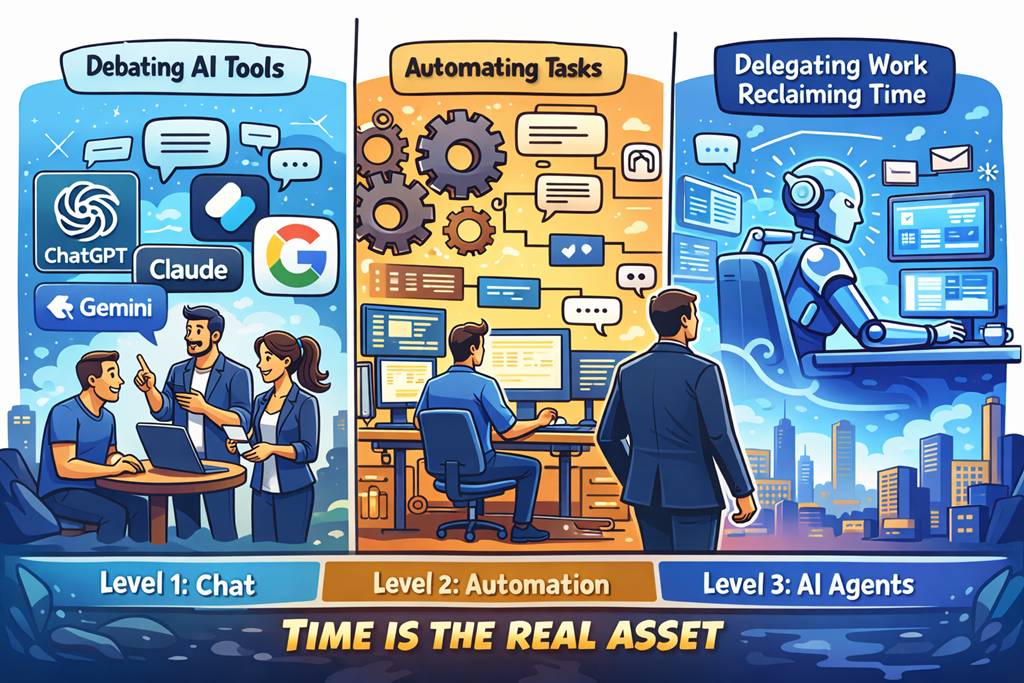
This Is the Reality Now

image

Most people are still stuck at Level 1.

They’re arguing about which AI tool is “best”.
ChatGPT vs Copilot. Claude vs Gemini. Model versions. Token limits. Benchmarks.

It’s all noise.

Because the real advantage was never the tool.

It’s how you delegate.

We’ve seen this movie before. When cloud arrived, people obsessed over which hypervisor was better instead of rethinking infrastructure. When SaaS took off, they argued about features instead of outcomes. AI is no different. The ones arguing about tools are missing the shift entirely.

Chat gives you answers.
Automation gives you leverage.
Agents give you time back.

And time is the only asset that actually matters.

Chat Is the Training Wheels

Chat-based AI is incredible. Don’t get me wrong. It’s useful, powerful, and accessible. It helps you think, draft, brainstorm, research, and unblock yourself.

But chat is still you doing the work.

You ask.
You refine.
You copy.
You paste.
You decide.

That’s not leverage. That’s assistance.

Chat is the equivalent of having a smart junior sitting next to you, waiting for instructions. Helpful? Absolutely. Transformational? Only if you stop there.

Most people do.

They feel productive because they’re faster — but they’re still the bottleneck.

Automation Is Where Leverage Starts

Automation changes the equation.

When you automate, work happens without you being present. Decisions are made based on rules. Actions trigger automatically. Systems talk to systems.

This is where output starts to scale without effort scaling with it.

But automation still has limits. It’s rigid. It does exactly what you tell it to do — no more, no less. It’s fantastic for repeatable, predictable processes, but it struggles when judgement is required.

Which brings us to the real shift.

Agents Are the Force Multiplier

Agents are where things get uncomfortable — because they replace you in the loop.

Agents don’t just answer questions.
They monitor.
They decide.
They act.
They escalate only when needed.

That’s delegation at a level most people aren’t ready for.

Instead of asking AI to help you do the work, you assign the work and walk away. You define outcomes, guardrails, and exceptions — and the agent handles the rest.

This is the difference between working with AI and working through AI.

One saves time.
The other gives it back.

Time Is the Only Asset That Matters

Money can be earned again.
Tools can be replaced.
Skills can be relearned.

Time is gone forever.

And yet most business owners, MSPs, and professionals are using AI to shave minutes instead of reclaim hours. They’re optimising tasks instead of eliminating them. They’re still “busy”, just faster at being busy.

The winners in this next phase aren’t going to be the people who know the most prompts.

They’ll be the people who know how to delegate to systems.

Who design workflows where AI works while they sleep.
Who build agents that handle the boring, repetitive, low‑value decisions.
Who spend their time on strategy, relationships, and leverage — not execution.

This Is the World We’re In Now

This isn’t future talk. It’s not hype. It’s not “someday”.

This is now.

AI isn’t just a tool you use anymore. It’s labour you can assign. And the moment you understand that, the question changes.

It’s no longer:
“Which AI should I use?”

It’s:
“What work should I never do again?”

The only real question left is whether you’re going to lean into that reality — or keep asking AI for answers while time keeps slipping through your fingers.

Because AI won’t run out of capacity.

You will.

Why Microsoft Copilot Wins: Because Copy‑Paste Isn’t a Workflow

image

There’s a lot of noise right now about AI tools.

Everyone has one. Everyone claims theirs is “the best”. And on the surface, they all seem to do the same thing: you type a prompt, it spits out words, code, or ideas.

But after working with AI daily — and helping MSPs and businesses actually use it — I’ve come to a very clear conclusion:

Microsoft Copilot isn’t better because it’s smarter.
It’s better because it’s integrated.

And that changes everything.

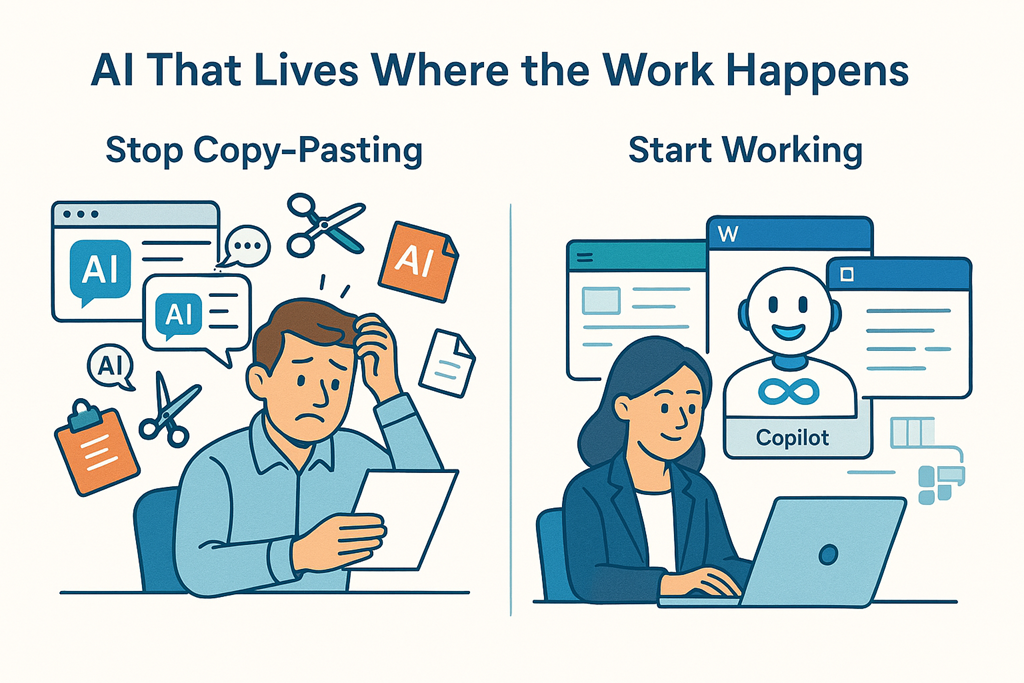
The Copy‑Paste Tax No One Talks About

Most AI tools live in a browser tab.

You ask a question.
You get an answer.
Then you copy it.
Then you paste it somewhere else.

Word. Excel. Outlook. Teams. PowerPoint. CRM. Ticketing system.

That constant switching feels minor… until you add it up.

It’s mental context‑switching.
It’s broken flow.
It’s extra clicks.
It’s friction.

Over a day, a week, a month — it’s a tax on productivity that nobody puts in a pricing comparison.

AI that forces you to copy and paste is still making you do the hard work.

Copilot Lives Where the Work Happens

Copilot doesn’t sit off to the side like a clever intern waiting for instructions.

It’s embedded directly into the tools people already use:

  • Writing inside Word
  • Analysing data inside Excel
  • Responding inside Outlook
  • Summarising conversations inside Teams
  • Building decks inside PowerPoint

That matters more than most people realise.

Because the real value of AI isn’t generating content.
It’s reducing friction in the flow of work.

With Copilot, you’re not moving information between systems.
You’re working on the thing, while the AI works with you.

Context Is the Secret Sauce

Here’s the uncomfortable truth about most AI tools:

They only know what you tell them.

Every prompt starts from scratch unless you manually paste in context. Emails. Documents. Spreadsheets. Notes. Meeting transcripts.

That’s not intelligence. That’s busywork.

Copilot, on the other hand, is grounded in your Microsoft 365 data — respecting permissions, security, and compliance — and understands:

  • The document you’re editing

  • The email thread you’re replying to

  • The meeting you just came out of

  • The spreadsheet you’re staring at

  • The chat you missed yesterday

You don’t have to re‑explain your world every time.

That’s the difference between an AI toy and an AI assistant built for work.

Real Productivity Is Invisible

The biggest productivity gains don’t look impressive in a demo.

They look like:

  • Finishing an email in 30 seconds instead of 5 minutes

  • Turning meeting notes into actions without rewriting them

  • Asking “what changed?” instead of rereading 20 messages

  • Starting a document without staring at a blank page

Copilot excels here because it removes micro‑tasks you shouldn’t be doing in the first place.

You’re not “using AI”.
You’re just getting work done faster.

Security and Compliance Aren’t Optional

This is where a lot of organisations quietly get nervous.

Browser‑based AI tools are often disconnected from your identity, your data controls, and your compliance posture. People paste sensitive information in because they’re trying to be efficient — and suddenly governance is gone.

Copilot inherits your existing Microsoft 365 security model:

  • Identity

  • Permissions

  • Data boundaries

  • Compliance controls

It only shows users what they already have access to.

That’s not just a technical detail.
For MSPs and regulated businesses, it’s the difference between “we can use this” and “we can’t touch this”.

The Best AI Is the One People Actually Use

Here’s the final point — and it’s the one that matters most.

If AI requires:

  • Training people on a new interface

  • Convincing them to change tools

  • Forcing them to remember “where the AI lives”

…adoption will stall.

Copilot shows up inside the tools people already know.

No change management theatre.
No new browser tabs.
No “remember to use the AI”.

It’s just… there.

And that’s why it wins.

Not because it’s flashy.
Not because it’s louder.
But because it understands a simple truth:

AI only delivers value when it disappears into the workflow.

And right now, Copilot does that better than anything else on the market.

From Push to Pull–A more effective approach to prompting

Video URL = https://www.youtube.com/watch?v=xYCVKQwEFgY

In this video, I reveal the game-changing secret to getting incredible results from AI tools like Copilot. If you’ve ever spent ages crafting detailed prompts only to get disappointing answers, you’re not alone! I show you how to flip the script with a simple mindset shift—turning your AI from a passive tool into an active collaborator. Discover the difference between push prompting and pull prompting, and learn a proven formula that boosts accuracy and makes your AI do the heavy lifting. Watch as I demonstrate this method in real-world scenarios, including Microsoft Excel, and see how a conversational approach can transform your workflow. Get ready to unlock smarter, faster, and more useful AI results—starting today! You can find my full publication at – https://directorcia.gumroad.com/l/aaiprompt

New Publication – Advanced AI Prompting Guide for Microsoft Copilot

blog

https://directorcia.gumroad.com/l/aaiprompt

Advanced AI Prompting Guide for Microsoft Copilot

Unlock the true power of Microsoft 365 Copilot with the definitive guide to advanced AI prompting. Written for experienced Copilot users, this publication transforms your approach from basic instructions to strategic, collaborative conversations that deliver more accurate, efficient, and tailored results across Word, Excel, Outlook, Teams, and PowerPoint.

Why Buy This Guide?
  • Go Beyond Basics: Move past simple prompts and discover the game-changing concept of pull prompting. Learn how to shift Copilot from a passive tool to an active collaborator, improving accuracy by up to 20% for complex tasks and reducing trial-and-error cycles.

  • Practical, Real-World Examples: Step-by-step methods and worked examples for business, education, and software development. Application-specific techniques help you get the most out of Copilot in every Microsoft 365 app.

  • Prompt Templates & Checklists: Access a comprehensive library of prompt templates, quick-reference checklists, and decision matrices to streamline your workflow and boost productivity.

  • Build Custom Copilot Agents: For administrators and developers, learn how to design and deploy custom Copilot agents using structured system instructions in Copilot Studio—perfect for recurring, organisation-wide workflows.

  • Grounded in Microsoft Guidance: All techniques are based on Microsoft’s official recommendations and real-world practice, ensuring you’re always aligned with best practices.

Who Should Buy?
  • Microsoft 365 Copilot users ready to advance beyond basic prompting

  • Business professionals, educators, and developers seeking more consistent and powerful AI interactions

  • IT administrators and Copilot Studio builders wanting to create custom agents for their organisation

Key Features
  • Clear explanations of push vs. pull prompting, with actionable strategies for each

  • Application-specific guidance for Word, Excel, Outlook, Teams, and PowerPoint

  • Best practices, common pitfalls, and troubleshooting tips

  • Licensing and usage terms for personal and organisational use (see publication for details)


Elevate your AI skills and productivity—purchase the Advanced AI Prompting Guide and become a leader in intelligent collaboration with Microsoft 365 Copilot.

See all the titles available at – https://directorcia.gumroad.com/

Copilot Isn’t Replacing You — It’s Replacing the Worst Parts of Your Job

image

I get the frustration. Microsoft Copilot can be poor at very specific, fussy tasks — Word formatting being the poster child. That’s not a controversial take, that’s just reality right now. If you’ve ever asked Copilot to “make this document look exactly like the template” and watched it confidently butcher margins, headings, and spacing, you’re not imagining things.

Copilot is not a replacement for someone who actually knows how to use Word properly. Especially not when a document has nuance, layout rules, or edge cases. Formatting is precision work, and Copilot is not a precision tool.

Where Microsoft (and plenty of enthusiastic commentators) get this wrong is by overselling Copilot as a “worker replacement”. It isn’t. Framing it that way sets the product up to fail and users up to be disappointed. Copilot is far closer to an assistant that’s good at rough drafts, restructuring ideas, and reducing cognitive load — and bad at exact execution.

That distinction matters.

Copilot works best when you treat it like a thinking aid, not a hands replacement. It’s excellent at getting a first-pass draft down when you’re staring at a blank page. It’s useful for rewording content, changing tone, summarising long material, or pulling scattered ideas into something coherent. It’s very good at explaining concepts and generating examples when your brain is already fried.

Where it consistently falls over is anything that requires exactness. Precise formatting. Layout-sensitive Word documents. Edge-case instructions. Anything that boils down to “do exactly this, not approximately this”.

And that’s fine — as long as we’re honest about it.

If someone genuinely believes Copilot is going to replace competent knowledge workers any time soon, that’s delusional. What Copilot replaces isn’t judgment or skill. It replaces blank pages. It replaces repetitive writing. It replaces the mental tax of context switching between tasks that don’t actually need human creativity.

Bad experience with Copilot doesn’t mean it’s useless. It means Microsoft’s marketing is miles ahead of the product’s actual reliability. Used correctly, Copilot saves time. Used incorrectly, it creates frustration.

The trick isn’t asking “Why isn’t Copilot perfect?”
It’s asking “What’s this tool actually good at — and where do I still need to be the professional?”

That’s the difference between disappointment and productivity.

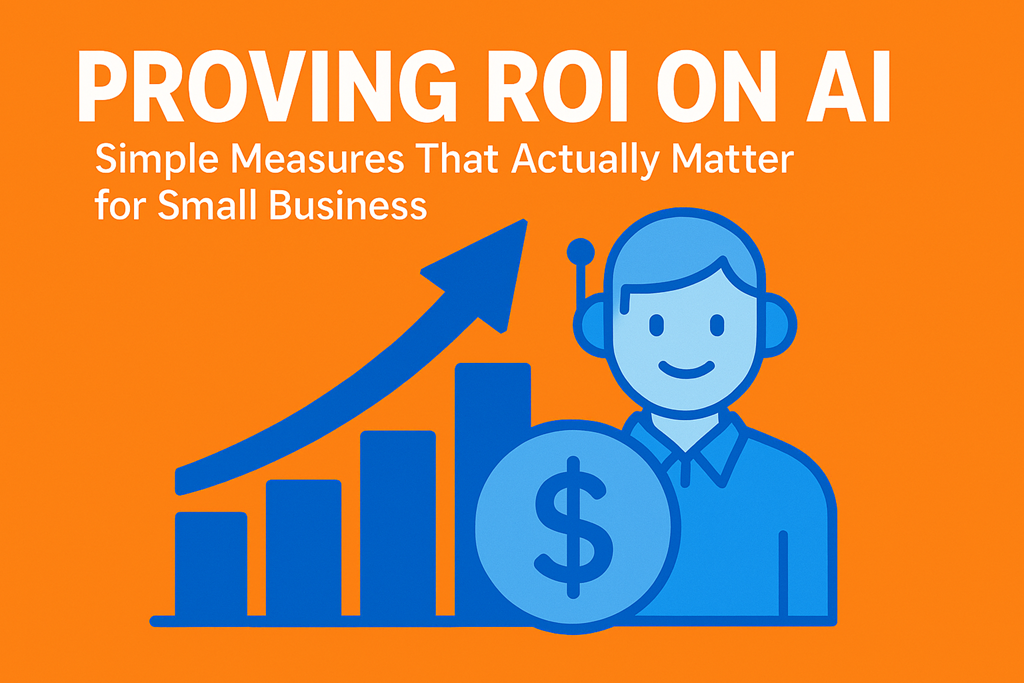
Proving ROI on AI: Simple Measures That Actually Matter for Small Business

image

One of the first questions I get from small business owners after deploying AI is predictable: “How do we prove this is worth the money?”

It’s a fair question. Budgets are tight, margins matter, and nobody wants another shiny tool that looks good in a demo but disappears into daily noise. The mistake many SMBs make, however, is trying to measure AI ROI the same way they measure hardware or software licences. AI—especially Microsoft Copilot—doesn’t work like that.

The good news? Proving ROI doesn’t need complex dashboards or consultant-led studies. In fact, the simplest measures are often the most powerful.

Start with time saved, not money earned. Copilot’s biggest immediate impact isn’t revenue generation—it’s friction removal. Ask staff one simple question: “What tasks do you finish faster now?” Email drafting, meeting summaries, document creation, policy updates, spreadsheet analysis—these all add up. If a staff member saves just 15 minutes a day, that’s over an hour a week. Multiply that across a team and suddenly the licence cost looks very small.

Next, look at output quality and consistency. Copilot doesn’t just make people faster—it helps them start better. First drafts are clearer. Reports are more structured. Emails are more professional. Policies are more consistent. You can prove this ROI by comparing before-and-after examples. If fewer documents need rewriting or fewer emails bounce back for clarification, that’s real operational value.

Another overlooked metric is decision speed. Copilot surfaces information that already exists in Microsoft 365—emails, files, chats, meetings—but does so in seconds rather than hours. Faster decisions reduce delays, reduce rework, and reduce risk. Ask leaders how long it takes now to get answers they previously had to chase.

Then there’s employee confidence and capability. This one is harder to put on a spreadsheet, but it matters. Copilot acts like a thinking partner—helping less experienced staff produce work that previously required senior input. That reduces bottlenecks and frees up your most expensive people to focus on higher‑value work.

Finally, measure what you stopped doing. Fewer manual notes. Fewer copy‑paste workflows. Fewer “can you rewrite this?” requests. ROI is often hidden in the work that quietly disappears.

The reality is this: if you expect Copilot to magically create new revenue, you’ll be disappointed. But if you measure what it removes—time, friction, rework, hesitation—you’ll quickly see the return.

AI ROI for small business isn’t about chasing big numbers. It’s about reclaiming capacity. And that’s something every SMB can feel, measure, and prove.

CIAOPS Need to Know Microsoft 365 Webinar – March

laptop-eyes-technology-computer_thumb

Now in our tenth year!

Join me for the free monthly CIAOPS Need to Know webinar. Along with all the Microsoft Cloud news we’ll be taking a look at Copilot Agents.

Shortly after registering you should receive an automated email from Microsoft Teams confirming your registration, including all the event details as well as a calendar invite.

You can register for the regular monthly webinar here:

March Registrations

(If you are having issues with the above link copy and paste – https://bit.ly/n2k2603 )

The details are:

CIAOPS Need to Know Webinar – March 2026
Tuesday 31st of March 2026
11.00am – 12.00am Sydney Time

All sessions are recorded and posted to the CIAOPS Youtube channel.

Also feel free at any stage to email me directly via director@ciaops.com with your webinar topic suggestions.

I’d also appreciate you sharing information about this webinar with anyone you feel may benefit from the session and I look forward to seeing you there.