
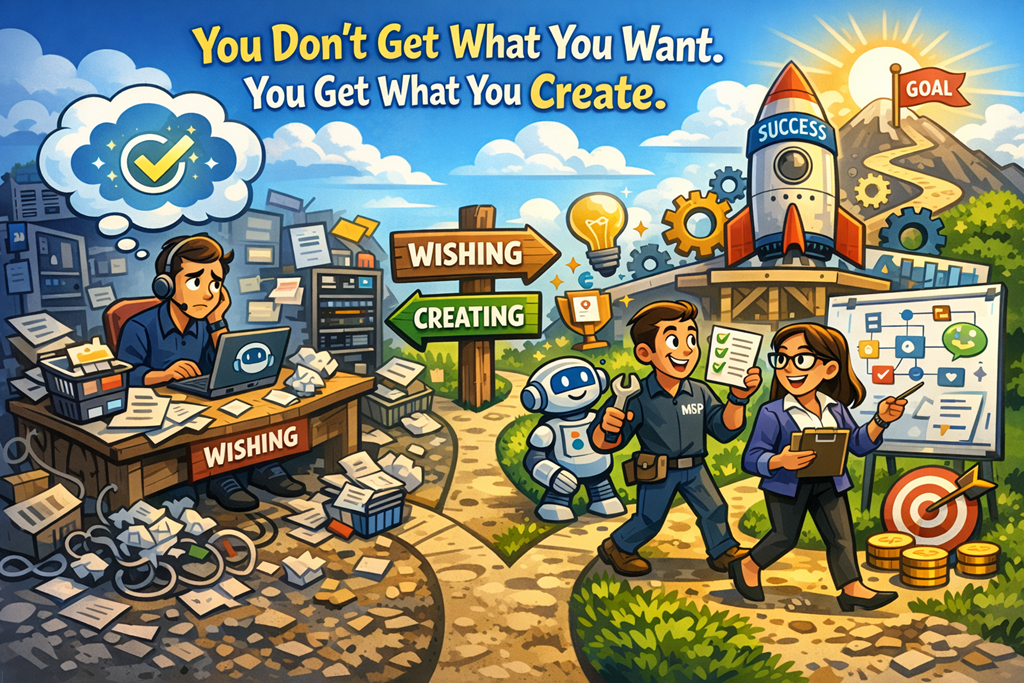
I keep seeing the same pattern play out across MSPs when it comes to Microsoft 365 Copilot.
Everyone wants the outcome.
They want more productive staff. Better documentation. Faster decision‑making. Clients who “get” the value of what they’re paying for. Less rework. Less noise. Better margins.
But wanting it doesn’t get you there.
What you actually get is the result of what you deliberately create—inside your business, your client environments, and your team’s habits. Copilot has made that reality impossible to ignore.
Copilot Doesn’t Do the Work for You
One of the biggest misconceptions I’m seeing is that Copilot is some kind of productivity switch. Turn it on and suddenly everything improves.
That’s not how it works.
Copilot doesn’t magically fix poor processes, unclear thinking, or disorganised environments. In fact, it often exposes them. If your documentation is messy, your Teams sprawl is out of control, or your staff can’t clearly explain what they’re trying to achieve, Copilot reflects that right back.
I’ve watched MSPs trial Copilot and walk away disappointed because “it didn’t give good answers”. Dig a layer deeper and the real issue is usually this: no one took the time to decide what good looks like.
Copilot amplifies intent. If there’s no clear intent, the output is exactly what you’d expect—average at best.
Action Creates Leverage
The MSPs getting real value from Copilot aren’t the ones talking about it the most. They’re the ones doing the boring, unsexy work first.
They’re standardising how they write internal notes.
They’re cleaning up SharePoint, not adding another layer on top.
They’re training staff how to ask better questions, not just how to click buttons.
One example I see regularly is meeting follow‑up. Some businesses want Copilot to magically “summarise meetings”. The ones getting value have already decided what a good meeting outcome looks like—decisions made, actions assigned, context captured. Copilot then becomes a force multiplier, not a crutch.
The difference isn’t the tool. It’s the willingness to act.
Clients Get the MSP You Build
The same applies on the client side.
I hear MSPs say, “Our clients aren’t ready for Copilot.” Often what they mean is: we haven’t created a clear, safe, guided way for clients to adopt it.
If you drop Copilot into an unmanaged tenant with poor security posture and no data boundaries, you’ll get chaos—and eventually pushback. If, instead, you deliberately design adoption around governance, role‑based use cases, and realistic expectations, the conversation shifts quickly.
Copilot rewards MSPs who lead, not those who wait for clients to ask.
Waiting feels safe. Action creates differentiation.
What You Create Shapes What You Get
Copilot is forcing a moment of honesty for a lot of MSPs.
You don’t get strategic insights just because you licensed an AI tool.
You don’t get better decisions without better thinking.
You don’t get momentum without someone taking responsibility for moving first.
The MSPs who will win in this next phase aren’t chasing features. They’re creating environments—technical, operational, and cultural—where tools like Copilot actually matter.
That takes intent. It takes effort. And yes, it takes saying no to shortcuts.
The Real Opportunity
Copilot isn’t the opportunity. Creation is.
If you want better internal productivity, create better standards.
If you want smarter clients, create better guidance.
If you want results, create the conditions for them.
Because in the end, you don’t get what you want.
You get what you create.
And the MSPs willing to take action now are the ones who’ll still be relevant when everyone else realises wishing never builds anything.


One thought on “You Don’t Get What You Want. You Get What You Create.”