
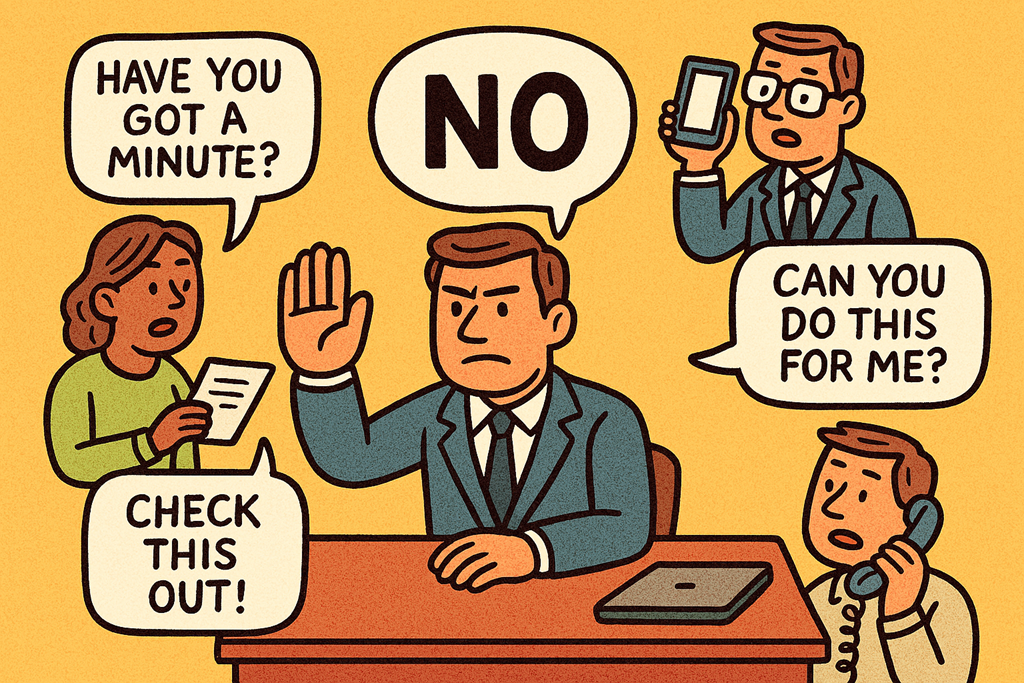
The most successful MSP owners I know aren’t superhuman.
They don’t have more hours in the day.
They don’t wake up at 4:30am to journal, ice-bathe, and manifest ARR.
They’re not running some secret productivity stack you’ve never heard of.
What they have done is get brutally honest about one uncomfortable truth:
Every yes has a price.
And once you see that clearly, you start saying no. A lot.
Not because you’re lazy.
Not because you don’t care.
But because you finally understand that attention is your scarcest resource.
The Hidden Cost of “Sure, Why Not”
MSPs are especially bad at this.
We say yes to:
- “Can you just jump on a quick call?”
- “Can you have a look at this while you’re here?”
- “This could turn into something big…”
- “We’ve always done it this way for this client.”
Each one feels harmless in isolation.
Collectively, they’re lethal.
That “quick call” blows out to 45 minutes.
That “small favour” turns into ongoing unpaid support.
That “opportunity” drags you sideways for six months with nothing to show for it.
And suddenly you’re busy all day… but somehow still stuck.
Busy is not the same as effective.
Why the Best MSP Owners Say No More Than Yes
The sharpest operators I know have made peace with disappointing people.
They say:
- No to meetings that could have been an email.
- No to shiny tools dressed up as “game changers”.
- No to custom work that doesn’t scale.
- No to clients who drain energy, margin, and morale.
- No to doing work outside their chosen lane.
Not aggressively.
Not rudely.
Just calmly. Clearly. Consistently.
Because they understand something most MSPs don’t learn until burnout hits:
Every yes you give is a no to something else.
A yes to low-margin work is a no to building IP.
A yes to reactive firefighting is a no to strategic services.
A yes to everyone else’s priorities is a no to your own.
“No” Is How You Protect the Work That Matters
Here’s the uncomfortable bit.
Most MSPs don’t have a time problem.
They have a boundary problem.
They haven’t decided:
- What kind of MSP they actually want to be
- Who they are not for
- What work they will never do again
- What a “hell yes” client looks like
Without those decisions, everything feels equally urgent.
And when everything is urgent, nothing is important.
Saying no forces clarity.
It forces you to choose:
- Productised services over bespoke chaos
- Fewer better clients over more mediocre ones
- Depth over breadth
- Long-term leverage over short-term busyness
That’s not easy. But it’s necessary.
The Myth of the Missed Opportunity
MSPs are plagued by FOMO.
“What if this client becomes huge?”
“What if this product takes off?”
“What if I say no and regret it?”
Here’s the reality:
Most opportunities aren’t opportunities. They’re distractions.
The real risk isn’t missing out.
It’s being spread so thin you never execute properly on anything.
Focus compounds.
Fragmentation exhausts.
The MSPs that win aren’t chasing everything.
They’re doubling down on a few things and executing them relentlessly well.
How to Say No (Without Being a Jerk)
You don’t need a speech.
You don’t need a justification essay.
You need a default posture.
- “That’s not something we offer.”
- “This isn’t aligned with how we work.”
- “We’re at capacity for that right now.”
- “That sits outside our support model.”
Full stop.
No over-explaining.
No apologies for having a business model.
No discounting your own time to make others comfortable.
Professional boundaries increase respect. They don’t reduce it.
Final Thought
“No” isn’t negativity.
It’s prioritisation.
It’s maturity.
It’s leadership.
If you want a clearer business, a calmer head, and work that actually moves the needle, start here:
Say no to the noise.
Say no to the drains.
Say no like you mean it.
Because on the other side of all those no’s
is the space to build something that actually matters.
And that’s not just a mindset shift.
That’s a business strategy.

