
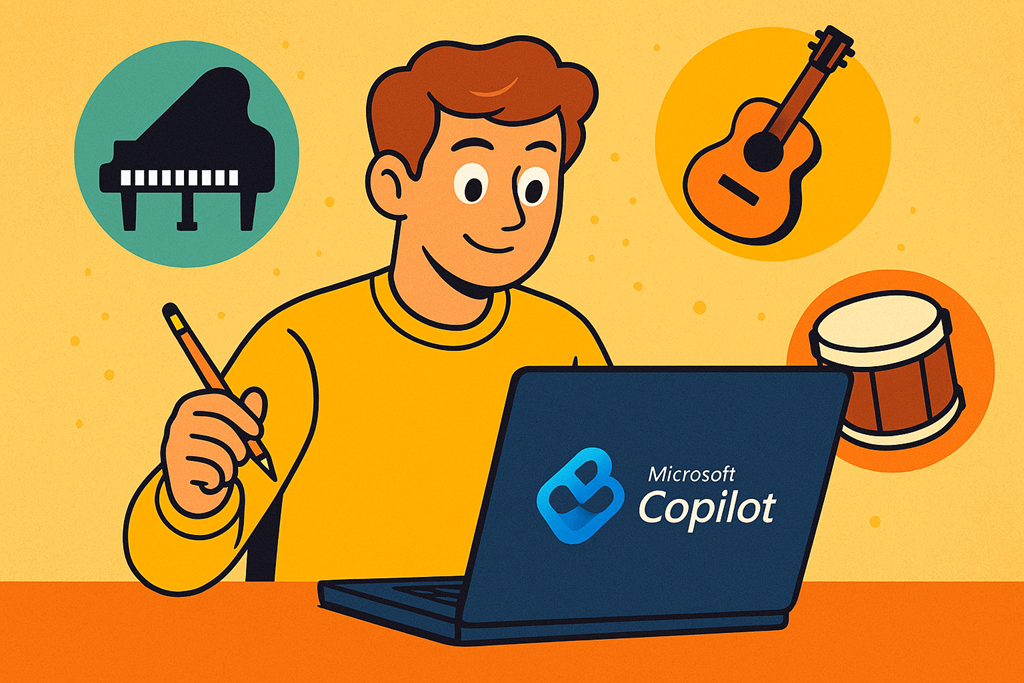
I see the same pattern play out with AI adoption over and over again.
People collect tools.
ChatGPT for writing.
Another AI for images.
Something else for meetings.
Yet another for data analysis.
Before long, they’re juggling half a dozen interfaces, prompts, logins, and workflows. The result isn’t leverage. It’s fragmentation. Lots of motion, very little progress.
Learning AI this way is like trying to learn three musical instruments at the same time. You might make some noise, but you won’t make music. Depth never comes from constant switching.
That’s why most AI initiatives stall.
The problem isn’t capability.
It’s focus.
Depth Beats Breadth Every Time
Real skill—whether it’s music, sport, or technology—comes from going deep before going wide. You don’t become competent by tasting everything. You get there by committing to one thing long enough to understand how it really works.
AI is no different.
If you want genuine productivity gains, you need to stop asking “Which AI tool should I try next?” and start asking “Which AI fits how I already work?”
For most SMBs and MSPs, the answer is obvious: Microsoft 365 Copilot.
Not because it’s flashy. Not because it’s perfect. But because it lives inside the tools you already use every day.
Copilot Wins Because It’s Embedded, Not Exotic
Copilot isn’t another destination you have to remember to visit. It’s not a separate browser tab or a disconnected chatbot. It sits inside Outlook, Word, Excel, Teams, SharePoint, and OneNote—the places where work actually happens.
That matters more than people realise.
When AI is embedded into your existing workflows, learning accelerates naturally. You don’t have to rethink how you work. You just augment it.
Drafting emails becomes faster.
Meeting notes stop being an afterthought.
Documents evolve instead of restarting from scratch.
Data gets explained, not just displayed.
This is where Copilot shines for SMBs: incremental improvement at scale, without cultural whiplash.
The 30‑Day Commitment Most People Avoid
Here’s the uncomfortable truth: most people never master Copilot because they never commit to it.
They test it once or twice, get a mediocre result, and move on. That’s not evaluation. That’s impatience.
If you want Copilot to deliver value, treat it like a skill, not a shortcut.
Commit to using Copilot as your primary AI for 30 days.
Not casually. Deliberately.
Use it every day.
Ask better questions.
Refine your prompts.
Push it into edge cases.
See where it breaks—and why.
That’s how understanding forms.
Copilot has quirks. It has limits. It has strengths that only become obvious once you stop dabbling and start relying on it.
Master One, Then Sequence
Once you truly understand Copilot—how it reasons, where it adds value, where it needs structure—you’re in a much stronger position to evaluate other AI tools.
At that point, adding another tool is a strategic decision, not a distraction.
This is the sequencing most organisations get wrong. They expand too early, before they’ve extracted value from what they already have.
Masters don’t rush to accumulate.
They build depth first.
Then they extend deliberately.
The Real AI Advantage for SMBs
The competitive advantage with AI isn’t having access to the most tools. Everyone has access now.
The advantage comes from consistent execution.
SMBs that win with AI won’t be the ones chasing every new model. They’ll be the ones that picked a single, integrated platform, learned it properly, and embedded it into daily work.
For most, that platform is already licensed, already deployed, and already waiting.
Microsoft 365 Copilot isn’t the loudest option.
It’s the most practical one.
And in business, practicality beats novelty every time.


One thought on “Why Most People Fail at AI (and How Copilot Fixes That)”