
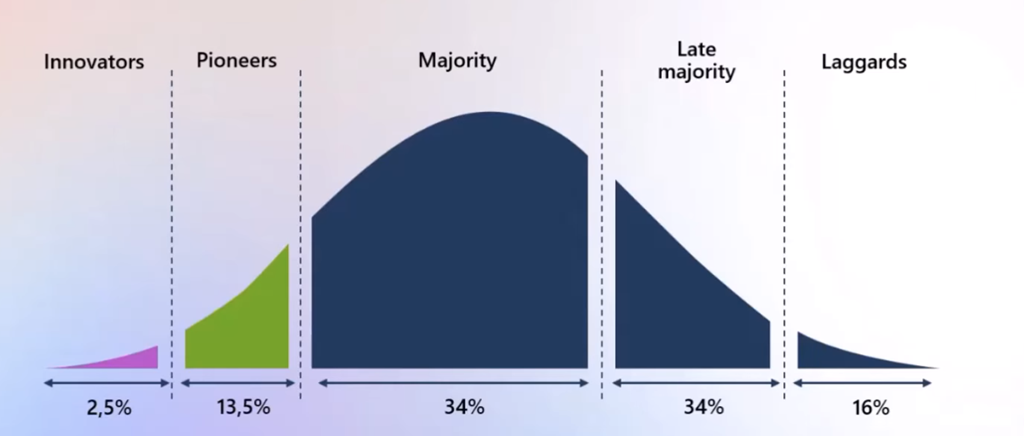
The image above should look familiar. It’s the classic technology adoption curve: Innovators, Pioneers (early adopters), the Majority, Late Majority, and Laggards. It’s been used for decades to explain why new technology doesn’t spread evenly. What’s interesting is how clearly Microsoft Copilot now fits into this model — and what that means for MSPs and business leaders trying to drive real adoption, not just licence sales.
Right now, most organisations experimenting with Copilot sit firmly on the left side of the curve. Innovators (roughly 2.5%) are the people who will try anything new just to see how it works. They don’t need much convincing. Give them access and they’ll start prompting, breaking things, and discovering value on their own.
Next come the Pioneers, about 13.5%. These are forward‑thinking leaders, power users, and teams who see Copilot as a competitive advantage. They’re curious, optimistic, and willing to tolerate some friction. Most early Copilot success stories live here — not because Copilot is “done”, but because these users are motivated enough to push through the learning curve.
The real challenge — and opportunity — sits in the middle.
The Majority (34%) won’t adopt Copilot because it’s exciting. They’ll adopt it because it clearly makes their work easier, faster, or better than what they’re doing today. This group doesn’t want AI theory, prompt engineering jargon, or hype. They want specific outcomes: “Will this save me time writing emails?”, “Will this help me understand documents faster?”, “Will this reduce rework?”
This is where most Copilot rollouts stall.
Too many deployments assume that once licences are assigned, value will magically appear. It won’t. The Majority needs structure: role‑based scenarios, simple starting prompts, guardrails, and reassurance that using Copilot won’t break anything or get them into trouble. Adoption here is less about technology and more about change management.
The Late Majority (another 34%) are even more cautious. They adopt only when Copilot becomes the normal way of working — when peers are already using it and the risk of not using it feels higher than the risk of trying. For this group, success stories, internal champions, and visible leadership usage matter far more than features.
Finally, the Laggards (16%) will resist until the very end. Some will never fully adopt, and that’s fine. Copilot doesn’t need 100% usage to deliver value. Forcing it here usually creates more friction than benefit.
The key takeaway from the image is this: Copilot adoption is not a technical rollout, it’s a staged journey. Each segment of the curve needs a different approach. Innovators need freedom. Pioneers need enablement. The Majority needs clarity and proof. The Late Majority needs confidence and social validation.
For MSPs, this changes the conversation. Success isn’t measured by how fast you sell Copilot licences, but by how effectively you help customers move from left to right on the curve. Those who focus on outcomes, education, and real‑world workflows will win. Those who treat Copilot like just another SKU will get stuck in the trough — wondering why “no one is using it”.
Copilot isn’t early anymore. But meaningful adoption still is.

