How SMBs can use AI with security

bp1

Microsoft 365 Business Premium offers a robust suite of security features, many of which are enhanced by Artificial Intelligence (AI) and machine learning. For SMBs, leveraging these AI capabilities can significantly bolster their cybersecurity posture. Here’s how:

1. AI-Powered Threat Detection and Prevention (Microsoft Defender for Business & Office 365):

  • Advanced Malware and Ransomware Protection: Microsoft Defender for Business (included in M365 Business Premium) uses AI and machine learning to analyze endpoint behavior (PCs, Macs, mobile devices) and detect suspicious activity indicative of malware, ransomware, and other advanced threats. It provides real-time threat detection and automated response capabilities to mitigate issues before they escalate [1, 2].

  • Phishing and Zero-Day Attack Protection: Microsoft Defender for Office 365 (Plan 1, also included) employs AI to identify and block sophisticated phishing attempts, including those crafted with Generative AI to appear more convincing. It uses “Safe Links” to scan URLs in emails and documents at the time of click, and “Safe Attachments” to open email attachments in a virtual environment to detect malicious content before it reaches users. This AI helps interpret email language and intent to classify threats at machine speed [1, 3].

  • Behavioral Anomaly Detection: AI models continuously learn normal user and system behavior. Any deviation from this baseline, such as unusual login patterns, large data downloads, or access from unfamiliar locations, can trigger alerts and automated responses, indicating potential account compromise or insider threats [3].

2. Identity and Access Management (Microsoft Entra ID Premium P1):

  • Risk-Based Conditional Access: AI plays a crucial role in Conditional Access policies. It analyzes factors like user location, device compliance, and detected risk levels (e.g., impossible travel, anomalous login times, leaked credentials) to determine if access to resources should be granted, denied, or require additional verification (like MFA). This proactive approach significantly reduces the risk of unauthorized access even if credentials are stolen [1, 4]. Microsoft Entra ID Protection categorizes risk into low, medium, and high confidence levels, using machine learning to inform these assessments [4].

  • Multi-Factor Authentication (MFA) Enforcement: While MFA itself isn’t AI, the AI in Entra ID (formerly Azure Active Directory) can recommend and enforce MFA based on detected risks, making it a critical layer of defense against identity attacks [1, 4].

3. Data Loss Prevention (DLP) and Information Protection (Microsoft Purview):

  • Intelligent Data Classification: AI in Microsoft Purview Information Protection can automatically identify and classify sensitive data (e.g., credit card numbers, health information, personally identifiable information) across Outlook, SharePoint, and Teams. This helps ensure that sensitive data is appropriately protected, encrypted, and prevented from leaving the organization, whether maliciously or accidentally [1, 5]. Sensitive information types and trainable classifiers leverage AI to find sensitive data in user prompts and responses when they use AI apps [5].

  • Automated Policy Enforcement: Based on the AI-driven classification, DLP policies can be automatically enforced, preventing sharing of sensitive information with unauthorized external parties or even internally if policies dictate [5]. DLP also uses machine learning algorithms to detect content that matches your DLP policies [5].

4. Device Management and Compliance (Microsoft Intune):

  • Automated Security Policy Deployment: While Intune primarily manages devices, AI can inform and automate the deployment of security policies, ensuring devices are compliant before accessing company resources. It can also help detect and flag non-compliant devices, preventing them from becoming entry points for attacks [1].

  • Remote Wipe and Data Protection: In case of lost or stolen devices, Intune allows for remote wiping of company data, which, while not directly AI-powered, is a critical security measure supported by the device management framework [1].

  • AI-powered insights for device management: Microsoft Intune leverages real-time data and AI-powered insights (e.g., in Endpoint analytics and with Copilot in Intune) to help proactively manage and secure devices, pinpoint problems, identify vulnerabilities, and deploy remediations [6].

5. AI for Security Operations (Microsoft 365 Copilot & Analytics):

  • Microsoft 365 Copilot (Add-on): While primarily a productivity tool, Copilot, when integrated with Microsoft 365 Business Premium, can contribute to security by:

    • Summarizing Security Alerts: Quickly digest and understand complex security alerts and incident reports [7].

    • Threat Intelligence Analysis: Help analyze security logs and data to identify potential threats and vulnerabilities [7].

    • Generating Security Policies/Documentation: Assist in drafting security policies, guidelines, or incident response plans [7].

    • Adhering to existing security controls: Copilot inherits existing Microsoft 365 security, privacy, identity, and compliance requirements, ensuring users only see what they have permission to access [7].

  • Security Analytics and Reporting: The underlying AI within M365’s security features continuously collects and analyzes vast amounts of security data. This allows for better insights into the organization’s security posture, identifies trends in attacks, and helps predict potential vulnerabilities, enabling SMBs to make informed security decisions [2].

How SMBs can best leverage this AI:

  • Enable and Configure: Don’t just subscribe to M365 Business Premium; actively enable and configure its security features. Many of the AI-powered capabilities need to be turned on and customized to your business’s needs.

  • Prioritize MFA and Conditional Access: These are foundational and highly effective in preventing identity-based attacks [1, 4, 7].

  • Educate Employees: Even with AI, human error is a significant vulnerability. Train employees on phishing awareness, data handling best practices, and the importance of reporting suspicious activity.

  • Regularly Review Security Reports: Pay attention to the security insights and recommendations generated by M365, as these are often powered by AI analysis.

  • Consider Professional Assistance: For complex configurations or if you lack in-house IT expertise, consider working with a Managed Service Provider (MSP) who specializes in Microsoft 365 security. They can help optimize your security posture and ensure you’re getting the most out of the AI-powered features.

  • Stay Updated: Microsoft continuously updates its security features. Keep your M365 environment updated to benefit from the latest AI enhancements.

By proactively utilizing the AI capabilities within Microsoft 365 Business Premium, SMBs can significantly enhance their defenses against evolving cyber threats, protecting their data, devices, and ultimately, their business continuity.


References:

[1] Security Features of Microsoft Business Premium | Smile IT. (n.d.). Retrieved from https://www.smileit.com.au/cybersecurity/security-features-of-microsoft-business-premium/

[2] Microsoft Defender for Business | Microsoft Security. (n.d.). Retrieved from https://www.microsoft.com/en-au/security/business/endpoint-security/microsoft-defender-business

[3] Microsoft Defender for Office 365 | Microsoft Security. (n.d.). Retrieved from https://www.microsoft.com/en-au/security/business/siem-and-xdr/microsoft-defender-office-365

[4] What are risks in Microsoft Entra ID Protection. (n.d.). Retrieved from https://learn.microsoft.com/en-us/entra/id-protection/concept-identity-protection-risks

[5] Use Microsoft Purview to manage data security & compliance for Entra-registered AI apps. (n.d.). Retrieved from https://learn.microsoft.com/en-us/purview/ai-entra-registered

[6] Microsoft Intune data-driven management | Device Query & Copilot – Mechanics Team. (n.d.). Retrieved from https://officegarageitpro.medium.com/microsoft-intune-data-driven-management-device-query-copilot-fc6b958a5e83

[7] Securing Microsoft 365 Copilot in a Small Business Environment – CIAOPS. (n.d.). Retrieved from https://blog.ciaops.com/2025/07/07/securing-microsoft-365-copilot-in-a-small-business-environment/

Unlocking Productivity: SharePoint, Teams, and OneDrive Best Practices for SMBs with M365 Business Premium

bp1

For Small and Medium Businesses (SMBs) leveraging Microsoft 365 Business Premium, the suite of tools – SharePoint, Teams, and OneDrive for Business – offers an incredible opportunity to transform collaboration and boost productivity. But simply having the tools isn’t enough; strategic configuration and a well-designed collaboration structure are key to unlocking their full potential. This blog post will guide you through the recommended best practices and provide detailed steps to configure your environment for maximum efficiency.

Understanding the Trio: SharePoint, Teams, and OneDrive

Before diving into configuration, it’s crucial to understand the distinct roles of each platform:

  • OneDrive for Business: Think of this as your personal cloud storage. It’s ideal for individual work files, drafts, and documents you’re not yet ready to share broadly. It provides seamless synchronization across devices and robust versioning.
  • SharePoint Online: This is your organization’s intranet and document management system. SharePoint sites are perfect for structured, long-term document storage, company-wide resources, policies, and departmental information. Every Microsoft Team gets an associated SharePoint Team Site.
  • Microsoft Teams: The hub for teamwork. Teams brings together chat, meetings, calls, and collaboration on files. It’s designed for dynamic, real-time collaboration within specific groups or projects, with the underlying file storage powered by SharePoint.

Designing Your Collaboration Structure: The “When to Use What” Guide

A common pitfall is using these tools interchangeably. A clear “when to use what” guideline is essential for user adoption and efficient collaboration.

  • Your Personal Work & Drafts: OneDrive for Business
  • Immediate Team/Project Collaboration: Microsoft Teams (with files stored in the connected SharePoint Team Site’s document library)
  • Company-wide Information & Structured Document Management: SharePoint Communication Sites (for intranets, HR portals) and SharePoint Team Sites (for departmental or long-term project repositories not necessarily tied to a daily Teams chat).
  • Formal/External Communication: Outlook (for email and calendaring)
  • Task Management: Microsoft Planner (for team tasks, integrated into Teams) and Microsoft To Do (for personal tasks).

Detailed Steps: Configuring Your Collaboration Environment

Phase 1: Foundation & Security (Admin-Focused)
  1. Initial Setup & Domain Verification: Ensure your Microsoft 365 tenant is fully set up, and your custom domain is verified. This is typically done during your initial M365 Business Premium subscription setup.
  2. User Management & Licensing:
    • Go to the Microsoft 365 Admin Center https://admin.microsoft.com
    • Navigate to Users > Active Users.
    • Add users and assign the appropriate Microsoft 365 Business Premium licenses. Ensure display names and usernames are consistent.
  3. Enable Multi-Factor Authentication (MFA) for ALL Users: This is non-negotiable for SMB security.

    • From the Admin Center, go to Azure Active Directory (now Microsoft Entra ID).
    • Under Security > Conditional Access or Identity > Users > Per-user MFA, enable MFA for all users. Consider setting up Conditional Access policies to enforce MFA based on location or device.
  4. Configure OneDrive for Business Default Settings:
    • In the Microsoft 365 Admin Center, go to Show all > SharePoint > Settings > OneDrive sync.
    • Ensure the OneDrive sync app is recommended and consider enabling Known Folder Move to automatically back up users’ Desktop, Documents, and Pictures folders to OneDrive.
    • Set appropriate retention policies for OneDrive files in the Microsoft Purview compliance portal.
    • Review external sharing settings for OneDrive. For SMBs, it’s often best to restrict external sharing to specific domains or require sign-in for external users.
  5. SharePoint Online Default Settings:

    • In the Microsoft 365 Admin Center, go to Show all > SharePoint > Policies > Sharing.
    • Set your default external sharing level (e.g., “Existing guests” or “New and existing guests”). Avoid “Anyone” links for sensitive data.
    • Implement retention policies for SharePoint sites and libraries in the Microsoft Purview compliance portal.
    • Consider configuring data loss prevention (DLP) policies to prevent sensitive information from being shared inappropriately.

    Microsoft Teams Default Settings:

    • Go to the Microsoft Teams Admin Center https://admin.teams.microsoft.com
    • Under Teams > Teams settings, define guest access permissions. Be clear on who can invite guests and what guests can do.
    • Establish Team and channel naming conventions (e.g., Dept-Marketing, Project-LaunchX). This helps with organization and searchability. Communicate these clearly to users.
    • Consider governance policies for Team creation (e.g., restricting who can create new Teams or requiring approval for new Teams). This prevents sprawl.
    • Review app availability. Limit or approve third-party apps based on your company’s security and productivity needs.
Phase 2: Structuring for Collaboration (User & Admin Collaboration)
  1. Identify Collaboration Needs & Groups:
    • Gather key stakeholders from different departments or projects.
    • Determine how teams currently communicate and share files.
    • Identify logical groups for collaboration (e.g., Sales Team, Marketing Team, Project X Team, Leadership).
  2. Create Microsoft 365 Groups/Teams:
    • For each identified collaboration group, create a Microsoft Team in the Teams Admin Center or directly in the Teams application.
    • When you create a Team, it automatically creates a corresponding Microsoft 365 Group (which includes a SharePoint Team Site, Exchange mailbox, Planner, etc.).
    • Best Practice: Start with a few core Teams (e.g., by department or major function) and add specific channels within them. Avoid creating a Team for every single small project initially.
  3. Organize Channels within Teams:
    • Within each Team, create Standard Channels for different topics, workstreams, or sub-projects.
    • Use the “General” channel for announcements and onboarding.
    • Private Channels should be used sparingly for sensitive discussions or files involving a subset of the Team members.
    • Shared Channels (if applicable) allow seamless collaboration with specific internal or external teams without granting full access to the parent Team. Ideal for client projects or vendor collaborations.
  4. Leverage SharePoint for Structured Content:
    • Team Sites (Connected to Teams): The “Files” tab in each Teams channel is powered by a document library in the connected SharePoint Team Site. Encourage users to store all Team-related documents here. Use folders within these libraries for further organization.
    • Communication Sites: Create dedicated SharePoint Communication Sites for company-wide news, HR resources, IT support, or marketing collateral that needs to be broadly accessible but controlled by a smaller group of content creators. Link these sites from within Teams using tabs or a central intranet portal.
  5. Integrate Apps & Tabs in Teams:
    • Pin frequently used files, SharePoint pages/lists, Planner boards, OneNote notebooks, or websites as tabs within relevant Teams channels.
    • For example, add a Planner tab to a project channel to track tasks, or a OneNote tab for meeting notes.
  6. Document Co-authoring Best Practices:
    • Encourage users to co-author documents directly in Teams or SharePoint Online instead of sending attachments via email.
    • Remind users to use the @mention feature in documents and Teams chats to notify specific colleagues.
    • Utilize version history in SharePoint and OneDrive for easy rollbacks and tracking changes.

Phase 3: Adoption & Ongoing Management (Continuous Improvement)
  1. User Training & Education: This is perhaps the most critical step.

    • Conduct internal workshops or provide clear, concise training on “when to use what” for OneDrive, SharePoint, and Teams.
    • Provide quick-reference guides, FAQs, and short video tutorials.
    • Leverage Microsoft Learn resources, which offer extensive free training materials.
    • Focus on practical scenarios: e.g., “How to share a document for team collaboration,” “How to find company policies,” “How to conduct a project meeting.”
  2. Establish “Champions” Program:
    • Identify enthusiastic users in different departments who can become internal experts and advocates.
    • They can help answer questions, promote best practices, and gather feedback.
  3. Regular Review & Optimization:
    • Periodically review your Microsoft 365 usage from the Admin Center. Identify underutilized features or areas of confusion.
    • Gather feedback from users regularly to understand their pain points and suggestions for improvement.
    • Stay updated with new Microsoft 365 features and enhancements, and communicate relevant updates to your team.
    • Conduct content audits in SharePoint to ensure information remains relevant and accurate.
  4. Data Governance & Compliance:
    • Regularly review and enforce retention and deletion policies to manage data lifecycle and compliance.
    • Monitor audit logs in the Microsoft Purview compliance portal for suspicious activities or data breaches.

Conclusion

Microsoft 365 Business Premium offers a powerful toolkit for SMBs to foster a highly productive and secure collaboration environment. By thoughtfully designing your collaboration structure and diligently applying these best practices for SharePoint, Teams, and OneDrive for Business, you can empower your employees, streamline workflows, and ultimately drive greater success for your business. Remember, it’s an ongoing journey of refinement and user engagement, so keep learning and adapting!

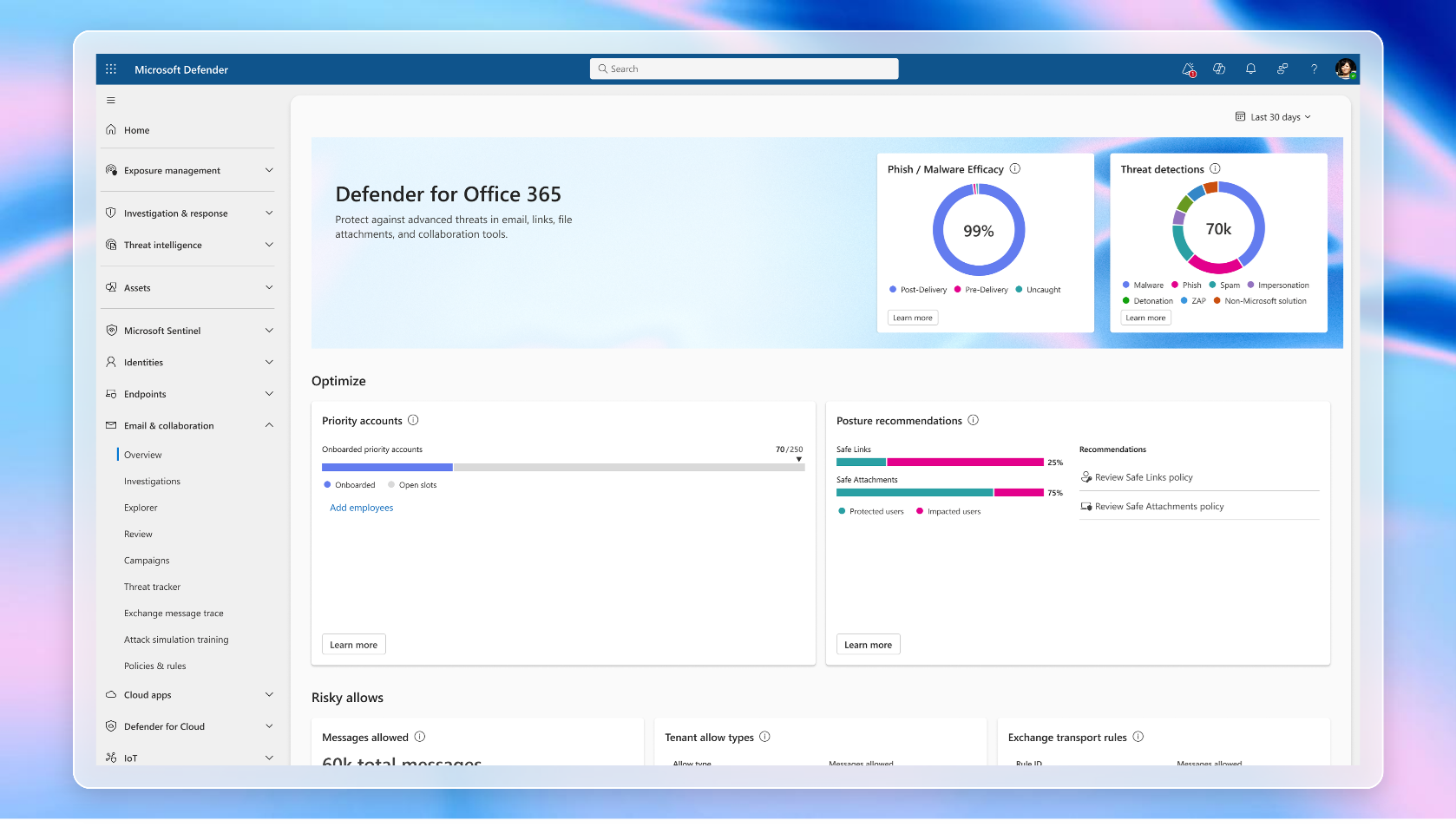
New Defender for Office 365 Dashboard

A screenshot of the new Defender for Office 365 overview dashboard.

The new customer overview dashboard allows security teams to track efficacy across cyberthreats blocked pre-delivery, threats mitigated post-delivery, and even “missed” threats. It includes details on how Microsoft Defender for Office 365 capabilities like Safe link, Safe attachments, and Zero-hour Auto Purge contribute to threat protection across an organization. Our goal is simple: to help you confidently answer the question “How are my organization’s users being protected from malicious content and cyberattacks when using email and other collaboration surfaces like Microsoft Teams?”

Transparency on Microsoft Defender for Office 365 email security effectiveness

View it now – https://security.microsoft.com | Email & Collaboration | Overview

Using Multiple Authenticator Apps with One Microsoft 365 Account: Guide for MSPs

bp1

For Managed Service Providers (MSPs) with multiple employees managing numerous customer Microsoft 365 tenants, efficiently and securely handling multi-factor authentication (MFA) is crucial. While a single Microsoft 365 user account typically links to one primary authenticator, there are legitimate scenarios and best practices for MSPs to leverage multiple authenticator apps for a single user, enhancing both security and operational flexibility.

Why Multiple Authenticator Apps for an MSP User?

While the general recommendation for individual users is to have a single, primary authenticator app for an account, MSPs often encounter unique needs:

  • Redundancy and Backup: In case a primary device is lost, stolen, or damaged, a secondary authenticator on another device ensures access isn’t lost, preventing costly downtime.
  • Shared Administrative Accounts (with caution): While not ideal, some MSP workflows might necessitate a shared administrative account for specific, highly controlled scenarios (e.g., break-glass accounts). In such cases, multiple technicians might need access to the MFA codes, making multiple authenticators a practical, albeit carefully managed, solution.
  • Employee Transition: When an employee leaves, transferring MFA access to a new team member can be streamlined if a secondary authenticator is already configured on a shared, secure device (e.g., a dedicated company phone for administrative access).
  • Location/Device Flexibility: Technicians working from different locations or using various company-issued devices might benefit from having the authenticator configured on each frequently used device.

Best Practice Approaches for MSPs

The core principle for MSPs managing MFA is to prioritize security while maintaining operational efficiency. Here’s a breakdown of best practices:

1. Leverage Conditional Access Policies (Azure AD Premium P1 or P2)

Conditional Access is the gold standard for managing MFA in Microsoft 365, especially for MSPs. It offers granular control over when and how MFA is enforced, allowing for much more sophisticated policies than basic security defaults.

  • Granular Control: Define policies based on user groups, location (trusted IPs, risky locations), device state (compliant, hybrid Azure AD joined), application being accessed, and sign-in risk.
  • MFA for Administrative Roles: Always enforce MFA for all administrative roles (Global Administrator, User Administrator, Helpdesk Administrator, etc.) across all customer tenants.
  • Location-Based MFA: Require MFA for sign-ins from outside your MSP’s trusted network locations.
  • Risky Sign-ins: Automatically require MFA or block access for sign-ins detected as risky by Microsoft Entra ID Protection.
  • Device Compliance: Require MFA for access from non-compliant devices.
  • Prioritize Microsoft Authenticator: Encourage or enforce the use of the Microsoft Authenticator app for push notifications or number matching. This is generally more secure and user-friendly than SMS or voice calls.
  • Phased Rollout: When implementing or modifying MFA, conduct a phased rollout. Start with your internal IT staff, then move to pilot groups, and finally to all users.
2. Designate Specific Authenticators for Specific Purposes

Avoid a free-for-all with authenticators. Be strategic:

  • Primary Authenticator (User’s Personal Device): The Microsoft Authenticator app on the technician’s primary work smartphone should be their main MFA method. This offers convenience and strong security (push notifications, biometrics).
  • Secondary Authenticator (Company-Provided Device or FIDO2 Key): For backup or shared administrative accounts (used rarely and with extreme caution), a secondary authenticator on a company-issued device (tablet, spare phone) or a hardware security key (FIDO2) is preferable. FIDO2 keys offer the strongest phishing resistance.
  • Avoid SMS/Voice as Primary MFA: While useful for recovery, SMS and voice MFA are susceptible to SIM-swapping and other attacks. Limit their use as primary authentication methods, especially for administrative accounts.
3. Implement Break-Glass Accounts

Maintain a small number of highly secured “break-glass” or emergency access accounts. These accounts are exempt from normal Conditional Access policies and are only used in extreme emergencies (e.g., a global MFA outage, or if all administrators are locked out). These accounts should:

  • Be cloud-only (not synchronized from on-premises AD).
  • Have strong, complex passwords stored securely and offline.
  • Be monitored for any sign-in activity.
  • Have their credentials rotated regularly.
  • Ideally, use hardware FIDO2 keys for MFA.
4. Regular Auditing and Monitoring
  • MFA Registration Reports: Regularly review who has registered for MFA and what methods they’ve configured.
  • Sign-in Logs: Monitor sign-in logs for unusual activity, failed MFA attempts, or sign-ins from untrusted locations. Microsoft 365 Lighthouse (for CSP partners) and Azure AD reports can provide consolidated views across tenants.
  • Access Reviews: Periodically review administrative roles and MFA configurations for all users, especially for those with elevated privileges.
5. Training and Documentation
  • User Education: Train your MSP employees on the importance of MFA, how to use their authenticator apps correctly, and how to report suspicious MFA prompts.
  • Internal Procedures: Document your internal policies for MFA, including how to set up new authenticators, handle lost devices, and manage break-glass accounts.

Step-by-Step Configuration: Adding Multiple Authenticator Apps to a Single User

This process generally involves the user adding additional authentication methods through their security info settings. An administrator initiates MFA enforcement, and the user then registers their chosen methods.

Prerequisites:
  • A Microsoft 365 user account.
  • Global Administrator or Authentication Administrator role (for initial setup/management).
  • Microsoft Authenticator app installed on the primary device.
  • Secondary device (another smartphone/tablet) for the second authenticator app.
  • (Optional) FIDO2 Security Key.
  • Azure AD Premium P1/P2 license for Conditional Access (highly recommended for MSPs).
Step 1: Enable MFA (if not already enabled)

For MSPs, using Conditional Access policies is the recommended way to enable and enforce MFA. Security Defaults are a simpler option but offer less flexibility.

Method A: Using Conditional Access Policies (Recommended for MSPs)
  1. Sign in to the https://entra.microsoft.com/ Microsoft Entra admin center (formerly Azure Active Directory admin center) as a Global Administrator.
  2. Navigate to Protection > Conditional Access.
  3. Click + New policy.
  4. Name the policy: e.g., “MFA for All Users” or “MFA for Admins”.
  5. Under Assignments > Users or workload identities, select the relevant scope (e.g., All users, or specific administrative roles/groups). For MSPs, definitely target administrative roles.
  6. Under Cloud apps or actions, select All cloud apps (or specific sensitive apps).
  7. Under Conditions (optional, but highly recommended for MSPs):

    • Locations: Exclude trusted locations (e.g., your MSP office IP ranges) to reduce MFA prompts when users are on-site, but require MFA when outside.
    • Device state: Consider requiring MFA for non-compliant devices.
    • Sign-in risk: Set to require MFA for medium or high sign-in risk.
  8. Under Grant:

    • Select Grant access.
    • Check Require multi-factor authentication.
  9. Set Enable policy to On.
  10. Click Create.
Method B: Using Security Defaults (Simpler, less flexible – good for quick enforcement)

If you don’t have Azure AD Premium licenses, Security Defaults provide a baseline level of MFA enforcement.

  1. Sign in to the https://entra.microsoft.com/ Microsoft Entra admin center as at least a Security Administrator.
  2. Browse to Identity > Overview > Properties.
  3. Select Manage security defaults.
  4. Set Security defaults to Enabled.
  5. Select Save.

Note: If you previously had “per-user MFA” enabled, you must disable it before using Conditional Access or Security Defaults. You can do this from the Microsoft 365 admin center > Users > Active users > Multi-factor authentication link, and set user status to disabled.

Step 2: User Registers Their First Authenticator App (Primary)

The first time a user signs in after MFA is enabled, they will be prompted to set it up.

  1. The user navigates to https://myaccount.microsoft.com/.
  2. They sign in with their username and password.
  3. They will see a message: “Your organization needs more information to keep your account secure.” Click Next.
  4. On the “Keep your account secure” page, they will be prompted to set up the Microsoft Authenticator app (recommended).

    • Choose Mobile app from the dropdown.
    • Select Receive notifications for verification (for push notifications) or Use verification code (for TOTP codes). Push notifications are preferred for ease of use and security. Click Set up.
    • A QR code will appear on the screen.
  5. On their primary smartphone:

    • Open the Microsoft Authenticator app.
    • Tap the + sign (top right on iOS, top left on Android) and choose Work or school account.
    • Select Scan a QR code and scan the code displayed on the computer screen.
    • The account will be added to the app.
  6. On the computer, click Next. Microsoft will send a test notification to the app.
  7. On the smartphone, approve the notification (or enter the number matching code if enabled).
  8. Once verified, click Next on the computer.
  9. They may be prompted to set up an alternative verification method (e.g., phone number) as a backup. It’s recommended to do this.
  10. Click Done.
Step 3: User Registers a Second Authenticator App (or another method)

Once the primary authenticator is set up, the user can add additional methods via their security info page.

  1. The user navigates to https://myaccount.microsoft.com/ and signs in (they will be prompted for MFA using their primary method).
  2. On the left-hand navigation, click Security info.
  3. Click + Add method.
  4. From the dropdown, choose the desired method:

    • Authenticator app: To add the Microsoft Authenticator app to a second device or another TOTP authenticator (e.g., Google Authenticator, Authy).
    • Phone: To add a secondary phone number for SMS or voice calls (less secure, use with caution for admin accounts).
    • Security key: To add a FIDO2 hardware security key (highly recommended for strong phishing resistance).
  5. For a second Authenticator App:
    1. Select Authenticator app and click Add.
    2. Follow the on-screen prompts. It will present a new QR code.
    3. On the second device, open the chosen authenticator app (e.g., Microsoft Authenticator, Google Authenticator).
    4. Add a new account (Work or school account for Microsoft Authenticator, or generic TOTP for others) and scan the QR code.
    5. Complete the verification steps.
  6. For a Security Key (FIDO2):
    1. Select Security key and click Add.
    2. Follow the instructions. This will involve plugging in the FIDO2 key and touching it when prompted.
    3. Give the key a memorable name.
  7. Once successfully added, the new authentication method will appear in the “Security info” list. The user can also set a default sign-in method from this page.
Important Considerations for MSPs:
  • Dedicated Admin Accounts: For managing customer tenants, use dedicated administrative accounts for each technician rather than a single shared account, where possible. This improves auditability and accountability. When shared accounts are necessary (e.g., for legacy systems or break-glass scenarios), ensure they are tightly controlled and monitored.
  • Microsoft 365 Lighthouse: For CSP partners, Microsoft 365 Lighthouse offers a centralized portal to manage multiple customer tenants, including MFA configuration and monitoring. This can significantly streamline MSP operations.
  • Azure Lighthouse: For Azure services, Azure Lighthouse enables MSPs to manage resources across customer subscriptions from their own tenant, reducing the need for direct access to customer tenants and simplifying MFA management.
  • Privileged Identity Management (PIM): For high-privileged roles, implement PIM to provide just-in-time and just-enough access. This requires administrators to activate their elevated roles, and each activation can require MFA, even if their standard user account doesn’t.
  • Regular Reviews: Conduct quarterly or bi-annual reviews of all administrative access, including MFA configurations, for all customer tenants.

By following these best practices and understanding the configuration steps, MSPs can effectively manage multiple authenticator apps for their users, enhancing security posture across all their managed Microsoft 365 customer environments.

Comprehensive Application Control for Windows with Microsoft 365 Business Premium

bp1

Executive Summary

The contemporary cybersecurity landscape necessitates robust application control mechanisms to safeguard organizational assets. While foundational methods, such as basic AppLocker configurations, offer some degree of application restriction, they often fall short against sophisticated modern threats. This report details a more comprehensive approach for preventing unauthorized applications from executing on Windows devices, leveraging the advanced capabilities of Windows Defender Application Control (WDAC) in conjunction with Attack Surface Reduction (ASR) rules. This strategy is particularly pertinent for Small and Medium Businesses (SMBs) utilizing Microsoft 365 Business Premium.


The core recommendation involves implementing WDAC through a stringent whitelisting methodology, meticulously refined via an audit-first deployment strategy, and fortified by complementary ASR rules. This layered defence provides superior protection against emerging threats, including zero-day exploits and ransomware, by significantly reducing the attack surface. Although the initial configuration may require a dedicated investment of time and resources, this proactive posture ultimately minimizes long-term operational overhead and enhances the overall security posture for SMBs, which often operate with limited dedicated IT security personnel.

Understanding Application Control: Beyond Basic Intune AppLocker

Effective application control is a cornerstone of modern cybersecurity. The method described in some basic guides, often relying on AppLocker, represents an initial step but is increasingly insufficient for the complexities of today’s threat landscape. A more advanced and resilient approach is imperative.

Limitations of Traditional AppLocker

The referenced blog post likely outlines a basic AppLocker configuration managed through Microsoft Intune. While AppLocker facilitates the blocking of applications based on attributes such as publisher, file path, or cryptographic hash, it possesses inherent limitations that diminish its efficacy against contemporary threats.[1, 2] AppLocker, introduced with Windows 8, is an older technology primarily designed for management via Group Policy.[3, 4] Microsoft’s strategic direction indicates a cessation of new feature development for AppLocker, with only security fixes being provided. This signals its eventual obsolescence as a primary application control solution.

A critical deficiency of AppLocker is its primary operation in user mode, rendering it incapable of blocking kernel-mode drivers. This limitation creates a significant security vulnerability, as many advanced threats operate at the kernel level to evade detection and maintain persistence. Furthermore, while AppLocker policies can be granularly targeted to specific users or groups—a feature useful for shared device scenarios—WDAC policies are fundamentally device-centric, offering a more consistent and robust security posture across the entire endpoint.[2, 5]

Introduction to Windows Defender Application Control (WDAC)

Windows Defender Application Control (WDAC), formerly known as Device Guard, represents Microsoft’s modern and significantly more robust application control solution, introduced with Windows 10.[3, 6] WDAC is engineered as a core security feature under the rigorous servicing criteria defined by the Microsoft Security Response Center (MSRC), underscoring its critical role in endpoint protection.

Fundamentally, WDAC operates on the principle of application whitelisting. This means that, by default, only applications explicitly authorized by the organization are permitted to execute, thereby drastically reducing the attack surface available to malicious actors.[6] This contrasts sharply with blacklisting, which attempts to identify and block known malicious applications, a reactive approach that is inherently vulnerable to unknown or zero-day threats.[7, 8] WDAC’s proactive stance provides a robust defense against malware propagation and unauthorized code execution.

Beyond the fundamental shift to whitelisting, WDAC offers advanced capabilities absent in AppLocker. These include the ability to enforce policies at the kernel level, integrate with reputation-based intelligence via the Intelligent Security Graph (ISG), provide COM object whitelisting, and support application ID tagging.[4, 9] WDAC is also fully compatible with Microsoft Intune, which streamlines the deployment and enforcement of these sophisticated application control policies across managed devices, making it an ideal solution for organizations leveraging Microsoft 365 Business Premium.[6, 10]

The transition from AppLocker’s implicit blacklisting to WDAC’s explicit whitelisting signifies a fundamental shift in Microsoft’s security philosophy towards a Zero Trust model.[6, 7, 8, 11, 12, 13] This is not merely a feature upgrade; it represents a paradigm shift from a reactive “clean up after an attack” mindset to a proactive “prevent attacks from executing” posture. For SMBs, this is particularly advantageous, as prevention is considerably less resource-intensive than remediation, which is crucial for environments with limited dedicated security staff. WDAC’s default-deny stance inherently protects against unknown (zero-day) threats, a major advantage over traditional antivirus or blacklisting approaches.[6, 8]

Microsoft’s clear endorsement of WDAC as the future of application control is evident in its continuous improvements and planned support from Microsoft management platforms, while AppLocker will only receive security fixes and no new features. This strategic direction means that investing time and effort into WDAC now aligns SMBs with Microsoft’s long-term security roadmap, ensuring their application control strategy remains effective and supported. This proactive adoption helps avoid the technical debt associated with implementing a solution that will not evolve to counter new threats.

Table 1: AppLocker vs. WDAC Comparison

Feature/Aspect AppLocker WDAC
OS Support Windows 8 and later Windows 10, Windows 11, Windows Server 2016+
Core Principle Blacklisting (Default Allow, Block Known Bad) Whitelisting (Default Deny, Allow Only Known Good)
Kernel Mode Control No Yes (Blocks kernel-mode drivers)
New Feature Development Security Fixes Only Active Development & Continual Improvements
Management Integration Group Policy (Primary), Limited Intune Microsoft Intune (Preferred), Configuration Manager, Group Policy
Reputation-Based Trust No Yes (Intelligent Security Graph – ISG)
Managed Installer Support No Yes (Automates trust for Intune-deployed apps)
Policy Scope User/Group Device
Attack Surface Reduction Less Comprehensive More Comprehensive (Blocks unauthorized code execution, including zero-day exploits)
Zero-Day Protection Limited Strong (Default-deny approach prevents unknown threats)

Core Concepts of WDAC for SMBs

Implementing WDAC effectively requires a foundational understanding of its operational principles and the various rule types that govern application execution. These concepts are crucial for SMBs to design and deploy a robust application control strategy.

The Principle of Application Whitelisting

WDAC fundamentally operates on an “allow-by-default” principle for explicitly trusted applications, and a “deny-by-default” for all other executables.[6] This approach is the inverse of blacklisting, which attempts to block known malicious items.[7] By adopting a whitelisting model, WDAC significantly reduces the attack surface, ensuring that only authorized software can execute. This minimizes the risk of malware propagation and unauthorized code execution, including protection against zero-day exploits, which are unknown to traditional signature-based defenses.[6] For SMBs, this proactive defense is invaluable, as it prevents threats from gaining a foothold, thereby reducing the burden on limited IT resources for incident response and remediation.

Detailed Explanation of WDAC Rule Types

WDAC policies define the criteria for applications deemed safe and permitted to run, establishing a clear boundary between trusted and untrusted software.[6] WDAC provides administrators with the flexibility to specify a “level of trust” for applications, ranging from highly granular (e.g., a specific file hash) to more general (e.g., a certificate authority).[14]

    • Publisher Rules (Certificate-based policies): These rules allow applications signed with trusted digital certificates from specific publishers.[6, 9, 14] This rule type combines the PcaCertificate level (typically one certificate below the root) and the common name (CN) of the leaf certificate.[14] Publisher rules are ideal for trusting software from well-known, reputable vendors such as Microsoft or Adobe, or for device drivers from Intel.[14] A significant benefit is reduced management overhead; when software updates are released by the same publisher, the policy generally does not require modification.[14] However, this level of trust is broader than a hash rule, meaning it trusts all software from a given publisher, which might be a wider scope than desired in highly sensitive environments.
    • Path Rules: Path rules permit binaries to execute from specified file path locations.[6, 9, 14] These rules are applicable only to user-mode binaries and cannot be used to allow kernel-mode drivers.[14] They are particularly useful for applications installed in directories typically restricted to administrators, such as Program Files or Windows directories.[5, 14] WDAC incorporates a runtime user-writeability check to ensure that permissions on the specified file path are secure, only allowing write access for administrative users.[14] It is crucial to note that path rules offer weaker security guarantees compared to explicit signer rules because they depend on mutable file system permissions. Therefore, their use should be avoided for directories where standard users possess the ability to modify Access Control Lists (ACLs).[9, 14]
    • Hash Rules: Hash rules specify individual cryptographic hash values for each binary.[6, 9, 14] This constitutes the most specific rule level available in WDAC.[14] While providing the highest level of control and security, hash rules demand considerable effort for maintenance.[14] Each time a binary is updated, its hash value changes, necessitating a corresponding update to the policy.[14] WDAC utilizes the Authenticode/PE image hash algorithm, which is designed to omit the file’s checksum, Certificate Table, and Attribute Certificate Table. This ensures the hash remains consistent even if signatures or timestamps are altered or a digital signature is removed, thereby offering enhanced security and reducing the need to revise policy hash rules when digital signatures are updated.[14] Hash rules are essential for unsigned applications or when a specific version of an application must be allowed irrespective of its publisher.
    • Managed Installer: This policy rule option automatically allows applications installed by a designated “managed installer”.[9, 14, 15, 16, 17] The Intune Management Extension (IME) can be configured as a managed installer.[15, 16] When IME deploys an application, Windows actively observes the installation process and tags any spawned processes as trusted.[15] This feature significantly simplifies the whitelisting process for applications deployed via Intune, as these applications are automatically trusted without requiring explicit, manual rule creation.[15, 16] A key limitation is that this setting does not retroactively tag applications; only applications installed after enabling the managed installer will benefit from this mechanism.[16] Existing applications will still require explicit rules within the WDAC policy.
    • Intelligent Security Graph (ISG) Authorization: The ISG authorization policy rule option automatically allows applications with a “known good” reputation, as determined by Microsoft’s Intelligent Security Graph.[9, 14, 17] The ISG leverages real-time data, shared threat indicators, and broader cloud intelligence to continuously assess application reputation.[12] This capability reduces the need for manual rule creation for widely used, reputable software [5, 14] and helps minimize false positives by trusting applications broadly recognized as safe.[12] However, organizations requiring the use of applications that might be blocked by the ISG’s assessment should utilize the WDAC Wizard to explicitly allow them or consider third-party application control solutions.[18] The “Enabled:Invalidate EAs on Reboot” option can be configured to periodically revalidate the reputation for applications previously authorized by the ISG.[14, 17]

Table 2: WDAC Rule Types and Their Application (Pros & Cons)

Rule Type Description Pros for SMBs Cons for SMBs Best Use Case for SMBs
Publisher Allows apps signed by trusted digital certificates from specific publishers. Low maintenance for updates from same vendor; broad trust for reputable software. Less granular; trusts all software from a given publisher. Core business applications from major, trusted software vendors (e.g., Microsoft Office, Adobe).
Path Allows binaries to run from specific file path locations. Simple to configure for applications in secure, admin-writeable directories. Less secure than signer rules; relies on file system permissions; only for user-mode. Applications installed in Program Files, Windows directories, or other paths where standard users cannot modify ACLs.
Hash Specifies individual cryptographic hash values for each binary. Highest level of control and security; essential for unsigned or specific versions. High maintenance; requires policy updates for every binary change. Highly sensitive custom line-of-business applications; specific versions of software; unsigned utilities.
Managed Installer Automatically allows apps installed by a designated managed installer (e.g., Intune Management Extension). Greatly simplifies whitelisting for Intune-deployed applications; reduces manual effort. No retroactive tagging for pre-existing apps; reliance on installer integrity. All software deployed and managed through Microsoft Intune.
Intelligent Security Graph (ISG) Automatically allows apps with a “known good” reputation as defined by Microsoft’s ISG. Reduces manual rule creation for widely used, reputable software; minimizes false positives. Relies on Microsoft’s reputation service; may block niche or internal apps; periodic revalidation needed. Widely used commercial software with established reputations; general productivity tools.

Understanding Base and Supplemental WDAC Policies

WDAC supports two policy formats: the older Single Policy format, which permits only one active policy on a system, and the recommended Multiple Policy format, supported on Windows 10 (version 1903 and later), Windows 11, and Windows Server 2022.[9] The multiple policy format offers enhanced flexibility for deploying Windows Defender Application Control.

This flexibility is manifest in two key policy types:

    • Base Policies: These policies define the fundamental set of trusted applications that are permitted to run across devices.[9, 16] They establish the core security baseline.
    • Supplemental Policies: These policies are designed to expand the scope of trust defined by a base policy without altering the base policy itself.[9, 16] Supplemental policies are particularly useful for accommodating specific departmental software, unique line-of-business applications, or different user personas (e.g., HR, IT departments) within an organization.[9, 17]

The multiple policy format also enables “enforce and audit side-by-side” scenarios, where an audit-mode base policy can be deployed concurrently with an existing enforcement-mode base policy. This capability is invaluable for validating policy changes before full enforcement, minimizing the risk of operational disruption.[9] For growing SMBs, this modular approach provides significant flexibility, allowing them to establish a broad, stable base policy and then add specific allowances as needed without compromising the core security posture or requiring extensive reconfigurations.

While hash rules offer the highest security granularity, they demand constant updates, creating a considerable maintenance burden.[14] In contrast, publisher rules, though less granular, significantly reduce maintenance efforts.[14] The Managed Installer and ISG features further automate the trust process, reducing manual intervention.[14] This illustrates a clear trade-off between the level of security granularity and the associated management overhead. For SMBs, a pragmatic approach involves prioritizing Publisher rules for major software vendors and extensively leveraging the Managed Installer for applications deployed via Intune, along with ISG for common, reputable software, to minimize manual effort. Hash rules should be reserved judiciously for critical, static, or unsigned line-of-business applications where the highest assurance is indispensable, acknowledging the increased maintenance requirement. This pragmatic strategy balances robust security with the practical constraints of limited IT resources.

WDAC’s default-deny nature means that any application not explicitly allowed will be blocked.[6] This characteristic can be highly disruptive if not meticulously planned and tested.[7, 8] The concepts of “audit mode” and “iterative refinement” directly address this challenge.[9, 17, 19, 20] The initial setup of a comprehensive whitelist can be time-consuming and may encounter user resistance.[7] Therefore, a phased approach, commencing with audit mode, is not merely a best practice but a fundamental necessity for SMBs. This approach prevents legitimate business operations from being crippled and facilitates user acceptance. The iterative process allows for gradual policy hardening, reducing the risk of unexpected disruptions and fostering a smoother transition to a more secure environment.

Step-by-Step Implementation of WDAC with Microsoft Intune

Implementing WDAC policies requires careful planning and execution within the Microsoft Intune environment. The following steps provide a practical guide for SMBs to configure and deploy WDAC.

Prerequisites and Licensing for WDAC

Before initiating WDAC deployment, several prerequisites must be met:

    • Microsoft 365 Business Premium: This subscription is essential as it includes Microsoft Intune Plan 1 and Microsoft Defender for Business, which are foundational for managing WDAC policies.[21, 22]
    • Windows Versions: WDAC policies are supported on modern Windows operating systems. Specifically, Windows 10 (version 1903 or later with KB5019959) and Windows 11 (version 21H2 with KB5019961, or version 22H2 with KB5019980) are compatible.[16]
    • Windows Professional Support: A significant development for SMBs is that WDAC policy creation and deployment are now fully supported on Windows 10/11 Professional editions, eliminating previous Enterprise/Education SKU licensing restrictions.[23] This makes WDAC highly accessible for SMBs operating with Business Premium licenses.
    • Intune Enrollment: All target devices must be enrolled in Microsoft Intune to receive and enforce WDAC policies.[16, 18]
    • Permissions: Accounts performing these configurations must possess the “App Control for Business” permission within Intune, which includes rights for creating, updating, and assigning policies. Additionally, “Intune Administrator” privileges may be required for enabling the managed installer feature.[16] Microsoft advises adhering to the principle of least privilege by assigning roles with the fewest necessary permissions to enhance organizational security.[16]

Enabling the Managed Installer in Intune

The Managed Installer feature is crucial for streamlining WDAC policy management by automatically trusting applications deployed via the Intune Management Extension (IME), thereby reducing the need for manual whitelisting efforts.[15, 16]

Step-by-Step Instructions:

    1. Sign in to the Microsoft Intune admin center at https://intune.microsoft.com.
    2. Navigate to Endpoint security > App control for Business (Preview).
    3. Select the Managed Installer tab.
    4. Click Add, then click Add again after reviewing the instructions.[10]
    5. This action is a one-time event for the tenant.[16]

It is important to understand that this setting does not retroactively tag applications. Only applications installed after the managed installer feature is enabled will be automatically trusted by this mechanism.[16] Existing applications on devices will require explicit rules within the WDAC policy to be permitted.

Creating a WDAC Base Policy using the WDAC Wizard

The WDAC Wizard is the recommended and most user-friendly tool for creating WDAC policies, particularly for SMBs that may not possess extensive PowerShell expertise.[9, 10, 15, 24, 25] The wizard simplifies the process by generating the necessary XML data for the policy.[10]

Step-by-Step Instructions:

    1. Download the WDAC Wizard from https://webapp-wdac-wizard.azurewebsites.net/.[10, 15, 25]
    2. Open the wizard and click Policy Creator, then Next.
    3. Ensure that Multiple Policy Format and Base Policy are selected (these are typically the default options), then click Next.[10]
    4. Select a base template. For SMBs, “Signed and Reputable Mode” is an excellent starting point, as it inherently trusts Microsoft-signed applications, Windows components, Store applications, and applications with a good reputation as determined by the Intelligent Security Graph (ISG).[5, 10] Alternatively, “Default Windows Mode” allows Windows in-box kernel and user-mode code to execute.[17, 23]
    5. On the subsequent page, review and enable desired options. For SMBs, ensuring “Managed Installer” and “Intelligent Security Graph Authorization” are turned on is highly beneficial. Crucially, select Audit Mode for the initial deployment; this is strongly recommended for testing purposes.[9, 10, 16, 17, 19, 26, 27]
    6. Click Next to initiate the policy build. The wizard will propose Microsoft trusted publisher rules.[15]
    7. Upon completion, the wizard will provide the file path to download both the .cip (binary) and .xml files, typically located in C:\Users\\Documents.[10]

Deploying the WDAC Policy via Intune

Once the WDAC policy XML file is generated, it can be deployed to managed devices through Microsoft Intune.

Step-by-Step Instructions:

    1. Return to the Microsoft Intune admin center.
    2. Navigate to Endpoint security > App Control for Business (Preview).
    3. Select the App Control for Business tab, then click Create Policy.
    4. On the Basics tab, enter a descriptive Name for the policy (e.g., “SMB Base WDAC Policy – Audit Mode”) and an optional Description.[10, 16]
    5. On the Configuration settings tab, select the Enter xml data option.
    6. Browse to the .xml file generated by the WDAC Wizard and upload it.[10]
    7. (Optional) If applicable, use Scope tags for managing policies in distributed IT environments.[10]
    8. On the Assignments tab, assign the profile to a security group containing the Windows devices targeted for WDAC implementation.[10] For initial deployment, it is critical to assign the policy to a small pilot group while still in audit mode.[17, 19]
    9. Review the settings on the Review + create tab, then click Create to deploy the policy.

It is important to note that while the WDAC Wizard provides both XML and binary (.cip) policy files, Intune handles the deployment of the binary policy automatically once the XML is uploaded.[19]

Strategies for Creating and Deploying Supplemental Policies

Supplemental policies are designed to extend the trust defined by a base WDAC policy for specific applications or user groups without modifying the core base policy.[9, 16] This modularity is particularly beneficial for SMBs managing line-of-business (LOB) applications or unique software requirements.

Method for creating and deploying supplemental policies:

    1. Creation with WDAC Wizard: Supplemental policies are also created using the WDAC Wizard.[9, 15] When creating a new policy in the wizard, select “Supplemental Policy” and specify the base policy it will augment.
    2. Rule Generation: Scan specific application installers or folders (e.g., D:\GetCiPolicy\testpackage) to generate rules tailored for those applications.[15] For signed applications, the “Publisher” rule level is preferred; for unsigned applications or to allow a highly specific version, the “Hash” rule level is appropriate.[24]
    3. Export and Deployment: Export the supplemental policy XML file. Deploy this supplemental policy via Intune following the same procedure as a base policy, assigning it to the relevant device groups.

This modular approach simplifies management for SMBs. Instead of maintaining a single, complex policy, organizations can leverage a stable base policy and introduce smaller, targeted supplemental policies for unique application requirements. This design makes policy updates and troubleshooting more manageable and less prone to unintended disruptions.

Whitelisting inherently requires that every allowed application has a defined rule, which can be a high-maintenance task.[7, 8] The Managed Installer feature directly addresses this challenge by automatically trusting applications deployed through the Intune Management Extension.[15, 16] This establishes a trusted “pipeline” for software distribution, significantly reducing the manual effort involved in maintaining WDAC policies. For SMBs with limited IT staff, manually creating and updating rules for every application is often impractical. By leveraging the Managed Installer, a substantial portion of application deployments can be automatically trusted, drastically lowering the ongoing management burden of WDAC and making a comprehensive whitelisting strategy feasible for smaller organizations.

The default-deny nature of WDAC means that misconfiguration can inadvertently block essential business applications.[7] Microsoft consistently recommends deploying WDAC policies in “audit mode” first.[9, 10, 16, 17, 19, 20, 26, 27] This mode logs potential blocks without enforcing them, allowing for meticulous policy refinement.[20, 26] For SMBs, where business continuity is paramount, a sudden, full enforcement of WDAC without prior auditing could cripple operations, leading to significant downtime and user frustration. The “audit first” approach is a critical risk mitigation strategy, enabling IT administrators to identify and address false positives before they impact productivity. This cautious progression also improves user acceptance and buy-in by minimizing unexpected disruptions to their workflows.[12]

Best Practices for WDAC Policy Refinement (Audit Mode & Monitoring)

The successful implementation of WDAC policies hinges on a meticulous refinement process, primarily conducted through audit mode, and supported by robust monitoring capabilities. This iterative approach is crucial for minimizing operational impact and ensuring policy effectiveness.

The Critical Role of Audit Mode in Policy Development

Audit mode serves as a vital phase in WDAC policy development, allowing IT administrators to assess the potential impact of a policy on their environment without actively blocking applications.[16, 17, 19, 26, 27, 28] In this mode, WDAC generates logs for any application, file, or script that would have been blocked if the policy were in enforced mode.[20, 26]

For SMBs, this “test before block” methodology is indispensable. It enables the discovery of legitimate applications, binaries, and scripts that might have been inadvertently omitted from the policy and thus should be included.[20] This proactive identification of potential conflicts helps prevent unexpected disruptions to business operations and significantly reduces user complaints and help desk tickets.[12] The policy refinement process is inherently iterative: deploy in audit mode, meticulously monitor events, refine the policy based on observations, and repeat this cycle until the desired outcome is achieved, characterized by minimal unexpected audit events.[9, 17, 20]

Collecting and Analyzing WDAC Audit Events

Effective policy refinement relies on comprehensive collection and analysis of WDAC audit events.

Local Event Viewer

All WDAC events are logged locally within the Windows Event Log. The primary logs to monitor are:

    • Microsoft-Windows-CodeIntegrity/Operational: This log captures events related to binaries.[9, 20]
    • Microsoft-Windows-AppLocker/MSI and Script: This log records events pertaining to scripts and MSI installers.[9, 20]

Key Event IDs to focus on in Audit Mode:

    • Event ID 3076: This event indicates an action that would have been blocked by a WDAC policy if it were enforced.[20]
    • Event ID 8028: This event signifies an action that would have been blocked by an AppLocker (MSI and Script) policy if it were enforced.[20]

To access these logs, administrators can open the Windows Event Viewer and navigate to Applications and Services Logs > Microsoft > Windows, then locate the CodeIntegrity and AppLocker logs.[29]

Centralized Monitoring with Azure Monitor / Log Analytics

For enhanced scalability and centralized management, particularly as an SMB expands, collecting these events in an Azure Monitor Log Analytics Workspace is highly recommended.[9, 20, 26, 30]

Prerequisites for centralized monitoring:

    • Azure Monitor Agent (AMA): The AMA must be deployed to the Windows devices from which events are to be collected.[20] The AMA installer can be packaged as a Win32 application and deployed efficiently via Intune.[20]
    • Visual C++ Redistributable 2015 or higher: This is a prerequisite for the AMA and should be deployed as a dependency.[20]
    • Azure Log Analytics Workspace: An active Log Analytics Workspace is required as the destination for collected events.

Creating a Data Collection Rule (DCR) in Azure:

    1. Open the Azure portal and navigate to Monitor > Data Collection Rules, then click Create.[20]
    2. On the Basics page, provide a descriptive Rule Name, select the appropriate Subscription, Resource Group, and Region, and choose Windows as the Platform Type. Click Next: Resources.[20]
    3. On the Resources page, add the specific devices or resource groups where AMA is deployed. Click Next: Collect and deliver.[20]


    1. On the Collect and deliver page, click Add data source.[20]

        • For Data source type, select Windows event logs.


        • Select Custom and provide the XPath queries: Microsoft-Windows-CodeIntegrity/Operational!* and Microsoft-Windows-AppLocker/MSI and Script!* to filter and limit data collection to relevant events.


        • On the Destination tab, select the Destination type, Subscription, and Account or namespace for your Log Analytics Workspace.[20]


    1. Review the configuration on the Review + create page, then click Create.[20]

Kusto Query Language (KQL) for Analysis:
Once event logs are ingested into Log Analytics, KQL queries can be used to filter and analyze the data effectively.[20, 26]

Example KQL for Event ID 3076 (Code Integrity Audit Events):

Event

| where EventLog == 'Microsoft-Windows-CodeIntegrity/Operational' and EventID == 3076
| extend eventData = parse_xml(EventData).DataItem.EventData.Data
| extend fileName = tostring(eventData.['#text']) // File name of the blocked executable
| extend filePath = tostring(eventData.['#text']) // File path of the blocked executable
| extend fileHash = tostring(eventData.['#text']) // Hash of the blocked executable
| extend policyName = tostring(eventData.['#text']) // Name of the WDAC policy that would have blocked it
| project TimeGenerated, Computer, UserName, fileName, filePath, fileHash, policyName

Note: The exact indices for eventData elements (e.g., eventData, eventData) may vary based on the specific XML structure within the EventData column in your environment. Administrators should verify the correct indices by inspecting raw event data in Log Analytics.

Similar queries can be constructed for Event ID 8028 from the AppLocker log. The power of KQL lies in its ability to perform powerful filtering, aggregation, and visualization of audit data, making it easier to identify patterns of blocked applications and prioritize policy adjustments.[26]

Table 3: Key Event IDs for WDAC Audit Log Analysis


Event Log Name Event ID Description Significance in Audit Mode Actionable Insight
Microsoft-Windows-CodeIntegrity/Operational 3076 An application or driver would have been blocked by a WDAC policy. Identifies legitimate executables or drivers that are not yet allowed by the policy. Add Publisher, Path, or Hash rules to the WDAC policy for this application/driver.
Microsoft-Windows-AppLocker/MSI and Script 8028 An MSI or script would have been blocked by an AppLocker policy. Identifies legitimate scripts or installers that are not yet allowed by the policy. Add corresponding rules (e.g., Publisher, Path, Hash) to the WDAC or AppLocker policy.

Iterative Process for Policy Refinement and Testing

The refinement of WDAC policies is an ongoing, iterative cycle:

    1. Analyze Audit Logs: Regularly review the collected audit events (from Event Viewer or Log Analytics) to identify legitimate applications or processes that are being flagged for blocking.[9, 20]
    2. Create Exceptions: Based on the audit log analysis, use the WDAC Wizard to generate new rules (Publisher, Path, or Hash) or create supplemental policies to explicitly allow these legitimate applications.[9, 15]
    3. Redeploy in Audit Mode: Deploy the updated policy (or supplemental policy) back to the pilot group in audit mode. This step is crucial to ensure that the newly added rules are effective and that no new, unexpected blocks occur.[9, 17, 19]
    4. Monitor and Repeat: Continue this cycle of monitoring, refining, and redeploying in audit mode until the number of unexpected audit events is minimal and acceptable.[9, 17, 20] A best practice involves building a “golden” reference machine with all necessary business applications installed to facilitate the generation of initial policies and the testing of refinements.[5, 27]

Transitioning from Audit to Enforced Mode

Once the audit logs demonstrate that the policy is stable and only blocking truly unwanted applications, the WDAC policy can be transitioned to “Enforced” mode.[9, 16, 17, 26, 27, 28]

    • Caution: It is imperative to ensure that the enforced policy precisely aligns with the audit mode policy that was thoroughly validated.[26] Discrepancies or mixing of policies can lead to unexpected and disruptive blocks.[26]
    • Phased Rollout: Even when moving to enforced mode, a phased rollout to larger groups of devices is advisable, beginning with a small, controlled group to mitigate risks.[19, 31, 32]
    • Ongoing Monitoring: Continuous monitoring of WDAC events remains critical even in enforced mode. This allows for the identification of new applications or changes that might necessitate further policy updates.[9, 19]

The “audit first” recommendation is not merely a technical best practice; it is a critical business continuity strategy for SMBs.[17, 19, 20] An incorrectly enforced WDAC policy can halt operations, leading to significant financial losses and reputational damage. Audit mode functions as a safety net, enabling the pre-emptive identification and resolution of conflicts. This emphasizes that the time invested in the audit and refinement phase is an investment in operational stability. SMBs should allocate sufficient time for this phase, prioritizing it over rapid deployment, even if it appears to slow down the initial process. The ability to “fail fast” in audit mode prevents “failing hard” in production.

While the core WDAC functionality is available with Microsoft 365 Business Premium, Microsoft Defender for Endpoint (MDE) Plan 2 offers “Advanced Hunting” capabilities for centralized monitoring of App Control events using KQL.[9, 19, 26] Microsoft 365 Business Premium includes Microsoft Defender for Business, which provides some MDE capabilities.[21] If an SMB has upgraded to Microsoft 365 E5 Security (which includes MDE Plan 2) or has Defender for Business, they can leverage these advanced hunting capabilities for more efficient and scalable audit log analysis. This provides a more robust and integrated security operations experience, even for smaller teams, enabling proactive threat hunting and policy refinement based on rich telemetry. Even without MDE Plan 2, the Azure Monitor agent and Log Analytics provide a strong centralized logging solution.[20]

Enhancing Security with Attack Surface Reduction (ASR) Rules

Beyond controlling which applications are permitted to run, a comprehensive security strategy must also address the behaviors of applications. Attack Surface Reduction (ASR) rules provide this crucial complementary layer of defense, working synergistically with WDAC.

How ASR Rules Complement WDAC for Layered Defense

WDAC focuses on what applications are allowed to run, operating on a whitelisting principle to ensure only approved code executes.[12, 33] In contrast, ASR rules, which are a component of Microsoft Defender for Endpoint, target behaviors commonly exploited by malware, irrespective of an application’s whitelisted status.[29, 33] These rules constrain risky software behaviors, such as:

    • Launching executable files and scripts that attempt to download or run other files.
    • Executing obfuscated or otherwise suspicious scripts.
    • Performing actions that applications do not typically initiate during normal day-to-day operations.[29]

The synergy between WDAC and ASR rules is powerful: WDAC prevents unauthorized applications from running altogether, while ASR rules provide an additional layer of defense by blocking malicious actions even from legitimate, whitelisted applications that might be exploited.[6, 12, 33] This dual approach creates a robust, layered security posture [6, 12] and aligns with a Zero Trust strategy by continuously verifying and controlling processes and behaviors.[11, 12]

Configuring ASR Rules in Intune

Deploying ASR rules is managed through Microsoft Intune and requires specific prerequisites.

    • Prerequisites: Devices must be enrolled in Microsoft Defender.[32] Microsoft Defender Antivirus must be configured as the primary antivirus solution, with real-time protection and Cloud-Delivery Protection enabled.[34] Microsoft 365 Business Premium includes Microsoft Defender for Business, which provides these essential capabilities.[21]

Step-by-Step Instructions:

    1. Open the Microsoft Intune admin center at https://intune.microsoft.com.
    2. Navigate to Endpoint security > Attack surface reduction.
    3. Click Create Policy.
    4. For Platform, select Windows 10, Windows 11, and Windows Server.
    5. For Profile, select Attack surface reduction rules.
    6. Click Create.
    7. In the Basics tab, enter a descriptive Name (e.g., “SMB ASR Rules – Audit Mode”) and an optional Description.[31]
    8. On the Configuration settings tab, under Attack Surface Reduction Rules, set all rules to Audit mode initially.[31, 32] This allows for monitoring and identification of false positives before any blocking occurs.[29, 32]

        • Note: Some ASR rules may present “Blocked” and “Enabled” as modes, which function identically to “Block” and “Audit” respectively.[31] Other available modes include “Warn” (allowing user bypass) and “Disable”.[34]
    1. (Optional) Add Scope tags if applicable for managing access and visibility in distributed IT environments.[31]
    1. On the Assignments tab, assign the profile to a security group containing your target devices.[31] It is advisable to begin with a small pilot group for initial testing.
    1. Review the settings on the Review + create tab, then click Create to deploy the policy.

Table 4: Common ASR Rules and Recommended Modes for SMBs

ASR Rule Name Description Recommended Mode for SMBs (Initial) Significance for SMBs
Block Adobe Reader from creating child processes Prevents Adobe Reader from launching executable child processes. Audit Mitigates common phishing vectors where malicious executables are launched from PDF documents.
Block all Office applications from creating child processes Prevents Office apps (Word, Excel, PowerPoint) from launching executable child processes. Audit Protects against macro-based malware and exploits that use Office applications to drop and execute payloads.
Block credential stealing from the Windows local security authority subsystem Prevents access to credentials stored in the Local Security Authority (LSA). Audit Protects critical user credentials from being harvested by attackers, preventing lateral movement.
Block execution of potentially obfuscated scripts Blocks scripts (e.g., PowerShell, VBScript) that are obfuscated or otherwise suspicious. Audit Mitigates script-based attacks, including fileless malware, which often use obfuscation to evade detection.
Block JavaScript or VBScript from launching downloaded executable content Prevents scripts from launching executables downloaded from the internet. Audit Addresses a common attack vector where malicious scripts initiate the download and execution of malware.

Managing ASR Exclusions and Monitoring

Just as with WDAC, ASR rules may occasionally block legitimate applications or processes. To maintain operational continuity, exclusions can be configured for specific files or paths.[31, 34]

    • Configuring Exclusions: In Intune, navigate to the ASR policy, select Properties, then Settings. Under “Exclude files and paths from attack surface reduction rules,” administrators can enter individual file paths or import a CSV file containing multiple exclusions.[34] Exclusions become active when the excluded application or service starts.[34]
    • Monitoring:

        • Microsoft Defender Portal: The Microsoft Defender portal provides detailed reports on detected activities, allowing administrators to track the effectiveness of ASR rules. Alerts are generated when rules are triggered, providing immediate visibility into potential threats.[29, 32]


        • Windows Event Log: Administrators can review the Windows Event Log, specifically filtering for Event ID 1121 in the Microsoft-Windows-Windows Defender/Operational log, to identify applications that would have been blocked by ASR rules.[29, 31]


      Advanced Hunting (MDE Plan 2): For organizations with Microsoft Defender for Endpoint Plan 2, Kusto Query Language (KQL) can be used for advanced hunting to query ASR events (e.g., DeviceEvents | where ActionType startswith 'Asr').[29] This capability offers deep insights for policy refinement.

    • Refinement: Continuous monitoring of audit logs, identification of false positives, addition of necessary exclusions, and gradual transition of ASR rules from audit to block mode are essential for optimal security and operational efficiency.[29, 32]

WDAC focuses on the identity of what is allowed to run, while ASR focuses on the behavior of applications.[33] This distinction means that even if a legitimate, whitelisted application is compromised (e.g., through a malicious macro or an exploited vulnerability), ASR rules can still prevent suspicious behavior that WDAC alone might not detect. This highlights the “layered security” aspect, where WDAC establishes a strong perimeter, and ASR acts as an internal tripwire [32], catching threats that bypass initial application control. This dual approach significantly enhances resilience against sophisticated attacks like fileless malware and zero-day exploits [6], which are increasingly targeting SMBs.

Like WDAC, ASR rules can cause operational disruptions if not properly configured.[32] Microsoft consistently recommends starting with “Audit” mode and testing with a small, controlled group.[29, 31, 32] User notifications can also appear when ASR blocks content.[29] For SMBs, a phased rollout and transparent communication with users are crucial. Starting with audit mode allows IT to identify legitimate business processes that trigger ASR rules. Customizing user notifications [29] can reduce help desk calls and improve user understanding and acceptance of new security measures. This proactive communication helps manage user expectations and ensures a smoother transition to enforced security.

Layered Security for SMBs with Microsoft 365 Business Premium

Achieving a robust security posture for SMBs requires a multi-faceted approach that integrates various security controls. The combination of WDAC and ASR rules within the Microsoft 365 Business Premium ecosystem provides a powerful, layered defense.

Integrating WDAC and ASR for a Robust Endpoint Security Posture

The synergistic combination of WDAC (application whitelisting) and ASR rules (behavioral control) establishes a powerful, multi-layered defense against a wide spectrum of cyber threats, including ransomware, zero-day exploits, and fileless malware.[6, 12] WDAC functions as the primary gatekeeper, ensuring that only trusted and approved code is permitted to execute. Concurrently, ASR rules provide a crucial secondary defense by detecting and blocking suspicious activities, even when originating from legitimate, whitelisted applications that might have been compromised.[33] This integrated approach significantly reduces the overall attack surface on Windows endpoints, minimizing opportunities for malicious actors to gain a foothold.[6, 29]

Leveraging Microsoft Defender for Business Capabilities

Microsoft 365 Business Premium is designed as a comprehensive productivity and security solution for SMBs, encompassing essential tools for modern endpoint protection.[21, 22] This subscription includes Microsoft Intune Plan 1 for endpoint management, security, and mobile application management, as well as Microsoft Defender for Business for device protection.[21] This suite provides the foundational capabilities necessary for centrally deploying and managing both WDAC and ASR policies via Intune.[6, 10, 16, 21, 31, 34] For SMBs seeking even more advanced security capabilities, an upgrade to Microsoft 365 E5 Security is available. This add-on includes Microsoft Defender for Endpoint Plan 2, which offers enhanced threat hunting, live response capabilities, and more extensive data retention for deeper security insights.[21, 29]

Microsoft 365 Business Premium bundles Intune and Defender for Business [21, 22], providing the core tools for implementing advanced application control (WDAC and ASR) without requiring additional, often expensive, third-party solutions. This aligns with the SMB imperative for managing security within limited budgets.[11] The integrated management through Intune simplifies both initial deployment and ongoing operations, which is critical for smaller IT teams. This offers a strong security baseline, extending protection “from the chip to the cloud” for SMBs.[11]

Practical Considerations for Ongoing Management and Maintenance in SMBs

Application control, particularly with WDAC, is not a “set-and-forget” solution.[5] It requires continuous attention to remain effective.

    • Continuous Monitoring: Regular monitoring of audit logs (via local Event Viewer or centralized Azure Monitor/Log Analytics) is essential to identify new legitimate applications or changes in existing ones that necessitate policy updates.[9, 19, 20]
    • Policy Updates: Organizations must be prepared to update WDAC and ASR policies as new software is introduced, existing software is updated, or business processes evolve.[5, 7, 8] Maintaining clear documentation of policy rules and exceptions is crucial for efficient management.
    • Resource Allocation: While WDAC and ASR significantly enhance security, they demand an initial investment of time for planning, testing, and refinement.[5, 7, 8, 17] SMBs should factor this into their IT planning and resource allocation.
    • User Education: Educating end-users about the purpose of application control and providing clear channels for reporting issues when legitimate applications are blocked can significantly reduce help desk tickets and improve user acceptance of new security measures.[7]
    • Least Privilege: The principle of least privilege for user accounts should continue to be applied. Even with robust application control, limiting user permissions adds an additional layer of defense against potential compromises.[13]
    • Hybrid Approach: In certain scenarios, a hybrid approach might be beneficial, where AppLocker is used for granular user- or group-specific rules on shared devices, complementing the device-wide WDAC policies.[2, 5]
    • Backup and Recovery: It is imperative to ensure robust backup and recovery procedures are in place. While application control prevents unauthorized execution, it does not negate the fundamental need for comprehensive data protection against other forms of data loss or corruption.

The repeated emphasis in the research that WDAC is not a “set-and-forget” solution and requires ongoing maintenance and refinement [5, 7, 8] highlights the dynamic nature of both software environments and the threat landscape. Policies can become outdated quickly.[5] For SMBs, while the initial setup is a significant undertaking, the long-term success of application control depends on a commitment to continuous monitoring and policy adaptation. SMBs should establish a regular review cadence for their policies and leverage audit mode for testing any changes. This ensures their security posture remains effective against evolving threats and adapts to changing business needs. This also implies the potential need for developing internal expertise or engaging a trusted IT partner for ongoing management.

Conclusion and Recommendations

The journey from basic application blocking to a comprehensive, proactive security posture for Windows devices with Microsoft 365 Business Premium involves a strategic shift from rudimentary AppLocker implementations to advanced Windows Defender Application Control (WDAC) and Attack Surface Reduction (ASR) rules. This report has detailed how WDAC, operating on a whitelisting principle, acts as a primary gatekeeper for application execution, while ASR rules provide a crucial behavioral safety net, together forming a robust, layered defense against a wide spectrum of cyber threats, including zero-day exploits and ransomware. The integrated management capabilities within Microsoft Intune, part of Microsoft 365 Business Premium, provide the necessary tools for SMBs to deploy and manage these sophisticated controls.

Actionable Next Steps for SMBs:

To implement this comprehensive application prevention strategy, SMBs should consider the following actionable steps:

    1. Assess Current Environment: Conduct a thorough inventory of existing applications and identify all critical business software essential for daily operations. This forms the basis for whitelist creation.
    2. Enable Managed Installer: Configure the Intune Management Extension as a managed installer within the Microsoft Intune admin center. This action automates the trust for applications deployed via Intune, significantly reducing manual whitelisting efforts for future software deployments.
    3. Start with WDAC in Audit Mode: Utilize the WDAC Wizard to create a base policy, such as the “Signed and Reputable Mode” template. Deploy this policy in audit mode to a small, controlled pilot group of devices. This crucial step allows for testing and identification of legitimate applications that might otherwise be blocked, without disrupting operations.
    4. Implement Centralized Logging: Set up Azure Monitor with a Log Analytics Workspace to collect WDAC audit events. This centralized logging solution facilitates efficient analysis of audit data using Kusto Query Language (KQL), providing a scalable approach to policy refinement.
    5. Iterative Refinement: Continuously monitor the collected audit logs, identify any legitimate applications that are being flagged for blocking, and use the WDAC Wizard to create supplemental policies or update the base policy to explicitly allow them. Redeploy the updated policies in audit mode to the pilot group and repeat this cycle until the number of unexpected audit events is minimal and acceptable.
    6. Transition to Enforced Mode (Phased): Once the audit logs confirm policy stability and effectiveness, gradually roll out WDAC policies in enforced mode. Begin with low-impact groups and expand systematically, ensuring the enforced policy precisely matches the validated audit mode policy.
    7. Configure ASR Rules in Audit Mode: Deploy Attack Surface Reduction rules via Intune, initially setting all rules to audit mode. This allows for monitoring of potential false positives and understanding their impact on your environment before enforcement.
    8. Refine and Enforce ASR Rules: Based on audit log analysis, configure necessary exclusions for ASR rules and gradually transition them to block mode. Continuously monitor the Microsoft Defender portal and Event Logs for triggered ASR events.
    9. Maintain and Monitor: Establish ongoing processes for continuous monitoring of both WDAC and ASR events. Regularly review and update policies as new software is introduced, existing applications are updated, or business processes evolve. Application control is an ongoing commitment, not a one-time configuration.
    10. Leverage Microsoft Defender: Ensure Microsoft Defender for Business, included with Microsoft 365 Business Premium, is fully utilized for its antivirus capabilities, real-time protection, and cloud-delivery protection. For organizations seeking deeper security insights and advanced threat hunting, consider the Microsoft 365 E5 Security add-on, which includes Microsoft Defender for Endpoint Plan 2.


CIAOPS AI Dojo 002 – Vibe Coding with VS Code: Automate Smarter with PowerShell

bp1

Following the success of our first session, https://blog.ciaops.com/2025/06/25/introducing-the-ciaops-ai-dojo-empowering-everyone-to-harness-the-power-of-ai/, we’re thrilled to announce the next instalment in the CIAOPS AI Dojo series.

What’s This Session About?

In Session 2, we dive into the world of Vibe Coding—a dynamic, intuitive approach to scripting that blends creativity with automation. Using Visual Studio Code and PowerShell, we’ll show you how to save hours every day by automating repetitive tasks and streamlining your workflows.

Whether you’re a seasoned IT pro or just getting started with automation, this session will equip you with practical tools and techniques to boost your productivity.

What You’ll Learn

  • What is Vibe Coding?
    Discover how this mindset transforms the way you write and think about code.
  • Setting Up for Success
    Learn how to configure Visual Studio Code for PowerShell scripting, including must-have extensions and productivity boosters.
  • Real-World Automation with PowerShell
    See how to automate everyday tasks—like file management, reporting, and system checks—with clean, reusable scripts.
  • AI-Powered Coding
    Explore how tools like GitHub Copilot can supercharge your scripting with intelligent suggestions and completions.
  • Time-Saving Tips & Tricks
    Get insider advice on debugging, testing, and maintaining your scripts like a pro.

Who Should Attend?

This session is perfect for:

  • IT administrators and support staff
  • DevOps engineers
  • Microsoft 365 and Azure professionals
  • Anyone looking to automate their daily grind

Save the Date

️ Date: Friday the 25th of July

Time: 9:30 AM Sydney AU time

Location: Online (link will be provided upon registration)

Cost: $80 per attendee (free for Dojo subscribers)

Register Now

Don’t miss out on this opportunity to level up your automation game with all these benefits:

✅ 1. Immediate Time Savings

Attendees will learn how to automate repetitive daily tasks using PowerShell in Visual Studio Code. This means:

  • Automating file management, reporting, and system monitoring
  • Reducing manual effort and human error
  • Saving hours each week that can be redirected to higher-value work

⚙️ 2. Hands-On Skill Building

This isn’t just theory. The session includes:

  • Live demonstrations of real-world scripts
  • Step-by-step guidance on setting up and optimising VS Code for scripting
  • Practical examples attendees can adapt and use immediately

3. AI-Enhanced Productivity

Participants will discover how to:

  • Use GitHub Copilot and other AI tools to write, debug, and optimise scripts faster
  • Integrate AI into their automation workflows for smarter, context-aware scripting

4. Reusable Templates & Best Practices

Attendees will walk away with:

  • Reusable PowerShell script templates
  • Tips for modular, maintainable code
  • A toolkit of extensions and shortcuts to boost efficiency in VS Code

Troubleshooting Email Delivery Failures in Exchange Online (Internal to External)

Troubleshooting Email Delivery Failures in Exchange Online

bp1

When an internal user’s email to an external recipient fails to deliver, Exchange Online will usually return a Non-Delivery Report (NDR) (also called a bounce message) to the sender. This guide provides an easy step-by-step approach to identify common causes of such failures and resolve them. It includes troubleshooting steps for both users and administrators, as well as a reference of common NDR error codes and their meanings.

Common Causes of Email Delivery Failures

1. Incorrect Recipient Address: Typos or outdated email addresses are a frequent cause.

2. Mailbox/Server Issues

Full mailbox or server issues: The recipient’s mailbox might be full, or their mail server is temporarily unreachable.

3. Policy or Security Blocks

Blocked by rules or spam filters: Messages can be rejected due to sending limits, spam protection, or permission settings (e.g. not authorized to send to a group).

Common Reasons for Exchange Online Email Delivery Failures

    • Incorrect or Non-Existent Email Address: A simple typo or an address that doesn’t exist will cause a bounce. Exchange Online will report a bad destination mailbox address error if the address is incorrect. Always double-check that the recipient’s email is spelled correctly and is up-to-date.
    • Recipient’s Mailbox is Unavailable: If the external recipient’s mailbox is full, disabled, or non-operational, the message might not be delivered. A full mailbox or temporarily offline server causes a soft bounce, meaning the delivery failed temporarily. In such cases, you might receive an NDR indicating the mailbox can’t accept the message (e.g., mailbox quota exceeded).
    • External Server or DNS Issues: Sometimes the recipient’s email server isn’t reachable or their domain’s DNS records are misconfigured. Exchange Online could try resending for a period and eventually give up with an NDR like “Message expired” (after 24-48 hours) if the destination never responded. This often points to an issue on the receiving side (server down, incorrect MX records, etc.).
    • Sending Limits or Security Policies Triggered: Office 365 has sending limits and security measures. For example, if an account sends an unusually high volume of emails, it might be temporarily blocked for suspected spam (to protect the service). Also, if your organization or the recipient’s organization has policies (transport rules) restricting who can send to certain addresses (like distribution lists that only accept internal emails), your message can be rejected with an “authorized sender” error.
    • Spam or Filter Rejection: The email could be blocked by spam filters on either side. Exchange Online’s outbound filter might block content deemed spam or malicious, or the recipient’s email system might reject the message due to sender reputation, SPF/DKIM failures, or content. For example, an NDR with error code 5.7.23 indicates the recipient’s server rejected the mail because of an SPF check failure (your organization’s SPF record might be misconfigured). Similarly, the recipient’s server might block your organization’s email domain or IP if it’s on a blocklist.
    • Attachment Size or Type Issues: Sending very large attachments can lead to a bounce if the message exceeds size limits on the recipient’s end. Many email providers reject emails over a certain size. In such cases, you’d see an NDR indicating the message is too large. (For instance, a “552 5.3.4 message size limit exceeded” error). Likewise, certain attachment types might be blocked by security policies.

Understanding the reason behind the failure is key to resolution. The NDR received usually contains a status code and a brief explanation. Next, we’ll cover what steps an email sender (user) can take, followed by administrator-level diagnostics and fixes.


Step-by-Step Troubleshooting for Users

    • Step 1: Review the NDR (Bounce Message)

      When you receive a bounce email, read the User Information section. It often states what went wrong in plain language. For example, it might say “The email address you entered couldn’t be found” or “Message size exceeds limit.” Note any error codes (like 5.1.1 or 5.7.1) mentioned.

      Step 2: Verify the Recipient’s Email Address

      One of the first things to check is the recipient’s address. Make sure there are no typos and that the address is current. An NDR with code 5.1.1 or 5.1.10 usually means the address was not recognized by the destination server. If the address is incorrect, fix it and try sending again.

    • Step 3: Check for Attachment or Size Issues

      If your email had a large attachment or many recipients, consider the possibility that it was rejected due to size or distribution. Try sending a simpler email (e.g., just text, no attachments) to the same recipient. If that goes through, the original message may have been too large or triggered a limit. In case of large files, use a cloud sharing link instead of attachment.

    • Step 4: Read the NDR for Guidance

      NDR messages often include a “How to fix it” section with suggestions. For example, if the error was “recipient’s mailbox full,” the suggestion might be to wait until the recipient frees up space. If it says you’re not allowed to send to the recipient, it could be a policy issue (the recipient’s system rejects outside emails) – in that case, you may need to contact the recipient by other means to let them know, or have your administrator reach out to theirs.

    • Step 5: Try Sending Again or Later

      For transient problems (like a busy server or DNS issue), you might receive a delayed delivery notice first. If the NDR indicates a timeout or “message expired” (4.4.7), it suggests the recipient’s server couldn’t be reached in time. You can simply wait and try to resend later. Temporary glitches often get resolved, allowing a future attempt to succeed.

    • Step 6: Contact Your Administrator if It Persists

      If you’ve verified the address and retried, but the email still bounces (or the NDR suggests something you can’t fix, like “Access denied, bad outbound sender”), it’s time to involve your mail administrator or IT support. Provide them with the exact error message and code from the NDR – this information is crucial for deeper troubleshooting.

Tips for Users:

    • Use Outlook on the Web (OWA) for comparison: If you normally send email via Outlook desktop and suspect a client issue, try sending the email through Outlook on the Web. This helps rule out local configuration problems. (If it works on OWA, your Outlook app might need troubleshooting.)
    • Check Sent Items and Drafts: Ensure the message actually left your outbox. If it’s sitting in Drafts or Outbox, it may not have been sent at all (due to client-side issues). An NDR confirms the message did leave your mailbox but bounced back.
    • Look at NDR Details: In the bounce email, there is often a section “Diagnostic information for administrators” with technical details. While this is intended for IT staff, you can sometimes glean info like which server rejected the email and why. For instance, it may show the external server’s response like “550 5.7.1 SPF check failed” or “550 5.2.2 Mailbox full”. Don’t worry if it’s too technical – pass it to your admin.
    • Spam Content Check: If your email was bounced due to content (though rarely is it explicitly stated), consider if your message might have looked like spam (certain phrases or links). Adjusting the wording or removing suspicious attachments and trying again could help. (Your admin can confirm if your account was blocked for sending spam, which can happen if a mailbox is compromised.)

By following the above steps, many user-side issues can be resolved (especially address errors or message content issues). If not, the administrator will need to investigate further using admin tools.


Step-by-Step Troubleshooting for Administrators

Check Microsoft 365 Service Health: Before deep diving, ensure there isn’t a broad email service issue. Go to the Microsoft 365 Admin Center and check Service Health for Exchange Online. If there’s a known service degradation or outage affecting mail flow, Microsoft would be working on it, and that could explain external delivery issues. In such cases, advise users that service is degraded and monitor the health status.

    1. Use the Exchange Online Troubleshooter: Microsoft 365 provides an automated Email Delivery Troubleshooter for admins. In the Microsoft 365 Admin Center, navigate to the Troubleshooting or Support section and look for “Troubleshoot Email Delivery”. Enter the sender’s and recipient’s email addresses and run the tests. This diagnostic can catch common problems and misconfigurations and suggest fixes automatically.
    2. Run a Message Trace: The message trace tool is one of the most powerful ways to investigate mail flow. In the Exchange Admin Center (under Mail flow > Message trace), run a trace for the specific message or sender/recipient around the time of the issue. Look for the problematic message in the results:
      – If the trace shows the message was “Delivered” to the external party, then technically Exchange Online handed it off successfully. A delivered status means the issue might be on the recipient’s side (perhaps delivered to their spam folder or dropped by their server).
      – If the trace shows “Failed” or “Pending/Deferred”, examine the details. By selecting the message, you can see an explanation of what happened and a suggested “How to fix it” in many cases. The trace detail will include the SMTP status code and error text that the system encountered.
      – If no trace result is found, ensure you search the correct timeframe and that the email was sent as reported. (Trace by default covers the last 48 hours, but you can extend the range or run an extended trace for up to 90 days of history, though older traces come as a downloadable CSV.)
    3. Interpret the Error and NDR Code: Using the information from the message trace or the NDR (which the user hopefully provided), identify the error code and message. Refer to the Common NDR Error Codes section in this guide for quick insight. For a deep dive, Microsoft’s documentation lists many specific SMTP codes and their causes in Exchange Online. For example:
      Bad address (5.1.1): Likely user error – verify if the address exists.
      Relay or DNS failure (5.4.1, 4.4.7): Could be an external domain issue – you might need to check DNS or contact the recipient’s admin.
      Spam-related or blocked (5.1.8, 5.7.50x): The sending account might be compromised or was sending bulk mail. If so, Microsoft may have temporarily blocked the account from external sending. You should scan the user’s system for malware, reset their password (in case of compromise), and then use the Exchange admin center or Microsoft 365 security portal to remove any sending block on the account. Microsoft might require you to contact support to re-enable a banned sender.
      Not authorized (5.7.1, 5.7.133-134): This indicates the recipient’s side is rejecting the mail due to policy (maybe the recipient is a group that only accepts internal emails). In such cases, the solution lies with the recipient’s email administrator to allow external senders. As the sending admin, you may need to inform your user that the recipient must adjust their settings or provide an alternate contact method.
      Use Microsoft’s NDR diagnostic tool if needed: In the Microsoft 365 Admin Center, there’s a feature to input the NDR code for more info. It can give tailored guidance on that specific error (for instance, it might direct you to a knowledge article like “Fix error code 5.4.1” with detailed steps).
    4. Verify Your Organization’s Mail Settings: If many users experience external delivery issues, check if there’s any configuration on your side:
      Outbound Connectors: In Exchange Online, no connector is needed for general external sending (it uses Microsoft’s default route). However, if you have a Hybrid setup or use a third-party email gateway, an improperly configured Send Connector or partner connector could cause external delivery to fail. Validate connectors using the built-in tool or PowerShell. A misconfigured connector can result in “Relay Access Denied” errors or mail loops.
      Transport Rules: Review your mail flow rules to ensure none are unintentionally blocking or redirecting external emails. For instance, a rule that restricts external forwarding or adds headers shouldn’t stop delivery outright (unless misconfigured).
      DNS Records: Confirm that your organization’s DNS settings (MX, SPF, DKIM) are correct. While these primarily affect inbound mail and recipient-side processing, an incorrect SPF record can lead to external servers rejecting your messages (SPF hard fail). Make sure SPF includes all your sending IPs (Microsoft 365 and any other mail sources). An up-to-date SPF/DKIM/DMARC setup improves your chances of delivery and prevents rejections due to authentication failures.
    5. Check Sender’s Account Status: If the NDR or trace suggests the sender was blocked (for example, 5.1.8 Access denied, bad outbound sender or any 5.7.50x spam errors), go to the Security & Compliance Center (or Exchange admin security settings) and check for alerts about that mailbox. Microsoft 365 might have flagged the account for sending outbound spam. Remove any user from blocked senders list if present, after ensuring the account is secure. Also verify the user hasn’t hit any legitimate sending limits (e.g., trial tenants have low external recipient limits).
    6. Test and Follow Up: After any fixes (correcting addresses, adjusting configurations, unblocking accounts, etc.), have the user resend the email. Monitor the message trace again or ask the user to confirm if the email goes through. If the problem persists with a specific external domain despite everything on your side being normal, consider reaching out to the recipient’s mail administrator – their server may be rejecting your mails (the reason should be in the NDR). You can also attempt to send a test message from a different internal account to the same recipient to see if it’s a sender-specific issue or affects all senders in your org.
    7. Utilize Support Resources if Needed: If you’ve exhausted your troubleshooting and can’t identify the cause, you may open a support case with Microsoft. Provide them with message trace results and NDR details. Microsoft can help if it’s an issue on the Exchange Online side or give insight if your domain/IP is on any of their internal block lists beyond your control.

Common NDR Error Codes and What They Mean

When an email bounces, the NDR will include an SMTP status code (also known as an enhanced delivery status code). Below is a list of some common NDR codes in Exchange Online and their typical meaning:

NDR Code Description Meaning / Possible Cause
550 5.1.1 Bad destination mailbox address The recipient’s email address is invalid or not found. Often caused by typos or an address that no longer exists on the destination server. The sender should verify the address and try again.
550 5.1.10 Recipient not found Similar to 5.1.1 – the specified recipient’s address (particularly the domain) doesn’t exist in the recipient’s system. This can happen if the email was correct before but the external account was removed or changed. Double-check the address spelling and existence.
550 5.1.8 Access denied, bad outbound sender Exchange Online blocked the sender’s account from sending externally. This typically happens if the account was detected sending spam (possibly due to a compromised account). Admin intervention is required to secure and unblock the account.
550 5.2.2 Submission quota exceeded The sender has exceeded sending limits. Office 365 throttles users who send an unusually large number of messages or recipients in a short time. This is often a sign of a compromised account or an automated sending gone awry. The user should reduce sending volume and an admin may need to confirm the account’s security.
450 4.4.7 Message expired (Deferred) The message stayed in queue too long and timed out without reaching the recipient’s server. This is usually due to issues on the receiving side (server down, network issues, or misconfigured DNS). The sender can retry later; the admin should check that the target domain is reachable (DNS MX record, etc.).
550 5.4.1 Relay access denied / Domain not found The sending server wasn’t allowed to relay the message, or the recipient domain isn’t accepting mail. In Office 365, this can happen in hybrid setups or if the recipient’s domain has no valid mail exchanger. It may indicate a configuration issue either in connectors or on the recipient’s side (e.g., an MX record problem).
550 5.7.1 Delivery not authorized, message refused General unauthorized – The sender is not allowed to send to the recipient. Common causes: the recipient might be a distribution list or address restricted to internal senders, or a transport rule is blocking the message. For example, if you send to an external mailing list that only accepts members, you’ll get this error. Only the recipient’s admin can change this, or the sender must obtain permission.
550 5.7.1 (variant) Unable to relay Relay attempt failed – This occurs when a server tries to forward a message to another server and is not permitted. In a pure Exchange Online scenario, end-users shouldn’t normally see this unless an application or device is misconfigured. In hybrid scenarios, it can mean the on-premises server is not allowed to route outbound via Office 365 without authentication.
530 5.7.57 Client not authenticated The sending client/server did not authenticate where expected. This often appears when using SMTP submission (smtp.office365.com) from a device or app that didn’t properly authenticate. For user-sent mail via Exchange Online, this should not occur unless a connector is set incorrectly. The solution is to configure authentication or use the proper SMTP settings.
550 5.7.23 SPF validation failed The recipient’s email system rejected the message because it failed the SPF check. In other words, the sender’s domain isn’t authorized in DNS to send mail from the originating server. The admin should verify the SPF record for the sending domain includes all legitimate sending services and IPs.
550 5.7.501 (or 502/503) Access denied, spam abuse – banned sender Office 365 has banned the sender due to suspected spam. The account was likely sending out bulk or malicious emails. An admin needs to confirm the account is secure (change password, scan for malware) and then contact Microsoft support to re-enable sending.
550 5.7.506 Access Denied, Bad HELO The sending server introduced itself with an invalid HELO (typically by identifying as the recipient’s server). This is often seen as a spam characteristic. If your organization runs its own SMTP server or device, ensure its HELO/EHLO is properly configured to use its own domain name.
550 5.7.508 Rejected by recipient (IP blocked) The recipient’s organization blocked the sending IP address. This means your mail might be on a blocklist or the recipient explicitly blacklisted your domain/IP. The sender or admin would need to contact the recipient to get unblocked or request removal from blocklists.
552 5.3.4 Message size limit exceeded The email was too large for one of the mail systems. This error is often returned by the recipient’s server if the message size (including attachments) is over their limit. The solution is to reduce the size (compress files or use cloud sharing) and resend.


Note: The first digit of the status code indicates the type of failure. 4.x.x codes (e.g., 4.4.7) are temporary failures (the service will usually keep trying for some time), whereas 5.x.x codes (e.g., 5.1.1, 5.7.1) are permanent failures that require changes before reattempting. The examples above are some of the most encountered codes for internal-to-external mail issues. For a full list, see Microsoft’s documentation or use the admin center’s NDR diagnostic tool.


Tools and Best Practices for Preventing Delivery Issues

Maintaining smooth email delivery in Exchange Online involves proactive monitoring and configuration. Both users and admins can take preventive steps:

    • Keep Address Books Updated: Users should update contacts when people change addresses. Auto-complete (Outlook cache) can retain outdated addresses; removing old entries avoids misdirected emails.
    • Monitor Sending Limits: Educate users about sending limits (for example, Office 365 may limit an account to send to a large number of external recipients per day). Sudden need to email thousands of people can trigger throttling. Use distribution lists or third-party mailing services for bulk email to avoid hitting these limits.
    • Enable Authentication Protocols: Admins should ensure SPF, DKIM, and DMARC are properly set for the domain. These help recipient servers trust your emails and reduce bounces due to authentication failures. An SPF misconfiguration can lead to many bounces (5.7.23 errors) until fixed.
    • Regularly Check Blocked Senders: In the Exchange Admin Center, keep an eye on restricted users (accounts automatically blocked for sending spam). Microsoft 365 will list these in the Security portal. If an account is compromised, follow procedure to secure it and remove the block. This prevents a situation where a user is unaware their account was blocked (they’d get 5.1.8 NDRs until unblocked).
    • Use Message Encryption or Alternatives for Large Files: Instead of sending very large attachments, users can use OneDrive or SharePoint links. This avoids bouncing on size grounds and is more reliable. Also, if sending sensitive content, using Office 365 Message Encryption or a secure link can sometimes avoid content-based rejections by external filters.
    • Test DNS Changes: If you change your DNS records (like MX or SPF), test email flow. Admins can use tools like the Microsoft Remote Connectivity Analyzer to send test emails or verify DNS and mail flow between your org and the outside world. This can catch issues (e.g., missing MX or incorrect SPF) before they impact users.
    • Stay Informed on Service Status: Admins should subscribe to Office 365 Service Health alerts. In the Admin Center, the Service Health dashboard provides up-to-date info on any email service problems. Microsoft also posts alerts in the Message Center for configuration changes or known issues that could affect mail flow. Being aware early can save time troubleshooting something that is a broader cloud issue.
    • Educate Users on NDRs: Make sure end-users know that when they get a bounce message, they should read it and share it with IT if needed. NDRs are helpful – they often contain the reason for failure and sometimes even how to resolve it. Users should not ignore these or just repeatedly resend without addressing the error.
    • Maintain Good Sending Reputation: Avoid practices that can get your domain flagged as spam (like users sending phishing or too much marketing email from their regular accounts). If your organization needs to send bulk emails (newsletters, etc.), consider using dedicated services or distinct IP pools. A good reputation means external servers won’t block you as often, resulting in fewer bounces (less “550 5.7.508 rejected by recipient” situations).

Additional Resources and Support

If you need more help, here are resources and next steps:

    • Microsoft Support and Recovery Assistant (SaRA): Microsoft offers a Support and Recovery Assistant tool that end-users can run for Outlook and email issues. While it’s more often used for client issues (like not receiving emails in Outlook), it’s a good first step for a user to self-diagnose common problems.
    • Office 365 Community and Q&A: You can ask questions on Microsoft Q&A forums or the Tech Community for Exchange. Often, other admins have encountered similar issues (for example, specific NDR codes in hybrid setups) and can offer guidance.
    • Contacting Microsoft Support: For persistent or unclear issues, don’t hesitate to reach out to Microsoft 365 Support. Provide them with the NDR details, message trace results, and what troubleshooting you have done so far. They have deeper tools to investigate mail flow logs and can determine if the issue lies within Exchange Online or advise on external causes.
    • Staying Updated: Keep an eye on the Message Center in your M365 Admin portal for any updates related to mail flow, spam filtering changes, or new features that could affect how emails are delivered. Microsoft regularly updates Exchange Online, and new security features (like enhanced spam protections or stricter compliance rules) can sometimes lead to delivery questions – announcements in Message Center will prepare you for these.

By systematically following the steps in this guide, most internal-to-external email delivery problems can be identified and resolved. Remember to use the tools available (like message trace and NDR diagnostics) and leverage the error information provided. With careful verification of settings and attentive monitoring, you can ensure reliable email delivery for your organization’s users.

Strategic Imperatives for Small MSPs: Ensuring Relevance and Profitability with Microsoft Technologies in 2025

bp1

Executive Summary

The Managed Service Provider (MSP) landscape is undergoing a significant transformation, driven by technological advancements, evolving customer expectations, and an escalating threat environment. For small MSPs focused on Microsoft technologies, relevance and profitability in 2025 and beyond hinge on a strategic pivot from reactive troubleshooting to proactive, value-driven partnerships. This report outlines key strategies, Microsoft technologies, essential skills, and operational optimizations to ensure sustainable growth and maximize profitability. The core pillars for success include a security-first mindset, aggressive adoption of artificial intelligence (AI) and automation to reduce labor costs, a shift to recurring revenue models, and a focus on delivering high-value, specialized services that address critical client needs.

The Evolving MSP Landscape: Trends and Opportunities

The MSP industry is experiencing rapid growth, projected to reach $69.55 billion by 2025 in the U.S. and $595 billion globally for IT managed services delivered by channel partners.1 This expansion reflects a fundamental shift in how businesses approach IT management, moving from reactive break-fix models to proactive, managed services.1 Small MSPs must understand these macro trends to position themselves effectively.

Shift from Reactive to Proactive, Holistic Managed Services

Historically, MSPs functioned as reactive troubleshooters, intervening only when technical issues arose. However, there is an undeniable and ongoing shift towards more holistic and proactive approaches, where MSPs assume greater responsibility for their clients’ IT environments.1 This means actively anticipating and preventing problems, rather than merely reacting to them.4 This proactive stance significantly improves system uptime, reduces client stress, and ultimately enhances the overall customer experience by minimizing disruptions.4

This industry-wide transition from reactive to proactive service models carries a profound implication for profitability. When an MSP proactively prevents problems, it leads to improved customer satisfaction and reduced operating costs for the MSP.3 Higher customer satisfaction naturally translates into stronger client loyalty and increased retention rates.4 Clients are less likely to seek alternative providers when their IT environment is stable and issues are pre-empted. This strong client retention is the bedrock of a successful recurring revenue model, providing predictable and stable income streams.6 This financial predictability is crucial for a small MSP’s strategic planning and investment capacity. The predictable revenue then allows the MSP to reinvest in advanced tools, such as AI and automation, and skilled personnel, further enhancing their proactive capabilities. This, in turn, leads to even better service delivery, higher customer satisfaction, and continued retention, perpetuating a self-reinforcing cycle of growth. For small MSPs, adopting a proactive service model is therefore not merely a service improvement; it is a direct, measurable driver of long-term financial stability, scalability, and competitive advantage. It transforms the MSP from a cost center, primarily fixing problems, to a value generator that prevents problems and enables business continuity.

The Transformative Impact of AI and Automation on MSP Operations and Profitability

Artificial intelligence is poised to significantly boost profitability for MSPs in 2025, primarily by facilitating and managing automation.3 This directly targets the largest cost component for MSPs: labor, which typically accounts for 60-70% of the cost of goods sold (COGS).3

Automation, particularly when enhanced with AI, can drastically reduce the time spent on manual tasks, freeing up valuable staff resources. Currently, MSP leaders estimate that 39% of their staff’s time is consumed by manual efforts, hindering their ability to focus on innovation and strategic goals.3 AI-driven automation can streamline complex operations such as monitoring, classifying, and routing support tickets, as well as executing scripts to “heal” (fix) anomalies before they cause outages.3 AI-powered analytics can proactively flag devices missing patches, running outdated security libraries, or exhibiting performance issues, leading to more robust computing environments and reduced operating costs by preventing problems.3

The ability of AI and automation to directly reduce labor costs, the highest expense for MSPs 3, has a broader strategic implication. Automation streamlines repetitive tasks, freeing up a significant portion of staff time.3 This freed-up time is not simply “saved” but can be strategically reallocated. Technicians can now manage a larger portfolio of clients, deliver more complex and higher-value services, or spend more time on strategic client engagement.8 The true power of AI and automation for a small MSP lies in its ability to enable scalability without a commensurate increase in labor force.3 This shifts the growth model from a linear progression, where more clients necessitate more staff, to a more exponential one, where existing staff can handle significantly more workload or higher-value work. This allows small MSPs to overcome traditional limitations of scale. They can effectively compete with larger players by maximizing revenue per employee, improving overall profit margins, and positioning themselves as innovative partners. It is about enabling the capacity for more valuable work, not just doing the same work more cheaply.

The Enduring Criticality of Cybersecurity and Compliance

Cybersecurity is consistently ranked as the number one concern for both MSPs and their clients.1 The threat landscape is escalating, with data breaches increasing by 72% between 2021 and 2023 3, and the average cost of a data breach reaching a staggering $4.88 million in 2024.16

Despite these alarming statistics, a significant market gap exists: fewer than a third of MSPs currently focus on cybersecurity as a primary service.1 This represents a substantial opportunity for specialization and differentiation.1 The regulatory environment is becoming increasingly stringent, with new data privacy regulations (e.g., GDPR, HIPAA, CCPA, DORA) imposing complex compliance requirements and substantial fines for non-compliance.2 MSPs are also facing increased liability in the event of a breach.12 Customers are demanding comprehensive, integrated IT solutions, with cybersecurity now expected as a standard offering, not an optional add-on.2 The market is moving towards advanced cyber solutions such as Managed Detection and Response (MDR), Extended Detection and Response (XDR), Secure Access Service Edge (SASE), and Zero-trust architectures.2

The convergence of high client demand driven by fear of breaches, market undersupply of specialized cybersecurity services, increasing regulatory pressure, and attractive profit margins elevates cybersecurity from a mere service offering to a mandatory, high-value profit center. By building strong in-house cybersecurity expertise or strategic partnerships, MSPs can position themselves as indispensable trusted advisors. This proactive stance in protecting client assets and ensuring compliance fosters deep trust, which is crucial for securing long-term, high-value contracts. For small MSPs, cybersecurity must be integrated as a foundational element of their service stack and a core part of their Unique Value Proposition (UVP). Failing to adopt a security-first mindset is not just a missed revenue opportunity but a significant business risk due to potential liability, reputational damage, and declining customer confidence. This transforms the MSP from a general IT provider to a critical risk management and business continuity partner.

Market Consolidation and the Need for Specialization

The MSP industry is experiencing increasing consolidation, driven by heightened competition and customer demand for comprehensive, integrated IT solutions across all areas, from security and cloud services to automation and data analytics.3 This trend suggests that the market will likely be dominated by a few large players offering integrated suites of services.3 For smaller MSPs, this competitive landscape means that failing to innovate or expand their capabilities puts them at risk of being left behind.3 To remain competitive and relevant, many are finding success by doubling down on specialized services.1

The market consolidation, with larger players offering broad, integrated service suites 3, presents a challenge for small MSPs who cannot effectively compete on the sheer breadth of services. This necessitates a strategic response: specialization.1 By focusing on a specific vertical market (e.g., healthcare, legal, finance) or a deep technical niche (e.g., advanced Microsoft security, specific Azure workload optimization), a small MSP can cultivate unparalleled expertise. This depth of knowledge allows them to become the go-to expert for a targeted Ideal Client Profile (ICP).17 This expertise reduces direct competition within that niche, justifies premium pricing, and fosters stronger, more loyal client relationships. Specialization enables a small MSP to carve out a distinct competitive edge, moving from being a generalist “jack-of-all-trades” to a highly sought-after “master of one.” This strategic focus simplifies marketing and sales efforts 17, improves operational efficiency by standardizing solutions for a specific client type, and ultimately drives greater profitability by allowing the MSP to command higher rates for specialized, high-value knowledge. It is about strategically choosing which clients not to serve to better serve those who are within the chosen niche.

Driving Customer Relevance and Profitability

To stay relevant and profitable in the evolving IT landscape, small MSPs must proactively engage with clients, offer services that deliver clear and measurable value, and strategically leverage the extensive Microsoft ecosystem.

Embracing Proactive and Value-Added Service Models
Transitioning to Recurring Revenue Models

Adopting recurring revenue models, such as subscription-based services or retainer agreements, is paramount for a small MSP’s financial stability. This model generates a consistent and predictable income stream, which is crucial for strategic planning, reinvestment in innovative technologies, and overall business growth.6 Critically, it transforms the client relationship from a transactional “break-fix” dynamic to a long-term, collaborative partnership, significantly reducing customer churn rates.6

Offering High-Value Services Beyond Basic IT Support

Small MSPs should strategically move beyond traditional, low-margin services like basic IT support (which only 11.8% of MSPs prioritize) and simple data backup (6.6%), as many businesses now handle these in-house or through basic cloud solutions.1 Instead, the focus should be on services that address clients’ most pressing concerns, such as business continuity 1 and, most importantly, advanced cybersecurity.1 High-value, high-markup services include:

  • Advanced Cybersecurity Solutions: Managed Detection and Response (MDR), Security Information and Event Management (SIEM), proactive security alerting and containment, managed patching, secure internet gateways, and essential phish testing and cybersecurity awareness training for employees.16 These services command high markups.2
  • Comprehensive Business Continuity and Disaster Recovery (BCDR): Beyond basic data backup, offer robust solutions encompassing advanced backup strategies, detailed disaster recovery planning, and proactive risk mitigation assessments.1
  • Strategic IT Consulting: Position the MSP as a strategic advisor, helping clients navigate digital transformation, conduct compliance audits, optimize IT budgeting and costs, and future-proof their technology infrastructure.19
  • Vendor Management: Simplify clients’ IT landscapes by acting as a single point of contact for multiple technology vendors, assisting with contract negotiations, and managing the lifecycle of IT assets.19
  • AI Integration & Consulting: With AI rapidly being integrated into most software 2, MSPs have a unique opportunity to help customers define the ROI of AI integrations within their line-of-business (LOB) tools, becoming a crucial partner in their AI adoption journey.2
Delivering Exceptional Customer Service and Building Long-Term Relationships

Exceptional customer service is a direct determinant of client retention, revenue generation, and overall business growth.21 This extends beyond mere technical support to include prompt, courteous interactions, clear and jargon-free communication, and proactive engagement.6 Regular check-ins, scheduled technical assessments, and fostering open dialogue are vital for identifying evolving client pain points and uncovering new opportunities for service expansion or upselling.22

Many MSPs struggle with pricing, often undercharging for their services, which impacts profitability.24 Attempting to compete solely on price leads to a “race to the bottom,” attracting clients who prioritize cost over value, ultimately resulting in low-profit margins.24 Instead, shifting the sales conversation to focus on the value delivered, such as increased efficiencies, demonstrable return on investment, guaranteed uptime, and enhanced security posture, allows MSPs to justify and command higher prices.24 By articulating services in terms of business outcomes rather than just technical features, MSPs can move away from commodity pricing. This is particularly effective for high-margin services like advanced cybersecurity, where the value of risk reduction and business continuity is easily quantifiable for the client.2 This consultative selling approach transforms the MSP from a perceived “cost center” to a “profit center” for the client. Small MSPs must educate their clients on the true value and cost of robust IT services, especially cybersecurity. By demonstrating how their services contribute directly to the client’s bottom line or mitigate significant risks, they can differentiate themselves from price-focused competitors, attract more profitable clients, and secure higher average contract values, thereby elevating overall business profitability.

Leveraging Microsoft Technologies for Growth and Profitability

Microsoft’s comprehensive ecosystem offers unparalleled opportunities for small MSPs to build robust recurring revenue streams and significantly enhance their service offerings.7

Key Microsoft Technologies & Profitability Drivers
Microsoft Technology/Service Key Features/Components Profitability Driver for MSPs
Microsoft 365 Copilot AI-powered writing assistance, data analysis, web grounding, real-time co-authoring, automated notetaking & summarization in Teams. Recurring Revenue (add-on, ongoing support), Strategic Value (client productivity), Upselling (optimization services).
Microsoft Defender (for Endpoint/Office 365) Enhanced cyberthreat protection against viruses, phishing, ransomware, malware; device and endpoint protection. High Markup Potential (critical security), Recurring Revenue (managed security services), Enhanced Client Retention (trust).
Microsoft Purview Data classification & labeling, sensitive information protection, insider risk management, data security posture management for AI activity, audit logs. High Markup Potential (compliance, data governance), Strategic Value (risk reduction), Recurring Revenue.
Microsoft Entra ID (formerly Azure AD) Advanced identity and access management, granular role-based access controls (RBAC), multi-layered authentication. Recurring Revenue (managed identity), High Markup Potential (security foundation), Compliance.
Microsoft Teams, OneDrive, SharePoint, Loop Core collaboration, file sharing, document management, co-creation workspaces. Recurring Revenue (managed collaboration), Upselling (optimization, integration), Operational Efficiency (client productivity).
Azure AI Comprehensive AI services & tools for building, deploying, managing AI solutions; predictive maintenance, data-driven insights. High Markup Potential (advanced services), Strategic Value (digital transformation), Recurring Revenue (managed AI solutions).
Azure Virtual Desktop (AVD) & Windows 365 Cloud-based virtual desktops, improved costs, enhanced security for clients. Recurring Revenue (managed desktop environments), Cost Optimization (for client), Efficiency Gains.
Power Platform (Power Apps, Power Automate, Power BI, Copilot Studio) Low-code app development, workflow automation, conversational analytics, custom AI agent creation. Recurring Revenue (managed automation, analytics), Strategic Value (business process optimization, digital transformation), Upselling.
Managed Backup & Disaster Recovery (using Azure) Reliable, scalable backup services, disaster recovery planning, cloud storage. High Markup Potential, Recurring Revenue (predictable income stream), Enhanced Client Retention (business continuity).
VoIP Services Reliable phone systems with managed support. High Margin, Recurring Revenue (“sticky” service), Essential Business Need.
Managed Email Services Secure, reliable email, spam filtering, compliance management. High Margin, Recurring Revenue, Addresses Fundamental Business Need.

Microsoft’s aggressive integration of AI (Copilot, Azure AI, Power Platform AI) across its entire product suite 7 presents a unique opportunity. Many customers struggle to move AI projects beyond the proof-of-concept stage and need assistance in defining the Return on Investment (ROI) for AI integrations.2 MSPs are uniquely positioned to provide ongoing support, updates, and optimization for these AI-powered tools and features.7 This goes beyond initial setup. As AI becomes embedded in core business applications, clients will increasingly rely on MSPs not just to manage their IT infrastructure, but to help them effectively leverage these transformative AI capabilities to achieve specific business outcomes. This creates a highly “sticky” service relationship, as the client’s operational efficiency and competitive advantage become deeply intertwined with the MSP’s expertise in managing and optimizing their AI-powered Microsoft environment. This reliance makes the service less susceptible to price-based competition. This positions the MSP at the cutting edge of digital transformation for their clients, elevating their role from IT support to a strategic business enabler. The recurring revenue generated from managing and optimizing AI solutions will be substantial and more resilient, as the value is clearly demonstrated through improved client efficiency, enhanced insights, and competitive advantage.

Developing Essential Skills and Expertise

To remain competitive and profitable, small MSPs must invest in a diverse range of skills, encompassing both technical mastery and crucial business acumen.

Core Technical Skills

A deep and practical understanding of Microsoft 365 and Azure is no longer optional but paramount.21 This includes advanced concepts such as Conditional Access and eDiscovery within M365 environments.32 Fundamental knowledge of network management is essential for overseeing data flow, connectivity, and basic security practices like antivirus and multi-factor authentication.21 Despite the shift to cloud, foundational knowledge of server management and general IT troubleshooting remains critical for supporting diverse small business environments.21 Proficiency in automation systems and understanding how to integrate disparate tools is vital for streamlining repetitive tasks and enhancing team productivity.21

Business Acumen

MSP owners require strong leadership skills to guide their teams, make crucial decisions, and foster a positive work environment.21 A solid grasp of financial concepts like cost drivers, burn rate, capital expenditures, and invoicing is indispensable for managing expenses, maximizing revenue, and ensuring the long-term sustainability of the business.21 The sales approach must evolve from purely transactional to a consultative model that focuses on delivering measurable business outcomes for clients.24 This requires active listening, the ability to relate to business leaders’ challenges, and crafting mutually beneficial partnerships.34 Developing a strong online presence is crucial, leveraging digital-first strategies such as social media (used by 25.8% of MSPs for client acquisition) and content marketing.1 Defining a clear Unique Value Proposition (UVP) and an Ideal Client Profile (ICP) is fundamental for effective differentiation in a crowded market.17

Soft Skills

Providing exceptional customer service is directly linked to client loyalty, retention, and the generation of new business through word-of-mouth referrals.21 This encompasses prompt and courteous support, consistent communication, and proactive engagement.6 The MSP industry is characterized by rapid technological evolution and intense competition. A commitment to continuous learning and adaptability is vital for staying relevant and responsive to changing market demands.3 Given the varied and often unique IT environments of small businesses, the ability to quickly “figure things out” and effectively utilize available resources is a highly valued skill.32 Clear, concise communication, free of excessive technical jargon, and a focus on setting clear expectations with clients are essential for building trust and avoiding misunderstandings.23

Microsoft Certifications and Partner Designations

Microsoft offers various Solutions Partner designations (e.g., Azure, Business Applications, Modern Work, Security) that allow MSPs to differentiate their capabilities, gain credibility, and unlock valuable partner benefits.25 Specializations further validate deep technical expertise in specific areas within these solution areas.25 Microsoft’s “Cloud Weeks for Partners” (covering Azure, Business Applications, Modern Work, and Security, with integrated AI & M365 Copilot content) are specifically designed to accelerate the journey toward these certifications and meet the skilling requirements for partner designations.38

The research highlights a wide array of necessary skills: traditional technical 32, cloud/AI technical 2, business acumen 21, and soft skills.21 Historically, MSPs might have focused heavily on technical skills. However, the market now demands strategic partnerships, not just technical fixes. A purely technical skillset is no longer sufficient for a small MSP to thrive. Profitability and relevance in the current landscape demand a sophisticated blend where technical depth, especially in cloud and AI, is complemented by strong business acumen to identify and monetize opportunities, and exceptional soft skills to build and maintain lasting client relationships. The ability to translate technical solutions into clear business outcomes is paramount. Small MSPs must move beyond viewing training solely as technical certification. They need to invest in continuous, multi-faceted professional development that includes sales training for technical staff, financial literacy for leadership, and comprehensive customer service training for all client-facing roles. This holistic approach transforms the MSP’s identity from a reactive “IT guy” to a proactive “business technology partner,” fostering a more integrated and profitable organizational capability.

Optimizing Operations and Minimizing Resource Drain

Maximizing profitability for small MSPs is not solely about increasing revenue; it equally hinges on ruthlessly optimizing internal operations and systematically eliminating inefficiencies and resource drains.

Strategic Automation and AI Integration
Automating Low-Value, Repetitive Tasks

While critical for security, manual patch management is highly time-consuming, prone to human error, and unrealistic in modern IT environments. Automation tools proactively scan for missing patches, test them in sandbox environments, and verify installations, significantly reducing technician workload and improving security posture.8 In dynamic IT infrastructures, assets are constantly changing. Automated asset discovery continuously scans and catalogs hardware and software in real-time, preventing “shadow IT” and expanding attack surfaces. This instant visibility is crucial for security and compliance.9 Manual network health monitoring is an uphill battle in complex environments. Automated solutions detect anomalies, identify bottlenecks, speed troubleshooting, and alert IT teams proactively before issues impact business operations. This also builds historical data for future performance optimization.8 Automating ticket creation, processing, resolution, categorization, assignment, and customer follow-up streamlines help desk operations. This leads to faster response times, improved efficiency, and enhanced client satisfaction.3 Automating recurring invoices, payments, and overdue payment reminders minimizes billing errors, improves cash flow, and reduces administrative overhead.7 Automated analytics and reporting systems provide clients with valuable insights into their system operations, enabling strategic planning and remediation. This demonstrates the MSP’s value while saving significant manual effort.8 Automating regular, verified data protection and disaster recovery processes ensures business continuity and minimizes costly downtime during incidents.6

Leveraging AI for Predictive Maintenance and Operational Efficiency

AI-powered systems can handle tasks like system monitoring, ticket triage, and incident response with greater speed and accuracy than human operators, reducing errors and ensuring prompt issue resolution.11 Predictive analytics, driven by AI, can process and analyze vast amounts of data in real-time, identifying patterns and trends in system performance to predict and prevent potential issues before they occur.11 AI-powered chatbots can significantly enhance customer support and streamline query handling, providing round-the-clock assistance, which is particularly beneficial for resource-limited small MSPs.35

Manual, repetitive tasks consume a significant portion of MSP staff time 3 and prevent focus on strategic goals.3 Automation directly reduces labor costs 3 and frees up technician time. This freed-up time can then be reallocated to higher-value activities that drive profitability and client satisfaction, such as strategic IT consulting, designing bespoke solutions, proactive client engagement, and developing new service offerings.8 Automation is not just an efficiency play; it is a critical enabler for a small MSP to effectively pivot from a reactive, low-margin model to a proactive, value-added one. Without automating the mundane, staff will remain perpetually “chasing fires” 12, leaving no capacity for the strategic work that commands higher prices and builds deeper client trust. Automation forms the operational backbone that allows a small MSP to “do more with less,” not by compromising service quality, but by intelligently reallocating human capital to tasks that generate higher margins and foster stronger client relationships. This directly supports the move away from price-based competition and enables sustainable growth.

High-Impact Automation Opportunities for Small MSPs
Task Area Manual Pain Point/Challenge Automation Approach/Tools Expected Benefits for MSP
Patch Management Time-consuming, error-prone, security vulnerabilities from missed updates. RMM tools (e.g., N-able N-Central RMM, Kaseya VSA), automated testing in sandbox. Reduced technician workload, improved security posture, reduced exposure window.
Ticket Management/Triage Manual classification & routing, delays, “cherry-picking”. PSA platforms (e.g., HaloPSA), AI-powered dispatching (e.g., MSPbots, Atera Autopilot), automated workflows. 80% dispatcher time saved, faster response times, consistent policy enforcement, reduced resolution times.
Network Monitoring & Alerting Manual oversight, missing anomalies, slow troubleshooting. RMM tools (e.g., N-able N-Central RMM, NinjaOne), AI-powered anomaly detection, predictive analytics. Enhanced network uptime, faster response times, reduced operational costs, proactive problem prevention.
Client Billing & Invoicing Manual invoice generation, tracking, payment reminders, errors. PSA platforms (e.g., Autotask, HaloPSA), billing automation tools. Minimized billing errors, improved cash flow, reduced administrative overhead, predictable cash flow.
Client Reporting Manual data compilation, time-consuming, inconsistent reports. Advanced reporting & analytics systems, AI-powered data visualization (e.g., MSPbots). Demonstrates value to clients, saves hours of manual effort, enables strategic discussions.
Backup & Disaster Recovery Orchestration Manual verification, slow recovery processes, human error. Automated backup solutions (e.g., BDRSuite, Slide BCDR), predictive maintenance. Ensures business continuity, minimizes costly downtime, secure data protection, predictable income.
Asset Discovery “Shadow IT,” forgotten devices, expanding attack surfaces. Automated asset discovery tools. Continuous real-time scanning, instant visibility into infrastructure changes, improved security & compliance.
Phasing Out Legacy Systems and Inefficient Practices

Profitability and relevance are significantly hampered by clinging to outdated technologies and inefficient business practices.

Addressing Security Vulnerabilities and Integration Roadblocks of Outdated Technology

Legacy systems, defined as outdated hardware or software platforms still in use despite newer alternatives, pose significant risks.42 They inherently lack modern security features and are often built on unsupported software, making them highly vulnerable to sophisticated cyberattacks like ransomware and data breaches.42 A 2025 study noted 78% of ransomware attacks targeted outdated software.42 Furthermore, legacy systems create substantial integration roadblocks. Unlike modern, API-driven software stacks, they often require costly custom integrations or manual workarounds, leading to inefficiencies and fragmented data silos.42 Maintaining these old systems is expensive, and the pool of qualified technicians with expertise in outdated technologies shrinks annually.43

Strategies for Modernizing Legacy IT

A crucial first step is to conduct a thorough system audit to identify all legacy components, assess their associated risks, and determine their business criticality.42 Develop a phased approach to modernization, rather than attempting a disruptive “rip and replace.” This can involve replatforming (porting applications to a new platform with minimal code changes), rehosting (lift-and-shift to a cloud platform without significant architectural changes), or gradually replacing components.42 A key strategy is to build APIs around existing legacy systems. This allows older platforms to communicate with newer tools, improving flexibility and integration without immediately disrupting core operations.42 Embracing hybrid environments (combining on-premise and cloud solutions) during the transition can reduce downtime and allow teams to adapt gradually.42 If internal teams lack specific legacy migration experience, partnering with specialized MSPs or IT consultants can provide the necessary expertise.42

Avoiding the “Race to the Bottom” by Competing on Value, Not Price

A common pitfall for many MSPs is undercharging for their services, often due to a lack of understanding of their true cost drivers.24 Attempting to compete solely on price is a “race to the bottom” that attracts clients focused only on cost, leading to unsustainable low profitability.24 Instead, small MSPs must focus on articulating and demonstrating the value they bring through their team and security toolset. This means conveying benefits in terms of efficiencies, measurable ROI, guaranteed network uptime, and enhanced security posture, rather than just listing line-item services.24 It is critical to understand that higher rates are necessary to properly secure clients, as robust cybersecurity solutions and expertise come at a cost.24

Minimizing Over-Flexibility in Service Offerings and Standardizing Solutions

While some flexibility is necessary to cater to diverse client needs, excessive customization or offering too many service bundles (e.g., six to eight bundles) can lead to inconsistent service delivery, operational nightmares, and make it difficult to maintain service levels.23 Standardizing equipment provided to clients and streamlining service bundles (e.g., offering three to four tiered packages like Silver, Gold, Platinum) significantly increases operational efficiency, simplifies technician training, and ensures consistent service quality across the client base.23 The goal is to offer what the MSP specializes in, in a standardized, efficient manner, while still allowing for some tailored solutions where truly necessary.23

These seemingly disparate challenges—costly legacy systems, low-margin price competition, and inefficient customized service offerings—all point to a common underlying factor: a lack of rigorous operational discipline. Proactively modernizing legacy IT, adopting a value-based pricing strategy, and standardizing service offerings are not isolated initiatives. They are interconnected aspects of imposing structure and efficiency across the entire business. This discipline is crucial for reducing hidden costs, preventing “profit leakage,” and freeing up valuable resources, both human and financial, that would otherwise be consumed by reactive fixes, inefficient processes, or underpriced services. For small MSPs, sustainable profitability is not solely about aggressive sales or introducing new services. It is equally, if not more, about optimizing the delivery of services. This disciplined approach to operations builds a more resilient, scalable, and ultimately more profitable business model, allowing the MSP to invest in future growth areas and maintain a competitive edge.

Strategic Recommendations for Small MSPs

Based on the comprehensive analysis of the evolving MSP landscape, key profitability drivers, and operational optimization opportunities, small MSPs should focus on the following strategic imperatives to ensure long-term relevance and maximize their business potential:

  • Prioritize a Security-First Mindset and Advanced Cybersecurity Offerings: Integrate comprehensive cybersecurity as a core, non-negotiable component across all service offerings, rather than treating it as an optional add-on.2 This includes foundational elements like multi-factor authentication (MFA) and endpoint detection and response (EDR), moving towards more advanced Managed Detection and Response (MDR) and Security Information and Event Management (SIEM).2 Invest strategically in specialized cybersecurity expertise and robust infrastructure to deliver high-value solutions, such as security awareness training, phish testing, and compliance services.1 Leverage Microsoft’s native security capabilities, including Microsoft Defender for Endpoint/Office 365, Microsoft Purview for data governance and compliance, and Microsoft Entra ID for advanced identity and access management, as foundational layers for client protection.26
  • Invest Heavily in AI and Automation to Reduce Labor Costs and Scale: Systematically identify and automate repetitive, low-value tasks across all operational areas, including patch management, network monitoring, asset discovery, ticket management, billing, and client reporting.3 Actively explore and implement AI-powered tools for predictive maintenance, advanced threat detection, intelligent ticket triage, and automated anomaly resolution.3 Utilize Microsoft’s AI capabilities, such as Azure AI, Microsoft 365 Copilot, and Power Automate, not only to enhance internal MSP efficiency but also to drive client productivity and create new recurring revenue streams.7
  • Deepen Specialization and Target Niche Markets: To differentiate in a consolidating market, define a precise Ideal Client Profile (ICP) and a compelling Unique Value Proposition (UVP).17 This involves targeting specific industries (e.g., healthcare, legal, finance) or client types with tailored IT solutions and compliance expertise.17 Develop deep industry-specific knowledge, certifications, and marketing materials (e.g., case studies, compliance guides) to reinforce expertise within the chosen niche.17 This specialization justifies higher pricing and fosters stronger client loyalty.1
  • Foster Strong Client Relationships Through Proactive Support and Value Delivery: Transition fully to a recurring revenue model, emphasizing long-term partnerships and continuous value delivery over one-time projects.6 Prioritize proactive support, actively monitoring systems and addressing potential issues before they escalate and impact client operations.4 Shift communication to focus on the business outcomes of services (e.g., ROI, increased uptime, enhanced efficiency, reduced risk) rather than merely technical features. This consultative approach enables value-based pricing.24 Implement regular client check-ins, technical assessments, and open dialogue to continuously understand evolving needs and identify opportunities for upselling or cross-selling new services.22
  • Continuously Upskill Staff in Modern Microsoft Cloud and AI Technologies: Invest in ongoing professional development that encompasses both advanced technical skills and essential business acumen.21 Actively pursue Microsoft certifications and Solutions Partner designations (e.g., Azure, Microsoft 365, Security, Power Platform) to validate expertise, enhance credibility, and unlock valuable partner benefits.25 Prioritize training in core cloud platforms (Microsoft 365, Azure), advanced networking, and automation tools, ensuring the team is equipped to manage modern, complex IT environments.32
Works cited
  1. Managed Service Provider (MSP) Statistics: USA 2025 – Infrascale, accessed on July 4, 2025, https://www.infrascale.com/msp-statistics-usa/
  2. MSP trends and predictions 2025 – executive summary – Canalys Insights, accessed on July 4, 2025, https://canalys.com/insights/msp-trends-2025-es
  3. The Future Of MSPs In 2025: Predictions And Trends – Forbes, accessed on July 4, 2025, https://www.forbes.com/councils/forbestechcouncil/2025/02/11/the-future-of-msps-in-2025-predictions-and-trends/
  4. http://www.channelpronetwork.com, accessed on July 4, 2025, https://www.channelpronetwork.com/2025/05/21/managed-service-model-or-break-fix-model/#:~:text=Proactive%20Support%20Model%3A%20You%20fix,recurring%20touchpoints%20build%20stronger%20relationships.
  5. Reactive vs Proactive Managed Services – Thread, accessed on July 4, 2025, https://www.getthread.com/blog/reactive-vs-proactive-managed-services
  6. A Guide to Recurring Revenue for MSPs – BDRSuite, accessed on July 4, 2025, https://www.bdrsuite.com/blog/a-guide-to-recurring-revenue-for-msps/
  7. Building Recurring Revenue With Microsoft AI-Powered Managed Services For MSPs, accessed on July 4, 2025, https://cspcontrolcenter.com/building-recurring-revenue-with-microsoft-ai-powered-managed-services-for-msps/
  8. MSP Automation: Complete Guide for 2025 – WisePay, accessed on July 4, 2025, https://www.wise-pay.com/blog/msp-automation
  9. 10 IT Tasks Every Team Should Automate to Increase Efficiency | ConnectWise, accessed on July 4, 2025, https://www.connectwise.com/blog/automate-it-tasks
  10. How Can I Automate Repetitive Tasks at My MSP? – The ChannelPro Network, accessed on July 4, 2025, https://www.channelpronetwork.com/2025/04/08/how-can-i-automate-repetitive-tasks-in-my-msp/
  11. AI for MSPs: How Artificial Intelligence is Revolutionizing Managed Service Operations and Client Success | Neo Agent Blog, accessed on July 4, 2025, https://www.neoagent.io/blog/ai-revolutionizing-msp-operations-client-success
  12. 2025 MSP survival guide: Strategies from an industry insider – Managed Services Journal, accessed on July 4, 2025, https://managedservicesjournal.com/articles/2025-msp-survival-guide-strategies-from-an-industry-insider/
  13. How MSPs Are Tackling Pressure, Burnout and Growth in 2025 – Kaseya, accessed on July 4, 2025, https://www.kaseya.com/blog/msp-benchmark-2025-growth-trends/
  14. Why NOC Services for MSPs Are Essential for Scaling Your Business? – Matellio Inc, accessed on July 4, 2025, https://www.matellio.com/blog/noc-services-for-msp/
  15. Complete Guide to MSP Automation | Zomentum, accessed on July 4, 2025, https://www.zomentum.com/blog/complete-guide-to-msp-automation
  16. 10 Cybersecurity Challenges MSPs Face in 2025: and How Advanced Capabilities Can Drive Growth – CyVent, accessed on July 4, 2025, https://www.cyvent.com/post/cybersecurity-challenges-msps-face
  17. How Do I Position My MSP to Stand Out in a Crowded Market? – The ChannelPro Network, accessed on July 4, 2025, https://www.channelpronetwork.com/2025/04/16/msp-guide-differentiate-your-msp-in-a-crowded-market/
  18. 25 Essential Managed Services for Small Businesses – MSP Corner – Cloudtango, accessed on July 4, 2025, https://www.cloudtango.net/blog/2025/02/26/25-essential-managed-services-for-small-businesses/
  19. What Your MSP Can Offer – Better IT, accessed on July 4, 2025, https://better-it.uk/what-your-msp-can-offer/
  20. IT Managed Services for Small Business: The 2025 No-Nonsense Guide, accessed on July 4, 2025, https://www.hypershift.com/blog/it-managed-services-for-small-business-the-2025-no-nonsense-guide
  21. Top Skills Every MSP Owner Needs to Succeed – Growth Generators, accessed on July 4, 2025, https://www.growth-generators.com/post/top-skills-every-msp-owner-needs-to-succeed
  22. Upselling Managed Services More Effectively: A Guide for MSPs – MSSP Alert, accessed on July 4, 2025, https://www.msspalert.com/native/upselling-managed-services-more-effectively-a-guide-for-msps
  23. Top 8 most common MSP mistakes, and how to avoid making them – ManageEngine, accessed on July 4, 2025, https://www.manageengine.com/products/service-desk-msp/common-msp-mistakes.html
  24. Stop Racing to the Bottom: Strategies to Elevate MSP Pricing and Value, accessed on July 4, 2025, https://mspsuccess.com/2025/02/stop-racing-to-the-bottom-strategies-to-elevate-msp-pricing-and-value/
  25. Microsoft Cloud Solution areas help partners drive revenue growth and profitability by delivering AI-powered services and solutions, accessed on July 4, 2025, https://partner.microsoft.com/en-us/explore/solution-areas
  26. Microsoft 365 for Business | Small Business, accessed on July 4, 2025, https://www.microsoft.com/en-us/microsoft-365/business
  27. July 2025 Microsoft 365 Changes: What’s New and What’s Gone? : r/msp – Reddit, accessed on July 4, 2025, https://www.reddit.com/r/msp/comments/1lozuy3/july_2025_microsoft_365_changes_whats_new_and/
  28. Microsoft 365 Products, Apps, and Services, accessed on July 4, 2025, https://www.microsoft.com/en-us/microsoft-365/products-apps-services
  29. Accurately quoting, right-sizing cloud costs, and protecting profit for MSPs – Nerdio, accessed on July 4, 2025, https://getnerdio.com/blog/accurately-quoting-right-sizing-cloud-costs-and-protecting-profit-for-msps/
  30. Highlights and news about Microsoft Business Applications June 2025 | AlfaPeople US, accessed on July 4, 2025, https://alfapeople.com/us/highlights-and-news-about-microsoft-business-applications-june-2025/
  31. How to Make More Money as an MSP with These 3 Services – YouTube, accessed on July 4, 2025, https://www.youtube.com/watch?v=yYSdUVtlmFw
  32. Working in MSP and Skills Needed!! – Reddit, accessed on July 4, 2025, https://www.reddit.com/r/msp/comments/1knxgm4/working_in_msp_and_skills_needed/
  33. MSP Job and Skills Needed!! – sysadmin – Reddit, accessed on July 4, 2025, https://www.reddit.com/r/sysadmin/comments/1knxclp/msp_job_and_skills_needed/
  34. The 7 attributes of a successful MSP business development manager, accessed on July 4, 2025, https://mspgrowthhacks.com/7-attributes-of-a-successful-it-business-development-manager/
  35. MSPs’ Guide to Building an AI Strategy – Channel Insider, accessed on July 4, 2025, https://www.channelinsider.com/managed-services/how-msps-can-use-ai/
  36. Differentiate your capabilities with Solutions Partner designations, accessed on July 4, 2025, https://partner.microsoft.com/en-us/partnership/solutions-partner
  37. Find a Microsoft partner, accessed on July 4, 2025, https://partner.microsoft.com/partnership/find-a-partner
  38. Information for partners about training, enablement, and building skills, accessed on July 4, 2025, https://partner.microsoft.com/en-us/training
  39. MSPbots – Microsoft AppSource, accessed on July 4, 2025, https://appsource.microsoft.com/en-us/product/office/wa200001128?tab=overview
  40. Benefits of Leveraging Automation and AI for MSPs – LogMeIn, accessed on July 4, 2025, https://www.logmein.com/blog/how-msps-can-leverage-automation-and-ai
  41. The 10 Coolest MSP Tools Of 2025 (So Far) – CRN, accessed on July 4, 2025, https://www.crn.com/news/managed-services/2025/the-10-coolest-msp-tools-of-2025-so-far
  42. Modernize Legacy Systems for Growth – One Step Secure IT, accessed on July 4, 2025, https://www.onestepsecureit.com/blog/scotts-insights-modernizing-legacy-tech
  43. 5 Problems with Legacy IT Systems in the Public Sector – Intelligent Technical Solutions, accessed on July 4, 2025, https://www.itsasap.com/blog/problems-legacy-it-public-sector
  44. Learning Legacy Systems Migration Inside and Out | OpenLegacy, accessed on July 4, 2025, https://www.openlegacy.com/blog/legacy-systems-migration
  45. What Is a Legacy System? Definition & Challenges – NinjaOne, accessed on July 4, 2025, https://www.ninjaone.com/blog/what-is-a-legacy-system/
  46. 10 Tips to Reduce MSP Costs From (and with) Auvik, accessed on July 4, 2025, https://www.auvik.com/franklyit/blog/reduce-msp-costs/
  47. Simplifying Microsoft 365 management for the modern MSP – Nerdio, accessed on July 4, 2025, https://getnerdio.com/blog/simplifying-microsoft-365-management-for-the-modern-msp/
  48. 9 Best MSP Growth Strategies for 2025 – MiroMind, accessed on July 4, 2025, https://miromind.com/blog/msp-growth-tips