The first thing most people do when they open Copilot in Excel is ask it for a formula.
That’s understandable. For decades, Excel expertise has often been measured by how quickly someone can build complex formulas, create PivotTables, or untangle messy spreadsheets. Copilot changes that. You can now describe what you want in plain English and let the AI do much of the heavy lifting.
But after looking at the latest capabilities around Copilot Skills in Excel, I think many people are missing the bigger opportunity.
The real value isn’t that Copilot can generate a formula.
It’s that it can help you repeat a proven process over and over again.
In most organisations, especially SMBs and MSPs, there are a handful of people who know how to make Excel sing. They’re the people who understand financial models, reporting structures, forecasting tools, and data analysis techniques. Everyone else tends to rely on them whenever something complicated appears in a workbook.
That creates a bottleneck.
I’ve seen it countless times. Month-end reporting arrives and everyone waits for the same person. Quarterly forecasting needs updating and the same expert gets involved again. A new staff member arrives and spends weeks learning spreadsheet processes that only exist in somebody’s head.
That’s not really an Excel problem.
It’s a knowledge-sharing problem.
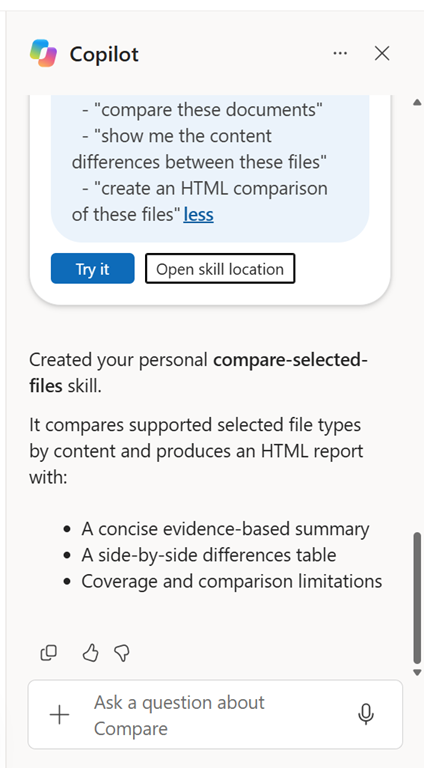
Copilot Skills in Excel feel like Microsoft’s attempt to address exactly that issue. Rather than repeatedly explaining the same process, you can package those instructions into a reusable skill that Copilot can invoke when required. According to Microsoft’s documentation, skills allow Copilot in Excel to perform repeatable tasks using predefined instructions, and organisations can create custom skills stored in OneDrive for reuse. [support.mi…rosoft.com], [support.mi…rosoft.com]
That might sound like a small change, but I think it’s significant.
From Spreadsheet Expert to Process Expert
Imagine you’ve spent years refining a monthly reporting workbook.
You know exactly how the raw data is imported. You know which columns need cleaning. You know which calculations matter and which charts management expects to see.
Traditionally, every new employee needed training. Documentation had to be updated. Mistakes inevitably crept in.
Now imagine creating a skill that guides Copilot through that process.
Instead of asking a colleague to remember twenty separate steps, they simply invoke the skill and allow Copilot to perform the work in a consistent manner.
The expertise becomes transferable.
That’s a very different proposition from merely generating formulas.
Excel Is Becoming More Conversational
Something else strikes me here.
For years, becoming good at Excel meant learning Excel’s language. You memorised formulas, syntax, functions, and workarounds.
Copilot flips that model.
Now Excel is increasingly learning your language.
You can ask questions about data. Request analysis. Generate charts. Create reports. Import information. Explain formulas. Build dashboards. And increasingly, define repeatable business processes using natural language instructions. [support.mi…rosoft.com], [support.mi…rosoft.com]
That’s a major shift.
The barrier to entry drops dramatically.
People who previously avoided advanced spreadsheet work now have a capable assistant sitting beside them.
The Opportunity for MSPs
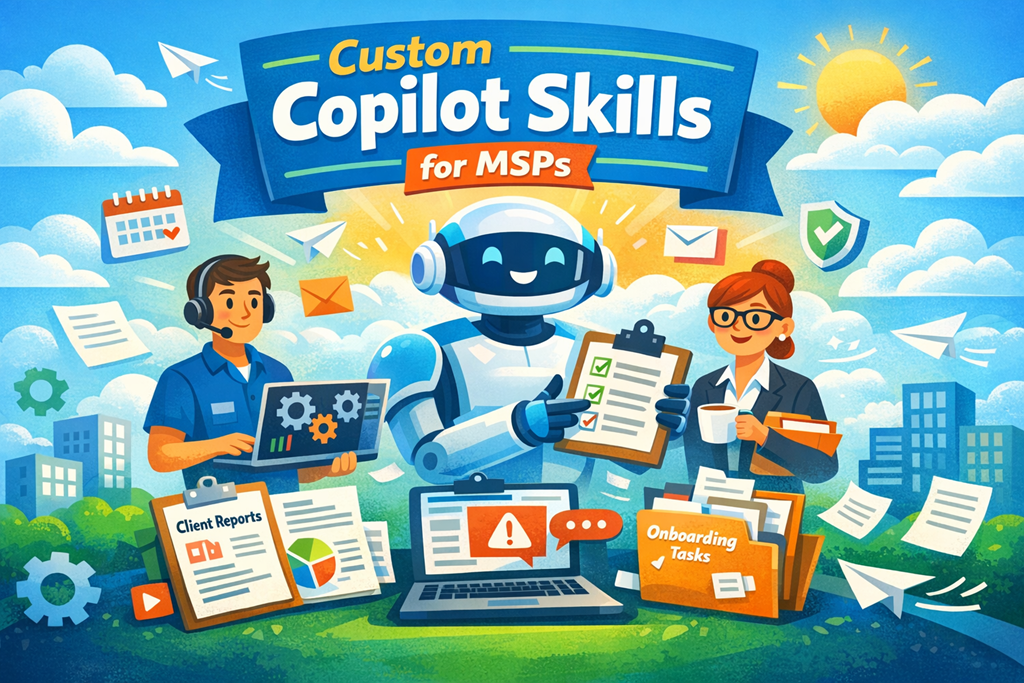
From an MSP perspective, I think this capability will become particularly interesting.
Most advice around AI focuses on content generation, meeting summaries, or email drafting. Those are valuable, but they’re often incremental productivity gains.
Skills have the potential to standardise operations.
Imagine creating repeatable Excel processes for:
- Monthly financial reporting
- Customer profitability analysis
- Service desk trend reporting
- Project forecasting
- Licence consumption tracking
- Security compliance reporting
Rather than documenting procedures in lengthy manuals, organisations can embed that knowledge directly into skills that guide Copilot.
That’s a much more scalable approach.
And importantly, it helps preserve organisational knowledge when staff move on.
The Human Still Matters
Of course, none of this removes the need for human oversight.
One lesson I’ve repeated many times with Microsoft 365 Copilot is that AI works best when it’s treated as a capable assistant, not an autonomous decision maker.
If Copilot analyses data, review the results.
If it creates a forecast, validate the assumptions.
If it generates a report, make sure the conclusions make sense.
The person remains accountable. Copilot simply removes much of the repetitive effort.
Final Thoughts
When people think about AI in Excel, they often focus on saving a few minutes creating formulas or formatting data.
That’s useful.
But I think the more interesting story is the ability to capture expertise and make it reusable.
The organisations that benefit most from AI won’t necessarily be those with the smartest prompts. They’ll be the ones that systematically turn repeatable knowledge into repeatable processes.
Excel Skills look like another step in that direction.
And for many businesses, that could end up being far more valuable than any individual formula.