Get your M365 questions answered via email

bp1

Yes, it is true, you can now gain access to my Microsoft Cloud knowledge simply by sending an email. I have achieved this by creating an agent in Copilot Studio that will respond to the query you place in the body of the email.

1. Send your questions to robert.agent@ciaops365.com. The questions need to be in the body of the email. For now the subject line is ignored.

2. After a few minutes you should receive a reply back with an AI generated answer across all my information sources, both public and private.

Some points to remember:

A. Each query is unique. The system current does not have ‘memory’. This means it does not keep track of any previous email or questions that you sent it. Each email is taken as unique.

B. The system is focused on answering questions around Microsoft 365 and the Microsoft Cloud. It has specific instructions to ignore other stuff, so if you ask it something silly at best you should get a polite reply declining to help and at worst no reply at all.

C. The more detailed the question, the better the answer. Simply asking for an answer will not return as comprehensive an answer if you asked for a detailed response, or step by step process.

D. The system is far from perfect. Firstly, it is AI, which means that answers should always be verified. Secondly, part of the reason that I am making this available publicly is to test how well it works at scale.

Hopefully, what you get out of this agent are answers to your question around M365, simply by sending an email. What I get out of this is to test the agent and also see what questions people are asking about M365 so I can create better responses and content.

I will continue to develop and improve the agent as Microsoft makes more capabilities available. For now, I’d really appreciate you asking a question about M365 in the body of the email sent to robert.agent@ciaops365.com.

You can of course reach out to me directly if you have any questions or other feedback for my agent that you’d like to see incorporated.

As an FYI, here is a report I generated based on what teh agents has already received:

Common Questions About Microsoft Cloud

Common Questions About Microsoft Cloud – A Summary and Insights

Introduction
Over the past few months, we’ve received numerous questions about utilizing the Microsoft cloud for business needs. These queries came through our support channels and covered a range of topics – from device management with Intune to security and compliance features in Microsoft 365. We’ve noticed some clear themes in what people are asking. In this blog post, we’ll summarize the most common Microsoft cloud questions, group them into key topic areas, and share brief answers and insights for each. Our goal is to highlight frequent concerns, reveal patterns in cloud adoption challenges, and offer recommendations to help everyone make the most of Microsoft’s cloud services.


1. Managing Devices and Updates with Intune

One of the most common questions is how to use Microsoft Intune (part of Endpoint Manager) to manage devices and deploy software updates across an organization. IT admins want to ensure all laptops and mobile devices are up-to-date without manual intervention.

What was asked: “How can I use Microsoft Intune to update software on devices in my organization?”

What we answered: Intune is a powerful cloud-based endpoint management tool that can centrally push OS and application updates to enrolled devices. We explained that the process involves a few key steps:

  • Prerequisites: First, make sure you have an active Intune subscription and that all target devices are enrolled in Intune under your tenant. Devices should be managed (Intune allows management of Windows, macOS, iOS, and Android devices) and you need the proper admin permissions to configure Intune policies.
  • Create an Update Policy: In the Microsoft Endpoint Manager admin center, you can create update rings (under Devices > Windows > Update rings for Windows 10 and later for Windows updates). This policy defines how and when updates are installed – for example, you can schedule update installation times, set deadlines, and configure user experience (like allowing user deferral or auto-restart behavior).
  • Deploy the Policy to Devices: Once the update ring (or any software update policy) is configured, assign it to the groups of devices or users that need those updates. Intune will then push the update settings to those devices. For app updates (such as line-of-business apps), you can use Apps section in Intune to assign newer app versions to devices/users.
  • Monitor and Troubleshoot: Intune provides reporting tools to monitor update compliance and installation status. We emphasized checking the Reports (for update compliance) to ensure devices are getting patches successfully. If some devices fail to update, Intune logs and error reports can help pinpoint issues (like connectivity problems or insufficient disk space). From there, admins can troubleshoot using the error codes or by ensuring the devices meet prerequisites (e.g. device must be powered on and online to receive updates).

By following these steps, our users learned that they could effectively manage software updates via the cloud, ensuring all endpoints are secure and up-to-date. This question falls under a broader theme: cloud-powered device management. Many organizations are moving away from manual or on-prem update servers, and are leveraging Intune and Windows Update for Business for a more hands-off, scalable approach. The pattern we see is a strong interest in using Microsoft cloud tools to automate device administration tasks.

Insight: If you’re not already using Intune for updates, it’s a good time to consider it. Start by enrolling a pilot group of devices and creating a basic update ring. You’ll gain insight into how smoothly updates roll out in your environment. In addition, ensure you communicate with your end-users about update timing (to avoid surprises). The key recommendation here is to take advantage of Intune’s cloud management capabilities – it saves time and keeps your fleet secure.


2. Securing Endpoints and Protecting Data

Another category of frequent queries revolves around security in the Microsoft cloud, particularly using Intune’s endpoint security features and related Microsoft 365 security tools. Administrators often ask what built-in options exist to protect devices and data beyond just deploying updates.

What was asked: “What does Microsoft Intune provide for endpoint security, and how can I use it to protect our organization’s devices and data?”

What we answered: We clarified that Microsoft Intune isn’t just for pushing apps or updates – it also has robust endpoint security and policy management capabilities. In fact, Microsoft’s cloud offers an integrated suite of security measures that work together. Our summary answer covered several facets:

  • Device Compliance Policies: Intune lets you define compliance requirements – for example, requiring devices to have a PIN/password of a certain complexity, encryption enabled, not jailbroken/rooted, etc. If a device falls out of compliance, Intune can flag it or even block it from corporate resources. We told users to set up compliance policies as a first layer of defense to ensure every device meets basic security hygiene.
  • Configuration Profiles for Security Settings: Through Intune, admins can deploy configuration profiles to enforce security settings on devices. This includes things like enabling BitLocker encryption on Windows, turning on firewall and antivirus (like ensuring Microsoft Defender is active), and configuring automatic screen lock timers. These settings help harden each device according to company security standards.
  • Integration with Defender for Endpoint: Many asked how to get “advanced threat protection” on cloud-managed devices. Intune integrates with Microsoft Defender for Endpoint, a cloud-based enterprise endpoint security platform. This means if you have the proper licensing, you can onboard devices to Defender for Endpoint for continuous monitoring, malware protection, and even threat response (EDR). Alerts from Defender can surface in Intune, creating a unified security dashboard. We recommended taking advantage of this integration to detect and respond to sophisticated threats like ransomware or suspicious behavior on endpoints.
  • App Protection Policies: Some questions went beyond device settings, into protecting the data within apps (especially on mobile devices or BYOD scenarios). Intune’s app protection policies (also known as MAM – Mobile Application Management) can restrict how corporate data is used in apps. For instance, you can prevent users from copying content from a work app into a personal app, or require an app-level PIN to open Outlook on a phone. This way, even if the device isn’t fully managed, the sensitive data is still containerized and secure.
  • Conditional Access (with Azure AD): We often reminded folks that Azure Active Directory Conditional Access works hand-in-glove with Intune compliance. A popular approach is to set Conditional Access policies that say: only allow sign-in to cloud resources (like Exchange Online or SharePoint) from devices that are Intune-compliant or from apps that are protected. This essentially turns away risky devices or sessions. For example, if a device falls out of compliance (as per Intune policy) or is unrecognized, it can be denied access or forced to re-authenticate. This dynamic duo of Intune + Conditional Access greatly reduces the chance of a breach if a device is lost, stolen, or compromised.

By outlining these points, we provided a brief overview of Intune’s security toolkit. The trend behind this question is that businesses are looking to the Microsoft cloud to not only manage devices but also to secure them comprehensively – without needing separate third-party solutions if possible. Microsoft has been expanding these capabilities (like adding more Endpoint Protection and even an Endpoint Privilege Management feature in Intune), and people are eager to utilize them.

Insight: If your organization uses Microsoft 365, make sure you’re leveraging the security features you already have access to. A recommendation is to audit your current setup: Are you using compliance policies? Do you enforce MFA and Conditional Access? Have you enabled Defender for Endpoint if licensed? We encourage users to start with baseline security configurations – Microsoft even provides security baseline templates in Intune that you can deploy for Windows, which is a great starting point. The big takeaway is that cloud-based security can significantly strengthen your defense. It’s easier to enforce uniform policies and to adjust them quickly if new threats emerge. Given the pattern of questions, it’s clear that investing time in Intune’s security configuration pays off in a safer environment.


3. Compliance and Data Retention (Archiving vs. Holding Data)

The third major category of questions centers on Microsoft 365’s compliance and data retention features. As companies move email and content to the cloud, they want to make sure they can retain data for legal purposes and manage mailbox sizes effectively. A representative question we received involves the relationship between mailbox litigation holds and the expanding archive feature in Exchange Online.

What was asked: “Can I enable an auto-expanding archive for a mailbox that’s already on litigation hold, and if so, how?”

What we answered: This question was about Exchange Online Archiving – a Microsoft cloud feature that provides additional storage for users’ mailboxes (commonly used when mailboxes reach capacity or to store older messages) – in conjunction with Litigation Hold (which is a compliance measure to preserve all mailbox content for legal/eDiscovery). The user’s worry was whether turning on an archive would conflict with the litigation hold. Here’s the summary of our guidance:

  • Yes, You Can Do Both: We confirmed that having a mailbox on Litigation Hold does not prevent you from enabling the archive mailbox (including the auto-expanding archive). The systems are designed to work together. The litigation hold ensures all original and deleted mailbox data is retained for legal review, and the archive mailbox simply provides more space to offload emails from the primary mailbox.
  • Steps to Enable Auto-Expanding Archive: In the Microsoft 365 compliance or Exchange admin center, an admin can enable the archive for a user’s mailbox. Once the standard archive is enabled, you can turn on the auto-expanding archive feature. This feature automatically adds additional storage chunks to the archive mailbox as the user’s archive grows (useful for very large or active mailboxes so you never run out of space). We walked through the interface where an admin would click “Enable Archive” for the mailbox, and noted that auto-expanding archive might require the organization to have it turned on globally (in newer versions, it can be enabled per tenant and it expands as needed without further admin intervention).
  • Verify Litigation Hold Status: We advised the user to double-check that the mailbox in question is indeed on hold (which it was) and to understand the hold settings (e.g., indefinite hold or time-based hold). The litigation hold means all items (including those moved to the archive) are preserved for discovery, even if the user deletes them. Enabling the archive doesn’t break that – in fact, any item in the archive mailbox is also held.
  • What to Expect After Enabling: With both litigation hold and an archive, users can continue to use their mailbox normally. New emails will go to their primary mailbox; older emails or auto-archiving policies can move items to the archive mailbox. The hold ensures copies are retained behind the scenes. We noted that admins can monitor archive usage in the Exchange admin center (there are usage reports that show mailbox and archive sizes). Also, if needed, during an eDiscovery process, content from both the primary and archive mailboxes will be available since the hold captures everything.

This answer addressed the practical “how-to” and reassured that compliance would be maintained. It highlighted Microsoft 365’s capability to handle both storage management and legal obligations simultaneously – a key advantage of the cloud platform.

The pattern here is questions about data governance: admins want to manage storage (like huge mailboxes) but must also meet legal retention requirements. We’ve seen queries about retention policies, eDiscovery, and archive mailboxes pop up frequently. It underscores that as companies embrace cloud email and documents, they’re also planning for compliance, regulation, and efficient data management.

Insight: For organizations, it’s important to familiarize yourself with Microsoft Purview (the new name for the compliance suite) features such as Retention Policies, Litigation Hold, and Archive Mailboxes. Our recommendation is to develop a data retention strategy: decide how long you need to keep emails, Teams messages, documents, etc., for business or legal reasons, and then configure the appropriate policies in Microsoft 365. The cloud makes this easier than old on-prem systems – you can globally apply a retention label or hold with a few clicks, and the service will automatically preserve content. Also, take advantage of auto-expanding archives if users have mailboxes over 100 GB; this ensures users don’t have to delete important emails just because of storage limits. The key takeaway is that Microsoft’s cloud provides flexible tools to both control data growth and meet compliance needs. The questions we get show that once people learn they can do both at once, they feel more confident migrating more data to the cloud.


Conclusion and Key Takeaways

Compiling these questions and answers has revealed a couple of clear trends. First, IT professionals are eager to leverage Microsoft cloud services to their full potential – they’re not just asking simple “what does this button do” questions, but really digging into how to implement best practices for device management, security, and compliance. This is a great sign that cloud adoption is maturing. Common threads include automation (automating updates, using policies instead of manual configs) and integration (ensuring security, management, and compliance tools all work together seamlessly).

Second, many of the questions revolve around trusting the cloud to handle critical IT functions. There can be understandable caution around, say, letting Intune automatically patch all your PCs, or believing that an auto-expanding archive will really keep all your important emails safe. But as shown above, with the right configuration, the cloud can greatly simplify these tasks. The pattern of questions shows initial caution turning into confidence as users get guidance and try things out. For example, after implementing Intune update rings as we suggested, admins often report that they spend far less time worrying about who has installed what patch – compliance reports are available and issues can be addressed proactively. Similarly, once an auto-archive is enabled alongside a litigation hold, legal teams breathe easier knowing nothing will be lost, and users are happier not constantly hitting mailbox size limits.

Third, we noticed a strong interest in step-by-step guidance and best practices. It’s not enough to know a feature exists; people want to know “what is the correct or recommended way to use this?” This is a good reminder for Microsoft (and for us as solution providers) that documentation and clear examples are very valuable. Cloud features tend to have tons of flexibility, which can sometimes be daunting. The questions summarized above often boiled down to “please give me a straightforward recipe to achieve my goal.” In response, we find that breaking things into clear steps or a checklist (as we did with each answer) helps a lot.

Recommendations for Readers: If you find yourself with similar questions, know that you’re not alone! The Microsoft cloud ecosystem is broad, but the community and knowledge base is rich. Here are a few closing tips based on the patterns we’ve seen:

  • Embrace cloud management: If you’re still doing things the old manual way, start exploring Intune, Endpoint Manager, and Azure AD features. Begin with a small scope (maybe pilot a set of devices or one department’s accounts) and apply some cloud policies. You’ll gain confidence as you see it in action.
  • Use built-in security features: Don’t let security be an afterthought. Turn on multi-factor authentication, use Conditional Access, require device compliance – these significantly reduce risks and are included in most Microsoft 365 plans. Our summary above barely scratched the surface of security options, but even the basics go a long way.
  • Plan your compliance: Work with your legal/compliance team to configure retention policies and holds before you need them. It’s easier to set the rules early than to scramble when a legal case or audit arises. Microsoft Purview compliance portal has templates and suggestions for common regulations – those can guide you.
  • Keep learning and asking: The cloud updates rapidly. New features and best practices emerge every month. Stay curious – Microsoft’s documentation, tech community blogs, and forums are excellent resources. If something isn’t clear, don’t hesitate to ask experts (as those who contacted us did). Often, the answers are out there and can save you hours of trial and error.

By summarizing these frequently asked questions, we hope we’ve provided a useful reference for others facing similar challenges. The Microsoft cloud is vast, but with each question answered, it becomes a bit more manageable and beneficial to use. As always, feel free to reach out with any new questions you have about making the most of these tools – chances are, if you’re wondering about it, someone else is too. By sharing our questions and solutions, we all help each other succeed in the cloud. Here’s to smooth sailing in your Microsoft cloud journey!


Getting Started with Microsoft 365 Copilot: First Steps for End Users

bp1

This guide outlines how to set up Copilot, integrate it into your daily work, and quickly showcase its value.

1. Confirm Access and Prepare Your Apps

Before diving in, ensure you have access to Copilot and that your Microsoft 365 apps are ready:

  • Check Your License: Verify that your Microsoft 365 Copilot add-on license is active for your account. If you don’t see Copilot features, contact your IT admin to confirm your license is assigned [1].

  • Update Microsoft 365 Apps: Make sure your Office apps (Word, Excel, PowerPoint, Outlook, Teams, etc.) are up to date. Copilot works best with the latest versions of Microsoft 365 Apps[1].

  • Sign In with Work Account: Copilot is integrated with your Microsoft 365 work account, so use your usual work credentials. Once signed in to Office or Teams, look for the Copilot icon or prompts inside the apps.

Tip: In some apps, Copilot appears as a sidebar or an icon (for example, a Copilot symbol in Word’s ribbon or a “Summarize” button in Outlook). If you’re not sure where to find it, check Microsoft’s support guides or ask IT for guidance on accessing Copilot in each app.

2. Find Copilot in Your Favorite Apps

Copilot is built into the Microsoft 365 tools you already use daily, making it easy to get started. Here’s how to access it in key applications:

  • Outlook: Open any email thread – you’ll see a Copilot option (such as a Summarize icon) in the toolbar. Clicking it will prompt Copilot to generate a summary of the email conversation[2]. You can also ask Copilot to draft emails; for example, “Draft an email to Jane Doe about the project delay, and make it concise and friendly.”[2].

  • Teams: In Microsoft Teams, start a Copilot chat during or after a meeting. Copilot can recap meeting discussions and list action items. Simply type a prompt like “Recap the meeting so far” in the Copilot pane to get an instant summary of key points and decisions[2].

  • Word: Look for the Copilot sidebar or icon. You can use it to generate content or improve your document. Try prompts like “Brainstorm ideas for the introduction of my report” or use the “Rewrite with Copilot” feature to polish a draft paragraph[2].

  • Excel: Click the Copilot icon in Excel to analyze or visualize data. For example, ask “What are the trends in this sales data?” and Copilot will create summaries or even suggest charts and PivotTables based on your dataset.

  • OneDrive/Word Online: When viewing a document in OneDrive or Word for web, Copilot is available to summarize or answer questions about the content (no additional setup needed, since your license covers it)[3]. This is handy for getting up to speed on lengthy docs.

By checking each app for the Copilot assistant, you ensure you’re ready to leverage its capabilities wherever you work – in email, chat, documents, spreadsheets, and meetings.

3. Try Quick “Win” Scenarios First

To quickly boost productivity and impress your team, start with high-impact Copilot scenarios that save time:

  1. Summarize Lengthy Emails: Instead of reading through long email threads, use Copilot in Outlook to get a concise summary with key points and decisions extracted in seconds[2]. This helps you respond faster without missing details.

  2. Draft Responses and Content: Suffering from writer’s block? Ask Copilot to draft a reply or create a first draft of a document. For instance, dictate a few bullet points and have Copilot draft a formatted Word report or an email response in a polished, ready-to-send format[4][2]. You can then fine-tune the tone or details.

  3. Recap Meetings in Teams: If you join a meeting late or need to share notes afterward, use Copilot in Teams to recap the meeting. It will produce a summary of what was discussed and list any action items or decisions made, so you don’t have to replay the recording[1][2].

  4. Brainstorm and Generate Ideas: In Word or OneNote, prompt Copilot to help brainstorm. For example: “Give me 5 ideas for our marketing campaign” or “Help me outline a project proposal.” Copilot will produce creative suggestions or an outline that you can build upon[2].

  5. Analyze Data Instantly: In Excel, use Copilot to get insights from data. You might ask: “Explain the sales performance this quarter” – Copilot can highlight trends, outliers, or create a chart for you. This turns a tedious analysis into a quick review.

These quick wins let you experience immediate value. Many users report that Copilot helps them accomplish tasks like email summarization and draft creation much faster than before – freeing up hours each week[5]. By starting with these, you’ll build confidence and see tangible time savings.

4. Incorporate Copilot into Daily Workflow

Make Copilot a habit in your routine so you continuously improve productivity. Here’s how to weave Copilot into your day-to-day work:

  • Begin Your Day with Copilot: Check your morning emails with Copilot summaries. Use it to triage your inbox by quickly understanding which threads are important[2]. In Microsoft 365 Copilot Chat (the enterprise chat interface), you can even ask, “What are the latest updates on Project X from emails and chats?” and Copilot will aggregate information from across Outlook, Teams, and SharePoint that you have access to[2]. This gives you a rapid briefing to start your day informed.

  • During Work Sessions: Whenever you start a significant task – writing a document, analyzing data, responding to customers – think “How can Copilot assist me?” For example, if you’re preparing a report, let Copilot generate a draft or an outline first[2]. If you’re stuck on a slide in PowerPoint, have Copilot suggest an image or even draft speaking notes. Using Copilot as a first pass for mundane parts of tasks lets you focus on review and creative tweaks, rather than starting from scratch.

  • End-of-Day Wrap Up: Use Copilot to help summarize what you accomplished. For instance, in Teams or OneNote, ask “Summarize today’s meeting notes and action items” to ensure you didn’t overlook anything. Or in Copilot Chat, ask “What did I commit to today?” to have it pull out your promises from meetings and emails so you can follow up. This helps you stay organized and prepared for the next day.

By integrating Copilot at these touchpoints, you turn it into a personal AI assistant that works alongside you throughout the day. Over time, you’ll likely discover more workflows where Copilot can step in to save time or improve quality.

5. Customize and Refine Your Copilot Experience

Every user and business is different – Copilot offers settings and best practices to tailor its help to your needs:

  • Adjust Copilot Settings: Copilot may allow some customization of tone or response preferences. For example, you might set a default tone (professional, casual, etc.) or specify the length/detail of answers. Make it your own: ensure the style of Copilot’s outputs aligns with your company’s voice. If you’re not sure how to change these settings, check Copilot’s help menu or ask IT for any available customization options[4]. A well-tuned Copilot will produce outputs that require minimal editing.

  • Learn Prompting Best Practices: Copilot works best when given clear instructions, much like guiding a colleague. Be specific in your requests – e.g. “Summarize the last 10 emails from the client and highlight any action items” will yield a more focused result than “Summarize my emails.” Include context in your prompt if needed (such as names, dates, or desired format). This specificity helps Copilot return more accurate and relevant answers[4].

  • Use Polite and Clear Language: While Copilot doesn’t require polite phrasing, some users find that framing requests conversationally (e.g. “Please draft a response thanking the team for their work on project Y”) can improve the tone of the output[4]. In any case, write instructions as if you’re talking to an assistant: state what you need and any constraints (tone, length, points to cover).

  • Verify and Edit Outputs: Always remember that Copilot’s suggestions are a starting point. Review its outputs carefully – especially for critical or client-facing content. Copilot uses AI to pull from your data and general knowledge, which can occasionally produce incorrect or nonspecific information. Treat the Copilot draft as a first draft: check facts, adjust wording, and make sure it conveys exactly what you want. You remain the editor-in-chief, and a quick proofread ensures the final product is accurate[4].

By customizing Copilot’s behavior and applying these best practices, you’ll get better results and smoother integration into your workflow. The more you use Copilot and fine-tune your approach, the more value it will provide.

6. Leverage Training Resources and Communities

To make the most of Copilot, take advantage of the training materials and support available:

  • Microsoft Learn Courses: Microsoft has published an official “Get Started with Microsoft 365 Copilot” learning path[6]. This is a beginner-friendly online course with modules that walk you through Copilot basics, versatility across apps, and tips for maximizing its potential. Completing this 3-module course can quickly ramp up your skills and ensure you’re aware of all Copilot features.

  • How-To Videos: Check out short tutorial videos on Microsoft Support and YouTube (such as “How to start using Microsoft 365 Copilot”[2]). These show Copilot in action within various apps. Watching a 2-minute demo of Copilot summarizing a meeting or analyzing data can give you new ideas for usage in your own role.

  • Copilot Success Kit (For Organizations): If your company provided the Copilot license, they may also have access to Microsoft’s Copilot Success Kit with user guides, FAQs, and scenario playbooks[2]. Ask your manager or IT team if there are internal trainings or “Copilot champions” in the organization. Often early adopters will share tips or host Q&A sessions to help colleagues get started quickly.

  • Community and Feedback: Microsoft’s Tech Community forums have a Copilot section where users post questions, share tips, and discuss new features. Engaging with the community can answer common “How do I do X with Copilot?” questions and let you learn from others’ experiences. Additionally, don’t hesitate to use the feedback option in Copilot (usually a little thumbs-up/down or feedback form) to send Microsoft input. Your feedback can help improve Copilot, and Microsoft often publishes updates based on user suggestions.

By educating yourself and tapping into resources, you’ll become confident and proficient with Copilot in no time. This not only boosts your productivity but also enables you to help teammates who are just starting out.

7. Showcasing ROI: Demonstrate Copilot’s Value

To justify the investment in Microsoft 365 Copilot, it’s important to demonstrate tangible benefits. Here are ways you, as an end user, can help show ROI (Return on Investment) for your business:

  • Track Time Saved: Pay attention to tasks that Copilot accelerates. For example, if writing a report draft normally takes you 3 hours and Copilot helped you create a solid draft in 1 hour, that’s a 2-hour savings. Keep a simple log of such wins over a few weeks. Even saving 3 hours per week by using Copilot adds up – some companies found that equates to reclaiming about 10% of the workweek for those employees[5]. Multiply that across many users and the value is clear.

  • Improve Quality and Outcomes: Note improvements in your work quality or throughput. Maybe Copilot’s assistance means you produce more polished emails or you’re able to handle 15% more customer inquiries by drafting responses faster. Microsoft’s early data showed 85% of users wrote better quality drafts faster with Copilot’s help[1]. If you experience something similar – like fewer revisions needed on your documents – call that out. Quality gains can be just as important as time savings.

  • Use the Copilot Dashboard (for Metrics): If your organization has enabled the Microsoft 365 Copilot Dashboard via Viva Insights, managers can see usage and impact metrics. This dashboard shows how many people are actively using Copilot and how it’s affecting work patterns, including aggregate measures of time saved on emails, meetings, etc.[5][5]. Encourage your team to use Copilot consistently, as higher adoption and usage will make these metrics more impressive. For instance, increasing the percentage of your team actively using Copilot (the “AI adoption” metric) is a quick win to show engagement.

  • Share Success Stories: Don’t underestimate anecdotal ROI. If Copilot helped you finish a proposal before a tight deadline or gave you insights that won a deal, share that story with your manager and colleagues. Concrete examples — “Copilot helped me create a client presentation in half the time, which helped us respond to the client faster and win the project” — make the value real for leadership. Consider sharing tips in a team meeting on how you achieved that with Copilot, which also encourages others to try it out.

  • Measure Key Business Metrics: Align Copilot use with metrics the business cares about. For example, if your department tracks customer satisfaction or sales cycle time, see if Copilot’s help (like faster email responses or better proposals) is moving those needles. Some organizations tie Copilot usage to dollar values: one company estimated Copilot would save their sales team $50 million per year in efficiency[5]. While your role might not see millions, even small improvements (like resolving internal support tickets faster, or reducing the need for overtime) contribute to ROI.

By actively using Copilot and highlighting these benefits, you help the business see a return on the Copilot licenses. Over time, these efficiency gains and quality improvements reinforce why Copilot is worth the investment.

8. Continue Expanding Copilot’s Use (and Stay Secure)

Finally, as you get comfortable, look for more opportunities to leverage Copilot – and do so responsibly:

  • Explore Advanced Scenarios: Beyond the basics, Copilot can assist in complex workflows. For instance, in Teams you can use Copilot in group chats to summarize project updates, or in PowerPoint to generate speaker notes for slides. Microsoft is also rolling out Copilot in Loop and OneNote, and even Copilot Lab experiences for learning prompt techniques[7]. Stay on the lookout for new features and try them out – they could open up new ways to save time.

  • Integrate with Business Data (if available): If your company enables Copilot Chat with plugins or connects internal data, you might be able to ask Copilot questions that go beyond Office documents – such as querying a knowledge base or an internal CRM. This can further boost productivity by bringing enterprise data into your Copilot answers. Make sure you follow any training or guidelines your IT provides for these advanced integrations.

  • Security and Privacy Reminders: Copilot adheres to your organization’s security policies – it only has access to data you can normally access and respects document permissions. Still, use Copilot responsibly: avoid asking it to summarize content you shouldn’t be sharing, and don’t copy sensitive information into prompts unnecessarily. Trust Copilot with day-to-day content, but continue to apply good judgment with confidential data as you would normally[8]. If in doubt, consult your company’s Copilot usage policy (many organizations include guidance as part of Copilot rollout).

  • Provide Feedback & Update: Keep your Copilot (and Office apps) updated to get the latest improvements. Microsoft is rapidly updating Copilot with new capabilities and better accuracy. Also, use the feedback mechanism – if Copilot gives an incorrect or unhelpful result, flag it. This helps Microsoft improve the service. You may even see your feedback addressed in a future update.

In summary, embrace Copilot as a powerful assistant. Start with the simple steps and quick wins outlined above, integrate it into your routine, and continuously learn and expand how you use it. By doing so, you’ll not only make your own work easier but also help prove the value of Microsoft 365 Copilot to your business through consistent productivity gains and real results.


By following these steps, end users can hit the ground running with Microsoft 365 Copilot. The journey begins with enabling Copilot in everyday tasks and leads to significant time savings and creativity boosts. With each email summarized and each document drafted, you’re not only working smarter but also gathering proof points of Copilot’s ROI. Happy prompting![5][1]

References

[1] Unlock your productivity: Here are our Top 10 tips for using Microsoft …

[2] Top 10 things to try first with Microsoft 365 Copilot

[3] Microsoft 365 Videos

[4] Copilot tutorial: Start using Copilot – Microsoft Support

[5] Driving adoption and measuring impact with the Microsoft 365 Copilot …

[6] Get started with Microsoft 365 Copilot – Training

[7] CSP Masters Copilot Technical Part 02. SMB Partner Readiness

[8] deploying-copilot-for-microsoft-365-for-executives-0517

Creating an Automated Agent to Post Historical Computer Events in Teams Daily

image

I recently did a video here –

Video link = https://www.youtube.com/watch?v=KZkhK41lynI

but I’ve now been able to produce the following steps for your to replicate this.

Automate Daily Updates in Teams with Copilot Studio & Power Automate: A Step-by-Step Guide

Ever wanted a little bot to automatically post daily updates, fun facts, or important reminders into your Microsoft Teams channel? Maybe a “This Day in History” update, a daily project status reminder, or a motivational quote?

In this guide, we’ll walk through how to build an automated agent using Microsoft Copilot Studio and Power Automate that posts information to a Teams channel on a daily schedule. We’ll use the example from the video: creating a bot that posts significant computer history events for the current day.

What You’ll Need:

  1. A Microsoft 365 account.

  2. Appropriate licenses to use Power Automate and Copilot Studio.

  3. Access to Microsoft Teams and permission to post in a specific channel.

The Overall Process:

We’ll create a system with a few interconnected parts:

  1. Power Automate Flow #1 (Trigger): Runs once a day on a schedule.

  2. Copilot Studio Agent: Receives a prompt from Flow #1, uses its general knowledge (AI) to find the relevant information (e.g., historical events).

  3. Copilot Studio Topic: Takes the AI-generated response and triggers another flow.

  4. Power Automate Flow #2 (Action): Receives the formatted response from the Copilot Topic and posts it to a designated Teams channel.

Let’s break it down!

Step 1: Create Your Copilot in Copilot Studio
  1. Navigate to Microsoft Copilot Studio.

  2. Create a New Copilot. Let’s name it “History Bot” for this example (the video used “History”).

  3. Configure Basic Details:

    • Name: History Bot

    • Description: An agent that posts historical events daily.

    • General Instructions: Use general knowledge to create a list of historical events that happened on this day relating to computers. (Adapt this instruction based on the type of information you want the bot to post).

  4. Enable Orchestration: Ensure the “Use generative AI to determine how best to respond…” toggle under Orchestration is Enabled. This allows the Copilot to understand the instructions and use AI.

  5. Configure Knowledge:

    • Go to the Knowledge section (you might need to scroll down or find it in the left navigation).

    • Ensure “Allow the AI to use its own general knowledge” is Enabled. This lets the bot search the web based on your instructions. We won’t add specific documents for this example.

Step 2: Create the Daily Trigger Flow (Power Automate Flow #1)

This flow starts the process each day.

  1. Go to Microsoft Power Automate.

  2. Create a New Flow > Scheduled cloud flow.

  3. Configure the Trigger:

    • Give your flow a name (e.g., “Daily History Trigger”).

    • Set the schedule: Repeat every 1 Day.

    • Choose a specific time for it to run (e.g., 12:45 PM as shown in the video).

  4. Add Action: Send Prompt to Copilot:

    • Click “+ New step”.

    • Search for and select the “Copilot Studio” connector.

    • Choose the action “Sends a prompt to the specified copilot for processing (Preview)”.

    • Select your Copilot: Choose the “History Bot” (or whatever you named it) from the dropdown.

    • Prompt: Enter the text you want to send to the Copilot each day. Based on the video and our Copilot instructions, this would be something like: Please tell me about today in history with computers.

  5. Save this flow.

Step 3: Create the Posting Topic in Copilot Studio

This topic handles the response from the AI and sends it to the next flow for posting.

  1. Go back to your History Bot in Copilot Studio.

  2. Navigate to the Topics section.

  3. Optional Cleanup: The video creator removed the default/generic system topics. You might want to do this for a dedicated bot like this to keep things clean, but it’s not strictly necessary.

  4. Create a New Topic > From blank.

  5. Name the Topic: Call it “Post Result”.

  6. Configure the Topic Trigger:

    • Click on the default “Phrase” trigger and delete it.

    • Add a new trigger. Select the trigger type: AI response generated (or similar wording like “On Generated Response”). This means the topic starts after the Copilot AI has formulated its answer based on the prompt from Flow #1.

  7. Add Action: Call Power Automate Flow:

    • Click the + below the trigger and select Call an action > Create a flow. This will open Power Automate in a new tab to create Flow #2.

Step 4: Create the Posting Flow (Power Automate Flow #2)

This flow takes the Copilot’s response and posts it to Teams.

  1. Power Automate should have opened with a trigger “When an agent calls the flow (Preview)”. This trigger will have an input field ready.

  2. Define Input:

    • Click on the trigger step.

    • Add an input of type Text. Name it something descriptive like CopilotResponseContent. This is where the Copilot topic will pass the AI’s generated text.

  3. Add Action: Post to Teams:

    • Click “+ New step”.

    • Search for the “Microsoft Teams” connector.

    • Select the action “Post message in a chat or channel”.

    • Post as: Choose Flow bot.

    • Post in: Select Channel.

    • Team: Select the Team you want to post to.

    • Channel: Select the specific Channel within that Team.

    • Message: Click in the message box. The dynamic content panel should appear. Select the CopilotResponseContent input variable you defined in the trigger step. This inserts the text generated by the Copilot.

  4. Add Action: Respond to Agent:

    • Click “+ New step”.

    • Search for “Copilot Studio” connector.

    • Select the action “Respond to the agent”. (This step simply tells the Copilot topic that the flow has finished). You usually don’t need to add outputs here for this simple scenario.

  5. Save this flow. Give it a name like “Post History Bot Result to Teams”.

Step 5: Connect the Topic to the Flow
  1. Go back to the Copilot Studio tab where you were editing the “Post Result” topic.

  2. The “Call an action” step should now let you select the flow you just created (“Post History Bot Result to Teams”). Select it.

  3. Map Inputs: You’ll see the CopilotResponseContent input field you created in Flow #2. You need to tell the topic what to send to this input.

    • Click the input field.

    • Select the lightning bolt icon (Insert variable).

    • Go to the System variables.

    • Find and select Response.FormattedText. This variable holds the final, formatted answer from the Copilot’s AI generation process.

  4. End the Topic: Add a final step to the topic: End conversation > End current topic.

  5. Save the topic.

Step 6: Testing and Troubleshooting
  1. Test Flow #1: In Power Automate, open the “Daily History Trigger” flow. Click Test > Manually > Run flow. This simulates the daily schedule.

  2. Check Copilot Activity: In Copilot Studio, go to the Activity tab for your “History Bot”. You should see a new session started by the “History Trigger”. It will show steps like “Knowledge sources used” and eventually call the “Post Result” topic.

  3. Check Teams: Look in the designated Teams channel. The message should appear shortly after the flows run successfully.

  4. Troubleshooting Connection Issues (Common Problem):

    • Symptom: In the Copilot Studio Activity > Transcript view, you might see the process get stuck on “Waiting for user” and display a card saying “Additional permissions are required to run this action. To proceed, please select ‘Connect’…” This usually means the connection for Flow #2 (posting to Teams) isn’t working correctly.

    • Problem: The “Connect” button on that card might not work reliably.

    • Workaround 1 (Recommended): In Copilot Studio, go to the Test your agent pane > click the More options (…) menu > Manage connections. This opens the connection management page. Find the connection related to your “Post History Bot Result to Teams” flow (it will likely show an error or ask for reconnection) and fix it, ensuring it’s properly authenticated to Teams.

    • Workaround 2 (Advanced): As shown in the video, you can use your browser’s Developer Tools (F12). Inspect the non-working “Connect” button element in the transcript view. Find the aria-label or similar attribute containing a URL (it will look something like https://copilotstudio.microsoft.com/c2/tenants/…/user-connections). Copy this URL, paste it into a new browser tab, and follow the prompts to fix the connection.

    • After fixing the connection, you may need to re-test Flow #1.

Conclusion

That’s it! You’ve now built an automated system where Power Automate triggers a Copilot Studio agent daily, the agent uses AI to generate content, and another Power Automate flow posts that content into Teams.

You can adapt the Copilot’s instructions, the trigger schedule, and the final Teams message formatting to suit countless automation needs. Happy automating!

Creating an Automated Agent to Post Historical Computer Events in Teams Daily

Video link = https://www.youtube.com/watch?v=KZkhK41lynI

In this video, I walk you through the process of creating an automated agent that posts daily historical computer events in a Teams channel. Starting from copilotstudio.microsoft.com, I show you how to set up the agent, configure triggers, and manage connections. Learn how to troubleshoot common issues and ensure your agent runs smoothly. Join me as I share tips and insights to help you leverage AI for regular updates in your business. Don’t miss out on this practical guide to enhancing your team’s productivity with automation!

Need to Know podcast–Episode 344

Join me to hear about the latest news and update from the Microsoft cloud as well as a deep dive into SharePoint agents. Plenty of AI news is again coming your way in this episode as Copilot spreads its wings and continues to grow across the stack. List in for more details.

Brought to you by www.ciaopspatron.com

you can listen directly to this episode at:

https://ciaops.podbean.com/e/episode-344-sharepoint-agents/

Subscribe via iTunes at:

https://itunes.apple.com/au/podcast/ciaops-need-to-know-podcasts/id406891445?mt=2

or Spotify:

https://open.spotify.com/show/7ejj00cOuw8977GnnE2lPb

Don’t forget to give the show a rating as well as send me any feedback or suggestions you may have for the show.

Resources

@directorcia

Join my shared channel

CIAOPS merch store

Become a CIAOPS Patron

CIAOPS Blog

CIAOPS Brief

CIAOPSLabs

Support CIAOPS

Widespread Microsoft Entra lockouts tied to new security feature rollout

FYAI: How agents will transform business and daily work

Announcing new computer use in Microsoft Copilot Studio for UI automation

Introducing agent flows: Transforming automation with AI-first workflows

Five things for IT administrators to know about SharePoint agent management

How to deploy Microsoft Purview DSPM for AI to secure your AI apps

Transforming security​ with Microsoft Security Exposure Management initiatives

Microsoft Purview: New data security controls for the browser & network

Step-by-Step Guide : How to enable QR code authentication for Microsoft Entra ID (Preview)

ActiveX disabled by default in Microsoft 365

Achieve greater security with Intune and Microsoft 365

Troubleshooting Windows Feature updates in Microsoft Intune

Azure Files: More performance, more control, more value for your file data

Feature deep dive: Using PDFs in OneDrive and our journey thus far

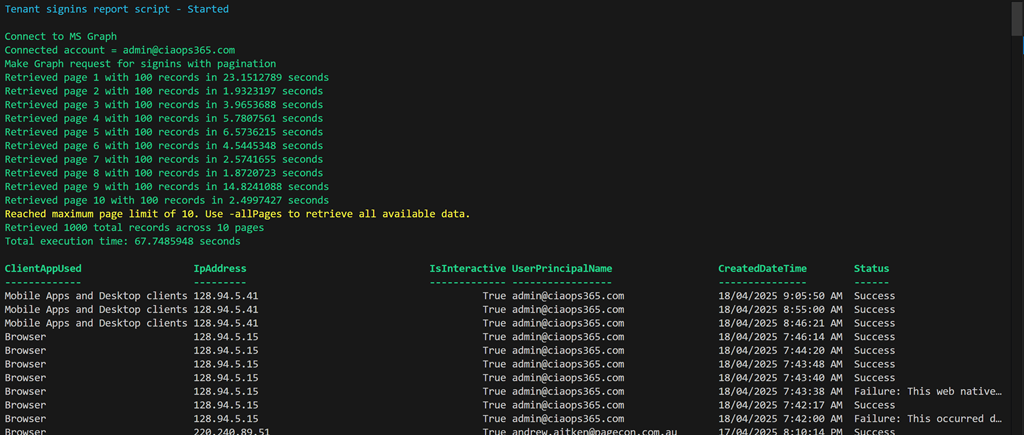
PowerShell script to report EntraID signin update

One the things that I have tasked myself with is to go back through my scripts and using AI (aka Github Copilot) to improve my code.

Screenshot 2025-04-18 095201

The latest script to get this treatment is:

https://github.com/directorcia/Office365/blob/master/graph-signins-get.ps1

which now has greater flexibility and speed. I also used Copilot to produce documentation for the script which is here:

https://github.com/directorcia/Office365/wiki/Get-tenant-signins

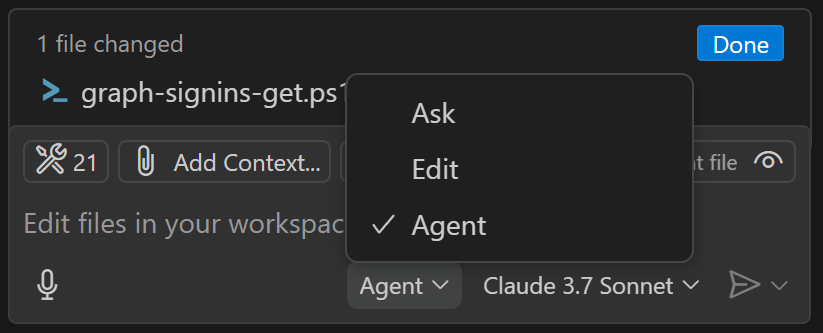
In my Visual Studio Code editor what I did was simply to open up the script.

Screenshot 2025-04-18 100356

I then set Copilot to operate in ‘agent’ mode, as shown above. I also selected an AI model to use. I have the default choices of:

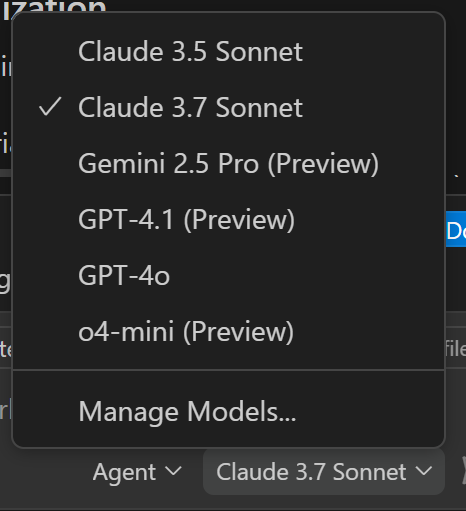
Screenshot 2025-04-18 100555

I can also configure others like Gemini if I want. This time I selected Claude 3.7 and then basically told Copilot to ‘improve’ my code. After that I asked it to provide options for using paging to get more results as well as ensuring the output was in local time.

After one update to the time format it produced an error when it ran but I simply told Copilot to fix that error and it did so. The code once again executed.

Thus, the updated script and documentation is now available via the links above and I am amazed at how easy it was to make all these changes to get the result that I wanted without having to type any additional code myself into the script! I suppose he downside is that the code is more complex and I don’t intrinsically understand it as well as if I had written every line, but I have Copilot to help explain any part of the code to me if needed and the time savings getting to a result speak for themselves.

The functionality that AI provided for me via Github Copilot is enormous and should make short work of any PowerShell automation I do in the future. If you are using PowerShell (or any code) then you really need to be looking at the benefits AI will provide you.

Enhancing Your Copilot Studio Agent with Topics and Actions

Video URL = https://www.youtube.com/watch?v=O-nHz5Z3Avk

In this video, we explore how to extend the capabilities of your Copilot Studio agent by integrating external knowledge sources using topics and actions. Here’s a step-by-step guide based on the video content:

1. Creating the Agent:

  • Start by creating an agent as usual, providing a description and general instructions. Ensure the orchestration option is selected and enabled. 0:12

  • The initial knowledge source selected is a single site, which allows the agent to answer questions in a basic manner. 0:23

2. Improving Information Retrieval:

  • To enhance the agent’s responses, especially for current news, create an action using Brave search. 0:54

  • Set up a free Brave account and obtain the API key for Brave search. 1:08

  • Configure the action to use Brave search for web news queries. 1:18

3. Creating and Configuring Topics:

  • Add a new topic that triggers when users ask about news. 2:01

  • Describe the trigger conditions and steps for the topic. 2:13

  • Create a search query variable to feed into the Brave search action. 2:31

  • Ensure the variable captures the prompt and keywords from the user’s query. 3:09

4. Testing and Publishing:

  • Test the setup by asking the agent for the latest news on a specific topic, such as “Alpine” or “Ferrari”. 3:58

  • Verify that the topic triggers correctly and retrieves detailed news results via Brave search. 4:19

  • Publish the updated agent to make the enhancements live. 4:35

By following these steps, you can significantly improve the relevance and detail of the information your Copilot Studio agent provides, leveraging external knowledge sources effectively.

Thank you for watching the video!