
The slides from this month’s webinar are available at:
and the video recording is also up on Youtube here:
Video URL – https://www.youtube.com/watch?v=1no1Sif3LVs
Watch out for next month’s webinar.

Information about SharePoint, Microsoft 365, Azure, Mobility and Productivity from the Computer Information Agency
The slides from this month’s webinar are available at:
and the video recording is also up on Youtube here:
Video URL – https://www.youtube.com/watch?v=1no1Sif3LVs
Watch out for next month’s webinar.
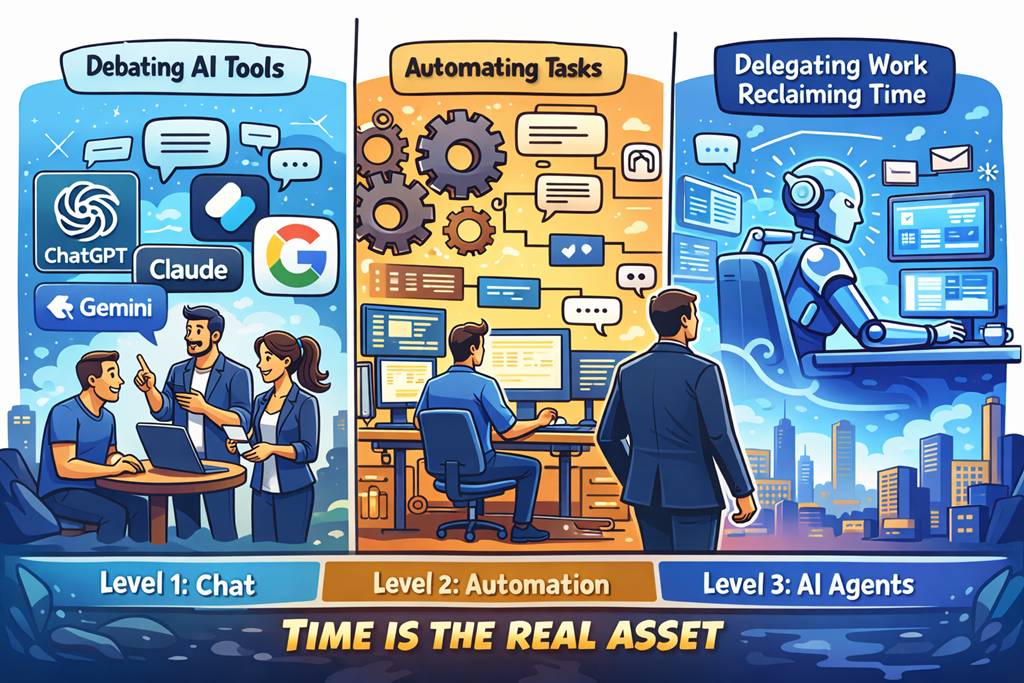
Most people are still stuck at Level 1.
They’re arguing about which AI tool is “best”.
ChatGPT vs Copilot. Claude vs Gemini. Model versions. Token limits. Benchmarks.
It’s all noise.
Because the real advantage was never the tool.
It’s how you delegate.
We’ve seen this movie before. When cloud arrived, people obsessed over which hypervisor was better instead of rethinking infrastructure. When SaaS took off, they argued about features instead of outcomes. AI is no different. The ones arguing about tools are missing the shift entirely.
Chat gives you answers.
Automation gives you leverage.
Agents give you time back.
And time is the only asset that actually matters.
Chat-based AI is incredible. Don’t get me wrong. It’s useful, powerful, and accessible. It helps you think, draft, brainstorm, research, and unblock yourself.
But chat is still you doing the work.
You ask.
You refine.
You copy.
You paste.
You decide.
That’s not leverage. That’s assistance.
Chat is the equivalent of having a smart junior sitting next to you, waiting for instructions. Helpful? Absolutely. Transformational? Only if you stop there.
Most people do.
They feel productive because they’re faster — but they’re still the bottleneck.
Automation changes the equation.
When you automate, work happens without you being present. Decisions are made based on rules. Actions trigger automatically. Systems talk to systems.
This is where output starts to scale without effort scaling with it.
But automation still has limits. It’s rigid. It does exactly what you tell it to do — no more, no less. It’s fantastic for repeatable, predictable processes, but it struggles when judgement is required.
Which brings us to the real shift.
Agents are where things get uncomfortable — because they replace you in the loop.
Agents don’t just answer questions.
They monitor.
They decide.
They act.
They escalate only when needed.
That’s delegation at a level most people aren’t ready for.
Instead of asking AI to help you do the work, you assign the work and walk away. You define outcomes, guardrails, and exceptions — and the agent handles the rest.
This is the difference between working with AI and working through AI.
One saves time.
The other gives it back.
Money can be earned again.
Tools can be replaced.
Skills can be relearned.
Time is gone forever.
And yet most business owners, MSPs, and professionals are using AI to shave minutes instead of reclaim hours. They’re optimising tasks instead of eliminating them. They’re still “busy”, just faster at being busy.
The winners in this next phase aren’t going to be the people who know the most prompts.
They’ll be the people who know how to delegate to systems.
Who design workflows where AI works while they sleep.
Who build agents that handle the boring, repetitive, low‑value decisions.
Who spend their time on strategy, relationships, and leverage — not execution.
This isn’t future talk. It’s not hype. It’s not “someday”.
This is now.
AI isn’t just a tool you use anymore. It’s labour you can assign. And the moment you understand that, the question changes.
It’s no longer:
“Which AI should I use?”
It’s:
“What work should I never do again?”
The only real question left is whether you’re going to lean into that reality — or keep asking AI for answers while time keeps slipping through your fingers.
Because AI won’t run out of capacity.
You will.

Now in our tenth year!
Join me for the free monthly CIAOPS Need to Know webinar. Along with all the Microsoft Cloud news we’ll be taking a look at Copilot Agents.
Shortly after registering you should receive an automated email from Microsoft Teams confirming your registration, including all the event details as well as a calendar invite.
You can register for the regular monthly webinar here:
(If you are having issues with the above link copy and paste – https://bit.ly/n2k2603 )
The details are:
CIAOPS Need to Know Webinar – March 2026
Tuesday 31st of March 2026
11.00am – 12.00am Sydney Time
All sessions are recorded and posted to the CIAOPS Youtube channel.
Also feel free at any stage to email me directly via director@ciaops.com with your webinar topic suggestions.
I’d also appreciate you sharing information about this webinar with anyone you feel may benefit from the session and I look forward to seeing you there.
In this episode I’m joined by Shervin Shaffie from Microsoft to do a deep dive into Copilot Studio. That’s the service from Microsoft that allows you to create agents in a ‘low-code’ manner right inside the M365 environment. Shervin has some great Youtube content I highly recommend and provides some great insights and tips and tricks in this episode when working with agents in Microsoft 365. I’ll also brin you up to date with the latest Microsoft Cloud news. Listen along.
Brought to you by www.ciaopspatron.com
you can listen directly to this episode at:
https://ciaops.podbean.com/e/episode-360-shervin-shaffie/
Subscribe via iTunes at:
https://itunes.apple.com/au/podcast/ciaops-need-to-know-podcasts/id406891445?mt=2
or Spotify:
https://open.spotify.com/show/7ejj00cOuw8977GnnE2lPb
Don’t forget to give the show a rating as well as send me any feedback or suggestions you may have for the show.
Explore the tools, communities, and content mentioned in this episode:
Shervin Shaffie – https://www.linkedin.com/in/sherv/
Principal Copilot Engineer at Microsoft
Collaboration Simplified YouTube: https://youtube.com/@collaborationsimplified
All About AI Podcast: https://cosi.pro/aipodcast
FY26 Q2 – Press Releases – Investor Relations – Microsoft
Secure Boot playbook for certificates expiring in 2026
SharePoint Showcase highlights: Copilot and agents governance and security essentials for admins
What’s New in Microsoft 365 Copilot | January 2026 | Microsoft Community Hub
Upcoming Conditional Access change: Improved enforcement for policies with resource exclusions
Things have changed recently when it comes to licensing Coilot Agents. Here is the latest information I can find. In short, every user that needs access to tenant information for use with Copilot, requires a license.
Confirmation: Correct. Your individual Microsoft 365 Copilot license does not include a pool of Copilot Studio message capacity that can be used by other users in the tenant who are unlicensed.
Your License Rights: Your M365 Copilot license grants you the right to:
Create and manage Copilot Studio agents for internal workflows at no extra charge for your own usage.
Access and use those agents yourself without incurring additional usage costs.
The Consumption: The consumption of your unlicensed colleagues is considered an organizational-level cost that must be covered by a separate organizational subscription for Copilot Studio.
Confirmation: Correct. Unlicensed users will not be able to use an agent that grounds its answers in shared tenant data (like SharePoint or OneDrive) unless the organization has set up a Copilot Studio billing subscription.
Agents that Access Tenant Data (SharePoint/OneDrive):
These agents access Graph-grounded data, which is considered a premium function and is billed on a metered basis (using “Copilot Credits”).
This metered consumption must be paid for by the organization.
The Required Organizational Licensing: To enable the unlicensed users to chat with your agent, the tenant administrator must set up one of the following Copilot Studio subscriptions:
Copilot Studio Message Pack (Pre-paid Capacity): Purchase packs of Copilot Credits (e.g., 25,000 credits per pack/month). The unlicensed users’ interactions are consumed from this central pool.
Copilot Studio Pay-As-You-Go (PAYG): Link a Copilot Studio environment to an Azure subscription. The interactions from the unlicensed users are billed monthly based on actual consumption (credits used) through Azure.
Quick reference table describing what licenses and costs are required for users to access an agent that integrates with SharePoint or OneDrive.
| Scenario | User’s License | Licensing Requirement to Access SharePoint/OneDrive Agent | Usage Cost |
|---|---|---|---|
| Licensed User (You) | Microsoft 365 Copilot (Add-on License) | No additional license required. | No additional charges for using the agent you created. |
| Unlicensed User (Colleague) | Eligible M365 Plan (e.g., E3/E5) WITHOUT M365 Copilot | Organizational Copilot Studio subscription (Pay‑As‑You‑Go or Message Pack) must be enabled in the tenant. | Metered charges (Copilot Credits) are incurred against the organizational capacity / Azure subscription. |
Key Reference: Microsoft documentation explicitly states: “If a user doesn’t have a Microsoft 365 Copilot license… if their organization enables metering through Copilot Studio, users can access agents in Copilot Chat that provide focused grounding on specific SharePoint sites, shared tenant files, or third-party data.” This confirms the unlicensed users’ access is contingent on the organizational metering being active.
To make your agent available to your unlicensed colleagues, you need to inform your IT/licensing administrator that they must procure and enable Copilot Studio capacity (either Message Packs or Pay-As-You-Go metering) in your tenant. Your personal M365 Copilot license covers your creation and use, but not the consumption of others who are accessing premium, tenant-grounded data.
Microsoft agent usage estimator
The organizational consumption for agents created in Copilot Studio is measured in Copilot Credits.
Microsoft offers two main ways for the organization to purchase the capacity consumed by unlicensed users accessing tenant-grounded data:
| Pricing Model | Cost | Capacity Provided | Best For |
|---|---|---|---|
| Prepaid Capacity Pack | USD $200.00 per month (per pack) | 25,000 Copilot Credits per month (tenant-wide pool) | Stable/predictable, moderate usage, budget control (lower cost per credit). |
| Pay-As-You-Go (PAYG) | USD $0.01 per Copilot Credit | No upfront commitment. Billed monthly based on actual usage. | Pilots, highly variable usage, or as an overage safety net for the Prepaid Packs. |
Note: All prices are Estimated Retail Price (ERP) in USD and are subject to change. Your final price will depend on your specific Microsoft agreement (e.g., Enterprise Agreement) and local currency conversion.
The cost is based on the complexity of the agent’s response, not just the number of messages. Since your agent uses SharePoint/OneDrive data, the key consumption rate to note is for Tenant Graph grounding.
| Agent Action/Scenario | Copilot Credits Consumed (Per Event) |
|---|---|
| Tenant Graph Grounding (Accessing SharePoint/OneDrive data) | 10 Copilot Credits |
| Generative Answer (Using an LLM to form a non-grounded answer) | 2 Copilot Credits |
| Classic Answer (Scripted topic response) | 1 Copilot Credit |
| Agent Action (Invoking tools/steps, e.g., a Power Automate flow) | 5 Copilot Credits |
Example Cost Calculation
Let’s assume an unlicensed user asks the agent a question that requires it to search your SharePoint knowledge source (Tenant Graph Grounding) and generate a summary answer (Generative Answer)The Prepaid Pack option is more economical for this level of steady, high usage. Your IT team will need to monitor usage and choose the appropriate mix of Prepaid Packs and PAYG overage protection.
Total Credits = (Credits for Grounding) + (Credits for Generative Answer)
Total Credits = 10 + 2 = 12 Credits per conversation
If 100 unlicensed users each have 5 conversations per day:
Daily Conversations: 100 users × 5 conversations = 500
Daily Credits: 500 conversations × 12 credits/conversation = 6,000 credits
Monthly Credits (approx): 6,000 credits/day × 30 days = 180,000 credits
Monthly Cost Estimate:
Using Prepaid Packs:
180,000 credits / 25,000 credits per pack ≈ 7.2 packs
The organization would need to buy 8 packs per month.
Monthly Cost: 8 packs × $200 = USD $1,600
Using Pay-As-You-Go (PAYG):
Monthly Cost: 180,000 credits × $0.01/credit = USD $1,800
The Prepaid Pack option is more economical for this level of steady, high usage. Your IT team will need to monitor usage and choose the appropriate mix of Prepaid Packs and PAYG overage protection.
Here are the sources that were used to compile the information, each with a direct hyperlink:
Copilot Studio licensing – Microsoft Learn
Billing rates and management – Microsoft Copilot Studio
Microsoft 365 Copilot Pricing – AI Agents | Copilot Studio
Copilot Studio pricing & licensing (2025): packs and credits
Copilot Credits consumption – LicenseVerse – Licensing School
Get access to Copilot Studio – Microsoft Learn
Manage Copilot Studio credits and capacity – Power Platform | Microsoft Learn
In this video, I walk you through how to enable Anthropic’s powerful AI models—like Claude—inside Microsoft Copilot. I’ll show you exactly where to find the settings, how to activate new AI providers, and what features you unlock in Researcher and Copilot Studio. Plus, I share an important compliance warning you need to know before turning this on, so you can make informed decisions for your organization. If you want to supercharge your Copilot experience and stay ahead with the latest AI integrations, this guide is for you!
Video link = https://www.youtube.com/watch?v=Gxa9OrI6VJs
In this episode of the CIAOPS “Need to Know” podcast, we dive into the latest updates across Microsoft 365, GitHub Copilot, and SMB-focused strategies for scaling IT services. From new Teams features to deep dives into DLP alerts and co-partnering models for MSPs, this episode is packed with insights for IT professionals and small business tech leaders looking to stay ahead of the curve. I also take a look at building an agent to help you work with frameworks like the ASD Blueprint for Secure Cloud.
Brought to you by www.ciaopspatron.com
you can listen directly to this episode at:
https://ciaops.podbean.com/e/episode-352-agents-to-the-rescue/
Subscribe via iTunes at:
https://itunes.apple.com/au/podcast/ciaops-need-to-know-podcasts/id406891445?mt=2
or Spotify:
https://open.spotify.com/show/7ejj00cOuw8977GnnE2lPb
Don’t forget to give the show a rating as well as send me any feedback or suggestions you may have for the show.
Resources
CIAOPS Need to Know podcast – CIAOPS – Need to Know podcasts | CIAOPS
X – https://www.twitter.com/directorcia
Join my Teams shared channel – Join my Teams Shared Channel – CIAOPS
CIAOPS Merch store – CIAOPS
Become a CIAOPS Patron – CIAOPS Patron
CIAOPS Blog – CIAOPS – Information about SharePoint, Microsoft 365, Azure, Mobility and Productivity from the Computer Information Agency
CIAOPS Brief – CIA Brief – CIAOPS
CIAOPS Labs – CIAOPS Labs – The Special Activities Division of the CIAOPS
Support CIAOPS – https://ko-fi.com/ciaops
Get your M365 questions answered via email
Microsoft 365 & GitHub Copilot Updates
GPT-5 in Microsoft 365 Copilot: https://www.microsoft.com/en-us/microsoft-365/blog/2025/08/07/available-today-gpt-5-in-microsoft-365-copilot/
GPT-5 Public Preview for GitHub Copilot: https://github.blog/changelog/2025-08-07-openai-gpt-5-is-now-in-public-preview-for-github-copilot/
Microsoft Teams & UX Enhancements
Mic Volume Indicator in Teams: https://techcommunity.microsoft.com/blog/Microsoft365InsiderBlog/new-microphone-volume-indicator-in-teams/4442879
Pull Print in Universal Print: https://techcommunity.microsoft.com/blog/windows-itpro-blog/pull-print-is-now-available-in-universal-print/4441608
Audio Overview in Word via Copilot: https://techcommunity.microsoft.com/blog/Microsoft365InsiderBlog/listen-to-an-audio-overview-of-a-document-with-microsoft-365-copilot-in-word/4439362
Hidden OneDrive Features: https://techcommunity.microsoft.com/blog/microsoft365insiderblog/get-the-most-out-of-onedrive-with-these-little-known-features/4435197
SharePoint Header/Footer Enhancements: https://techcommunity.microsoft.com/blog/spblog/introducing-new-sharepoint-site-header–footer-enhancements/4444261
Security & Compliance
DLP Alerts Deep Dive (Part 1 & 2): https://techcommunity.microsoft.com/blog/microsoft-security-blog/deep-dive-dlp-incidents-alerts–events—part-1/4443691
Security Exposure Management Ninja Training: https://techcommunity.microsoft.com/blog/securityexposuremanagement/microsoft-security-exposure-management-ninja-training/4444285
Microsoft Entra Internet Access & Shadow AI Protection: https://techcommunity.microsoft.com/blog/microsoft-entra-blog/uncover-shadow-ai-block-threats-and-protect-data-with-microsoft-entra-internet-a/4440787
ASD Blueprint for Secure Cloud – https://blueprint.asd.gov.au/
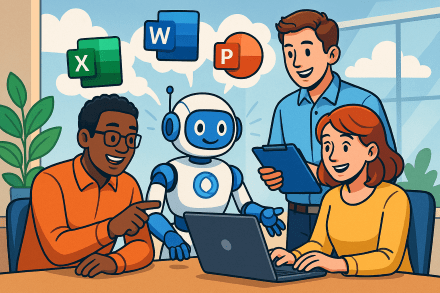
Creating a Microsoft 365 Copilot agent (a custom AI assistant within Microsoft 365 Copilot) can dramatically streamline workflows. These agents are essentially customised versions of Copilot that combine specific instructions, knowledge, and skills to perform defined tasks or scenarios[1]. The goal here is to build an agent that multiple team members can collaboratively develop and easily maintain – even if the original creator leaves the business. This report provides:

To build your Copilot agent without code, you will use Microsoft 365 Copilot Studio’s Agent Builder. This tool provides a guided interface to define the agent’s behavior, knowledge, and appearance. Follow these steps to create your agent:
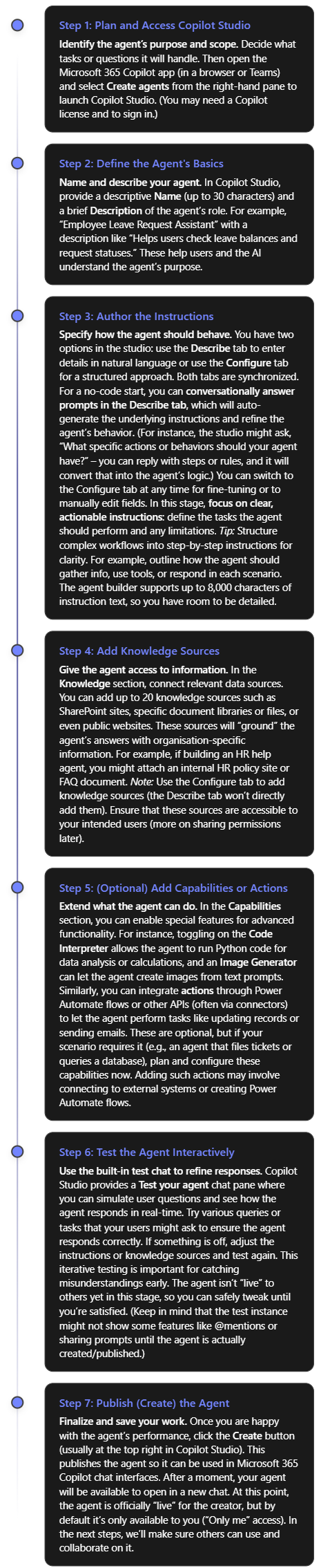
As a result of the steps above, you have a working Copilot agent with its name, description, instructions, and any connected data sources or capabilities configured. You built this agent in plain language and refined it with no code required, thanks to Copilot Studio’s declarative authoring interface[2].
Before rolling it out broadly, double-check the agent’s responses for accuracy and tone, especially if it’s using internal knowledge. Also verify that the knowledge sources cover the expected questions. (If the agent couldn’t answer a question in testing, you might need to add a missing document or adjust instructions.)
Note: Microsoft also provides pre-built templates in Copilot Studio that you can use as a starting point (for example, templates for an IT help desk bot, a sales assistant, etc.)[2]. Using a template can jump-start your project with common instructions and sample prompts already filled in, which you can then modify to suit your needs.
One key to long-term maintainability is ensuring multiple people can access and work on the agent. You don’t want the agent tied solely to its creator. Microsoft 365 Copilot supports this through agent sharing and permission controls. Here’s how to enable collaboration and manage who can use or edit the agent:
By following these practices, you create a safety net around your Copilot agent. Multiple team members can improve or update it, and no single individual is irreplaceable for its maintenance. Should someone exit the team, the remaining editors (or an admin) can continue where they left off.
Even with a collaborative platform, it’s important to document the agent’s design and maintain version control as if it were any other important piece of software. This ensures that knowledge about how the agent works is not lost and changes can be tracked over time. Here are key practices:
By maintaining both a digital paper trail (documents) and technical version control (solution exports or code repositories), you safeguard the project’s knowledge. This prevents the “single point of failure” scenario where only one person knows how the agent really works. It also makes onboarding new team members to work on the agent much easier.
Finally, here are additional recommendations to ensure your Copilot agent remains reliable and easy to manage in the long run:
By following the above tips, your Microsoft 365 Copilot agent will be well-positioned to serve users over the long term, regardless of team changes. You’ve built it with a collaborative mindset, documented its inner workings, and set up processes to manage changes responsibly. This not only makes the agent easy to edit and enhance by multiple people, but also ensures it continues to deliver value even as your organisation evolves.
Conclusion: Building a Copilot agent that stands the test of time requires forethought in both technology and teamwork. Using Microsoft’s no-code Copilot Studio, you can quickly create a powerful assistant tailored to your needs. Equally important is opening up the project to your colleagues, setting the right permissions so it’s a shared effort. Invest in documentation and consider leveraging export/import or even coding options to keep control of the agent’s “source.” And always design with clarity and governance in mind. By doing so, you create not just a bot, but a maintainable asset for your organisation – one that any qualified team member can pick up and continue improving, long after the original creator’s tenure. With these steps and best practices, your Copilot agent will remain helpful, accurate, and up-to-date, no matter who comes or goes on the team.
References
[1] Manage shared agents for Microsoft 365 Copilot – Microsoft 365 admin
[2] Use the Copilot Studio Agent Builder to Build Agents
[3] Share agents with other users – Microsoft Copilot Studio
[4] Control how agents are shared – Microsoft Copilot Studio
[5] Publish and Manage Copilot Studio Agent Builder Agents
[6] Export and import agents using solutions – Microsoft Copilot Studio
[7] Phase 4: Testing, deployment, and launch – learn.microsoft.com
[8] Create and deploy an agent with Microsoft 365 Agents SDK
 CIAOPS