Prepare for a OneDrive for Sync client upgrade

A heads up for everyone using OneDrive for Business sync client with tenants of less than 250 users.

Beginning in May 2016, Office 365 customers with fewer than 250 Office 365 licenses will be required to use the OneDrive for Business Next Generation Sync Client to sync OneDrive for Business files. This requirement will be rolled out between May 2016 and July 31, 2016 and will not apply to on-premises customers or customers with more than 250 Office 365 licenses.

From:

https://support.office.com/en-us/article/Transition-from-the-previous-OneDrive-for-Business-sync-client-4100df3a-0c96-464f-b0a8-c20de34da6fa

I wrote an article about the different OneDrive Sync clients a while back that may also help answer some questions:

The various OneDrive Sync clients

Basically, this will ensure all Office 365 installations with <250 users will be using the NextGen sync client.


SBS to Azure event in Perth

I am happy to announce that I’m heading back to Perth on June 2, 2016 to speak at a Microsoft SBS to Azure event. You can register here:

https://msevents.microsoft.com/CUI/EventDetail.aspx?EventID=1032778010&Culture=en-AU&community=0

it is a morning session focused on giving you an overview of how to successfully transition a standard SBS environment to Azure and Office 365. You get plenty of strategy, demos and hopefully your questions answered.

I hope to see you there.

Need to Know Podcast–Episode 102

We had a few technical hitches getting this episode out and we apologise for the delay but thanks to the hard work of our producer Marc Kean and guest Paul Ward we have stitched together this episode for you all about Windows 10 deployments.

Marc and I are joined by Paul Ward to talk about Windows 10 deployments as well as tool like System Center. We discuss the update of Windows 10 for consumers as well as enterprise as well as were we see the future of the Windows platform from Microsoft leading. There is also our usual update on all the cloud news around Office 365 and Azure. It’s been almost 12 months since the release of Windows 10 so listen along and join in the anniversary celebrations.

As always don’t forget to send us you questions and feedback as well as leaving review to help grow our audience. We appreciate you taking the time to listen.

or can listen to this episode at:

http://ciaops.podbean.com/e/episode-102-paul-ward/

or subscribe to this and all episodes in iTunes at:

https://itunes.apple.com/au/podcast/ciaops-need-to-know-podcasts/id406891445?mt=2

The podcast is also available on Stitcher at:

http://www.stitcher.com/podcast/ciaops/need-to-know-podcast?refid=stpr

Don’t forget to give the show a rating as well as send me any feedback or suggestions you may have for the show.

Resources

Marc Kean

Robert Crane

Azure cool storage now available

Azure Site Recovery now available via Resource Manager

New SharePoint book – Beyond the Basics

The future of SharePoint

Updates to SharePoint Online are coming

Project Madeira

Miracast

Windows Phone 10 Continuum

System Center Dudes

Windows Noob

Coretech

System Center on Technet

Enabling Azure Remote App

You can think of Azure Remote App as basically Remote Desktop Services (RDS) as a service. At this point in time you will need to enable Azure Remote App using the ‘classic’ portal. Here’s how you do it.

image

Firstly, login to the Azure portal and scroll down the options on the left until you identify the option for Remote App that appears like:

image

Select this.

image

Typically, when you select this you will see that no current RemoteApp collection has been configured as shown above.

Select the Create a RemoteApp Collection link.

image

This will display the configuration dialog as shown above. Enter a collection name, region, plan and template image.

The region is the data center in which you wish to host this Remote App service. Typically you’ll want to select the region that is closest to you.

There are currently four pricing tiers and you can find more information about these here:

Azure Remote App pricing plans

Typically you’ll want to select the Standard or Premium Plan.

You can then select from the template image to use for the remote server. You have the choice of a number of preconfigured images or you can use your own if it has been suitably prepared. In this case the Office Professional Plus (30-day trial) will be select to provide Office applications to users.

When ready, select the Create RemoteApp Collection at the bottom of the page.

image

You should now see that RemoteApp collection has commenced creation as shown above. This process will take 15 – 30 minutes typically.

image

You’ll see that there is also the option to create a RemoteApp collection with a Virtual Network. This allows the RDS server to be placed on an existing Azure LAN so it can share other Azure resources. This article won’t cover this specifically, it will be covered in an upcoming article.

image

You may also see that by default you receive a 30 day trial of RemoteApp. If you want to upgrade to paid subscriptions immediately ensure you select the option provided at the top of the screen as shown above.

image

After the service has been enabled you will a check mark as shown above. Select the service name to view the settings.

image

Under the User Access option you will a list of any users who have access. You can add users that have Microsoft Account or if they are part of the Azure tenant already.

image

Under the Publishing option you can see all the applications that will be available to users. These applications are those that are currently on the virtual machine image used.

image

You can make additional options available by selecting the Publish button and either manually entering the directory path or you can select from the start menu as shown above.

image

Users can then use the appropriate RemoteApp application on their device to access this instance of RemoteApp and run the applications. Above is an example of the Windows 10 Universal App. Remote App device clients can be downloaded from:

https://www.remoteapp.windowsazure.com/en/

That has been only a basic overview of how to get RemoteApp up and running in Azure. Look out for more upcoming articles on RemoteApp including deeper dives into configuration and management.

Creating an Azure Resource Group using PowerShell

At the beginning of my recent post about creating an Azure files backup using Azure Resource Manager (ARM) and the Azure portal I detailed how to create an Azure Resource Group. This is of course not the only way that you can create an Azure Resource Group, you can also use PowerShell.

Before you use PowerShell make sure you have read my article:

Connecting to Azure Resource Manager via PowerShell

and you follow the steps outline to connect to your Azure Resource Manager account.

image

If we look at the Azure portal we see there is currently only one Resource Group called CIA.

image

Once connected to the Azure tenant with PowerShell run the command:

new-azurermresourcegroup –name “name” –location “data-center”

where you need to enter the desired “name” and “datacenter” here I have chosen to create a new Azure Resource group called cia2 located in the Australia East data center (“australiaeast”).

image

Once the command has completed successfully, if you now return to Azure portal and refresh the Resource Group display you should see a new Azure Resource Group has been created as shown above with the name you selected (here cia2)

You can now use this Azure Resource Group to put all sorts of resources into. I’ll cover more on how to do that specifically with PowerShell in an upcoming article, however, that’s how easy it is to create an Azure Resource Group using PowerShell.

Creating a Basic LAN in Azure

I’ve just uploaded a video presentation I gave a while back on creating a basics LAN in Azure. The process uses the Azure Service Manager portal to do this in a ‘classic’ cloud deployment. Note, this is not the same as with the Azure Resource Manager (ARM). I’ll be doing something around that soon.

Hopefully, this will give you a basic idea of what’s involved in creating a LAN in Azure.

Connecting to Azure Resource Manager via PowerShell

There is no doubt PowerShell is the premier way to configure and manage things like Azure. However, there has always been a challenge actually connecting to the environment to get the ball rolling.

The first thing that you need to do to connect to Azure Resource Manager via the command line is ensure that you have PowerShell 5 installed and configured for Azure Resource Manager. This previous article of mine:

Life is far easier with PowerShell 5

which will show you how to not only configure your PowerShell environment on a Windows 2012 R2 server but also install the modules required to access Azure Resource Manager.

image

Once you have launched the PowerShell environment enter the following commands to load the ‘classic’ Azure Service Manager and the newer Azure Resource Manager modules into the session:

import-module azure

import-module azurerm

image

You’ll now need to login to your Azure account and in this case you’ll login to the Azure Resource Manager account using the command:

login-azurermaccount

Typically a dialog will now appear asking you to enter your Azure account login and password.

image

When this has been successfully completed you should details of the account echoed back to you as shown above.

image

If you also want to access the ‘classic’ Azure Service Manager account issue the command:

add-azureaccount

You may need to login again with your Azure account details.

Once complete you’ll again be echoed back the details of that account as shown above.
image

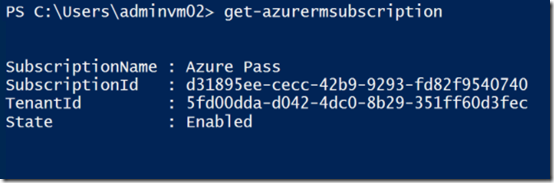
We will continue to work with the newer Azure Resource Manager here. So if you now issue the command:

get-azurermsubscription

You will see the details of the Resource Manager subscription as shown above. The important thing here is typically the subscription name (here ‘Azure Pass’). You’ll typically need to refer to the subscription by name when using PowerShell commands for Azure.

image

The recommendation way to do this easily is to issue the command:

$subscription=get-azurermsubscription

This will store the results of the get-azuresubscription command in a variable called $subscription.

To extract the actual name of the subscription and store it in a variable issue the command:

$subscriptionnname = $subscription.subscriptionname

In this case, the command will store the string ‘Azure Pass’ into a variable called $subscriptionname that can be used later throughout the script.

image

You can then issue the command:

select-azurermsubscription –subscriptionname $subscriptionname

To select the Azure Resource Manager subscription to work with (remembering that it is possible to have multiple different subscriptions inside a single Azure tenant).

You should see the Azure Resource Manager account details echoed back to you as shown above.

image

If you also want to target the older Azure Service Manager subscription then you should issues similar commands:

$subscriptionold = get-azuresubscription

$subscriptionnameold = $subscriptionold.subscriptionname

select-azuresubscription –subscriptionname $subscriptionnameold

as shown above.

Now you can work with you Azure tenant and PowerShell commands for both Azure Resource Manager and the older Azure Service Manager if required.

As you can appreciate with scripting and PowerShell there is lot more we can do to improve the connection experience and I’ll look to detail that in the future but this should at least get you started.

Life is far easier with PowerShell 5

PowerShell is a scripting language that allows you to control and automate a whole lot of technology. It is really the premier administration tool for managing Office 365 and Azure. Unfortunately, because of its ‘programming’ nature many IT Professionals have avoided it.

One of the issues with PowerShell has been configuring the environment to allow access to everything you need. Typically, you needed to download and install separate modules to allow commands to be execute for Office 365 service and Azure. PowerShell 5 has overcome that problem by allowing you to download and install these modules directly from the PowerShell command line.

Thus, you need to firstly have PowerShell 5.0 on your machine. PowerShell 5 is included with the latest versions of Windows 10 but unfortunately it isn’t currently installed by default on Windows Server 2012 R2. This means if you want to use PowerShell version 5 on a server you’ll typically need to firstly download and install it.

image

For a Windows Server 2012 R2 you’ll need to download and install the Windows Management Framework 5,0 which you can find here:

https://www.microsoft.com/en-us/download/details.aspx?id=50395

image

When executed it will scan the machine to determine what updates need to be installed.

image

You’ll then be promoted to install any updates.

image

After these updates have been installed you may need to be reboot the machine.

image

To download and install the Azure module for PowerShell simply open a new PowerShell command prompt now and type:

install-module azure

You maybe be prompted to install the NuGet provider. Enter Y here to accept this.

image

You may also be prompted that you are installing from an untrusted repository. Again, select Y here to continue.

image

You should now see the module package being downloaded and installed as shown above.

When complete you’ll be returned to the command prompt.

image

To install the Azure Resource Manager module now type:

install-module azurerm

You should again see this module being downloaded and installed as shown above.

You’ll again be returned to the command prompt when complete.

image

Now if you issue the command:

get-module –listavailable

You will see all the see all the PowerShell modules that are available to you. In the above example you can see both the Azure and AzureRM modules are listed as available.

image

If you now issue the command:

$psversiontable.psversion

You will see the version of PowerShell installed (here version 5 as expected).

That’s a lot easier than it ever used to be with PowerShell and another reason why you should be using the latest version!