CIAOPS Need to know Webinar – January 2017

Welcome to 2017. Our first webinar of the new year is ready to kick off shortly, so it’s time to register. As always, the event is free to attend and provides you with the latest news around Office 365 and the Microsoft Cloud as well as deep dive into a particular topic. This month we are going to have a close look at the automation options that are available to you in Office 365, including things such as SharePoint Designer and Microsoft Flow.

You can register now at:

January Webinar Registration

The details are:

CIAOPS Need to Know Webinar – January 2017
Thursday 19th of January 2017
11am – 12am Sydney Time

All sessions are recorded and posted to the CIAOPS Academy.

There of course will also be open Q and A so make sure you bring your questions for me and I’ll do my best to answer them.

The CIAOPS Need to Know Webinars are free to attend but if you want to receive the recording of the session you need to sign up as a CIAOPS patron (for only USD$10 per month) which you can do here:

https://www.patreon.com/ciaops

or purchase them individually at:

http://www.ciaopsacademy.com/

Also feel free at any stage to email me directly via director@ciaops.com with your webinar topic suggestions.

I’d also appreciate you sharing information about this webinar with anyone you feel may benefit from the session.

Joining Windows 10 machines to Office 365

image

One of the great things that Windows 10 Professional and above provide is the ability to connect directly to Azure AD. Hopefully, as you are aware Office 365 identity is built on Azure AD. Thus, if we connect Windows 10 to an Azure AD that is part of an Office 365 tenant we get simplified sign on. This basically means when users open Microsoft browsers (IE or Edge) and navigate to the Office 365 portal they are automatically logged on because their credentials are already part of Windows 10 thanks to Azure AD join. This simplified login also works with desktop applications like Word, Excel, PowerPoint etc plus some third party applications. In short, users get logged directly into applications once they login to their desktop thanks to Azure AD join.

Now there are a couple of ways of joining Windows 10 to Azure AD. I’ve previously covered how to basically ‘add’ your Azure AD/Office 365 credentials to an existing Windows 10 installation here:

Connect Windows 10 to Azure AD

That method isn’t quite as full featured as if you set up your Windows 10 machine to join Office 365 during the setup of Windows 10.
image

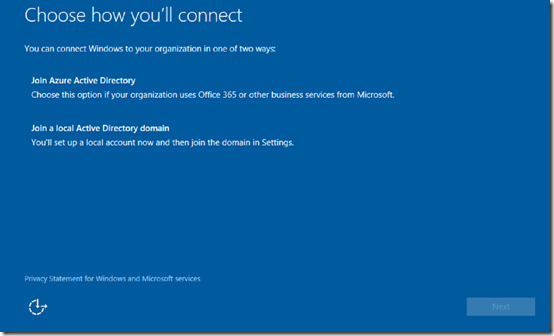
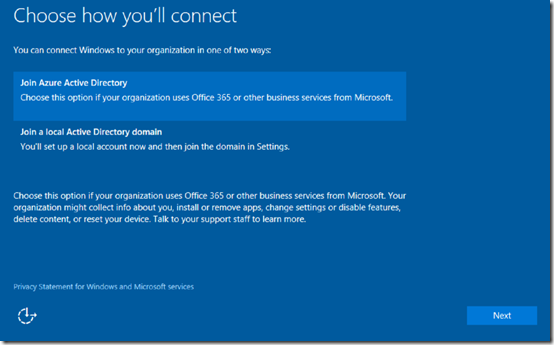
The process for doing that configuration, is that during the installation of Windows 10 onto a machine you’ll receive a prompt like that show above asking you to Join Azure Active Directory or Join a local Active Directory domain.

So what I’m going to assume here is that I want this Windows 10 machine to be only joined to Office 365/Azure AD because there no local AD. So I select the Join Azure Active Directory option.

image

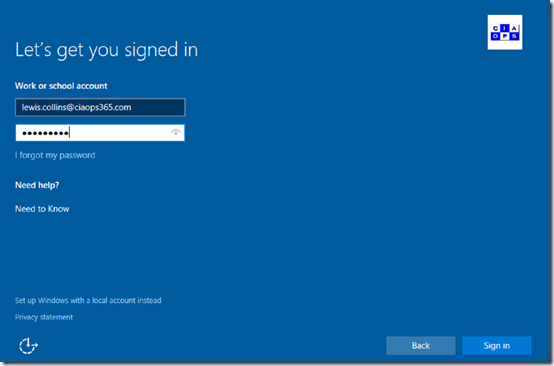
I’m then prompted to enter my Azure AD credentials. Remember, these credentials are what you use to login to Office 365.
image

I enter the user’s Office 365 details and select Sign in. Now it is also important to note here that this new user will also be, by default, an administrator of the local Windows 10 machine. If you don’t want to allow your users to be administrators of the local desktop then you’ll need to remove this account after setup has completed.
image

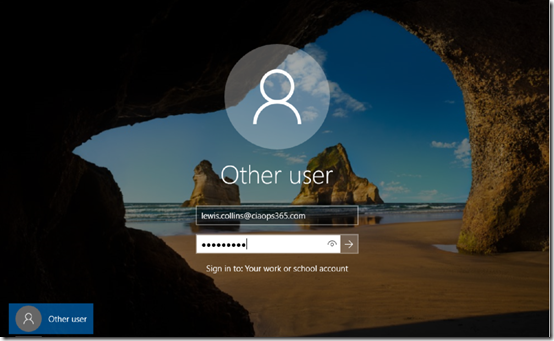
The Windows 10 setup process will continue and eventually you’ll be prompted to login to the machine. You should login with your Office 365 credentials as shown when prompted.
image

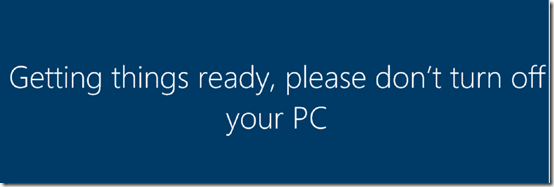
The Windows 10 desktop will then do a little more setup as shown above.
image

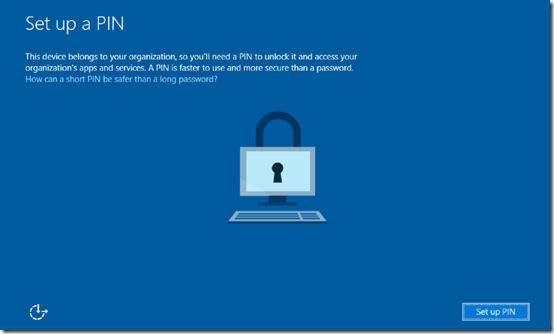
In this case I’m also then prompted to create a 4 digit pin for this machine. I’ll show you more about why this happens shortly but basically because I am joining this machine to Office 365 the Mobile Device Management (MDM) policies I have established are now being applied to this device. One of the policies I have configured is to require a PIN.
image

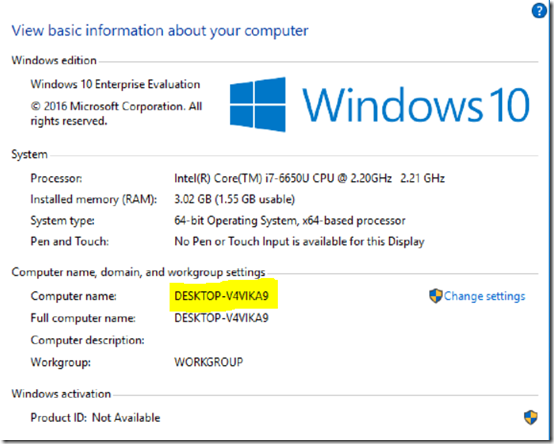
If we dig into the local machine name as seen above,
image

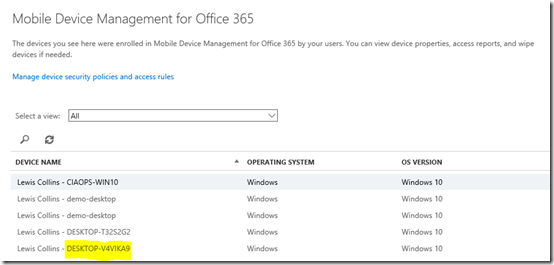
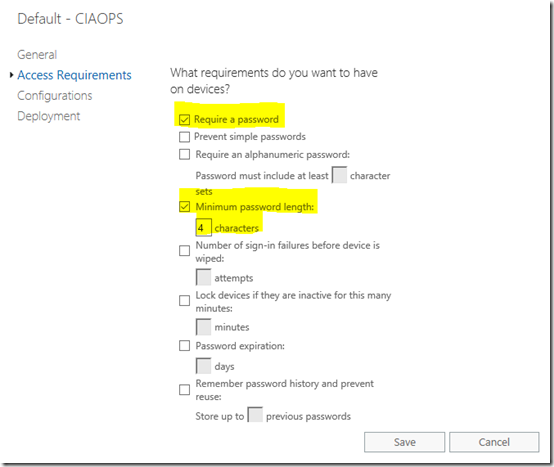
We now see that same machine in the MDM for Office 365 as shown above.
image

This means it will have the MDM security policies applied to it that I have configured. In this case, as you can see from the above configuration, I require devices to have at least a 4 digit pin password.

Don’t forget that Office 365 MDM is a free and included part of the service.
image

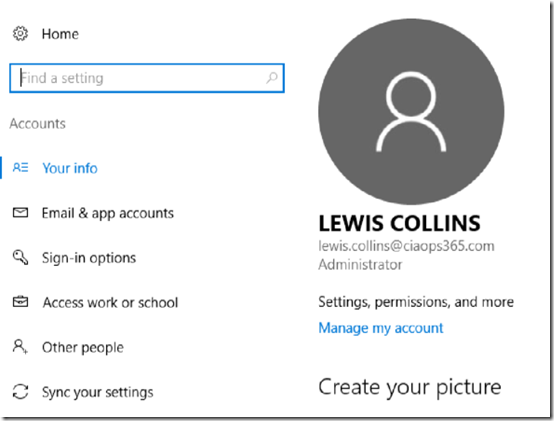
If I now look at the properties of the user on the directly joined machine just set up, I see the above, basically a single user with an Office 365 identity.
image

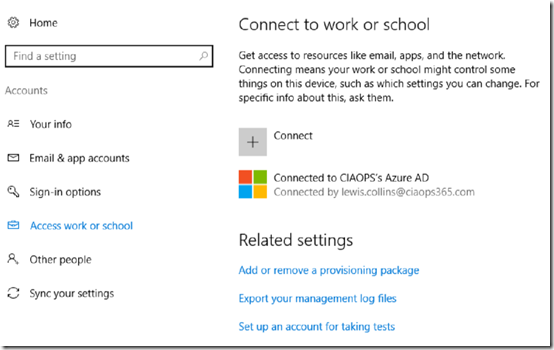
If I then look in the work and school account I see that it is connected to my Azure AD as shown above. Therefore, here I have only one account that logs me into the local machine and my Office 365.
image

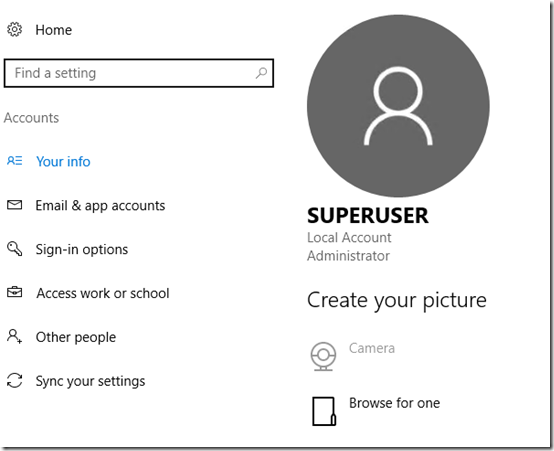
Compare that situation to when I already have a functioning Windows 10 machines and I associate it to Azure AD. When I do that I only see the local user as the identity as shown above. Thus, I am actually logging into this Windows 10 machine with a local account rather than my Office 365 account.
image

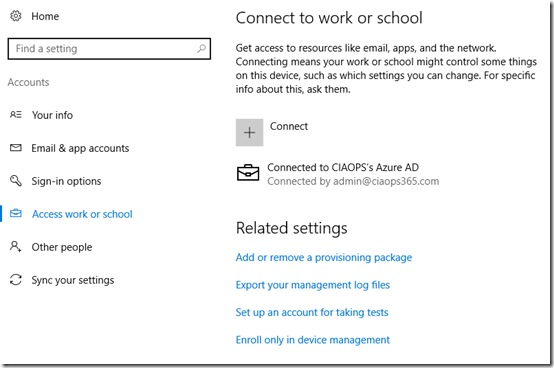
When I look in the work or school account area I again see a connection to my Azure AD. Thus, I login to this Windows 10 device with a local account which is then associated to an Office 365 account. Therefore I have two accounts in operation now, a local account and an Office 365 account.

The big difference here is that by using an Office 365 login during the installation of Windows 10 I get an Office 365 login to my box, whereas if I connect to Azure AD after my Windows 10 is installed I only get a local account login.

In both cases, when I visit a site in an Microsoft browser (IE or Edge) such as the Office 365 portal, I am not prompted to login because these credential are furnished directly from Windows 10.

It is my experience that having just the one Office 365 login associated with a Windows 10 device is more reliable when it comes to this same sign on than if you merely associate an Office 365 login with an existing Windows 10 box. The trade off is, of course, that you only get this single Office 365 login to the box if you install Windows 10 from scratch, which may not always be possible.

So can you add an Office 365 to an existing Windows 10 machine and achieve browser and application same sign on? Yes. However, I would suggest a better option is to actually setup Windows 10 from scratch using an Office 365 account. You’ll get much better same sign on and be prepared for further integration down the track. You also remove the complexity of multiple accounts on the one desktop.

The main reason that you want to join your Windows 10 machines to Office 365/Azure AD is probably to eliminate the need for any local AD. This will also mean the elimination of on premises equipment and ensuing cost savings.

The main reason for retaining a local AD these days is simply for group policy, but in my experience is that most of what needs to be done with group policy can either be done with Office 365 MDM (which is free) out of the box or upgrading to Windows Intune or Azure AD Domain Services. That, in essence, now suggests that there is no real need for a local domain controller on premises at all. It can easily be eliminated with the integration of Windows 10, Office 365 and Azure AD as shown.

Special access for CIAOPS Patrons

I have created a number of different levels that you can become involved in my CIAOPS community. You sign up using the CIAOPS patron page at:

https://www.patreon.com/ciaops

on which you’ll find the following support levels (per month)
:

$10 per month – Pledge ten dollars a month and you’ll receive access to my restricted Facebook support group that will answer your questions on Office 365, Azure and other Microsoft cloud technologies. You’ll also get 25% discount off any one of my online courses per month. You’ll get free access to the recording of each monthly recorded support webinar. You’ll also get 50% discount off any one of my existing paid publications.

$50 per month – Pledge fifty dollars a month and you’ll receive access to my restricted Facebook support group that will answer your questions on Office 365, Azure and other Microsoft Cloud technologies. You’ll get 50% discount off any one of my online courses per month. You’ll receive an invite to attend live my monthly support webinar that will answer questions and demonstrate Microsoft cloud technologies as well as receive access to the recordings. You’ll also receive free access to all my existing paid publications and any new paid publications I create.

$100 per month – Pledge one hundred dollars a month and you’ll receive access to my restricted Facebook support group that will answer your questions on Office 365, Azure and other Microsoft Cloud technologies. You’ll get 80% discount off an one of my online courses per month. You’ll receive an invite to attend my live monthly support webinar that will answer questions and demonstrate Microsoft cloud technologies as well as receive access to the recordings. You’ll also receive free access to all my existing paid publications and any new paid publications I create. You will also receive a monthly one on one remote consulting session for training or problem solving up to one hour (valued at over $250).

Not only will you get access to all the information that I regularly create, you’ll get access to a community of cloud focuses resellers who are digitally transforming their business and those of their customers. That is knowledge you can leverage when you become a CIAOPS Patron.

My Podcasts

Apart from my Kindle and Audible consumption I spend a lot of time listening to podcasts. Whether travelling in the car, on the train, out walking, taking a flight, wherever. I’m not usually far from a having a podcast in my ear.

So here’s my current listening list:

1. Windows Weekly

The latest Microsoft news with some fun and entertainment along the way. Paul Thurrott’s musing make this podcast alone.

2. This Week in Google

Always good to hear about the wider internet but of late has become too involved in US politics for me. May need to review my subscription is that continues.

3. The Tim Ferriss Show

Some really great advice and business insights. Also lots of life lessons that I have found work really well for me. A weekly must listen for me.

4. Microsoft Cloud Show

Can get a little deep into the developer weeds for me sometime but generally great information and insight into what’s happening with the Microsoft Cloud.

5. Hardcore History

Not a regular event but when these episodes drop I’m all ears. They are are deep dive into history told by a master narrator. If you love history, you’ll love these episodes.

6. Jocko Podcast

Probably too hard core for most. For me it is a great mix of military history and business mindset training. If you have a ‘fanatical’ tendency then give this one a listen.

7. Unbeatable Mind Podcast

A short format that hosts interesting people who have typically overcome adversity to succeed. Also some great mind and resilience training methodologies as well.

8. Ammo NYC

Another thing I’m fanatical about is my cars and especially detailing them. Here you’ll learn all the tricks and secrets to becoming a master car detailer. Why? Because there’s is nothing more satisfying than a shiny car.

I listen to all episodes at at least 2X speed to allow me to crank through most of these episodes in a week. I’ve added and deleted many podcasts over the time, and continue to do so, but the above is are the long term residents of my device.

Since 2010 I have published my own podcast:

Need to Know podcast

which covers the Microsoft Cloud (typically Office 365 and Azure) as well as business topics. I do these with my co-host Marc Kean and encourage you to have a listen and me know what you think.


The phone is the desktop

This is the sixth part of my presentation “Making money from the cloud”. You can find the full slides at:

https://doc.co/LyrxvF/qcihGm

and the previous parts are at:

We live in exponential times

Consider the following

Major Trends

Macro Trends

Software will eat the world

image

A sure sign that technology beliefs are rooted in the past is believing that desktops and servers are the most important user devices in a business. Unfortunately, nothing could be further from the truth as mobile devices, predominately phones but also tablets, continue to dominate the IT market.

The next wave of Internet adoption and opportunity will not come from places such as Australia and the US, it will come from places like India, China and Africa. It will come thanks to the growing accessibility of smart phones and mobile Internet access. The multiplication effect of Internet access across these large populations will be unprecedented.

However, even in places like Australia that already have high mobile penetration, look at how often people upgrade their phones. Most last no more than twelve months before they are relegated to the scrap heap. Why? Because, like early PCs, we are still at the dawn of what hardware can do for mobile devices. Faster processors, more memory, better screens, etc. are driving the turnover of mobile devices as people seek a better experience and, importantly, as people use their mobile devices more and more as their primary device to access the Internet.

With that in mind, ask yourself, how mobile friend is my business? How embracing is my business when it comes to mobile technology. Are we making a centre piece of our strategy to enable employees to work where they want and when they want? Or are we still ignoring the fact that our employees are using their phone with corporate data in a way that maybe inappropriate to our organisational needs?

Good employees desire the ability to work where and when suits them. They want to be able to drop their kids off at school in the morning as well as pick them up. They want to be able to run that small errand during the day. They want to be able to choose the environment that makes them most productive and for many (including myself) that is not an office. Mobile devices allow them to achieve all this and still remain productive. It allows them to continue working for the business while suiting themselves. Good employees are beginning to demand these conditions and smart businesses are enabling it to attract and retain the best talent.

The importance of the mobile device can easily be illustrated. Let’s say that you are in presentation session filled with people you don’t particularly know. How many of you would be comfortable unlocking your phone and handing to someone else randomly? Most people would be far from comfortable in doing that. Why? Because their mobile is now their identity. It has all their contacts, messages, notes, access to financial institutions and so on. It is such an important piece of what constitutes a person in today’s digital age that it should be given the respect it deserves.

A majority of Internet based transactions are now taking place via mobile devices. We are seeing the growth of mobile payment platforms thanks to Apple and Google. Doing things any other way is beginning to introduce more and more friction in the sales process. More friction simply means less sales, so smart businesses are embracing mobile payments as way to maintain but also attract new customers.

However, one of the things that doesn’t change when it comes to corporate mobile devices is the need for control. Security and compliance of information is still a requirement for most businesses no matter where their information is accessed from. In a world where information can be accessed from anywhere a new set of challenges arises as devices are no longer within the four walls of a business. In a world where your device is your identity, what protections do you have in place to protect information you are unwilling to openly share with others as illustrated previously? Although the mobile devices is something most ‘can’t live without’ few take any steps to protect actually it.

My experience is currently that few end user mobile devices have any sort of management at all. This is strange in a world where products like Office 365 include basic mobile device management out of the box. I think the main reason is that IT Professionals are lagging in their knowledge and acceptance of these mobile trends. The worm has turned and customers are now adopting technology at a much faster rate than IT Professionals, many of whom are still land locked with outdated concepts and beliefs of how technology is used.

The limited number of mobile devices currently under management should immediately raise the opportunity and threat flags for someone with a business mindset. The opportunity is clear. To focus on offering the ability to manage devices for businesses in a market where there is currently little competition. The risk is that if you don’t do it for your customers or users then you are vulnerable to your competition coming in and doing for them and potentially pushing you out as a provider in total.

Our modern technology world is ruled by mobile devices and this will only continue to grow. It is time for IT Professionals to embrace the changing landscape of mobility and provide the necessary security and compliance services they have always provided to keep business information secure. They have the experience, they simply need the skills. Services like Office 365 already provides these mobile device management tools, it simply comes down to implementing them.

Embracing mobility is the key to success going forward for both businesses and IT Professionals. It will provide yet another differentiation point between the old and new worlds with those who ‘get it’ reaping the benefits.

My tech books

As much as business books are the mainstay of helping you grow a business, I would assert that there is a place for good fiction and non fiction as a way of expanding what is possible and what we may see with technology in the future. Form such ideas, opportunities flow.

Below is a list of tech (both fiction and non-fiction) that I have really enjoyed and recommend to anyone interested in technology and the impact it may play in our lives down the track.

You can follow all the books I read and want to read over at Goodreads where I have an account. You can also view my activity via:

https://www.goodreads.com/director_cia

or just follow me on Facebook:

www.facebook.com/ciaops

1. Daemon – Daniel Suarez [Fiction]

A glimpse into the future of where drones and augmented reality may take us. That may not necessarily be a good place either.

2. Freedom TM – Daniel Suarez [Fiction]

A follow up to Daemon. What happens when technology dominates the world? Who benefits?

3. Ready Player One – Ernest Cline [Fiction]

Much like the Matrix. What is life like if you live inside the machine? You can be just about anyone you choose. I also love this book for all the retro technology that was part of my life. TRS-80 anyone?

4. Future Crimes: Inside the Digital Underground and the Battle for our Connected World – Marc Goodman [Non-fiction]

Technology will ultimately doom us all I believe because we are building our world on stuff that unfortunately places a low regard for security and privacy. This book will show you why that is a road to ruination.

5. Countdown to Zero Day: Stuxnet and the Launch of the World’s First Digital Weapon – Kim Zetter [Non-Fiction]

If you don’t believe cyber warfare is real then read this book to understand how software is now a weapon as potentially devastating as any nuclear device.

6. Beyond Fear: Thinking Sensibly about Security in an Uncertain World – Bruce Schneier [Non-Fiction]

Security is important but it is important in context. We need to be rational when we consider our security not emotional. A great level headed approach to how we need to be secure.

7. Trojan Horse – Mark Russinovich [Fiction]

Yet another book on IT security. Love this stuff because it is so interesting and so relevant I believe to our future. A more contemporary book on technology security and its impacts.

8. The Cuckoos Egg – Clifford Stoll [Non-Fiction]

Before the Internet was in the public sphere it existed in the world of academia. This is the story of how one man’s search for the source of an accounting error uncovered something are more sinister.

9. Takedown – John Markoff and Tsutomu Shimomura [Non-Fiction]

The pursuit and eventual capture of notorious hacker Kevin Mitnick makes for great reading.

10. Hackers: Heroes of the Computer Revolution – Steven Levy [Non-Fiction]

Ah, the good ole days when it was more about proving how smart you were than trying to actually cause harm. If you think hacking is something new, then you’re in for a surprise with this book.

My business books

This is an updated list of business books that have made a big impact on me and I believe will also on others. I do read a lot of books and it takes something pretty special to break into this top 10, so list doesn’t change a whole lot. I thoroughly recommend each and every one of these books as an absolute must read for anyone and especially anyone running a business.

You can follow all the books I read and want to read over at Goodreads where I have an account. You can also view my activity via:

https://www.goodreads.com/director_cia

or just follow me on Facebook:

www.facebook.com/ciaops

Here’s my current top 10 in order:

1. The Art of War – Sun Tzu

The all time classic on strategy. As relevant today as it ever was. A very short read but very deep.

2. The Millionaire Fastlane – M.J. DeMarco

I love the brutal honesty of this book. It doesn’t mince words about what it takes to shift from a pay check to actually living the life you want.

3. The Tipping Point – Malcolm Gladwell

The world is all about not what you know but who you know. This book explains exactly how this works and how to use it to your advantage.

4. The Four Hour Work Week – Tim Ferriss

Many people believe this book is about shirking responsibility. It is in fact a blueprint for how to free up your time to do things you want and enjoy. It will challenge the way you look at your career.

5. Secrets of the Millionaire Mind: Mastering the Inner Game of Wealth – T. Harv Eker

The successful are defined by a different mindset. This mindset can be learned. It can be trained. This is a great book to show you how to do just that.

6. Book Yourself Solid: The Fastest, Easiest, and Most Reliable System for Getting More Clients Than You Can Handle Even If You Hate Marketing and Selling – Michael Port, Tim Sanders

You can’t survive in business without a steady flow of customers. Selling to people is the wrong approach, you instead need to attract them to your business. This book helps you achieve exactly that.

7. Unbeatable Mind: Forge Resiliency and Mental Toughness to Succeed at an Elite Level – Mark Divine

Another mindset book. Business is not always going to be easy or take the intended route. This is when you need to have the determination to see your plans through to success. This book shows you how to develop the mental toughness to make this happen.

8. The E-Myth – Michael Gerber

The classic on ‘procedurising’ your business and creating a structure that doesn’t need you to survive. The simple secrets inside this book can transform any business from hardship to joy.

9. Profit First: A Simple System To Transform Any Business From A Cash-Eating Monster To A Money-Making Machine – Mike Michalowicz

Business is about making a profit. This then gives you the freedom to do what you want with that profit. This book helps you focus on profit and setting up systems to make the most of the profit you generate.

10. Tools of Titans – Tim Ferriss

There are few books that take the learnings for so many exceptional people and puts them at your fingertips. This is one such book that packs a lot of business and life learnings between the covers.

These books make my top 10 list because I have read them all multiple times and continue to do so. No matter how many times I read them I always get something from them. There are of course many others I’d suggest you read but I don’t think you’ll go far wrong by starting with the above 10. 

Let me know what you think. Do these work for you? What’s your top 10? I’d love to hear.

My apps

I’ll be the first to admit that I’m really not a big apps guy. I test a lot of apps but in reality few hold my attention or become part of my daily routine. These however do.

Podcast Addict – for all my podcasts. Easy to use, listen and update.

Google Authenticator – used to provide two factor authentication for access to Google accounts as well as for Lastpass password manager.

Android auto – connects to my daily drive to provide the ability to listen to podcasts (via Podcast Addict) as well as use Google Maps for navigation.

OneNote – is a must on every device I own. Syncs all my notes to every device. Allows me to not only truly have my information everywhere I am but also capture information quickly and easily.

Office Lens – available on all platforms. Allows capturing of information such as documents, whiteboards, etc to OneNote. I have written about the importance of this app previously:

A mobile device must have

Fitbit – for tracking my fitness stats. I am generally most interested in tracking my sleep progress but also aim to get 10,000 steps a day done.

Tripview – One of the few apps that I have happily paid for. I use this to let me know the Sydney train schedule to help me get around when I need to negotiate the ‘real world’.

Swarm – for reporting my location to Facebook and Twitter. Combined with Foursquare this allows me to keep track of where I have been, when. Also, by making my location publically available to others, I’m encouraging them to catch up with me when I’m local.

Audible – If I can’t read my Kindle then I can normally always listen. This app allows me to listen to my audio books where ever I am.

Amazon Kindle – If I don’t have access to my Kindle then I can still read my books. In my case that will most likely be on my iPad. I also use the Kindle app on the iPad when the ebook has a lot of images that sometime don’t display well or are too small for the Kindle device.

Of course I have all the social media apps, such as Twitter, Linkedin and Facebook on my devices.

I also have all the Microsoft/Office 365 apps. The ones I use the most are probably the SharePoint, OneDrive and Yammer, although Word and Excel also get used regularly. Just about every Microsoft Office 365 service has an app that you should have on your mobile device.

I use the Microsoft Next Lock Screen on my Android device.

Like I said, there are plenty of other apps I use now and then on different platforms but the above ones I typically use across all platforms an/or use them everyday. That’s why they make this list.