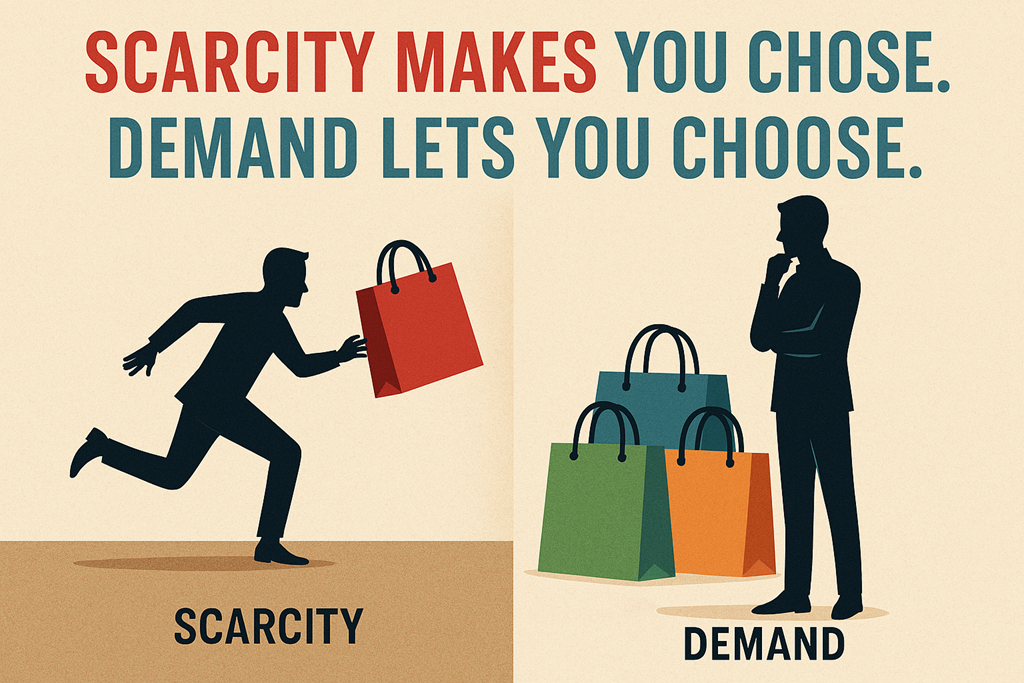
Scarcity Makes You Chase. Demand Lets You Choose.

image

Because when you only have three leads, every one of them feels like the one.

You know the feeling.

The phone rings and suddenly you’re leaning forward. You reply faster than you should. You offer discounts you promised yourself you’d never offer again. You start justifying things that don’t sit right.

“It’s only a small exception.”
“We can make this work.”
“It’s revenue, at least.”

And deep down, you already know where this ends.

This isn’t about mindset.
It’s not imposter syndrome.
It’s not a confidence issue.

It’s a demand problem.

Scarcity Changes Your Behaviour (Whether You Like It or Not)

Scarcity doesn’t just affect how you price. It affects how you think.

When leads are rare, you stop being selective. Every prospect feels precious. Every enquiry feels like a potential lifeline. You start treating interest as intent.

That’s when things go wrong.

You chase prospects who are slow to respond.
You follow up when your gut says “leave it”.
You take meetings you shouldn’t take.
You accept clients who don’t value what you do.

Not because you want to.
Because you feel like you have to.

MSPs are particularly vulnerable to this because the work is technical, the margins are tight, and cash flow anxiety is always lurking in the background. One missed deal feels personal. One lost opportunity feels dangerous.

So you compromise.

And every compromise reinforces the problem.

The Real Cost of “Just One More Client”

Bad-fit clients don’t just cost you margin. They cost you focus, energy, and confidence.

They argue about price.
They ignore your advice.
They push back on security.
They treat you like a helpdesk, not a partner.

Worse, they consume time you could have spent finding better clients.

Scarcity traps you in a loop:

  • You take whoever shows up

  • You spend too much time servicing them

  • You have no time left to market properly

  • So you stay stuck with low demand

That’s not a sales issue. That’s a structural issue.

Power in Business Comes from Options

Here’s the uncomfortable truth most MSPs don’t want to hear:

If you need every lead, you have no leverage.

Power in business comes from options.

When you have multiple leads, you don’t chase.
You don’t discount.
You don’t rush decisions.
You don’t tolerate nonsense.

You can say, “We’re probably not the right fit.”
You can hold your pricing.
You can enforce boundaries.

Not because you’re arrogant — but because you’re not desperate.

Demand changes the dynamic completely.

Scarcity Isn’t a Sales Problem. It’s a Marketing Problem.

Most MSPs try to fix scarcity by “getting better at sales”.

That’s the wrong lever.

Sales converts demand. It does not create it.

If your pipeline is thin, no amount of better closing techniques will fix the underlying issue. You’ll just become better at persuading the wrong people.

Demand is created before the sales conversation ever starts.

It’s created by:

  • Being known for something specific

  • Publishing ideas people recognise themselves in

  • Having a clear point of view

  • Repeating the same message long after you’re sick of hearing it

Generic MSPs don’t create demand. Specialists do.

Opinion creates demand.
Clarity creates demand.
Consistency creates demand.

Why “Chasing” Feels So Awful

Here’s the thing no one tells you: chasing feels bad because it is bad.

It puts you in a reactive position.
It forces you to behave out of alignment with your values.
It makes you feel smaller than your work deserves.

Most MSPs didn’t start their business to beg for work. They started it to solve problems, create value, and build something sustainable.

Scarcity strips that away.

Demand restores it.

Demand Lets You Choose (And That Changes Everything)

When demand is healthy:

  • You choose clients instead of hoping they choose you

  • You price for value, not fear

  • You stop convincing and start qualifying

  • You enjoy the work again

That’s not theory. That’s observable reality in every mature MSP business.

The goal isn’t “more leads”.
The goal is enough demand that no single lead matters too much.

When no one deal can make or break you, you show up differently. Calmer. Clearer. Stronger.

And ironically, that’s when more people want to work with you.

Scarcity makes you chase.
Demand lets you choose.

If your business feels uncomfortable right now, don’t blame your confidence.

Look at your demand.

The new MSP Model. Find a Window. Throw a Brick.

image

Want my advice on what your MSP business model should be?

“Find a window, and throw a brick through it.”

At first, that sounds reckless. Unprofessional. Maybe even stupid. But the more I think about it, the more I realised it might be the most honest description of a successful MSP business model in years.

Because the “window” wasn’t a customer.
It wasn’t staff.
It wasn’t technology.

The window was the common advice in our industry. The stuff everyone repeats. The playbooks, frameworks, podcasts, and LinkedIn posts that all say the same thing, just with different branding.

And the brick?
That’s your contrarian move. Your better way.

The Problem With Following the Advice

Spend five minutes in the MSP space and you’ll hear the same guidance:

  • “Standardise everything.”

  • “Move everyone to a flat‑fee, all‑you‑can‑eat model.”

  • “Sell outcomes, not tools.”

  • “Niche down.”

  • “Productise your services.”

  • “Just add more MRR.”

None of this advice is wrong. That’s the dangerous part.

It’s just… crowded.

When everyone is told to do the same things, in the same way, with the same language, you don’t end up with differentiation. You end up with a race to the middle. Or worse, a race to the bottom.

If your website reads like every other MSP website, if your proposals look identical, if your pricing model mirrors your competitors, then from a customer’s perspective you’re interchangeable. And interchangeable always becomes price‑sensitive.

That’s the window.
Clear. Shiny. Widely accepted.

Why MSPs Struggle to Stand Out

Most MSPs aren’t short on effort. They’re short on permission.

Permission to say:

  • “We don’t do that.”

  • “We disagree with that approach.”

  • “That model doesn’t work anymore.”

  • “There’s a better way for our customers.”

Instead, many MSPs try to execute harder on advice that was never designed to be a universal truth. They optimise. They refine. They polish.

But polishing the window doesn’t change the building.

The uncomfortable truth is that the MSP business model itself is under strain. Margins are tighter. Customers are more informed. Vendors are moving up the stack. Automation and AI are eroding the value of “doing the thing”.

If your value proposition is still “we manage IT so you don’t have to”, you’re already vulnerable.

The Brick Is a Point of View

Throwing a brick doesn’t mean being reckless. It means being deliberate.

A brick is a clear point of view that challenges accepted wisdom.

For example:

  • Refusing unlimited support and charging for consumption instead.

  • Focusing on security and governance over helpdesk volume.

  • Saying no to certain customers—even when you need revenue.

  • Pricing based on risk reduction, not device count.

  • Leading with compliance frameworks instead of shiny tools.

These aren’t tactics. They’re positions.

A brick creates a crack. A crack lets customers see that there is an alternative way of thinking. And for the right customers, that’s magnetic.

Contrarian doesn’t mean argumentative. It means intentional.

Customers Don’t Want Average

The MSPs that struggle most with sales are usually the ones trying to appeal to everyone.

The MSPs that grow sustainably are often polarising.

They repel the wrong customers early. They attract the right ones faster. They spend less time justifying their value because their value is obvious to the people they’re meant to serve.

When you throw a brick, some people will walk away.

Good.

Those were never your customers.

The mistake is thinking your job is to be liked by the market. Your job is to be trusted by a subset of it.

What Brick Are You Holding?

Here’s the uncomfortable question most MSPs avoid:

If you removed your logo from your website, would anyone know it was you?

If the answer is no, you don’t need better marketing. You need a brick.

Ask yourself:

  • What common MSP advice do I quietly disagree with?

  • What do my best customers value that others complain about?

  • What do we do that others won’t?

  • Where are we already different but afraid to say it out loud?

That’s where your strategy lives.

Not in copying what’s popular.
Not in chasing the latest model.
Not in waiting for permission.

Strategy Isn’t Safe

Real strategy makes you uncomfortable.

It forces trade‑offs. It creates tension. It risks being wrong.

But playing it safe in a crowded market is the riskiest move of all.

So yes—find a window.

Find the assumptions everyone else accepts without question.

Then decide whether you’re brave enough to throw the brick.

Because nobody remembers the MSP that blended in.

They remember the one that changed the shape of the room.

CIA Brief 20260315

image

A faster way to find your Word, Excel and PowerPoint files online –

https://techcommunity.microsoft.com/blog/microsoft365insiderblog/a-faster-way-to-find-your-word-exc…

A closer look at Work IQ –

https://techcommunity.microsoft.com/blog/microsoft365copilotblog/a-closer-look-at-work-iq/4499789

Detecting and analyzing prompt abuse in AI tools –

Detecting and analyzing prompt abuse in AI tools | Microsoft Security Blog

Copilot in Outlook: New agentic experiences for email and calendar –

https://techcommunity.microsoft.com/blog/Outlook/copilot-in-outlook-new-agentic-experiences-for-ema…

Storm-2561 uses SEO poisoning to distribute fake VPN clients for credential theft –

https://www.microsoft.com/en-us/security/blog/2026/03/12/storm-2561-uses-seo-poisoning-to-distribut…

When Trust Becomes the Attack Vector: Analysis of the EmEditor Supply-Chain Compromise –

https://techcommunity.microsoft.com/blog/microsoftsecurityexperts/when-trust-becomes-the-attack-vec…

Organize your week with Copilot Cowork –

https://www.youtube.com/watch?v=BL95ZlP8cgY

Microsoft Agent 365 – The control plane for AI agents –

https://www.youtube.com/watch?v=viPY8ZFsYos

Meet Copilot Cowork: A New Way of Getting Work Done –

https://www.youtube.com/watch?v=j8rHJsM3fxQ

Introducing effective settings: See security configurations enforced on your device –

https://techcommunity.microsoft.com/blog/microsoftdefenderatpblog/introducing-effective-settings-se…

Pin Microsoft 365 Copilot apps to the taskbar –

https://www.youtube.com/watch?v=7xks9A-yilE

Secure agentic AI for your Frontier Transformation –

https://www.microsoft.com/en-us/security/blog/2026/03/09/secure-agentic-ai-for-your-frontier-transf…

Copilot Cowork: A new way of getting work done –

https://www.microsoft.com/en-us/microsoft-365/blog/2026/03/09/copilot-cowork-a-new-way-of-getting-w…

Available today: GPT-5.4 Thinking in Microsoft 365 Copilot –

https://techcommunity.microsoft.com/blog/microsoft365copilotblog/available-today-gpt-5-4-thinking-i…

Powering Frontier Transformation with Copilot and agents –

https://www.microsoft.com/en-us/microsoft-365/blog/2026/03/09/powering-frontier-transformation-with…

Introducing the First Frontier Suite built on Intelligence + Trust –

https://blogs.microsoft.com/blog/2026/03/09/introducing-the-first-frontier-suite-built-on-intellige…

Microsoft Agent 365 –

https://www.youtube.com/watch?v=viPY8ZFsYos

After hours

The AI book that’s freaking out national security advisors  – https://www.youtube.com/watch?v=Nl7-bRFSZBs

Editorial

If you found this valuable, the I’d appreciate a ‘like’ or perhaps a donation at https://ko-fi.com/ciaops. This helps me know that people enjoy what I have created and provides resources to allow me to create more content. If you have any feedback or suggestions around this, I’m all ears. You can also find me via email director@ciaops.com and on X (Twitter) at https://www.twitter.com/directorcia.

If you want to be part of a dedicated Microsoft Cloud community with information and interactions daily, then consider becoming a CIAOPS Patron – www.ciaopspatron.com.

Watch out for the next CIA Brief next week

If Your MSP Sounds Like Everyone Else, It Doesn’t Belong in the Market

image

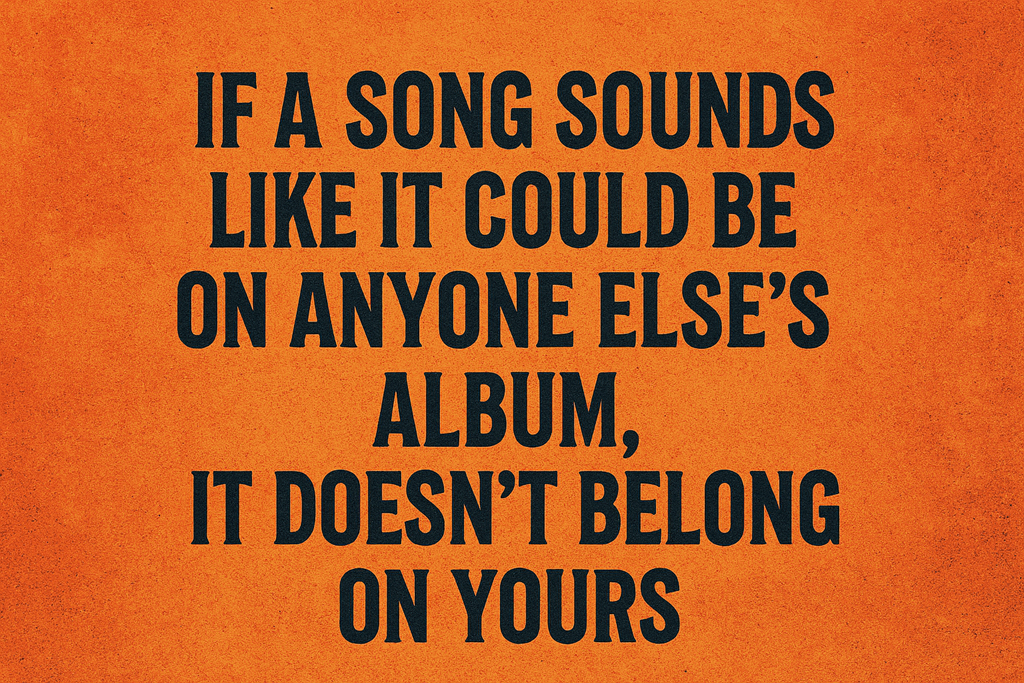
“If a song sounds like it could be on anyone else’s album, it doesn’t belong on yours.”

That quote has nothing to do with IT on the surface, but it has everything to do with the state of the MSP market right now.

Because let’s be honest: most MSPs sound exactly the same.

Same websites.
Same pitch decks.
Same “trusted partner” language.
Same stack.
Same promises.

And then everyone wonders why price becomes the only differentiator.

The uncomfortable truth is this: if your MSP could be swapped with another one down the street and the customer wouldn’t notice, you don’t have a brand — you have a commodity.

MSPs Have Confused Professionalism With Personality

Somewhere along the way, MSPs decided that sounding “professional” meant sounding bland.

We stripped out opinion.
We removed perspective.
We hid behind vendor marketing.
We borrowed language instead of earning it.

The result? An industry full of technically capable businesses that are completely interchangeable.

That quote about albums is really about authorship. Ownership. Identity.

A band doesn’t exist to sound like other bands.
An artist doesn’t release an album to blend in.

Yet MSPs routinely build their entire business around not standing out.

“Best Practice” Has Become a Crutch

Don’t get me wrong — standards, frameworks, and best practice absolutely matter. I spend a huge amount of my time talking about security baselines, compliance frameworks, and repeatable processes.

But best practice should be a foundation, not your personality.

Too many MSPs hide behind phrases like:

  • “We follow Microsoft best practices”

  • “We align to industry standards”

  • “We offer enterprise‑grade solutions”

So does everyone else.

If your entire story can be replaced with a vendor brochure, you’re not leading — you’re reselling.

Your MSP Is the Album

Here’s the hard part: you don’t get to outsource your voice.

You can outsource monitoring.
You can outsource SOC.
You can outsource help desk overflow.

But the way you think about technology?
The way you explain risk?
The way you say “no” to customers?

That’s the album.

And if it sounds like it could belong to any other MSP, it doesn’t belong to you.

Opinion Is a Feature, Not a Risk

MSPs are terrified of being wrong in public.

So instead of saying:

“This is what we believe, and this is why”

They say:

“It depends.”

Instead of drawing a line, they hedge.
Instead of setting direction, they offer options.
Instead of leading, they wait for customers to decide.

The irony? Customers don’t pay MSPs for neutrality. They pay for judgement.

An MSP without opinion is just a technical order‑taker with recurring billing.

Sounding Different Means Saying No

If your MSP truly has its own “album”, it will automatically exclude some customers.

That’s not a bug. That’s the point.

  • You won’t support everything

  • You won’t chase every deal

  • You won’t bend your standards to keep a bad fit

The MSPs that struggle most are the ones trying to be everything to everyone — and end up being nothing memorable to anyone.

Strong voice repels as much as it attracts. That’s how you know it’s real.

Vendor‑Led Messaging Is Killing MSP Identity

One of the biggest reasons MSPs all sound the same is over‑reliance on vendor language.

When your website, proposals, and presentations are just lightly edited Microsoft, security vendor, or RMM marketing copy, you’ve effectively handed your voice to someone else.

Vendors sell tools.
MSPs sell outcomes, trade‑offs, and accountability.

If your message could be sent directly from a vendor to a customer without you in the room, you’ve already lost relevance.

Your Voice Comes From Lived Experience

Your voice doesn’t come from branding workshops or taglines. It comes from:

  • The incidents you’ve dealt with

  • The mistakes you’ve made

  • The customers you’ve fired

  • The security failures you’ve cleaned up

  • The shortcuts you now refuse to take

That’s the stuff no vendor can give you — and exactly what customers want to hear.

But it requires honesty. And courage. And a willingness to say, “This is how we do things — and if that’s not for you, that’s okay.”

The MSPs That Win Sound Like Themselves

The MSPs that stand out aren’t louder. They’re clearer.

They have a point of view on security.
They have a stance on AI.
They have a philosophy on support.
They have a reason for their pricing.

You might not agree with them — but you remember them.

And in a market flooded with sameness, memorability is everything.

Final Thought

That quote about albums isn’t telling you to be different for the sake of it.

It’s telling you to be authentic.

If your MSP sounds like it could be on anyone else’s album, it doesn’t belong on yours.

So ask yourself:

If you removed your logo from your website, would anyone know it was you?

If the answer is no, it’s time to write your own songs again.

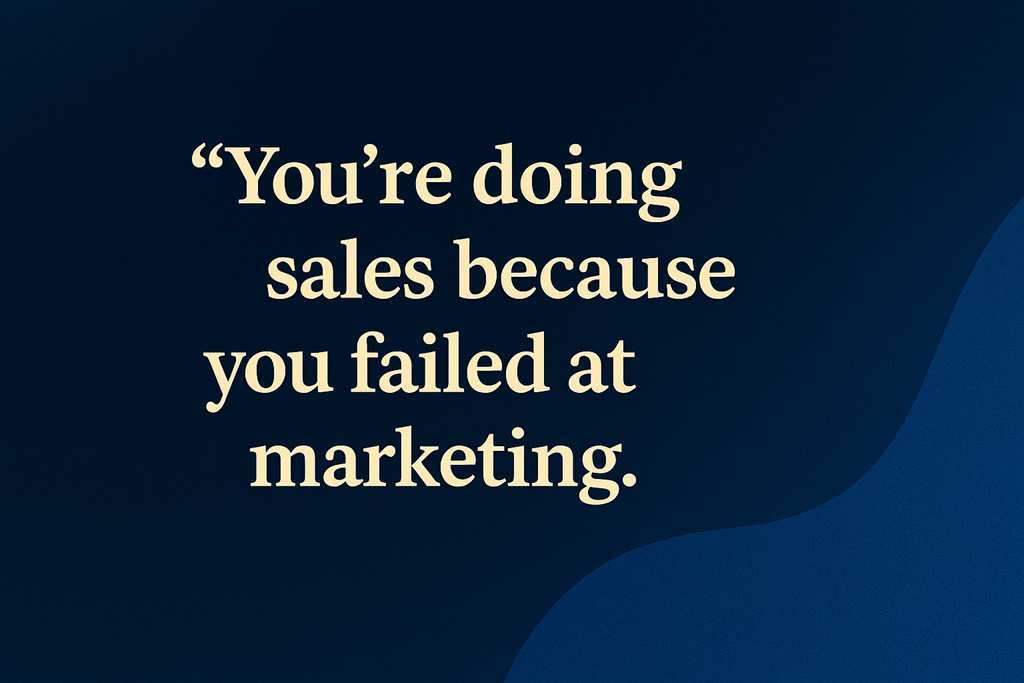
You’re doing sales because you failed at marketing

image

That quote tends to make MSPs uncomfortable. And that’s exactly why it matters.

Most MSPs will instinctively push back and say, “That’s not true. Sales is just part of running a business.” And yes, sales does matter. But if you’re spending your days cold calling, endlessly following up on quotes, discounting to close deals, and convincing prospects why you’re different… then the quote probably applies more than you’d like to admit.

Because here’s the reality: when marketing works, sales becomes easy. When marketing doesn’t exist—or worse, is inconsistent—sales turns into a grind.

MSPs default to sales because it feels productive

Sales feels like work. You can measure it. You can log calls, book meetings, send proposals, and tell yourself you’re “busy”. Marketing, on the other hand, feels vague and uncomfortable. Writing content, showing up consistently online, talking about your point of view, and putting ideas out there without an immediate payoff feels risky.

So MSPs fall back to what they know: selling.

That usually looks like:

  • Chasing referrals without a system

  • Relying on vendors for “marketing campaigns”

  • Attending networking events hoping something sticks

  • Reacting to inbound leads instead of shaping demand

None of that is strategic marketing. It’s just manual sales activity filling the gap where marketing should be.

Good marketing pre-sells for you

Real marketing does something sales never can: it pre-qualifies prospects before you ever speak to them.

When marketing works:

  • Prospects already understand your value

  • They already trust your expertise

  • They already know who you’re for (and who you’re not)

  • Price becomes a secondary conversation, not the first objection

At that point, sales isn’t persuasion. It’s confirmation.

The MSPs who complain most about “price-sensitive customers” are usually the ones with no visible marketing. If the only thing a prospect knows about you is that you “do IT support”, then of course price becomes the differentiator.

Marketing is what gives context to your pricing.

Most MSP marketing fails because it’s not opinionated

Here’s the uncomfortable truth: most MSP marketing is bland, generic, and forgettable.

It sounds like everyone else:

  • “We provide proactive IT support”

  • “We partner with leading vendors”

  • “We help businesses grow securely”

That’s not marketing. That’s noise.

Real marketing takes a stance. It has a point of view. It says something that not everyone agrees with. That’s why content that challenges thinking—like the quote in this article—gets attention.

Marketing that tries to appeal to everyone appeals to no one.

Sales-first MSPs stay trapped on the hamster wheel

When you rely on sales instead of marketing, you lock yourself into a cycle:

  • You stop selling → leads dry up

  • You get busy delivering → marketing disappears

  • Pipeline empties → panic selling resumes

This is why so many MSPs feel stuck working in the business instead of on it.

Marketing breaks that cycle by creating momentum that continues even when you’re busy. Content, messaging, and positioning compound over time. Sales does not.

Every sales conversation starts from zero. Marketing builds leverage.

Marketing is not campaigns. It’s consistency.

One of the biggest mistakes MSPs make is treating marketing as an occasional activity:

  • A quarterly email

  • A one-off webinar

  • A burst of social posts when things get quiet

That’s not marketing. That’s noise spikes.

Marketing is showing up even when you don’t need leads. Especially then.

Because by the time you need sales, it’s already too late for marketing to help you in the short term. Marketing is a long game, and MSPs who refuse to play it end up stuck selling forever.

If sales feels hard, marketing is missing

Here’s a simple test.

If you:

  • Constantly have to explain what makes you different

  • Get ghosted after sending proposals

  • Hear “we’re just getting other quotes” regularly

  • Compete mainly on price

Then your marketing isn’t doing its job.

Marketing should answer those questions before a prospect ever talks to you.

The goal isn’t to eliminate sales — it’s to make it boring

The best MSPs don’t get rid of sales. They make it boring.

Their sales calls are calm, predictable, and focused. Prospects already know:

  • What they stand for

  • What they don’t do

  • Why they charge what they charge

That doesn’t happen by accident. It happens because marketing has been doing the heavy lifting quietly, consistently, and publicly.

So yes, the quote stings — but it’s useful

“You’re doing sales because you failed at marketing” isn’t an insult. It’s a diagnosis.

If sales feels exhausting, unpredictable, and stressful, the solution probably isn’t more sales effort. It’s better marketing:

  • Clear positioning

  • Consistent content

  • Strong opinions

  • Visible expertise

Fix the marketing, and sales stops being a daily firefight.

And that’s when running an MSP starts to feel like a business — not just a job with invoices.

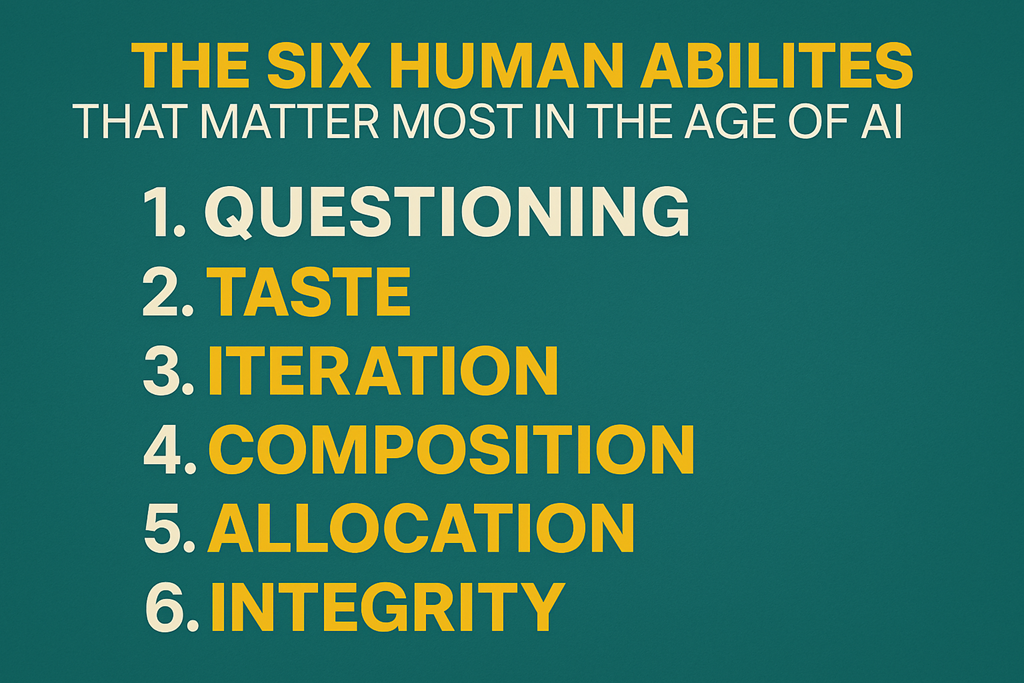
The Six Human Abilities That Matter Most in the Age of AI

image

Every time a new wave of AI tools lands, the same fear resurfaces: What happens to the humans?
The uncomfortable truth is that some work will disappear. But the more important question is this: what work becomes more valuable?

The image above nails it. In an age where machines can generate content, write code, analyse data, and automate workflows at scale, the differentiator isn’t technical capability alone. It’s the human abilities that sit around the technology.

These six skills aren’t soft. They’re not optional. And for MSPs and IT professionals, they may be the difference between being replaced… and being indispensable.

1. Questioning: The Skill AI Can’t Replace

AI is exceptional at answering questions.
It’s terrible at deciding which questions actually matter.

Most poor outcomes with AI don’t come from bad tools. They come from bad prompts, shallow thinking, or unchallenged assumptions. The real value comes from people who know how to ask:

  • What problem are we actually solving?
  • Who benefits from this answer?
  • What’s missing from this output?

In an MSP context, questioning is what separates “we deployed Copilot” from “we changed how the business operates”. It’s knowing when to push back on a client request, when to reframe the problem, and when the obvious solution isn’t the right one.

AI accelerates answers. Humans decide direction.

2. Taste: Knowing What “Good” Looks Like

AI can generate ten versions in seconds.
Taste is knowing which one to ship.

Whether it’s a policy document, a client report, a security recommendation, or a piece of marketing content, AI will happily give you something. What it won’t give you is judgement.

Taste is pattern recognition built over time. It’s experience. It’s knowing when something feels off, even if it technically works. It’s why two MSPs can use the same tools and produce vastly different outcomes.

In a world flooded with AI-generated noise, taste becomes a competitive advantage. Clients don’t pay for volume. They pay for discernment.

3. Iteration: Progress Beats Perfection

AI enables speed, but humans enable momentum.

One of the most overlooked skills in the AI era is the willingness to iterate in public. To test, refine, adjust, and improve without waiting for perfection. AI lowers the cost of iteration dramatically — but only if people are willing to use it that way.

MSPs who succeed with AI don’t roll out massive, once‑off transformations. They make small changes, learn quickly, and build confidence over time. Iteration is how ideas become systems, and experiments become offerings.

AI gives you the draft. Humans do the shaping.

4. Composition: Seeing the Whole, Not Just the Parts

AI is very good at isolated tasks.
Humans are still better at composition.

Composition is the ability to connect ideas, systems, and outcomes into something coherent. It’s understanding how security impacts productivity, how automation affects culture, and how tools interact across the Microsoft ecosystem.

For MSPs, composition is architectural thinking. It’s not just deploying solutions, but designing experiences. It’s knowing how Entra ID, Intune, Defender, Copilot, and business processes fit together — and explaining that clearly to non‑technical decision makers.

AI assists. Humans integrate.

5. Allocation: Deciding Where Effort Belongs

Time and attention are the new scarcity.

AI creates the illusion that everything can be done, all at once. Allocation is the skill of deciding what should be done — and what should be ignored.

Great operators know where human effort adds the most value, and where machines should take over. They know when to automate, when to delegate to AI, and when a human touch is non‑negotiable.

For MSPs under constant pressure, allocation is survival. It’s choosing focus over busyness, leverage over labour, and outcomes over activity.

6. Integrity: The Non‑Negotiable Advantage

This one matters more than most people realise.

As AI becomes capable of generating convincing outputs at scale, trust becomes the real currency. Integrity is what ensures AI is used responsibly, ethically, and transparently — especially when clients don’t fully understand what’s happening behind the scenes.

Integrity shows up in how data is handled, how recommendations are made, and how risks are communicated. It’s choosing long‑term trust over short‑term gains.

Technology changes fast. Reputation doesn’t.


The Bottom Line

AI isn’t replacing humans.
It’s exposing the difference between people who add judgement… and people who just follow instructions.

The future belongs to those who can question, curate, iterate, connect, prioritise, and act with integrity. Tools will come and go. These abilities compound.

And the MSPs who invest in them now won’t just survive the AI era — they’ll define it.

From Push to Pull–A more effective approach to prompting

Video URL = https://www.youtube.com/watch?v=xYCVKQwEFgY

In this video, I reveal the game-changing secret to getting incredible results from AI tools like Copilot. If you’ve ever spent ages crafting detailed prompts only to get disappointing answers, you’re not alone! I show you how to flip the script with a simple mindset shift—turning your AI from a passive tool into an active collaborator. Discover the difference between push prompting and pull prompting, and learn a proven formula that boosts accuracy and makes your AI do the heavy lifting. Watch as I demonstrate this method in real-world scenarios, including Microsoft Excel, and see how a conversational approach can transform your workflow. Get ready to unlock smarter, faster, and more useful AI results—starting today! You can find my full publication at – https://directorcia.gumroad.com/l/aaiprompt

I’m Watching Business Owners Work Harder Than Ever – and Get Less Done

image

I’m seeing something that would have been unthinkable a few years ago.

Business owners are working harder than ever and achieving less than they did before.

Sixty‑hour weeks. Back‑to‑back meetings. Calendars so full there’s no white space left to actually think. They’re always “on”, always responding, always busy. And yet, when you strip it back, progress feels slower, decisions take longer, and strategy keeps getting pushed to “next week”.

At the same time, there’s a smaller group of business owners who seem to be playing a completely different game.

Same market.
Same team size.
Same pressures.

But they’ve quietly bought back 20 or more hours every week.

Not by hiring armies of staff.
Not by working harder.
And not by finding some mythical work‑life balance hack.

They’ve done it by changing what they do versus what AI does.

And that’s the part most people still don’t want to hear.

The Old Rulebook Worked – Until It Didn’t

For the last 20 years, the advice for business owners was brutally simple:

Work harder.
Do more.
Hustle.

If you hit your limits, you hired more people.

And for a long time, that worked. There was a reasonably straight line between hours worked and output created. More effort generally meant more results. More people meant more capacity.

But that line has snapped.

Not bent. Not blurred. Broken.

What used to be a law of work no longer applies.

The Moment Everything Changed

Not long ago, AI crossed a line most people didn’t notice at the time.

AI agents arrived.

And suddenly, you could hand off what used to be an eight‑hour task and get something usable back in minutes. Research that once swallowed entire days now runs overnight. Analysis that used to be blocked out in your calendar is ready before your first coffee.

This wasn’t just another productivity tool.

It rewrote the productivity equation itself.

For the first time, the constraint on output wasn’t human effort. It was decision‑making. Knowing what to do with the output became more important than doing the work to create it.

And that’s where the gap started to open.

Work Has Split Into Two Types

What I see now is that work has quietly divided itself into two categories.

The first is execution work: drafting, researching, summarising, analysing, documenting, formatting, preparing. Necessary, but largely mechanical.

The second is judgement work: deciding what matters, setting direction, weighing trade‑offs, saying yes to the right things and no to the rest.

AI is eating the first category at an alarming rate.

And many business owners are still spending most of their week buried in it.

They’re writing the documents.
They’re doing the research.
They’re preparing the decks.
They’re stuck in the weeds.

Not because they need to be there, but because that’s how they’ve always worked.

The Business Owners Who “Get It” Look Very Different

The business owners who figured this out early don’t look busier. They look calmer.

They’re not in operations anymore. They’re in strategy.

They’re not executing tasks. They’re making decisions.

They’re not asking, “How do I get through more work today?”
They’re asking, “What work should I never be doing again?”

They’ve learned how to hand off the right work to AI and keep the work that only a human business owner can do. Not blindly. Not recklessly. But deliberately.

That shift alone frees up hours every single day.

And those hours compound.

This Is Why the Gap Is Growing So Fast

Here’s the uncomfortable truth.

The gap between these two groups of business owners isn’t linear. It’s exponential.

While one group is still spending their time producing outputs, the other is spending their time deciding where the business should go next. While one group is drowning in tasks, the other is looking for leverage.

AI doesn’t just save time. It reallocates attention.

And attention is now the scarcest resource in running a business.

The business owners who are winning aren’t smarter or more disciplined. They’ve simply stopped doing work that no longer requires a human.

Everyone else is still busy proving they can.

This Isn’t About Replacing People

Let’s be clear. This isn’t about replacing teams or stripping businesses back to the bone.

It’s about redeploying human effort where it actually creates value.

AI doesn’t remove the need for leadership. It exposes the absence of it.

If your day is filled with work AI could already handle, that’s not a badge of honour. It’s a signal. One that says your role hasn’t evolved as fast as the tools around you have.

The Question Every Business Owner Needs to Ask

The most important question right now isn’t, “How do I work harder?”

It’s this:

“What am I still doing that AI could do better, faster, or cheaper than me?”

Until that question is answered honestly, nothing changes.

Calendars stay full. Weeks stay long. Strategy stays theoretical.

The business owners who answer it decisively are already operating at a different level.

And the longer others wait, the harder it will be to catch up.

Because this shift isn’t coming.

It’s already here.