Enabling Office 365 mailbox auditing

You may not be aware that by default Office 365 mailbox auditing isn’t turned on. Don’t believe me? Well check out this article, especially the first paragraph:

Enable mailbox auditing in Office 365

which says:

In Office 365, you can turn on mailbox audit logging to log mailbox access by mailbox owners, delegates, and administrators. By default, mailbox auditing in Office 365 isn’t turned on. That means mailbox auditing events won’t appear in the results when you search the Office 365 audit log for mailbox activity. But after you turn on mailbox audit logging for a user mailbox, you can search the audit log for mailbox activity. Additionally, when mailbox audit logging is turned on, some actions performed by administrators, delegates, and owners are logged by default.

If you want to check your own tenant then connect to Exchange Online with PowerShell and run this command:

get-mailbox | select userprincipalname,auditenabled

You’ll probably see that all the mailboxes don’t have auditing enabled.

To enable auditing, simply run this command:

Get-Mailbox -ResultSize Unlimited | Set-Mailbox -AuditEnabled $true

and then run the first command again to verify it is now enabled for all mailboxes.

You also need to appreciate that out of the box, not all items are audited and you may need to adjust these options, also using PowerShell. The options you can audit for are:

Mailbox auditing actions

I’ll cover how to set these in an upcoming article.

Configuring an Office 365 SPAM filtering policy with PowerShell

I recently wrote an article that shows you how to configure the spam policy in Office 365 using the web interface. If you missed that you can find it here:

Configuring an Office 365 SPAM filtering policy

Doing this multiple times via the web interface is a lot of work. A better approach is to use PowerShell. So once, how have connected to Exchange Online PowerShell, run these two commands:

$policyparams = @{
“name” = “Configured Policy”;
‘Bulkspamaction’ =  ‘movetojmf’;
‘bulkthreshold’ =  ‘7’;
‘highconfidencespamaction’ =  ‘movetojmf’;
‘inlinesafetytipsenabled’ = $true;
‘markasspambulkmail’ = ‘on’;
‘increasescorewithimagelinks’ = ‘off’
‘increasescorewithnumericips’ = ‘on’
‘increasescorewithredirecttootherport’ = ‘on’
‘increasescorewithbizorinfourls’ = ‘on’;
‘markasspamemptymessages’ =’on’;
‘markasspamjavascriptinhtml’ = ‘on’;
‘markasspamframesinhtml’ = ‘on’;
‘markasspamobjecttagsinhtml’ = ‘on’;
‘markasspamembedtagsinhtml’ =’on’;
‘markasspamformtagsinhtml’ = ‘on’;
‘markasspamwebbugsinhtml’ = ‘on’;
‘markasspamsensitivewordlist’ = ‘on’;
‘markasspamspfrecordhardfail’ = ‘on’;
‘markasspamfromaddressauthfail’ = ‘on’;
‘markasspamndrbackscatter’ = ‘on’;
‘phishspamaction’ = ‘movetojmf’;
‘spamaction’ = ‘movetojmf’;
‘zapenabled’ = $true
}

new-hostedcontentfilterpolicy @policyparams

The first basically sets up an array of all the parameters you are going to see into the spam policy. It makes it easier to adjust if you need to.

The second command creates a new policy based off this array that will be called ‘Configured Policy’.

However, after running these two commands you aren’t quite done yet because you have created the policy BUT you actually need to create a rule that uses this policy to do that use the following:

$ruleparams = @{
‘name’ = ‘Configured Recipients’;
‘hostedcontentfilterpolicy’ = ‘Configured Policy’;
## this needs to match the above policy name
‘recipientdomainis’ = ‘domain.com’;
## this needs to match the domains you wish to protect in your tenant
‘Enabled’ = $true
}

New-hostedcontentfilterrule @ruleparams

You’ll need to ensure the policy names match as noted and you include the domains you wish to protect.

image

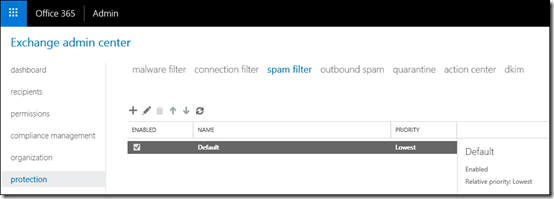
Once this has been completed, if you go and look in your Exchange Admin area, under protection and spam filter, you should see a new policy called ‘Configured Recipients’ that was created by the above script commands.

Save the script away and run it as many times as you need. That should make life easier!

Free CIAOPS Yammer support network

image

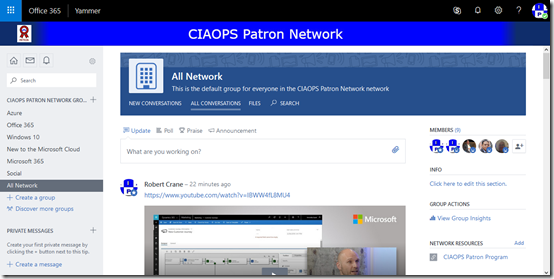
I am happy to announce that I have set up a free CIAOPS Patron support network on Yammer that is focused on the Microsoft Cloud. In there I have groups on Azure, Microsoft 365, Office 365, Windows 10 and more. Members can ask questions, reply to posts as well as a share interesting information to help others.

Although access to this network is free it is by invite only, so if you want access you’ll need to send me an email (director@ciaops.com) requesting access.

I’ve done this in Yammer for a few reasons. Firstly, it is going to give me the experience of managing a ‘larger’ Yammer external network. This will hopefully improve both my technical experience with the product but also skill me more on how to successfully implement adoption. Secondly, I’ve hopefully giving people a way to get a feel for what Yammer is all about, how it works and what benefits it provides. Yammer for me is probably the most important adoption tool as I have said before:

Focus on the “me” services first

so hopefully giving people a reason to come and experience Yammer for themselves will give them a better idea of what role it can play in a business.

Again, this offering is free but by invite only. To secure your invite just email me at director@ciaops.com.

Need to Know podcast–Episode 183

I’m joined by Gabe Long from Microsoft to look at Microsoft 365 Business in depth. Gabe has been involved with the Microsoft 365 Business product since its launch and shares with use all the great new stuff that has been added since April. Of course there is news and updates from myself and Brenton bringing you up to date with the latest from the Microsoft Cloud.

Take a listen and let us know what you think –feedback@needtoknow.cloud

You can listen directly to this episode at:

https://ciaops.podbean.com/e/episode-183-gabe-long/

Subscribe via iTunes at:

https://itunes.apple.com/au/podcast/ciaops-need-to-know-podcasts/id406891445?mt=2

The podcast is also available on Stitcher at:

http://www.stitcher.com/podcast/ciaops/need-to-know-podcast?refid=stpr

Don’t forget to give the show a rating as well as send us any feedback or suggestions you may have for the show.

Resources

Gabe Long

@contactbrenton

@directorcia

CIAOPS Patron program

Upcoming CIAOPS classroom training

Microsoft acquires GitHub

Windows switch to GitHub

Enhanced User Experience for Office 365 Advanced Threat Protection

Office 365 Advanced Threat Protection

What’s new and what’s next with Windows Autopilot

Modernize your SharePoint team sites by connecting them to new Office 365 Groups

Share your mobile screen in Teams meeting

Introducing list sharing in Microsoft To Do

Standard SSD disks for Azure VMs

3 reasons why Azure’s infrastructure is secure

Storage Explorer in Azure portal

Configuring an Office 365 SPAM filtering policy

A common complaint I hear about Office 365 from IT Professionals is that it doesn’t filter spam as well as other third party solutions. My immediate question at that point is always “Well, have you actually gone in and configured ANY of the spam settings in Office 365 to improve your results?” to which the answer is always No. Thus, if you don’t take the time to customise what you get out of the box you’ll only get an out of the box solution which is probably not what you want! Thus, some configuration is required for EVERY Office 365 tenant to improve its spam filtering abilities.

The out of the box spam settings for Office 365 are not configured in an aggressive manner and you should go in and make changes from the defaults I would suggest. Here’s how to do that.
image

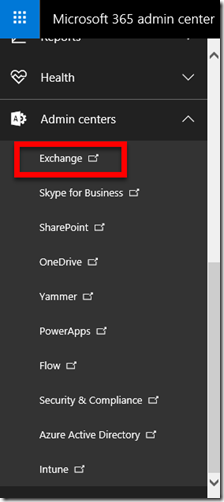
You’ll firstly need to login to the Office 365 portal as an administrator with rights to make changes. You’ll need to then navigate to the Office 365 Admin Center and select from the Admin centers on menu on the left hand side. You’ll find the Admin centers option right at the bottom.

From the list of options that now appear select Exchange as shown above.
image

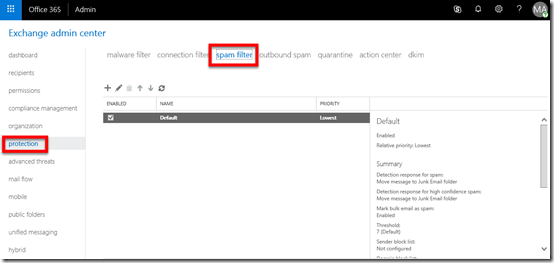
This will take you to the Exchange Admin center as shown above. In here select the protection option on the left and then spam filter on the right.

You will then typically see a single policy called Default.
image

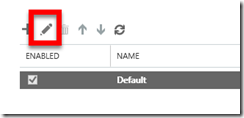
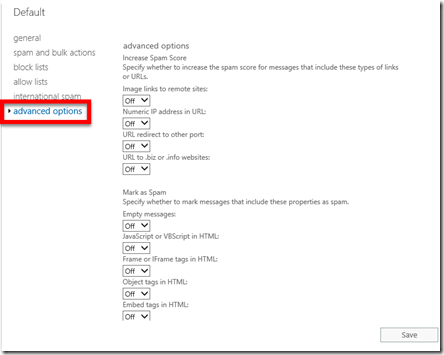
With this default policy selected, press the edit button (pencil) from the menu to view what settings this default policy has.
SNAGHTML58800d3

Select the different menu options on the left to view all the settings. Most you will see, like in the advanced settings shown above, are set to off.

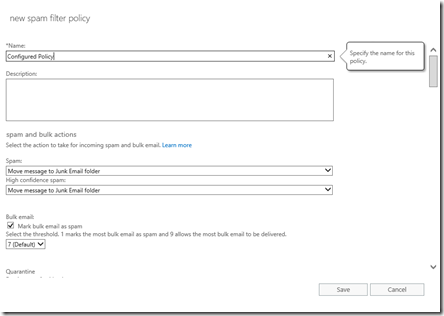
You can of course edit this default policy, however it is better practice to go back to the list of policies and create a new one and leave the default one in place.
image

When you create a new policy using the plus button (+) a new dialog will appear like show above.

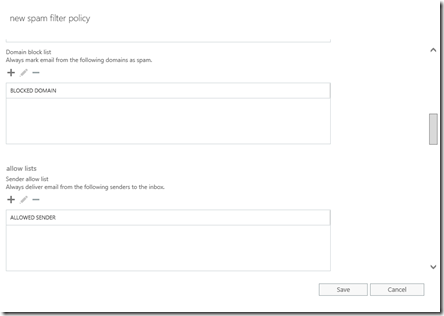
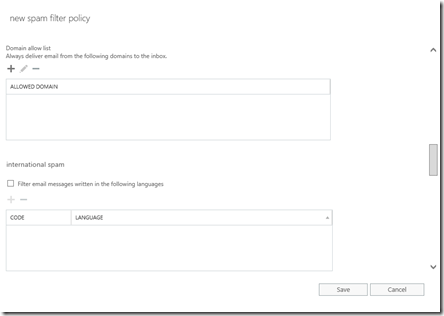
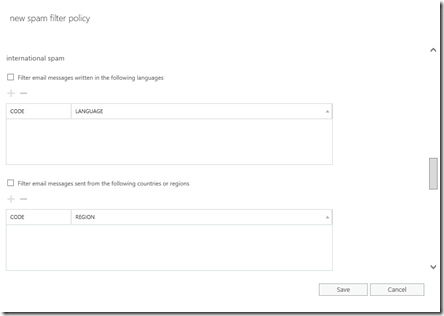
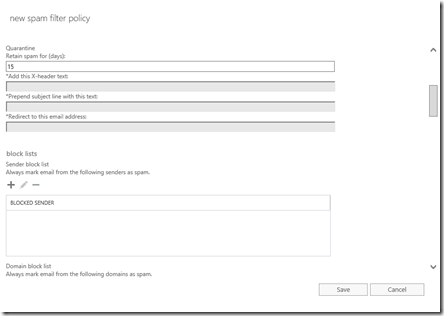
Give the new policy a name and now scroll through the settings to configure them for your needs.
image

image

image

image

image

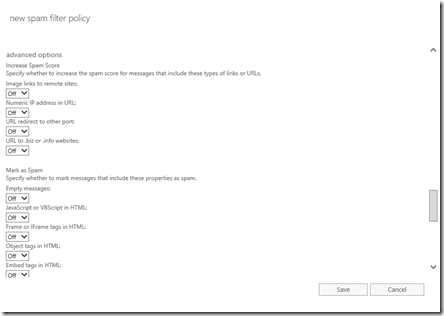
When you reach the advanced options towards the bottom you’ll see a number of options that can set on or off. The crowd sourced results I obtained for these were:

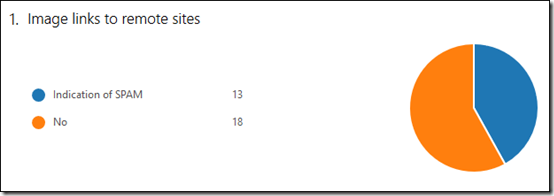
Image links to remote sites = OFF

Numeric IP addresses = ON

URL redirect to other port = ON

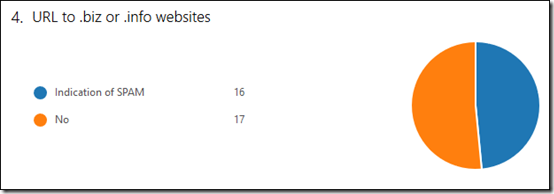
URL to .biz or .info websites = ON

Empty messages = ON

Javascript or VBScript in HTML = ON

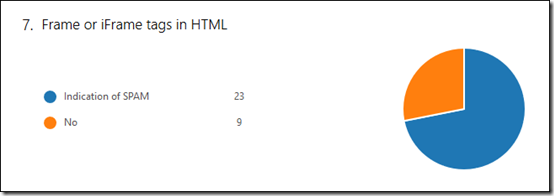
Frame or iFrame tags in HTML = ON

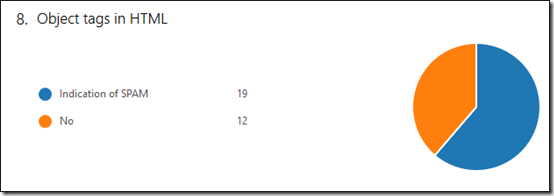
Object tags in HTML = ON

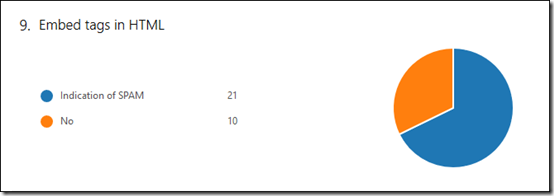
Embed tags in HTML = ON

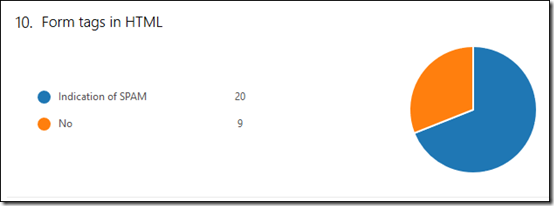
Form tags in HTML = ON

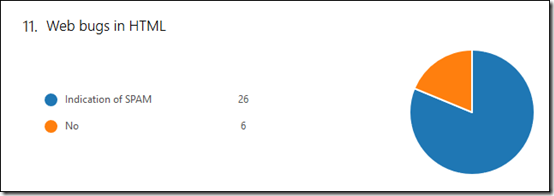
Web bugs in HTML = ON

Apply sensitive word list = ON

SPF record hard fail = ON

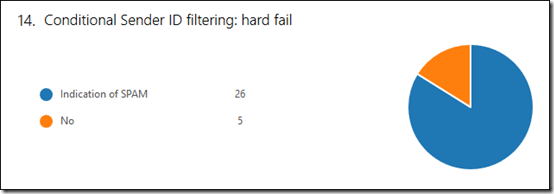
Conditional sender ID hard fail = ON

NDR backscatter = ON

image

You can then set whether the policy will simply run in test mode if you wish.
image

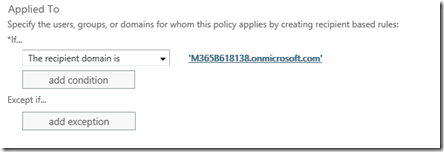
The final option is to determine where this policy will apply. Normally you want this across all your domains and users but as you see, you can have different policies for different users and domains if you wish.

All you now need to do is save the policy and start monitoring the results.

Hopefully, you can now see that out of the box Office 365 does take a very relaxed approached to spam which is not uncommon for most spam protection products. You can, and should, of course go in and configure the available options to be more restrictive. When you do this you will of course get much better results.

This post showed you how to make spam filter setting via the web interface, a much better and more consistent approach across many tenants is to do this using PowerShell. Look out for an upcoming article on this.

SPAM filtering in Office 365–Best practice results

Recently, I asked people to vote on the settings in Office 365 Spam protection they believe should be made active to improve protection. That survey will continue to run and you can add your voice here:

http://bit.ly/o365spam

However, with just over 30 votes as I write this I think we can draw some indications of what the best practice options are going to be.

So let’s start with the ones that should be definitely turned on based on a majority of votes for that condition:

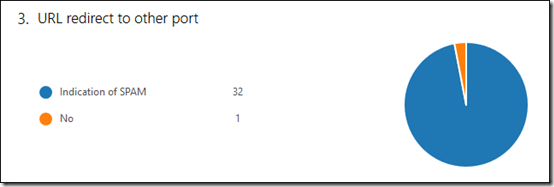
URL direction to another port = ON

image

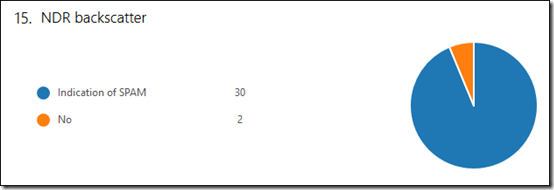
Backscatter = ON

image

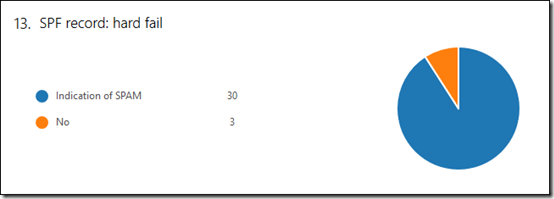
SPF Hard fail = ON

image

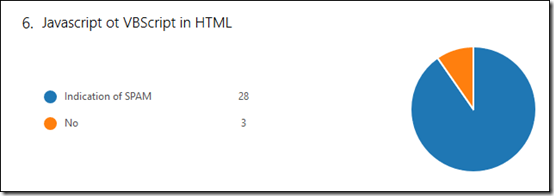
Scripts in HTML = ON

image

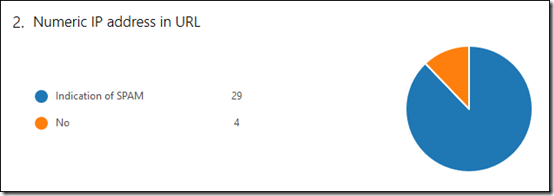
Numeric IP addresses in URL = ON

image

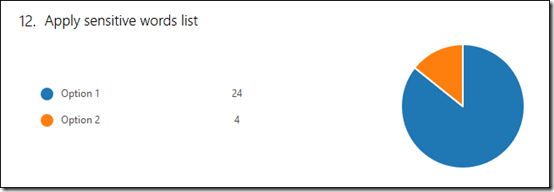
Apply sensitive words list = ON

image

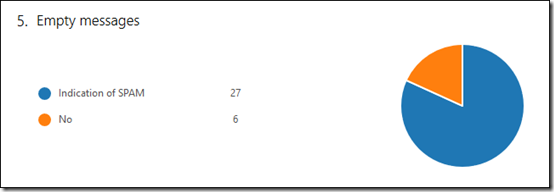
Empty Messages = ON

image

Web Bugs = ON

image

Condition Sender hard fail = ON

image

Form Tags in HTML = ON

image

Frame or iFrame tags in HTML = ON

image

Embed Tags in HTML = ON

image

Next, the one’s that should be off are:

Image links in Remote Site = OFF

image

Lastly, border line results that you probably want to set on if you want aggressive anti spam or off if you want relaxed.

Object tags in HTML = ?

image

URL to .INFO or .BIZ sites = ?

image

I’ll leave the survey running and you can check the results at any time in the future here.

In upcoming post I’ll show you how to set these options inside Office 365. However, thanks to the wisdom of the crowd (thanks to all who voted) we have an idea of what the settings should be.

SPAM filtering Office 365–Help shape a best practice

image

I hear a lot of people say that they don’t find Office 365 anti-spam filtering as good as other providers. My reply to that is – “Have you ever actually gone in and configured the settings from what is there by default?”. Unsurprisingly, the answer is always No.

The out of the box spam settings you get with Office 365 are designed for the “average” and probably configured for the least business interruption (i.e. less aggressive classification of what is spam). Thus, to get the optimal level of filtering you desire, it is recommended that you go and set the options the way that you want.

I have configured my tenant for the way I wish to handle spam but that is probably not exactly the best place for people to start. So with that in mind I thought that I’d call on the power of the crowd and offer up a survey were people can nominate what they consider to be major indicators of spam, based on the policy options that Microsoft provide. You’ll find that survey here:

http://bit.ly/o365spam

which I encourage you to fill out and share with everyone else.

The idea is that once the results are in I report back on an overall “best practices” starting policy that the majority would feel comfortable with. I can then also show you how to exactly configure that in Office 365.

So please take a moment to complete the survey and share you expertise and thought on the ‘best practice’ approach of configure anti-spam policies in Office 365.

You can find the details on the specific advanced spam filtering options in Office 365 here:

http://technet.microsoft.com/en-us/library/jj200750(v=exchg.150).aspx