ASD iOS Compliance policy check script

Screenshot 2025-11-25 085221

I’ve taken the iOS Compliance policy settings recommendations from the ASD Blueprint for Secure Cloud and created an online JSON settings file here:

https://github.com/directorcia/bp/blob/main/Intune/Policies/ASD/ios-compliance.json

I’ve then created a PowerShell script here:

https://github.com/directorcia/Office365/blob/master/asd-ioscomp-get.ps1

with documentation here:

https://github.com/directorcia/Office365/wiki/ASD-iOS-Compliance-Policy-Check

that reads the online JSON file (or uses a local version if you want to use that) and compares the recommended ASD settings to those in your own Intune environment. Note, the script makes NO CHANGES to your environment, it simply reads the current settings.

It then produces the console output you see above and a HTML report like this:

Screenshot 2025-11-25 085940

You can refer to this page I also created:

https://github.com/directorcia/bp/wiki/iOS-Compliance-Policy-Settings-%E2%80%90-Security-Rationale

as to why these settings are important to the security of your M365 environment.

Look out for more scripts like this coming soon. I welcome any suggestion about improving this.

ASD Windows Compliance policy check script

Screenshot 2025-11-19 101833

I’ve taken the Windows Compliance policy settings recommendations from the ASD Blueprint for Secure Cloud and created an online JSON settings file here:

https://github.com/directorcia/bp/blob/main/Intune/Policies/ASD/windows-compliance.json

I’ve then created a PowerShell script here:

https://github.com/directorcia/Office365/blob/master/asd-wincomp-get.ps1

with documentation here:

https://github.com/directorcia/Office365/wiki/Windows-Compliance-Policy-Check

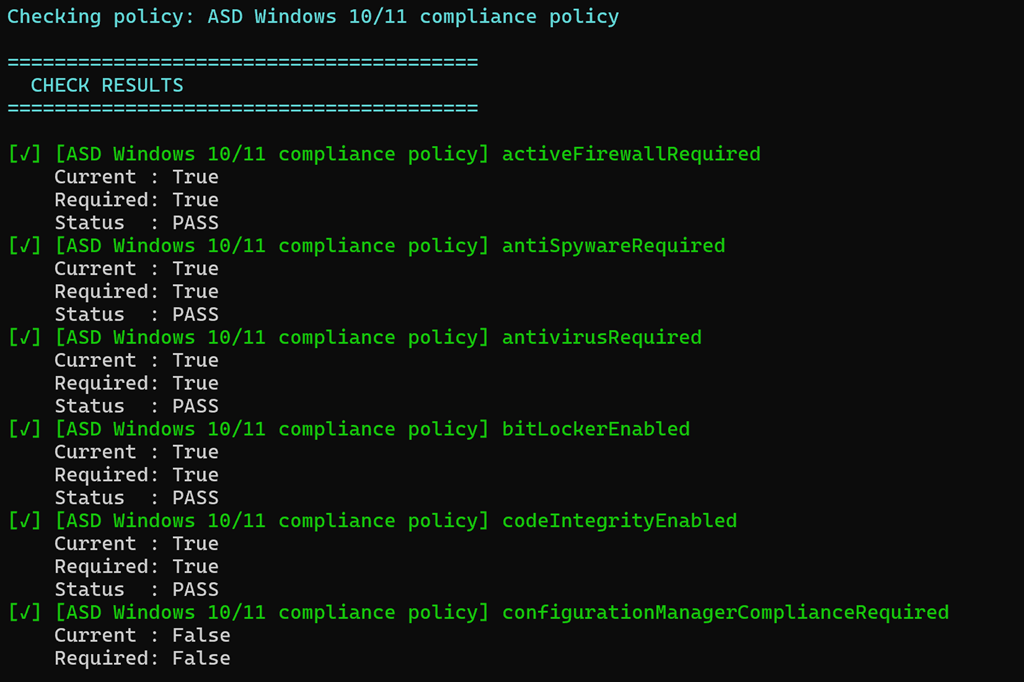
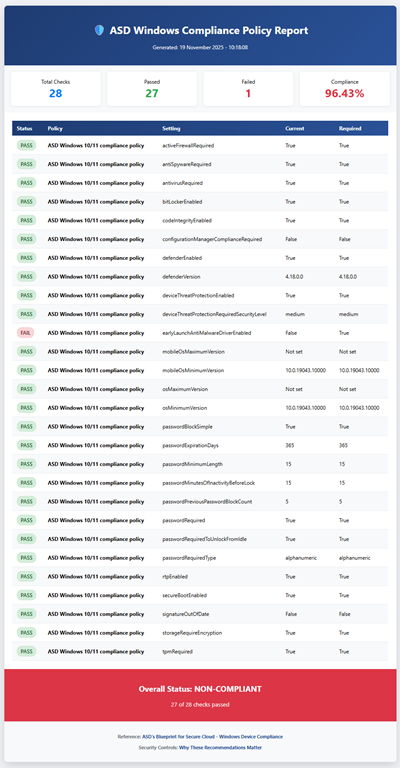
that reads the online JSON file (or uses a local version if you want to use that) and compares the recommended ASD settings to those in your own Intune environment. Note, the script makes NO CHANGES to your environment, it simply reads the current settings.

It then produces the console output you see above and a HTML report like this:

Screenshot 2025-11-19 101937

You can refer to this page I also created:

https://github.com/directorcia/bp/wiki/indows-Compliance-Policy-Settings-%E2%80%90-Security-Rationale

as to why these settings are important to the security of your M365 environment.

Look out for more scripts like this coming soon. I welcome any suggestion about improving this.

Analysis of Intune Windows 10/11 Compliance Policy Settings for Strong Security

This report examines each setting in the provided Intune Windows 10/11 compliance policy JSON and evaluates whether it represents best practice for strong security on a Windows device. For each setting, we explain its purpose, configuration options, and why the chosen value helps ensure maximum security.


Device Health Requirements (Boot Security & Encryption)

Require BitLockerBitLocker Drive Encryption is mandated on the OS drive (Require BitLocker: Yes). BitLocker uses the system’s TPM to encrypt all data on disk and locks encryption keys unless the system’s integrity is verified at boot[1]. The policy setting “Require BitLocker” ensures that data at rest is protected – if a laptop is lost or stolen, an unauthorized person cannot read the disk contents without proper authorization[1]. Options: Not configured (default, don’t check encryption) or Require (device must be encrypted with BitLocker)[1]. Setting this to “Require” is considered best practice for strong security, as unencrypted devices pose a high data breach risk[1]. In our policy JSON, BitLocker is indeed required[2], aligning with industry recommendations to encrypt all sensitive devices.

Require Secure Boot – This ensures the PC is using UEFI Secure Boot (Require Secure Boot: Yes). Secure Boot forces the system to boot only trusted, signed bootloaders. During startup, the UEFI firmware will verify that bootloader and critical kernel files are signed by a trusted authority and have not been modified[1]. If any boot file is tampered with (e.g. by a bootkit or rootkit malware), Secure Boot will prevent the OS from booting[1]. Options: Not configured (don’t enforce) or Require (must boot in secure mode)[1]. The policy requires Secure Boot[2], which is a best-practice security measure to maintain boot-time integrity. This setting helps ensure the device boots to a trusted state and is not running malicious firmware or bootloaders[1]. Requiring Secure Boot is recommended in frameworks like Microsoft’s security baselines and the CIS benchmarks for Windows, provided the hardware supports it (most modern PCs do)[1].

Require Code Integrity – Code integrity (a Device Health Attestation setting) validates the integrity of Windows system binaries and drivers each time they are loaded into memory. Enforcing this (Require code integrity: Yes) means that if any system file or driver is unsigned or has been altered by malware, the device will be reported as non-compliant[1]. Essentially, it helps detect kernel-level rootkits or unauthorized modifications to critical system components. Options: Not configured or Require (must enforce code integrity)[1]. The policy requires code integrity to be enabled[2], which is a strong security practice. This setting complements Secure Boot by continuously verifying system integrity at runtime, not just at boot. Together, Secure Boot and Code Integrity reduce the risk of persistent malware or unauthorized OS tweaks going undetected[1].

By enabling BitLocker, Secure Boot, and Code Integrity, the compliance policy ensures devices have a trusted startup environment and encrypted storage – foundational elements of a secure endpoint. These Device Health requirements align with best practices like Microsoft’s recommended security baselines (which also require BitLocker and Secure Boot) and are critical to protect against firmware malware, bootkits, and data theft[1][1]. Note: Devices that lack a TPM or do not support Secure Boot will be marked noncompliant, meaning this policy effectively excludes older, less secure hardware from the compliant device pool – which is intentional for a high-security stance.

Device OS Version Requirements

Minimum OS version – This policy defines the oldest Windows OS build allowed on a device. In the JSON, the Minimum OS version is set to 10.0.19043.10000 (which corresponds roughly to Windows 10 21H1 with a certain patch level)[2]. Any Windows device reporting an OS version lower than this (e.g. 20H2 or an unpatched 21H1) will be marked non-compliant. The purpose is to block outdated Windows versions that lack recent security fixes. End users on older builds will be prompted to upgrade to regain compliance[1]. Options: admin can specify any version string; leaving it blank means no minimum enforcement[1]. Requiring a minimum OS version is a best practice to ensure devices have received important security patches and are not running end-of-life releases[1]. The chosen minimum (10.0.19043) suggests that Windows 10 versions older than 21H1 are not allowed, which is reasonable for strong security since Microsoft no longer supports very old builds. This helps reduce vulnerabilities – for example, a device stuck on an early 2019 build would miss years of defenses (like improved ransomware protection in later releases). The policy’s min OS requirement aligns with guidance to keep devices updated to at least the N-1 Windows version or newer.

Maximum OS version – In this policy, no maximum OS version is configured (set to “Not configured”)[2]. That means devices running newer OS versions than the admin initially tested are not automatically flagged noncompliant. This is usually best, because setting a max OS version is typically used only to temporarily block very new OS upgrades that might be unapproved. Leaving it not configured (no upper limit) is often a best practice unless there’s a known issue with a future Windows release[1]. In terms of strong security, not restricting the maximum OS allows devices to update to the latest Windows 10/11 feature releases, which usually improves security. (If an organization wanted to pause Windows 11 adoption, they might set a max version to 10.x temporarily, but that’s a business decision, not a security improvement.) So the policy’s approach – no max version limit – is fine and does align with security best practice in most cases, as it encourages up-to-date systems rather than preventing them.

Why enforce OS versions? Keeping OS versions current ensures known vulnerabilities are patched. For example, requiring at least build 19043 means any device on 19042 or earlier (which have known exposures fixed in 19043+) will be blocked until updated[1]. This reduces the attack surface. The compliance policy will show a noncompliant device “OS version too low” with guidance to upgrade[1], helping users self-remediate. Overall, the OS version rules in this policy push endpoints to stay on supported, secure Windows builds, which is a cornerstone of strong device security.

*(The policy also lists “Minimum/Maximum OS version for *mobile devices” with the same values (10.0.19043.10000 / Not configured)[2]. This likely refers to Windows 10 Mobile or Holographic devices. It’s largely moot since Windows 10 Mobile is deprecated, but having the same minimum for “mobile” ensures something like a HoloLens or Surface Hub also requires an up-to-date OS. In our case, both fields mirror the desktop OS requirement, which is fine.)

Configuration Manager Compliance (Co-Management)

Require device compliance from Configuration Manager – This setting is Not configured in the JSON (i.e. it’s left at default)[2]. It applies only if the Windows device is co-managed with Microsoft Endpoint Configuration Manager (ConfigMgr/SCCM) in addition to Intune. Options: Not configured (Intune ignores ConfigMgr’s compliance state) or Require (device must also meet all ConfigMgr compliance policies)[1].

In our policy, leaving it not configured means Intune will not check ConfigMgr status – effectively the device only has to satisfy the Intune rules to be marked compliant. Is this best practice? For purely Intune-managed environments, yes – if you aren’t using SCCM baselines, there’s no need to require this. If an organization is co-managed and has on-premises compliance settings in SCCM (like additional security baselines or antivirus status monitored by SCCM), a strong security stance might enable this to ensure those are met too[1]. However, enabling it without having ConfigMgr compliance policies could needlessly mark devices noncompliant as “not reporting” (Intune would wait for a ConfigMgr compliance signal that might not exist).

So, the best practice depends on context: In a cloud-only or lightly co-managed setup, leaving this off (Not Configured) is correct[1]. If the organization heavily uses Configuration Manager to enforce other critical security settings, then best practice would be to turn this on so Intune treats any SCCM failure as noncompliance. Since this policy likely assumes modern management primarily through Intune, Not configured is appropriate and not a security gap. (Admins should ensure that either Intune covers all needed checks, or if not, integrate ConfigMgr compliance by requiring it. Here Intune’s own checks are quite comprehensive.)

System Security: Password Requirements

A very important part of device security is controlling access with strong credentials. This policy enforces a strict device password/PIN policy under the “System Security” category:

  • Require a password to unlockYes (Required). This means the device cannot be unlocked without a password or PIN. Users must authenticate on wake or login[1]. Options: Not configured (no compliance check on whether a device has a lock PIN/password set) or Require (device must have a lock screen password/PIN)[1]. Requiring a password is absolutely a baseline security requirement – a device with no lock screen PIN is extremely vulnerable (anyone with physical access could get in). The policy correctly sets this to Require[2]. Intune will flag any device without a password as noncompliant, likely forcing the user to set a Windows Hello PIN or password. This is undeniably best practice; all enterprise devices should be password/PIN protected.
  • Block simple passwordsYes (Block). “Simple passwords” refers to very easy PINs like 0000 or 1234 or repeating characters. The setting is Simple passwords: Block[1]. When enabled, Intune will require that the user’s PIN/passcode is not one of those trivial patterns. Options: Not configured (allow any PIN) or Block (disallow common simple PINs)[1]. Best practice is to block simple PINs because those are easily guessable if someone steals the device. This policy does so[2], meaning a PIN like “1111” or “12345” would not be considered compliant. Instead, users must choose less predictable codes. This is a straightforward security best practice (also recommended by Microsoft’s baseline and many standards) to defeat casual guessing attacks.
  • Password typeAlphanumeric. This setting specifies what kinds of credentials are acceptable. “Alphanumeric” in Intune means the user must set a password or PIN that includes a mix of letters and numbers (not just digits)[1]. The other options are “Device default” (which on Windows typically allows a PIN of just numbers) or explicitly Numeric (only numbers allowed)[1]. Requiring Alphanumeric effectively forces a stronger Windows Hello PIN – it must include at least one letter or symbol in addition to digits. The policy sets this to Alphanumeric[2], which is a stronger stance than a simple numeric PIN. It expands the space of possible combinations, making it much harder for an attacker to brute-force or guess a PIN. This is aligned with best practice especially if using shorter PIN lengths – requiring letters and numbers significantly increases PIN entropy. (If a device only allows numeric PINs, a 6-digit PIN has a million possibilities; an alphanumeric 6-character PIN has far more.) By choosing Alphanumeric, the admin is opting for maximum complexity in credentials.
    • Note: When Alphanumeric is required, Intune enables additional complexity rules (next setting) like requiring symbols, etc. If instead it was set to “Numeric”, those complexity sub-settings would not apply. So this choice unlocks the strongest password policy options[1].
  • Password complexity requirementsRequire digits, lowercase, uppercase, and special characters. This policy is using the most stringent complexity rule available. Under Intune, for alphanumeric passwords/PINs you can require various combinations: the default is “digits & lowercase letters”; but here it’s set to “require digits, lowercase, uppercase, and special characters”[1]. That means the user’s password (or PIN, if using Windows Hello PIN as an alphanumeric PIN) must include at least one lowercase letter, one uppercase letter, one number, and one symbol. This is essentially a classic complex password policy. Options: a range from requiring just some character types up to all four categories[1]. Requiring all four types is generally seen as a strict best practice for high security (it aligns with many compliance standards that mandate a mix of character types in passwords). The idea is to prevent users from choosing, say, all letters or all numbers; a mix of character types increases password strength. Our policy indeed sets the highest complexity level[2]. This ensures credentials are harder to crack via brute force or dictionary attacks, albeit at the cost of memorability. It’s worth noting modern NIST guidance allows passphrases (which might not have all char types) as an alternative, but in many organizations, this “at least one of each” rule remains a common security practice for device passwords.
  • Minimum password length14 characters. This defines the shortest password or PIN allowed. The compliance policy requires the device’s unlock PIN/password to be 14 or more characters long[1]. Fourteen is a relatively high minimum; by comparison, many enterprise policies set min length 8 or 10. By enforcing 14, this policy is going for very strong password length, which is consistent with guidance for high-security environments (some standards suggest 12+ or 14+ characters for administrative or highly sensitive accounts). Options: 1–16 characters can be set (the admin chooses a number)[1]. Longer is stronger – increasing length exponentially strengthens resistance to brute-force cracking. At 14 characters with the complexity rules above, the space of possible passwords is enormous, making targeted cracking virtually infeasible. This is absolutely a best practice for strong security, though 14 might be considered slightly beyond typical user-friendly lengths. It aligns with guidance like using passphrases or very long PINs for device unlock. Our policy’s 14-char minimum[2] indicates a high level of security assurance (for context, the U.S. DoD STIGs often require 15 character passwords on Windows – 14 is on par with such strict standards).
  • Maximum minutes of inactivity before password is required15 minutes. This controls the device’s idle timeout, i.e. how long a device can sit idle before it auto-locks and requires re-authentication. The policy sets 15 minutes[2]. Options: The admin can define a number of minutes; when not set, Intune doesn’t enforce an inactivity lock (though Windows may have its own default)[1]. Requiring a password after 15 minutes of inactivity is a common security practice to balance security with usability. It means if a user steps away, at most 15 minutes can pass before the device locks itself and demands a password again. Shorter timers (5 or 10 min) are more secure (less window for an attacker to sit at a logged-in machine), whereas longer (30+ min) are more convenient but risk someone opportunistically using an unlocked machine. 15 minutes is a reasonable best-practice value for enterprises – it’s short enough to limit unauthorized access, yet not so short that it frustrates users excessively. Many security frameworks recommend 15 minutes or less for session locks. This policy’s 15-minute setting is in line with those recommendations and thus supports a strong security posture. It ensures a lost or unattended laptop will lock itself in a timely manner, reducing the chance for misuse.
  • Password expiration (days)365 days. This setting forces users to change their device password after a set period. Here it is one year[2]. Options: 1–730 days or not configured[1]. Requiring password change every 365 days is a moderate approach to password aging. Traditional policies often used 90 days, but that can lead to “password fatigue.” Modern NIST guidelines actually discourage frequent forced changes (unless there’s evidence of compromise) because overly frequent changes can cause users to choose weaker passwords or cycle old ones. However, annual expiration (365 days) is relatively relaxed and can be seen as a best practice in some environments to ensure stale credentials eventually get refreshed[1]. It’s basically saying “change your password once a year.” Many organizations still enforce yearly or biannual password changes as a precaution. In terms of strong security, this setting provides some safety net (in case a password was compromised without the user knowing, it won’t work indefinitely). It’s not as critical as the other settings; one could argue that with a 14-char complex password, forced expiration isn’t strictly necessary. But since it’s set, it reflects a security mindset of not letting any password live forever. Overall, 365 days is a reasonable compromise – it’s long enough that users can memorize a strong password, and short enough to ensure a refresh if by chance a password leaked over time. This is largely aligned with best practice, though some newer advice would allow no expiration if other controls (like multifactor auth) are in place. In a high-security context, annual changes remain common policy.
  • Number of previous passwords to prevent reuse5. This means when a password is changed (due to expiration or manual change), the user cannot reuse any of their last 5 passwords[1]. Options: Typically can set a value like 1–50 previous passwords to disallow. The policy chose 5[2]. This is a standard part of password policy – preventing reuse of recent passwords helps ensure that when users do change their password, they don’t just alternate between a couple of favorites. A history of 5 is pretty typical in best practices (common ranges are 5–10) to enforce genuine password updates. This setting is definitely a best practice in any environment with password expiration – otherwise users might just swap back and forth between two passwords. By disallowing the last 5, it will take at least 6 cycles (in this case 6 years, given 365-day expiry) before one could reuse an old password, by which time it’s hoped that password would have lost any exposure or the user comes up with a new one entirely. The policy’s value of 5 is fine and commonly recommended.
  • Require password when device returns from idle stateYes (Required). This particularly applies to mobile or Holographic devices, but effectively it means a password is required upon device wake from an idle or sleep state[1]. On Windows PCs, this corresponds to the “require sign-in on wake” setting. Since our idle timeout is 15 minutes, this ensures that when the device is resumed (after sleeping or being idle past that threshold), the user must sign in again. Options: Not configured or Require[1]. The policy sets it to Require[2], which is certainly what we want – it’d be nonsensical to have all the above password rules but then not actually lock on wake! In short, this enforces that the password/PIN prompt appears after the idle period or sleep, which is absolutely a best practice. (Without this, a device could potentially wake up without a login prompt, which would undermine the idle timeout.) Windows desktop devices are indeed impacted by this on next sign-in after an idle, as noted in docs[1]. So this setting ties the loop on the secure password policy: not only must devices have strong credentials, but those credentials must be re-entered after a period of inactivity, ensuring continuous protection.

Summary of Password Policy: The compliance policy highly prioritizes strong access control. It mandates a login on every device (no password = noncompliant), and that login must be complex (not guessable, not short, contains diverse characters). The combination of Alphanumeric, 14+ chars, all character types, no simple PINs is about as strict as Windows Intune allows for user sign-in credentials[1][2]. This definitely meets the definition of best practice for strong security – it aligns with standards like CIS benchmarks which also suggest enforcing password complexity and length. Users might need to use passphrases or a mix of PIN with letters to meet this, but that is intended. The idle lock at 15 minutes and requirement to re-authenticate on wake ensure that even an authorized session can’t be casually accessed if left alone for long. The annual expiration and password history add an extra layer to prevent long-term use of any single password or recycling of old credentials, which is a common corporate security requirement.

One could consider slight adjustments: e.g., some security frameworks (like NIST SP 800-63) would possibly allow no expiration if the password is sufficiently long and unique (to avoid users writing it down or making minor changes). However, given this is a “strong security” profile, the chosen settings err on the side of caution, which is acceptable. Another improvement for extreme security could be shorter idle time (like 5 minutes) to lock down faster, but 15 minutes is generally acceptable and strikes a balance. Overall, these password settings significantly harden the device against unauthorized access and are consistent with best practices.

Encryption of Data Storage on Device

Require encryption of data storage on deviceYes (Required). Separate from the BitLocker requirement in Device Health, Intune also has a general encryption compliance rule. Enabling this means the device’s drives must be encrypted (with BitLocker, in the case of Windows) or else it’s noncompliant[1]. In our policy, “Encryption: Require” is set[2]. Options: Not configured or Require[1]. This is effectively a redundant safety net given BitLocker is also specifically required. According to Microsoft, the “Encryption of data storage” check looks for any encryption present (on the OS drive), and specifically on Windows it checks BitLocker status via a device report[1]. It’s slightly less robust than the Device Health attestation for BitLocker (which needs a reboot to register, etc.), but it covers the scenario generally[1].

From a security perspective, requiring device encryption is unquestionably best practice. It ensures that if a device’s drive isn’t encrypted (for example, BitLocker not enabled or turned off), the device will be flagged. This duplicates the BitLocker rule; having both doesn’t hurt – in fact, Microsoft documentation suggests the simpler encryption compliance might catch the state even if attestation hasn’t updated (though the BitLocker attestation is more reliable for TPM verification of encryption)[1].

In practice, an admin could use one or the other. This policy enables both, which indicates a belt-and-suspenders approach: either way, an unencrypted device will not slip through. This is absolutely aligned with strong security – all endpoints must have storage encryption, mitigating the risk of data exposure from lost or stolen hardware. Modern best practices (e.g. CIS, regulatory requirements like GDPR for laptops with personal data) often mandate full-disk encryption; here it’s enforced twice. The documentation even notes that relying on the BitLocker-specific attestation is more robust (it checks at the TPM level and knows the device booted with BitLocker enabled)[1][1]. The generic encryption check is a bit more broad but for Windows equates to BitLocker anyway. The key point is the policy requires encryption, which we already confirmed is a must-have security control. If BitLocker was somehow not supported on a device (very rare on Windows 10/11, since even Home edition has device encryption now), that device would simply fail compliance – again, meaning only devices capable of encryption and actually encrypted are allowed, which is appropriate for a secure environment.

(Note: Since both “Require BitLocker” and “Require encryption” are turned on, an Intune admin should be aware that a device might show two noncompliance messages for essentially the same issue if BitLocker is off. Users would see that they need to turn on encryption to comply. Once BitLocker is enabled and the device rebooted, both checks will pass[1][1]. The rationale for using both might be to ensure that even if the more advanced attestation didn’t report, the simpler check would catch it.)

Device Security Settings (Firewall, TPM, AV, Anti-spyware)

This section of the policy ensures that essential security features of Windows are active:

  • FirewallRequire. The policy mandates that the Windows Defender Firewall is enabled on the device (Firewall: Require)[1]. This means Intune will mark the device noncompliant if the firewall is turned off or if a user/app tries to disable it. Options: Not configured (do not check firewall status) or Require (firewall must be on)[1]. Requiring the firewall is definitely best practice – a host-based firewall is a critical first line of defense against network-based attacks. The Windows Firewall helps block unwanted inbound connections and can enforce outbound rules as well. By ensuring it’s always on (and preventing users from turning it off), the policy guards against scenarios where an employee might disable the firewall and expose the machine to threats[1]. This setting aligns with Microsoft recommendations and CIS Benchmarks, which also advise that Windows Firewall be enabled on all profiles. Our policy sets it to Require[2], which is correct for strong security. (One thing to note: if there were any conflicting GPO or config that turns the firewall off or allows all traffic, Intune would consider that noncompliant even if Intune’s own config profile tries to enable it[1] – essentially, Intune checks the effective state. Best practice is to avoid conflicts and keep the firewall defaults to block inbound unless necessary[1].)
  • Trusted Platform Module (TPM)Require. This check ensures the device has a TPM chip present and enabled (TPM: Require)[1]. Intune will look for a TPM security chip and mark the device noncompliant if none is found or it’s not active. Options: Not configured (don’t verify TPM) or Require (TPM must exist)[1]. TPM is a hardware security module used for storing cryptographic keys (like BitLocker keys) and for platform integrity (measured boot). Requiring a TPM is a strong security stance because it effectively disallows devices that lack modern hardware security support. Most Windows 10/11 PCs do have TPM 2.0 (Windows 11 even requires it), so this is feasible and aligns with best practices. It ensures features like BitLocker are using TPM protection and that the device can do hardware attestation. The policy sets TPM to required[2], which is a best practice consistent with Microsoft’s own baseline (they recommend excluding non-TPM machines, as those are typically older or less secure). By enforcing this, you guarantee that keys and sensitive operations can be hardware-isolated. A device without TPM could potentially store BitLocker keys in software (less secure) or not support advanced security like Windows Hello with hardware-backed credentials. So from a security viewpoint, this is the right call. Any device without a TPM (or with it disabled) will need remediation or replacement, which is acceptable in a high-security environment. This reflects a zero-trust hardware approach: only modern, TPM-equipped devices can be trusted fully[1].
  • AntivirusRequire. The compliance policy requires that antivirus protection is active and up-to-date on the device (Antivirus: Require)[1]. Intune checks the Windows Security Center status for antivirus. If no antivirus is registered, or if the AV is present but disabled/out-of-date, the device is noncompliant[1]. Options: Not configured (don’t check AV) or Require (must have AV on and updated)[1]. It’s hard to overstate the importance of this: running a reputable, active antivirus/antimalware is absolutely best practice on Windows. The policy’s requirement means every device must have an antivirus engine running and not report any “at risk” state. Windows Defender Antivirus or a third-party AV that registers with Security Center will satisfy this. If a user has accidentally turned off real-time protection or if the AV signatures are old, Intune will flag it[1]. Enforcing AV is a no-brainer for strong security. This matches all industry guidance (e.g., CIS Controls highlight the need for anti-malware on all endpoints). Our policy does enforce it[2].
  • AntispywareRequire. Similar to antivirus, this ensures anti-spyware (malware protection) is on and healthy (Antispyware: Require)[1]. In modern Windows terms, “antispyware” is essentially covered by Microsoft Defender Antivirus as well (Defender handles viruses, spyware, all malware). But Intune treats it as a separate compliance item to check in Security Center. This setting being required means the anti-malware software’s spyware detection component (like Defender’s real-time protection for spyware/PUPs) must also be enabled and not outdated[1]. Options: Not configured or Require, analogous to antivirus[1]. The policy sets it to Require[2]. This is again best practice – it ensures comprehensive malware protection is in place. In effect, having both AV and antispyware required just double-checks that the endpoint’s security suite is fully active. If using Defender, it covers both; if using a third-party suite, as long as it reports to Windows Security Center for both AV and antispyware status, it will count. This redundancy helps catch any scenario where maybe virus scanning is on but spyware definitions are off (though that’s rare with unified products). For our purposes, requiring antispyware is simply reinforcing the “must have anti-malware” rule – clearly aligned with strong security standards.

Collectively, these Device Security settings (Firewall, TPM, AV, antispyware) ensure that critical protective technologies are in place on every device:

  • The firewall requirement guards against network attacks and unauthorized connections[1].
  • The TPM requirement ensures hardware-based security for encryption and identity[1].
  • The AV/antispyware requirements ensure continuous malware defense and that no device is left unprotected against viruses or spyware[1].

All are definitely considered best practices. In fact, running without any of these (no firewall, no AV, etc.) would be considered a serious security misconfiguration. This policy wisely enforces all of them. Any device not meeting these (e.g., someone attempts to disable Defender Firewall or uninstall AV) will get swiftly flagged, which is exactly what we want in a secure environment.

*(Side note: The policy’s reliance on Windows Security Center means it’s vendor-agnostic; e.g., if an organization uses Symantec or another AV, as long as that product reports a good status to Security Center, Intune will see the device as compliant for AV/antispyware. If a third-party AV is used that *disables* Windows Defender, that’s fine because Security Center will show another AV is active. The compliance rule will still require that one of them is active. So this is a flexible but strict enforcement of “you must have one”.)*

Microsoft Defender Anti-malware Requirements

The policy further specifies settings under Defender (Microsoft Defender Antivirus) to tighten control of the built-in anti-malware solution:

  • Microsoft Defender AntimalwareRequire. This means the Microsoft Defender Antivirus service must be running and cannot be turned off by the user[1]. If the device’s primary AV is Defender (as is default on Windows 10/11 when no other AV is installed), this ensures it stays on. Options: Not configured (Intune doesn’t ensure Defender is on) or Require (Defender AV must be enabled)[1]. Our policy sets it to Require[2], which is a strong choice. If a third-party AV is present, how does this behave? Typically, when a third-party AV is active, Defender goes into a passive mode but is still not “disabled” in Security Center terms – or it might hand over status. This setting primarily aims to prevent someone from turning off Defender without another AV in place. Requiring Defender antivirus to be on is a best practice if your organization relies on Defender as the standard AV. It ensures no one (intentionally or accidentally) shuts off Windows’ built-in protection[1]. It essentially overlaps with the “Antivirus: Require” setting, but is more specific. The fact that both are set implies this environment expects to use Microsoft Defender on all machines (which is common for many businesses). In a scenario where a user installed a 3rd party AV that doesn’t properly report to Security Center, having this required might actually conflict (because Defender might register as off due to third-party takeover, thus Intune might mark noncompliant). But assuming standard behavior, if third-party AV is present and reporting, Security Center usually shows “Another AV is active” – Intune might consider the AV check passed but the “Defender Antimalware” specifically could possibly see Defender as not the active engine and flag it. In any case, for strong security, the ideal is to have a consistent AV (Defender) across all devices. So requiring Defender is a fine security best practice, and our policy reflects that intention. It aligns with Microsoft’s own baseline for Intune when organizations standardize on Defender. If you weren’t standardized on Defender, you might leave this not configured and just rely on the generic AV requirement. Here it’s set, indicating a Defender-first strategy for antimalware.
  • Microsoft Defender Antimalware minimum version4.18.0.0. This setting specifies the lowest acceptable version of the Defender Anti-Malware client. The policy has defined 4.18.0.0 as the minimum[2]. Effect: If a device has an older Defender engine below that version, it’s noncompliant. Version 4.18.x is basically the Defender client that ships with Windows 10 and above (Defender’s engine is updated through Windows Update periodically, but the major/minor version has been 4.18 for a long time). By setting 4.18.0.0, essentially any Windows 10/11 with Defender should meet it (since 4.18 was introduced years ago). This catches only truly outdated Defender installations (perhaps if a machine had not updated its Defender platform in a very long time, or is running Windows 8.1/7, which had older Defender versions – though those OS wouldn’t be in a Win10 policy anyway). Options: Admin can input a specific version string, or leave blank (no version enforcement)[1]. The policy chose 4.18.0.0, presumably because that covers all modern Windows builds (for example, Windows 10 21H2 uses Defender engine 4.18.x). Requiring a minimum Defender version is a good practice to ensure the anti-malware engine itself isn’t outdated. Microsoft occasionally releases new engine versions with improved capabilities; if a machine somehow fell way behind (e.g., an offline machine that missed engine updates), it could have known issues or be missing detection techniques. By enforcing a minimum, you compel those devices to update their Defender platform. Version 4.18.0.0 is effectively the baseline for Windows 10, so this is a reasonable choice. It’s likely every device will already have a later version (like 4.18.210 or similar). As a best practice, some organizations might set this to an even more recent build number if they want to ensure a certain monthly platform update is installed. In any case, including this setting in the policy shows thoroughness – it’s making sure Defender isn’t an old build. This contributes to security by catching devices that might have the Defender service but not the latest engine improvements. Since the policy’s value is low (4.18.0.0), practically all supported Windows 10/11 devices comply, but it sets a floor that excludes any unsupported OS or really old install. This aligns with best practice: keep security software up-to-date, both signatures and the engine. (The admin should update this minimum version over time if needed – e.g., if Microsoft releases Defender 4.19 or 5.x in the future, they might raise the bar.)
  • Microsoft Defender security intelligence up-to-dateRequire. This is basically ensuring Defender’s virus definitions (security intelligence) are current (Security intelligence up-to-date: Yes)[1]. If Defender’s definitions are out of date, Intune will mark noncompliant. “Up-to-date” typically means the signature is not older than a certain threshold (usually a few days, defined by Windows Security Center’s criteria). Options: Not configured (don’t check definitions currency) or Require (must have latest definitions)[1]. It’s set to Require in our policy[2]. This is clearly a best practice – an antivirus is only as good as its latest definitions. Ensuring that the AV has the latest threat intelligence is critical. This setting will catch devices that, for instance, haven’t gone online in a while or are failing to update Defender signatures. Those devices would be at risk from newer malware until they update. By marking them noncompliant, it forces an admin/user to take action (e.g. connect to the internet to get updates)[1]. This contributes directly to security, keeping anti-malware defenses sharp. It aligns with common security guidelines that AV should be kept current. Since Windows usually updates Defender signatures daily (or more), this compliance rule likely treats a device as noncompliant if signatures are older than ~3 days (Security Center flag). This policy absolutely should have this on, and it does – another check in the box for strong security practice.
  • Real-time protectionRequire. This ensures that Defender’s real-time protection is enabled (Realtime protection: Require)[1]. Real-time protection means the antivirus actively scans files and processes as they are accessed, rather than only running periodic scans. If a user had manually turned off real-time protection (which Windows allows for troubleshooting, or sometimes malware tries to disable it), this compliance rule would flag the device. Options: Not configured or Require[1]. Our policy requires it[2]. This is a crucial setting: real-time protection is a must for proactive malware defense. Without it, viruses or spyware could execute without immediate detection, and you’d only catch them on the next scan (if at all). Best practice is to never leave real-time protection off except perhaps briefly to install certain software, and even then, compliance would catch that and mark the device not compliant with policy. So turning this on is definitely part of a strong security posture. The policy correctly enforces it. It matches Microsoft’s baseline and any sane security policy – you want continuous scanning for threats in real time. The Intune CSP for this ensures that the toggle in Windows Security (“Real-time protection”) stays on[1]. Even if a user is local admin, turning it off will flip the device to noncompliant (and possibly trigger Conditional Access to cut off corporate resource access), strongly incentivizing them not to do that. Good move.

In summary, the Defender-specific settings in this policy double-down on malware protection:

  • The Defender AV engine must be active (and presumably they expect to use Defender on all devices)[1].
  • Defender must stay updated – both engine version and malware definitions[1][1].
  • Real-time scanning must be on at all times[1].

These are all clearly best practices for endpoint security. They ensure the built-in Windows security is fully utilized. The overlap with the general “Antivirus/Antenna” checks means there’s comprehensive coverage. Essentially, if a device doesn’t have Defender, the general AV required check would catch it; if it does have Defender, these specific settings enforce its quality and operation. No device should be running with outdated or disabled Defender in a secure environment, and this compliance policy guarantees that.

(If an organization did use a third-party AV instead of Defender, they might not use these Defender-specific settings. The presence of these in the JSON indicates alignment with using Microsoft Defender as the standard. That is indeed a good practice nowadays, as Defender has top-tier ratings and seamless integration. Many “best practice” guides, including government blueprints, now assume Defender is the AV to use, due to its strong performance and integration with Defender for Endpoint.)

Microsoft Defender for Endpoint (MDE) – Device Threat Risk Level

Finally, the policy integrates with Microsoft Defender for Endpoint (MDE) by using the setting:

  • Require the device to be at or under the machine risk scoreMedium. This ties into MDE’s threat intelligence, which assesses each managed device’s risk level (based on detected threats on that endpoint). The compliance policy is requiring that a device’s risk level be Medium or lower to be considered compliant[1]. If MDE flags a device as High risk, Intune will mark it noncompliant and can trigger protections (like Conditional Access blocking that device). Options: Not configured (don’t use MDE risk in compliance) or one of Clear, Low, Medium, High as the maximum allowed threat level[1]. The chosen value “Medium” means: any device with a threat rated High is noncompliant, while devices with Low or Medium threats are still compliant[1]. (Clear would be the most strict – requiring absolutely no threats; High would be least strict – tolerating even high threats)[1].

Setting this to Medium is a somewhat balanced security stance. Let’s interpret it: MDE categorizes threats on devices (malware, suspicious activity) into risk levels. By allowing up to Medium, the policy is saying if a device has only low or medium-level threats, we still consider it compliant; but if it has any high-level threat, that’s unacceptable. High usually indicates serious malware outbreaks or multiple alerts, whereas low may indicate minimal or contained threats. From a security best-practice perspective, using MDE’s risk as a compliance criterion is definitely recommended – it adds an active threat-aware dimension to compliance. The choice of Medium as the cutoff is probably to avoid overly frequent lockouts for minor issues, while still reacting to major incidents.

Many security experts would advocate for even stricter: e.g. require Low or Clear (meaning even medium threats would cause noncompliance), especially in highly secure environments where any malware is concerning. In fact, Microsoft’s documentation notes “Clear is the most secure, as the device can’t have any threats”[1]. Medium is a reasonable compromise – it will catch machines with serious infections but not penalize ones that had a low-severity event that might have already been remediated. For example, if a single low-level adware was detected and quarantined, risk might be low and the device remains compliant; but if ransomware or multiple high-severity alerts are active, risk goes high and the device is blocked until cleaned[1].

In our policy JSON, it’s set to Medium[2], which is in line with many best practice guides (some Microsoft baseline recommendations also use Medium as the default, to balance security and usability). This is still considered a strong security practice because any device under an active high threat will immediately be barred. It leverages real-time threat intelligence from Defender for Endpoint to enhance compliance beyond just configuration. That means even if a device meets all the config settings above, it could still be blocked if it’s actively compromised – which is exactly what we want. It’s an important part of a Zero Trust approach: continuously monitor device health and risk, not just initial compliance.

One could tighten this to Low for maximum security (meaning even medium threats cause noncompliance). If an organization has low tolerance for any malware, they might do that. However, Medium is often chosen to avoid too many disruptions. For our evaluation: The inclusion of this setting at all is a best practice (many might forget to use it). The threshold of Medium is acceptable for strong security, catching big problems while allowing IT some leeway to investigate mediums without immediate lockout. And importantly, if set to Medium, only devices with severe threats (like active malware not neutralized) will be cut off, which likely correlates with devices that indeed should be isolated until fixed.

To summarize, the Defender for Endpoint integration means this compliance policy isn’t just checking the device’s configuration, but also its security posture in real-time. This is a modern best practice: compliance isn’t static. The policy ensures that if a device is under attack or compromised (per MDE signals), it will lose its compliant status and thus can be auto-remediated or blocked from sensitive resources[1]. This greatly strengthens the security model. Medium risk tolerance is a balanced choice – it’s not the absolute strictest, but it is still a solid security stance and likely appropriate to avoid false positives blocking users unnecessarily.

(Note: Organizations must have Microsoft Defender for Endpoint properly set up and the devices onboarded for this to work. Given it’s in the policy, we assume that’s the case, which is itself a security best practice – having EDR (Endpoint Detection & Response) on all endpoints.)

Actions for Noncompliance and Additional Considerations

The JSON policy likely includes Actions for noncompliance (the blueprint shows an action “Mark device noncompliant (1)” meaning immediate)[2]. By default, Intune always marks a device as noncompliant if it fails a setting – which is what triggers Conditional Access or other responses. The policy can also be configured to send email notifications, or after X days perform device retire/wipe, etc. The snippet indicates the default action to mark noncompliant is at day 1 (immediately)[2]. This is standard and aligns with security best practice – you want noncompliant devices to be marked as such right away. Additional actions (like notifying user, or disabling the device) could be considered but are not listed.

It’s worth noting a few maintenance and dependency points:

  • Updating the Policy: As new Windows versions release, the admin should review the Minimum OS version field and advance it when appropriate (for example, when Windows 10 21H1 becomes too old, they might raise the minimum to 21H2 or Windows 11). Similarly, the Defender minimum version can be updated over time. Best practice is to review compliance policies at least annually (or along with major new OS updates)[1][1] to keep them effective.
  • Device Support: Some settings have hardware prerequisites (TPM, Secure Boot, etc.). In a strong security posture, devices that don’t meet these (older hardware) should ideally be phased out. This policy enforces that by design. If an organization still has a few legacy devices without TPM, they might temporarily drop the TPM requirement or grant an exception group – but from a pure security standpoint, it’s better to upgrade those devices.
  • User Impact and Change Management: Enforcing these settings can pose adoption challenges. For example, requiring a 14-character complex password might generate more IT support queries or user friction initially. It is best practice to accompany such policy with user education and perhaps rollout in stages. The policy as given is quite strict, so ensuring leadership backing and possibly implementing self-service password reset (to handle expiry) would be wise. These aren’t policy settings per se, but operational best practices.
  • Complementary Policies: A compliance policy like this ensures baseline security configuration, but it doesn’t directly configure the settings on the device (except for password requirement which the user is prompted to set). It checks and reports compliance. To actually turn on things like BitLocker or firewall if they’re off, one uses Configuration Profiles or Endpoint Security policies in Intune. Best practice is to pair compliance policies with configuration profiles that enable the desired settings. For instance, enabling BitLocker via an Endpoint Security policy and then compliance verifies it’s on. The question focuses on compliance policy, so our scope is those checks, but it’s assumed the organization will also deploy policies to turn on BitLocker, firewall, Defender, etc., making it easy for devices to become compliant.
  • Protected Characteristics: Every setting here targets technical security and does not discriminate or involve user personal data, so no concerns there. From a privacy perspective, the compliance data is standard device security posture info.

Conclusion

Overall, each setting in this Windows compliance policy aligns with best practices for securing Windows 10/11 devices. The policy requires strong encryption, up-to-date and secure OS versions, robust password/PIN policies, active firewall and anti-malware, and even ties into advanced threat detection (Defender for Endpoint)[2][2]. These controls collectively harden the devices against unauthorized access, data loss, malware infections, and unpatched vulnerabilities.

Almost all configurations are set to their most secure option (e.g., requiring vs not, or maximum complexity) as one would expect in a high-security baseline:

  • Data protection is ensured by BitLocker encryption on disk[1].
  • Boot integrity is assured via Secure Boot and Code Integrity[1].
  • Only modern, supported OS builds are allowed[1].
  • Users must adhere to a strict password policy (complex, long, regularly changed)[1].
  • Critical security features (firewall, AV, antispyware, TPM) must be in place[1][1].
  • Endpoint Defender is kept running in real-time and up-to-date[1].
  • Devices under serious threat are quarantined via noncompliance[1].

All these are considered best practices by standards such as the CIS Benchmark for Windows and government cybersecurity guidelines (for example, the ASD Essential Eight in Australia, which this policy closely mirrors, calls for application control, patching, and admin privilege restriction – many of which this policy supports by ensuring fundamental security hygiene on devices).

Are there any settings that might not align with best practice? Perhaps the only debatable one is the 365-day password expiration – modern NIST guidelines suggest you don’t force changes on a schedule unless needed. However, many organizations still view an annual password change as reasonable policy in a defense-in-depth approach. It’s a mild requirement and not draconian, so it doesn’t significantly detract from security; if anything, it adds a periodic refresh which can be seen as positive (with the understanding that user education is needed to avoid predictable changes). Thus, we wouldn’t call it a wrong practice – it’s an accepted practice in many “strong security” environments, even if some experts might opt not to expire passwords arbitrarily. Everything else is straightforwardly as per best practice or even exceeding typical baseline requirements (e.g., 14 char min is quite strong).

Improvements or additions: The policy as given is already thorough. An organization could consider tightening the Defender for Endpoint risk level to Low (meaning only absolutely clean devices are compliant) if they wanted to be extra careful – but that could increase operational noise if minor issues trigger noncompliance too often[1]. They could also reduce the idle timeout to, say, 5 or 10 minutes for devices in very sensitive environments (15 minutes is standard, though stricter is always an option). Another possible addition: enabling Jailbreak detection – not applicable for Windows (it’s more for mobile OS), Windows doesn’t have a jailbreak setting beyond what we covered (DHA covers some integrity). Everything major in Windows compliance is covered here.

One more setting outside of this device policy that’s a tenant-wide setting is “Mark devices with no compliance policy as noncompliant”, which we would assume is enabled at the Intune tenant level for strong security (so that any device that somehow doesn’t get this policy is still not trusted)[3]. The question didn’t include that, but it’s a part of best practices – likely the organization would have set it to Not compliant at the tenant setting to avoid unmanaged devices slipping through[3].

In conclusion, each listed setting is configured in line with strong security best practices for Windows devices. The policy reflects an aggressive security posture: it imposes strict requirements that greatly reduce the risk of compromise. Devices that meet all these conditions will be quite well-hardened against common threats. Conversely, any device failing these checks is rightfully flagged for remediation, which helps the IT team maintain a secure fleet. This compliance policy, especially when combined with Conditional Access (to prevent noncompliant devices from accessing corporate data) and proper configuration policies (to push these settings onto devices), provides an effective enforcement of security standards across the Windows estate[3][3]. It aligns with industry guidelines and should substantially mitigate risks such as data breaches, malware incidents, and unauthorized access. Each setting plays a role: from protecting data encryption and boot process to enforcing user credentials and system health – together forming a comprehensive security baseline that is indeed consistent with best practices.

[1][2]

References

[1] Windows compliance settings in Microsoft Intune

[2] Windows 10/11 Compliance Policy | ASD’s Blueprint for Secure Cloud

[3] Device compliance policies in Microsoft Intune

Blocking Applications on Windows Devices using Intune (M365 Business Premium)

Blocking Applications on Windows Devices using Intune (M365 Business Premium)

Managing which applications can run on company devices is crucial for security and productivity. Microsoft Intune (part of Microsoft 365 Business Premium) offers powerful ways to block or restrict applications on Windows 10/11 devices. This guide explains the most effective method – using Intune’s Mobile Device Management (MDM) with AppLocker – in a step-by-step manner. We also cover an alternative app-level approach using Intune’s Mobile Application Management (MAM) for scenarios like BYOD.

Introduction and Key Concepts

Microsoft Intune is a cloud-based endpoint management service (included with M365 Business Premium along with Azure AD Premium P1) that provides both MDM and MAM capabilities[1]. In the context of blocking applications on Windows:

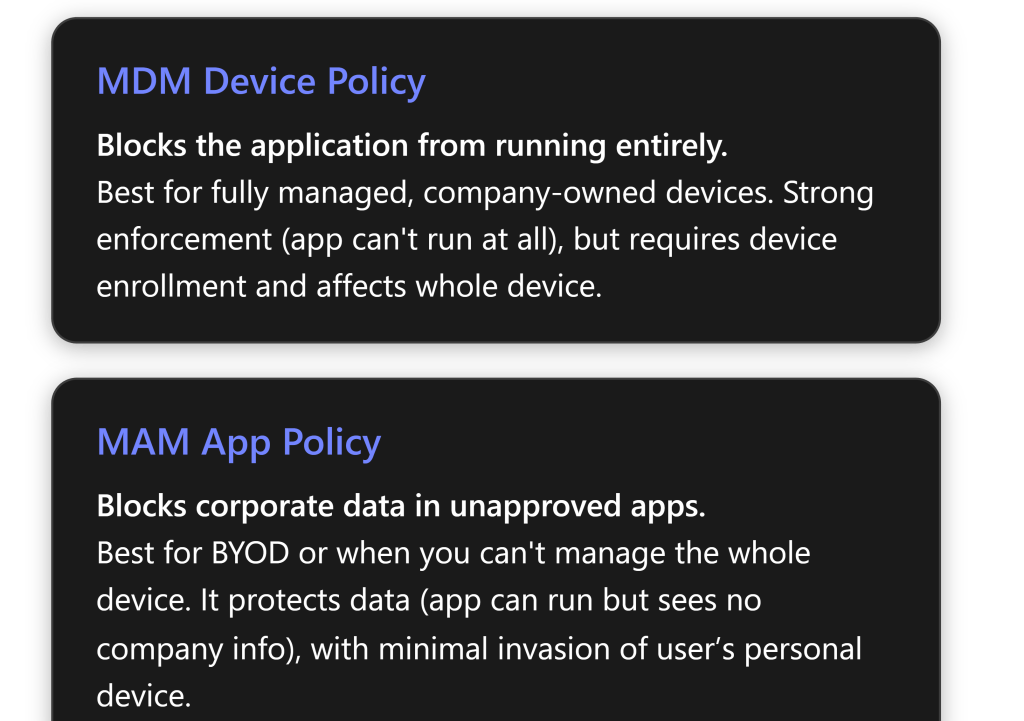
  • MDM (Mobile Device Management) means the Windows device is enrolled in Intune, allowing IT to enforce device-wide policies. With MDM, you can prevent an application from launching at all on the device[1][1]. Attempting to run a blocked app will result in a message like “This app has been blocked by your system administrator[1]. This is ideal for corp-owned devices where IT has full control.
  • MAM (Mobile Application Management) uses App Protection Policies to protect corporate data within apps without full device enrollment. Instead of stopping an app from running, MAM blocks the app from accessing or sharing company data[1][1]. Users can install any app for personal use, but if they try to open corporate content in an unapproved app, it will be prevented or the data will remain encrypted/inaccessible[1]. This is suited for BYOD scenarios.

Most Effective Method: In a typical small-business with M365 Business Premium, the MDM approach with AppLocker is the most direct way to block an application on Windows devices – it completely prevents the app from launching on managed PCs[1][1]. The MAM approach is effective for protecting data (especially on personal devices) but does not physically stop a user from installing or running an app for personal use[1]. Often, MDM is used on corporate devices and MAM on personal devices to cover both scenarios without overreaching on user’s personal device freedom[1][1].

Prerequisites and Setup

Before implementing application blocking, make sure you meet these prerequisites[1][1]:

  • Intune License: You have an appropriate Intune license. Microsoft 365 Business Premium includes Intune, so if you have M365 BP, you’re covered on licensing and have the necessary admin access to the Intune admin center[1][1].
  • Supported Windows Edition: Devices should be running Windows 10 or 11 Pro, Business, or Enterprise editions. (Windows Home is not supported for these management features[1].) Ensure devices are up to date – recent Windows 10/11 updates allow AppLocker enforcement even on Pro edition (the historical limitation to Enterprise has been removed)[1][1].
  • Device Enrollment (for MDM): For device-based blocking, Windows devices must be enrolled in Intune (via Azure AD join, Hybrid AD join, Autopilot, or manual enrollment)[1]. Enrollment gives Intune the control to push device configuration policies that block apps.
  • Azure AD and MAM Scope (for app protection): If using app protection (MAM) policies, users should exist in Azure AD and you need to configure the MAM User Scope so Intune can deliver app protection to their devices[1]. In Azure AD -> Mobility (MDM and MAM), set Intune as the MAM provider for the relevant users/groups. (Typically, for BYOD scenarios you might set MDM scope to a limited group or none, and MAM scope to all users[1].)
  • Administrative Access: Ensure you have Intune admin permissions. Log into the https://endpoint.microsoft.com (also known as Microsoft Endpoint Manager portal) with an admin account to create policies[1].
  • Test Environment: It’s wise to have a test or pilot device/group enrolled in Intune to trial the blocking policy before broad deployment[1]. Also, identify the application(s) you want to block and have one installed on a test machine for creating the policy.

With the basics in place, we can proceed with the blocking methods.

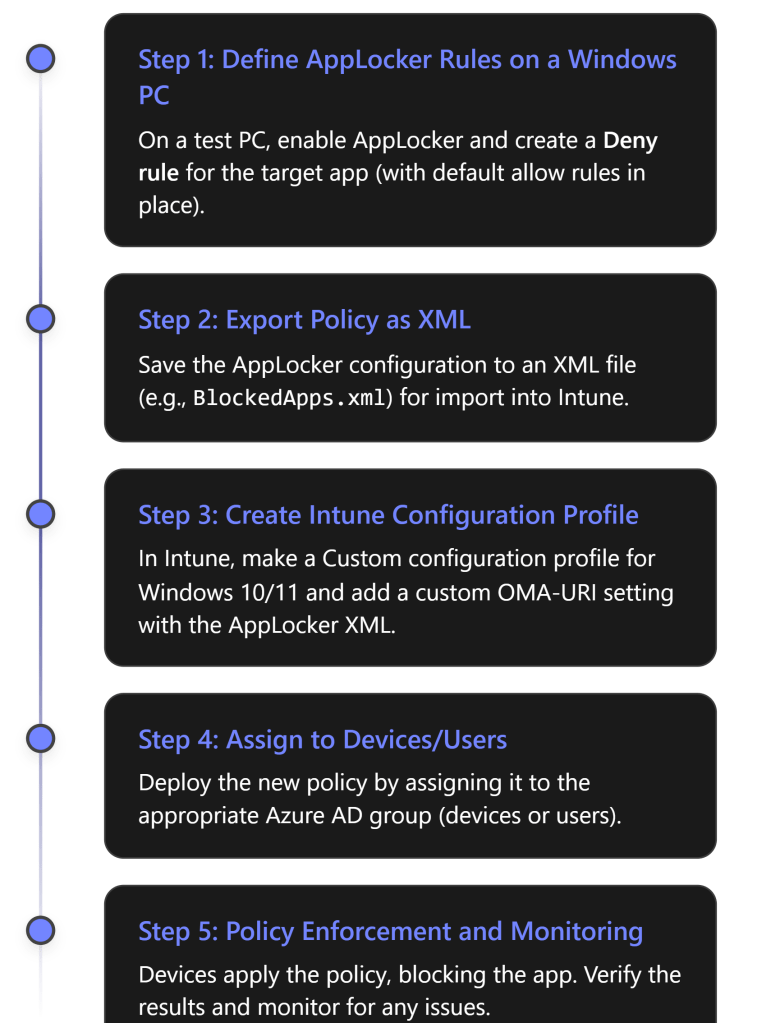
Method 1: Block Applications via Intune MDM (AppLocker Policy)

Overview: Using Intune’s device (MDM) capabilities, we will create an AppLocker policy to block a specific application and deploy that policy through Intune. AppLocker is a Windows feature that allows administrators to define which executables or apps are allowed or denied. Intune can deliver AppLocker rules to managed devices, effectively preventing targeted apps from running[1][1].

High-Level Steps (MDM + AppLocker):[1]

  1. Create an AppLocker rule on a reference Windows PC to deny the unwanted application.
  2. Export the AppLocker policy to an XML file.
  3. Create an Intune Device Configuration profile (Custom OMA-URI) in the Intune portal and import the AppLocker XML.
  4. Assign the profile to the target devices or user group.
  5. Monitor enforcement and adjust if necessary.

We will now go through these steps in detail:

Step 1: Create & Export an AppLocker Policy (Blocking Rule)

First, on a Windows 10/11 PC (your own admin machine or a lab device), set up the AppLocker rule to block the chosen application:

  • Open Local Security Policy: Log in as an administrator on the reference PC and run “Local Security Policy” (secpol.msc). Navigate to Security Settings > Application Control Policies > AppLocker[1].
  • Enable AppLocker & Default Rules: Right-click AppLocker and select “Properties.” For each rule category (Executable, Script, Windows Installer (.msi), Packaged app (*.appx)), check “Configured” and set it to “Enforce rules”, then click OK[1]. Next, create the default allow rules for each category: e.g., right-click Executable Rules and choose “Create Default Rules.” This adds baseline allow rules (e.g., allow all apps in %ProgramFiles% and Windows directories, and allow Administrators to run anything) so that you don’t inadvertently block essential system files or admin actions[1][1]. (Ensuring default rules exist is crucial to avoid locking down the system accidentally.)
  • Create a Deny Rule for the Application: Decide which app to block and under the appropriate category, right-click and select “Create New Rule…”[1]. This launches the AppLocker rule wizard:
    • Action: Choose “Deny” (we want to block the app)[1].
    • User or Group: Select “Everyone” (so the rule applies to all users on the device)[1]. (Alternatively, you could target a specific user or group if needed.)
    • Condition (Identification of the app): If it’s a classic Win32 app (an EXE), you can choose a Publisher rule (recommended for well-known signed apps), a Path rule, or a File hash rule. For a well-known signed app (e.g., Chrome, Zoom), choosing Publisher is ideal so that all versions of that app from that publisher get blocked[1][1]. You will be prompted to browse for the app’s executable on the system – select the main EXE (for example, chrome.exe in C:\Program Files\Google\Chrome\Application\chrome.exe for Google Chrome)[1][1]. The wizard will read the digital signature and populate the publisher and product info. You can adjust the slider to define the scope (e.g., blocking any version of Chrome vs. a specific version) – typically, slide to “File name” or “Product” level to block all versions of that app[1]. If blocking a Microsoft Store (UWP) app, switch to Packaged app Rules and select the app from the list of installed packages (e.g., TikTok if installed from Store)[1]. This will use the app’s package identity as the condition. (If the app isn’t installed on your ref machine to select, you can use a File hash, but Publisher rules are easier to maintain when possible[1].)
    • Complete the wizard by giving the rule a name and optional description (e.g., “Block Chrome”) and finish. You should now see your new Deny rule listed under the appropriate AppLocker rule category[1] (e.g., under Executable Rules for a .exe).
  • Confirm Rule Enforcement: Ensure AppLocker enforcement is enabled (the earlier step of setting to Enforced in Properties should handle this). With the deny rule created and default allow rules in place, the local policy will block the chosen app on this test machine.
  • Export the Policy: Now export these AppLocker settings to an XML file so we can deploy them via Intune. In the AppLocker console, right-click the AppLocker node and choose “Export Policy.” Save the file (e.g., BlockedApps.xml)[1][1]. This XML contains all AppLocker rules you configured.Tip: We only need the relevant portion of the XML for the rule category we configured (to avoid conflicts with categories we didn’t use). For example, if we only created an Executable rule, open the XML in a text editor and find the <RuleCollection Type="Exe" EnforcementMode="Enabled"> ... </RuleCollection> section[1]. Copy that entire <RuleCollection> block to use in Intune[1]. (Similarly, if blocking a packaged app, use the <RuleCollection Type="AppX"...> section, etc.) This way, we import just the necessary rules into Intune without overriding other categories that we didn’t configure[1][1].
Step 2: Deploy the AppLocker Policy via Intune

Now that we have our AppLocker XML snippet, we’ll create a Custom Device Configuration Profile in Intune to deliver this policy to devices:

  1. Create a Configuration Profile in Intune: Log in to the Intune admin center (Endpoint Manager portal) and navigate to Devices > Configuration Profiles (or Devices > Windows > Configuration Profiles). Click + Create profile.
    • Platform: Select Windows 10 and later.
    • Profile type: Choose Templates > Custom (because we’ll input a custom OMA-URI for AppLocker)[1][1].
    • Click Create and give the profile a name (e.g., “Block AppLocker Policy”) and an optional description[1][1].
  2. Add Custom OMA-URI Settings: In the profile editor, under Configuration settings, click Add to add a new setting. Enter the following details for the custom setting:
    • Name: A descriptive name like “AppLocker Exe Rule” (if blocking an EXE) or “AppLocker Store App Rule” depending on your target[1][1].
    • OMA-URI: This is the path that Intune uses to set the AppLocker policy via the Windows CSP. Use the path corresponding to your rule type:
      • For executable (.exe) apps:\ ./Vendor/MSFT/AppLocker/ApplicationLaunchRestrictions/Apps/EXE/Policy[1].
      • For Microsoft Store (packaged) apps:\ ./Vendor/MSFT/AppLocker/ApplicationLaunchRestrictions/Apps/StoreApps/Policy[1].
      • (If you were blocking other types, there are similar OMA-URI paths for Script, MSI, DLL under AppLocker CSP, but most common cases are EXE or StoreApps.)
    • Data type: Select String (we’ll be uploading the XML as a text string)[1].
    • Value: Paste the XML content of the <RuleCollection> that you copied earlier, including the <RuleCollection ...> tags. This is essentially the AppLocker policy definition in XML form[1]. Double-check that you included the opening and closing tags and that the XML is well-formed. (Intune will accept the large XML string here – if there’s a syntax error in the XML, the policy might fail to apply.)
    • Click Save after adding this OMA-URI setting.
  3. Complete Profile Creation: Click Next if additional pages appear (for Scope tags, etc., usually can leave default). On Assignments, choose the group of devices or users to which this blocking policy should apply:
    • For initial testing, you might assign it to a small pilot group or a single device group (perhaps an “IT Test Devices” group).
    • For full deployment, you could assign to All Devices or a broad group like “All Windows 10/11 PCs” if all devices should have this app blocked[1]. (Consider excluding IT admin devices or others if you need to ensure they can run the app, but generally “Everyone” was set in the rule so any device that gets this policy will block the app for all users on it.)
    • After selecting the group, click Next through to Review + Create, then click Create to finish creating the profile[1][1].

Intune will now deploy this policy to the targeted Windows endpoints. Typically, devices check in and apply policies within minutes if online (or the next time they come online).

Step 3: Policy Assignment and Enforcement

Once the profile is created and assigned, Intune will push the AppLocker policy to the devices. On each device:

  • The policy is applied via the Windows AppLocker Configuration Service Provider (CSP). When the device receives the policy, Windows integrates the new AppLocker rule.
  • If the user attempts to launch the blocked application, it will fail to open. On Windows, they will see a notification or error dialog stating the app is blocked by the administrator or system policy[1][1]. Essentially, the app is now inert on those machines – nothing happens when they try to run it (or it closes immediately with a message).

To summarize the MDM enforcement: the application itself is blocked from running on the device – the user cannot launch it at all on a managed, compliant device[1]. This provides a strong guarantee that the software can’t be used (preventing both intentional use and accidental use of unauthorized apps).

Example: If we deployed a policy to block Google Chrome, any attempt to open Chrome on those Intune-managed PCs will be prevented. The user will typically see a Windows pop-up in the lower-right saying something like “ has been blocked by your organization”[1]. They will not be able to use Chrome unless the policy is removed.

Note: Intune/MDM-based AppLocker policies apply to any user on the device by default. If multiple users use the same PC (as Azure AD users), the blocked app will be blocked for all (since we set the rule for Everyone). Keep this in mind if any shared devices are in scope.

Step 4: Testing, Monitoring and Verification

After deploying the policy, it’s important to verify it’s working correctly and monitor device compliance:

  • Test on a Pilot Device: On a test device that received the policy, try launching the blocked application. You should confirm that it does not run and that you receive the expected block message[1][1]. If the app still runs, double-check that the device is indeed Intune-managed, in the assigned group, and that the policy shows as successfully applied (see below).
  • Intune Policy Status: In the Intune admin center, go to the Configuration Profile you created and view Device status or Per-user status. Intune will report each targeted device with status “Succeeded” or “Error” for applying the policy[1][1]. Verify that devices show Success for the AppLocker profile. If there are errors, click on them to get more details. A common error might be malformatted XML or an unsupported setting on that OS edition.
  • Event Logs: On a Windows client, you can also check the Windows Event Viewer for AppLocker events. Look under Application and Services Logs > Microsoft > Windows > AppLocker > EXE and DLL. A successful block generates an event ID 8004 (“an application was blocked by policy”) in the AppLocker log[1][1]. This is useful for auditing and troubleshooting – you can see if the rule fired as expected. If you see event 8004 for your app when a user tried to open it, the policy is working.
  • Monitor Impact: Ensure no critical application was inadvertently affected. Thanks to the default allow rules, your policy should not block unrelated apps, but it’s good to get feedback from pilot users. Have IT or a pilot user attempt normal work and ensure nothing else is broken. If something necessary got blocked (e.g., perhaps the rule was too broad and blocked more than intended), you’ll need to adjust the AppLocker rule criteria (see Step 5).

Common issues and troubleshooting:\ Even with a straightforward setup, a few issues can arise:

  • Correct App Identification: Make sure the rule accurately identifies the app. If using a publisher rule for an EXE, it should cover all versions. If the app updates and the publisher info remains the same, it stays blocked. If you used a file hash rule, a new version (with a different hash) might bypass it – so publisher rules are generally preferred for well-known apps[1][1]. For Store apps, ensure you selected the correct app package or used the correct Package Family Name. Microsoft documentation suggests using the Store for Business or PowerShell to find the precise Package Identity if needed[1].
  • Application Identity Service: Windows has a service called Application Identity (AppIDSvc) that AppLocker relies on to function. This service should start automatically when AppLocker policies are present. If it’s disabled or not running, AppLocker enforcement will fail. Ensure the service is not disabled on your clients[1][1]. (By default it’s Manual trigger-start – Intune’s policy should cause it to run as needed.)
  • Windows Edition: Remember that Windows Home edition cannot enforce AppLocker policies[1]. Pro, Business, or Enterprise should be fine (if fully updated). If a device is not enforcing the policy, check that it’s not a Home edition.
  • Default Rules: Always have the AppLocker default allow rules in place (or equivalent allow rules) for all categories you enforce, otherwise you might end up blocking the OS components or all apps except your deny list. If you skipped creating default rules, go back and add them, then re-export the XML. Missing default rules can lead to “everything is blocked” scenarios which require recovery.
  • Multiple Policies: In Intune, if you apply multiple AppLocker policies (say two different profiles targeting the same device), they could conflict or override each other[1]. It’s best to consolidate blocked app rules into one policy if possible. If you must use separate policies for different groups, ensure they target mutually exclusive sets of devices or users. In a small business, one AppLocker policy for all devices is simpler[1].
  • Policy Application Timing: Intune policies should apply within a few minutes, but if a device is offline it will apply next time it connects. You can trigger a manual sync from the client (Company Portal app or in Windows settings under Work & School account > Info > Sync) to fetch policies immediately.
Step 5: Maintaining and Updating the Block Policy

Over time, you may need to adjust which applications are blocked (add new ones or remove some):

  • Updating the Policy: To change the list of blocked apps, you have two main options:
    1. Edit the AppLocker XML: On your reference PC, you can add or remove AppLocker rules (for example, create another Deny rule for a new app, or delete a rule) and export a new XML. Then, in Intune, edit the existing configuration profile – update the XML string in the Custom OMA-URI setting to the new XML (containing all current rules)[1][1]. Save and let it repush. The updated policy will overwrite the old rules on devices.
    2. Create a New Profile: Alternatively, you could create a new Intune profile for an additional blocked app. However, as noted, multiple AppLocker profiles can conflict. If it’s a completely separate rule set, Intune might merge them, but to keep things simple, it’s often easier to maintain one XML that contains all blocked app rules and update it in one profile[1]. For example, maintain a “BlockedApps.xml” with all forbidden apps listed, and just update that file and Intune profile as needed.
  • Removing a Block: If an application should no longer be blocked (e.g., business needs change or a false alarm), you can remove the rule from the AppLocker XML and update or remove the profile. Removing the Intune profile will remove the AppLocker policy from devices (restoring them to no AppLocker enforcement)[1][1]. However, note that Intune’s configuration profiles sometimes “tattoo” settings on a device (meaning the setting remains even after the profile is removed, until explicitly changed)[2]. AppLocker CSP settings typically are removed when the profile is removed while the device is still enrolled. If a device was removed from Intune without first removing the policy, the block might persist. In such a case, you’d need to either re-enroll and remove via Intune, or use a local method to clear AppLocker policy. Microsoft’s guidance for Windows Defender Application Control (WDAC) suggests deploying an “Allow all” policy to overwrite a blocking policy, then removing it[2]. Similarly, for AppLocker, the cleanest removal is: (a) push an updated policy that doesn’t have the deny rule (or explicitly allows the app), then (b) remove that policy. So, plan the removal carefully to avoid orphaned settings.
  • Communication to Users: When implementing or updating blocked apps, inform your users in advance if possible. Users might encounter a blocked application message and create helpdesk tickets if they weren’t expecting it. Ensure that your organizational policy documentation lists which apps are disallowed and why (e.g. security or compliance reasons), so employees know the rules. If an important app is blocked, have a process for exception requests or review.
  • User Support: Be prepared to handle cases where a user says “I need this app for my work.” Evaluate if that app can be allowed or if there’s an approved alternative. Sometimes an app might be blocked for most users but certain roles might need it – in such cases, consider scoping the Intune policy to exclude those users or create a separate policy for them with a different set of rules.

Best Practices:

  • Pilot first, then deploy broad: As emphasized, always test your blocking policy on a limited set of machines before rolling out company-wide[1]. This prevents any nasty surprises (like blocking critical software).
  • Document and Align with Policies: Ensure that the list of blocked apps aligns with written company security policies or compliance requirements. For example, many organizations ban apps like BitTorrent or certain social media or games for compliance/security[3]. Some bans might be regulatory (e.g., government directives to ban specific apps due to security concerns[4]) – make sure your Intune policies support those mandates.
  • Gather feedback: After deploying, gather feedback from users or IT support about any impact. Users should generally not be impacted outside of being unable to use the forbidden app (which is intended). If there’s confusion or pushback, it might require management communication – e.g., explaining “We blocked XYZ app because it poses a security risk or is against company policy.”
Alternative Device-Based Protections (Compliance & Conditional Access)

In addition to AppLocker, Intune provides a few other mechanisms to deter or react to forbidden apps on devices:

  • Compliance Policy with Script: Intune compliance policies for Windows can detect certain conditions and mark a device non-compliant if criteria are met. While there isn’t a built-in “app blacklist” compliance setting for Windows, admins can use custom compliance scripts to check for the presence of an .exe. For instance, a PowerShell script could check if a disallowed app is installed, and if yes, set the device’s compliance status accordingly[1]. Then you could create an Azure AD Conditional Access policy to block non-compliant devices from accessing corporate resources. This approach does not directly stop the app from running, but it creates a strong incentive for users not to install it: their device will lose access to email, Teams, SharePoint, etc., if that app is present[1][1]. This is more complex to set up and punitive rather than preventive, but can be useful for monitoring and enforcing policy on devices where you might not be ready to hard-block apps.
  • Microsoft Defender for Endpoint Integration: If your M365 Business Premium includes Defender for Endpoint P1, note that P1 doesn’t have all app control features of P2, but one thing you can do is use Defender for Endpoint (MDE) for network blocking. For example, if the unwanted “app” is actually accessing a service via web, you can use MDE’s Custom Network Indicators to block the URL or domain (which also prevents usage of that service or PWA)[4][4]. Microsoft’s guidance for the DeepSeek app, for instance, shows blocking the app’s web backend via Defender for Endpoint network protection, so even if installed it can’t connect[4][4]. MDE can also enforce web content filtering across browsers (with network protection enabled via Intune’s Settings Catalog)[4][4].
  • App Uninstall via Intune: If an unwanted app was deployed through Intune (for example, a store app pushed earlier), Intune can also uninstall it by changing the assignment to “Uninstall” for that app[4][4]. However, Intune cannot directly uninstall arbitrary software that it did not install. For Win32 apps not deployed by Intune, you’d need to use scripts or other tools if you wanted to actively remove them. In many cases, simply blocking execution via AppLocker (and leaving the stub installed) is sufficient and less disruptive[1][1].

These alternatives can complement the primary AppLocker method, but for immediate prevention, AppLocker remains the straightforward solution on managed devices[1].

Method 2: Block Applications via Intune MAM (App Protection for Data)

For scenarios where devices are not enrolled (personal PCs) or you prefer not to completely lock down the device, Intune’s App Protection Policies provide a way to ensure corporate data never ends up in unapproved apps. This doesn’t stop users from installing or running apps, but it effectively blocks those apps from ever seeing or using company information[1][1]. In practice, an unapproved app becomes useless for work – e.g., a user could install a personal Dropbox or a game on their BYOD PC, but they won’t be able to open any work files with it or copy any text out of Outlook into that app.

This approach uses a feature formerly known as Windows Information Protection (WIP) for Windows 10/11, integrated into Intune’s App Protection Policies. M365 Business Premium supports this since it includes the necessary Intune and Azure AD features.

Key points about MAM data protection:

  • It works by labeling data as “enterprise” vs “personal” on the fly. Any data from corporate sources (e.g., Office apps signed in with work account, files from OneDrive for Business, emails in Outlook) is considered corporate and is encrypted/protected when at rest on the device.
  • You define a set of “protected apps” (also called allowed apps) that are approved to access corporate data (typically Office apps, Edge browser, etc.)[1][1]. Only these apps can open or handle the corporate data.
  • If a user tries to open a corporate document or email attachment in an app not on the allowed list, it will be blocked — either it won’t open at all, or it opens encrypted gibberish. Similarly, actions like copy-paste from a work app to a personal app can be blocked[1][1].
  • Unlike MDM, this doesn’t require device enrollment. You can apply it to any Windows device where a user logs in with a work account in an app (Azure AD registered). Enforcement is strengthened by pairing with Conditional Access policies to ensure they can only access, say, O365 data if they are using a protected app[1].
  • This is ideal for BYOD: the user keeps full control of their device and personal apps, but the company data stays within a managed silo.

Note: Microsoft has announced that Windows Information Protection (WIP) is being deprecated eventually[1]. It’s still supported in current Windows 10/11 and Intune, so you can use it now, but be aware that long-term Microsoft is focusing on solutions like Purview Information Protection and other DLP (data loss prevention) strategies[1][1]. As of this writing, WIP-based MAM policies are the main method for protecting Windows data on unenrolled devices.

Step-by-Step: Configure Intune App Protection (MAM) Policy for Windows

Follow these steps to set up a policy that will “protect” corporate data and block its use in unapproved apps:

1. Enable MAM for Windows in Azure AD (if not already):\ In the Azure AD (Entra) admin center, ensure Intune MAM is activated for Windows users:

  • Navigate to Azure AD > Mobility (MDM and MAM). Find Microsoft Intune in the MAM section.
  • Set the MAM User Scope to include the users who will receive app protection (e.g., All users, or a specific group)[1][1]. This allows those users to use Intune App Protection on unenrolled devices.
  • Ensure the MDM User Scope is configured as you intend. For example, in a BYOD scenario, you might set MDM user scope to None (so personal devices don’t auto-enroll) and MAM user scope to All. In a mixed scenario, you can have both scopes enabled; an unenrolled device will simply only get MAM policies, whereas an enrolled device can have both MDM and MAM policies (though device-enrolled Windows will prefer device policies)[1][1].

2. Create a Windows App Protection Policy:\ In the Intune admin center:

  • Go to Apps > App protection policies and click Create Policy.
  • Platform: Select Windows 10 and later[1].
  • It will ask “Windows 10 device type:” – choose “Without enrollment” for targeting BYOD/personal devices (this means the policy applies via MAM on Azure AD-registered devices, not requiring full Intune enrollment)[1]. (If you also want to cover enrolled devices with similar restrictions, you could create a separate policy “with enrollment.” For now, we’ll assume without enrollment for personal device usage.)
  • Give the policy a Name (e.g., “Windows App Protection – Block Unapproved Apps”) and a description[1].

**3. Define *Protected Apps* (Allowed Apps):**\ Now specify which applications are considered *trusted for corporate data*. These apps will be allowed to access organization data; anything not in this list will be treated as untrusted.

  • In the policy settings, find the section to configure Protected apps (this might be under a heading like “Allowed apps” or similar). Click Add apps[1].
  • Intune provides a few ways to add apps:
    • Recommended apps: Intune offers a built-in list of common Microsoft apps that are “enlightened” for WIP (e.g., Office apps like Outlook, Word, Excel, PowerPoint, OneDrive, Microsoft Teams, the Edge browser, etc.). You can simply check the ones you want to allow (or Select All to allow the full suite of Microsoft 365 apps)[1][1]. This covers most needs: you’ll typically include Office 365 apps and Edge. Edge is particularly important if users access SharePoint or web-based email – Edge can enforce WIP, whereas third-party browsers cannot[1].
    • Store apps: If there’s a Microsoft Store app not in the recommended list that you need to allow, you can add it by searching the store. You’ll need the app’s Package Family Name and Publisher info. Intune’s interface may allow selection from the Store if the app is installed on a device or via the Store for Business integration[1][1].
    • Desktop apps (Win32): You can also specify classic desktop applications to allow by their binary info. This requires providing the app’s publisher certificate info and product name or file name. For example, if you have a specific line-of-business app (signed by your company), you can allow it by publisher name and product name so it’s treated as a protected app[1][1]. This can also be used to allow third-party apps (e.g. perhaps Adobe Acrobat, if you trust it with corporate data).
  • After adding all needed apps, you’ll see your list of protected apps. Common ones: Outlook, Word, Excel, PowerPoint, Teams, OneDrive, SharePoint, Skype for Business (if used), Edge. The idea is to include all apps that you want employees to use for work data. Data will be protected within and between these apps.
  • (Optional) Exempt Apps: Intune allows designation of exempt apps which bypass WIP entirely (meaning they can access corporate data without restriction)[1]. Generally do NOT exempt any app unless absolutely necessary (e.g., a legacy app that can’t function with encryption). Exempting defeats the purpose by allowing data leakage, so ideally leave this empty[1][1].

4. Configure Data Transfer Restrictions:\ The policy will have settings for what actions are allowed or blocked with corporate data:

  • Key setting: “Prevent data transfer to unprotected apps” – set this to Block (meaning no sharing of data from a protected app to any app that isn’t in the protected list)[1]. This ensures corporate content stays only in the allowed apps.
  • Clipboard (Cut/Copy/Paste): You likely want to Block copying data from a protected app to any non-protected app[1]. Intune might phrase this as “Allow cut/paste between corporate and personal apps” – set to Block, or “Policy managed apps only”.
  • Save As: Block users from saving corporate files to unmanaged locations (e.g., prevent “Save As” to a personal folder or USB drive). In Intune, this might be a setting like “Block data storage outside corporate locations”[1].
  • Screen capture: You can disable screenshots of protected apps on Windows. This might be less straightforward on Windows 10 (since WIP can do it on enlightened apps). Set Block screen capture if available[1].
  • Encryption: Ensure Encrypt corporate data is enabled so that any work files saved on the device are encrypted and only accessible by protected apps or when the user is logged in with the right account[1].
  • Application Mode (Enforcement level): WIP had modes like Block, Allow Overrides, Silent, Off[1]. In Intune’s UI, this might correspond to a setting called “Protection mode”. You will want Block mode for strict enforcement (no override)[1][1]. Allow Overrides would prompt users but let them bypass (not desirable if your goal is full blocking of data transfer). Silent would just log but not prevent. So choose the strictest option to truly block data leakage.
  • There are other settings like “Protected network domains” where you specify which domains’ data is considered corporate (often your Office 365 default domains are auto-included, e.g., anything from @yourcompany.com email or SharePoint site is corporate). Intune usually auto-populates these based on your Azure AD tenant for Windows policies. Double-check that your organization’s email domain and SharePoint/OneDrive domains are listed as corporate identity sources.
  • Set any other policy flags as needed (there are many options, such as requiring a PIN for access to protected apps after a idle time, etc., but those are more about app behavior than data transfer).

5. (Optional) Conditional Launch Conditions:\ Intune’s app protection policies may allow you to set conditional launch requirements – e.g., require device to have no high-risk threats detected, require devices to be compliant, etc. For Windows, a notable one is integrating with Microsoft Defender:

  • You could require that no malware is present or device is not jailbroken (not as relevant on Windows), or if malware is detected, you can have the policy either block access or wipe corporate data from the app[1][1].
  • These settings can enhance security (ensuring the app won’t function if the device is compromised). They rely on Defender on the client and can add complexity. Use as needed or stick to defaults for now[1][1].

6. Assign the App Protection Policy:\ Unlike device config which targets devices, app protection policies target users (because they apply when a user’s account data is in an app).

  • Choose one or more Azure AD user groups that should receive this policy[1]. For example, “All Employees” or all users with a Business Premium license. In a small business, targeting all users is common, so any user who signs into a Microsoft 365 app on a Windows device will have these rules applied.
  • If you want to pilot, you could target only IT or a subset first.

7. Enforce via Conditional Access (CA):\ This step is crucial: to ensure that users actually use these protected apps and not find a workaround, use Azure AD Conditional Access:

  • Create a CA policy that targets the cloud apps you want to secure (Exchange Online, SharePoint Online, Teams, etc.).
  • In conditions, scope it to users or groups (likely the same users you target with the MAM policy).
  • In Access controls, require “Approved client app” or “Require app protection policy” for access[1]. In the CA settings, Microsoft 365 services have a condition like “Require approved client app” which ensures only apps that are Intune-approved (they have a list, e.g., Outlook, Teams mobile, etc.) can be used. On Windows, a more fitting control is Require app protection policy (which ensures that if the device is not compliant (MDM-enrolled), then the app being used must have an app protection policy).
  • One common approach: Require managed device OR managed app. This means if a device is Intune enrolled (compliant), fine – they can use any client. If not, then the user must use a managed (MAM-protected) app to access. For example, you could say: if not on a compliant (MDM) device, then the session must come from an approved client app (which essentially enforces app protection; on Windows this correlates to WIP-protected apps)[1][1].
  • This ensures that if someone tries to use a random app or an unmanaged browser to access, say, Exchange or SharePoint, they will be blocked. They’ll be forced to use Outlook or Edge with the app protection policy in place.
  • Without CA, the user could potentially use web access as a loophole (e.g., log into Outlook Web Access via Chrome on an unmanaged device). CA closes that gap by requiring either the device to be enrolled or the app to be a known protected app.

8. User Experience and Monitoring:\ Once deployed, the user experience on a personal Windows device with this policy is:

  • The user can install Office apps or use the Office web, but if they try to use a non-approved app for corp data, it won’t work. For example, if they try to open a corporate SharePoint file in WordPad or copy text from Outlook to Notepad, the action will be blocked by WIP (they might just see nothing happens or a notice saying the action is not allowed).
  • They might see a brief notification like “Your organization is protecting data in this app” when they first use a protected app[1].
  • Their personal files and apps are unaffected. They can still use personal email or personal versions of apps freely; the protection only kicks in for data that is tagged as corporate (which originates from the company accounts)[1][1].
  • If they attempt something disallowed (like pasting company data into a personal app), it will silently fail or show a message. These events can be logged.

Admins should monitor logs to ensure the policy works:

  • Intune App Protection Reports: Intune provides some reporting for app protection policies (e.g., under Monitor section for App Protection, you might see reports of blocked actions).
  • Event Logs on device: WIP events might be logged in the local event viewer under Microsoft->Windows->EDP (Enterprise Data Protection).
  • Azure AD Sign-in logs: If Conditional Access is used, sign-in logs will show if a session was blocked due to CA policy, which helps confirm that CA rules are working[1][1].
  • Periodically review these logs, and also gather any user feedback if they experience prompts or have trouble accessing something so you can fine-tune the allowed app list or policy settings.

9. Maintain the MAM Policy:\ If you need to add another allowed app (say your company adopts a new tool that should be allowed to access corp data), just edit the App Protection Policy in Intune and add that app to the protected list. Policy updates apply near-real-time to usage. Removing an app from allowed list effectively immediately prevents it from opening new corporate data (though any already saved corporate data in that app would remain encrypted and inaccessible). If an employee leaves, removing their account or wiping corporate data from their device is possible from Intune (App Protection has a wipe function that will remove corporate data from the apps on the next launch).

Summary of MAM Approach: With Intune MAM, the app itself isn’t blocked from running, but it’s blocked from accessing any company info[1][1]. This is ideal if you don’t manage the entire device, such as personal devices. Even if a user installs an unapproved app, it cannot touch work data – making it effectively useless for work. The user retains the freedom to use their device for personal tasks, while IT ensures corporate data stays confined to secure apps[1][1]. This approach requires less device control and is generally more palatable for users worried about privacy on their own machines[1]. The trade-off is that it doesn’t prevent all risks (a user could still run risky software on their personal device – it just won’t have company data to abuse)[1][1].

Comparison of MDM vs MAM Approaches

To summarize the differences between the device-based blocking (MDM/AppLocker) and app-based blocking (MAM/App Protection) approach, consider the following comparison:

What is blocked: MDM completely blocks the application from launching on the device – the user clicks it, and nothing happens (or gets a “blocked by admin” notice)[1][1]. MAM allows the app to run, but blocks access to any protected (corp) data. The app can launch and be used for personal things, but if it tries to access work files or data, that access is denied or the data is unreadable[1][1].

Use case: MDM is best for company-owned devices under IT control where you want to outright ban certain software for security, licensing, or productivity reasons[1]. MAM is best for personal/BYOD devices (or to add a second layer on corporate devices) where you can’t or don’t want full control over the device, but still need to protect corporate information[1][1].

Implementation effort: MDM/Applocker requires a more technical setup initially (creating rules, exporting XML, etc.) – but once in place, it’s mostly “set and forget”, with occasional updates to the XML for changes[1][1]. It does require devices to be enrolled and on supported Windows editions[1]. MAM is configured through Intune’s UI (selecting apps and settings), which is a bit more straightforward. However, to be fully effective, you also need to configure Conditional Access, which can be complex to get right[1][1]. MAM doesn’t require device enrollment, just Azure AD sign-in.

User experience: With MDM blocking, if a user tries to open the app, it will not run at all. This could potentially disrupt work if, say, an important app was accidentally blocked – but otherwise the enforcement is silent/invisible until they actually try the blocked app[1][1]. With MAM, the user might see some prompts or restrictions in effect (like copy/paste blocked, or a message “your org protects data in this app”)[1][1]. Personal use of the device is unaffected, only when they deal with work data they encounter restrictions. This usually necessitates a bit of user education so they understand why certain actions are blocked[1][1].

Security strength: MDM’s AppLocker is very strong at preventing the app from causing any trouble on that device – if the app is malware or a forbidden tool, it simply can’t run[1][1]. It also means you could lockdown a device to only a whitelisted set of apps if you wanted (kiosk mode scenarios). MAM is very strong for data loss prevention – corporate content won’t leak to unapproved apps or cloud services[1][1]. However, it doesn’t stop a user from installing something risky on their own device for personal use (that risk is mitigated only to the extent that company data isn’t exposed). So to fully cover security, an enterprise might use MDM+MAM combined (MDM for device posture, antivirus, etc., and MAM for data protection on the edge cases).

Privacy impact: MDM is high impact on user privacy – IT can control many aspects of the device (and even wipe it entirely). So employees might resist MDM on personal devices[1][1]. MAM is low impact – it doesn’t touch personal files or apps at all, only corporate data within certain apps is managed[1][1]. If someone leaves the company, IT can remotely wipe the corporate data in the apps, but their personal stuff stays intact[1].

Licensing considerations: Both approaches are fully supported in M365 Business Premium. MDM with AppLocker needs Windows 10/11 Pro or higher (which Business Premium covers via Windows Business, essentially Pro)[1][1]. MAM for Windows needs Azure AD Premium (for CA) and Intune, which are included in Business Premium[1][1]. No extra licensing is needed unless you want advanced features like Defender for Endpoint P2 or Purview DLP in the future.

Additional Tips and Resources

  • Use Intune Reporting: Regularly check Intune’s Discovered Apps report (in Endpoint Manager under Apps > Monitor > Discovered apps). This report shows what software is found on your managed devices[3]. It can help identify if users have installed something that should be blocked, or to verify that a banned app is indeed not present.
  • Stay Informed on Updates: Intune and Windows are evolving. For example, new features like “App Control for Business” (a simplified interface for application control in Intune) or changes to WIP deprecation may come. Keep an eye on Microsoft 365 roadmap and Intune release notes so you can adapt your approach.
  • Training and Communication: Ensure that your IT support staff know how the policies work, so they can assist users. For instance, if a user tries to use a blocked app, the helpdesk should be able to explain “That application isn’t allowed by company policy” and suggest an approved alternative. Provide employees with a list of approved software and explain the process to request new software if needed (so they don’t attempt to install random tools).
  • Troubleshooting: If something isn’t working:
    • Microsoft’s documentation on https://learn.microsoft.com/windows/client-management/mdm/applocker-csp and https://learn.microsoft.com/intune/apps/app-protection-policy can be very helpful. The Recast Software guide references the AppLocker CSP documentation which details these OMA-URI settings[5].
    • The Microsoft Tech Community and Q\&A forums have real-world Q\&As. For example, handling removal of a stuck AppLocker policy was discussed in a community question[2][2].
    • The Microsoft Intune Customer Success blog has a post on “Blocking and removing apps on Intune managed devices” (Feb 2025) which provides guidance using a real example (blocking the DeepSeek AI app) across different platforms[4]. It’s a good supplemental read for advanced scenarios and cross-platform considerations.
  • Compliance and Legal: If your blocking is driven by compliance (e.g., a government ban on an app), ensure you archive proof of compliance. Intune logs and reports showing the policy applied can serve as evidence that you took required action. Also ensure your Acceptable Use Policy given to employees clearly states that certain applications are prohibited on work devices — this helps cover legal bases and user expectations.

Conclusion

With Microsoft 365 Business Premium, you have robust tools to control application usage on Windows devices. By leveraging Intune MDM with AppLocker, you can completely block unauthorized applications from running on company PCs, thereby enhancing security and productivity. The detailed steps above guide you through creating and deploying such a policy in a manageable way. Additionally, Intune’s App Protection (MAM) capabilities offer a complementary solution for protecting corporate data on devices you don’t fully manage, ensuring that even in BYOD situations, sensitive information remains in sanctioned apps.

In practice, many organizations will use a blend: e.g., require MDM for corporate laptops (where you enforce AppLocker to ban high-risk apps) and use MAM for any personal devices that access company data. The most effective method ultimately depends on your scenario, but with MDM and MAM at your disposal, M365 Business Premium provides a comprehensive toolkit to block or mitigate unapproved applications. By following the step-by-step processes and best practices outlined in this guide, IT administrators can confidently enforce application policies and adapt them as the organization’s needs evolve, all while keeping user impact and security compliance in balance.

References

[1] Blocking Applications on Windows Devices with Intune: MDM vs. MAM …

[2] Allowing a blocked app from Intune policy – Microsoft Q&A

[3] Practical Protection: Banning Apps with Intune | Practical365

[4] Blocking and removing apps on Intune managed devices (Windows, iOS …

[5] How to Block Apps with Intune – Recast Software

Comprehensive Application Control for Windows with Microsoft 365 Business Premium

bp1

Executive Summary

The contemporary cybersecurity landscape necessitates robust application control mechanisms to safeguard organizational assets. While foundational methods, such as basic AppLocker configurations, offer some degree of application restriction, they often fall short against sophisticated modern threats. This report details a more comprehensive approach for preventing unauthorized applications from executing on Windows devices, leveraging the advanced capabilities of Windows Defender Application Control (WDAC) in conjunction with Attack Surface Reduction (ASR) rules. This strategy is particularly pertinent for Small and Medium Businesses (SMBs) utilizing Microsoft 365 Business Premium.


The core recommendation involves implementing WDAC through a stringent whitelisting methodology, meticulously refined via an audit-first deployment strategy, and fortified by complementary ASR rules. This layered defence provides superior protection against emerging threats, including zero-day exploits and ransomware, by significantly reducing the attack surface. Although the initial configuration may require a dedicated investment of time and resources, this proactive posture ultimately minimizes long-term operational overhead and enhances the overall security posture for SMBs, which often operate with limited dedicated IT security personnel.

Understanding Application Control: Beyond Basic Intune AppLocker

Effective application control is a cornerstone of modern cybersecurity. The method described in some basic guides, often relying on AppLocker, represents an initial step but is increasingly insufficient for the complexities of today’s threat landscape. A more advanced and resilient approach is imperative.

Limitations of Traditional AppLocker

The referenced blog post likely outlines a basic AppLocker configuration managed through Microsoft Intune. While AppLocker facilitates the blocking of applications based on attributes such as publisher, file path, or cryptographic hash, it possesses inherent limitations that diminish its efficacy against contemporary threats.[1, 2] AppLocker, introduced with Windows 8, is an older technology primarily designed for management via Group Policy.[3, 4] Microsoft’s strategic direction indicates a cessation of new feature development for AppLocker, with only security fixes being provided. This signals its eventual obsolescence as a primary application control solution.

A critical deficiency of AppLocker is its primary operation in user mode, rendering it incapable of blocking kernel-mode drivers. This limitation creates a significant security vulnerability, as many advanced threats operate at the kernel level to evade detection and maintain persistence. Furthermore, while AppLocker policies can be granularly targeted to specific users or groups—a feature useful for shared device scenarios—WDAC policies are fundamentally device-centric, offering a more consistent and robust security posture across the entire endpoint.[2, 5]

Introduction to Windows Defender Application Control (WDAC)

Windows Defender Application Control (WDAC), formerly known as Device Guard, represents Microsoft’s modern and significantly more robust application control solution, introduced with Windows 10.[3, 6] WDAC is engineered as a core security feature under the rigorous servicing criteria defined by the Microsoft Security Response Center (MSRC), underscoring its critical role in endpoint protection.

Fundamentally, WDAC operates on the principle of application whitelisting. This means that, by default, only applications explicitly authorized by the organization are permitted to execute, thereby drastically reducing the attack surface available to malicious actors.[6] This contrasts sharply with blacklisting, which attempts to identify and block known malicious applications, a reactive approach that is inherently vulnerable to unknown or zero-day threats.[7, 8] WDAC’s proactive stance provides a robust defense against malware propagation and unauthorized code execution.

Beyond the fundamental shift to whitelisting, WDAC offers advanced capabilities absent in AppLocker. These include the ability to enforce policies at the kernel level, integrate with reputation-based intelligence via the Intelligent Security Graph (ISG), provide COM object whitelisting, and support application ID tagging.[4, 9] WDAC is also fully compatible with Microsoft Intune, which streamlines the deployment and enforcement of these sophisticated application control policies across managed devices, making it an ideal solution for organizations leveraging Microsoft 365 Business Premium.[6, 10]

The transition from AppLocker’s implicit blacklisting to WDAC’s explicit whitelisting signifies a fundamental shift in Microsoft’s security philosophy towards a Zero Trust model.[6, 7, 8, 11, 12, 13] This is not merely a feature upgrade; it represents a paradigm shift from a reactive “clean up after an attack” mindset to a proactive “prevent attacks from executing” posture. For SMBs, this is particularly advantageous, as prevention is considerably less resource-intensive than remediation, which is crucial for environments with limited dedicated security staff. WDAC’s default-deny stance inherently protects against unknown (zero-day) threats, a major advantage over traditional antivirus or blacklisting approaches.[6, 8]

Microsoft’s clear endorsement of WDAC as the future of application control is evident in its continuous improvements and planned support from Microsoft management platforms, while AppLocker will only receive security fixes and no new features. This strategic direction means that investing time and effort into WDAC now aligns SMBs with Microsoft’s long-term security roadmap, ensuring their application control strategy remains effective and supported. This proactive adoption helps avoid the technical debt associated with implementing a solution that will not evolve to counter new threats.

Table 1: AppLocker vs. WDAC Comparison

Feature/Aspect AppLocker WDAC
OS Support Windows 8 and later Windows 10, Windows 11, Windows Server 2016+
Core Principle Blacklisting (Default Allow, Block Known Bad) Whitelisting (Default Deny, Allow Only Known Good)
Kernel Mode Control No Yes (Blocks kernel-mode drivers)
New Feature Development Security Fixes Only Active Development & Continual Improvements
Management Integration Group Policy (Primary), Limited Intune Microsoft Intune (Preferred), Configuration Manager, Group Policy
Reputation-Based Trust No Yes (Intelligent Security Graph – ISG)
Managed Installer Support No Yes (Automates trust for Intune-deployed apps)
Policy Scope User/Group Device
Attack Surface Reduction Less Comprehensive More Comprehensive (Blocks unauthorized code execution, including zero-day exploits)
Zero-Day Protection Limited Strong (Default-deny approach prevents unknown threats)

Core Concepts of WDAC for SMBs

Implementing WDAC effectively requires a foundational understanding of its operational principles and the various rule types that govern application execution. These concepts are crucial for SMBs to design and deploy a robust application control strategy.

The Principle of Application Whitelisting

WDAC fundamentally operates on an “allow-by-default” principle for explicitly trusted applications, and a “deny-by-default” for all other executables.[6] This approach is the inverse of blacklisting, which attempts to block known malicious items.[7] By adopting a whitelisting model, WDAC significantly reduces the attack surface, ensuring that only authorized software can execute. This minimizes the risk of malware propagation and unauthorized code execution, including protection against zero-day exploits, which are unknown to traditional signature-based defenses.[6] For SMBs, this proactive defense is invaluable, as it prevents threats from gaining a foothold, thereby reducing the burden on limited IT resources for incident response and remediation.

Detailed Explanation of WDAC Rule Types

WDAC policies define the criteria for applications deemed safe and permitted to run, establishing a clear boundary between trusted and untrusted software.[6] WDAC provides administrators with the flexibility to specify a “level of trust” for applications, ranging from highly granular (e.g., a specific file hash) to more general (e.g., a certificate authority).[14]

    • Publisher Rules (Certificate-based policies): These rules allow applications signed with trusted digital certificates from specific publishers.[6, 9, 14] This rule type combines the PcaCertificate level (typically one certificate below the root) and the common name (CN) of the leaf certificate.[14] Publisher rules are ideal for trusting software from well-known, reputable vendors such as Microsoft or Adobe, or for device drivers from Intel.[14] A significant benefit is reduced management overhead; when software updates are released by the same publisher, the policy generally does not require modification.[14] However, this level of trust is broader than a hash rule, meaning it trusts all software from a given publisher, which might be a wider scope than desired in highly sensitive environments.
    • Path Rules: Path rules permit binaries to execute from specified file path locations.[6, 9, 14] These rules are applicable only to user-mode binaries and cannot be used to allow kernel-mode drivers.[14] They are particularly useful for applications installed in directories typically restricted to administrators, such as Program Files or Windows directories.[5, 14] WDAC incorporates a runtime user-writeability check to ensure that permissions on the specified file path are secure, only allowing write access for administrative users.[14] It is crucial to note that path rules offer weaker security guarantees compared to explicit signer rules because they depend on mutable file system permissions. Therefore, their use should be avoided for directories where standard users possess the ability to modify Access Control Lists (ACLs).[9, 14]
    • Hash Rules: Hash rules specify individual cryptographic hash values for each binary.[6, 9, 14] This constitutes the most specific rule level available in WDAC.[14] While providing the highest level of control and security, hash rules demand considerable effort for maintenance.[14] Each time a binary is updated, its hash value changes, necessitating a corresponding update to the policy.[14] WDAC utilizes the Authenticode/PE image hash algorithm, which is designed to omit the file’s checksum, Certificate Table, and Attribute Certificate Table. This ensures the hash remains consistent even if signatures or timestamps are altered or a digital signature is removed, thereby offering enhanced security and reducing the need to revise policy hash rules when digital signatures are updated.[14] Hash rules are essential for unsigned applications or when a specific version of an application must be allowed irrespective of its publisher.
    • Managed Installer: This policy rule option automatically allows applications installed by a designated “managed installer”.[9, 14, 15, 16, 17] The Intune Management Extension (IME) can be configured as a managed installer.[15, 16] When IME deploys an application, Windows actively observes the installation process and tags any spawned processes as trusted.[15] This feature significantly simplifies the whitelisting process for applications deployed via Intune, as these applications are automatically trusted without requiring explicit, manual rule creation.[15, 16] A key limitation is that this setting does not retroactively tag applications; only applications installed after enabling the managed installer will benefit from this mechanism.[16] Existing applications will still require explicit rules within the WDAC policy.
    • Intelligent Security Graph (ISG) Authorization: The ISG authorization policy rule option automatically allows applications with a “known good” reputation, as determined by Microsoft’s Intelligent Security Graph.[9, 14, 17] The ISG leverages real-time data, shared threat indicators, and broader cloud intelligence to continuously assess application reputation.[12] This capability reduces the need for manual rule creation for widely used, reputable software [5, 14] and helps minimize false positives by trusting applications broadly recognized as safe.[12] However, organizations requiring the use of applications that might be blocked by the ISG’s assessment should utilize the WDAC Wizard to explicitly allow them or consider third-party application control solutions.[18] The “Enabled:Invalidate EAs on Reboot” option can be configured to periodically revalidate the reputation for applications previously authorized by the ISG.[14, 17]

Table 2: WDAC Rule Types and Their Application (Pros & Cons)

Rule Type Description Pros for SMBs Cons for SMBs Best Use Case for SMBs
Publisher Allows apps signed by trusted digital certificates from specific publishers. Low maintenance for updates from same vendor; broad trust for reputable software. Less granular; trusts all software from a given publisher. Core business applications from major, trusted software vendors (e.g., Microsoft Office, Adobe).
Path Allows binaries to run from specific file path locations. Simple to configure for applications in secure, admin-writeable directories. Less secure than signer rules; relies on file system permissions; only for user-mode. Applications installed in Program Files, Windows directories, or other paths where standard users cannot modify ACLs.
Hash Specifies individual cryptographic hash values for each binary. Highest level of control and security; essential for unsigned or specific versions. High maintenance; requires policy updates for every binary change. Highly sensitive custom line-of-business applications; specific versions of software; unsigned utilities.
Managed Installer Automatically allows apps installed by a designated managed installer (e.g., Intune Management Extension). Greatly simplifies whitelisting for Intune-deployed applications; reduces manual effort. No retroactive tagging for pre-existing apps; reliance on installer integrity. All software deployed and managed through Microsoft Intune.
Intelligent Security Graph (ISG) Automatically allows apps with a “known good” reputation as defined by Microsoft’s ISG. Reduces manual rule creation for widely used, reputable software; minimizes false positives. Relies on Microsoft’s reputation service; may block niche or internal apps; periodic revalidation needed. Widely used commercial software with established reputations; general productivity tools.

Understanding Base and Supplemental WDAC Policies

WDAC supports two policy formats: the older Single Policy format, which permits only one active policy on a system, and the recommended Multiple Policy format, supported on Windows 10 (version 1903 and later), Windows 11, and Windows Server 2022.[9] The multiple policy format offers enhanced flexibility for deploying Windows Defender Application Control.

This flexibility is manifest in two key policy types:

    • Base Policies: These policies define the fundamental set of trusted applications that are permitted to run across devices.[9, 16] They establish the core security baseline.
    • Supplemental Policies: These policies are designed to expand the scope of trust defined by a base policy without altering the base policy itself.[9, 16] Supplemental policies are particularly useful for accommodating specific departmental software, unique line-of-business applications, or different user personas (e.g., HR, IT departments) within an organization.[9, 17]

The multiple policy format also enables “enforce and audit side-by-side” scenarios, where an audit-mode base policy can be deployed concurrently with an existing enforcement-mode base policy. This capability is invaluable for validating policy changes before full enforcement, minimizing the risk of operational disruption.[9] For growing SMBs, this modular approach provides significant flexibility, allowing them to establish a broad, stable base policy and then add specific allowances as needed without compromising the core security posture or requiring extensive reconfigurations.

While hash rules offer the highest security granularity, they demand constant updates, creating a considerable maintenance burden.[14] In contrast, publisher rules, though less granular, significantly reduce maintenance efforts.[14] The Managed Installer and ISG features further automate the trust process, reducing manual intervention.[14] This illustrates a clear trade-off between the level of security granularity and the associated management overhead. For SMBs, a pragmatic approach involves prioritizing Publisher rules for major software vendors and extensively leveraging the Managed Installer for applications deployed via Intune, along with ISG for common, reputable software, to minimize manual effort. Hash rules should be reserved judiciously for critical, static, or unsigned line-of-business applications where the highest assurance is indispensable, acknowledging the increased maintenance requirement. This pragmatic strategy balances robust security with the practical constraints of limited IT resources.

WDAC’s default-deny nature means that any application not explicitly allowed will be blocked.[6] This characteristic can be highly disruptive if not meticulously planned and tested.[7, 8] The concepts of “audit mode” and “iterative refinement” directly address this challenge.[9, 17, 19, 20] The initial setup of a comprehensive whitelist can be time-consuming and may encounter user resistance.[7] Therefore, a phased approach, commencing with audit mode, is not merely a best practice but a fundamental necessity for SMBs. This approach prevents legitimate business operations from being crippled and facilitates user acceptance. The iterative process allows for gradual policy hardening, reducing the risk of unexpected disruptions and fostering a smoother transition to a more secure environment.

Step-by-Step Implementation of WDAC with Microsoft Intune

Implementing WDAC policies requires careful planning and execution within the Microsoft Intune environment. The following steps provide a practical guide for SMBs to configure and deploy WDAC.

Prerequisites and Licensing for WDAC

Before initiating WDAC deployment, several prerequisites must be met:

    • Microsoft 365 Business Premium: This subscription is essential as it includes Microsoft Intune Plan 1 and Microsoft Defender for Business, which are foundational for managing WDAC policies.[21, 22]
    • Windows Versions: WDAC policies are supported on modern Windows operating systems. Specifically, Windows 10 (version 1903 or later with KB5019959) and Windows 11 (version 21H2 with KB5019961, or version 22H2 with KB5019980) are compatible.[16]
    • Windows Professional Support: A significant development for SMBs is that WDAC policy creation and deployment are now fully supported on Windows 10/11 Professional editions, eliminating previous Enterprise/Education SKU licensing restrictions.[23] This makes WDAC highly accessible for SMBs operating with Business Premium licenses.
    • Intune Enrollment: All target devices must be enrolled in Microsoft Intune to receive and enforce WDAC policies.[16, 18]
    • Permissions: Accounts performing these configurations must possess the “App Control for Business” permission within Intune, which includes rights for creating, updating, and assigning policies. Additionally, “Intune Administrator” privileges may be required for enabling the managed installer feature.[16] Microsoft advises adhering to the principle of least privilege by assigning roles with the fewest necessary permissions to enhance organizational security.[16]

Enabling the Managed Installer in Intune

The Managed Installer feature is crucial for streamlining WDAC policy management by automatically trusting applications deployed via the Intune Management Extension (IME), thereby reducing the need for manual whitelisting efforts.[15, 16]

Step-by-Step Instructions:

    1. Sign in to the Microsoft Intune admin center at https://intune.microsoft.com.
    2. Navigate to Endpoint security > App control for Business (Preview).
    3. Select the Managed Installer tab.
    4. Click Add, then click Add again after reviewing the instructions.[10]
    5. This action is a one-time event for the tenant.[16]

It is important to understand that this setting does not retroactively tag applications. Only applications installed after the managed installer feature is enabled will be automatically trusted by this mechanism.[16] Existing applications on devices will require explicit rules within the WDAC policy to be permitted.

Creating a WDAC Base Policy using the WDAC Wizard

The WDAC Wizard is the recommended and most user-friendly tool for creating WDAC policies, particularly for SMBs that may not possess extensive PowerShell expertise.[9, 10, 15, 24, 25] The wizard simplifies the process by generating the necessary XML data for the policy.[10]

Step-by-Step Instructions:

    1. Download the WDAC Wizard from https://webapp-wdac-wizard.azurewebsites.net/.[10, 15, 25]
    2. Open the wizard and click Policy Creator, then Next.
    3. Ensure that Multiple Policy Format and Base Policy are selected (these are typically the default options), then click Next.[10]
    4. Select a base template. For SMBs, “Signed and Reputable Mode” is an excellent starting point, as it inherently trusts Microsoft-signed applications, Windows components, Store applications, and applications with a good reputation as determined by the Intelligent Security Graph (ISG).[5, 10] Alternatively, “Default Windows Mode” allows Windows in-box kernel and user-mode code to execute.[17, 23]
    5. On the subsequent page, review and enable desired options. For SMBs, ensuring “Managed Installer” and “Intelligent Security Graph Authorization” are turned on is highly beneficial. Crucially, select Audit Mode for the initial deployment; this is strongly recommended for testing purposes.[9, 10, 16, 17, 19, 26, 27]
    6. Click Next to initiate the policy build. The wizard will propose Microsoft trusted publisher rules.[15]
    7. Upon completion, the wizard will provide the file path to download both the .cip (binary) and .xml files, typically located in C:\Users\\Documents.[10]

Deploying the WDAC Policy via Intune

Once the WDAC policy XML file is generated, it can be deployed to managed devices through Microsoft Intune.

Step-by-Step Instructions:

    1. Return to the Microsoft Intune admin center.
    2. Navigate to Endpoint security > App Control for Business (Preview).
    3. Select the App Control for Business tab, then click Create Policy.
    4. On the Basics tab, enter a descriptive Name for the policy (e.g., “SMB Base WDAC Policy – Audit Mode”) and an optional Description.[10, 16]
    5. On the Configuration settings tab, select the Enter xml data option.
    6. Browse to the .xml file generated by the WDAC Wizard and upload it.[10]
    7. (Optional) If applicable, use Scope tags for managing policies in distributed IT environments.[10]
    8. On the Assignments tab, assign the profile to a security group containing the Windows devices targeted for WDAC implementation.[10] For initial deployment, it is critical to assign the policy to a small pilot group while still in audit mode.[17, 19]
    9. Review the settings on the Review + create tab, then click Create to deploy the policy.

It is important to note that while the WDAC Wizard provides both XML and binary (.cip) policy files, Intune handles the deployment of the binary policy automatically once the XML is uploaded.[19]

Strategies for Creating and Deploying Supplemental Policies

Supplemental policies are designed to extend the trust defined by a base WDAC policy for specific applications or user groups without modifying the core base policy.[9, 16] This modularity is particularly beneficial for SMBs managing line-of-business (LOB) applications or unique software requirements.

Method for creating and deploying supplemental policies:

    1. Creation with WDAC Wizard: Supplemental policies are also created using the WDAC Wizard.[9, 15] When creating a new policy in the wizard, select “Supplemental Policy” and specify the base policy it will augment.
    2. Rule Generation: Scan specific application installers or folders (e.g., D:\GetCiPolicy\testpackage) to generate rules tailored for those applications.[15] For signed applications, the “Publisher” rule level is preferred; for unsigned applications or to allow a highly specific version, the “Hash” rule level is appropriate.[24]
    3. Export and Deployment: Export the supplemental policy XML file. Deploy this supplemental policy via Intune following the same procedure as a base policy, assigning it to the relevant device groups.

This modular approach simplifies management for SMBs. Instead of maintaining a single, complex policy, organizations can leverage a stable base policy and introduce smaller, targeted supplemental policies for unique application requirements. This design makes policy updates and troubleshooting more manageable and less prone to unintended disruptions.

Whitelisting inherently requires that every allowed application has a defined rule, which can be a high-maintenance task.[7, 8] The Managed Installer feature directly addresses this challenge by automatically trusting applications deployed through the Intune Management Extension.[15, 16] This establishes a trusted “pipeline” for software distribution, significantly reducing the manual effort involved in maintaining WDAC policies. For SMBs with limited IT staff, manually creating and updating rules for every application is often impractical. By leveraging the Managed Installer, a substantial portion of application deployments can be automatically trusted, drastically lowering the ongoing management burden of WDAC and making a comprehensive whitelisting strategy feasible for smaller organizations.

The default-deny nature of WDAC means that misconfiguration can inadvertently block essential business applications.[7] Microsoft consistently recommends deploying WDAC policies in “audit mode” first.[9, 10, 16, 17, 19, 20, 26, 27] This mode logs potential blocks without enforcing them, allowing for meticulous policy refinement.[20, 26] For SMBs, where business continuity is paramount, a sudden, full enforcement of WDAC without prior auditing could cripple operations, leading to significant downtime and user frustration. The “audit first” approach is a critical risk mitigation strategy, enabling IT administrators to identify and address false positives before they impact productivity. This cautious progression also improves user acceptance and buy-in by minimizing unexpected disruptions to their workflows.[12]

Best Practices for WDAC Policy Refinement (Audit Mode & Monitoring)

The successful implementation of WDAC policies hinges on a meticulous refinement process, primarily conducted through audit mode, and supported by robust monitoring capabilities. This iterative approach is crucial for minimizing operational impact and ensuring policy effectiveness.

The Critical Role of Audit Mode in Policy Development

Audit mode serves as a vital phase in WDAC policy development, allowing IT administrators to assess the potential impact of a policy on their environment without actively blocking applications.[16, 17, 19, 26, 27, 28] In this mode, WDAC generates logs for any application, file, or script that would have been blocked if the policy were in enforced mode.[20, 26]

For SMBs, this “test before block” methodology is indispensable. It enables the discovery of legitimate applications, binaries, and scripts that might have been inadvertently omitted from the policy and thus should be included.[20] This proactive identification of potential conflicts helps prevent unexpected disruptions to business operations and significantly reduces user complaints and help desk tickets.[12] The policy refinement process is inherently iterative: deploy in audit mode, meticulously monitor events, refine the policy based on observations, and repeat this cycle until the desired outcome is achieved, characterized by minimal unexpected audit events.[9, 17, 20]

Collecting and Analyzing WDAC Audit Events

Effective policy refinement relies on comprehensive collection and analysis of WDAC audit events.

Local Event Viewer

All WDAC events are logged locally within the Windows Event Log. The primary logs to monitor are:

    • Microsoft-Windows-CodeIntegrity/Operational: This log captures events related to binaries.[9, 20]
    • Microsoft-Windows-AppLocker/MSI and Script: This log records events pertaining to scripts and MSI installers.[9, 20]

Key Event IDs to focus on in Audit Mode:

    • Event ID 3076: This event indicates an action that would have been blocked by a WDAC policy if it were enforced.[20]
    • Event ID 8028: This event signifies an action that would have been blocked by an AppLocker (MSI and Script) policy if it were enforced.[20]

To access these logs, administrators can open the Windows Event Viewer and navigate to Applications and Services Logs > Microsoft > Windows, then locate the CodeIntegrity and AppLocker logs.[29]

Centralized Monitoring with Azure Monitor / Log Analytics

For enhanced scalability and centralized management, particularly as an SMB expands, collecting these events in an Azure Monitor Log Analytics Workspace is highly recommended.[9, 20, 26, 30]

Prerequisites for centralized monitoring:

    • Azure Monitor Agent (AMA): The AMA must be deployed to the Windows devices from which events are to be collected.[20] The AMA installer can be packaged as a Win32 application and deployed efficiently via Intune.[20]
    • Visual C++ Redistributable 2015 or higher: This is a prerequisite for the AMA and should be deployed as a dependency.[20]
    • Azure Log Analytics Workspace: An active Log Analytics Workspace is required as the destination for collected events.

Creating a Data Collection Rule (DCR) in Azure:

    1. Open the Azure portal and navigate to Monitor > Data Collection Rules, then click Create.[20]
    2. On the Basics page, provide a descriptive Rule Name, select the appropriate Subscription, Resource Group, and Region, and choose Windows as the Platform Type. Click Next: Resources.[20]
    3. On the Resources page, add the specific devices or resource groups where AMA is deployed. Click Next: Collect and deliver.[20]


    1. On the Collect and deliver page, click Add data source.[20]

        • For Data source type, select Windows event logs.


        • Select Custom and provide the XPath queries: Microsoft-Windows-CodeIntegrity/Operational!* and Microsoft-Windows-AppLocker/MSI and Script!* to filter and limit data collection to relevant events.


        • On the Destination tab, select the Destination type, Subscription, and Account or namespace for your Log Analytics Workspace.[20]


    1. Review the configuration on the Review + create page, then click Create.[20]

Kusto Query Language (KQL) for Analysis:
Once event logs are ingested into Log Analytics, KQL queries can be used to filter and analyze the data effectively.[20, 26]

Example KQL for Event ID 3076 (Code Integrity Audit Events):

Event

| where EventLog == 'Microsoft-Windows-CodeIntegrity/Operational' and EventID == 3076
| extend eventData = parse_xml(EventData).DataItem.EventData.Data
| extend fileName = tostring(eventData.['#text']) // File name of the blocked executable
| extend filePath = tostring(eventData.['#text']) // File path of the blocked executable
| extend fileHash = tostring(eventData.['#text']) // Hash of the blocked executable
| extend policyName = tostring(eventData.['#text']) // Name of the WDAC policy that would have blocked it
| project TimeGenerated, Computer, UserName, fileName, filePath, fileHash, policyName

Note: The exact indices for eventData elements (e.g., eventData, eventData) may vary based on the specific XML structure within the EventData column in your environment. Administrators should verify the correct indices by inspecting raw event data in Log Analytics.

Similar queries can be constructed for Event ID 8028 from the AppLocker log. The power of KQL lies in its ability to perform powerful filtering, aggregation, and visualization of audit data, making it easier to identify patterns of blocked applications and prioritize policy adjustments.[26]

Table 3: Key Event IDs for WDAC Audit Log Analysis


Event Log Name Event ID Description Significance in Audit Mode Actionable Insight
Microsoft-Windows-CodeIntegrity/Operational 3076 An application or driver would have been blocked by a WDAC policy. Identifies legitimate executables or drivers that are not yet allowed by the policy. Add Publisher, Path, or Hash rules to the WDAC policy for this application/driver.
Microsoft-Windows-AppLocker/MSI and Script 8028 An MSI or script would have been blocked by an AppLocker policy. Identifies legitimate scripts or installers that are not yet allowed by the policy. Add corresponding rules (e.g., Publisher, Path, Hash) to the WDAC or AppLocker policy.

Iterative Process for Policy Refinement and Testing

The refinement of WDAC policies is an ongoing, iterative cycle:

    1. Analyze Audit Logs: Regularly review the collected audit events (from Event Viewer or Log Analytics) to identify legitimate applications or processes that are being flagged for blocking.[9, 20]
    2. Create Exceptions: Based on the audit log analysis, use the WDAC Wizard to generate new rules (Publisher, Path, or Hash) or create supplemental policies to explicitly allow these legitimate applications.[9, 15]
    3. Redeploy in Audit Mode: Deploy the updated policy (or supplemental policy) back to the pilot group in audit mode. This step is crucial to ensure that the newly added rules are effective and that no new, unexpected blocks occur.[9, 17, 19]
    4. Monitor and Repeat: Continue this cycle of monitoring, refining, and redeploying in audit mode until the number of unexpected audit events is minimal and acceptable.[9, 17, 20] A best practice involves building a “golden” reference machine with all necessary business applications installed to facilitate the generation of initial policies and the testing of refinements.[5, 27]

Transitioning from Audit to Enforced Mode

Once the audit logs demonstrate that the policy is stable and only blocking truly unwanted applications, the WDAC policy can be transitioned to “Enforced” mode.[9, 16, 17, 26, 27, 28]

    • Caution: It is imperative to ensure that the enforced policy precisely aligns with the audit mode policy that was thoroughly validated.[26] Discrepancies or mixing of policies can lead to unexpected and disruptive blocks.[26]
    • Phased Rollout: Even when moving to enforced mode, a phased rollout to larger groups of devices is advisable, beginning with a small, controlled group to mitigate risks.[19, 31, 32]
    • Ongoing Monitoring: Continuous monitoring of WDAC events remains critical even in enforced mode. This allows for the identification of new applications or changes that might necessitate further policy updates.[9, 19]

The “audit first” recommendation is not merely a technical best practice; it is a critical business continuity strategy for SMBs.[17, 19, 20] An incorrectly enforced WDAC policy can halt operations, leading to significant financial losses and reputational damage. Audit mode functions as a safety net, enabling the pre-emptive identification and resolution of conflicts. This emphasizes that the time invested in the audit and refinement phase is an investment in operational stability. SMBs should allocate sufficient time for this phase, prioritizing it over rapid deployment, even if it appears to slow down the initial process. The ability to “fail fast” in audit mode prevents “failing hard” in production.

While the core WDAC functionality is available with Microsoft 365 Business Premium, Microsoft Defender for Endpoint (MDE) Plan 2 offers “Advanced Hunting” capabilities for centralized monitoring of App Control events using KQL.[9, 19, 26] Microsoft 365 Business Premium includes Microsoft Defender for Business, which provides some MDE capabilities.[21] If an SMB has upgraded to Microsoft 365 E5 Security (which includes MDE Plan 2) or has Defender for Business, they can leverage these advanced hunting capabilities for more efficient and scalable audit log analysis. This provides a more robust and integrated security operations experience, even for smaller teams, enabling proactive threat hunting and policy refinement based on rich telemetry. Even without MDE Plan 2, the Azure Monitor agent and Log Analytics provide a strong centralized logging solution.[20]

Enhancing Security with Attack Surface Reduction (ASR) Rules

Beyond controlling which applications are permitted to run, a comprehensive security strategy must also address the behaviors of applications. Attack Surface Reduction (ASR) rules provide this crucial complementary layer of defense, working synergistically with WDAC.

How ASR Rules Complement WDAC for Layered Defense

WDAC focuses on what applications are allowed to run, operating on a whitelisting principle to ensure only approved code executes.[12, 33] In contrast, ASR rules, which are a component of Microsoft Defender for Endpoint, target behaviors commonly exploited by malware, irrespective of an application’s whitelisted status.[29, 33] These rules constrain risky software behaviors, such as:

    • Launching executable files and scripts that attempt to download or run other files.
    • Executing obfuscated or otherwise suspicious scripts.
    • Performing actions that applications do not typically initiate during normal day-to-day operations.[29]

The synergy between WDAC and ASR rules is powerful: WDAC prevents unauthorized applications from running altogether, while ASR rules provide an additional layer of defense by blocking malicious actions even from legitimate, whitelisted applications that might be exploited.[6, 12, 33] This dual approach creates a robust, layered security posture [6, 12] and aligns with a Zero Trust strategy by continuously verifying and controlling processes and behaviors.[11, 12]

Configuring ASR Rules in Intune

Deploying ASR rules is managed through Microsoft Intune and requires specific prerequisites.

    • Prerequisites: Devices must be enrolled in Microsoft Defender.[32] Microsoft Defender Antivirus must be configured as the primary antivirus solution, with real-time protection and Cloud-Delivery Protection enabled.[34] Microsoft 365 Business Premium includes Microsoft Defender for Business, which provides these essential capabilities.[21]

Step-by-Step Instructions:

    1. Open the Microsoft Intune admin center at https://intune.microsoft.com.
    2. Navigate to Endpoint security > Attack surface reduction.
    3. Click Create Policy.
    4. For Platform, select Windows 10, Windows 11, and Windows Server.
    5. For Profile, select Attack surface reduction rules.
    6. Click Create.
    7. In the Basics tab, enter a descriptive Name (e.g., “SMB ASR Rules – Audit Mode”) and an optional Description.[31]
    8. On the Configuration settings tab, under Attack Surface Reduction Rules, set all rules to Audit mode initially.[31, 32] This allows for monitoring and identification of false positives before any blocking occurs.[29, 32]

        • Note: Some ASR rules may present “Blocked” and “Enabled” as modes, which function identically to “Block” and “Audit” respectively.[31] Other available modes include “Warn” (allowing user bypass) and “Disable”.[34]
    1. (Optional) Add Scope tags if applicable for managing access and visibility in distributed IT environments.[31]
    1. On the Assignments tab, assign the profile to a security group containing your target devices.[31] It is advisable to begin with a small pilot group for initial testing.
    1. Review the settings on the Review + create tab, then click Create to deploy the policy.

Table 4: Common ASR Rules and Recommended Modes for SMBs

ASR Rule Name Description Recommended Mode for SMBs (Initial) Significance for SMBs
Block Adobe Reader from creating child processes Prevents Adobe Reader from launching executable child processes. Audit Mitigates common phishing vectors where malicious executables are launched from PDF documents.
Block all Office applications from creating child processes Prevents Office apps (Word, Excel, PowerPoint) from launching executable child processes. Audit Protects against macro-based malware and exploits that use Office applications to drop and execute payloads.
Block credential stealing from the Windows local security authority subsystem Prevents access to credentials stored in the Local Security Authority (LSA). Audit Protects critical user credentials from being harvested by attackers, preventing lateral movement.
Block execution of potentially obfuscated scripts Blocks scripts (e.g., PowerShell, VBScript) that are obfuscated or otherwise suspicious. Audit Mitigates script-based attacks, including fileless malware, which often use obfuscation to evade detection.
Block JavaScript or VBScript from launching downloaded executable content Prevents scripts from launching executables downloaded from the internet. Audit Addresses a common attack vector where malicious scripts initiate the download and execution of malware.

Managing ASR Exclusions and Monitoring

Just as with WDAC, ASR rules may occasionally block legitimate applications or processes. To maintain operational continuity, exclusions can be configured for specific files or paths.[31, 34]

    • Configuring Exclusions: In Intune, navigate to the ASR policy, select Properties, then Settings. Under “Exclude files and paths from attack surface reduction rules,” administrators can enter individual file paths or import a CSV file containing multiple exclusions.[34] Exclusions become active when the excluded application or service starts.[34]
    • Monitoring:

        • Microsoft Defender Portal: The Microsoft Defender portal provides detailed reports on detected activities, allowing administrators to track the effectiveness of ASR rules. Alerts are generated when rules are triggered, providing immediate visibility into potential threats.[29, 32]


        • Windows Event Log: Administrators can review the Windows Event Log, specifically filtering for Event ID 1121 in the Microsoft-Windows-Windows Defender/Operational log, to identify applications that would have been blocked by ASR rules.[29, 31]


      Advanced Hunting (MDE Plan 2): For organizations with Microsoft Defender for Endpoint Plan 2, Kusto Query Language (KQL) can be used for advanced hunting to query ASR events (e.g., DeviceEvents | where ActionType startswith 'Asr').[29] This capability offers deep insights for policy refinement.

    • Refinement: Continuous monitoring of audit logs, identification of false positives, addition of necessary exclusions, and gradual transition of ASR rules from audit to block mode are essential for optimal security and operational efficiency.[29, 32]

WDAC focuses on the identity of what is allowed to run, while ASR focuses on the behavior of applications.[33] This distinction means that even if a legitimate, whitelisted application is compromised (e.g., through a malicious macro or an exploited vulnerability), ASR rules can still prevent suspicious behavior that WDAC alone might not detect. This highlights the “layered security” aspect, where WDAC establishes a strong perimeter, and ASR acts as an internal tripwire [32], catching threats that bypass initial application control. This dual approach significantly enhances resilience against sophisticated attacks like fileless malware and zero-day exploits [6], which are increasingly targeting SMBs.

Like WDAC, ASR rules can cause operational disruptions if not properly configured.[32] Microsoft consistently recommends starting with “Audit” mode and testing with a small, controlled group.[29, 31, 32] User notifications can also appear when ASR blocks content.[29] For SMBs, a phased rollout and transparent communication with users are crucial. Starting with audit mode allows IT to identify legitimate business processes that trigger ASR rules. Customizing user notifications [29] can reduce help desk calls and improve user understanding and acceptance of new security measures. This proactive communication helps manage user expectations and ensures a smoother transition to enforced security.

Layered Security for SMBs with Microsoft 365 Business Premium

Achieving a robust security posture for SMBs requires a multi-faceted approach that integrates various security controls. The combination of WDAC and ASR rules within the Microsoft 365 Business Premium ecosystem provides a powerful, layered defense.

Integrating WDAC and ASR for a Robust Endpoint Security Posture

The synergistic combination of WDAC (application whitelisting) and ASR rules (behavioral control) establishes a powerful, multi-layered defense against a wide spectrum of cyber threats, including ransomware, zero-day exploits, and fileless malware.[6, 12] WDAC functions as the primary gatekeeper, ensuring that only trusted and approved code is permitted to execute. Concurrently, ASR rules provide a crucial secondary defense by detecting and blocking suspicious activities, even when originating from legitimate, whitelisted applications that might have been compromised.[33] This integrated approach significantly reduces the overall attack surface on Windows endpoints, minimizing opportunities for malicious actors to gain a foothold.[6, 29]

Leveraging Microsoft Defender for Business Capabilities

Microsoft 365 Business Premium is designed as a comprehensive productivity and security solution for SMBs, encompassing essential tools for modern endpoint protection.[21, 22] This subscription includes Microsoft Intune Plan 1 for endpoint management, security, and mobile application management, as well as Microsoft Defender for Business for device protection.[21] This suite provides the foundational capabilities necessary for centrally deploying and managing both WDAC and ASR policies via Intune.[6, 10, 16, 21, 31, 34] For SMBs seeking even more advanced security capabilities, an upgrade to Microsoft 365 E5 Security is available. This add-on includes Microsoft Defender for Endpoint Plan 2, which offers enhanced threat hunting, live response capabilities, and more extensive data retention for deeper security insights.[21, 29]

Microsoft 365 Business Premium bundles Intune and Defender for Business [21, 22], providing the core tools for implementing advanced application control (WDAC and ASR) without requiring additional, often expensive, third-party solutions. This aligns with the SMB imperative for managing security within limited budgets.[11] The integrated management through Intune simplifies both initial deployment and ongoing operations, which is critical for smaller IT teams. This offers a strong security baseline, extending protection “from the chip to the cloud” for SMBs.[11]

Practical Considerations for Ongoing Management and Maintenance in SMBs

Application control, particularly with WDAC, is not a “set-and-forget” solution.[5] It requires continuous attention to remain effective.

    • Continuous Monitoring: Regular monitoring of audit logs (via local Event Viewer or centralized Azure Monitor/Log Analytics) is essential to identify new legitimate applications or changes in existing ones that necessitate policy updates.[9, 19, 20]
    • Policy Updates: Organizations must be prepared to update WDAC and ASR policies as new software is introduced, existing software is updated, or business processes evolve.[5, 7, 8] Maintaining clear documentation of policy rules and exceptions is crucial for efficient management.
    • Resource Allocation: While WDAC and ASR significantly enhance security, they demand an initial investment of time for planning, testing, and refinement.[5, 7, 8, 17] SMBs should factor this into their IT planning and resource allocation.
    • User Education: Educating end-users about the purpose of application control and providing clear channels for reporting issues when legitimate applications are blocked can significantly reduce help desk tickets and improve user acceptance of new security measures.[7]
    • Least Privilege: The principle of least privilege for user accounts should continue to be applied. Even with robust application control, limiting user permissions adds an additional layer of defense against potential compromises.[13]
    • Hybrid Approach: In certain scenarios, a hybrid approach might be beneficial, where AppLocker is used for granular user- or group-specific rules on shared devices, complementing the device-wide WDAC policies.[2, 5]
    • Backup and Recovery: It is imperative to ensure robust backup and recovery procedures are in place. While application control prevents unauthorized execution, it does not negate the fundamental need for comprehensive data protection against other forms of data loss or corruption.

The repeated emphasis in the research that WDAC is not a “set-and-forget” solution and requires ongoing maintenance and refinement [5, 7, 8] highlights the dynamic nature of both software environments and the threat landscape. Policies can become outdated quickly.[5] For SMBs, while the initial setup is a significant undertaking, the long-term success of application control depends on a commitment to continuous monitoring and policy adaptation. SMBs should establish a regular review cadence for their policies and leverage audit mode for testing any changes. This ensures their security posture remains effective against evolving threats and adapts to changing business needs. This also implies the potential need for developing internal expertise or engaging a trusted IT partner for ongoing management.

Conclusion and Recommendations

The journey from basic application blocking to a comprehensive, proactive security posture for Windows devices with Microsoft 365 Business Premium involves a strategic shift from rudimentary AppLocker implementations to advanced Windows Defender Application Control (WDAC) and Attack Surface Reduction (ASR) rules. This report has detailed how WDAC, operating on a whitelisting principle, acts as a primary gatekeeper for application execution, while ASR rules provide a crucial behavioral safety net, together forming a robust, layered defense against a wide spectrum of cyber threats, including zero-day exploits and ransomware. The integrated management capabilities within Microsoft Intune, part of Microsoft 365 Business Premium, provide the necessary tools for SMBs to deploy and manage these sophisticated controls.

Actionable Next Steps for SMBs:

To implement this comprehensive application prevention strategy, SMBs should consider the following actionable steps:

    1. Assess Current Environment: Conduct a thorough inventory of existing applications and identify all critical business software essential for daily operations. This forms the basis for whitelist creation.
    2. Enable Managed Installer: Configure the Intune Management Extension as a managed installer within the Microsoft Intune admin center. This action automates the trust for applications deployed via Intune, significantly reducing manual whitelisting efforts for future software deployments.
    3. Start with WDAC in Audit Mode: Utilize the WDAC Wizard to create a base policy, such as the “Signed and Reputable Mode” template. Deploy this policy in audit mode to a small, controlled pilot group of devices. This crucial step allows for testing and identification of legitimate applications that might otherwise be blocked, without disrupting operations.
    4. Implement Centralized Logging: Set up Azure Monitor with a Log Analytics Workspace to collect WDAC audit events. This centralized logging solution facilitates efficient analysis of audit data using Kusto Query Language (KQL), providing a scalable approach to policy refinement.
    5. Iterative Refinement: Continuously monitor the collected audit logs, identify any legitimate applications that are being flagged for blocking, and use the WDAC Wizard to create supplemental policies or update the base policy to explicitly allow them. Redeploy the updated policies in audit mode to the pilot group and repeat this cycle until the number of unexpected audit events is minimal and acceptable.
    6. Transition to Enforced Mode (Phased): Once the audit logs confirm policy stability and effectiveness, gradually roll out WDAC policies in enforced mode. Begin with low-impact groups and expand systematically, ensuring the enforced policy precisely matches the validated audit mode policy.
    7. Configure ASR Rules in Audit Mode: Deploy Attack Surface Reduction rules via Intune, initially setting all rules to audit mode. This allows for monitoring of potential false positives and understanding their impact on your environment before enforcement.
    8. Refine and Enforce ASR Rules: Based on audit log analysis, configure necessary exclusions for ASR rules and gradually transition them to block mode. Continuously monitor the Microsoft Defender portal and Event Logs for triggered ASR events.
    9. Maintain and Monitor: Establish ongoing processes for continuous monitoring of both WDAC and ASR events. Regularly review and update policies as new software is introduced, existing applications are updated, or business processes evolve. Application control is an ongoing commitment, not a one-time configuration.
    10. Leverage Microsoft Defender: Ensure Microsoft Defender for Business, included with Microsoft 365 Business Premium, is fully utilized for its antivirus capabilities, real-time protection, and cloud-delivery protection. For organizations seeking deeper security insights and advanced threat hunting, consider the Microsoft 365 E5 Security add-on, which includes Microsoft Defender for Endpoint Plan 2.

Onboarding Checklist for BYOD Windows Devices (Microsoft 365 Business Premium)

bp1

Introduction

Bring Your Own Device (BYOD) programs allow employees to use personal Windows laptops for work, but this flexibility demands strict security measures to protect company data. Microsoft 365 Business Premium provides integrated tools like Azure AD (for identity), Intune (Microsoft Endpoint Manager for device management), and Microsoft Defender for Business to secure both managed and unmanaged devices[1]. A comprehensive onboarding checklist helps IT departments ensure that every personal Windows device meets the organization’s security requirements and compliance standards before accessing corporate resources. This report outlines key steps and best practices for onboarding BYOD Windows 10/11 devices under M365 Business Premium, including installing security software, configuring security policies, and protecting company information at all stages.

Key Objectives: By following this checklist, organizations can: (1) Standardize the BYOD setup process to cover all critical security configurations, (2) Enforce best practices like encryption, up-to-date antivirus, and multi-factor authentication, and (3) Ensure ongoing compliance and support, including handling lost devices and user training. Adopting these measures helps maintain data integrity and regulatory compliance while enabling employees to work productively on their own devices[2][2].


Step-by-Step BYOD Onboarding Checklist

Below is an ordered checklist of steps to onboard a personal Windows device under M365 Business Premium. Each step is crucial to safeguard corporate information on that device from the start:

  1. Verify Device Requirements and Update OS: Ensure the personal PC meets minimum security requirements before enrollment. Check that the device is running a supported version of Windows 10 or 11, and install the latest system updates and patches. If the PC is on Windows Home edition, upgrade it to Windows 10/11 Pro because advanced security features like BitLocker encryption require Pro or Enterprise editions[1]. (M365 Business Premium includes upgrade rights from Windows 7/8/8.1 Pro to 10/11 Pro at no extra cost[1].) Confirm that Windows Update is enabled so the device continues to receive security patches regularly.

  2. Enable Multi-Factor Authentication (MFA) for User Accounts: Secure user identity before granting access to company data. Require all BYOD users to set up MFA on their Microsoft 365 accounts before or during device enrollment. Microsoft 365 Business Premium supports strong authentication policies – for example, using the Microsoft Authenticator mobile app for OTP codes or push notifications[1]. Helping every user enable MFA is one of the first and most important steps[3], as it significantly reduces the risk of account breaches by adding a verification step beyond just passwords. Administrators can enforce MFA through Azure AD Conditional Access or Security Defaults. Ensure users have registered at least two MFA methods (such as authenticator app and phone) and have tested that they can log in with MFA. This guarantees that even if a password is compromised, attackers cannot easily access corporate apps.

  3. Install Microsoft 365 Apps and Company Portal: Set up work applications and tools needed for a managed, secure experience. Instruct the user to install the latest Microsoft 365 Apps (Office suite including Outlook, Word, Excel, Teams, OneDrive, etc.) on the personal device[3]. These official apps are designed to work with M365 security controls. Additionally, have the user install the Intune Company Portal app (for Windows, it’s available from the Microsoft Store or as part of Windows settings) – this app will facilitate device enrollment in Microsoft Intune (Endpoint Manager) and allow the device to receive security policies. Using the Company Portal, the employee should sign in with their work account and register/enroll the device in Intune. This enrollment marks the device as known to the organization and allows IT to apply required configurations (while respecting privacy on personal data). If full enrollment is not desired for BYOD, consider using Windows device registration (Azure AD register instead of join) along with app protection policies; however, full Intune enrollment is recommended for comprehensive policy enforcement.

  4. Enroll the Device in Azure AD and Intune: Connect the device to the company’s Azure AD for identity and enable mobile device management. During or after Company Portal installation, guide the user to join or register the device to Azure AD (work account) and complete Intune enrollment. This process may involve navigating to Settings > Accounts > Access work or school on Windows and clicking “Connect” to add the work/school account. The user will authenticate (using MFA as set up earlier) and the device will become Azure AD joined or registered, and automatically enroll in Intune MDM if configured. Once enrolled, Intune will push down the organization’s security configurations and compliance policies to the BYOD device[1][1]. Tip: Have clear instructions or an enrollment wizard for users – possibly leverage Microsoft Autopilot for a smoother experience if the device is being set up from scratch[1]. Successful enrollment allows the device to be monitored and managed remotely by IT.

  5. Apply Security Configuration and Compliance Policies: Configure the device with all required security settings via Intune or guided manual steps. After enrollment, the device should receive Intune policies that enforce the organization’s security standards. Key security policies to configure include:

    • Device Encryption: Require full-disk encryption (BitLocker) on the BYOD Windows device. Intune compliance policy can mark a device non-compliant if BitLocker is not enabled. For devices that support device encryption (a lighter form available on some Windows Home/modern devices), ensure it’s turned on[4]. BitLocker (or Device Encryption) ensures that if the laptop is lost or stolen, data on the drive cannot be accessed without proper credentials. (Note: BitLocker requires Windows Pro or higher; this is why upgrading Home editions is necessary.)
    • Antivirus and Anti-malware: Ensure that Microsoft Defender Antivirus (Windows Security) is active and up-to-date on the device[4]. Intune’s Endpoint Security policies or Microsoft Defender for Business can enforce real-time protection and signature updates. Users should be prevented from disabling antivirus. If the organization opts for a third-party security suite, that should be installed at this stage. M365 Business Premium includes Microsoft Defender for Business, an endpoint protection platform with advanced threat detection; devices can be onboarded to this service for enhanced protection against malware, ransomware, and phishing[1].

    • Firewall: Verify that the Windows Defender Firewall is enabled on all network profiles[4]. Intune can configure firewall settings or a baseline security policy. A firewall helps block unauthorized network access, and it should remain on even if an alternative firewall is in use[4].

    • Device Access Requirements: Enforce a secure lock screen and sign-in policy. Intune configuration can require a strong PIN/password or Windows Hello for Business (biometric or PIN) for device login. This ensures the device is inaccessible to others if left unattended. Also configure idle timeouts (auto lock after a period of inactivity).

    • OS and App Updates: Use Intune policies or Windows Update for Business settings to force automatic updates for Windows OS and Microsoft 365 Apps. Keeping the system updated patches vulnerabilities regularly[1]. Enable Microsoft Store auto-updates as well, so other apps (like Company Portal) stay updated.

    • Application Protection: Optionally deploy App Protection Policies (MAM-WE) for sensitive apps. For example, require that company Outlook and OneDrive apps have additional PIN or only allow saving files to company-approved locations. This can contain corporate data within managed apps even on a personal device, adding a layer of data loss prevention.

    • Conditional Access Policies: Configure Azure AD Conditional Access to complement device policies. For BYOD scenarios, set policies that allow access to company cloud resources only if the device is marked compliant with Intune or if accessing via approved client apps. Also require MFA on unmanaged or new devices. Conditional Access ensures that devices not meeting security criteria (or unknown devices) are blocked from company email, SharePoint, Teams, etc., thereby protecting data.

    By applying these policies, the BYOD PC is transformed into a trusted device: it has encryption enabled, a firewall up, active malware protection, and adherence to password/MFA rules. Intune’s compliance reports will show if any device falls out of line (e.g., encryption turned off or OS outdated), enabling IT to take action[1].

  6. Install and Verify Security Software: Deploy and confirm all necessary security software is running correctly on the device. This includes:

    • Microsoft Defender Antivirus & Firewall: As noted, ensure the built-in Windows Security suite (Defender AV and Firewall) is enabled. No separate installation is needed on Windows 10/11 because these come pre-installed, but verify real-time protection is on and virus definitions are current[4]. In the Windows Security settings, check for any alerts or needed actions (update definitions, run an initial scan, etc.).

    • Microsoft Defender for Business (Endpoint): Since M365 Business Premium includes this advanced security, onboard the device to Defender for Business if not done via Intune. This can be achieved through Intune onboarding policies or via the Microsoft 365 Defender portal by downloading an onboarding script. Onboarding allows the device to report threats and be monitored for sophisticated attacks in the Defender portal[1]. Once onboarded, verify in the Microsoft 365 Defender Security Center that the device status is healthy (showing as onboarded/active) and that no threats are detected[1][1].

    • Additional Security Tools: If your organization uses additional security software (such as a VPN client for secure remote access, endpoint DLP agents, or device management agents), install those as part of onboarding. For example, install a corporate VPN and test that it connects successfully. Ensure any browser security extensions or configurations (like enabling SmartScreen filter in Edge or Chrome) are in place as required.

    • Verify Security Settings: After installation, run a security health check on the device. This could include verifying BitLocker status (e.g., using manage-bde -status command or via Windows settings), running a test malware scan with Defender, and confirming that firewall rules/policies have applied. Many of these can be reviewed in the Intune device record (which will list compliance with each setting) or directly on the PC.

    Document that security software is in place (via screenshots or compliance reports) for auditing. This step ensures the device is not only configured to be secure but actively running protections against threats on an ongoing basis.

  7. Test Access to Company Resources Securely: Before declaring the onboarding complete, verify that the user can access work resources under the new security constraints. For example, sign into Office 365 (Outlook, Teams, SharePoint) from the device. The login should prompt MFA if not already remembered (testing that MFA is working). Access email and ensure that any email security features (like Outlook’s phishing protection or Safe Links, if configured under Defender for Office 365) are active. Try opening a company document from OneDrive/SharePoint and ensure it opens in the managed Office app. If you have set up conditional access such that only compliant devices can download certain content, confirm that this device is allowed. Conversely, attempt an action that should be blocked (for instance, downloading a sensitive file to an unapproved location or using a non-managed app to access a secure file) to verify policies are effective. This practical test ensures that all configuration from previous steps is correctly enforced and the device is ready for productive use without exposing data.

  8. Communicate Usage Guidelines to the Employee: As the final onboarding step, educate the device owner on their responsibilities and how to stay within compliance. Review the BYOD policy and security best practices with the user as part of the hand-off. Key points to cover include: keeping the device password private, not disabling security settings (e.g., not turning off the firewall or antivirus), recognizing company data vs personal data on the device, and how to report issues or lost devices. Provide the employee with support resources (like IT helpdesk contact, or a quick-start guide) for using corporate apps on their Windows PC. Emphasize that while IT has enrolled and secured their laptop, the user plays a crucial role in maintaining security—through safe browsing habits, avoiding suspicious email links, and complying with all policies. Regular training and awareness are essential, since even the best technical measures can be undermined by user actions[2]. The user should feel confident about what is expected and what steps to take in various scenarios (e.g., if they see an unfamiliar device warning or if they need to install updates). This wraps up the onboarding, ensuring the employee is ready to work securely on their BYOD laptop.


Post-Onboarding Security Practices and Policies

Onboarding is just the beginning; maintaining security for BYOD devices is an ongoing process. After the initial setup, IT departments should enforce additional measures and be prepared for the full device lifecycle. Below are key practices and policy considerations to ensure company information remains protected on BYOD Windows devices:

  • Continuous Compliance Monitoring: Once devices are enrolled and in use, IT must continuously monitor their compliance and health status. Leverage the Microsoft 365 Defender portal and Intune for visibility[1][1]. Set up alerts or periodic reports for non-compliance (e.g., a device that falls out of encryption or misses updates). Microsoft Intune provides compliance dashboards showing which devices comply with policies and which don’t. Only compliant devices should retain access to sensitive resources – use Conditional Access rules so that if a device becomes non-compliant (say antivirus turns off or OS updates lapse), the device’s access is restricted until issues are resolved. Regularly review devices’ threat status in Defender for Business; if malware was detected on a BYOD machine, ensure it was successfully remediated and investigate if any data was compromised. Monitoring tools allow administrators to run remote antivirus scans or even isolate a device if a serious threat is detected[1].

  • Security Policy Updates and Patching: Threats evolve, and so should your policies. Periodically re-evaluate security policies in Intune/Endpoint Manager to incorporate new best practices or address any gaps. For instance, if a new Windows 11 security feature becomes available (such as improved ransomware protection or driver block rules), update your configuration profiles or baselines to enable it on BYOD devices. Ensure that patch management remains enforced – devices should be getting Windows security updates at least monthly. Intune can be configured to force updates outside active hours and even auto-reboot if needed (with user warnings). The organization should also push updates for Microsoft 365 Apps and any other managed applications. Keep all software (including third-party apps) up to date to reduce vulnerabilities[1]. This may involve user education for apps not managed by Intune, reminding them to update browsers, PDF readers, etc., which could pose risks if outdated.

  • Handling Lost or Stolen Devices: Despite precaution, a BYOD laptop might be lost or stolen – swift action is vital to protect data. Prepare a clear procedure for such incidents as part of the BYOD policy. Usually, the employee must report the loss to IT immediately. IT can then remotely wipe corporate data from the lost device using Intune’s “Retire” or “Selective Wipe” function, which removes company apps, email, and data without erasing personal files. In more severe cases or if the device is fully managed, a full remote wipe/reset might be executed to factory settings. Also, revoke the device’s access in Azure AD (mark it as lost, disable it, or remove it from the list of trusted devices). Because BitLocker encryption was enforced, data on the device’s drive remains inaccessible to unauthorized parties[4]. Nonetheless, monitor the Azure AD sign-in logs or Defender alerts for any unusual attempts from that device. Document the incident, and if appropriate, have the user file a police report. The key is to ensure that a lost BYOD machine cannot be a gateway to company information, thanks to the layered protections in place.

  • Secure Data Removal and Offboarding: When an employee leaves the company or a personal device is no longer used for work, securely remove all corporate information from that BYOD device. Intune provides a Retirement option which will scrub organization data: it removes managed email profiles, de-registers the device from Azure AD, and deletes any locally cached corporate files (for instance, it can wipe the work OneDrive folder if it was marked for enterprise wipe). In addition, ensure that any company licenses or access tokens are invalidated on that device: sign the user out of Office 365 apps (you can expire user sessions from the Microsoft 365 admin center or Azure AD). If BitLocker was used and the recovery key was escrowed to Azure AD, verify that key is revoked from user’s account. Have a checklist for employee exit that includes confirming all their BYOD devices are either wiped or returned to personal-only use. Instruct the user on how to uninstall Company Portal and any work apps if necessary. The goal is to prevent any residual corporate data from remaining on a personal device once it’s out of the BYOD program. This protects company information and also respects the employee’s device ownership going forward.

  • User Education and Training: A strong BYOD security posture combines technology with informed users. Regular security awareness training is crucial, because users who understand the importance of policies are less likely to violate them inadvertently[2]. Conduct periodic training sessions or send out tips covering topics like: how to spot phishing emails, safe internet habits on a work device, proper use of VPNs, and what to do if they suspect a security issue. Also, educate users on acceptable use policies – for instance, discourage storing work files on unapproved personal cloud services or sharing work data via personal email. Make sure employees know the boundaries of IT’s access to their BYOD device (for transparency and trust, clarify that IT manages only corporate data/configuration, and personal files/apps remain private). Provide a BYOD handbook or quick-reference guide that summarizes do’s and don’ts, security steps, and contact information for support. When users understand the “why” behind each security measure, they are more likely to cooperate and less likely to attempt workarounds[2][2].

  • Clear BYOD Policies and Compliance Requirements: Develop a formal BYOD policy document that employees must read and sign. This should outline security requirements (like those in this checklist), acceptable use guidelines, and consequences for non-compliance. From a compliance standpoint, the policy helps ensure the company meets legal and regulatory obligations by extending them to personal devices. Consider data protection laws relevant to your industry – for example, if subject to GDPR or other privacy regulations, the policy should mandate encryption and access controls on any device processing personal data, even if owned by employees. Many regulations (HIPAA for healthcare, PCI-DSS for payment data, etc.) require demonstrable protection of sensitive information; extending those controls to BYOD is essential to stay compliant. Make sure the BYOD program is vetted by the compliance and legal teams so that it aligns with any certifications or standards the company adheres to. In practice, this means personal devices must meet the same security bars as corporate devices – e.g., encryption, audit logging (where feasible), secure user authentication – to protect confidential information[2][2]. Regular audits or reviews of BYOD devices can be done to ensure compliance (with the user’s knowledge and consent as per the policy). Non-compliant devices should be compelled to comply or be blocked from access. This proactive stance and clear documentation help mitigate legal risks and demonstrate due diligence in protecting data.

  • Staying Updated on Threats and Best Practices: Technology and cyber threats evolve rapidly. IT departments should stay informed about the latest security advisories, updates, and best practices, especially related to Windows and Microsoft 365. Subscribe to official Microsoft security blogs or newsletters for updates on new features in Intune, Defender, Windows, etc. Leverage the Microsoft 365 Secure Score tool – it provides suggestions to improve security posture which can highlight areas to tighten in your BYOD policy. Attend webinars or training offered by Microsoft (or reputable security organizations) to continuously improve your BYOD management strategy. It’s also wise to periodically revisit this checklist and policy: at least annually, update it to include new controls or to address any incidents that occurred. For example, if there’s news of a particular type of attack targeting BYOD scenarios, ensure your defenses cover it (perhaps by adding a new rule or user training point). By keeping both IT staff and employees up-to-date on security knowledge, the organization creates a culture of security that extends to all devices. In summary, continuous improvement and vigilance are part of the BYOD security lifecycle – the checklist is a living document that should adapt to emerging risks and technological advancements.


Conclusion

Implementing a robust onboarding checklist for BYOD Windows devices ensures that personal devices meet corporate security standards from day one. Through Microsoft 365 Business Premium’s capabilities like Intune device management, Defender for Business, and Azure AD Conditional Access, organizations can achieve a balance where employees enjoy the convenience of using their own laptops while the company’s information remains well-protected. By following the steps outlined – from enforcing MFA and installing security software to enabling encryption and configuring policies – IT administrators can significantly reduce the risk of data breaches on personal machines. Equally important are the post-onboarding practices: continuous monitoring, user training, and clear policies will maintain security over time and address challenges such as lost devices or evolving compliance requirements.

In essence, securing BYOD is a shared responsibility[2]: IT provides the tools and guidance, and employees uphold the required practices. When done right, a BYOD program with a thorough security checklist can enhance productivity without compromising on security. This report and checklist serve as a comprehensive guide for IT departments to onboard and manage personal Windows devices confidently, ensuring that sensitive company data stays safe on any device, anywhere.。[2][4]

References

[1] Secure managed and unmanaged devices – Microsoft 365 Business Premium

[2] Securing BYOD with Microsoft Intune – A Practical Approach

[3] Set up unmanaged devices with Microsoft 365 Business Premium …

[4] Protect unmanaged devices with Microsoft 365 Business Premium

Onboarding Checklist for BYOD Android Devices (M365 Business Premium)

bp1

This checklist provides a comprehensive guide to onboard Bring Your Own Device (BYOD) Android phones into a Microsoft 365 Business Premium environment. It ensures that personal Android devices are set up with strong security policies so company information remains protected and secure. The process is broken into phases for clarity: Preparation (Admin setup), User Enrollment Steps, Post-Enrolment Configuration, and Ongoing Management. Key security policies for BYOD Android are highlighted throughout.


1. Preparation (IT Admin Configuration)

1.1 Verify Licensing & Prerequisites

  • M365 Business Premium License: Ensure each BYOD user has an M365 Business Premium licence assigned. This suite includes Intune (for MDM/MAM), Azure AD Premium P1 (for Conditional Access), and information protection features[1] needed for secure BYOD management.

  • Multi-Factor Authentication (MFA): Require all users to have MFA enabled on their Microsoft 365 accounts. This provides an extra layer of identity security before devices can access company data (e.g. using Microsoft Authenticator app).

  • Intune (Endpoint Manager) Setup: Confirm that Microsoft Intune is configured as the Mobile Device Management (MDM) authority for your tenant (in modern tenants it’s enabled by default). Verify you have admin access to the Microsoft 365 admin center and Endpoint Manager admin center.

1.2 Intune Enrollment Configuration

  • Enable Android BYOD Enrollment: In Intune, enable Android Enterprise “personally-owned work profile” enrollment (the setting might be called Android Enterprise work profile). This allows personal Android devices to register with a Work Profile – a separate, encrypted container on the phone for work apps and data[2]. Work profiles isolate corporate information from personal apps, respecting user privacy while securing business data.

  • Managed Google Play Integration: Connect Intune with Managed Google Play. In Endpoint Manager portal, navigate to Devices > Android > Android Enrollment and link to a Managed Google Play account (using a corporate Google account). This integration is required to deploy the Intune Company Portal app and any managed apps to Android devices[3].

  • Define Enrollment Restrictions: (Optional) Review Intune Enrollment Restrictions to ensure personal Android devices are allowed. You may limit enrollment to certain Android OS versions (e.g. block very old, insecure Android versions) or disallow jailbroken/rooted devices.

  • Communicate BYOD Policy: Prepare and distribute a BYOD usage policy document to users. Include what IT will control on the device (work profile only), what security measures will be enforced, and assure users that personal data (photos, personal apps, etc.) remains untouched. Users should consent to remote wipe of company data if the device is lost or upon separation.

1.3 Configure Security Policies in Intune
Set up the following Intune policies before users enroll their devices, so that they apply automatically during enrollment:

  • Compliance Policy for Android (Work Profile): Create a compliance policy targeting Android Enterprise work profile devices with at least:

    • Device must not be rooted – Mark rooted (jailbroken) devices as non-compliant[1].

    • OS version patch level – (Optional) Require a minimum Android version or security patch level. This ensures older, vulnerable OS versions are not allowed.

    • Device Password/PIN – Require a device lock PIN or password of sufficient complexity on the device. For example, a minimum 6-digit PIN or password, with a limit on simple sequences. Set an inactivity auto-lock (e.g. 5 minutes). Intune can enforce these on the whole device or at least on the work profile.

    • Encryption – Require device encryption. Most modern Androids are encrypted by default, but ensure the policy demands encryption is enabled for compliance[4]. This protects data at rest on lost/stolen devices.

    • Threat Protection – If leveraging Microsoft Defender for Endpoint (Mobile), set “Require device at or under Medium threat level” (or Low for stricter security)[1][1]. This uses mobile threat defense to evaluate device risk (e.g. malware detected). Devices with high risk are marked non-compliant automatically. (This requires deploying Defender – see step 3.2).

    • Safety Net/Play Protect – Enable Google Play Protect and SafetyNet device attestation if available[1], to ensure the Android device hasn’t been compromised.
  • App Protection Policy (MAM): Configure an Intune App Protection Policy targeting the user accounts on unmanaged devices (i.e. applying to apps even if the device isn’t fully enrolled, though in work profile scenarios it complements MDM):

    • Approved Apps Only – Specify that corporate data can only be accessed via approved apps (e.g. Outlook, Teams, OneDrive, Office mobile apps, etc.).

    • Prevent Data LeakageBlock backups of work data to personal cloud services (e.g. Google Drive). Prevent “Save As” of corporate files to unmanaged locations; allow saving only to OneDrive for Business or SharePoint[1][5].

    • Restrict Copy/Paste – Do not allow copying text or data from a managed corporate app to personal apps. Conversely, you may allow or restrict personal-to-work copy as appropriate[1].

    • Require App PIN/Biometric – Even if the device is unlocked, require a PIN or fingerprint to open company apps (adds a second layer if device falls into wrong hands)[1].

    • Disable Screenshots – For work profile apps on Android, consider blocking screenshots or screen captures of sensitive app content[1].

    • Selective Wipe – Enable the ability to wipe corporate app data if the device is unenrolled or non-compliant (Intune default for app protection).
  • Configuration Profile (Device Settings): Optionally, deploy a configuration profile to the work profile for additional settings: e.g. enforce device encryption (if not covered by compliance), configure email profile (to push Outlook settings), Wi-Fi profiles for office, etc. These profiles apply to the managed work container on the device.

  • Conditional Access Policies: In Azure AD (Entra ID) > Security > Conditional Access, create policies to protect cloud resources:

    • Require Compliant or Protected Device – e.g. for all Exchange Online, SharePoint, Teams access by mobile apps, require device to be marked compliant or require use of an Intune-approved client app with app protection. This ensures only devices under Intune policies (MDM or MAM) can access company email and files[3][6]. Unmanaged or non-compliant devices will be blocked.

    • Block Unapproved Apps – Require approved client apps for email (forces use of Outlook rather than native mail apps).

    • Require MFA on New/Untrusted Devices – Although MFA is enabled tenant-wide, a CA policy can enforce MFA specifically on risky sign-in or outside trusted locations.

    • Exclude Emergency Accounts – Be sure to exclude break-glass admin accounts from CA rules to avoid lockout.

By completing the above preparation, you have established the policies and infrastructure so that when a user enrolls their BYOD Android, it will automatically receive the necessary protections.


2. User Enrollment Steps (On the Android Device)

Once the admin setup is done, instruct users to follow these steps to onboard their personal Android phones:

2.1 Install Company Portal & Setup Work Profile

  1. Download Microsoft Intune Company Portal app from Google Play Store.

  2. Sign in to Company Portal with the work (Office 365) credentials. The app will begin the device registration process into Intune.

  3. Enroll and Create Work Profile: Follow the on-screen prompts to enroll the device. The user will be asked to set up a Work Profile on their phone (this is an Android OS feature for BYOD). They must accept the creation of a managed work profile and Company Portal will configure it.[2]
    • Note: The user will see their phone “copying” certain system apps into a work profile. A separate Work folder/icon will appear, containing work versions of apps (marked with a briefcase icon).
  4. Accept Management & Policies: The user must agree to allow the organisation to manage the work profile. Assure them that only the work container is managed – personal apps and data remain unaffected. Intune will not collect personal information like photos or texts; it only monitors compliance info on the device.

  5. Set a Work Profile PIN: As part of enrollment or first app launch, the user will be prompted to set a PIN or biometric specifically for the work profile (if required by app protection policy)[2]. For example, they may need to configure a 6-digit PIN that will be used whenever they open a company app like Outlook.

2.2 Install Required Work Apps

  1. Company Portal Checks: Once enrollment is complete, open Company Portal and check device status. It should show as Enrolled/Compliant if all requirements are met (or show actions needed if not).

  2. Automatic App Installation: Intune can automatically deploy essential apps to the work profile. Common apps include: ** Outlook**, *Teams*, *OneDrive*, *Office (Word/Excel)*, *Microsoft Defender*, etc. These will appear in the work profile section of the phone (with briefcase icons).
    • If apps are not pushed automatically, the user can open the Managed Google Play Store (accessible via the Company Portal or Work Profile) which lists approved apps. They should download the required corporate apps from there.
  3. Sign Into Work Apps: User should sign in to the Outlook app and other apps with their work credentials. The Conditional Access policies will enforce that sign-ins only succeed within these approved apps. For example, if they try to add their work email to the phone’s native mail app, it should be blocked by policy, guiding them back to using Outlook.

2.3 Comply with Security Prompts
During or after enrollment, Intune will enforce the compliance settings:

  • If the user had no lock screen, they will be prompted to set a device PIN/password before enrollment completes (the compliance policy requires it). This is mandatory to protect the device.

  • If the OS is out-of-date beyond allowed threshold, it will mark as non-compliant – the user should update their Android to the latest security patch to regain compliance.

  • The user might see a prompt to enable device encryption (if not already enabled). They should follow the instructions to encrypt the device (in most cases, modern Androids are encrypted by default, so this step may be transparent).

2.4 Confirm Setup Completion

  • The device should now show in Company Portal as Compliant. The work profile is active and corporate apps are installed. At this point, the user’s work email, files, and Teams chats are accessible only inside the protected apps.

  • The user should verify they can send and receive work emails in Outlook, access OneDrive files, etc. All company data is now inside the secure work profile environment.

  • Verify that personal apps (e.g. Gmail, personal Facebook, etc.) still function normally – there should be no interference, as policies apply only to the work side.


3. Post-Enrolment Configuration & Security Policies Enforcement

After a successful enrollment, the following protections and policies will be in effect to secure the corporate data on the BYOD device:

3.1 Work Profile Isolation
The Android device now has a dedicated Work Profile. This means:

  • Work apps cannot share data with personal apps. For example, files downloaded in the work profile are stored in a separate encrypted space and can’t be opened by personal apps.

  • The user’s personal notifications and data stay private. Work apps might have their own notifications labelled as work. The admin cannot see personal contacts, photos, or SMS, etc., only an inventory of the work profile apps and device compliance status.

3.2 Policy Enforcement on Device

  • Device Compliance: Intune continuously evaluates the device against the compliance policy. If the user disables their device PIN, or if the device is later rooted or falls out of date, it will flip to non-compliant status. Intune can optionally notify the user and even auto-remediate some issues (like require them to set a PIN again).

  • App Protection: All managed apps apply the App Protection Policy settings: e.g. if the user tries to copy text from a Teams chat (work) to a personal texting app, it will be blocked. Screenshots in a work app will show as blank if disallowed. If they try to save an attachment from Outlook, they’ll only be allowed to save to OneDrive for Business, not to device Downloads folder[5]. These controls ensure company info stays within approved apps and cannot leak to personal space[5].

  • Microsoft Defender for Endpoint (Optional): If deployed, the Defender app runs in the background of the work profile, providing antivirus and anti-phishing protection. It can detect malicious apps or files in the work profile. If malware is detected or the device faces a threat, Defender can raise the device’s risk level. Intune’s compliance policy can then mark the device non-compliant (if risk is above the allowed threshold)[1], and Conditional Access will block the device from accessing company resources until the threat is resolved.

  • Email and Data Access: Thanks to conditional access, if the user attempts any other method to access corporate email or data outside the approved apps, it will be denied. For instance, downloading mail in a personal email app or moving a file to a personal Google Drive won’t be possible. Only Outlook can access Exchange, only OneDrive app can access OneDrive/SharePoint, etc., under the managed context.

  • Conditional Access in Action: When the user launches a protected app (like Outlook), Azure AD checks compliance. If the device ever becomes non-compliant (say the user removes the PIN or the device is detected with an issue), their access token is revoked – Outlook/Teams will inform the user that the device does not meet security requirements and deny access until compliance is restored. This mechanism ensures only secure, policy-abiding devices can use company services[3].

3.3 Security Policy Summary (BYOD Android)
The following is a summary of key security policies now active on the BYOD Android device:

  • Device Protection: Device encryption is enabled and a strong lock PIN/password is enforced. The device is not allowed to be rooted or running outdated software.

  • Separate Work Container: Corporate apps and data reside in an encrypted work profile isolated from personal apps.

  • Data Loss Prevention: No copying of corporate data to personal apps, no backing up work data to unapproved cloud services. Only approved apps can open or edit work files[5].

  • Access Control: Corporate apps require re-authentication or app PIN periodically. If the device fails compliance, corporate app access is blocked.

  • Threat Response: Integrated threat defense (Defender) monitors the device for malware; high risk devices are quarantined from company resources[1][1].

  • User Privacy: Only work profile information is managed. Personal apps, data, and usage remain private and unaffected (aside from the requirement of a device PIN which benefits the user’s own security as well).

These policies together align with common compliance standards by enforcing encryption, access control, and data protection on BYOD devices. For example, requiring encryption and strong authentication helps meet GDPR and other data protection regulations for safeguarding personal data on portable devices, and the strict separation addresses privacy requirements.


4. Ongoing Management and User Responsibilities

Security is not a one-time setup – it requires continuous management and user cooperation. Both IT administrators and the device user have ongoing responsibilities:

4.1 IT Admin Monitoring & Maintenance

  • Compliance Monitoring: Intune provides reports of device compliance. Regularly review the compliance dashboard to spot any non-compliant BYOD devices. If a device is non-compliant for an extended period, follow up with the user. Common issues might include an expired OS version, or a user who hasn’t signed in for a long time (which could indicate a lost device).

  • Update Policies: Keep the compliance and configuration policies up to date. For instance, if a new Android OS version comes out with important security features, you might raise the minimum OS level after a grace period. Similarly, periodically review app protection settings to incorporate new policy options or new corporate apps that need protection.

  • Defender Alerts: If using Defender for Endpoint, monitor its alerts. A malware alert from a BYOD device should be addressed immediately – ensure the threat is remediated and device is clean before marking it compliant again.

  • Conditional Access Reviews: Audit sign-in logs to ensure Conditional Access rules are working as intended (e.g., no unexpected app access). Adjust rules if users encounter false positives (e.g., a new approved app might need to be added to the allowed list).

  • Support & Troubleshooting: Be prepared to assist users with issues. For example, if the Company Portal shows the device as non-compliant due to a setting, guide the user on how to resolve it (update OS or set a PIN, etc.). Ensure helpdesk can answer questions about what IT can and cannot see on BYOD (to alleviate privacy concerns).

4.2 User Best Practices & Responsibilities

  • Keep Device Updated: Users should install Android system updates and security patches promptly. Even with compliance policies, user diligence ensures their device stays secure and compliant.

  • Maintain Screen Lock: Users should never remove or weaken their device PIN/password. If they do, company data access will stop. Encourage them to use biometric unlock for convenience, but the PIN is still required in background.

  • Only Use Work Apps for Work Data: Remind users to only use the apps provided in the work profile for any company information. They should avoid downloading company attachments or data into personal apps. The system largely enforces this, but user understanding helps prevent attempts to circumvent.

  • Report Lost or Stolen Device: It is the user’s duty to immediately inform IT if their phone is lost or stolen. This allows IT to take swift action (see 4.3).

  • No Tampering: Users should not attempt to root their phone or install untrusted firmware. These actions will break compliance and pose security risks. Instruct that doing so will result in loss of access to work resources (until they reset the device to a secure state).

  • Personal Data Backups: Users should continue their normal personal data backups (this is outside of work profile). For work data, they don’t need to worry – it’s in cloud (OneDrive, Exchange) or protected within apps, but not bad practice to remind them corporate data is backed up by the company’s cloud, not by their personal Google account.

4.3 Device Retirement and Incident Response

  • Offboarding Users: When an employee leaves the company or no longer needs corporate access on their phone, perform a Selective Wipe (Retire) via Intune. This action removes all company data and apps from the work profile without affecting personal data. The work profile and its contents will be erased[6]. Always do this for departing staff BYOD devices to prevent any residual access.

  • Lost/Stolen Device: If a device is reported lost or is suspected stolen, Intune can issue a Remote Wipe. For BYOD, you’d typically do a selective wipe (work profile only) to remove business info. In higher-risk scenarios (or if the user requests it), a full device wipe can be initiated, but note this erases personal data too – typically only done if absolutely needed and with user consent. Either way, because data is encrypted and protected by PIN, the risk of data exposure before wipe is low, but timely action adds assurance.

  • Non-Compliant & Inactive Devices: Intune can be set to retire devices that haven’t checked in for a long period (e.g. 90 days of inactivity), which could indicate the device is no longer in use. This auto-cleans stale records and ensures access isn’t lingering on an unused phone.

  • Periodic Policy Acknowledgement: It’s wise to have users periodically re-accept the BYOD policy (e.g. annually). This can be done via a simple internal process or a compliance requirement in Intune that asks users to open Company Portal and acknowledge a Terms of Use. This keeps users aware of their role in protecting company data.

4.4 Continuous User Education
Security is an ongoing effort. Provide regular training or tips to users about mobile security:

  • Educate on phishing threats via SMS or email on their mobile and how to avoid them (the Defender app can help alert if a malicious link is clicked in the work profile).

  • Remind about not installing untrusted apps on the device – even though work data is compartmentalised, a compromised device at the OS level could still be dangerous.

  • Share any updates in policy or new security features (for example, “Now we enforce a 8-digit PIN due to updated policy – please update your PIN proactively.”).


Conclusion

By following this onboarding checklist, organisations can successfully enable employees to use their personal Android devices for work while maintaining a robust security posture. Microsoft 365 Business Premium provides the necessary tools – Intune for device/app management, Conditional Access, Defender for Endpoint, and information protection – to implement a zero-trust approach for BYOD: never trust a device until it meets all security requirements, and continually verify compliance. The result is a balance of productivity and security: users gain the convenience of a single device for work and personal needs, and the company ensures its sensitive emails, files, and applications are safe from unauthorised access or leakage on those devices.

All stakeholders should regularly revisit this checklist and update it as technology and threats evolve. A well-maintained BYOD program with clearly defined security policies will significantly reduce the risk of data breaches and ensure that even outside the office, corporate information remains secure and under IT’s control[3].

References

[1] Android Enterprise compliance settings in Microsoft Intune

[2] Microsoft 365 Business Premium Setup Checklist A Comprehensive Guide for IT Professionals

[3] Comprehensive Android Device Onboarding Checklist for M365 Business Premium

[4] Protect unmanaged devices with Microsoft 365 Business Premium

[5] BYOD iPhone Onboarding Checklist – Microsoft 365 Business Premium

[6] Onboarding a Windows Device into M365 Business Premium Step-by-Step Checklist

BYOD iPhone Onboarding Checklist – Microsoft 365 Business Premium

bp1

Introduction
Bring Your Own Device (BYOD) policies allow employees to use personal devices (like iPhones) for work, offering flexibility and productivity benefits. However, every personal device connecting to company data is a potential attack avenue if not properly secured
[1]. It’s crucial to onboard iPhones with robust security measures so that company information remains protected. Microsoft 365 Business Premium provides advanced tools (Microsoft Intune for device/app management, Azure AD for identity and Conditional Access, information protection and more) to secure BYOD devices[2][3]. This checklist outlines detailed steps for initial setup of a BYOD iPhone and ongoing management practices to maintain security over time.

Key Terms and Concepts

Term Definition
BYOD (Bring Your Own Device) When employees use their personal devices (phones, tablets, laptops) for work purposes. The device is not company-owned, but is granted access to company resources.
Microsoft 365 Business Premium A subscription service that includes Office 365 apps, cloud services (email, OneDrive, Teams, etc.), and advanced security features (like Intune MDM/MAM, Azure AD Premium P1 for Conditional Access, Defender for Business, information protection with DLP and encryption). Tailored for small-to-midsize organisations, it helps protect user accounts, data, and devices.
Initial Setup The one-time configuration process during onboarding of a device. For BYOD iPhones, this includes registering the device, applying security settings, and installing required apps so it meets company security requirements from the start.
Ongoing Management Continuous practices after initial setup to ensure the device remains secure and compliant. This includes regular updates, policy enforcement, monitoring, user training, and incident response over the device’s lifetime in the organisation.

Why Secure BYOD iPhones?
Using personal iPhones for work introduces certain security risks that must be mitigated:

  • Data Leakage – Personal and business data coexist on BYOD devices, which can lead to accidental sharing or unauthorized access to sensitive company information[4]. For example, a user might inadvertently back up work files to a personal cloud or send corporate data via a personal app.
  • Lost or Stolen Device – If a BYOD iPhone is lost or stolen, company data on it could be exposed. Without proper controls (like remote wipe), confidential data might fall into the wrong hands[4].
  • Malware/Phishing Threats – Personal devices may lack the stringent safeguards of managed corporate devices, making them more susceptible to malware or phishing attacks that can compromise corporate data[4]. Users could unknowingly download malicious apps or click phishing links, endangering both personal and work data.
  • Compliance and Privacy – Regulated industries face challenges ensuring BYOD devices meet data protection standards. Blurred personal/work use can complicate compliance (e.g. with GDPR, HIPAA) and raise privacy concerns if devices are not handled correctly[4].
  • Human Error – Without adequate training, employees might use their personal iPhones in insecure ways (weak passcodes, connecting to unsafe Wi-Fi, etc.), inadvertently exposing company data[4]. A strong BYOD policy and user awareness are needed to minimize mistakes.

Given these risks, a zero-trust approach should be applied: assume no personal device is secure by default and layer multiple protections (strong authentication, device compliance enforcement, data protection policies, and user education)[1][2]. Microsoft 365 Business Premium equips organisations with the needed capabilities to implement this, such as enforcing multi-factor authentication, using Intune to manage or contain corporate data on the device, and applying data loss prevention. The following checklist is divided into two parts – initial setup and ongoing management – to ensure a BYOD iPhone is onboarded and maintained securely.


Initial Setup Checklist (BYOD iPhone Onboarding)

Preparation – IT Administration (before user enrolls device):

  1. Enable Multi-Factor Authentication (MFA) for User Accounts: Ensure the user’s Office 365/Azure AD account is protected with MFA. Enforce company-wide MFA as a policy so that even if an iPhone is compromised, an attacker cannot access the account without a second factor[1]. Have users install the Microsoft Authenticator app and register it for MFA on their account[5]. This significantly reduces the risk of account compromise.
  2. Configure Mobile Device Management (MDM) and App Management: Set up Microsoft Intune (part of Business Premium) to handle BYOD iPhone enrollments. This involves adding an Apple MDM push certificate to Intune (a prerequisite for managing iOS devices) and defining an enrollment policy for BYOD scenarios. Intune supports Apple User Enrollment (a privacy-friendly mode for BYOD) which creates a managed work partition on the device, or standard device enrollment for full MDM control[6]. Choose the approach that fits your organisation’s BYOD policy (User Enrollment or full MDM). If full device enrollment is not desired, plan to rely on App Protection Policies (MAM) without device enrollment[2].
  3. Set Compliance Policies in Intune: Define compliance requirements that the iPhone must meet to be considered secure. For example, require the device to have a passcode, block jailbroken devices, and enforce a minimum iOS version[7][7]. In Intune’s compliance settings for iOS, you can mark a device as non-compliant if it’s jailbroken[7], require encryption (which is automatic when a passcode is set on iOS)[7], and require the latest iOS updates (you can set a minimum allowed OS or build version)[7]. These policies ensure that only healthy, secure devices can access corporate data.
  4. Configure App Protection Policies (MAM): In Intune, create App Protection Policies for iOS targeting company apps (especially if you allow access without full device enrollment). These policies protect corporate data at the app level even on unmanaged devices[2]. Key settings include preventing backup of work data to iCloud, restricting copy-paste of data from work apps to personal apps, requiring app data to be encrypted, and requiring a PIN or biometric to open company apps[2][2]. For example, you might block saving corporate files to personal storage and only allow saving to OneDrive for Business or SharePoint[2]. Such controls ensure that even on a personal iPhone, company information stays within approved apps and cannot be easily leaked.
  5. Set up Conditional Access Policies: Use Azure AD Conditional Access to tie everything together. Create policies that apply to all BYOD mobile access – for instance, require that users accessing Exchange Online, SharePoint, Teams, etc., from an iOS device must use approved apps with app protection in place[2]. In Conditional Access rules, you can grant access only if the device/app meets conditions: e.g. Require app protection policy and Require approved client app (so that users must use Outlook mobile rather than any mail app)[2]. You can also require device compliance for certain sensitive apps if you choose to mandate full enrollment for those. These controls ensure that even if a user tries to use a personal app or an unsecured device, they will be blocked from company data – only the secured route is allowed.
  6. Communicate BYOD Policies to the User: Before onboarding, inform the employee of the BYOD usage policy. This should include what data the company can manage on their device, their responsibilities (e.g. maintaining a passcode, not disabling security), and privacy assurances. Make sure they consent to any management profiles to be installed and understand the consequences (for example, IT’s right to wipe corporate data if the device is lost or on separation). Clear communication and user buy-in will make the onboarding smoother[4][4].

Onboarding – End User Device Steps (actual device setup process for the user):

  1. Update iPhone to Latest iOS: Before connecting to corporate services, the user should update their iPhone to the latest iOS version. Current iOS updates include important security patches that help protect the device. (Intune’s compliance policy will require a minimum OS or show the device as non-compliant if it’s outdated[7].) Encourage enabling automatic iOS updates to keep the device up to date going forward. Also verify the device is not jailbroken or tampered (jailbroken devices will be blocked as non-compliant by policy[7]).
  2. Set a Strong Device Passcode (and Enable Touch ID/Face ID): The user must secure their iPhone with a strong passcode if not already done. A passcode (or biometric lock) is the first line of defense if the phone is lost. Not only does a passcode prevent unauthorized access, it also encrypts the device storage on modern iPhones – iOS automatically enables full-device encryption when a passcode is set[7]. Company policy may enforce complexity (e.g. no simple “1234”, minimum length, etc.)[7]. Advise the user to set a 6-digit or alphanumeric passcode and configure auto-lock (e.g. 1-5 minutes of inactivity) to reduce exposure.[7].
  3. Install Microsoft 365 Apps: Next, the employee should install the necessary work applications from the Apple App Store. At a minimum, this usually includes Microsoft Outlook (for corporate email/calendar), Teams, OneDrive/SharePoint, Office (Word/Excel/PowerPoint), and possibly Microsoft Edge for a secure browsing experience. Microsoft 365 Business Premium allows the user to sign into these Office mobile apps with their work account. Installing the official Microsoft apps is important – Conditional Access will likely require “approved client apps” for accessing company data[2]. (The organisation may also use Apple’s managed app deployment, but for BYOD it’s common to let users grab apps themselves from the App Store.)[1] Ensure the user has the latest versions of these apps.
  4. Enroll in Intune via Company Portal: The user must register the device with the company’s Intune MDM if required by policy. Have them download the Microsoft Intune Company Portal app from the App Store and sign in with their work Office 365 credentials[6]. The Company Portal will guide them through the enrollment process. This typically involves: granting the app the necessary permissions, downloading an MDM profile from Intune, and going to iOS Settings to install that profile (the user will see a prompt to install a management profile). Once done, the device is marked as enrolled and will show up in the company’s Intune console. At this point, any compliance policies (from step 3 of Preparation) are enforced on the device via Intune. For example, if the policy requires a passcode or certain OS level, the user might be prompted to set those to comply. Note: In some BYOD setups, full device enrollment might be optional – if the organisation is doing app-level management only (MAM), the user may skip full device enrollment. In such cases, simply logging into Outlook or another managed app will trigger application protection policies without installing a device profile. (For instance, upon first run of Outlook, the user might be asked to set a PIN for the app or enable Authenticator as a broker app for policy enforcement.) Ensure the user follows whichever flow your IT has defined.
  5. Sign In and Configure Work Apps: After enrollment, the user should sign into the Microsoft 365 apps using their work account (if they haven’t already during the Company Portal step). Upon login, the device will be evaluated by Conditional Access. If everything is in order (MFA done, device compliant or app protected), the sign-in will succeed and data will start syncing (emails, files, etc.). The user might see a few additional prompts as final configuration: for example, Outlook for iOS might prompt “Your organisation is now protecting its data in this app” and enforce a policy like requiring a separate app PIN or enabling encryption — these stem from the App Protection Policy applied[2]. The user should accept all prompts for permissions and policy enforcement (these are there to protect company info). At this stage, verify that email is working in Outlook (or the native Mail app if your policy allowed a managed email profile). If native Mail is allowed, Intune would have installed a managed email profile during enrollment; otherwise, the user will use Outlook.
  6. Verify Device Compliance and Security Settings: Once setup is complete, both the user and IT admin should double-check that the device is properly secured. On the iPhone, the user can open Company Portal app to see device status – it will show if the device is compliant or if any action is needed. The user should see that all requirements (like having a passcode, encryption, etc.) are met. The IT admin, on the Intune/Endpoint Manager portal, should also see the device listed under the user with a compliant status. This ensures that the iPhone is successfully onboarded under management. Additionally, test that security controls are in effect: e.g., try copy-pasting from a corporate app to a personal app – it should be blocked if App Protection is correctly applied, per policy[2]. Or confirm that if the user tries to use an unapproved email app, access to email is denied[2]. These validations confirm that company data on the BYOD iPhone is fenced off and protected as intended.
  7. Educate the User on Secure Usage: Finally, spend a moment to highlight to the employee how to use their newly set up device securely. Remind them of key points: Only use the approved apps (e.g. Outlook, Teams) for work data[2]; do not save work files to personal apps or personal cloud storage; be cautious of phishing messages or suspicious apps; and never remove the management profile or jailbreak the device. Also let them know what to do if something goes wrong – for instance, if they forget their app PIN or if the device falls out of compliance (Company Portal can show remediation steps – e.g., “update your OS to regain access”). User awareness at onboarding will reduce risky behavior later[4].

With these steps, the iPhone should now be securely integrated into the company’s ecosystem with appropriate protections. The device has MFA on the account, is registered or monitored by Intune, has all necessary apps under policy, and the user is informed of their role. Company data is now confined to secure applications and can be remotely wiped if needed, and the device’s integrity is continuously checked.


Ongoing Management Checklist (Maintaining Security Over Time)

Once a BYOD iPhone is onboarded, security is not a one-time set-and-forget task. Ongoing vigilance is required from both the user and IT to ensure the device continues to protect company information. The following are best practices and actions for ongoing management:

  • Regular Software Updates: Keep the iPhone OS and apps up to date at all times. New iOS versions often patch security vulnerabilities, so timely updates are critical. Encourage users to enable automatic iOS updates and periodically verify they are on the latest version. The IT team can make OS version part of compliance: Intune can flag devices that fall behind on updates as non-compliant (e.g. if below a minimum iOS or if an important security patch isn’t applied)[7]. Likewise, Microsoft apps (Outlook, Teams, etc.) should be updated via the App Store. Outdated apps or OS could become entry points for attacks. Maintaining up-to-date software ensures the device has the latest defenses.
  • Device Compliance Monitoring: Continuously monitor device compliance and health status. In the Intune/Endpoint Manager admin center, IT administrators should regularly check reports of device compliance, and remediate issues promptly. For example, if a device becomes non-compliant (perhaps the user disabled their passcode or the OS fell out of date), Intune can be set to send the user a notification or email. IT should follow up on these alerts to help the user fix the issue or to block access until it’s resolved. Microsoft 365 Business Premium also includes Microsoft Defender for Business, which can provide mobile threat detection. Admins can view device risk levels in the security portal – if a BYOD iPhone is flagged with a threat (say malware is detected, or it’s jailbroken), take immediate action (like locking the device from company data)[7][5]. Regular compliance audits ensure no device drifts into an insecure state unnoticed.
  • Enforce App Protection and Data Loss Prevention: The organisation should maintain and update its data protection policies over time. App Protection Policies (MAM) and Data Loss Prevention (DLP) rules need to stay aligned with evolving business needs. For instance, if new cloud apps are introduced, ensure your Intune app policies cover them or block them appropriately. Microsoft 365 Business Premium includes DLP capabilities to prevent sharing of sensitive info (like credit card numbers, client data) via email or cloud[3] – make sure these policies are enabled in Microsoft Purview Compliance Center. Over time, tune the policies based on incidents: e.g., if users are frequently tripping a policy erroneously, adjust it; if data leaks are observed in a channel not covered, extend the DLP coverage. Also, periodically review which apps are approved for corporate data. Remove any that are no longer needed and add new trusted apps as required, updating your Conditional Access “approved apps” list accordingly[2]. These ongoing adjustments keep your data protection current and effective.
  • User Training and Awareness: Continue to educate BYOD users about security. Initial training at onboarding isn’t enough; threats evolve and users might forget policies. Conduct periodic security refresher trainings or send out tips for mobile security. Emphasize practices like avoiding public Wi-Fi or using a VPN, not clicking suspicious links on the phone, and maintaining a strong device passcode. Reinforce the importance of not circumventing controls – for example, explain why copying data out of managed apps is restricted, so users don’t try risky workarounds. Keep an open channel for users to ask questions or report concerns about their BYOD device. Cultivating a security-aware culture helps counter the human error factor that is often the weakest link[4].
  • Periodic Access Review: IT should perform periodic reviews of enrolled BYOD devices and their access. Retire any devices that have not checked in for a long time or belong to users who have since left the company. Azure AD and Intune logs can indicate when a device last successfully met policy. If a device is inactive or the user no longer needs corporate access on it, it’s safer to remove organizational data from it. Also, confirm that only approved users/devices are accessing sensitive apps – use Conditional Access reports to see if any unknown or non-compliant devices attempted access. This regular housekeeping ensures only intended, managed devices retain access.
  • Lost or Stolen Device Response: Plan and practice an incident response for lost devices. If an employee’s iPhone is lost or stolen, act immediately: the user (or their manager) should notify IT at once as per policy. Using Intune, the administrator should perform a Selective Wipe on the device to remotely remove all corporate data from it. In a BYOD scenario, a selective wipe will delete company app data (email, files, Teams chats, etc.) but leave personal data intact. This ensures that sensitive information doesn’t remain on a device that could be in someone else’s hands. In some cases, if the risk is very high, a full device wipe might be warranted (with user consent as per policy). Additionally, the admin may choose to block or reset the user’s Office 365 sign-in sessions, and require password change, in case the device access could have been compromised. Users should also use Apple’s “Find My iPhone” to put the device in Lost Mode or erase it if possible. The BYOD policy should clearly state the steps for reporting and what actions will be taken[4]. Time is critical in these situations – having a predefined process helps protect data quickly.
  • Employee Offboarding (Device Separation): When an employee leaves the organisation or no longer needs to use a personal device for work, ensure their device is cleanly offboarded. This means removing corporate access and data: Intune’s Retire or wipe action should be used to remove all company apps, profiles, and data from the BYOD iPhone when the employment or BYOD usage ends. Azure AD device objects for that phone should be disabled/removed as well. The offboarding checklist should be part of HR’s exit process so it isn’t overlooked. Having clear protocols for data retrieval at employee departure is vital to prevent any lingering access to sensitive info[4]. Likewise, if a user replaces their phone or decides to opt out of BYOD, perform the same cleanup. Proper offboarding ensures that company information doesn’t remain on personal hardware indefinitely.
  • Policy Updates and Continuous Improvement: Finally, treat BYOD security as an ongoing program. Regularly revisit your BYOD policy and technical controls. As new iOS features or M365 features become available (for example, improved device compliance checks or new types of data encryption), consider adopting them. Stay informed on updates in Microsoft 365 Business Premium – Microsoft frequently enhances Intune, Conditional Access, and Defender capabilities. Also review any security incidents or near-misses involving BYOD devices to learn lessons: if, say, a user found a loophole to save corporate data to an unmanaged app, address it through tighter policy or user guidance. Aim to refine the onboarding checklist itself over time. Continuous improvement will keep the organisation one step ahead of threats.

By following this comprehensive checklist, an organisation can confidently allow iPhone BYOD usage while minimizing security risks. The initial setup establishes a secure baseline – enforcing strong authentication, isolating corporate data in managed apps, and ensuring the device meets security standards. The ongoing management then sustains that security posture through updates, monitoring, user awareness, and swift incident handling. This two-phase approach – onboarding + maintenance – is essential for a robust BYOD program. Microsoft 365 Business Premium’s toolset (Intune, Azure AD, Defender, and information protection features) plays a central role in implementing these steps, making it possible to protect company information on personal devices without unduly interfering in the users’ personal data and privacy. With the right configurations and practices in place, employees like those at Your Organisation can enjoy the convenience of using their iPhones for work, and the company’s data remains safe and under control. [2][2]

References

[1] Set up unmanaged devices with Microsoft 365 Business Premium …

[2] Enforce device compliance and app protection policies on BYOD with M365 …

[3] Set up information protection capabilities – Microsoft 365 Business …

[4] BYOD security risks: mitigation strategies for organizations

[5] Secure managed and unmanaged devices – Microsoft 365 Business Premium

[6] iOS/iPadOS device enrollment guide for Microsoft Intune

[7] iOS/iPadOS device compliance settings in Microsoft Intune