
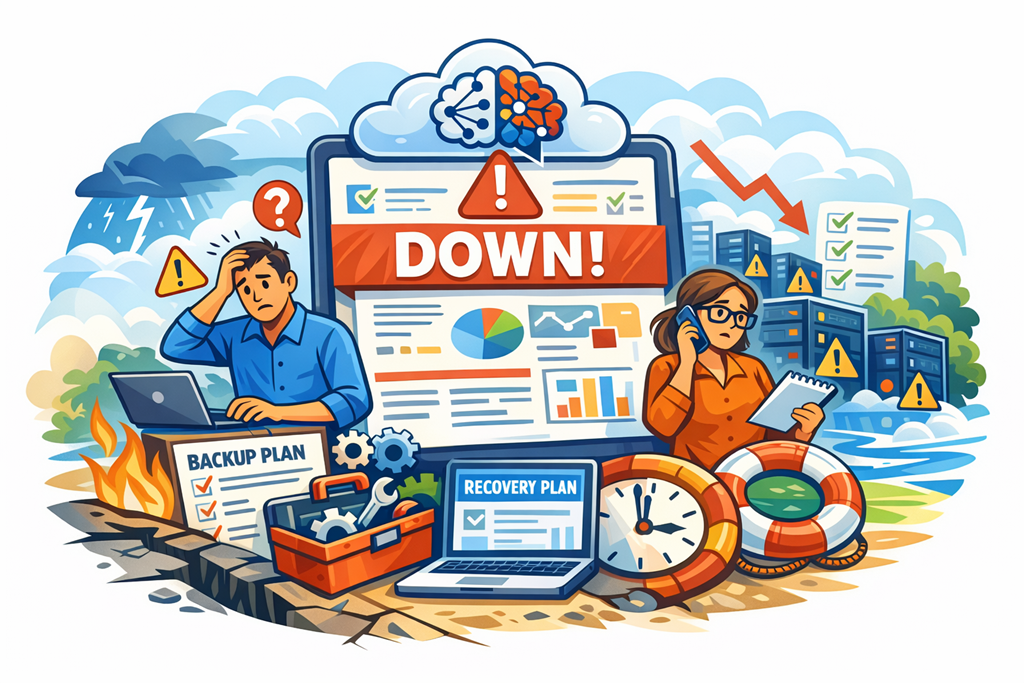
Over the past year, I’ve watched something fascinating—and slightly uncomfortable—happen inside MSPs and their clients’ businesses. AI tools, particularly Microsoft 365 Copilot, have gone from “interesting experiment” to “critical part of how work gets done” at a pace I don’t think many people fully appreciate yet.
And that raises an uncomfortable question we haven’t really answered:
What happens when the LLM isn’t there?
Not slow. Not “a bit less helpful.”
Actually unavailable.
AI Has Quietly Moved Into the Critical Path
In some of the environments I’m seeing, Copilot isn’t just helping draft emails or summarise meetings. It’s shaping decisions.
Staff are using it to draft client responses, interpret data, build proposals, prepare board slides, and make sense of complex information faster than they ever did before. Managers are using it to think through options, not just document outcomes.
That’s important, because it means AI has crossed a line. It’s no longer a convenience layer. It’s becoming part of the business process itself.
From an MSP perspective, that should set off the same internal alarm bells as any other critical dependency. Because if your client’s process assumes Copilot is available, then Copilot downtime is no longer “an inconvenience”. It’s downtime.
The New Form of Business Continuity Risk
We’re very good, as an industry, at talking about disaster recovery in traditional terms. Backups. Redundancy. Failover. RPOs and RTOs.
But AI introduces a different kind of risk—cognitive dependency.
Here’s a simple scenario I’ve already seen play out in smaller ways:
A staff member is used to Copilot summarising long email threads before client calls. One day it’s unavailable. They’re still expected to run the meeting, but they haven’t read the full thread because the process evolved around “the AI will summarise it”.
No data was lost. No system was breached. But productivity drops, confidence drops, and errors creep in.
Now scale that to proposal preparation, reporting, or internal decision-making processes that assume AI assistance.
We haven’t lost data—but we’ve lost thinking capacity under time pressure.
“The AI Will Be Back Soon” Is Not a Strategy
One of the more dangerous assumptions I hear is:
“Microsoft will fix it quickly.”
Maybe. Probably. But that’s not business continuity planning. That’s hope.
As MSPs, we need to start asking different questions during AI discussions:
- What manual process exists if AI is unavailable for a day?
- Do staff know how to complete the task without AI, or have we trained that muscle out of them?
- Which workflows are AI‑assisted—and which are AI‑dependent?
This isn’t about rejecting AI. I’m fully in favour of using Copilot when it genuinely improves outcomes. But professional-grade technology adoption has always meant understanding failure modes, not just success stories.
Designing AI‑Resilient Workflows
The smarter MSPs I’m working with are starting to treat AI like any other tier‑one system:
- Document the “AI unavailable” version of key workflows
- Set expectations with clients that AI enhances productivity but is not guaranteed
- Train staff to validate, understand, and reconstruct work without AI assistance
- Decide consciously where AI is optional versus where it must never be the only path
Ironically, the organisations doing this best often get more value from Copilot, not less. Why? Because they understand it as an accelerator—not a replacement for thinking.
The Question MSPs Should Be Asking Right Now
AI isn’t going away. Dependency will increase, not decrease. That makes this a leadership issue, not a technical one.
So here’s the question I think every MSP owner should be asking themselves:
If Copilot vanished tomorrow, which of my clients’ processes would break—and would they even realise why?
If the answer makes you uncomfortable, that’s a good thing.
That discomfort is the early warning system telling you it’s time to evolve disaster recovery thinking for the age of AI.

