
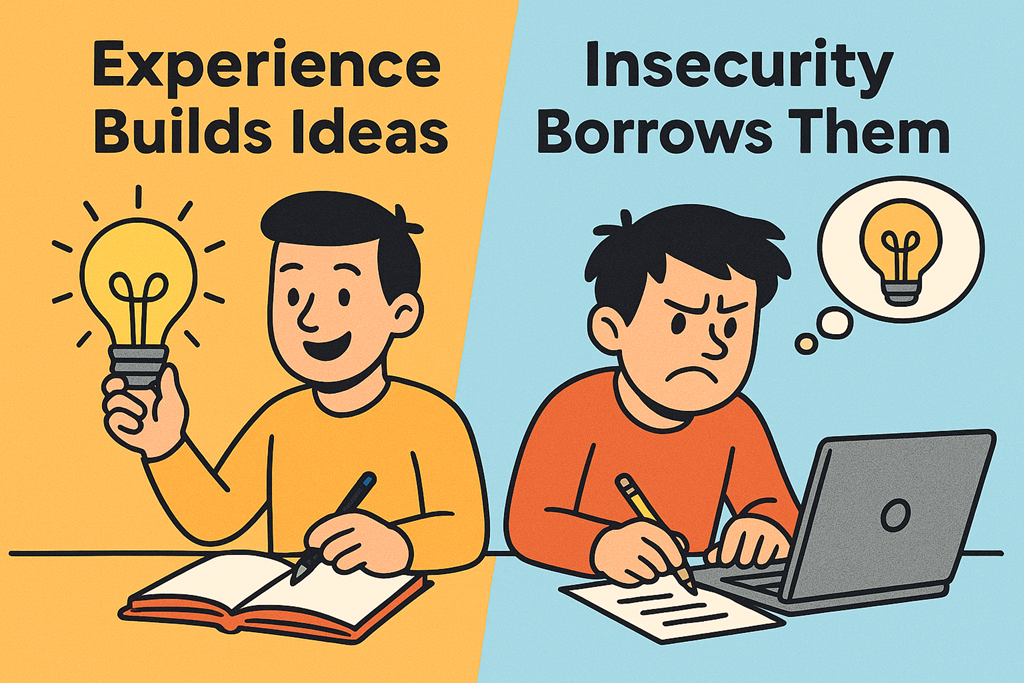
There’s a clear line between people who are doing the work and people who are just talking about it.
You don’t need a title or a following to spot the difference. You see it in how they speak, not how loudly.
People with real experience tend to build their own thinking. It’s imperfect, occasionally blunt, and often inconvenient. It comes from trying things, getting them wrong, adjusting, and doing it again. Their ideas are shaped by reality.
Everyone else tends to borrow.
They echo whatever message is trending. They swap a few words, add a diagram, and pass it off as insight. Same advice, different branding. No scars. No evidence. No ownership.
Doing the work changes your language
When you’ve actually implemented something—whether that’s a security framework, a new service offering, or AI inside a business—you stop speaking in absolutes.
You don’t say “this will change everything”.
You say “this worked here, under these conditions”.
You don’t promise miracles. You talk about trade-offs.
That shift only happens when you’ve been responsible for the outcome. When you’ve had to answer the awkward questions. When you’ve watched users ignore the thing that looked perfect in a slide deck.
That’s why experience produces original thinking. It can’t help it.
The AI gold rush has exposed the gap
AI has made this divide painfully obvious.
Right now, it’s easy to generate confident-sounding content without having touched a real deployment. Tools can produce posts, prompts, courses, and “frameworks” at scale. The barrier to publishing has collapsed.
The barrier to credibility hasn’t.
Most AI commentary falls into the same bucket:
- Vague promises
- Recycled examples
- Zero mention of friction
Very little of it answers the questions businesses actually ask:
- Why didn’t staff use it?
- What broke when permissions were wrong?
- Where did the time savings not appear?
- What did we stop doing to make this work?
Those answers only come from hands-on work. You can’t fake them convincingly for long.
MSPs live or die on credibility
This matters even more for MSPs and IT pros.
Our job isn’t to repeat vendor messaging. It’s to interpret reality for customers. That means filtering hype, testing claims, and sometimes saying “not yet” or “not like that”.
The strongest MSPs I know don’t rush to publish hot takes. They pilot first. Internally. With a handful of customers. They watch what actually happens, then they form a point of view.
When they speak, it sounds different. Less polished. More grounded. More useful.
That’s not an accident. That’s earned.
Borrowing ideas is safe. Creating them isn’t.
Borrowing someone else’s thinking feels low-risk. If it doesn’t land, you can shrug and move on. You were just sharing something interesting.
Creating your own position is riskier. It invites disagreement. It exposes what you don’t know yet. It ties your name to an outcome.
But that’s also where authority comes from.
Not from being first. Not from being loudest. From being responsible.
Ask yourself the harder question
Before publishing, presenting, or advising, it’s worth pausing and asking:
Am I speaking from repetition, or from experience?
Have I tested this, or just read about it?
Would I still hold this view if the tool, platform, or trend disappeared tomorrow?
If the answer is uncomfortable, that’s probably a signal—not to stop sharing, but to go deeper. To build something. To test something. To get closer to the work.
Because in the long run, people don’t follow confidence. They follow clarity. And clarity comes from contact with reality, not from copying what’s already out there.
That’s how real ideas are formed. And that’s what makes them worth listening to.

