
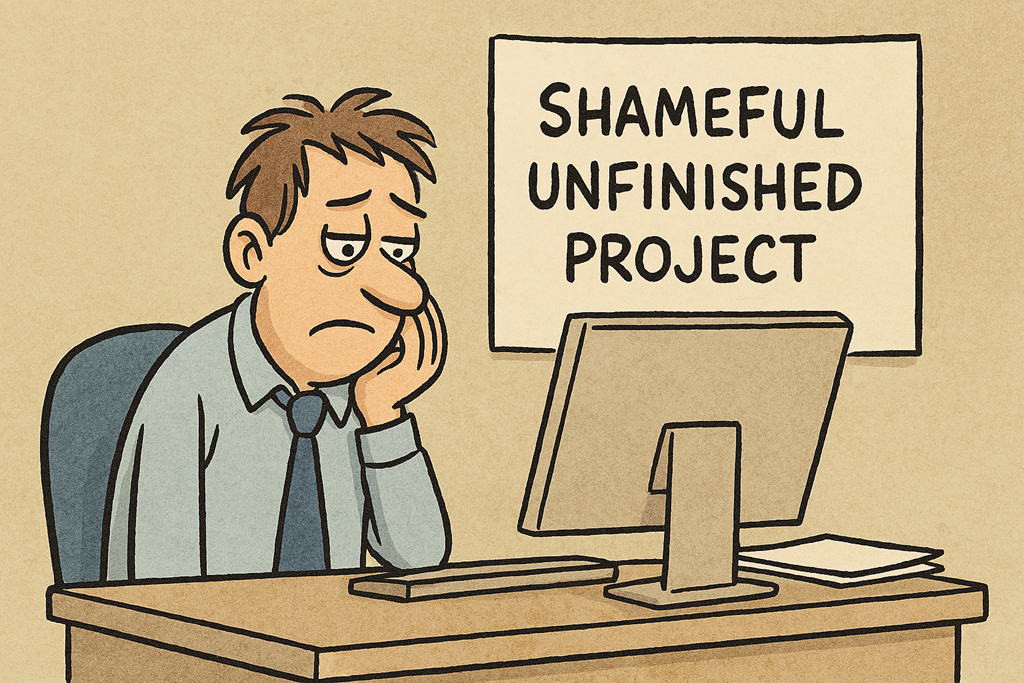
Let’s talk about something uncomfortable.
Not ransomware.
Not margins.
Not Microsoft licensing.
Shame.
Most MSPs I speak to carry some form of business shame. Quiet, private, often unspoken. It’s the thing you don’t put on your website. The thing you hope no one asks too many questions about. The thing you keep tolerating because “we’ll fix it later”.
And “later” never comes.
Maybe it’s your internal documentation. You know it’s a mess. Half-written KBs, outdated screenshots, tribal knowledge locked in one senior tech’s head. You keep telling yourself you’ll clean it up “when things slow down”. They never do.
Maybe it’s that half‑finished project. A security uplift. A standardisation initiative. A proper onboarding process. You started strong, then client work got busy, fires popped up, and now it’s sitting there like an abandoned renovation — expensive, unfinished, and quietly mocking you.
Or maybe it’s you.
Your calendar is chaos. You’re still the escalation point for everything. You know deep down that the business relies too heavily on your heroics rather than good systems. You tolerate it because you’re capable, because clients like you, because it’s easier than changing.
But here’s the hard truth.
What you tolerate is what you choose.
If something in your business causes you embarrassment, frustration, or a knot in your stomach every time you think about it — that’s a signal. Not a failure. A signal.
What Have You Been Tolerating for Too Long?
Ask yourself honestly:
- What do I avoid looking at?
- What do I explain away with “that’s just how we do things here”?
- What would I be embarrassed to show another MSP owner?
That’s your shame point.
And no, this isn’t about beating yourself up. MSPs are hard. Growth is messy. Most of us built our businesses reactively, not from some perfectly designed playbook.
But ignoring the shame doesn’t make it go away. It just makes it normal.
Now Flip the Question
Instead of asking “Why is this still broken?”, ask:
“What would this look like if I was genuinely proud of it?”
Not “acceptable”.
Not “good enough”.
Proud.
What would that neglected project look like if it actually reflected your standards?
- Properly scoped
- Properly finished
- Properly documented
- Properly embedded into how the business runs
What would change if you decided that this thing was no longer allowed to be embarrassing?
Here’s the interesting part: you already know the answer.
You know what needs to be done. You know the next step. You’ve probably written it down three times already.
What’s missing isn’t knowledge. It’s permission.
Permission to slow down briefly so you can speed up later.
Permission to say no to new work while you fix the foundations.
Permission to stop tolerating something that’s draining energy every single week.
Pride Is a Business Strategy
The MSPs that last — the ones that scale, that attract good staff, that don’t burn out their owners — they work on the unsexy stuff.
They finish projects.
They close loops.
They turn shame into systems.
Not because it’s fun, but because pride compounds.
When you’re proud of how something is built, you maintain it. You protect it. You improve it. And that pride quietly leaks into everything else — culture, delivery, confidence.
So here’s your challenge.
Pick one thing you’ve been tolerating too long.
Just one.
Decide what “I’d be proud of this” actually looks like.
Then take the first uncomfortable step towards finishing it properly.
You don’t need to fix everything.
But you do need to stop pretending that the shame isn’t there.
Because the moment you turn and face it, it loses most of its power.
And that’s where real progress starts.

