
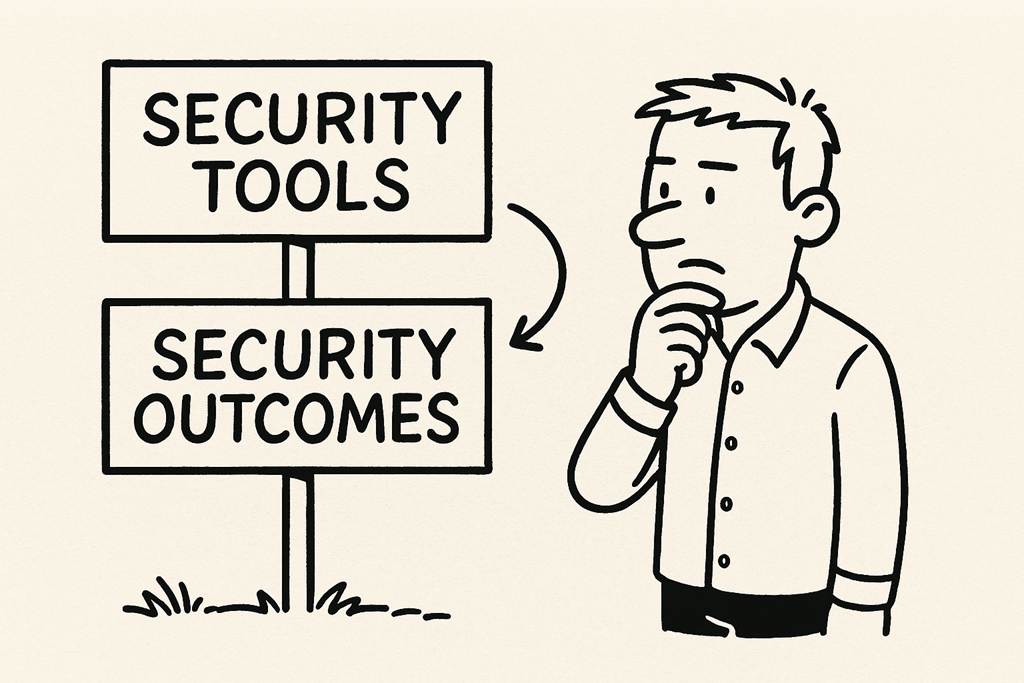
One of the biggest mistakes I see in SMB security is confusing owning security tools with being secure.
“We’ve got MFA.” “We’ve got Defender.” “We’ve got backups.” “We’ve got a firewall.”
Great. None of those are outcomes.
They’re ingredients.
Security outcomes are what actually matter to the business — and if you don’t frame your security work that way, you end up with clients who think they’re safe right up until the day they’re not.
Tools Don’t Stop Incidents. Outcomes Do.
An SMB doesn’t wake up worried about Conditional Access policies or EDR configurations.
They worry about:
- Getting locked out of email
- Paying a ransom
- Losing customer data
- Missing payroll
- Failing a cyber insurance claim
- Being offline for days
Those are business outcomes — and security should be measured against how well it prevents or limits those events, not how many licences are assigned.
Owning a tool doesn’t mean it’s configured correctly. Having it configured doesn’t mean it’s monitored. Monitoring doesn’t mean anyone knows what to do when something breaks.
Security only exists when all of those pieces work together to achieve a real‑world result.
Outcome‑Driven Security Changes the Conversation
When you focus on outcomes, the conversation with SMBs changes dramatically.
Instead of saying:
“We’re deploying Microsoft Defender.”
You say:
“We’re reducing the chance that ransomware takes out your business — and if it does get in, we’ll detect it early and recover fast.”
Instead of:
“We’re enforcing MFA.”
You say:
“We’re stopping attackers from logging in as your staff, even if passwords are stolen.”
Instead of:
“We’ve configured backups.”
You say:
“If everything is encrypted tomorrow, we can restore your critical systems within hours, not days.”
Same tools. Completely different value.
The Outcome Stack Most SMBs Actually Need
If you strip away the marketing noise, most SMB security outcomes fall into a few simple buckets:
1. Prevent the most common attacks Phishing, credential theft, malware, token abuse. Outcome: attackers struggle to get in.
2. Limit blast radius If someone does get in, they can’t access everything. Outcome: one compromised account doesn’t become a company‑wide incident.
3. Detect quickly Alerts fire early, not days later. Outcome: incidents are contained before they become disasters.
4. Recover confidently Backups work, restores are tested, roles are clear. Outcome: downtime is measured in hours, not weeks.
5. Prove it Evidence exists for insurance, audits, and management. Outcome: no scrambling, no guesswork, no “we think it’s set”.
Notice something?
None of those outcomes mention a specific product.
Why Tool‑First Security Fails SMBs
SMBs are especially vulnerable to tool‑centric security because:
- Licences get sold but not fully configured
- Defaults are mistaken for “secure”
- Alerts are ignored or misunderstood
- No one owns incident response
- Evidence is never collected
This is how you end up with tenants full of expensive security features that would look great in a demo… and fail completely in a real incident.
Security theatre feels good. Security outcomes save businesses.
Frameworks Help — If You Use Them Properly
Frameworks like Essential Eight, SMB1001, or similar are useful only when they’re treated as outcome checklists, not box‑ticking exercises.
The question shouldn’t be:
“Do we have this control?”
It should be:
“What risk does this reduce, and how do we know it’s working?”
That mindset forces:
- Validation
- Testing
- Monitoring
- Evidence collection
- Continuous improvement
In other words: real security.
MSPs: This Is Your Unfair Advantage
For MSPs, outcome‑focused security isn’t just better — it’s a differentiator.
Anyone can resell licences. Anyone can deploy a baseline. Very few can explain, demonstrate, and continuously deliver security outcomes.
If you can show a client:
- What you’re protecting
- Why it matters to their business
- How you’ll know if it fails
- What happens when it does
…you move from “IT provider” to trusted risk partner.
That’s where long‑term value lives.
Final Thought
Security tools are necessary. They are not sufficient.
If your security story starts and ends with products, dashboards, or licences, you’re missing the point.
Focus on outcomes. Design backwards from real‑world incidents. Measure what matters. Prove it continuously.
Because at the end of the day, the business doesn’t care what tools you deployed.
They care whether they can still operate tomorrow.
 CIAOPS