
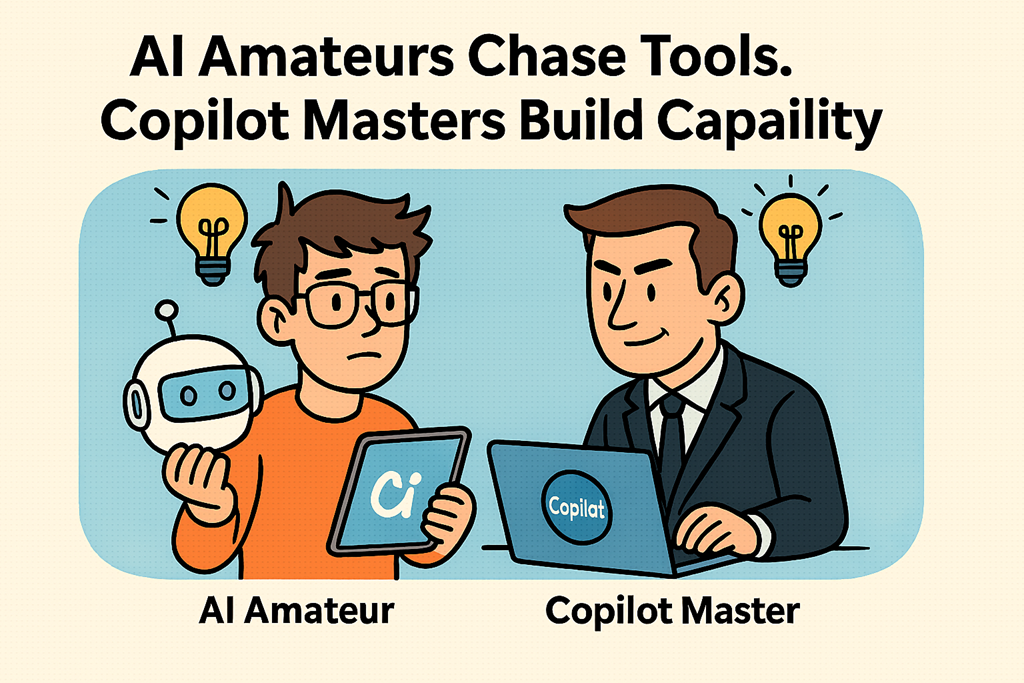
There’s a pattern I see over and over again with AI adoption, especially with Microsoft Copilot.
Beginners obsess over features.
Professionals obsess over outcomes.
Masters obsess over capability.
The amateurs ask questions like:
- “What can Copilot do?”
- “Is Copilot better than ChatGPT?”
- “What’s the best prompt?”
The professionals ask very different questions:
- “Where does Copilot save me time?”
- “Which tasks does it remove friction from?”
- “How do I make this repeatable?”
That gap is the difference between using Copilot and mastering it.
Copilot Is Not a Magic Button
Let’s get this out of the way early.
Turning on Copilot does not make you productive.
Licensing Copilot does not make you efficient.
Asking Copilot a vague question does not make you clever.
Copilot doesn’t fix unclear thinking. It exposes it.
If your emails are rambling, Copilot will rewrite rambling emails faster.
If your meetings are unfocused, Copilot will summarise unfocused meetings.
If your documents lack structure, Copilot will confidently generate more of the same.
That’s not a Copilot problem. That’s a mastery problem.
Copilot Masters Think in Workflows, Not Prompts
Amateurs treat Copilot like a search engine with opinions. One prompt. One answer. Done.
Masters treat Copilot like an embedded assistant inside real work.
They don’t ask:
“Write me an email.”
They ask:
“Based on this thread, draft a response that acknowledges concerns, proposes next steps, and matches my usual tone.”
They don’t ask:
“Summarise this document.”
They ask:
“Extract the decision points, risks, and actions I need to brief leadership on.”
The difference isn’t the tool.
The difference is intent.
Copilot works best when you already understand:
- What “good” looks like
- What the output will be used for
- How you’ll validate it
- Where it fits in the workflow
That’s mastery.
Productivity Is the Result, Not the Feature
Copilot mastery shows up as outcomes, not excitement.
Real Copilot productivity looks like:
- Emails drafted in minutes, not rewritten three times
- Meetings that produce actions, not transcripts
- Documents that start at 70%, not 0%
- Decisions made faster because context is clearer
Notice what’s missing?
There’s no mention of “cool features”.
Because productivity isn’t created by what Copilot can do.
It’s created by how you apply it consistently.
Masters Use Copilot Every Day, Not Just When It’s Impressive
The biggest mistake I see is people only using Copilot for “big” tasks.
Masters use Copilot constantly:
- To reframe thinking
- To sanity‑check assumptions
- To extract signal from noise
- To reduce cognitive load
They don’t wait for the perfect prompt.
They iterate.
They don’t trust blindly.
They validate quickly.
They don’t jump tools.
They go deep.
Copilot Mastery Is a Skill You Develop
Here’s the uncomfortable truth: Copilot mastery is work.
You earn it by:
- Using Copilot daily on real tasks
- Learning how much context is “enough”
- Understanding when Copilot is guessing
- Designing repeatable ways to use it
- Improving your thinking, not just your typing
Once you reach that point, the tool fades into the background. Copilot becomes an extension of how you work, not something you “try”.
And when the next Copilot feature arrives?
You adapt easily — because you’ve mastered the method, not memorised the button clicks.
Stop Asking What Copilot Can Do. Start Becoming Good at Using It.
If Copilot “isn’t delivering”, the answer is rarely another feature.
It’s better inputs.
Better structure.
Better workflows.
Better thinking.
Copilot doesn’t replace judgement.
It amplifies it.
And that’s why amateurs chase tools — while Copilot masters build capability.
 CIAOPS