
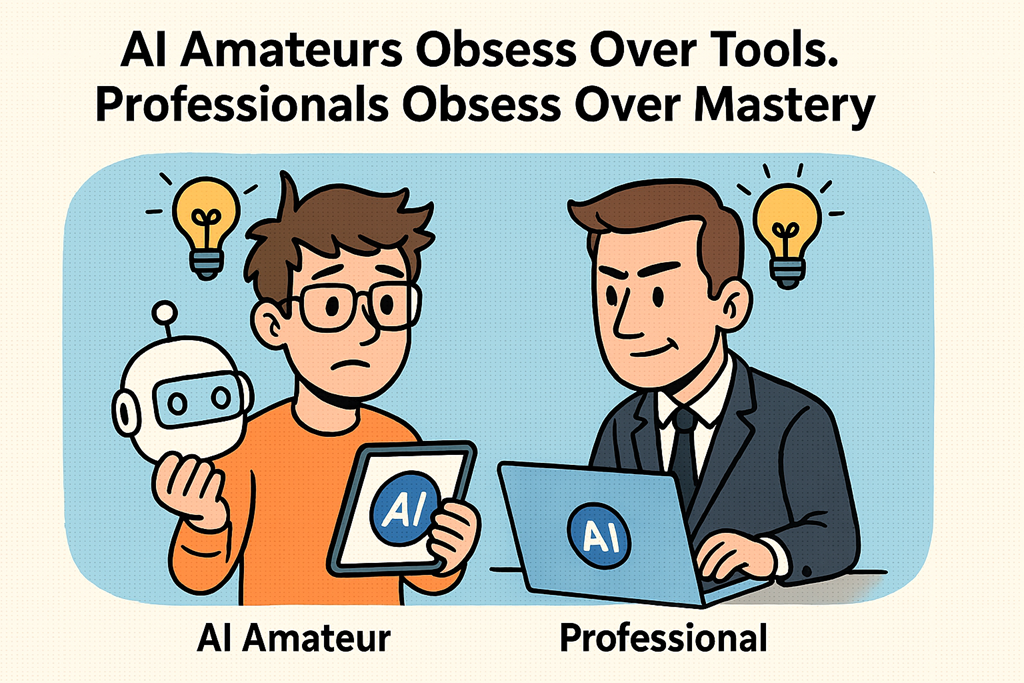
Spend five minutes in any AI forum or LinkedIn thread and you’ll see the same behaviour on repeat.
“What’s the best AI tool?”
“Which model should I switch to?”
“Is this new thing better than the last thing?”
That’s amateur thinking.
Not because those tools are bad. But because tools don’t create productivity. Mastery does.
The uncomfortable truth is this: most people aren’t struggling with AI because the tools are limited. They’re struggling because they haven’t learned how to use them properly. They expect magic. They get disappointment. Then they move on to the next shiny object.
Rinse. Repeat.
Tools Feel Productive. Mastery Is Productive.
Chasing tools feels like progress. It’s easy. It’s exciting. It gives you something new to talk about.
Mastery is boring by comparison.
Mastery looks like:
- Learning how to frame better prompts
- Giving context instead of vague instructions
- Iterating instead of accepting the first answer
- Embedding AI into real workflows, not demos
- Understanding when not to use AI
That’s not sexy. There’s no announcement blog post for it. But that’s where the results live.
I’ve said this before and it keeps proving itself true: a competent operator with average tools will outperform an unskilled operator with the best tools every time. AI hasn’t changed that. It’s reinforced it.
Productivity Is the Result, Not the Purchase
Buying or enabling AI doesn’t make you productive. It makes AI available.
Productivity only shows up when:
- A task gets done faster
- The quality improves
- Cognitive load is reduced
- Decisions get clearer
- Rework decreases
None of that happens automatically.
AI doesn’t fix unclear thinking. It amplifies it.
AI doesn’t replace process. It exposes the lack of one.
AI doesn’t remove effort. It shifts where effort is required.
If your inputs are sloppy, your outputs will be too. “Garbage in, garbage out” didn’t stop being true just because the interface looks friendly.
Professionals Pick One Tool and Go Deep
Watch what experienced users actually do.
They don’t jump tools every week. They pick one, learn its strengths and limitations, and build muscle memory around it. They develop reusable prompts. They understand how to structure inputs. They know when the model is guessing. They validate outputs quickly.
They treat AI like a junior staff member:
- Clear instructions
- Examples of what “good” looks like
- Feedback and refinement
- Supervision, not blind trust
That mindset shift alone is worth more than any model upgrade.
AI Mastery Is a Skill, Not a Subscription
Here’s the part people don’t like hearing: AI productivity is a skill you have to earn.
You don’t get it by:
- Switching models
- Reading release notes
- Watching hype videos
- Arguing about benchmarks
You get it by:
- Using AI daily on real work
- Reflecting on what worked and what didn’t
- Improving how you think, not just what you type
- Designing workflows where AI actually saves time
Once you do that, the tool almost becomes irrelevant. If tomorrow’s AI looks different, you’ll adapt. Because you’ve mastered the method, not memorised the interface.
Stop Chasing Better Tools. Start Becoming Better.
If AI “isn’t delivering” for you, the answer probably isn’t another tool.
It’s better prompts.
Better structure.
Better expectations.
Better thinking.
Productivity isn’t hiding in the next release. It’s already available to those willing to put in the work.
AI doesn’t replace thinking.
It amplifies it.
And that’s why amateurs chase tools — while professionals chase mastery.
 CIAOPS