
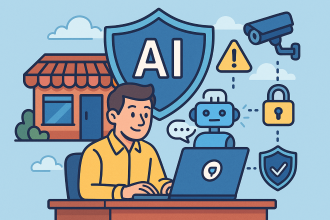
Microsoft 365 Business Premium offers a robust suite of security features, many of which are enhanced by Artificial Intelligence (AI) and machine learning. For SMBs, leveraging these AI capabilities can significantly bolster their cybersecurity posture. Here’s how:
1. AI-Powered Threat Detection and Prevention (Microsoft Defender for Business & Office 365):
-
Advanced Malware and Ransomware Protection: Microsoft Defender for Business (included in M365 Business Premium) uses AI and machine learning to analyze endpoint behavior (PCs, Macs, mobile devices) and detect suspicious activity indicative of malware, ransomware, and other advanced threats. It provides real-time threat detection and automated response capabilities to mitigate issues before they escalate [1, 2].
-
Phishing and Zero-Day Attack Protection: Microsoft Defender for Office 365 (Plan 1, also included) employs AI to identify and block sophisticated phishing attempts, including those crafted with Generative AI to appear more convincing. It uses “Safe Links” to scan URLs in emails and documents at the time of click, and “Safe Attachments” to open email attachments in a virtual environment to detect malicious content before it reaches users. This AI helps interpret email language and intent to classify threats at machine speed [1, 3].
-
Behavioral Anomaly Detection: AI models continuously learn normal user and system behavior. Any deviation from this baseline, such as unusual login patterns, large data downloads, or access from unfamiliar locations, can trigger alerts and automated responses, indicating potential account compromise or insider threats [3].
2. Identity and Access Management (Microsoft Entra ID Premium P1):
-
Risk-Based Conditional Access: AI plays a crucial role in Conditional Access policies. It analyzes factors like user location, device compliance, and detected risk levels (e.g., impossible travel, anomalous login times, leaked credentials) to determine if access to resources should be granted, denied, or require additional verification (like MFA). This proactive approach significantly reduces the risk of unauthorized access even if credentials are stolen [1, 4]. Microsoft Entra ID Protection categorizes risk into low, medium, and high confidence levels, using machine learning to inform these assessments [4].
-
Multi-Factor Authentication (MFA) Enforcement: While MFA itself isn’t AI, the AI in Entra ID (formerly Azure Active Directory) can recommend and enforce MFA based on detected risks, making it a critical layer of defense against identity attacks [1, 4].
3. Data Loss Prevention (DLP) and Information Protection (Microsoft Purview):
-
Intelligent Data Classification: AI in Microsoft Purview Information Protection can automatically identify and classify sensitive data (e.g., credit card numbers, health information, personally identifiable information) across Outlook, SharePoint, and Teams. This helps ensure that sensitive data is appropriately protected, encrypted, and prevented from leaving the organization, whether maliciously or accidentally [1, 5]. Sensitive information types and trainable classifiers leverage AI to find sensitive data in user prompts and responses when they use AI apps [5].
-
Automated Policy Enforcement: Based on the AI-driven classification, DLP policies can be automatically enforced, preventing sharing of sensitive information with unauthorized external parties or even internally if policies dictate [5]. DLP also uses machine learning algorithms to detect content that matches your DLP policies [5].
4. Device Management and Compliance (Microsoft Intune):
-
Automated Security Policy Deployment: While Intune primarily manages devices, AI can inform and automate the deployment of security policies, ensuring devices are compliant before accessing company resources. It can also help detect and flag non-compliant devices, preventing them from becoming entry points for attacks [1].
-
Remote Wipe and Data Protection: In case of lost or stolen devices, Intune allows for remote wiping of company data, which, while not directly AI-powered, is a critical security measure supported by the device management framework [1].
-
AI-powered insights for device management: Microsoft Intune leverages real-time data and AI-powered insights (e.g., in Endpoint analytics and with Copilot in Intune) to help proactively manage and secure devices, pinpoint problems, identify vulnerabilities, and deploy remediations [6].
5. AI for Security Operations (Microsoft 365 Copilot & Analytics):
-
Microsoft 365 Copilot (Add-on): While primarily a productivity tool, Copilot, when integrated with Microsoft 365 Business Premium, can contribute to security by:
-
Summarizing Security Alerts: Quickly digest and understand complex security alerts and incident reports [7].
-
Threat Intelligence Analysis: Help analyze security logs and data to identify potential threats and vulnerabilities [7].
-
Generating Security Policies/Documentation: Assist in drafting security policies, guidelines, or incident response plans [7].
-
Adhering to existing security controls: Copilot inherits existing Microsoft 365 security, privacy, identity, and compliance requirements, ensuring users only see what they have permission to access [7].
-
-
Security Analytics and Reporting: The underlying AI within M365’s security features continuously collects and analyzes vast amounts of security data. This allows for better insights into the organization’s security posture, identifies trends in attacks, and helps predict potential vulnerabilities, enabling SMBs to make informed security decisions [2].
How SMBs can best leverage this AI:
-
Enable and Configure: Don’t just subscribe to M365 Business Premium; actively enable and configure its security features. Many of the AI-powered capabilities need to be turned on and customized to your business’s needs.
-
Prioritize MFA and Conditional Access: These are foundational and highly effective in preventing identity-based attacks [1, 4, 7].
-
Educate Employees: Even with AI, human error is a significant vulnerability. Train employees on phishing awareness, data handling best practices, and the importance of reporting suspicious activity.
-
Regularly Review Security Reports: Pay attention to the security insights and recommendations generated by M365, as these are often powered by AI analysis.
-
Consider Professional Assistance: For complex configurations or if you lack in-house IT expertise, consider working with a Managed Service Provider (MSP) who specializes in Microsoft 365 security. They can help optimize your security posture and ensure you’re getting the most out of the AI-powered features.
-
Stay Updated: Microsoft continuously updates its security features. Keep your M365 environment updated to benefit from the latest AI enhancements.
By proactively utilizing the AI capabilities within Microsoft 365 Business Premium, SMBs can significantly enhance their defenses against evolving cyber threats, protecting their data, devices, and ultimately, their business continuity.
References:
[1] Security Features of Microsoft Business Premium | Smile IT. (n.d.). Retrieved from https://www.smileit.com.au/cybersecurity/security-features-of-microsoft-business-premium/
[2] Microsoft Defender for Business | Microsoft Security. (n.d.). Retrieved from https://www.microsoft.com/en-au/security/business/endpoint-security/microsoft-defender-business
[3] Microsoft Defender for Office 365 | Microsoft Security. (n.d.). Retrieved from https://www.microsoft.com/en-au/security/business/siem-and-xdr/microsoft-defender-office-365
[4] What are risks in Microsoft Entra ID Protection. (n.d.). Retrieved from https://learn.microsoft.com/en-us/entra/id-protection/concept-identity-protection-risks
[5] Use Microsoft Purview to manage data security & compliance for Entra-registered AI apps. (n.d.). Retrieved from https://learn.microsoft.com/en-us/purview/ai-entra-registered
[6] Microsoft Intune data-driven management | Device Query & Copilot – Mechanics Team. (n.d.). Retrieved from https://officegarageitpro.medium.com/microsoft-intune-data-driven-management-device-query-copilot-fc6b958a5e83
[7] Securing Microsoft 365 Copilot in a Small Business Environment – CIAOPS. (n.d.). Retrieved from https://blog.ciaops.com/2025/07/07/securing-microsoft-365-copilot-in-a-small-business-environment/
 CIAOPS