
Microsoft Purview’s Data Lifecycle Management (DLM) and Records Management solutions provide a comprehensive toolkit to help organisations keep the data they need and delete the data they don’t – critical for meeting regulatory requirements and managing information in Small and Medium-sized Businesses (SMBs)[1]. This report details the full range of features offered by these solutions, how to set them up and use them effectively in an Australian SMB context, and the licensing options (and costs in AUD) for Microsoft 365 Business Premium customers. Practical examples are included to illustrate common use cases like email retention policies, protecting sensitive documents, and automated labelling.

Features and Capabilities of Purview DLM and Records Management
Microsoft Purview Data Lifecycle Management focuses on broad retention and deletion policies for Microsoft 365 data, ensuring your organisation “keeps what you need and deletes what you don’t”[1]. Microsoft Purview Records Management builds on this by managing high-value or regulated content as formal records, with stricter controls and tracking[1]. Below is a comprehensive overview of their capabilities:
Data Lifecycle Management (Retention and Archiving)
Retention Policies (across Microsoft 365) – Create organisation-wide or location-specific retention policies to automatically retain or delete data at scale[1]. A single policy can cover multiple workloads (Exchange email, SharePoint sites, OneDrive, Teams chats, Viva Engage/Yammer, etc.) so that content is kept for a required period or removed when it’s no longer needed. These policies apply at the service or container level (mailbox, site, etc.), ensuring all items in those locations inherit the retention settings[1]. For example, an SMB could apply a 7-year retention policy to all Exchange mailboxes to meet record-keeping rules. (Note: For Teams messages, Business Premium supports retention ≥30 days by policy[2].)
Retention Labels (for exceptions) – In addition to broad policies, you can use retention labels for more granular control as exceptions. A retention label is applied to individual items (a specific document or email) and travels with that item, even if moved across locations[1]. Labels can have their own retention period and action (retain or delete), overriding any general policy. For instance, most content might be covered by a 3-year policy, but you could label certain files as “Keep 7 Years” individually. (Basic manual labelling is included in Business Premium[3] – advanced auto-labeling requires additional licensing, discussed later.)
Mailbox Archiving (Online Archive) – Archive mailboxes provide additional storage for email beyond the primary 50 GB mailbox. Business Premium includes Exchange Online Plan 2 capabilities, meaning each user gets a 50 GB archive mailbox and the option to enable auto-expanding archiving up to 1.5 TB[2]. This effectively gives users a long-term email storage solution separate from their active inbox. Admins can enable the archive for users in the Exchange admin center; once enabled, older emails can be moved automatically via retention or manually by the user to the archive folder. Archive mailboxes ensure older emails are retained without cluttering the main mailbox.
Inactive Mailboxes – When an employee leaves, you can retain their mailbox content without paying for an active license by leveraging inactive mailboxes. This is achieved by placing a retention policy (or hold) on the mailbox before the user’s account is removed; once the user license is removed, Exchange converts it to an inactive mailbox that preserves the data as per the policy[1]. Administrators and compliance officers can still search and access this mailbox data for compliance or legal needs[1]. For example, an SMB can retain ex-employee John’s emails for 7 years after departure by ensuring a retention policy covers his mailbox; after John’s account is deleted, his mailbox remains searchable as inactive. (No extra licence is required for inactive mailboxes, but only content covered by a retention policy or hold is kept.)
Importing PST Files – Purview DLM includes an import service for PSTs to help bring legacy email data into Exchange Online[1]. SMBs often have old Outlook PST archives on network drives; using the PST Import feature, you can upload these files (via network upload or drive shipping) and ingest emails into designated mailboxes or archives. This ensures historical emails are now governed by retention policies and searchable. This is useful during migration or to consolidate compliance data. (Business Premium users have rights to use the PST import service since it’s part of Exchange Plan 2 functionality[1].)
Records Management (Retention Labels & Records Lifecycle)
Retention Labels & Item-Level Retention – At the core of Records Management are retention labels that you create and configure with specific retention periods and actions. These can be published for users to manually apply in Outlook, SharePoint, OneDrive, etc., or applied by default to certain locations (e.g. a SharePoint library)[4][4]. Retention labels support flexible schedules – you can base retention on when an item was created or last modified, or even when a custom event occurs (see below)[5]. They also define what happens after the period: deletion, retention (do nothing), or even a review before deletion. Importantly, labels can be configured to mark content as a record or regulatory record (this adds controls; see next points). Publishing and using retention labels allows a consistent retention strategy at the item level, complementing broader policies[1]. For example, an “HR Record – 7 years” label could be applied to specific employee files, irrespective of where they reside. (Business Premium supports creating and publishing retention labels for manual use[3], while certain advanced settings noted below require additional licensing[2].)
Marking Items as Records – A retention label can be configured to declare content as a record. When an item is labelled as a record, certain actions on that item are blocked or restricted to preserve its integrity[5][5]. For example, if a SharePoint document or an email is marked as a record, users cannot delete it and, depending on settings, might be prevented from editing its content or metadata while the record label is in effect[5]. All modifications are logged for audit purposes[5]. This helps ensure important documents (legal, financial, etc.) remain unaltered and are retained for the required period. An SMB might use this for contracts or policy documents that must remain unchanged. By default, records in SharePoint/OneDrive can be unlocked by a Records Manager (to allow edits) and then relocked – this is called record versioning[5][5]. (Record declaration via labels requires an advanced compliance license – see Licensing section – as it’s not available with just Business Premium[2].)
Regulatory Records – A regulatory record is a special (more strict) type of record for the most sensitive needs. If a label is set as a regulatory record, nobody – not even a global administrator – can remove that label or delete the content before the retention period ends[5]. The retention period on such a label becomes locked (you cannot reduce it once set)[5]. This provides an immutable retention hold, often needed for certain regulated data. For example, in an industry where law mandates certain data must be absolutely undeletable for 7 years, a regulatory record label can enforce that. (Because of its irreversible nature, this option is disabled by default and must be enabled via PowerShell if needed[5]. Regulatory record labels also cannot be auto-applied and must be manually published and applied[5]. Using regulatory records requires E5-level licensing.)
File Plan & Label Management – Purview provides a File Plan interface to manage retention labels in bulk. It lets you import a spreadsheet of retention schedule details to create multiple labels at once, each with metadata like category, department, etc., and you can export the plan for analysis or documentation[1]. This is especially useful if your organisation already has a records retention schedule (e.g., from a policy document) – you can mirror that in Purview. The file plan also allows adding descriptive info to each label (like a reference to legal citation, record category, etc.) for tracking regulatory requirements[1]. An SMB with a simple retention schedule might not need bulk import, but a file plan can still document what each label is for. (The file plan import/export capability is considered an advanced feature – available with E5 compliance licensing[2].)
Event-Based Retention – With Records Management, retention can be triggered by real-world events. An admin can define an event type (e.g. “Employee Departure” or “Contract Closed”) and then, when such an event is registered in the system with a date and associated items, it will start the retention period for those items[5]. For example, you might have documents labeled to retain for 5 years after an employee leaves. When the employee leaves and an “Employee Departure” event is triggered for that person, all items tagged to that employee can start their 5-year countdown from that date. Common event scenarios include employee leaving, contract expiration, or project end. Event-based retention ensures the clock starts at a meaningful time rather than at creation or modification of the content[5]. (This feature requires advanced licensing – not available with just Business Premium[2]. It’s typically used alongside retention labels and events must be managed in the Purview portal.)
Disposition Reviews and Proof of Deletion – At the end of a retention period, instead of auto-deleting content sight unseen, Purview can require a disposition review. This means designated reviewers (e.g. a records manager or content owner) get to manually approve the deletion of each item labeled for review[1]. They can examine the content and decide to delete it, extend retention, or re-label it. This is especially helpful for records where human judgment is needed before disposal. All items that are deleted (whether via automatic expiration or after a review) are logged, and Purview provides proof of disposition – an audit trail showing what was deleted and when[1][5]. This proof can be exported for compliance evidence[5]. For example, an SMB in finance could have a disposition review for all client files prior to deletion, to ensure no required records are mistakenly purged. (Disposition review capability is an E5-level feature; Business Premium users would need an add-on to use it[2].)
Automatic Application of Labels – Rather than relying only on users to apply labels, Purview can auto-classify content and apply retention labels based on conditions. There are three main methods:
- Sensitive info detection: e.g. automatically tag any document containing a credit card number or tax file number with a “Financial Data – Retain 7 Years” label.
- Keyword or query-based: e.g. auto-apply a label to items containing specific keywords (like “Confidential” or project codes), or to specific content types or metadata properties.
- Trainable classifiers: using AI models to identify content by concept (for example, a classifier that recognises resumes/CVs or contracts and applies a relevant label). Auto-labeling greatly eases policy enforcement – ensuring items are labeled even if users forget. For instance, you could configure Purview to automatically label any email with an attachment containing personal data as a record to be retained for compliance. However, these auto-labeling features require advanced licensing (Microsoft 365 E5 Compliance or the E5 Information Protection & Governance add-on)[2]. Business Premium includes the ability to create and use retention labels manually[3], but auto-apply (by sensitive info, keywords, or classifiers) is unlocked only with the add-on[2]. Auto-applying by default to all content in a location (e.g. default label for a SharePoint library) also falls under this requirement[2].
- Sensitive info detection: e.g. automatically tag any document containing a credit card number or tax file number with a “Financial Data – Retain 7 Years” label.
Monitoring and Analytics – Purview provides some monitoring tools for retention. In the Records Management section, you can see the label usage across your tenant and track items pending disposition, etc. Additionally, Activity Explorer (in the Data Classification section of Purview) can show label application events. These help admins ensure policies are in effect. (These are available with appropriate permissions; some advanced analytics might need higher SKUs, but basic audit of label actions is present with any retention usage[5].)
How These Features Work Together
In practice, Data Lifecycle Management features (like broad retention policies, email archive, etc.) are used to establish baseline data governance for all users, while Records Management features (retention labels, records, disposition) are used for specific content that needs special handling. For example, an SMB might use a retention policy to delete all emails older than 5 years (general cleanup) and use retention labels to mark certain emails (like executive correspondence or legal notices) to be retained for 10 years as records despite the general policy.
It’s important to note that retention policies and retention labels can coexist. If both apply to an item, the most retentive action wins (content won’t be deleted before the longest retention period applicable). Also, if something is marked as a record, that takes precedence and prevents deletion until the record schedule is up. This layered approach gives flexibility: use broad policies for general compliance, and labels for exceptions or special categories.
Setting Up Purview Compliance (Records & Retention) in an SMB
Implementing Microsoft Purview’s retention and records capabilities in an SMB environment involves a series of steps to configure the policies, labels, and ensure compliance processes are in place. Below is a step-by-step guide for setup and effective use, from planning through to monitoring:
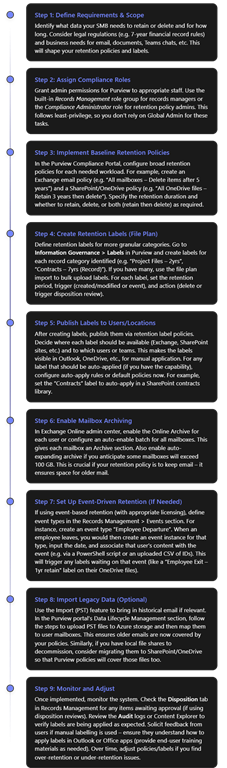
Step 1: Define Requirements. Start by documenting retention requirements. This includes legal mandates (for example, Australian tax law might require keeping financial records for 7 years, and email records could fall under discovery rules) as well as business needs (e.g. “we want to delete old Teams chats after 1 year to reduce clutter unless flagged as record”). Classify the types of data you have and decide how long each type should be kept. Tip: It’s often better to involve leadership or compliance officers in this discussion to ensure the retention schedule aligns with business policy.
Step 2: Assign Compliance Roles. Next, ensure the right people have access to set up and manage Purview features. It’s recommended not to use the global admin account for day-to-day records management. Instead, add your responsible users to the Records Management role group or Compliance Administrator role in the Purview portal[4][6]. The Records Management role group grants the ability to manage retention labels, records, disposition, etc. (including adaptive scopes and disposition reviews)[4]. If someone should only view records info and not change it, use the View-Only roles (e.g. View-Only Record Management)[4]. For general retention policies without record functionalities, the Retention Management role would suffice[6]. In an SMB, this might just be one or two people (e.g. the IT admin and perhaps a compliance officer). Setting these roles up ensures audit accountability (actions are tracked under those roles) and limits risk.
Step 3: Implement Baseline Retention Policies. With requirements set, create broad Retention Policies in Purview for each type of location:
- Go to Data Lifecycle Management > Retention policies in the Purview compliance portal.
- Add a new policy, give it a name and description (e.g. “All Exchange Mailboxes – 7yr retain, then delete”).
- Choose locations: you can target All or specific locations/users for Exchange email, SharePoint sites, OneDrive, Teams (chats or channel messages), etc., as needed.
- Set the retention period (a number of days, months, or years, or choose “Forever” if no deletion is to occur). For example, 7 years = 2555 days.
- Choose the action: e.g. “Retain items for 7 years, then delete permanently” or “Only delete items older than 7 years” or “Only retain (don’t delete after)” depending on your scenario. (Retain+delete means items are kept for at least 7 years and auto-deleted after; Delete only means items older than 7 years are purged even if not retained before, and Retain only means keep for 7 years then do nothing – user could delete after that point.)
- If using advanced scopes (available with E5 add-on), you could create adaptive scope policies (for instance, apply a policy to all users in Department = X). But for most SMB scenarios, static scopes (all or select list of locations) are used. Business Premium supports static includes/excludes for policies[2].
- Save the policy and let it deploy (can take up to 1 day to fully take effect across all content).
For example, you might configure:
- Email: Retain all Exchange Online mail for 7 years and then delete. This means even if a user deletes an email, it’s preserved in a hidden Recoverable Items store until the 7 years are up (ensuring compliance), and at 7 years, the service will purge it[1].
- SharePoint/OneDrive: Retain content for 5 years after last modification, then delete. This would clean up old files five years after they were last edited, which might suit an SMB’s data lifecycle.
- Teams: Perhaps, if no compliance need to keep chats, you might just delete Teams messages after 1 year (no retention). Note: As mentioned, Teams chat retention policies for <30 days aren’t available for Business Premium (shorter periods require enterprise licenses)[2], but 30 days or more is fine. Many SMBs choose 1 year or more for Teams if they retain at all, due to these limitations and to preserve conversation history for a while.
Step 4: Create Retention Labels (and File Plan). Now address the more specific needs via retention labels:
- In the Purview portal, go to Records Management > File plan (Labels). You can create labels one by one here or import a CSV file with multiple label definitions if you planned them externally.
- For each retention label, define the name (e.g. “Legal Hold – 10yr record”, “General Docs – 3yr”), a description for admins and users (so it’s clear when to use it), and the retention settings.
- Choose if the label will mark the item as a record or regulatory record (if you have advanced licensing and truly need regulatory-level immutability).
- Set the retention duration (finite number or “Never delete” if it should be kept indefinitely).
- Set when the retention period begins: either when the content was created, last modified, or when an event is triggered (if using event-based retention)[5].
- Select the action after period: delete the content automatically, or trigger a disposition review (for a human to decide at that time)[1]. If neither, you can just have the label indicate “ensure it’s retained for at least X years” without auto-deletion.
- (Advanced) Optionally, configure what happens after deletion – e.g. you can have it auto-apply a different label after deletion (relabeling), but this is a niche scenario and requires higher licensing.
- Choose if the label will mark the item as a record or regulatory record (if you have advanced licensing and truly need regulatory-level immutability).
- If using the file plan import, fill in the template with all labels and their settings and import in bulk[1].
- Once labels are created, you might organise them in the file plan with categories or reference IDs if useful, but that’s optional metadata for administrative ease.
For SMBs, you might only need a handful of labels. Example set: – “Standard Record – 7 years”: marks as record, 7-year retention from creation, auto-delete, with disposition review enabled (so someone checks before final deletion). – “Financial Record – 7 years (Regulatory)”: marks as regulatory record (for things like tax or financial statements that must not be altered), 7-year retention from year-end, auto-delete without review. – “Transient – 1 year delete”: not a record, just a label to tag data that should purge sooner (could be applied to trivial files or communications). – “Permanent”: perhaps a label for things that should be kept indefinitely until manually reviewed (retain only, no deletion). Use sparingly – “keep forever” can be risky unless truly needed.
Step 5: Publish and Apply Labels. After defining labels, they must be published so they become usable:
- Create a Retention label policy (in Records Management > Label policies). Add the labels you want to deploy, then choose the locations: you can select all Exchange mailboxes, or specific SharePoint sites, etc., or even specific users’ OneDrives or specific Microsoft 365 Groups. For broad deployment, you might publish to “All” for simplicity (so the label is available everywhere content lives)[4].
- Once published (this can take up to a day to appear to end users), users will see these labels in the Compliance or Retention settings of Outlook, SharePoint, OneDrive, or Office apps (depending on the app, they might appear under File -> Info for documents, or in Outlook’s Assign Policy menu).
- If you have labels you want automatically applied and you have the license for it:
- Set up an auto-labeling policy (under Records Management or Information Governance, “Auto-apply retention label”). Here you choose a label and define the conditions (specific words, a built-in sensitive info type like “Credit Card Number”, or choose a trainable classifier if one is prepared)[2].
- Alternatively, to auto-apply by location, you can configure default label on a SharePoint document library or to all content in an Exchange folder. For SharePoint libraries, this is done in the library’s settings (requires that the label is published to that site). For Exchange default folder (like default for Inbox), this can be done via PowerShell or the Compliance portal’s label policy settings. Both are considered “auto-application” methods that require the advanced license as well[2].
- Set up an auto-labeling policy (under Records Management or Information Governance, “Auto-apply retention label”). Here you choose a label and define the conditions (specific words, a built-in sensitive info type like “Credit Card Number”, or choose a trainable classifier if one is prepared)[2].
- Make sure to inform users (if relevant) about how to manually apply labels. Typically, for SharePoint/OneDrive, users can right-click a document > Details pane > Apply label; in Outlook, they can assign retention labels to emails if you enable that in Outlook’s compliance settings.
Step 6: Enable Archive Mailboxes. In the Exchange Admin Center (EAC), check under Recipients > Mailboxes for each user that the Archive is enabled. For Business Premium, the archive mailbox feature is available[2], but it may not be auto-on. You can multi-select mailboxes and click “Enable archive” to turn it on for all. Once enabled:
- Optionally enable auto-expanding archiving (via PowerShell or the Purview portal’s Exchange settings). This allows mailboxes to grow beyond 100 GB by automatically adding additional storage as needed[2].
- Ensure your users are aware of how the archive works – by default, nothing moves to archive automatically unless you use a Retention Tag (an older Exchange feature) or a retention policy that explicitly moves items to archive after X days. Purview retention policies do not move emails to archive (they only delete/not delete). If you want messages to move to archive after, say, 2 years, you must configure an MRM policy with an archive tag (this is separate from Purview retention and configured in Exchange’s Messaging Records Management). Many organisations skip this – archive is often used as user-driven storage or for auto copying old mail via Microsoft’s Default Archive and Retention policy (which by default moves mail >2 years to archive). Verify or adjust those settings in Exchange if needed[6][6].
- With archiving enabled, if your retention policy is “delete after 7 years”, users can still offload older emails to archive (which is still subject to the retention policy) but at least their primary mailbox stays smaller. Inactive mailbox functionality also relies on the mailbox having had retention in place (with archive, it preserves everything in primary + archive).
Step 7: (Advanced) Configure Event-Based Retention. If you decided some content should start the clock based on events like employee leaving or contract closure, set up event types:
- In Purview’s Records Management > Events, create a new Event Type (e.g. “Employee Departure”). Provide a description and perhaps link it to a particular retention label if that label will use this event.
- Ensure your retention label from Step 4 is configured to start on that event.
- When an actual event happens (say Alice leaves on Oct 1, 2025), you need to trigger the event. This can be done by going to the Events page, creating a new Event instance for “Employee Departure”, date = Oct 1, 2025, and add references to Alice’s content (likely her mailbox or OneDrive URL). You can also do bulk via PowerShell if multiple items. After submission, the service marks those items so that their retention period starts counting from Oct 1, 2025.
- From then, those items will behave as per their label (e.g. retain 3 years from that date, then delete).
- If using this for many users frequently (like every time someone leaves), it can be a bit of overhead without automation – larger organisations integrate HR systems to call the compliance API, but SMBs might handle events manually on a case-by-case basis.
Step 8: Import Legacy Data (if needed). Many SMBs migrating to Microsoft 365 have old data silos:
- To import PST files: In Purview > Data Lifecycle Management > Import, use Network upload for PST. This provides an Azure Storage SAS URL to upload PSTs. You upload them (e.g. using Azure Storage Explorer or AzCopy tool). Then you use the Import wizard to map each PST to a target mailbox (either to the primary mailbox or archive of a user). Once you finalize, Microsoft will ingest those PSTs into the mailboxes[6].
- After import, those emails become part of Exchange Online and your retention policies will include them (e.g. if you imported 10-year-old emails and your policy deletes after 7 years, those older-than-7 emails might get deleted soon after import unless you adjust policies for them – consider that in planning).
- For old documents (if coming from file servers), you might manually migrate them to SharePoint/OneDrive libraries and then apply appropriate retention labels/policies to those libraries.
- The goal is to bring all important data under Purview management, so you’re not leaving things out and uncategorised.
Step 9: Monitor and Refine. With everything deployed:
- Regularly check the Disposition tab in Records Management if you configured any labels with disposition review. This will list files or emails whose retention period ended and are pending approval for deletion. Reviewers can go in, inspect content, and approve or postpone deletions. Ensure this process is followed so records don’t sit indefinitely awaiting review.
- Use audit logs to verify retention actions. For instance, you can search the Unified Audit Log for events like ”Retention label applied” or ”Record deleted”.
- Spot-check that users are indeed seeing the labels. Go into a few SharePoint sites or Exchange mailboxes and verify the labels appear in the UI.
- Over time, gather feedback: Are any important items getting deleted too soon? (If so, you may need to prolong retention or ensure those items get a special label.) Are you keeping too much redundant data? (Maybe shorten a policy if storage or legal considerations warrant.)
- Also ensure new content locations are covered – e.g. if a new SharePoint site is created and your policy was not set to “All sites” but specific ones, you’ll need to update it or change scope.
By following these steps, an SMB can methodically configure Microsoft Purview to manage data lifecycle and records in line with its needs. The key is to start with broad strokes (policies) then refine with labels where needed. This hybrid approach ensures compliance (nothing important is lost) while also enabling data minimisation (old stuff is cleaned up when permitted).
Licensing Considerations and Pricing (AUD)
Microsoft 365 Business Premium includes core compliance features, but some of the advanced capabilities of Purview Records Management require additional licensing. Below we outline what is included in Business Premium versus what requires an upgrade or add-on, and provide a comparison of licensing options relevant to retention and records management. All prices are in Australian dollars (AUD) and are per user per month (estimated retail costs).
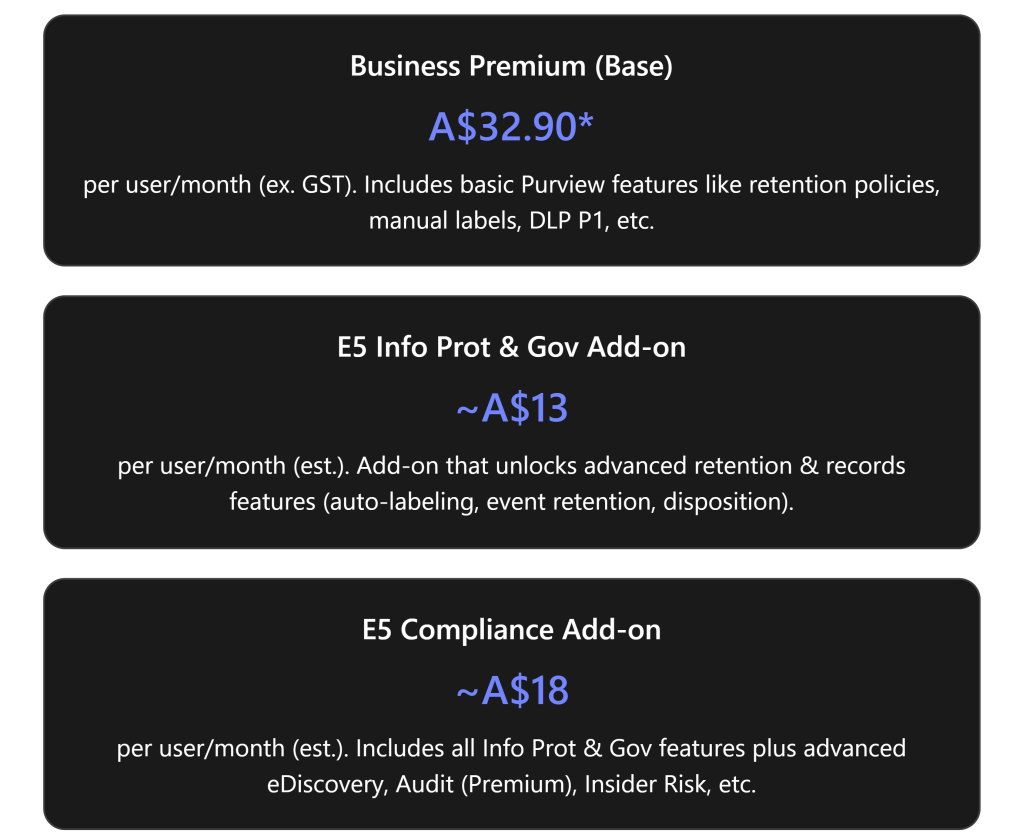
Pricing notes: A$32.90 is the approximate price per Business Premium licence per month (excluding GST) as of early 2024[7]. The add-on prices (~A$13 and ~A$18) are approximate conversions/estimates based on typical Microsoft USD pricing ($8–$12 USD) and available Australian pricing info, as Microsoft’s MSRP in AUD can vary. These add-ons are purchased on top of Business Premium for only those users who need the capabilities.
Included with Business Premium: Microsoft 365 Business Premium covers many standard compliance features out-of-the-box. For data retention, a Business Premium user already has rights to:
- Exchange Online Archiving (Plan 2) – i.e. 50GB archive mailbox and auto-expand up to 1.5TB[2] (this is part of the Exchange license within Business Premium).
- Core retention policies – You can create organisation-wide or location-based retention policies covering Exchange, SharePoint, OneDrive, Teams, etc. Business Premium (like Office 365 E3) allows these baseline policies[2][3].
- Manual retention labels – You can create and publish retention labels for users to manually apply, and use them to enforce retention or deletion (except the settings that specifically need E5). Basic label usage is included[3].
- In-place records management (basic) – Essentially, you can implement a rudimentary records management by instructing users to not delete certain content and using retention policies to protect it. However, the explicit “Declare as record” functionality via label is not active without E5.
- Data Loss Prevention (DLP) for emails & files – (Though not our focus here, note that Business Premium includes DLP for Exchange, SharePoint, OneDrive – this complements retention by preventing improper sharing of info[3].)
- Sensitivity Labels (AIP P1) – Again tangential, but Business Premium includes sensitivity labels (without auto-label) which is separate from retention labels but often used in the same Purview portal for classifying data.
In short, Business Premium provides retention policies and manual labeling – the fundamental tools to implement a retention strategy[3]. What it lacks are the more automated and advanced governance capabilities (which are typically reserved for E5 Compliance or the add-on).
Add-On: Microsoft 365 E5 Information Protection & Governance – This is a specific add-on licence that “offers the same information protection and governance capabilities as E5 Compliance, but at a lower cost” (it excludes things like eDiscovery, Audit, Insider Risk)[3]. By adding this to a Business Premium user, you unlock Purview’s advanced retention and records management features, namely:
- Auto-apply retention labels based on sensitive info or keywords[2].
- Trainable classifiers for auto-labeling[2].
- Event-based retention (start retention on events)[2].
- Record labels and regulatory record capabilities (to mark items as immutably record)[2].
- Disposition review and proof in the interface[2].
- Adaptive policy scopes (dynamically include/exclude content in retention policies by attributes, useful in bigger orgs)[2].
- Label-based retention on SharePoint Syntex model output (niche case)[2].
- File plan manager (import/export labels)[2].
- “Priority” retention policies (to override other policies in special cases)[2].
For an SMB, the most relevant of these are auto-labeling, record immutability, event triggers, and disposition – all enabled by this add-on. The E5 Info Protection & Governance add-on is generally cheaper than the full E5 Compliance; as of 2023 its global list price was about US$8 user/month (versus US$12 for E5 Compliance), which we’ve estimated around A$12–13.
Add-On: Microsoft 365 E5 Compliance – This is a superset that includes all compliance features: everything in Info Prot & Gov plus things like Insider Risk Management, Communication Compliance, eDiscovery (Premium), Audit (Premium), Customer Key, etc. If an SMB also needs those (which is less common unless in highly regulated industry or legal proceedings heavy), they might opt for the full E5 Compliance. Price is roughly ~A$17–18 per user/month (ex GST) in Australia for commercial customers (it can be purchased as an add-on to Business Premium or Office 365 E3, etc.)[8]. It requires that the user already has a base licence (which Business Premium satisfies).
For the scope of Records Management and Data Lifecycle, either the E5 Compliance or the E5 Information Protection & Governance add-on will give the needed features. The Info Prot & Gov add-on is more cost-effective if you don’t need the other fluff. Microsoft documentation notes that many customers are unaware of the IP\&G add-on, but it can “reduce costs by about $5 per month per license” for the same retention features[3].
Below is a feature-by-feature breakdown of what Business Premium offers versus what the E5 Compliance add-on provides, specifically for Purview retention and records functions:
| Feature / Capability | Business Premium (Included) | With E5 Compliance Add-on (or E5 Info P&G) |
|---|---|---|
| Organisation-wide retention policies (Exchange, SharePoint, OneDrive, Teams, etc.) – create, include/exclude locations | ✔ Yes2 | ✔ Yes (no change) |
| Mailbox archival (50GB + auto-expand) – Exchange Online Archiving for users | ✔ Yes2 | ✔ Yes |
| Inactive mailboxes (preserve data of departed users via retention) | ✔ Yes (supported by retention policy) | ✔ Yes (supported the same way) |
| Import PST to Exchange (legacy email import) | ✔ Yes1 | ✔ Yes |
| Manual retention labels – create and publish labels; users can apply in Outlook/SharePoint | ✔ Yes3 | ✔ Yes |
| Default retention label on locations (e.g. default for a SharePoint library or mailbox folder) | ❌ Not available | ✔ Yes2 |
| Auto-apply labels by sensitive info (e.g. credit card numbers) | ❌ Not available | ✔ Yes2 |
| Auto-apply labels by keywords/query | ❌ Not available | ✔ Yes2 |
| Auto-apply via trainable classifier | ❌ Not available | ✔ Yes2 |
| Retention label marks item as “Record” (user can’t delete; editable if unlocked) | ❌ Not available | ✔ Yes (Records Mgmt)2 |
| Retention label as “Regulatory Record” (even admin can’t remove or alter) | ❌ Not available | ✔ Yes52 |
| Event-based retention (start retention on event trigger) | ❌ Not available | ✔ Yes2 |
| Disposition review (manual approval for deletions) | ❌ Not available | ✔ Yes2 |
| Proof of disposal (item audit trail export) | ❌ No* (only basic audit logs) | ✔ Yes (via disposition reports)5 |
| Adaptive policy scopes (dynamic targeting of retention by user/site attributes) | ❌ Not available | ✔ Yes2 |
| File Plan manager (bulk import/export labels with additional metadata) | ❌ Not available | ✔ Yes2 |
| “Priority” retention label/policy (override other policies, e.g. force-delete even if record) | ❌ Not available | ✔ Yes2 |
| Advanced eDiscovery (Collections, Holds, Review) | ❌ Not in BP | ✔ Yes (full E5 Compliance only) |
| Audit (Premium) | ❌ 90 days audit | ✔ Yes (E5 Compliance) |
| Insider Risk Management, Comms Compliance | ❌ No | ✔ Yes (E5 Compliance) |
Table: Purview Retention/Records features in Business Premium vs E5 Compliance Add-on. (✔ = available, ❌ = not available)
Key Takeaways:
- With Business Premium alone, you can do a lot: implement retention policies and use retention labels manually. This covers fundamental compliance needs for many SMBs (e.g. keep email 7 years, allow manual tagging of a few records).
- By adding the E5 Information Protection & Governance or E5 Compliance add-on for specific users (e.g. those managing records or those mailboxes that need auto-classification), you gain the automation and stricter record controls. This is often worth it if your regulatory environment is complex or you have a high volume of content to manage.
- If you only need one or two features (like just auto-labeling), you still have to purchase the whole add-on – Microsoft doesn’t sell these capabilities standalone. However, you can choose to license just a subset of users. Only users who ”benefit from the service” need to be licensed[2]. For example, if only the compliance officer is doing disposition reviews, and records labels are applied tenant-wide (affecting all mailboxes), technically all mailboxes with a record label benefit from Records Management features, so Microsoft’s guidelines suggest those users should be licensed. It can be a grey area, but generally for compliance features, if a user’s content is subject to an advanced policy (like auto-label or record), that user should have the add-on. In practice, some SMBs license just the admin and a few key users, but formally one should license everyone whose data is being governed by those advanced features[2].
Finally, Microsoft offers a 90-day free trial of Purview add-ons for up to 25 users[4]. It’s a great way for an SMB to test out auto-labeling, event retention, etc., before deciding to purchase the add-on. You can activate this trial in the Compliance admin center (look for the Purview solutions trial banner).
Practical Examples and Use Cases for SMBs
To illustrate how Microsoft Purview’s Records Management and Data Lifecycle features can be used in a small or mid-sized business, here are a few common scenarios:

Managing Email Records (Compliance with Law): An Australian accounting firm with 20 staff uses Exchange Online (via Business Premium) and is obligated under tax law to retain correspondence for 7 years. They configure a 7-year Exchange retention policy to cover all mailboxes[1]. This means if an accountant accidentally deletes an email about a client’s tax return, the email remains in the recoverable items for 7 years and can be produced if needed. After the 7 years, Exchange auto-deletes it, so the firm isn’t keeping data longer than necessary. They also enable online archives for all users to ensure mailbox size isn’t an issue over that period. In practice, this has made compliance automatic – users continue using email normally, and the system transparently takes care of retention. If a legal discovery request arises, the admin can search the mailboxes knowing even deleted mails within 7 years will be available.
Securing Important Documents as Immutable Records: A construction company often deals with multi-year projects and legal contracts. They use SharePoint to store project documents. For each new project, the project contract and blueprint files are labeled as records using a retention label (e.g. “Project Contract – 6yr Record”). Once applied, no one at the company can delete those files or alter their contents[5]. Employees can still read them and even update minor metadata if allowed, but the critical content is locked. After 6 years (starting from project completion date, set via an event trigger), a records manager will get a notification in the Purview portal to review the contract file. Only upon approval will the document be deleted, and a proof of deletion is logged. This process protects the documents from tampering – which is crucial if there’s a future dispute about what was agreed in the contract – and it also means the company isn’t holding onto contracts indefinitely. They have a defensible deletion process after 6 years, reducing storage and liability.
Cleaning Up Chat Data: A 50-person tech startup uses Microsoft Teams heavily for daily communication. Not all those chats need to live forever (and they could pose a risk if kept). With Business Premium, they set a Teams retention policy to delete Teams channel messages and chat messages after 1 year. They chose 1 year since Business Premium allows ≥30 days for Teams retention[2] and they figured one year is enough history for any practical business need. Now, any Teams message older than 365 days is automatically removed. Users see a notice if they scroll back in a chat that older messages have been deleted due to policy. This keeps their Teams environment more performant and minimizes old irrelevant messages. They combine this with a policy that SharePoint (where files shared in Teams channels reside) retains files for 3 years, ensuring that any file shared isn’t lost too soon. Essentially, routine conversation is cleaned up, while important files or discussions can be saved separately if needed.
Automated Labelling of Sensitive Files: A small law firm deals with sensitive case files in Word and PDF format. They created a trainable classifier in Purview to detect “legal case files” based on samples, or they could simply use a query (
Subject: Case# OR contains words like 'Privileged'). With the E5 Compliance add-on, they set up an auto-label policy: any document in their SharePoint or OneDrive that matches the pattern of a legal case file is automatically tagged with a “Legal – Retain 10 years” label and marked as a record. Now lawyers don’t have to remember to tag each file; if a paralegal creates a new file and it has indicators of being a case document, within a day or so, Purview will label it. This label prevents premature deletion – even if someone tried to delete it, retention will keep it for the period. It also helps the firm demonstrate to clients that their data management is strict. (Before using auto-label, they often relied on manual practice which was hit-or-miss. Now it’s consistent.)Lifecycle for Employee Data (Event-based): A human resources consulting company needs to purge personal data when it’s no longer needed. They keep employee data for 2 years after an employee leaves, per their data retention policy. They use event-based retention to manage this: All employee files in a particular SharePoint folder (“Alumni Records”) are labeled “Former Employee – 2yr”. The retention is configured to start when an “Employee Departure” event is triggered for that employee. When an employee leaves, the HR manager goes into Purview > Events, triggers “Employee Departure” for that person effective on their leave date. Now all documents related to that employee (which are labeled accordingly) will be retained for exactly 2 years from that date, then subject to deletion. Purview will list them for disposition, and the HR manager can approve deletion knowing the policy was to keep for 2 years. This ensures the company isn’t holding personal data longer than allowed, aiding GDPR-like compliance and saving space. Without event-based capability, they would have to calculate dates manually or keep a spreadsheet – the system now automates it. (This requires the add-on for the event trigger functionality.)
Proving Compliance via Disposition Logs: A medical clinic (SMB with 15 staff) must delete certain health records 8 years after a patient’s last visit. They tag those in Teams or SharePoint with appropriate labels. When the time comes, they use disposition review to double-check and then delete the records. Purview then provides a disposition report (CSV or Excel) that lists each item deleted, with its label and date[5]. The clinic’s compliance officer downloads this report annually and files it. If ever audited by health regulators, they can produce this report as evidence that, for example, “All patient records from 2015 were indeed disposed of in 2023 as per our policy.” This kind of audit trail is something they never had when using shared folders on a server – it adds confidence and transparency to their data lifecycle management.
Each of these scenarios demonstrates how Purview’s tools can be applied in a practical, business-centric way. For SMBs, the strategy is often to start simple (broad strokes like email retention) and progressively layer on more controls (like records and auto-labeling) as needed. Microsoft Purview’s integration into Microsoft 365 means even smaller organisations can leverage enterprise-grade compliance features – tailoring them to ensure regulatory peace of mind without onerous manual processes.
References:
The information and best practices above were based on Microsoft’s official documentation and licensing guidance, including Microsoft Learn articles on Purview Records Management[5][1] and Data Lifecycle Management[1], as well as the Microsoft 365 licensing guide for security & compliance[2][2]. Pricing references were drawn from Australian price lists and partner sources[7][3]. All feature descriptions correspond to capabilities as of September 2025. Always consult the latest Microsoft documentation for updates, especially since Purview features (and licensing) evolve regularly.
References
[1] Data lifecycle & records management overview | Microsoft Learn
[2] Microsoft 365 guidance for security & compliance
[3] Microsoft Compliance and Information Protection Licensing Guide
[4] Get started with records management in Microsoft 365
[5] Records management for documents and emails in Microsoft 365
[6] Get started with data lifecycle management | Microsoft Learn
 CIAOPS