What is your biggest challenge with the Microsoft Cloud

pexels-photo-356079

Tis the season for a survey I think. What I’d like to do is start off with this one question:

What is the biggest challenge you face with the Microsoft Cloud?

That’s it. Just one question. You can answer the question here:

http://bit.ly/mscloudsurvey

I’ll collate all the answers and report back on the results. I’ll try and group the issues into categories so you get a better of idea of what generally are the major challenges a majority of people have.

It doesn’t matter whether you are an end user, business, IT resellers, IT professional, whatever, please take a moment to share what you find most challenging about the Microsoft Cloud (Office 365, Microsoft 365, Azure, etc)

The more people that take a moment to answer the more results and information we’ll have to share. The results are anonymous.

Thanks in advance for completing the survey.

Need to Know podcast–Episode 197

In this episode we focus on security starting with our interview of Alex Wilson from Yubico talking all about multi factor authentication. We take the time to dive deep into the benefits of using devices like the Yubikey to protect identities an help prevent phishing attacks. Brenton and I also discuss a number of interesting security items before the interview as well as give you the latest updates from the Microsoft Cloud.

Take a listen and let us know what you think –feedback@needtoknow.cloud

You can listen directly to this episode at:

https://ciaops.podbean.com/e/episode-197-yubikey/

Subscribe via iTunes at:

https://itunes.apple.com/au/podcast/ciaops-need-to-know-podcasts/id406891445?mt=2

The podcast is also available on Stitcher at:

http://www.stitcher.com/podcast/ciaops/need-to-know-podcast?refid=stpr

Don’t forget to give the show a rating as well as send us any feedback or suggestions you may have for the show.

Resources

Alex Wilson – alex.wilson@yubico.com

Yubico

@contactbrenton

@directorcia

Join us for the 200th episode

Australia gets world-first encryption busting laws

Australia passes new law to thwart strong encryption

Microsoft adopts ethical principles aiming to bar misuse of facial recognition technology

New breakthrough in combating tech support scams

Mastercard and Microsoft join forces to Advance Digital Identity Innovations

New Office app icons

Outlook on iOS gets a redesign

CIAOPS Patron program

Unable to save attachments to SharePoint Online

One of the most important things when you implement adoption is to have a positive initial experience. This typically means ‘easing’ a user’s transition during the adoption process. If too many things are different, then there is much more likely to be a negative impression of the new processes. This slows adoption and at worst, can actually halt it in its tracks.

When moving to Microsoft 365, one of the most common things that a user needs to accomplish to be able to save and add attachments to emails. They have been performing this seamlessly using on premises file servers for years. They simply select to attach and then navigate to the file, attach it, then send. Easy.

Unfortunately, as I have documented before:

Saving attachments to SharePoint

it isn’t easily done with SharePoint Online. This is really strange, given that SharePoint Online is the place where users should save and access common files in the Microsoft Cloud. Let’s take a look at the issues I’m taking about.
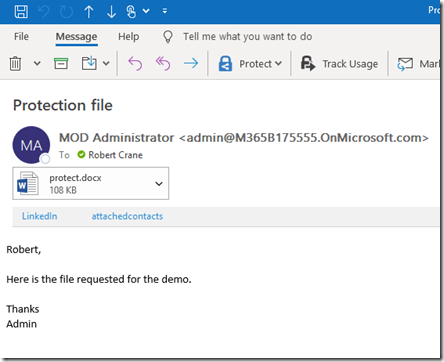
image

So an email arrives in my inbox on Outlook on the desktop, as shown above.
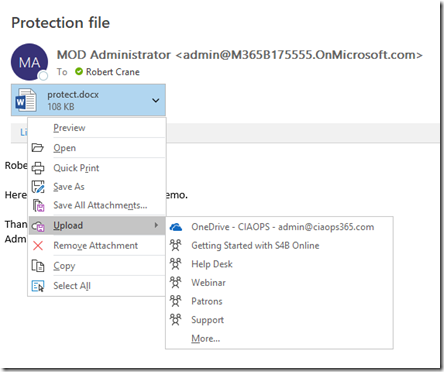
image

I want to upload this directly into an existing SharePoint stand alone Team Site, but as you can see the only option I have is my own personal OneDrive for Business or a range of Office 365 Groups and Teams that already exist.

Just to make sure I haven’t missed anything, I’ll select the More option at the bottom of the list.
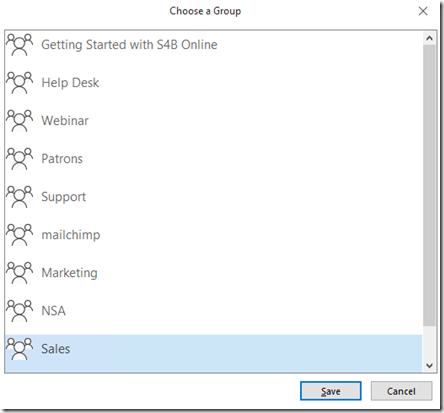
image

Now I only have the option to save to a Group (which includes Microsoft Teams). So, let’s say I select the Sales Group (which is actually a Microsoft Team).

I’m now returned to Outlook. Where did that attachment actually go?
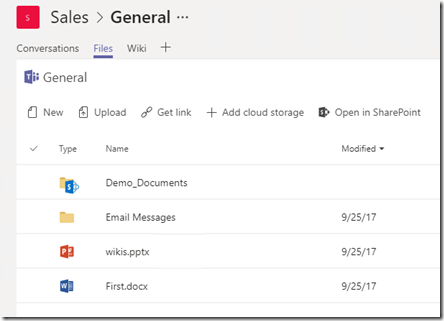
image

So, if I call up my Sales Team and rifle through all the file locations in Teams interface, I can’t find the file as you see above!
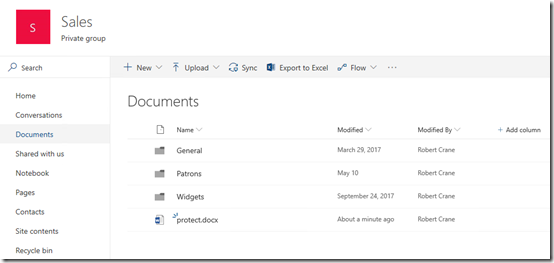
image

Turns out that the attachment I saved is placed into the root of the default Document Library in the Microsoft Team as you see above. But guess what? There is no way to actually see that unless I navigate to that location via SharePoint. I actually can’t see that attachment I just saved if I’m using the Microsoft Teams app! They all end up in the root of the Documents location, which isn’t accessible in the Teams app!
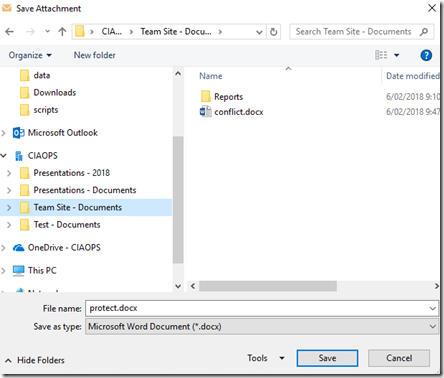
image

This means, that the only REAL solution for users to save the document to other locations in various SharePoint Document Libraries, is to firstly sync those destination locations to their desktop and then save the attachments the old fashioned way to the sync location so they will end up in SharePoint.

That means, to save or add attachments I firstly have to sync EVERY location I might want to save a file too!
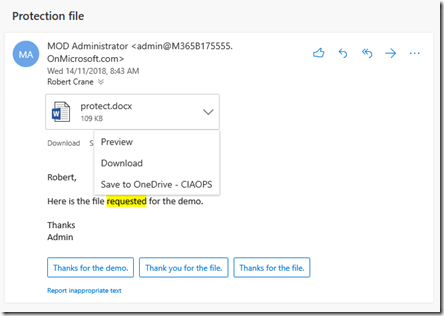
image

Outlook Web Access is actually worse than the desktop client as the only options you have are to download or save to OneDrive for Business as seen above.
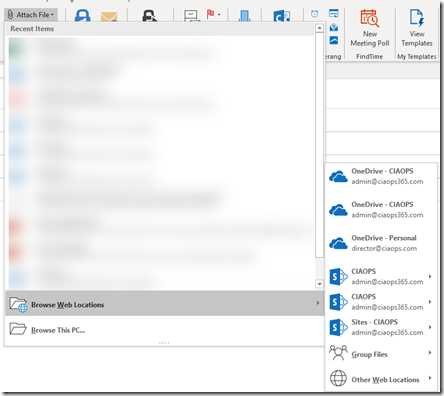
image

Interestingly, if I want to attach a file from a SharePoint site I can navigate to Browse Web Locations, select the Team Site I want
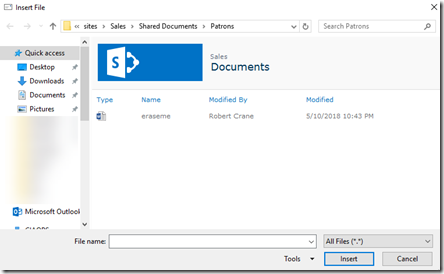
image

and I see a Windows Explorer pane where I can navigate to locate the file I wish to attach, just like on premises days. However, the look and feel here is pretty dated and requires Windows Explorer to be working and may pop up warning dialogs which will freak most users out.

image

When I use Outlook Web Access I can Browse cloud locations for an attachment
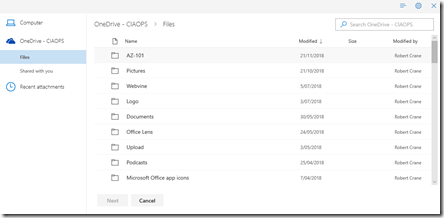
image

I effectively only see my OneDrive for Business as shown above.

These experiences leave a bad taste in the mouth for users, especially first time users grasping with the ‘modern’ way of working. They need to have an experience which is pretty much identical to the one they had on premises. Why can’t we simply save and add attachments directly from SharePoint Online Team Sites like we have always been able to do from on premises network file shares?

I’m seeing this end user frustration more and more in the field and was prompted to write the article to hopefully rally the masses to get a change enacted. So the best thing you can do is visit this UserVoice request:

https://office365.uservoice.com/forums/264636-general/suggestions/18553747-please-enable-the-attachment-of-sharepoint-files-w

and vote it up.

Next, tweet about getting this enabled to the following accounts:

https://twitter.com/Outlook

https://twitter.com/SharePoint

https://twitter.com/Microsoft365

and

https://twitter.com/jeffteper

I will be!

Perhaps I’m missing something obvious here and if I am please let me know but I don’t think I am. Help me raise awareness and improve Outlook so it is easier for users to adopt Microsoft 365!


CIAOPS Need to Know Office 365 Webinar–December

laptop-eyes-technology-computer

For the last webinar of 2018 we are going to take a look back at everything that’s changed with Office 365 and what we can expect to see in 2019. If you want a summary of what’s been and what’s to come then this is webinar for you! There’ll also be the usual detailed updates of everything that’s happened in the Microsoft Cloud for December as well.

You can register for the regular monthly webinar here:

December Webinar Registrations

The details are:

CIAOPS Need to Know Webinar – December 2018
Thursday 20th of December 2018
11am – 12am Sydney Time

All sessions are recorded and posted to the CIAOPS Academy.

There of course will also be open Q and A so make sure you bring your questions for me and I’ll do my best to answer them.

The CIAOPS Need to Know Webinars are free to attend but if you want to receive the recording of the session you need to sign up as a CIAOPS patron which you can do here:

http://www.ciaopspatron.com

or purchase them individually at:

http://www.ciaopsacademy.com/

Also feel free at any stage to email me directly via director@ciaops.com with your webinar topic suggestions.

I’d also appreciate you sharing information about this webinar with anyone you feel may benefit from the session.

Need to Know podcast–Episode 196

I am joined by a familiar guest to many, previous co-host of the Need to Know podcast, Marc Kean, who shares with us what he has been up to lately and his career journey to now being a full time Microsoft employee. Listen along and you’ll get some insight into one of the technical job roles at Microsoft.

Of course Brenton and I also bring you up to date with the latest Microsoft cloud news including recent a Azure AD multi factor outage and how Microsoft is now more valuable than Apple! Listen on for full details.

Take a listen and let us know what you think –feedback@needtoknow.cloud

You can listen directly to this episode at:

https://ciaops.podbean.com/e/episode-196-marc-kean/

Subscribe via iTunes at:

https://itunes.apple.com/au/podcast/ciaops-need-to-know-podcasts/id406891445?mt=2

The podcast is also available on Stitcher at:

http://www.stitcher.com/podcast/ciaops/need-to-know-podcast?refid=stpr

Don’t forget to give the show a rating as well as send us any feedback or suggestions you may have for the show.

Resources

@marckean

@askbrenton

@directorcia

Marc’s blog

Azure AD MFA outage analysis – look for event on 19th November

Microsoft now more valuable than Apple

Microsoft helps create a secure modern workplace

New management for Microsoft Teams

Windows 1809 rollout continues

SharePoint customisation code will bite you

A very common thing I see when working with many businesses implementing collaboration solutions in Office 365, is their rigid desire to implement customisations via code to SharePoint immediately.

Many have a pre-conceived idea of what they believe an ‘intranet’ should be and operate. Thus, they want to force SharePoint to fit that model. The only way to achieve this typically is to use custom code on the site. They want lots of changes made to not only the look and feel but also the functionality prior to implementing it across the business.

I warn them strongly, that the more you customise with code the more it is likely to break and the more issues you will have down the track. A much better option, at least to start with, is to go with what Microsoft provides you out of the box. Only once you have exhausted all in the out of box options, then look at custom code. Then and only then, and when you do be prepared to continually maintain it.

As further evidence for this stance, if you take a look at this video from the recent Microsoft 2018 Ignite from 47:03

https://www.youtube.com/watch?v=rhYHdYn5jdQ&t=2928s

and listen to what Tracey Haun, Director, IT Collaboration and Privacy from Dupont says:

When we set up SharePoint we were so proud of ourselves for only customizing less than 5% of the environment and that less than 5% customization has come back to bite us time and time again. Every time we upgrade, every time we migrate we have to deal with these customizations. I just want to say that we were so rigid in the way that we in way we wanted to — and this is specifically around our records management and the way we classify the security classification of our sites, we were so rigid and so set in our ways on how we wanted to do that. So I highly recommend, if you are just getting started, go with the industry standard. Don’t force your business model into SharePoint. Let the it adapt to the Microsoft way.

Thus, if you want to make major changes to the way SharePoint Online works out of the box you firstly need to find a developer who is specifically experienced with SharePoint Online. Even after the job is complete, you are going to need to have someone on tap to maintain that code, because sooner or later it will break. Why? Because Microsoft makes changes and improvements to the underlying SharePoint base that will affect the code.

When that happens, and you won’t know when it will, the more you have used custom code the more catastrophic the failure of your site is going to be. If the site has become a critical part of your business, then it means that system will be down until a developer can be found to rectify the problems. That could be quite a while.

Putting your business in that situation, to me, is increasing your risk which is not something you want to do. Going with what Microsoft give you out of the box may not be “exactly” what you want but it is going to keep on working as SharePoint is updated, unlike custom code.

Of late, Microsoft has added many improvements to SharePoint and collaboration in Office 365, that really make me question why you would want custom code at all? Is it really worth the risk and costs involved?

So my STRONGEST advice when it comes to SharePoint is to use what you are given out of the box to it’s fullest. After that, if you still want changes, make sure you FULLY understand the indications and increased risk this places your business under.

I’m sure people would love desktop applications like Excel to do more but they generally don’t go making wholesale customisations via code. They tend to work with what they are given out of the box. So too, it should be with SharePoint.

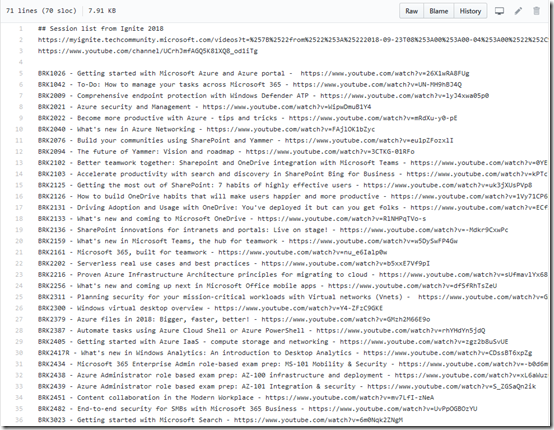
Ignite 2018 sessions on YouTube

With Microsoft Ignite 2018 now over for 2018 I wanted to let people know that like last year:

Ignite 2017 sessions on YouTube

I’m maintaining a list of links directly to the sessions on Github.

image

The list is maintained at:

https://github.com/directorcia/general/blob/master/ignite2018.txt

and I will be updating it throughout the year as I find links to new sessions.

Of course, if you have a link to a session that I don’t have up there yet, please send it along so I can add it and we can all benefit.

All the sessions are not there as yet. I add them when I find them and the update this file, so make sure you check back regularly to get the latest list.

Thanks again to Microsoft for doing this and uploading the sessions to YouTube. They are a great source of learning and allows people like me would couldn’t get to Ignite the ability to work through the content.