Azure VPN performance

I’ve be working a lot recently with Azure VPNs thanks to the development of my new online course:

CIAOPS Azure VPN course

One of options you need to select when you create a new Azure VPN gateway is the SKU.

image

With all the VPNs I had been working with I’d always just left the option set as Standard but then I wondered whether selecting another VPN SKU made any real difference?

I therefore set out to do some basic testing of the performance of the different Azure VPN SKUs to get an indication of what differences, if any, there was between them.

The place to start if you want more information about Azure VPN Gateways is here:

About VPN Gateway

In my case, I started with 6.9GB of data, composed of a number of large PST files (100 – 500MB each) that I would copy between local and Azure VM’s via an Azure VPN.

I kept the VMs at both ends the same and only recreated the VPN gateway as needed, with a different SKU each time. I did all the transfers using drag and drop from Windows Explorer.

clip_image001

You can see the speed test results from the link that I had my local VM connected to the Internet with.

After copying the 6.9GB of data up from the local VM to Azure and then back down from Azure my results showed that there was no appreciable difference in performance between any of the Azure VPN SKUs. The time taken to upload or download the data was identical at around 12 minutes or around 720 seconds. That is about 9.81 MB/s in my maths (6.9 x 1,024)/720 up and down.

When you look at the quoted VPN gateway throughput you find that Basic and Standard are around 100Mbps, while High Performance is 200Mbps. However, as the Microsoft notes:

“The VPN throughput is a rough estimate based on the measurements between VNets in the same Azure region. It is not a guaranteed throughput for cross-premises connections across the Internet. It is the maximum possible throughput measurement.”

So, based on my rudimentary tests, I didn’t see any difference in performance based on the different VPN SKU’s.

image

Where a major difference surfaces is price. If you go to the Azure pricing calculator and calculate the monthly cost of the different VPN SKUs you find that to run for a full month the Basic VPN SKU costs AU$34.11.

image

The Standard SKU costs AU$180.05 (428% higher) and

image

the High Performance SKU costs AU$464.34 (12,610% higher than the Basic SKU).

Based on my rudimentary transfer tests, and provided you don’t need some of the additional features of the more advanced VPN SKUs (such as additional IPSec tunnels) then I have to say that probably for most cases, the Basic VPN SKU is more than adequate. Thus, from what I can determine, the Basic Azure VPN SKU is the most cost effective option.

However, I’m sure when you get lots of varied traffic, with different file sizes and a more typical work environment the more advanced Azure VPN SKUs shine but as I said, from I see, the Basic SKU is a great place to start when you want to connect your environment securely to Azure.

The other value that I’ll share with you is the fact that creating a VPN Gateway using the Azure Resource Manager (ARM) portal takes about 40 minutes. It is easy enough to change the Azure VPN SKU you use over time but remember that, if you do want to change the Gateway SKU, you’ll need to delete the existing Gateway and create a new one. And that will take about 40 minutes to complete.

In summary, my take aways from this rudimentary testing of the different Azure VPN SKUs is that, in the SMB world, a Basic VPN SKU appears to be the most cost effective, unless you need some specific advanced VPN features. It is also easy enough to upgrade the Azure VPN Gateway at any time but doing so requires about 40 minutes of creation time.

So, for about AU$35 per month (excluding traffic costs out of Azure of course) you can get a secure VPN connection from Azure to your on premises infrastructure, and that ain’t expensive at all for the flexibility it provides!

Make ‘less’ your first resolution

1444552941950_HD

As we approach the end of another year, many people’s mind now turn to creating resolutions for the New Year. This is a very commendable thing to do, however the reality is that most fail to follow through with such resolutions and I have an idea as to why this might be.

The majority of resolutions that people make are additive. This means that they are things are in addition to what they are already doing. Herein lies the seeds of failure I would suggest, because the most important resolutions initially are subtractive ones.

The reasons why subtractive goals are more important is because they promote focus and build the resolution muscles. How is this you make well ask? Well, if you firstly go through your life and look at what you can eliminate or minimise there is no doubt that such processes are ‘hard’. Why is that? Over time you have accumulated all this ‘’extra’ stuff and you psychologically attach value to that accumulation even though that is logically invalid. In short, because you already have it, you think that is ‘worth’ something and thus, should be retained.

Let me give you an example of what I mean. How many time have you cleaned up your desk, closet, garage, etc. and come across an item that you honestly know no longer provides value and really should be eliminated? However, the internal dialogue steps in to tell you ‘not to throw this out because you may need it’ or ‘you just never know when situation X may arise when you will need this’. Pretty common eh? We’ve all been there haven’t we?

In these situations, your will power to eliminate and focus simply hasn’t been strong enough to over come the historical belief that the item still has value. However, conversely, it much easier to add ‘stuff’ isn’t? This because there is no historical baggage with the item or desire in question. You want because you don’t have so adding is easy you believe. The problem is that by adding without making room, you are adding more mental ‘load’ and spreading yourself thinner. Doing so greatly increases your chances of failure, not of just one item but of the whole system. In short, there comes a time when you are simply juggling too many items and they all fall out of the sky.

So, if your ability to eliminate is not strong then you are going to accumulate far more than you really need. Sound familiar? The solution therefore lies in exercising your elimination muscles first. The trick if to do the unpleasant and hard stuff first, when your resolution is at its strongest. Only when the hard tasks are complete should you move onto the easier tasks of addition. If you are unable to eliminate the truly unnecessary, then you are unlikely to keep any resolutions you add. It is really as simple as that.

The constant addition of items and resolutions increases the distraction and removes our focus. The more you have, the more that you need to maintain and more mental energy you devote to maintaining these. Eliminating give you focus, it makes you truly prioritise not only what is important but what is actually required rather than potentially useful. It allows you to devote your precious and limited energy you have to what truly matters, rather than a sea of unnecessary and irrelevant material.

So before you go making new resolutions, start with the resolution of elimination. If you can’t master that one simple one then your chances of mastering anything else are slim indeed. Only the resolution of elimination will set you free and allow you to achieve your goals. So, go forth and eliminate this New Year. I think be you’ll be surprised at how focused you’ll become.

Pricing a VM as an SMB share

I posted a recent article on pricing a 1TB file share using Azure that you can find here:

Clarification on Azure SMB file share transactions

The estimated cost for that was AU$115.35 per month.

Let’s repeat the exercise but this time price up the share in Azure using a virtual machine (VM) for storage.

image

I’m going to use the DS1_V2 machine as my base for two reasons. Firstly, it is low power, which is what we want if we are simply using it as a file share and secondly this machine supports premium storage, which I’ll also look at pricing as an option.

image

If I now price this using the Azure pricing calculator (and remembering that a DS2_V2 is the same as a D1_V2 in the calculator) I come up with an estimate of AU$139.30 per month.

However, this is just for the host machine. I now need to add additional storage of at least 1TB to host the file share.

image

You can see when I select basic storage (HDD) and 300,000 (i.e. 3 units) transactions as before, for 1TB of additional storage. This comes to a total of AU$104.36 for storage alone.

The total of the VM and storage here is AU$243.66.

image

Now, let’s say I select premium storage (SSD) for this additional 1TB rather than basic.

The first thing you’ll notice is that you are no longer charged for transactions, just a flat storage cost of AU$172.17.

I need to select the P30 to give me at least 1TB of storage. I could of course use multiple disks striped together but one big disk works out cheaper anyway. Thus, the total cost of the VM + premium storage is AU$311.47 per month. This is about a 28% premium over the basic storage option above.

image

So let’s now say I want to go with the cheapest VM (host) available. That would be an A0 machine as shown above. However, choosing an A0 machine now means I don’t have premium storage available as an option.

image

That means my additional storage option is back to AU$104.36, giving me a total cost of AU$131.84. Which is about a 50% discount on the basic storage option and 58% discount on the premium storage option.

So in terms of pure cost, Azure SMB file shares wins out at AU$115.34 while the cheapest VM share option is AU$131.34. However, in terms of flexibility the VM is probably the winner because:

1. You can potentially run other processes on the VM.

2. The VM supports low level NTFS permissions inside the share which the Azure file solution currently doesn’t.

3. It is easy to upgrade the base VM and add more storage if required.

But wait, there is still something else that hasn’t yet been considered here. How do you access the share?

With an Azure SMB File share you simply map a drive on any modern machine by running a command but how would an end user map a drive with a VM?

For an end user to easily map a drive letter to an Azure VM they are typically going to need to have in place a site to site VPN from on premises to Azure.

image

As you can see from above the cost of a standard Azure VPN gateway is AU$180.05 per month. There is also the need to factor transfers out of Azure (you don’t pay for data into Azure, only out from). Let’s say that half of our data (i.e. 500GB) is transferred per month out of Azure. That leaves the total cost of the VPN gateway to be AU$267.06.

The inclusion of the VPN gateway now inflates our original DS1_V2 scenario with basic storage to a cost of AU$510.71 which is much more expensive than the initial Azure SMB file share option considered previously. However again, a VPN to Azure is going to provide a huge amount of flexibility when it comes to the infrastructure going forward.

So what this means is that as a pure stand alone file share solution the Azure SMB file share option is going to be typically the most cost effective. However, in terms of an overall shift of on premises infrastructure to the cloud, the VM share option is going to provide the flexibility and growth capability that you are going to want.

Which should you choose? In reality, both. Why? The scenario for most SMB customers is a desire to move the majority, if not all of their infrastructure, to the cloud. However they are not going to do it all immediately. It will be a process undertaken over time. Thus, an Azure SMB file share makes good sense initially but in the long run a VM share solution is probably the most effective solution.

The great thing is that because everything is Azure you can set all of this up under one tenant and add and remove components as you need over time and only be billed for what you consume. That’s the real flexibility here. Azure gives you a range of tools that you can use to solve just about any infrastructure challenge. That’s why it needs to be part of your toolbox!

Yes, there are lot more ‘if’s and but’s’ than if you simply went out and purchased an on premises NAS for storage but that doesn’t give you the flexibility for what is ultimately the end game of migrating infrastructure to the cloud now does it?

We live in a world where everyone wants more options. SMB resellers also need to get comfortable with the fact that there is really no end to a ‘migration’ because it simply continues on in other forms. That should be music to IT resellers ears as it means growing demand by customers for assistance and the opportunity to generate more revenue.

Yes, the world may be different and pricing may be a little more involved than it used to be but there is no beating the flexibility that is now available thanks to Azure.

CIAOPS Online training special offer

With 2016 drawing to a close, I thought I’d do a special offer on the Complete Course Catalogue for my online training academy you can find at:

www.ciaopsacademy.com

The Complete Course Catalogue is an annual subscription that gives you access to every course I have created (including courses on Azure, Office 365, Yammer, SharePoint and more) and will create. Thus, if you sign up today you get access to the 25+ courses I have already created PLUS you’ll also get access to all the new courses I have in the works for 2017.

So the deal until December 25 and for a strictly limited number of takers is:

10% discount off the first year’s subscription ($60 value)

– a 1 hour remote consulting call with me that you can use for training, business mentoring or the like ($275 value)

– access to the private CIAOPS Facebook tech community to discuss and ask your questions in and share with other members ($120 value)

– free Getting Started With Skype for Business eBook ($10 value)

– free Beyond the Basics with SharePoint Online eBook ($10 value)

That’s over $450 in value plus what you’ll get from the online courses that include video lessons, downloadable notes, links and more.

As I said, this offer is strictly limited until the 25th of December 2016 or until sold out, so don’t delay. Sign up today to take advantage of this strictly limited learning opportunity.

To take advantage of this deal use the code MERRY2016 at checkout or click this link:

http://ciaops-academy.teachable.com/p/complete-catalogue/?product_id=153214&coupon_code=MERRY2016

I look forward to seeing you in the CIAOPS Academy and Facebook Tech group.

Software will eat the world

This is the fifth part of my presentation “Making money from the cloud”. You can find the full slides at:

https://doc.co/LyrxvF/qcihGm

and the previous parts are at:

We live in exponential times

Consider the following
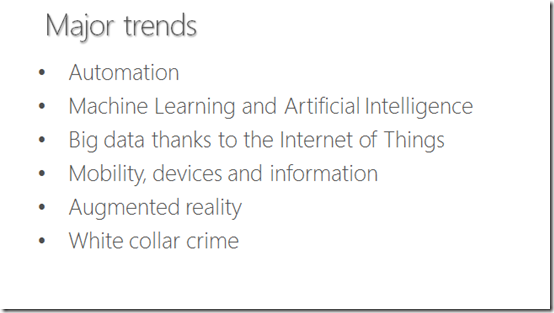
Major Trends

Macro Trends

image

If you consider all the trends in the changing IT environment the next questions that results is ‘Where should I invest for the future?’. Luckily, the answer to that is pretty simple. Software.

Marc Andreessen wrote an article back in 2009 entitled:

Why Software Is Easting the World

that I encourage everyone to read. In essence, it is saying the the IT world of the future is all about software. Every business, whether they are in IT or not will effectively become a software company given the amount of data it needs to analyse. Software provides automation, reducing costs. Software provides efficiency and a competitive edge, etc., etc..

Some other articles that echo this are:

Hardware is sexy, but it’s software that matters

from Seth Godin

Software is still eating the world

from Techcrunch

How robots, drones and artificial intelligence will change everything

from the Financial Post.

Those who only have on premises IT skill sets are fast being left behind by those who have embraced the world of IaaS (Infrastructure as a Service) thanks to Azure, AWS and the like. However, the journey does not cease there. It will continue from IaaS to Platform as a Service (PaaS) and to Software as a Service (SaaS).

The reasons for retaining a complex system such as an email server on premises are pretty minute these days in the face of the pricing of global services like Office 365 Exchange Online. It makes more sense for the creator of something like Exchange to set it up, manage and maintain the system then sell it as a demand based service per user per month. Global corporations like Microsoft can get economies of scale that no one else really can, effectively making many computing services simply a utility much like electricity.

That trend means there is less need for Exchange engineers and technicians on premises. What happens to these people? Simple. If they don’t skill up they are going to struggle big time.

IT Professionals increasing face an environment that is all about DevOps. That is the intersection between being a developer and managing operations of computing resources. However, the key skill for that role is clear. It is software and more so coding. If you can’t code to some extent going forward you are not going to have a skill set sought by employers or businesses.

The classic example I see in the Microsoft eco-system is the lack of skills IT Professionals have with basic tools such as PowerShell. You should be using PowerShell to manage your on premises networks TODAY. You should be using PowerShell to manage Office 365 TODAY. You should be using PowerShell to manage Azure TODAY. Write once, run many should be the mantra of today’s IT Professionals but sadly it isn’t. The excuse is normally that ‘I don’t have the time to learn PowerShell’ to which my response is ‘your problem is NOT a time issue, it is a priority issue’.

The world of DevOps doesn’t mean you have to spend your whole day writing code or diving deep into APIs. What is does however mean is that you need to have a balance of skills in the software world, whether that is PowerShell, JSON, Visual Studio, or whatever. Software skills are mandatory for the future of the IT industry because that is the basis on which our future is built on. Software.

Just about every system we interact with today is done via the web. HTML, CSS, Javascript, etc are again key technologies I see few IT Professionals actually possessing or seeking to develop. Even automation tools as simple as If This Then That, Zapier, Microsoft Flow, etc are things most IT Professionals have NEVER seen, let alone used. These tools are the future of the IT Professional and a key skill that must be acquired because they are all the solution of some business problems simply created by connecting available software services together. You don’t need to writing C sharp code to be considered a developer by any means!

The great thing about software is that is all about the creativity of the human mind. That’s why software skills will always be in demand, because it is hard for a ‘machine’ to be artistic. Good software is an art and there is a shortage of good artists because so many have failed to update their skills and embrace the new world of software. Those that have now have a vehicle they could potentially use to develop mobile applications that could be sold to just about everyone on the planet with a mobile device, all without stepping outside their office. You can’t do that with hardware!

The take away here is that our world today and increasingly of tomorrow, is going to be dominated by software. If you can’t do software then you are going to be consigned to an unskilled role that it isn’t even worth a machine doing. There has never therefore been a better time than now to invest in software skills. Learn PowerShell. Learn how to deploy Azure JSON templates via scripts. Go and develop a mobile app using Microsoft PowerApps and Flow for starters. There has never been more opportunity for those who are willing to embrace the tenant that ‘Software is eating the world’ and a greater warning for those who ignore it.

Macro Trends

This is the fourth part of my presentation “Making money from the cloud”. You can find the full slides at:

https://doc.co/LyrxvF/qcihGm

and the previous parts are at:

We live in exponential times

Consider the following

Major Trends

image

We previously took a look at the large trends that are shaping our world but now let’s take a look at the small trends that impact smaller businesses.

No matter how large or small you are technology is the key differentiation point. The Internet has allowed any single person to compete globally, The Cloud has allowed any single person access to the same level (power) of technology that once was only once available to the largest of businesses for a few dollars a month. Now it is not about what technology you have, it is about how effectively you use that technology. That is what determines your profitability above everything else.

Companies like Amazon are at the cutting edge of utilising technology to provide better service to their customers as the above video demonstrates. Thus, the focus of technology is about being able to deliver better results for customers.

This means that if you are an IT professional you need to be not simply ‘selling’ technology, you need to implementing technology that helps your customers grow their business. IT professionals need to help their customers understand and get the best out of technology. If left to their own devices people use less than 10% of the full functionality of any technology that is provided to them. This means there is an untapped 90% opportunity to work with the existing technology people have. It is much easier to get more from what you have rather than trying to sell you something new now isn’t it?

This means that the business of an IT professional is all about consulting now. Pure reselling of technology is a commodity game and only the largest can survive in that environment. Much of this consulting will also involve the re-engineering of existing businesses. A good example of this, once again, is the shift from traditional email to things such as social networks for communications. You can’t simply enable a social network like Yammer inside a business, you need to help the business make the transition to this new way of working. However, this is not possible unless the IT professional themselves is actually using the latest technology themselves. You can’t implement a technology without understanding, and typically using it, yourself.

Here’s the key. Those that adopt new technology effectively are simply more competitive, able to react faster and adapt to suit market conditions quicker. Yes, that adoption requires and investment but that investment pays major dividends in the future. Unfortunately, so many businesses and IT professionals don’t want to make that investment, instead preferring to ‘stay with the current way of doing things’. That of course means living in the past as the future continues to accelerate away. That means that when change is forced upon the organisation it is that much harder because the leap is that much greater.

There is no doubt that change is hard, both for a business and for an individual. However, if you can get comfortable with change then you really have a competitive edge. The trick to becoming comfortable with change is to develop a system to help you manage it and therefore look at change as providing you a competitive advantage in the market as the vast majority are resistant to change.

However, the really adjustment most need to make when it comes to change is simply doing less. The real secret of success in the future is doing less and doing that exceptionally well. The traditional model of business growth was always to continue to grow revenue more and more. The problem is that costs and complications can rise faster than revenue. Thus, a focus on revenue is folly, while a focus on profit is sanity. The smaller you are, the reality is that you can’t do ‘everything’. You need to focus on a niche and become the best in the world at that niche and partner with others to fill any gaps. If you need heart surgery you don’t go to a GP now do you? You go to a heart surgeon. Heart surgeons make pretty good money even though they specialise. The same applies elsewhere. If you are everything to everyone, then you are nothing to no one. Focus on becoming more effective and generating more profit not merely revenue.

Technology is the game changer that effectively levels the playing field for all businesses. However, it is something that is always changing and needs a process for adoption. Those that can deal with the changes we see have an opportunity to be more competitive than any one else. This opportunity requires an on going investment and typically results in a change of business model but the message is clear. You can’t remain in the past. You can’t remain standing still as the progress of technology continues to move forward allowing others to leap frog you and take away your advantage.

Technology is a tool. Success is a measure of how well that is applied to benefit customers. Therefore, any technology implementations need to be focused on the value they provide to their customers. This will also require challenges of innovation to solve problems using different tools but when you do, truly, the world is your oyster!

Major trends

This is the third part of my presentation “Making money from the cloud”. You can find the full slides at:

https://doc.co/LyrxvF/qcihGm

and the previous parts are at:

We live in exponential times

Consider the following

image

To develop a plan for your professional and business development going forward you need to start with the macro and move to the micro. So what are the major trends we see in today’s world?

The first is automation. A great discussion on this can be found in this Dan Pink video:

If you play the video by clicking the above it should start at the right place, if not forward to 29 minutes and 52 seconds to hear about automation. The whole video is worth watching, and I recommend you do, but the section on automation is especially pertinent. In essence what we will see is anything that is routine, linear, or process driven can be automated using software. Have a look at this video at the 46m mark through to the 50m 30s point for a idea of what is becoming possible when it comes to automating something as mundane as ordering at the drive through:

The ramifications here are two fold. Firstly, it indicates that to be more competitive and attractive is today’s business environment you need to be developing more and more automated systems. This automation is typically created via software. Thus, no matter who or what you are you need to using software effectively to become more competitive. Secondly, it means that tasks that can be automated will fast move to a commodity model, which means the lowest price wins. For most business and individuals this will not be a profitable option. Thus, if you can’t compete in the world of process that can be automated then may be you shouldn’t be playing there!

We are witnessing a new focus on artificial intelligence and machine learning thanks to software. The data you generate when you shop, use your credit card, use GPS navigation, read your emails is all being aggregated to create a better profile of you as an individual. This allows the system to deliver you better results. It allows the system to know what you want before you know you want it.

Here’s a good example:

ThyssenKrupp is using tools from Microsoft like Internet of Things (IoT), Azure machine learning, and Power to provide more reliable lift operations. With the sensor data feeding into predictive algorithms in Azure machine learning ThyssenKrupp can determine pre-emptively when components may fail and can take action before they do.

We live in a world were more and more items are becoming directly connected to the Internet. These devices are generating massive amounts of data that can be analysed to provide benefits in so many ways. Here’s a great example of what is possible with IoT;

So the question is, what is your business doing about IoT? Machine Learning? Big Data? and Artificial Intelligence? They need to be part of your game plan going forward. How can you use these technologies in you business to be more productive or provide better solutions for you customers?

An indicative statistic when it comes to the growth of mobile devices is the fact that mobile ads now exceed ads delivered on TV! Also previously, nearly all office workers were tethered to their cubicle by a blue network patch lead. Today, by contrast, users are rarely solely working from their cubicle. Work is no longer a place you go, it is something that you do. That typically means that wherever you have internet connectivity the expectation is that you can work. The growth of mobile device has fuelled this ability to work remotely and will continue to do so.

Mobility raises challenges for IT departments in that they are still expected to manage, monitor and maintain fleets of devices now roaming the streets untethered. I see that many IT support departments have the ability to manage desktop devices but as yet have no strategy in place to manage mobile devices. Consider that the decline of desktop workstations and servers is only going to increase while sales of mobile device will increase. Also, mobile devices are upgraded at a much faster clip than on-premises hardware. If you consider those trends, what should your IT management business be focused on? Yes, that’s right, mobile devices.

Augmented reality is allowing a new layer on top of our existing world that can provide some amazing abilities as the above video demonstrates. Combine a HoloLens with a drone and now you can examine some of the dangerous places in the world from the safety of your armchair. The applications for business are enormous. Imagine being able to work on a jet engine and having the full schematics available to you in front of your eyes. Imagine being able to overlay those plans on what you are exactly looking at.

Some good novels I have read that give you a glimpse into this potential universe are:

Daemon

Freedom TM

Ready Player One

Rather than learning about something by reading it or watching a video, imagine instead immersing yourself directly in the experience, right in front of your eyes? The quickest way to learn someone is to actually do it as they say. Augmented reality allows that. Although perhaps still in its infancy it won’t be long before we simple accept this ability as the default.

If you want to being to appreciate how modern technology is changing the basics of how people learn then I urge you to watch the video above Build a School in the Cloud. You’ll see how the availability of information has levelled the playing field. The question for you however is, how are you taking advantage of these trends? How are you using the wealth of information and technology that is in your hands TODAY, to lead a better life and help others?

Unfortunately, there are always two sides to the technology coin. Technology is neutral. It is neither good or bad. It’s nature depends solely on how it is used.

I have written many articles on how we are allowing the bad guys to constantly win:

Bad guys just keep winning

and I fear as we rush into this new world of everything being connected we are making ourselves more vulnerable to catastrophic failure.

An eye opening video I’d encourage you to watch is:

A vision of crimes in the future

Don’t believe security will be ab issue in our technological future? Then tell me why cryptolocker is still running rampant through businesses today? How it this possible with all the security, anti-virus and protection software in place? In most cases the cryptolocker delivery mechanism goes straight through all of these and entices the end user to activate. How is that possible? Why haven’t we solved these issues as IT people?

Technology is two headed beast. What works for good can also be used for bad. The more technology we adopt, the more risk we place ourselves in. If you took most people’s mobile phone away from them, they’d be lost and pretty much be unable to function in today’s society. That is not a good state of affairs now is it?

At this point many IT people smile smugly believing they are immune from such a future. My response to that is to ask whether every device they carry outside their business is encrypted? Every mobile device today has the ability to have the information on it encrypted so that if it is every lost the data can not be read by unauthorised parties.

So, is EVERY device you have encrypted? Are you using two factor authentication to protect you identity? Hmmm… are you? If not then you are certainly vulnerable and as we move forward more and more of your precious data will be vulnerable unless you take continuing steps to give security the primary priority it should have when it comes to our digital world. Alas, I fear the opposite is transpiring with more and more people abdicating the security of their digital universe and that unfortunately makes us all more vulnerable every day because we live an increasingly connected world.

These are the major technology trends sweeping our world today, both good and bad. Their adoption continues at unprecedented rates. However, the question remains, what are you doing to take advantage, adapt and to keep up in the face of these changes?

Consider the following

This is the second part of my presentation “Making money from the cloud”. You can find the full slides at:

https://doc.co/LyrxvF/qcihGm

and the first part at:

We live in exponential times

image

One of the major changes that is a reality in today’s world is the fact that millennials have become the dominant component of the workforce. This also means their dominance will continue to increase as will their influence inside organisations as they move into positions of responsibility and power inside all businesses.

The question therefore becomes, what are you doing to cater for this generation? They work in very different ways from previous generations you will soon find out. Don’t believe me? Ok, tell me what happens when you send a millennial an email? You never get a reply is what happens. Why? Because they don’t use emails to communicate. They typically use social media or chat, especially Facebook. They are going to expect the same style of “social” communications tools when they work in a business. They are also going to expect communication channels such as Slack (and Microsoft Teams now) where they can contribute and be heard broadly and publically across the organisation. If the only tool your business communications support is email, don’t expect it to be a place where the best millennial talent wants to work!

Coupled with the change in worker demographic, the vast majority of interactions people have with technology and information is now via mobile devices, typically their phone. Fewer and fewer people are remaining tethered to a network cable, desktop and cubical in the business. You want your sales people out talking with customers. You want your support staff out with customers in the real world. In fact you want your whole business out in the listening to what customers want and they can only do this if they have access to information through their mobile devices.

So how are you enabling your mobile workforce? Are you supporting and encouraging staff to work from the field? Are you enabling them to work when it suits them to provide a better work/life balance? If you aren’t, then there is a good chance you won’t retain them for long. Work is no longer somewhere you go to, it is something you do. Smart businesses reward their staff on what they do, not how they do it.

We are still at the beginning of the mobile revolution. What happens when countries like India, China, Indonesia and like come fully online? When they do, it will be via mobile devices not traditional desktops. How as a business are you going to enable, and also importantly, control this mobility? How are you going to enable ease of access but also ensure your information remains secure? There are no longer any borders to your network. You business information is free to roam outside your walls, wherever your users go. How are you dealing with that?

Mobile technology puts a powerful computing device within everyone’s hands cheaply. Combined with cloud services like Office 365, Azure, AWS and like it also gives them access to computing power beyond the wildest dreams of the largest governments just a few years back. The cost of all this is mere pennies per month. Importantly, it is also available freely to anyone. Anyone can sign up today for a 30 day trial of services like Office 365 and Azure, no matter where they are in the world. Technology has become pervasive, it is everywhere and technology alone is no longer the differentiator. How you actually use technology is the main determination of how successful you are personally and your business is.

Such pervasiveness allows anyone to deliver a product or service just about anywhere in the world. Mobile app stores are available to anyone who has a mobile device 24 hours a day 7 days a week. Successful businesses understand their greatest opportunity if outside their existing markets. As mentioned before, the sheer number of potential consumer is countries like India, China and Indonesia should have any business salivating ate the prospect of selling into such markets. With technology, it is possible today. Right now.

You can never be a success in business if you do what everyone else is doing. If you are simply selling hardware items you are in a race to the bottom with companies who are larger, better funded and more suited to the commodity game. The rules of this game you should be following are – if you can’t win, don’t play!

Here in Australia we have seen the demise of large businesses such as Dick Smith and Master’s who tried to play the commodity game against stronger players and lost everything. Even our biggest retailers, Coles and Woolworths, are struggling and deathly afraid of players like Amazon coming into our market, which they are by the way:

Amazon plans to ‘destroy’ Australia’s retail industry

The only conclusion a rational individual can make is that the commodity business is for ‘mugs’ and you shouldn’t be in it, yet you continue to see so many holding dearly onto it as their sole business model. Right. Good luck with that.

The world is a very different place from what many believe. The evidence is all around us, plain as day, yet many fail to heed the new reality. In the face of just points the mentioned here alone, you should now be looking to go back to the drawing board and chart a new plan for the future. There is massive opportunities for those businesses that embrace these changes because many are still living in denial. Yes, change is hard but it is also a fact of life. Once you embrace it, it won’t control you, you won’t fear it and you’ll see the opportunities were others only see threats.

We live in exponential times. The actions that you take right here and right now are what will determine your personal and business viability in the future. Grasp the opportunity or fade away. The choice is yours.