Office 365 Lync troubleshooting

One of the real gems that I have found with Office 365 is Lync. I use it everyday and communicate with a range of people using it. I find it much better than Live Meeting and the only real downside I have found is that it currently doesn’t support the ability to record (see http://support.microsoft.com/kb/2433212/). My understanding is that it is only a matter of time before it does.


One of best things about Lync is that is now available on a variety of platforms, including those running iOS. However, not all the features of Lync are currently available on all platforms. The best way to find out what does and doesn’t work is to have a look at the Mobile Client Comparison Tables at:


http://technet.microsoft.com/en-us/library/hh691004.aspx


So if you do have problems getting Lync to work have a look at the following articles:


Automatic sign-in, domain federation, and other features do not work as expected in Lync Online when you use a custom domain in Office 365http://support.microsoft.com/kb/2566790


and


How to use and troubleshoot issues with Lync Mobile on Apple iPhone and iPad mobilehttp://support.microsoft.com/kb/2636320


Which are both great starting points.


If you want to federate with my Lync feel free to do so at admin@ciaops365.com but maybe send me an email (director@ciaops.com) so I know who you are first.

Recipient Rate for Office 365 P plans goes up

Microsoft has announced that it is increasing the recipient rate limit with the Office 365 P1 plan to allow users to send email to up to 1,500 recipients per day. This is an increase from the previous limit of 500. Here’s the announcement:


http://community.office365.com/en-us/b/office_365_technical_blog/archive/2012/01/31/recipient-rate-limit-for-office-365-p1.aspx


You’ll also find information about Bulk Email and Daily recipient limits here:


http://help.outlook.com/en-us/140/Ff381292.aspx


Not unexpected and shows that Microsoft is listening to its customers and adjust things as required and with Office 365 they can do this very quickly.

SharePoint beyond the Basics course

So not long now until my next workshop. This one will focus on utilizing the advanced features of SharePoint. Here are the details:


To really make the most of SharePoint you need to take it beyond the basics. This means connecting data, creating and utilizing metadata, customizing the look and feel of sites, add web parts and implement workflows. This course will show you how to do all that plus work effectively with products like SharePoint Workspace and designer to take any SharePoint installation from default to a true productivity and communications hub.

The aim of this hands on course is to provide you with the technical ability to work with SharePoint at an intermediate to advanced level as well as understand the tools that are required to craft advanced SharePoint solutions.


Venue: North Ryde RSL Club, 33 Magdala Rd, North Ryde, NSW 2113


Date: Wednesday 22nd of February 2012, from 8.30am – 5.30pm


More details and registration at – http://ciaopsfeb12.eventbrite.com/

Office 365 P Domains

One of the interesting things I find about Office 365 and the drive to get resellers and partners involved is the almost zero focus on the Small Business and Professional plan (P SKU). When you qualify as a Microsoft Cloud partner you get access to an Enterprise (E SKU) for testing and demonstration, which is great. However, the difference between the E plans and the P plan in my experience is vast. Now if you are an SMB reseller focused on installation up to 50 seats then the chances of you having to support P plans is pretty high. Unfortunately, as even I find myself, you can never quite sure of some of the ‘features’ (and importantly limitations) of these plans. This makes selling and supporting those plans difficult.

Now I have never really liked the P plans because I believe they are too limiting. Most customers may say they only care about price (which is a good thing about the P plans, they are cheap) but what typically happens is they later on down the track want the additional functionality offered by E plans (say, Form Services in SharePoint, Archiving in Exchange, or Office on their desktop). E plans have these options and more importantly can be scaled up or down to suit. Not so with the P plan. Once you are on a P plan you only get those features and nothing more. If you want to use the features of the E plan you have to migrate out of a P plan, delete it, and then migrate into an E plan. Painful stuff. This is why I advocate E plans everywhere, they simply provide more flexibility, which in my experience is the mainstay of what SMB customers need.

However, all that won’t prevent P plans being the main product sold to SMB’s. In fact reports are that 90% of Office 365 sales are made to SMB customers, and I’ll bet more than 50% of those sales are P plans. So no matter what happens P plans are here to stay and something most resellers and IT providers are going to know how to configure. Problem is they not been given access to a P SKU for their own use and that makes it hard to support when the differences are so marked.

A good example of this is configuring DNS. Now in the E plans you get to control your own DNS records as you would normally. However, in the P plan the ‘recommended’ method if to allow Office 365 to manage the DNS for you. This option to manage DNS is not available at all in the E plans.

The first step in the process for P plans is to create a TXT record in the DNS for the domain you wish to use with Office 365 P plans so that Office 365 can verify that you own that domain. This record is unique for each domain in Office 365. You login to your Office 365 portal as an admin and select Domains from under the Management section on the left.

image_2_140E10DE

You’ll then see a list of domains that this tenant of Office 365 uses (if any). Select the Add a domain option.

image_4_140E10DE

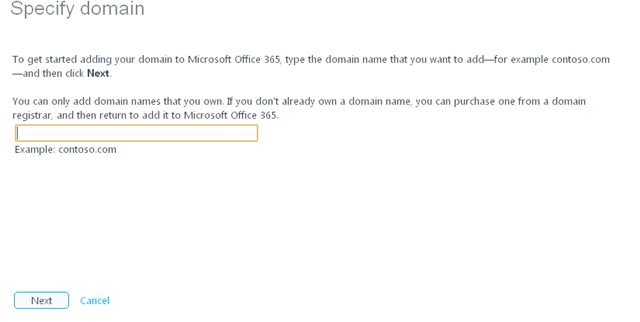
You’ll then be asked to enter the domain you wish to use.

image_6_140E10DE

Simply enter the domain and press Next.

You’ll then be asked to verify your domain.

image_8_7F1C8E6A

You’ll see that you can pull down an option that will help you with setting up the required verification. In this case we’ll select General Instructions.

image_14_7F1C8E6A

Here you will find the TXT record (or MX if you choose) that you need to insert into the DNS records of your domain. Once you have done that you need to press the Verify button so Office 365 can check that the required record is there for that domain and that domain. It is important to remember that when you change the DNS to add the required record it may take 72 hours for that to become available across the Internet.

This wait for verification can be very frustrating and I would recommend http://www.whatsmydns.net.

You enter in the domain you wish to check and the site will give your a report of whether the details for that domain appear in DNS servers around the globe. If it does then there is good chance Office 365 will be able to verify it.

Once the domain is verified you are requested to transfer the Name Server records for the domain to Office 365.

image_18_7F1C8E6A

In this case it is asking for the Name Server to be changed to ns1.bdm.microsoftonline.com and ns2.bdm.microsoftonline.com. What Office 365 has done in the background is set up all the required Office 365 DNS records for you. Once the name server changes have filtered out to the Internet again you Office 365 should be operational.

If you return to your Domains area in Office 365 you’ll see that you can select a domain and then click Manage DNS. Again, this is only available with P Plans.

image_20_2D09E123

When you do so you’ll see a list of all the DNS records that existing in the Office 365 for that domain. They are basically all the records you’ll need to get Office 365 operational. If need be you can add DNS records but they can only be A or CNAME records, however that is for another blog post.

Now that is all well and good and to my knowledge at the time that was more or less the ‘only’ way that it could be done. For most resellers and IT providers that look after SMB customers they will want to manage the customers DNS records via their own DNS management tools. So their question was always ‘. How do we do this without using Office 365 DNS?’. My response was that it really couldn’t be done. However, as someone pointed out to me recently Microsoft has the following document that explains how to do set up DNS for P plans if you don’t want to use Office 365 DNS management.

http://onlinehelp.microsoft.com/en-us/office365-smallbusinesses/hh416759.aspx

In essence you go through that whole process but you merely duplicate the DNS records that Microsoft creates in the alternate DNS management tool and then point the Name Server records to the alternate DNS management tool and everything works fine.

So what is the downside to using an alternate DNS tool for the P Plans? According to the above document:

If you add your domain name to Office 365 without redirecting your name server records to Office 365, consider the following:

  • SharePoint Online: If you enable SharePoint Online to host your public website, the DNS records that are required to route traffic to SharePoint Online won’t be created automatically by Office 365. You have to manually create those DNS records at your DNS provider, as described in this article, because Office 365 isn’t hosting the DNS records for your domain.
  • Domains troubleshooting tool: Because you didn’t configure your name server records to point to Office 365 name servers, the Office 365 domains troubleshooting wizard will always report that your name server records are incorrect. You can disregard this warning because you have manually created the DNS records for each of your services.
  • DNS manager: Microsoft Office 365 for professionals and small businesses provides DNS management tools that you can use to add custom DNS records. However, if you create, or have already created, custom records by using this tool, because the name server records for your domain don’t point to Office 365, the custom records won’t work. You must create, or recreate, any custom records by using your current DNS hosting provider.
  • Future Office 365 updates: When we add new services to Office 365, we won’t be able to automatically add the DNS records that are required to enable the services to work on your domain. To use the services, you must manually add the DNS records at your DNS hosting provider.

Most IT reseller probably wouldn’t see this as a major downside as it gives them more control, however it is important to remember for P plans using an alternate DNS provider is not recommended.

To sum up then. You can host your DNS with an alternate provider on the P plans but it is not generally recommended and to my mind creates confusion as you have DNS records in Office 365 Domain Management as well as any alternate tool. Never good to have two sources of the same information. Knowing where the Name Server points in that case is VERY important.

My main point is that there ARE major differences between P and E plans and if you are selling and supporting them you really need to understand these differences. That is going to be especially hard in the case of the P plan because you don’t get a version you can play with as a Microsoft Cloud Partner by default. Given they are so cheap it is probably worthwhile going out and purchasing a copy for your own purposes. This something that I have had to do to get up to speed with the differences myself and I admit that I am still learning all of the nuances and will endeavour to detail them here for you as it goes along.

If you are selling Office 365 to SMB customers, P plans ARE very different from E plans in many, many ways. One of these is DNS which I have hopefully shed light on here.

Linking from My Sites in Office 365

One of the greatest features of SharePoint 2010, especially on Office 365, is ‘My Sites’ (sorry, those on Office 365 P plans don’t get these, another reason not to have a P plan in my books). What ‘My Sites’ basically provides is a ‘home’ area in SharePoint for users that they can store information about themselves, their job experience and files in their own SharePoint site. Imagine  it a bit like a combination of Linkedin and SkyDrive but a whole lot better.


You get to your ‘My Site’ by generally going to the top left of your SharePoint site and selecting My Site from the pull down menu like so:


image_4_525A9BE5


That’ll take you to a screen that looks like this:


image_2_525A9BE5


From here you can get to your own SharePoint site via ‘My Content’ and to your Linkedin style information via ‘My Profile’. But hang on, how do I get back to my original SharePoint site without having to the back button in the browser? Bottom line is that there is no default link to take you back, which is frustrating once you have gone a few screen into your ‘My Site’.


The reason there is no default link is you can have access to many different SharePoint sites but you only have one ‘My Site’ per user. But your are in luck! There is a way to add a link at the top of the screen back to any URL you want. To do this you’ll need to login to your Office 365 portal as an administrator and then select Manage from under the SharePoint Heading.


image_6_525A9BE5


Then select Manage Site collections from the next menu.


image_8_525A9BE5


Then select User Profiles from the menu on the left.


image_10_525A9BE5


Now on the right, under the My Site Settings section select Configure Personalization Site.


image_12_525A9BE5


Now select the New Link option and enter in address of the SharePoint site you want to return to as well as an owner.


image_18_525A9BE5


Now when you go to ‘My Site’ you’ll see the link you just created and you use that to navigate back to your SharePoint site. In this case I created a link called Intranet to the right of ‘My Profile’.


image_16_525A9BE5


If you want to create more links just repeat the process.


So now that link will appear on everyone’s ‘My Site’ banner making navigation to and from their ‘My Site’ much easier.

Reflections on exams for Office 365


I have recently completed the beta exams for the two upcoming Office 365 certifications 70-321, Deploying Office 365 and 70-323, Administering Office 365. I won’t know the results for a few months but I’d like to convey some thoughts on these exams in context of those resellers in small to medium business (SMB).

I am very privileged to know many exceptional SMB technology resellers around the world. Not only are they hard working, very customer focused but they are some of the most technically astute and knowledgeable people I have ever met in technology. I have worked with enterprise people who perhaps know more on ONE single product but most SMB technology resellers have to be across so many different products and technologies in contrast to enterprise people who are normally focused on a single technology like Active Directory (AD), SQL, Exchange etc. Most SMB resellers have to be across these products also for multiple customers and configurations, where most enterprise people work only for a single business.

After completing both Office 365 exams I was struck by how much Office 365 is like Small Business Server. Why is that? Both product require a breadth of knowledge that most enterprise people would struggle with. To pass the Office 365 exams you are going to HAVE to know Exchange, Lync, SharePoint, AD integration, etc. Likewise, to pass the SBS certification test you need to be across Exchange, SharePoint, Windows Server, Remote connectivity and the like. Sure, Office 365 focuses more on the enterprise features of the products but few enterprise people I know are across such a broad range. However, just about every person I know who does SBS has skills across the entire product range.

To me this bodes well for SBS people looking to get into Office 365 and become certified. You already know what it is like to be across so many products, this gives you a leg up in my books. At the moment you’ll need to learn the advanced features of Office 365, as that is part of the curriculum and will certainly be tested in any certification exam. Even if perhaps SBS people will never implement things like Single Sign On (SSO) and ADFS configuration. I think that many SBS people who have the SBS certification will look at this as a great opportunity to learn more about the advanced features of products they have already been using. They’ll certainly have to study, but they’ll really learn something and that will make them better technology people and most likely open up additional opportunities for them.

However, just as there is a dedicated SBS certification exam from Microsoft it would nice to have an Office 365 certification exam that is focused on the SMB market. A market that typically doesn’t do AD integration, a market that moves everything to Office 365, a market that is truly looking to adopt the total cloud model. Bah humbug I hear the enterprise people say. Ok you guys and gals may have the greatest number of licenses perhaps but from what I understand 90% of businesses that use Office are small to medium in size. If Microsoft wants to speed adoption of this market then it need to make it easier for people who service that market to get certified. These people, like their customers, are time and cash poor. They believe the best reflection of certification is the fact that they could pass it simply based on their direct experiences with customers. At the moment I don’t believe that is possible and as such that will hinder to move of existing SMB resellers to supporting, adopting and selling Office 365.

So in summary, I think the existing exams cover the whole Office 365 products and configuration very well. This means that if you are weak in any area or on a specific product you need to bring that up to strength before attempting the exams. For SMB resellers this means you are going to have to dive into areas of Office 365 that you may never see in the field. It would also be nice for Microsoft to consider an Office 365 certification for the SMB market that can pretty much be passed provided you have enough experience setting it up and supporting it for SMB customers (i.e. those < 100 seats).

That pesky 10GB Limit


As I have always foreseen, the 10GB database limit for SharePoint Foundation 2010 is becoming more and more of an issue as installations start to grow. I really see this more and more, especially when it comes to SBS 2011 Standard which includes SharePoint Foundation 2010 which many people simply know as Companyweb.

Background

All forms of SharePoint require some form of database storage to store their content. SharePoint uses Microsoft SQL Server for this storage. There are however many different versions of Microsoft SQL Server all with different capabilities and limitations.

In the days of Windows SharePoint Services v3 (WSS v3) the SharePoint content was saved into SQL Server 2005 Express Edition (SSEE). This version was not only free but supported unlimited database sizes. The downsides where that it wasn’t upgradable and it was a 32 bit database.

When SharePoint Foundation 2010 came along it had the requirement of 64 bit databases. That immediately ruled out SSEE. The initial choice was SQL Server 2008 Express. This version is 64 bit and is free but has a 4GB database limit. If you download and install SharePoint Foundation 2010 as a stand alone package and accept the default installation you’ll also get SQL Express 2008 and thus a 4GB database limit.

As you can appreciate, a 4GB database limit is pretty restrictive so when SBS 2011 became available it shipped with SQL Express 2008 R2 for SharePoint storage which upped the database limit to 10GB. Problem is now that is still not enough.

Options

So what happens if you have SBS 2011 and you are approaching the 10GB limit? What are your options? Here are some suggestions. They all come with compromises so beware.

1. Create a new SharePoint site and site collection move some of the data here. Doing this will give you new 10GB database into which you can store information. Given that companyweb is a web site you can link to another SharePoint site fairly seamlessly. The down side is that things like the search database are still limited to 10GB and if your data keep growing you are going to hit the 10GB limit again at some point. Also, it can be a little more confusing for users.

2. Do an in place upgrade of SQL 2008 Express R2 to a version that doesn’t have database restrictions. This can be achieved via the SBS Premium add on however don’t forget that there are other applications that use SQL on SBS including monitoring and reporting. This in place upgrade option also places more strain on the single box and is generally not recommended as best practice.

3. You can move the SQL databases to a second server running SQL. This can be achieved again with the SBS Premium add on that provides a Windows Server 2008 license and an SQL license. downsides include the fact that this requires additional hardware, setup, configuration and maintenance. It also means that things like the standard SBS wizards no longer work because it is now a custom installation. You also have to work out how to backup the second server as it is not generally covered by standard SBS backups. If you do want to do this then Microsoft has a Technet article you can follow at:

http://technet.microsoft.com/en-us/library/gg616007.aspx

4. You can implement Binary Large Object (BLOB) storage. This basically allows the storage of file data outside the SQL database into the file system. Although this gets around the 10GB database limit (as files are generally your largest storage item) there are trade offs which I have detail in previous blog posts. Personally, I don’t think it is a good move, especially in an SBS environment for the simple reason is the added complexity amongst other things but it can be done. My advice if you are thinking about moving that way read my previous post.

5. Move Companyweb to Office 365. Here you’ll get access to SharePoint Enterprise Server 2010, you’ll get 10GB database limits as a starting point, you won’t have to worry about upgrades and you’ll get Office Web Apps to boot which you won’t get with Companyweb on SBS. You’ll obviously have to pay for suitable Office 365 licenses, migrate the data and help users understand what differences Office 365 provides. 

So you do have options but they all come with a cost. Personally, if your users are really getting into SharePoint then I’d be looking at Office 365 simply because of the added functionality and reduced hassle. Failing that, there is always the option of pruning your data, removing old files and versions but sooner or later, chances are you’ll hit the 10GB limit again.