Need to Know Podcast–Episode 120

Marc and I chew the fat over the latest updates from the Microsoft Cloud. No guest for this episode just us giving you the latest news. Don’t worry we are buys teeing up some great guests for future episodes but we thought we’d get this update out for everyone.

You can listen to this episode directly at:

http://ciaops.podbean.com/e/episode-120-cloud-update/

or subscribe via iTunes at:

https://itunes.apple.com/au/podcast/ciaops-need-to-know-podcasts/id406891445?mt=2

The podcast is also available on Stitcher at:

http://www.stitcher.com/podcast/ciaops/need-to-know-podcast?refid=stpr

Don’t forget to give the show a rating as well as send us any feedback or suggestions you may have for the show.

Resources

@marckean

@directorcia

Satya’s Australian visit

Azure N Series machines available

Azure functions now generally available

Azure backups directly from VM blade in portal

CMD to be replaced by PowerShell

Azure news from Marc

Outlook Customer Manager in Office 365

New SharePoint Team news authoring

New Microsoft documentation site

Some Office 365 training from me coming soon

I’ll be on the road in December in Brisbane, Melbourne and Perth doing two full day Office 365 reseller training sessions for Microsoft. These sessions are broken up into a “Start” and an advanced “Grow” session (conducted back to back).

The sessions cover both the technical and business aspects of implementing Office 365. That means you’ll get a deep dive into Office 365 and you’ll also learn successful strategies for selling and implementing Office 365 for customers.

Here’s some feedback from previous attendees:

“Fantastic presentation on adding value to your existing Office 365 practice. Do you want to know the value of the new E5 plans and how it can practically benefit them, thereby increasing your revenue stream? No fluff – just the information that you need to grow your business using Office 365/Azure was presented.” – Jason Shim

“This was a great overview of available opportunities within Office 365 Enterprise now and in the future presented by Robert Crane [MVP] So many great tools on offer to upsell and promote more with PowerBI, Delve and Yammer more in organizations” – Robert Coleiro

“Excellent session today … not like the regular training. We were immersed in practical exercise and working in a small group. You have to think differently when on a team! What we don’t know (and that’s a pretty big area!) we can ask our partner who knows a different skill set to help with the solutions. Great stuff.” – Martin Maloney

“The best training I have been to in recent memory – very practical, customer-focused exercises and loads of great information and resources” – Tristram Morgan

The training is very hands on and requires you to work in teams to solve practical real world challenges presented throughout the day. Importantly, it is also focused on solutions for SMB customers.

Best off all? The training is totally free if you are a Microsoft Partner, all you need to do is register which you can do here:

Office 365 Start – https://www.microsoftevents.com/profile/web/index.cfm?PKWebId=0x259617bc5f

Office 365 Grow – https://www.microsoftevents.com/profile/web/index.cfm?PKWebId=0x260206cf75

I hope to see you there.

Major trends

This is the third part of my presentation “Making money from the cloud”. You can find the full slides at:

https://doc.co/LyrxvF/qcihGm

and the previous parts are at:

We live in exponential times

Consider the following
image

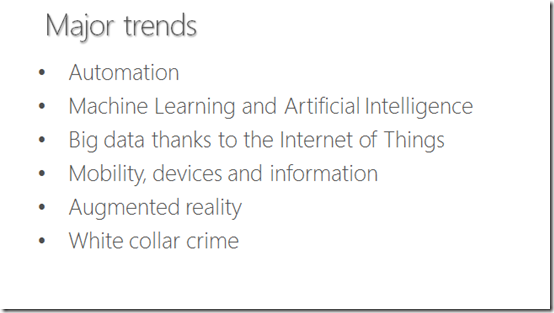
To develop a plan for your professional and business development going forward you need to start with the macro and move to the micro. So what are the major trends we see in today’s world?

The first is automation. A great discussion on this can be found in this Dan Pink video:

If you play the video by clicking the above it should start at the right place, if not forward to 29 minutes and 52 seconds to hear about automation. The whole video is worth watching, and I recommend you do, but the section on automation is especially pertinent. In essence what we will see is anything that is routine, linear, or process driven can be automated using software. Have a look at this video at the 46m mark through to the 50m 30s point for a idea of what is becoming possible when it comes to automating something as mundane as ordering at the drive through:

The ramifications here are two fold. Firstly, it indicates that to be more competitive and attractive is today’s business environment you need to be developing more and more automated systems. This automation is typically created via software. Thus, no matter who or what you are you need to using software effectively to become more competitive. Secondly, it means that tasks that can be automated will fast move to a commodity model, which means the lowest price wins. For most business and individuals this will not be a profitable option. Thus, if you can’t compete in the world of process that can be automated then may be you shouldn’t be playing there!

We are witnessing a new focus on artificial intelligence and machine learning thanks to software. The data you generate when you shop, use your credit card, use GPS navigation, read your emails is all being aggregated to create a better profile of you as an individual. This allows the system to deliver you better results. It allows the system to know what you want before you know you want it.

Here’s a good example:

ThyssenKrupp is using tools from Microsoft like Internet of Things (IoT), Azure machine learning, and Power to provide more reliable lift operations. With the sensor data feeding into predictive algorithms in Azure machine learning ThyssenKrupp can determine pre-emptively when components may fail and can take action before they do.

We live in a world were more and more items are becoming directly connected to the Internet. These devices are generating massive amounts of data that can be analysed to provide benefits in so many ways. Here’s a great example of what is possible with IoT;

So the question is, what is your business doing about IoT? Machine Learning? Big Data? and Artificial Intelligence? They need to be part of your game plan going forward. How can you use these technologies in you business to be more productive or provide better solutions for you customers?

An indicative statistic when it comes to the growth of mobile devices is the fact that mobile ads now exceed ads delivered on TV! Also previously, nearly all office workers were tethered to their cubicle by a blue network patch lead. Today, by contrast, users are rarely solely working from their cubicle. Work is no longer a place you go, it is something that you do. That typically means that wherever you have internet connectivity the expectation is that you can work. The growth of mobile device has fuelled this ability to work remotely and will continue to do so.

Mobility raises challenges for IT departments in that they are still expected to manage, monitor and maintain fleets of devices now roaming the streets untethered. I see that many IT support departments have the ability to manage desktop devices but as yet have no strategy in place to manage mobile devices. Consider that the decline of desktop workstations and servers is only going to increase while sales of mobile device will increase. Also, mobile devices are upgraded at a much faster clip than on-premises hardware. If you consider those trends, what should your IT management business be focused on? Yes, that’s right, mobile devices.

Augmented reality is allowing a new layer on top of our existing world that can provide some amazing abilities as the above video demonstrates. Combine a HoloLens with a drone and now you can examine some of the dangerous places in the world from the safety of your armchair. The applications for business are enormous. Imagine being able to work on a jet engine and having the full schematics available to you in front of your eyes. Imagine being able to overlay those plans on what you are exactly looking at.

Some good novels I have read that give you a glimpse into this potential universe are:

Daemon

Freedom TM

Ready Player One

Rather than learning about something by reading it or watching a video, imagine instead immersing yourself directly in the experience, right in front of your eyes? The quickest way to learn someone is to actually do it as they say. Augmented reality allows that. Although perhaps still in its infancy it won’t be long before we simple accept this ability as the default.

If you want to being to appreciate how modern technology is changing the basics of how people learn then I urge you to watch the video above Build a School in the Cloud. You’ll see how the availability of information has levelled the playing field. The question for you however is, how are you taking advantage of these trends? How are you using the wealth of information and technology that is in your hands TODAY, to lead a better life and help others?

Unfortunately, there are always two sides to the technology coin. Technology is neutral. It is neither good or bad. It’s nature depends solely on how it is used.

I have written many articles on how we are allowing the bad guys to constantly win:

Bad guys just keep winning

and I fear as we rush into this new world of everything being connected we are making ourselves more vulnerable to catastrophic failure.

An eye opening video I’d encourage you to watch is:

A vision of crimes in the future

Don’t believe security will be ab issue in our technological future? Then tell me why cryptolocker is still running rampant through businesses today? How it this possible with all the security, anti-virus and protection software in place? In most cases the cryptolocker delivery mechanism goes straight through all of these and entices the end user to activate. How is that possible? Why haven’t we solved these issues as IT people?

Technology is two headed beast. What works for good can also be used for bad. The more technology we adopt, the more risk we place ourselves in. If you took most people’s mobile phone away from them, they’d be lost and pretty much be unable to function in today’s society. That is not a good state of affairs now is it?

At this point many IT people smile smugly believing they are immune from such a future. My response to that is to ask whether every device they carry outside their business is encrypted? Every mobile device today has the ability to have the information on it encrypted so that if it is every lost the data can not be read by unauthorised parties.

So, is EVERY device you have encrypted? Are you using two factor authentication to protect you identity? Hmmm… are you? If not then you are certainly vulnerable and as we move forward more and more of your precious data will be vulnerable unless you take continuing steps to give security the primary priority it should have when it comes to our digital world. Alas, I fear the opposite is transpiring with more and more people abdicating the security of their digital universe and that unfortunately makes us all more vulnerable every day because we live an increasingly connected world.

These are the major technology trends sweeping our world today, both good and bad. Their adoption continues at unprecedented rates. However, the question remains, what are you doing to take advantage, adapt and to keep up in the face of these changes?

November Webinar Resources


https://docs.com/d/embed/D25192295-5506-5426-8700-001814412624%7eMd4186d87-61d5-259a-4d26-00a8bd86cfff

Only on more webinar before we greet 2017! A big turn out this month and some good questions around the Power BI Office 365 content pack and Teams Sites was had and recorded. I also did a quick overview of the new Microsoft Teams and how to enable it in your Office 365 tenant.

The slides are now available for free download at:

November 2016 Need to Know Webinar

If you are not a CIAOPS patron you want to view or download a full copy of the video from the session you can do so here:

http://ciaops-academy.teachable.com/p/november-2016-need-to-know-webinar1

you can also now get access to all webinars via:

http://ciaops-academy.teachable.com/courses/need-to-know-webinars

for a nominal fee.

I’ll be posting information about the December which at this stage looks like being around the 15th of December. As yet I haven’t settled on a topic, so if you have a suggestion of what you’d like to see a deep dive on when it comes to Office 365 please don’t hesitate to contact me (director@ciaops.com).

Need to Know Podcast–Episode 119

Marc reports back on what happened during his first trip to the MVP Summit in Redmond. You’ll learn his experiences with the events, the people and the places as well as an interesting aside on Microsoft grass! You’ll also get the latest Office 365 and Azure news so listen for details of our roving reporter in the belly of the beast.

You can listen to this episode directly at:

http://ciaops.podbean.com/e/episode-119-mvp-summit/

or subscribe via iTunes at:

https://itunes.apple.com/au/podcast/ciaops-need-to-know-podcasts/id406891445?mt=2

The podcast is also available on Stitcher at:

http://www.stitcher.com/podcast/ciaops/need-to-know-podcast?refid=stpr

Don’t forget to give the show a rating as well as send us any feedback or suggestions you may have for the show.

Resources

@marckean

@directorcia

Automated patching for Azure VMS

Getting started with the new Azure AD Management experience

The Azure portals

https://rc.portal.azure.com

https://ms.portal.azure.com

https://portal.azure.com

Master the art of stage presence with James Whittaker

Azure detailed login auditing

Microsoft Teams

Consider the following

This is the second part of my presentation “Making money from the cloud”. You can find the full slides at:

https://doc.co/LyrxvF/qcihGm

and the first part at:

We live in exponential times

image

One of the major changes that is a reality in today’s world is the fact that millennials have become the dominant component of the workforce. This also means their dominance will continue to increase as will their influence inside organisations as they move into positions of responsibility and power inside all businesses.

The question therefore becomes, what are you doing to cater for this generation? They work in very different ways from previous generations you will soon find out. Don’t believe me? Ok, tell me what happens when you send a millennial an email? You never get a reply is what happens. Why? Because they don’t use emails to communicate. They typically use social media or chat, especially Facebook. They are going to expect the same style of “social” communications tools when they work in a business. They are also going to expect communication channels such as Slack (and Microsoft Teams now) where they can contribute and be heard broadly and publically across the organisation. If the only tool your business communications support is email, don’t expect it to be a place where the best millennial talent wants to work!

Coupled with the change in worker demographic, the vast majority of interactions people have with technology and information is now via mobile devices, typically their phone. Fewer and fewer people are remaining tethered to a network cable, desktop and cubical in the business. You want your sales people out talking with customers. You want your support staff out with customers in the real world. In fact you want your whole business out in the listening to what customers want and they can only do this if they have access to information through their mobile devices.

So how are you enabling your mobile workforce? Are you supporting and encouraging staff to work from the field? Are you enabling them to work when it suits them to provide a better work/life balance? If you aren’t, then there is a good chance you won’t retain them for long. Work is no longer somewhere you go to, it is something you do. Smart businesses reward their staff on what they do, not how they do it.

We are still at the beginning of the mobile revolution. What happens when countries like India, China, Indonesia and like come fully online? When they do, it will be via mobile devices not traditional desktops. How as a business are you going to enable, and also importantly, control this mobility? How are you going to enable ease of access but also ensure your information remains secure? There are no longer any borders to your network. You business information is free to roam outside your walls, wherever your users go. How are you dealing with that?

Mobile technology puts a powerful computing device within everyone’s hands cheaply. Combined with cloud services like Office 365, Azure, AWS and like it also gives them access to computing power beyond the wildest dreams of the largest governments just a few years back. The cost of all this is mere pennies per month. Importantly, it is also available freely to anyone. Anyone can sign up today for a 30 day trial of services like Office 365 and Azure, no matter where they are in the world. Technology has become pervasive, it is everywhere and technology alone is no longer the differentiator. How you actually use technology is the main determination of how successful you are personally and your business is.

Such pervasiveness allows anyone to deliver a product or service just about anywhere in the world. Mobile app stores are available to anyone who has a mobile device 24 hours a day 7 days a week. Successful businesses understand their greatest opportunity if outside their existing markets. As mentioned before, the sheer number of potential consumer is countries like India, China and Indonesia should have any business salivating ate the prospect of selling into such markets. With technology, it is possible today. Right now.

You can never be a success in business if you do what everyone else is doing. If you are simply selling hardware items you are in a race to the bottom with companies who are larger, better funded and more suited to the commodity game. The rules of this game you should be following are – if you can’t win, don’t play!

Here in Australia we have seen the demise of large businesses such as Dick Smith and Master’s who tried to play the commodity game against stronger players and lost everything. Even our biggest retailers, Coles and Woolworths, are struggling and deathly afraid of players like Amazon coming into our market, which they are by the way:

Amazon plans to ‘destroy’ Australia’s retail industry

The only conclusion a rational individual can make is that the commodity business is for ‘mugs’ and you shouldn’t be in it, yet you continue to see so many holding dearly onto it as their sole business model. Right. Good luck with that.

The world is a very different place from what many believe. The evidence is all around us, plain as day, yet many fail to heed the new reality. In the face of just points the mentioned here alone, you should now be looking to go back to the drawing board and chart a new plan for the future. There is massive opportunities for those businesses that embrace these changes because many are still living in denial. Yes, change is hard but it is also a fact of life. Once you embrace it, it won’t control you, you won’t fear it and you’ll see the opportunities were others only see threats.

We live in exponential times. The actions that you take right here and right now are what will determine your personal and business viability in the future. Grasp the opportunity or fade away. The choice is yours.

They shall not grow old

As a student of military history it is easy to gloss over the personal impact that war reeks. Millions of people have willingly and unwillingly sacrificed their lives in the human experience that we call war, which unfortunately continues to this day.

Reflecting on the grandeous ambitions of a war to end all wars (1914 – 1918) it is truly sad to see that what it really brought to the fore were more effective methods of killing more people. Resulting in tremendous waste of human life.

Into this hellfire marched many Australia soldiers to serve for what they believed to be right. We can certainly fault that naivety given the hindsight of history, but we cannot fault their sacrifice and dedication to duty.

It is for this reason, on this date, the 11th day of the 11 month, we pause to remember theirs (and others) commitment and belief to the future which we now enjoy.

We are a product of our past and soldiers like many of those from the First World War gave up their future for something they believed in. Being right or wrong is simply a judgement history makes, however at its core is an individual making a decision that, for many, cost them their lives for just such a belief.

Today we should focus on the those that scarified in a way that many of us will never experience or hope to experience. Our legacy should be to leave the world a better place, to live up to the expectations of those who had their lives tragically cut short.

If nothing else, take a moment and simply remember those that fought and died for causes they held true and hope that you are never put to such a test.

Lest we forget.

For more information on the Australian Battlefields of World War One visit my historical site:

http://www.anzacsinfrance.com/

Enabling Azure AD Domain Services

One of the last remaining pieces of infrastructure that was required to either stay on premises or be virtualised was the Active Directory Domain Controller (DC). That is no longer the case as Microsoft has made its Directory Services as a Service available from Azure.

What that effectively now means is that you no longer need a dedicated box (physical or virtualised) for Active Directory, you can simply consume it as a service directly from Azure.

Given that this is a new Azure service there are some challenges. The main one is that Azure Active Directory Services is only available in the older Service Manager portal, not the newer Resource Manager model where everything should really be created these days. Azure Active Directory Services will be coming to the Resource Manager, however at the moment, we need to deploy it using the older Service Manager.

In preparation, I’ve used Azure AD Connect to synchronise users from an existing on-premises Active Directory to Office 365. This has also created accounts for those users in Azure AD. I’ve then added a paid Azure subscription to my free Office 365 Azure AD to enable all the services required.

Next, I created a Virtual Network in both Service Manager and Resource Manager. I then connected these together using a site to site VPN. The idea is that the Service Manager network will simply be used for Directory Services, while the Resource Manager network will hold all the other services such as member servers and so on.

Now, with the site to site VPN between Azure Service Manager (ASM) and Azure Resource Manager (ARM) in place, I navigate to the ASM portal.

image

Here I select my Active Directory option and then name of the Active Directory.

image

I select the Groups option at the top of the page and create a new security group called:

AAD DC Administrators

It is to create a group EXACTLY as it appears above.

Into this new security group add all the users from your AD that you want to be effectively Domain Administrators in Azure AD Domain Services.

image

Now select the Configure option at the top of the page.

image

Scroll down the page until you locate the Domain Services area as shown above.

Select the Yes option to enable the service.

image

You’ll also need to check that the DNS Domain and Virtual Network options are correct. in this case I’ve select the custom domain I have in Office 365 and synchronised from an on-premises AD.

Select Save at the bottom of the page to complete the configuration.

image

Azure will now hum away for about 35 minutes enabling the service for you.

image

When the enablement process is complete you should now see two IP addresses at the bottom of the domain services area as shown above.

You should update the virtual network on the ARM network to point to these DNS servers on the ASM network. You can think of it like the Domain Controller for the whole network is now on the ASM network which is reached by the ARM network across the VPN.

So let’s say you now spin up a member server on the ARM network. You add this member server to the domain as you would normally. When you do, you’ll be prompted for credentials to allow this. Here you’ll need to use a member of the security group AAD DC Administrators you created earlier. Apart from that everything is exactly the same as if there was a physical domain controller in the network.

image

So your next question is probably going to be about to manage this ‘DC as a service’? Easy. Simply add the AD management tools to any member server and as you can see from the above, the domain appears exactly like it would if there as an on-premises server on the network. If you go in and look a the domain controllers on the network you’ll two, as see above. They have a random GUID and obvious correlate to the two IP addresses provided by the Directory Service during configuration.

If you then elect to say, remove the on-premises domain controller you’ll have all your users and a fully functioning domain in Azure. You’ll have your AD now as service rather than requiring dedicated equipment, which is far more flexible as easier to manage. You’ll be able to manage your users, group policy and the like just as you could on premises, but now totally in the cloud.

At the moment there is some extra configuration because of the necessity of an ASM network for Directory Services but in time everything will move to ARM which will make it even easier to have your domain controllers as a service!

For more information on Azure AD Domain Services visit:

https://azure.microsoft.com/en-us/documentation/articles/active-directory-ds-getting-started/