Risk-based Conditional Access policies provide adaptive security that automatically adjusts authentication requirements based on the risk level of sign-ins and user behavior, helping you maintain an optimal balance between security and productivity.
Prerequisites and Licensing
Microsoft Entra ID P2 license required for risk-based policies (includes Identity Protection)
Microsoft 365 Business Premium includes Conditional Access features for small businesses
Users must be registered for Multi-Factor Authentication (MFA) before policy enforcement
Configure trusted network locations to reduce false positives
Step-by-Step Implementation Guide
Phase 1: Foundation Setup (Week 1)
Create Emergency Access Accounts
Set up at least two break-glass accounts excluded from all policies
These prevent complete lockout if policies are misconfigured
Start with Report-Only Mode
Deploy all new policies in report-only mode first
Monitor for at least 7-14 days to understand impact
Review sign-in logs to identify potential issues
Phase 2: Sign-in Risk Policy Configuration
Navigate to Microsoft Entra admin center > Conditional Access
Create new policy: “Require MFA for risky sign-ins”
Configure settings:
Users: Include all users, exclude emergency accounts
Cloud apps: All cloud apps
Conditions > Sign-in risk: Select Medium and High
Grant: Require multi-factor authentication
Session: Sign-in frequency – Every time
Enable policy: Report-only (initially)
Phase 3: User Risk Policy Configuration
Create new policy: “Require password change for high-risk users”
Configure settings:
Users: Include all users, exclude emergency accounts
Cloud apps: All cloud apps
Conditions > User risk: Select High
Grant: Require password change + Require MFA
Enable policy: Report-only (initially)
Microsoft’s Recommended Risk Levels for Small Business
Sign-in Risk: Require MFA for Medium and High risk levels
Provides security without excessive user friction
Allows self-remediation through MFA completion
User Risk: Require secure password change for High risk only
Prevents account lockouts from overly aggressive policies
Users can self-remediate compromised credentials
Balancing Security and Productivity
Enable Self-Remediation
Sign-in risks: Users complete MFA to prove identity and continue working
User risks: Users perform secure password change without admin intervention
Reduces helpdesk tickets and minimizes productivity disruption
Conditional Access is Microsoft’s Zero Trust policy engine that evaluates signals from users, devices, and locations to make automated access decisions and enforce organizational policies. Think of it as intelligent “if-then” statements: If a user wants to access a resource, then they must complete an action (like multifactor authentication).
For SMBs using Microsoft 365 Business Premium, Conditional Access provides enterprise-grade security without requiring complex infrastructure, protecting your organization from 99.9% of identity-based attacks.
Prerequisites
License Requirements: Microsoft 365 Business Premium (includes Entra ID P1) or Microsoft 365 E3/E5
Admin Role: Conditional Access Administrator or Global Administrator privileges
Preparation: Ensure all users have registered for MFA before implementing policies
Emergency Access Account: Create at least one break-glass account excluded from all policies
Phase 1: Initial Setup and Planning (Week 1)
Step 1: Turn Off Security Defaults
Navigate to Microsoft Entra admin center (entra.microsoft.com)
Go to Entra ID → Properties
Select Manage security defaults
Toggle Security defaults to Disabled
Select My organization is using Conditional Access as the reason
Click Save
Important: Only disable security defaults after you’re ready to create Conditional Access policies immediately.
Step 2: Create Emergency Access Accounts
Create two cloud-only accounts with complex passwords
Assign Global Administrator role to both accounts
Store credentials securely (separate locations)
Document these accounts for emergency use only
Exclude these accounts from ALL Conditional Access policies
Step 3: Access the Conditional Access Portal
Sign in to entra.microsoft.com
Navigate to Entra ID → Conditional Access
Select Policies to view the main dashboard
Phase 2: Create Baseline Policies (Week 1-2)
Policy 1: Require MFA for All Users
Click New policy from templates
Select Require multifactor authentication for all users template
Name your policy: “Baseline: MFA for All Users”
Under Assignments:
Users: All users
Exclude: Select your emergency access accounts
Under Target resources:
Select All resources (formerly ‘All cloud apps’)
Under Access controls → Grant:
Select Require multifactor authentication
Set Enable policy to Report-only
Click Create
Policy 2: Block Legacy Authentication
Click New policy from templates
Select Block legacy authentication template
Name your policy: “Security: Block Legacy Authentication”
Under Assignments:
Users: All users
Exclude: Emergency access accounts
Under Conditions → Client apps:
Configure: Yes
Select Exchange ActiveSync clients and Other clients
Under Access controls → Grant:
Select Block access
Set Enable policy to Report-only
Click Create
Policy 3: Require MFA for Administrators
Click New policy from templates
Select Require multifactor authentication for admins template
Name your policy: “Security: MFA for Admin Roles”
Under Assignments:
Users: Select users and groups
Select Directory roles
Choose all administrative roles
Exclude: Emergency access accounts
Under Access controls → Grant:
Select Require multifactor authentication
Set Enable policy to Report-only
Click Create
Phase 3: Testing and Validation (Week 2)
Step 1: Use the What If Tool
Navigate to Conditional Access → Policies → What If
Enter test scenarios:
Select a test user
Choose target applications
Set device platform and location
Click What If to see which policies would apply
Review both “Policies that will apply” and “Policies that will not apply”
Document results for each test scenario
Step 2: Monitor Report-Only Mode
Leave policies in Report-only mode for at least 7 days
Navigate to Entra ID → Sign-in logs
Filter by Conditional Access = Report-only
Review impacts:
Check for “Report-only: Success” entries
Investigate any “Report-only: Failure” entries
Look for “Report-only: User action required” entries
Address any issues before enforcement
Step 3: Pilot Testing
Create a pilot group with 5-10 users
Create a duplicate policy targeting only the pilot group
Set this pilot policy to On (enforced)
Monitor for 3-5 days
Gather feedback from pilot users
Address any issues identified
Phase 4: Production Deployment (Week 3)
Step 1: Enable Policies
After successful testing, return to each policy
Change Enable policy from Report-only to On
Start with one policy at a time
Wait 2-4 hours between enabling each policy
Monitor sign-in logs after each activation
Step 2: Communicate to Users
Send announcement email before enforcement
Include:
What’s changing and when
Why it’s important for security
What users need to do (register for MFA)
Support contact information
Provide MFA registration instructions
Schedule optional training sessions
Phase 5: Advanced Policies (Week 4+)
Optional: Require Compliant Devices
Only implement after basic policies are stable
Create new policy: “Security: Require Compliant Devices”
Microsoft has introduced two new add-on suites for Microsoft 365 Business Premium – the Defender Suite and the Purview Suite – to bring enterprise-grade security and compliance features to small and mid-sized businesses (SMBs) at an affordable price[1][2]. Below, we’ll break down each suite’s included services, compare them to what Business Premium already offers, and assess their value for an SMB. Real-world examples are provided to illustrate how these features can be used effectively in a small business setting.
Business Premium Baseline: What’s Included Already
Microsoft 365 Business Premium (≈$22 per user/month in the U.S. for annual subscriptions) is an SMB-focused bundle that already includes a solid foundation of productivity, security, and device management features. Key security/compliance features built into Business Premium (base license) are:
Azure AD Premium P1 (Microsoft Entra ID P1) – gives advanced identity management like Conditional Access policies and self-service password reset[3]. (Entra ID P2 is not included in base; more on that later.)
Microsoft Defender for Business – an endpoint security solution providing next-gen antivirus and endpoint detection and response (EDR) on PCs and mobile devices[4]. This is essentially a version of Defender for Endpoint tailored to SMBs; it includes robust malware protection and automated remediation, but lacks some advanced features like threat hunting that are in Plan 2.
Microsoft Defender for Office 365 Plan 1 – provides email and collaboration security such as Safe Attachments and Safe Links for phishing/malware protection in Exchange, OneDrive, SharePoint, and Teams[3]. (Plan 1 is included; Plan 2 features are not.)
Core Microsoft Purview Compliance features – Business Premium offers basic compliance tools:
Information Protection (AIP Plan 1) for manual sensitivity labeling and encryption of documents/emails[3][3].
Office 365 Data Loss Prevention (DLP) for Exchange Online, SharePoint, and OneDrive (but not Teams chats or device endpoints)[3][3]. This lets admins create policies to prevent sensitive info (e.g. credit card numbers) from being emailed or shared in documents.
Basic eDiscovery and Audit – content search and ability to place simple legal holds on mailboxes, plus audit log retention for 90 days[3][3]. This covers standard needs to find information across M365 and track user activities, but without advanced analytics.
Basic retention policies for data (manual setup of retention tags in Exchange/SharePoint)[3].
In short, Business Premium’s base license provides a “secure productivity foundation” for SMBs[3]. It has strong baseline security (device management and basic threat protection) and some compliance capabilities, sufficient for many smaller organizations’ needs. However, more advanced, enterprise-grade features – like proactive threat hunting, AI-driven identity protection, or comprehensive data governance – are not included in the base plan[3]. To get those, SMBs traditionally had to upgrade to costly Enterprise E5 licenses or layer multiple standalone products. This is where the new add-on suites come in.
Microsoft Defender Suite for Business Premium (Security Add-on)
Microsoft Defender Suite for Business Premium is a security-focused add-on that layers full E5-level threat protection onto Business Premium. Priced at $10 per user/month (U.S.), it includes five advanced security tools that were formerly found only in Microsoft 365 E5 (Security) subscriptions[2][1]:
Microsoft Entra ID P2 (Azure AD Premium P2): Upgrades your identity management to include risk-based Conditional Access, Identity Protection, and advanced identity governance. This means the system uses Microsoft’s trillions of signals to detect and automatically block or challenge risky sign-ins (e.g. atypical locations or known breached credentials) in real time[5]. It also includes features like Privileged Identity Management (PIM) and access reviews (helping enforce least privilege by time-bound admin access). Base Business Premium has Entra ID P1, which supports Conditional Access but does not do automated risk-based policies or PIM – with P2, an SMB gets the same identity security as an enterprise[5][6]. Example: if a hacker runs a password spray attack (trying common passwords on many accounts), Entra ID P2’s Identity Protection can detect the suspicious behavior and lock out the attempts, preventing a breach without IT needing to intervene[5].
Microsoft Defender for Endpoint Plan 2 (MDE P2): Enhances endpoint security beyond the included “Defender for Business” capabilities. With this, SMBs get industry-leading endpoint detection and response with features like threat advanced hunting, custom threat detection rules, detailed threat analytics, and up to 180 days of timeline retention for investigations[4][4]. Base Business Premium already provides next-gen antivirus and automated remediation on endpoints; the add-on unlocks advanced EDR: analysts can proactively hunt for threats using queries (KQL), detect advanced attacks, and even protect IoT devices[4][4]. It also adds capabilities like device-based Conditional Access (tying endpoint risk score to access decisions) and attack surface reduction rules. Example: With MDE P2, a small IT provider can query all devices for traces of a new ransomware indicator and quickly identify which PC is infected – something not possible with just the base antivirus alone.
Microsoft Defender for Office 365 Plan 2: Extends email and collaboration protection with Automated investigation & response, Threat Explorer, and Attack Simulation Training[5][1]. Base Business Premium includes Plan 1 (anti-phishing, safe links, safe attachments). Plan 2 adds the ability to run realistic phishing simulation campaigns to train employees in a safe environment[5], and to automatically investigate and remediate phishing attacks (e.g. auto-quarantine all emails malware after the first alert). It also provides rich reporting (who clicked what, etc.) and tools to analyze attacks after they happen. Example: An SMB can conduct a phishing simulation for its staff – say, sending a fake “reset your password” email – using built-in templates. Those who click the dummy link are flagged for training. This proactive training (available only with Plan 2) helps reduce real-world click rates, as one construction firm found it crucial after several employees fell for actual phishing emails (a scenario where Plan 2’s training could build awareness).
Microsoft Defender for Identity: A cloud-based tool that monitors on-premises Active Directory signals (if the business has local servers or domain controllers) to detect threats like lateral movement, DC attacks (e.g. Pass-the-Hash, Golden Ticket attacks). It’s essentially an Identity Threat Detection & Response (ITDR) sensor for your directory services[4][4]. Most small businesses with solely cloud identities might not use this, but those with hybrid setups benefit. Base Business Premium has no equivalent for on-prem AD monitoring – this is an added layer of defense against insider attacks or network intrusions targeting identity infrastructure. Example: A manufacturing SMB with a legacy AD server can catch suspicious behavior – Defender for Identity might alert if an attacker inside the network is trying to replicate domain controller credentials, giving early warning of a breach[4][4].
Microsoft Defender for Cloud Apps (formerly MCAS): A Cloud Access Security Broker (CASB) solution that gives visibility and control over SaaS app usage[5]. It can discover shadow IT (e.g. employees using unauthorized cloud storage or AI tools), monitor data in 3rd-party cloud apps, and enforce policies (like blocking downloads or applying DLP to those apps)[5][4]. Base Business Premium does not include a CASB, so SMBs often had zero visibility into, say, an employee using personal Dropbox or ChatGPT with company data. With this add-on, SMB IT can see all cloud apps in use and set risk policies. Example: A small consulting firm discovers via Defender for Cloud Apps that several employees are uploading client data to personal Google Drive accounts – a major data risk. They use the tool to block unapproved cloud storage and coach users to use OneDrive instead[5]. It can even apply real-time controls, like blocking risky file downloads from generative AI platforms (e.g. stop users from feeding confidential info into an AI chatbot web app)[4].
How Defender Suite Differs from Business Premium Base: Essentially, Defender Suite fills all the “gaps” in Business Premium’s security:
Identities: Base has Entra ID P1 (static policies), add-on gives P2 (adaptive risk-based policies, PIM)[5].
Endpoints: Base has Defender for Business (EDR without advanced hunt), add-on gives full Defender for Endpoint P2[4].
Email/Collab: Base has Defender for O365 P1, add-on gives P2 with automation & training[5].
Cloud Apps: Base has none, add-on includes CASB[5].
Threat Analytics: The combined XDR capability of correlating signals across identity, endpoint, email, and SaaS is realized only with the add-on. In other words, Defender Suite turns Business Premium into a unified XDR platform like an enterprise SOC would have[4][1].
Value for SMB: For $10/user, the Defender Suite is highly cost-effective. Buying these components individually would total around $30-$50+ per user (e.g. Entra P2 ~$6, Defender Endpoint P2 ~$5, Defender O365 P2 ~$6, etc.) – Microsoft cites about $47.20 if bought standalone vs $10 in the suite (≈ 68% savings)[1][1]. More importantly, SMBs face the same threats as enterprises (phishing, ransomware, credential attacks), but often lack the tools or full-time specialists. This add-on gives “big company” defenses in an integrated, easy-to-manage way[2][2]. For example, instead of juggling one vendor for email security, another for endpoint, etc., an SMB IT admin gets one unified Microsoft 365 security dashboard with all signals, making threat response faster and simpler[2].
Real-world SMB scenario: Consider a 20-person accounting firm handling sensitive financial data. With Business Premium alone, they get basic protection, but they still worry about things like business email compromise or malware sneaking in. By adding the Defender Suite, they dramatically boost their security: Defender for Office 365 P2 catches an employee’s risky click on a phishing email and automatically isolates the affected mailbox; Defender for Endpoint P2 flags and quarantines a strange PowerShell script on a PC before ransomware can execute; Entra ID P2 forces MFA re-authentication for a user sign-in coming from an unusual location (stopping a possible stolen password login)[4][4]. All these defenses work in concert, minimizing the chances of a breach that could be devastating for a small firm. Given the relatively low cost, the Defender Suite add-on often represents a very good value for SMBs that need stronger cyber defenses, especially those in sectors like finance, healthcare, or any handling sensitive data.
Microsoft Purview Suite for Business Premium (Compliance Add-on)
Microsoft Purview Suite for Business Premium is a compliance and data protection-focused add-on that brings the full range of Microsoft’s E5 compliance & information governance features to an SMB. It costs $10 per user/month and includes a comprehensive set of Microsoft Purview capabilities[1][2]. These go far beyond the base Business Premium’s limited compliance tools, enabling an SMB to protect and govern data just like an enterprise. The suite’s key components are:
Microsoft Purview Information Protection (Premium) – Extends sensitivity labeling and data classification with auto-labeling and encryption enforcement. In Business Premium, you can manually tag documents or emails as “Confidential” and apply encryption; with the Purview add-on, you can automatically detect sensitive content (e.g. a document containing a Social Security number or client health data) and have the system label and protect it in real-time[3][3]. It also includes Microsoft Purview Message Encryption (to easily send encrypted emails externally) and Customer Key (bring your own encryption keys for M365 data)[5][5]. Example: A small law firm can configure auto-labeling so that any file containing the keyword “Attorney-Client Privilege” or any credit card number is automatically labeled “Highly Sensitive” and encrypted. Even if an employee mistakenly emails that file externally, only authorized recipients can open it thanks to the attached encryption[3][3].
Microsoft Purview Data Loss Prevention (DLP) – Expands DLP beyond email/Documents to cover endpoints and Teams. Base Business Premium’s DLP can stop a sensitive email or document in SharePoint from being shared; the add-on enables endpoint DLP (monitoring and blocking sensitive data copied to USB drives, printed, or uploaded from a device) and extends DLP policies to Microsoft Teams chat conversations[3][3]. Example: With Purview DLP, a health clinic can ensure that staff cannot copy patient records to a USB stick or paste them into a Teams message. If someone tries to, the system will block it and log the attempt[3]. This helps prevent accidental leaks or malicious exfiltration of sensitive data (like medical info or credit card numbers), across all channels.
Microsoft Purview Insider Risk Management – Provides tools to detect and investigate potential insider threats. It uses behavioral analytics to flag risky activities by users, such as an employee downloading unusually large amounts of data, multiple file deletions, or attempts to forward sensitive info outside[5][3]. It intentionally anonymizes user identities in its dashboard until a certain risk threshold is met (to preserve privacy)[3]. Base Business Premium has no insider risk solution. Example: An SMB in design services notices via Insider Risk Mgmt that one of their designers downloaded 500 files in a day and attempted to upload them to a personal cloud account – a red flag the person may be preparing to leave and take IP with them. The system alerts IT, who can investigate and intervene before a data theft incident occurs[5][3].
Microsoft Purview Communication Compliance – Monitors internal communications (Teams, Exchange email, even Yammer) for policy violations like harassment, inappropriate language, or sharing of sensitive info[5][3]. In an SMB without a large HR or compliance team, this tool can automatically flag problematic communications. Base Business Premium doesn’t include this. Example: A 20-person company can set up a policy to detect harassment or discriminatory language in Teams chats. If an employee uses offensive language in a Teams channel, a compliance officer (or owner) is alerted with a snippet of the conversation[3]. This helps SMBs maintain a professional, safe work environment and meet workplace compliance standards without manually reading chats.
Microsoft Purview Records Management & Data Lifecycle Management – Offers advanced retention and records management capabilities. While Business Premium allows basic retention policies, the Purview suite lets you classify certain content as official records, apply retention labels with event-based retention (e.g. start a 7-year retention when a project closes or an employee leaves), and require dispositions (reviews before deletion)[3][3]. Example: A small investment advisory firm is legally required to keep client communications for 7 years. With Purview, they create a retention label “Client Record – 7yr” and apply it to all client email folders. All emails are then automatically retained for 7 years (and can’t be deleted sooner), helping them comply with regulations without manual admin work[3].
Microsoft Purview eDiscovery (Premium) – Greatly enhances the ability to respond to legal or investigative inquiries. Base Business Premium has Standard eDiscovery (basic search and hold). eDiscovery Premium offers an end-to-end workflow: case management, the ability to search across mailboxes, Teams, SharePoint with advanced filters, place content on hold, perform OCR text recognition, thread Teams chats, use relevance analytics to cull down data, and export results with auditing[3][3]. It essentially lets an SMB handle litigation-related document discovery in-house, similar to what large enterprises do. Example: A 50-person company gets an unexpected lawsuit and needs to gather all communications from certain employees over the past year. With eDiscovery Premium, their IT admin can create a case, search all email and Teams chats by keywords and date range, and quickly export the findings for legal counsel[3]. This could save significant time and outsourcing costs – bringing a capability in-house that normally only big firms have.
Microsoft Purview Audit (Premium) – Extends the audit log capabilities by keeping audit logs for up to 1 year (or more) and logging more events (like exactly who viewed or accessed a specific document, mailbox, or item)[3]. Base audit only retains 90 days and might miss certain detailed events. Audit Premium is invaluable for forensic investigations after an incident. Example: After a suspected data leak, an SMB can use Audit (Premium) to trace back an incident – e.g. see if a particular file was accessed or exported by a user, even 8 months ago, since the logs are retained[3]. That level of detail can provide evidence for an investigation or regulatory response that wouldn’t be available with standard logs.
Microsoft Purview Compliance Manager – While available in base in a limited form, the full suite gives the full Compliance Manager toolset: templates for various regulations (GDPR, HIPAA, ISO 27001, etc.), an assessment dashboard, and improvement actions tailored for your tenant[3]. This acts like a virtual consultant, showing where you meet or fall short of compliance requirements and suggesting steps to improve. Example: An SMB in healthcare can load the HIPAA template in Compliance Manager and instantly see a checklist of controls they should implement (e.g. enable DLP for certain data, enforce MFA, etc.)[3]. As they implement each recommendation, it checks off and improves their compliance score. This helps a small team manage complex regulations systematically.
(New)Microsoft Purview Data Security Posture Management (DSPM) for AI – A new capability mentioned for AI oversight[5]. It helps monitor how AI applications (like Microsoft 365 Copilot or even third-party generative AI) are accessing sensitive data, with real-time alerts for risky behavior and enforcement of policies (like blocking an AI from seeing certain content)[5]. Example: If an employee tries to have an AI bot summarize a file containing customer SSNs, DSPM for AI could flag or block that operation. This is forward-looking for SMBs preparing to adopt AI responsibly.
How Purview Suite Differs from Business Premium Base: In summary, the Purview Suite unlocks all the advanced compliance features that Business Premium lacks:
Broader DLP: from just emails/SharePoint to Teams chats and devices[3][3].
Smarter labeling: from just manual labels to auto-classification and enforcement (with encryption, etc.)[3][3].
Insider Risk & Comm Monitoring: none in base, fully available with suite[3][3].
Records Management: basic retention vs advanced records declarations and event-based retention[3].
Discovery & Audit: basic vs Premium eDiscovery and long-term audit logs[3][3].
Compliance Manager: base access vs full templates and analytics[3].
In effect, the Purview add-on transforms Business Premium into the equivalent of Microsoft 365 E5 Compliance for an SMB[3][3].
Value for SMB: For organizations in regulated industries (financial services, healthcare, legal, government contractors, etc.), the Purview Suite provides immense value. It allows a small business to enforce data protections and privacy controls on par with a Fortune 500 company, without hiring an army of compliance staff or buying multiple solutions. At $10/user, it’s much cheaper than third-party compliance tools (which might be needed for DLP or eDiscovery if one doesn’t have this). It’s also far cheaper than upgrading to Microsoft 365 E5 (which can cost ~$57/user) just to get these features – Business Premium ($22) + Purview ($10) totals around $32, nearly half the cost of E5, with almost the same compliance benefits[1][1]. And if both security and compliance are needed, the combined bundle at $15 makes it ~$37 total, still much lower cost than enterprise plans (while staying within the 300-user SMB licensing limit)[5].
Real-world SMB scenario: Imagine a small medical clinic (50 employees) handling patient records. With Business Premium alone, they can label documents as sensitive and have some basic DLP on email, but an employee could still, say, download a bunch of patient files to a personal device undetected. After adding the Purview Suite, the clinic gains fine-grained control: endpoint DLP blocks a nurse from saving patient data to an unencrypted USB drive; auto-labeling ensures any document containing patient insurance numbers is tagged “PHI – Confidential” and encrypted; Communication Compliance flags if a staff member tries to gossip about a patient’s case in Teams (violating HIPAA privacy); Insider Risk alerts the admin that a departing employee downloaded an unusual volume of records last week[5][3]. Later, when an audit or legal inquiry comes up, they use eDiscovery Premium to quickly pull all relevant emails and Teams chats about a specific patient, instead of combing through mailboxes manually[3]. All of this significantly reduces the risk of data breaches or compliance violations that could cost the clinic fines or reputational damage. For many SMBs, especially those dealing with sensitive customer data, the Purview Suite’s capabilities offer peace of mind and concrete risk reduction that justify the cost.
Feature Comparison: Business Premium vs. Defender & Purview Add-ons
The following table compares which key features are included in Business Premium out-of-the-box versus what is added by the Defender Suite and Purview Suite add-ons:
Feature / Capability
Business Premium (Base)
+ Defender Suite Add-on
+ Purview Suite Add-on
Identity Protection & Governance
Entra ID P1 – Conditional Access, basic SSPR; no risk-based policies[5].
Entra ID P2 – Adds risk-based Conditional Access, Identity Protection (automated ML-driven risk detection) and Privileged Identity Management[5][6].
(No change)
Endpoint Security (EDR)
Defender for Business – Included EDR with next-gen AV and auto-remediation; no advanced hunting[4][4].
Defender for Endpoint Plan 2 – Full EDR suite with threat advanced hunting, custom detections, 180-day data retention, threat analytics[4][4].
(No change)
Email & Office 365 Security
Defender for Office 365 Plan 1 – Safe Links, Safe Attachments, anti-phish for email/SharePoint/OneDrive/Teams[3].
Defender for Office 365 Plan 2 – Adds Attack Simulation Training, automated investigation & response, threat trackers, rich reporting[5].
(No change)
Cloud App Security (CASB)
None included (no CASB; shadow IT not visible)[5].
Defender for Cloud Apps – Full CASB: SaaS app discovery, OAuth app control, session policies (e.g. block risky downloads)[5][4].
(No change)
On-Prem Identity Threat Detection
None (no on-prem AD monitoring).
Defender for Identity – AD threat analytics (sensors for DCs to detect lateral movement, credential theft)[4][4].
(No change)
Information Protection (Sensitivity Labels & Encryption)
Manual labeling & encryption (AIP Plan 1). Users can apply sensitivity labels to emails/docs and encrypt them manually[3][3].
(No change)
Auto-labeling & advanced protection. Automatically detect sensitive content and apply labels with encryption automatically; includes Message Encryption for emails and Customer Key for BYO encryption keys[5][3].
Data Loss Prevention (DLP)
Office 365 DLP for Exchange, SharePoint, OneDrive. Can detect/prevent sharing sensitive info in email and M365 documents[3][3]. No coverage of Teams or Windows endpoints.
(No change)
Advanced DLP across Exchange, SharePoint, OneDrive, Teams chats, and endpoints (Windows devices). Can block sensitive info in Teams messages or copying to USB, etc.[3][3].
Insider Risk Management
Not included.
(No change)
Insider Risk Management – Detects risky user actions (mass downloads, data exfiltration indicators) with dashboards & alerts[5][3]. Privacy controls to pseudonymize user identities during investigation.[3]
Communication Compliance
Not included.
(No change)
Communication Compliance – Monitors internal communications (Teams, Exchange) for policy violations (e.g. harassment, inappropriate sharing) and flags them for review[5][3].
Records & Data Lifecycle Mgmt
Basic retention policies for email and files (manual setup, no record declaration)[3].
(No change)
Advanced Records Management – Classify content as records, apply retention with triggers & disposition reviews; automated lifecycle policies for regulatory compliance[3][3].
eDiscovery & Legal Hold
eDiscovery (Standard) – Basic content search and ability to place holds on mailboxes/sites[3][3]. Limited features, suitable for small-scale searches.
(No change)
eDiscovery (Premium) – Full case management, legal hold across M365, Teams conversation threading, search analytics, export toolset[3][3]. Enables in-house handling of legal inquiries at enterprise scale.
Audit Logging
Standard Audit – 90 days log retention; basic user/activity events[3][3].
(No change)
Audit (Premium) – 1 year (extendable) retention of detailed audit logs, including events like document read/access, item deletions, etc.[3]. Critical for forensic investigations and compliance audits.
Compliance Manager
Basic access – Compliance Manager with a few assessments; limited automation (mostly manual tracking)[3].
(No change)
Full Compliance Manager – All regulatory templates (GDPR, HIPAA, ISO, etc.), automated control tracking, improvement action workflow[3]. Provides a centralized compliance dashboard for managing requirements.
AI Data Insights (New)
None (base has no specialized AI data governance tools).
(No change)
DSPM for AI – Monitors AI/cognitive services interactions with your data, alerting on risky prompts or data exposure via AI. Helps ensure sensitive data isn’t misused by AI like Copilot[5].
Table: Key feature comparison between Business Premium base, and with Defender Suite or Purview Suite add-ons enabled. (A checkmark “✔” indicates the feature is included with that plan; blank/‘no’ means it’s not included. Some base features are enhanced by the add-ons as noted.)[3][1]
Are These Add-Ons Good Value for SMBs?
Considering their breadth of features and pricing, the Defender and Purview suites offer strong value for SMBs that need advanced security or compliance:
Cost-Effectiveness: At $10 per user each (or $15 for both), these add-ons are dramatically cheaper than upgrading to an Enterprise E5 license. For example, Business Premium + both suites = ~$37/user, whereas Microsoft 365 E5 (which includes similar security/compliance features plus other things) is ~$57/user – a significant jump[1][2]. Microsoft and partners estimate ~65–68% cost savings compared to purchasing equivalent capabilities standalone or moving to E5[1][6]. This puts enterprise-grade tools within reach of smaller budgets.
No Paying for Unneeded Extras: Unlike a full E5 upgrade, these focused suites let an SMB pay only for security and/or compliance enhancements, without paying for other E5 features they might not use (like phone system, Power BI Pro, etc.). It’s a targeted uplift: “exactly what SMBs need to stay secure and compliant” without unnecessary extras[2].
Integrated Simplicity: All Defender and Purview tools are part of the M365 platform, meaning one unified ecosystem instead of a patchwork of point solutions[2][1]. SMB IT teams benefit from a single pane of glass and correlated insights (e.g. a Defender alert can link directly to related user activities that Purview Audit logged)[2]. This reduces complexity and the learning curve. For a small business with perhaps one IT admin (who wears many hats), having these advanced capabilities built-in to Microsoft 365 is far easier than managing separate third-party security or compliance products.
Improved Security Posture: The Defender Suite’s real-time detection and XDR approach can dramatically shorten response times to threats – automatically containing incidents that might otherwise go unnoticed for days[2][2]. Shorter “dwell time” means less damage if a breach occurs. In an SMB, where a single cyberattack (ransomware, business email compromise, etc.) could be devastating, this proactive defense is invaluable. Additionally, many cyber insurers now require enhanced controls (like EDR, MFA, DLP) – these suites can help meet insurance or regulatory requirements that an SMB might face[4].
Strengthened Compliance & Client Trust: The Purview Suite helps SMBs meet data protection laws (like HIPAA for health, GDPR for any business dealing with EU data, GLBA for finance, etc.) without hiring a compliance team[2]. It can also be a selling point to clients – an SMB can demonstrate they use the same robust compliance tools as an enterprise to safeguard data. This can build trust and open doors to business that might demand certain security/compliance standards in contracts.
Flexibility: SMBs can choose either or both suites depending on their needs. For example, a small CPA firm might adopt Purview for compliance (to protect financial data) even if they feel base security is enough, or vice versa, a tech startup might take Defender Suite for security hardening. There’s also flexibility to license only certain users if desired – e.g. give Purview Suite licenses just to legal/HR personnel for eDiscovery and communication monitoring, or Defender Suite just to IT admins and high-risk users. (Note: Microsoft does recommend a consistent deployment for security tools to be fully effective[4], but the add-ons can technically be applied per user.)
Potential Considerations: Of course, whether it’s “good value” depends on the specific SMB. For a very small business (say 5-10 users) with a tight budget and minimal sensitive data, the base Business Premium might suffice – $10/user extra might not seem worth it if they feel low-risk. However, as soon as an organization has valuable data or regulatory obligations, the cost of these add-ons is modest compared to the potential cost of a data breach, fines, or a serious cyber incident. Also, deploying these advanced tools does require some IT expertise to configure policies (e.g. writing good DLP rules or tuning insider risk thresholds) – SMBs may need a partner’s help or IT consultant to get the most out of it. But many Microsoft partners offer managed services on top of these suites to assist SMBs (as noted by providers like Chorus and others)[1][1].
Overall, Microsoft has intentionally priced and packaged Defender and Purview suites to deliver high value to SMB customers. They effectively “democratize” enterprise security and compliance, letting a 50-person or 200-person company attain nearly the same level of protection as a 5,000-person company[2][3]. For most SMBs that “face the same threats as large enterprises, but without the same resources”, these add-ons are a welcome solution[2]. In practice, they allow SMBs to level up their security and data protection posture significantly without breaking the bank – which, in today’s threat and regulatory landscape, represents a very good value.
Real-World Examples of SMBs Using Defender & Purview Features
To illustrate how features from the Defender and Purview suites can be applied effectively, let’s look at a few concrete scenarios in small or mid-sized organizations:
Phishing and Ransomware Defense (Defender Suite):Scenario: A 100-user manufacturing company was frequently targeted by phishing emails, one of which led to a malware infection that halted production for a day. After adding the Defender Suite, they used Attack Simulation Training (Defender for O365 P2) to run quarterly fake phishing campaigns, educating employees on spotting malicious emails[5]. They also benefited from automated investigation – when an employee later clicked a real phishing link, Defender instantly quarantined the suspicious email across all mailboxes and isolated the user’s device. The attack was contained in minutes, with minimal impact. Defender for Endpoint P2’s advanced hunting then allowed their IT service provider to scour all machines for the malware’s indicators to ensure no foothold remained. This multi-layered defense, previously only feasible for enterprises, dramatically reduced successful phishing incidents at the company.
Shadow IT Control & Data Oversharing (Defender Suite + Purview):Scenario: A 50-person marketing agency found that employees were signing up for unapproved cloud apps to share large graphics files with clients, bypassing IT policies. This posed both security and client-data privacy concerns. Using Defender for Cloud Apps (CASB) from the Defender Suite, they discovered dozens of third-party apps in use[5]. The IT manager set policies to block high-risk apps and require OAuth approval for others. At the same time, with Purview DLP, they put rules in place so that even if users tried using personal apps, any file containing client personally identifiable information would be blocked from upload[2]. In one case, Defender for Cloud Apps flagged an employee trying to use a free AI writing tool with client data; thanks to integration with Purview, a DLP policy automatically prevented the user from feeding sensitive client info into that tool[2]. The combined suites helped the agency rein in shadow IT and protect client data, all through their Microsoft 365 admin consoles.
Insider Threat and Fraud Prevention (Purview Suite):Scenario: A small financial services firm (100 users) dealt with an incident where a departing employee attempted to take client lists and sensitive reports on their way out. Without Purview tools, this wasn’t noticed until after the data was gone. Now, with Insider Risk Management, the firm has policies to alert if someone downloads unusually large amounts of confidential data or tries to mass-delete files[3]. Recently, it flagged a middle manager who downloaded a portfolio of 200 client files in two days. Upon investigation, it turned out to be for legitimate work, and no action was taken – but the company leadership expressed relief knowing the system is actively looking for early warning signs. In another instance, Communication Compliance caught an employee in the finance department discussing “off-book accounts” in Teams with a colleague – triggering an alert to compliance officers. This led to an internal review that uncovered a potentially fraudulent activity, which they stopped early. For a firm subject to financial regulations, these kinds of internal checks were something they never imagined they could implement with a small IT team.
Regulatory Compliance & Audit Readiness (Purview Suite):Scenario: A healthcare clinic with 30 staff must follow HIPAA regulations. They used to rely on manual policies and trust. After adopting the Purview Suite, they leveraged Compliance Manager with the HIPAA template, which gave them a clear to-do list and showed they were only ~60% compliant initially. Over a few months, they methodically raised this score by enabling various controls (DLP policies for patient data, encryption on all sensitive emails, strict retention on medical records, etc.)[3]. When an external auditor came, the clinic was able to demonstrate – using Compliance Manager’s reports – exactly what safeguards were in place and how they map to HIPAA rules. They also had Audit (Premium) logs to show detailed histories of who accessed what information when, which impressed the auditors. The clinic’s administrator noted that what used to be a nerve-wracking, costly compliance audit process became far smoother thanks to having enterprise-grade compliance tooling. They avoided potential fines and felt more confident that they weren’t inadvertently failing their legal obligations.
Legal eDiscovery for a Small Business (Purview Suite):Scenario: A 25-person consulting company became party to a legal dispute and needed to produce all communications related to a particular project from the last year. Without eDiscovery tools, they would have had to manually search individual mailboxes and Teams chats – a time-consuming task (or hire an expensive external eDiscovery service). However, since they had the Purview add-on, their IT admin used eDiscovery Premium to create a case, search across all user data (emails, Teams, SharePoint files) with date and keyword filters, and then used the built-in relevance sorting to cull irrelevant data[3]. They placed a few mailboxes on hold to preserve data and exported a neatly organized dataset for their lawyer. What could have taken weeks manually was done in days, saving on legal fees and minimizing disruption. This level of capability, once exclusive to big companies’ legal departments, proved extremely valuable to this small firm in handling an unexpected legal challenge.
Conclusion
For small and medium businesses, the Microsoft Defender Suite and Microsoft Purview Suite add-ons represent a significant opportunity to enhance security and compliance without overspending or adding complexity. Business Premium already provides a strong base for SMB productivity and security, and with these add-ons an SMB can effectively elevate itself to E5-level protection in the areas of threat defense and data governance[3].
These suites include a rich array of services (from XDR across identities, devices, email, and cloud apps in Defender[6], to end-to-end information protection and risk management in Purview[6]) that previously were out-of-reach for many smaller organizations. Now, at roughly $10–15 per user, SMBs get access to tools that enterprise CISOs rely on, which can be a game-changer in fending off cyber threats and staying compliant with laws. The real-world examples above underscore how such capabilities can directly reduce incidents (like breaches or leaks) and empower SMBs to handle situations internally that they otherwise couldn’t.
In assessing value, it’s clear that Microsoft has targeted these suites to deliver maximum bang for the buck for SMBs: they consolidate multiple solutions into one package, leverage the existing Microsoft 365 platform (no extra infrastructure needed), and come at a price point that is justified by the risk mitigation they provide[1][2]. For most growing businesses – especially those handling sensitive customer data or operating in regulated sectors – the Defender and Purview suites are indeed worth the investment to secure their environment and protect their data. As one Microsoft partner put it, “You get an immense amount of coverage… at a heavily reduced price point. It’s offering incredible value for SMBs and offers the level of protection they’ve desperately wanted and needed for a long time.”[1][1]
Ultimately, with cyber threats rising and data regulations tightening even for smaller firms, these add-ons enable SMBs to operate with the same confidence and compliance as a larger enterprise, without having to incur an enterprise cost or complexity. In summary: Microsoft Defender Suite and Purview Suite for Business Premium equip SMBs to defend against external threats and guard against internal risks in a holistic way, making enterprise-grade security accessible and practical for businesses of any size[1][2].
Overview: What is Microsoft Purview Audit (Premium)?
Microsoft Purview Audit is a unified logging solution that captures user and admin activities across Microsoft 365 services, enabling organizations to track security events, investigate incidents, and meet compliance obligations[1]. Audit (Standard) refers to the baseline auditing features included by default in Microsoft 365 plans, while Audit (Premium) is an enhanced auditing tier providing longer log retention, advanced event insights, and custom retention policies beyond the standard offering[1][1]. In practice, Audit (Standard) gives you searchable audit logs for the last 180 days of activities, whereas Audit (Premium) extends that retention to 1 year (or more with add-ons) and logs additional detailed events (like when a user reads an email or searches content) useful for deeper forensic analysis[1][1].
For small and medium-sized businesses (SMBs) using Microsoft 365 Business Premium, Audit (Standard) is already enabled by default – no setup or licensing is needed to start recording basic audit logs[1]. Administrators can search these logs (e.g. who accessed a file, deleted a SharePoint item, or logged into Teams) to monitor user activity and verify policies. However, out-of-the-box Business Premium only includes Audit (Standard) capabilities. Audit (Premium) features are not included in Business Premium by default and require additional licensing (as detailed below)[2]. Upgrading to Audit (Premium) can be extremely valuable for an SMB: it provides a full year of audit history (instead of 6 months), the ability to retain certain logs up to 10 years, and captures high-value events that help investigate insider risks or security incidents more effectively[1][1].
In summary, Microsoft Purview Audit (Premium) is an advanced auditing solution tailored for organizations with heightened security or compliance needs. It builds upon Audit (Standard) by offering longer log retention, richer analytics, and granular policy control[1]. For an SMB already on Business Premium, enabling Audit (Premium) means bringing enterprise-grade audit and forensics capabilities into your environment – useful for scenarios like in-depth insider threat investigations, detailed tracking of data access, and meeting strict regulatory audit requirements.
Audit (Standard) vs Audit (Premium): Key Differences
Audit (Premium) includes all the functionality of Audit (Standard) and adds important enhancements. The table below compares their features, availability, and licensing:
Capability
Audit (Standard)
Audit (Premium)
Included by default?
Yes – enabled by default for all Microsoft 365 organisations[1]. No extra setup needed.
Partially – available only for licensed users (e.g. those with an E5 or add-on). Requires enabling Advanced Auditing for those users[2].
Audit log retention (default)
180 days (6 months) for all activities[1]. ⃣ (Pre-Oct 2023: was 90 days, now extended to 180) [1]
1 year for core workloads (Exchange, SharePoint, OneDrive, Entra ID) by default[1]; 180 days for other services unless extended.
Extended retention options
None beyond 180 days. (Logs expire after 6 months)
Yes – can retain logs up to 1 year via custom policies. Up to 10 years with an add-on license for specific users[1][1].
Custom audit retention policies
Not available. All activities use default retention.
Available. Create policies to retain certain audit records longer (e.g. by service, user, or activity) up to 1 year (or 10 years with add-on)[1][1].
“Intelligent” audit events (detailed insights)
Not included. Only standard events logged.
Included. Logs detailed events like when emails are read/accessed, replied or forwarded, and when users perform searches[1]. These insights help investigate insider actions (e.g. mass document access)[3].
Audit log search tools
Yes – same tools in Purview portal, PowerShell (Search-UnifiedAuditLog), Graph API, CSV export[1][1].
Yes – uses the same search interfaces as Standard. (Premium just ensures more data is available to search, for a longer period.)
Office 365 Management API access
Yes – baseline access (throttled at standard rate)[1].
Yes – higher bandwidth access (roughly double the API throughput for faster log export)[1]. Useful if exporting logs to SIEM.
Licensing – Business Premium
Included in Microsoft 365 Business Premium (and all M365 plans) with no additional cost[1].
Not included in Business Premium by default. Requires an add-on or upgrade (e.g. Purview Suite or E5 Compliance add-on) to license Audit (Premium) features[2].
Licensing – Enterprise
Included in E1/E3 plans (Standard only).
Included in E5 plans out of the box[4]. Also available with E3 + add-ons (e.g. Microsoft 365 E5 Compliance or E5 eDiscovery & Audit)[5].
*⃣ Note: The default retention for Audit (Standard) was extended from 90 to 180 days in late 2023[1]. All organisations now get six months of audit history without needing E5. Audit (Premium) further extends this to one year for certain services by default, with options for more.
As shown above, the main advantages of Audit (Premium) for an SMB are the longer retention period (12 months) and additional audit data that can be crucial in investigations (for example, the ability to see if a user merely read a file or email, not just that they accessed it)[1]. Audit (Standard) is sufficient for basic admin tracking and recent activity checks, but if you need to investigate incidents over a longer term or require detailed logs for compliance, Audit (Premium) is essential. In particular, regulated industries or scenarios involving potential insider misuse will greatly benefit from the extra visibility and history that Audit (Premium) provides.
Licensing Audit (Premium) in a Business Premium Environment
Microsoft 365 Business Premium includes Audit (Standard) for all users by default, but does not include Audit (Premium) features on its own[2]. To get Audit (Premium) capabilities in an SMB environment with Business Premium, you will need to augment your licensing. Here are the ways to access Audit (Premium) and how each maps to Australian pricing (AUD):
Microsoft Purview Suite Add-on for Business Premium: Introduced in September 2025, this is a new add-on designed for SMBs on Business Premium. For approximately A$15 per user/month (roughly US$10) you can add the Purview Suite, which unlocks Audit (Premium) along with other Microsoft Purview compliance features (like eDiscovery Premium, Insider Risk Management, Information Protection, etc.)[3][3]. The Purview Suite add-on is limited to tenants with 25–300 users (same scope as Business Premium) and offers a cost-effective way to get E5-level compliance capabilities without upgrading fully to E5. Licensing note: The Purview Suite is purchased through your Microsoft 365 admin center or partner as an add-on SKU and requires that all users who need Audit Premium (or other Purview features) have the add-on assigned.
Microsoft 365 E5 Compliance Add-on (or E5 eDiscovery and Audit Add-on): Prior to the Purview Suite bundle, the common way to get advanced auditing on non-E5 plans was to purchase an E5 Compliance add-on. This add-on similarly provides Audit (Premium) rights (as well as the full suite of E5 Compliance features) to users on an E3 or Business Premium plan[5]. The pricing is in the same ballpark, roughly A$18–20 per user/month for the compliance add-on (the Microsoft 365 E5 Compliance license is listed at ~A$216 per user/year in Australia, i.e. about A$18 per month). Functionally, if you have Business Premium + the E5 Compliance add-on for a user, that user will have Audit (Premium) logging enabled (after activating the Advanced Auditing service plan as described later). Similarly, Microsoft offers a more targeted E5 eDiscovery and Audit add-on (which is a subset just focusing on those features). Any of these E5-level add-ons will meet the requirement for Audit Premium.
Microsoft 365 E5 license: A full Microsoft 365 E5 subscription per user includes Audit (Premium) by default[4]. However, E5 is a much more expensive plan (roughly A$80–$90+ per user/month in Australia for the full suite) and is generally outside the budget or seat limit of most SMBs. If an organisation already has some E5 licenses (or the older Office 365 E5) for key users, those users automatically get Audit Premium capability (e.g. audit log retention for their activities goes to 1 year). For an SMB with Business Premium, adopting E5 licenses wholesale is usually not cost-effective; hence the introduction of the SMB-focused add-ons above.
Microsoft Defender and Purview Suite Bundle: For completeness, Microsoft also offers a bundled add-on that combines the Purview Suite and the Defender Suite for Business Premium for around A$22–23 per user/month (US$15)[3]. This includes Audit (Premium) (via the Purview portion) as well as advanced security (via Defender for Endpoint P2, Defender for Office 365 P2, etc.). SMBs that need both advanced compliance and security could opt for this bundle to save costs. However, if your primary goal is enabling Audit (Premium) and related compliance features, the standalone Purview Suite add-on is sufficient.
In summary, an SMB on Business Premium will require an add-on license to use Audit (Premium). The most straightforward path in 2025 is to obtain the Microsoft Purview Suite for Business Premium add-on, which is tailored for organisations of your size and offers the advanced auditing capability at a relatively affordable price point[3]. Each user who needs their activities retained for a year or to generate premium audit events should be assigned the add-on. Once licensed appropriately, those users’ actions will be recorded under the Audit (Premium) tier. (Users without the add-on will continue to be covered only by Audit Standard logs.)
Tip: If you want to try out Audit (Premium) before committing to additional licenses, Microsoft offers a 90-day free trial of Microsoft Purview solutions (which can enable E5 Compliance features like advanced audit during the trial)[2]. This can be activated from the Purview compliance portal trials hub and is a good way to evaluate the benefits (e.g. see if the additional audit log data is valuable for your organisation) before purchase.
Step-by-Step: Setting Up Microsoft Purview Audit (Premium)
Enabling Audit (Premium) in your Business Premium environment involves a few configuration steps. Below is a step-by-step guide to set up and use Audit (Premium) effectively, assuming you have already acquired the necessary licenses (e.g. Purview add-on or trial):
Note: If you ever need to disable Audit (Premium) or auditing generally (for example, in rare cases for troubleshooting), you can turn off audit log ingestion using the PowerShell command in Step 4 with $false. However, this is not recommended in production as it means you will stop capturing activity logs. In almost all cases, keep auditing enabled at all times for security and compliance continuity.
At this stage, you have set up Audit (Premium) in your Business Premium environment. You should have: the proper licenses in place, appropriate admin permissions, extended audit events (like search logs and mailbox reads) enabled, and custom retention policies (if needed) configured. Now you can leverage these logs to strengthen your organisation’s security monitoring and compliance reporting. In the next section, we’ll discuss how to use these audit logs effectively in common SMB scenarios like detecting insider threats, preventing data leaks, and fulfilling regulatory requirements.
Effective Use Cases for SMBs Using Audit (Premium)
Microsoft Purview Audit (Premium) equips SMBs with powerful capabilities that were once the domain of large enterprises. Here are some key use cases and scenarios where Audit (Premium) can be especially valuable for a Business Premium organisation:
Insider Risk Detection and User Activity Monitoring
Insider threats are a concern for organisations of all sizes. Whether it’s a disgruntled employee or simply an honest employee taking company data home out of misunderstanding, Audit (Premium) can be a critical tool for detection. In an SMB, IT staff can use audit logs to monitor tell-tale signs of risky behavior:
Mass download or access of files: With standard audit, you could see file download events, but only for 180 days. Audit (Premium) ensures you have a full year of file access records. If an employee is leaving and suddenly downloads hundreds of files from SharePoint or OneDrive, you’ll catch that in the logs. You can even set up an alert policy (in the Compliance portal’s Alert section) to notify you of unusual download activity. For example, if user X downloads >N files in an hour, trigger an alert. The audit data (file names, timestamps) will help confirm if they took sensitive information.
MailItemsAccessed (Premium insight): This is a special Audit (Premium) log that records when emails in a mailbox are read/accessed, even by the mailbox owner. Why is this useful? Imagine a scenario where an attacker compromises a user’s email account. They quietly read through the mailbox looking for valuable info. In standard audit logs, if the attacker didn’t send or delete anything, you might not have a clear trail. MailItemsAccessed, however, would show that a large number of emails were opened/read at odd hours[6][6]. This can be an early indicator of compromise or misuse. SMBs can utilize this to detect if, say, a terminated employee’s mailbox was accessed after departure or if a delegated admin is snooping on others’ emails.
Search queries: As enabled in the setup, Audit (Premium) can log what content a user searched for in Exchange or SharePoint. This can be useful in insider investigations – for instance, if an employee was searching SharePoint for “salary data” or other sensitive info before a leak. It’s a niche signal, but in certain cases provides insight into user intent. Insider Risk Management (as a higher-level tool) uses many of these audit signals to score risk, but even without IRM, an admin can manually look at audit logs for such patterns.
Privileged user monitoring: Audit logs also track admin actions (e.g., an admin downloading a mailbox via eDiscovery, or changing a configuration). With longer retention, you can periodically review admin activity. In an SMB, IT admins wear many hats – but it’s good practice to have oversight. For example, you could search the audit log for “Added mailbox permission” or “File deleted” activities over the last year to ensure no unauthorised or unexplained changes were made. This helps with separation-of-duties even in a small IT team.
By actively reviewing these logs or setting up alerts, an SMB can spot internal issues early – before they become major incidents. Microsoft Purview Audit (Premium) essentially provides an “activity DVR” for your organisation: you can rewind and see exactly what a user did, which is invaluable for both deterrence and investigation.
Data Loss Prevention and Forensic Investigations
When it comes to data leaks or policy violations, Audit (Premium) proves its worth by providing a detailed audit trail:
Suppose your company has set up Data Loss Prevention (DLP) policies (available in Business Premium for Exchange/SharePoint/OneDrive). If a DLP policy flags an attempted sharing of sensitive information (e.g. someone tried to email out a list of customer credit card numbers, which was blocked), you can use audit logs to investigate further. The audit log would show the “DLP rule match” event as well as the user’s subsequent activities. Did they attempt another method to send the data? Did they save it to a personal device? Audit logs will show file access, print events (if recorded by Windows and fed into audit logs via AIP), etc., giving a full picture around the incident.
In case of a confirmed data breach or cyber-incident, time is of the essence to understand what happened. Audit (Premium) lets you triage and scope incidents effectively. For example, if a rogue third-party application was discovered (perhaps a user installed an OAuth app that siphoned data), you can search audit logs for activities that app performed or what the user did under its influence. If ransomware hit your SharePoint, audit logs can show which files were mass-deleted or encrypted and by which account. With 1-year retention, you might find the initial entry point which could have been many months ago (some breaches aren’t discovered until long after the fact). Without Audit (Premium), those older breadcrumbs might be gone.
Forensic detail: Audit (Premium) records include useful information such as IP addresses, user agents, object details, etc., for each event[5]. After an incident, you can export relevant logs and hand them to forensic analysts or authorities. For example, after a suspected insider data theft, you could export all audit events of that user for the last 12 months – giving a timeline of their activities (file downloads, email sent, USB device insertions if those were captured by Defender and fed to audit, etc.). This can serve as evidence if needed and guide your response (e.g., which systems to secure or which partners to notify).
One thing to note is that Audit (Premium) isn’t a real-time blocking tool – it’s investigatory. For proactive protection, you’d rely on things like DLP policies, Defender for Cloud Apps (for anomaly detection), etc. But the audit logs are the backbone of investigating any alerts those systems raise. They often answer the questions “what exactly happened?” and “when and who did it?”. For an SMB, having this level of detail can be the difference in confidently handling an incident or being in the dark.
Compliance, Audit Trails, and Reporting
For organisations subject to compliance standards or client security assessments, Audit (Premium) provides assurance that you have robust audit trails in place:
Regulatory audits: If you need to comply with standards like HIPAA, ISO 27001, or various government regulations, auditors may ask for proof of controls. Audit logs can demonstrate controls like data access governance. For example, under GDPR, you should be able to trace who accessed personal data. With Audit (Premium), if a European customer exercises their right to know who accessed their data, you could query the audit log for any access events related to that data over the last year. Many SMBs struggle with these requests, but having the audit log makes it feasible. It shows a commitment to transparency and control.
Retention requirements: Some industries require logs to be kept for longer than 6 months. If you fall under such a rule (or your customers contractually require it), enabling Audit (Premium) is necessary. Moreover, the 10-year audit log retention (with add-on) might be relevant for, say, financial services or healthcare where legal proceedings or investigations can occur years later. SMBs like accounting firms or clinics, for instance, might consider using the 10-year retention for certain high-risk user accounts. Audit (Premium) allows you to meet these needs, whereas without it you’d have to implement an external log archive solution.
Internal audits and policy compliance: Even outside formal regulation, an organisation may have internal policies (“we review admin access every year” or “we ensure only authorised people accessed Project X files”). Audit logs are how you verify and report on these. With the ability to export to CSV and analyze in Excel or Power BI, you can generate internal audit reports. For example, you might periodically review all “File accessed” events on a confidential SharePoint site to ensure only the intended team accessed it. If someone outside the team shows up in the logs, that’s a flag to investigate permissions. Audit (Premium) giving 12 months of data means you can do a thorough annual review, not just a snapshot of recent activity.
Legal eDiscovery synergy: Often, when there’s litigation, you perform eDiscovery (searching across mailboxes and documents for relevant content). Audit logs complement this by showing audit trails of content. E.g., if a legal case questions whether a document was seen by certain people at a certain time, the audit log can confirm access. Interestingly, Microsoft’s eDiscovery (Premium) (also included in the Purview Suite add-on) can leverage audit logs to track views/edits of content. So, Audit (Premium) feeds into a stronger eDiscovery process. For an SMB, this level of preparedness can save a lot of time and cost if a legal situation arises.
In essence, Audit (Premium) helps SMBs operate with enterprise-level diligence. You can confidently answer “Who did what, when, and how” for most actions in your Microsoft 365 environment, even up to a year ago or more. This instills confidence not only within your security team but also for any external parties evaluating your IT controls.
Best Practices for Audit Policy Configuration and Usage
Enabling Audit (Premium) is powerful, but to get the most value (and avoid being overwhelmed by data), consider these best practices for configuring and using your audit logs:
🌳 Define clear audit retention policies: Don’t just blindly keep everything for one year. Decide which activities are most critical to retain longer. For example, Exchange, SharePoint, OneDrive, and Azure AD logs are already kept 1 year by default with Audit Premium[1]. You might not need to extend all other activities to 1 year. Perhaps extend Teams chat audit events or Power BI events if those are important, but maybe you don’t need year-long logs for, say, Sway or Yammer. Tailor the retention policies (Step 5 in setup) to balance useful data vs. clutter. Also, keep in mind storage – although Microsoft stores audit logs in the cloud and it’s not in your tenant data quota, extremely large volumes can affect export and search speed. So retain what you need for compliance/forensics, not just everything.
🔒 Limit and monitor access to audit logs: Audit logs contain sensitive information (they can reveal user activities, email subjects, file names, etc.). Only assign the Audit Reader/Manager roles to trusted personnel. In a small business, this might just be the IT manager or security officer. Consider enabling Multi-Factor Authentication on those accounts (as you should for all admins). Microsoft Purview doesn’t currently generate alerts for audit log access, but you as an admin could manually audit the auditors – e.g., check if someone outside the expected roles ran an audit search (that itself is an auditable event). This ensures privacy and security of the audit data itself.
📊 Use tools to analyze the logs: The Purview portal search is great for interactive queries, but for deeper analysis use export and other tools. For instance, export a month of logs to CSV and use Excel PivotTables or Power BI to spot trends (failed logins over time, most accessed files, etc.). There are also Microsoft Graph APIs to programmatically retrieve audit events, which could feed into a SIEM like Microsoft Sentinel or a custom dashboard[1]. If your SMB uses Sentinel or another security monitoring solution, configuring the Office 365 Management Activity API to pull your audit logs is a good idea[1]. With Audit Premium, you have higher API bandwidth, meaning such integrations will run more smoothly[1]. This way, you can get automated anomaly detection on top of your audit data.
🚦 Set up alert policies for critical events: Within the Compliance portal, under Alerts (or in the older Security & Compliance Center under Alert policies), you can define rules that trigger alerts based on audit events. Common ones to create:
Alert when an admin privilege is granted (e.g., someone added to a role group).
Alert when mass deletion of files occurs.
Alert on eDiscovery searches or content exports (to catch any misuse of those tools).
Alert on downgrading audit or disabling the log (if someone tried to turn off auditing, you want to know immediately). Many default alerts exist (like suspicious logins via Azure AD), but custom ones for these audit events can significantly improve your security oversight.
📆 Periodic audit reviews: Make audit log review a routine. For example, monthly spot checks on different areas: one month review sharing activities on OneDrive, next month review mailbox access logs, etc. In a small business, dedicating a couple of hours per month to this can help you catch issues proactively. It’s like doing an internal audit continuously. You may rarely find issues, but when you do, you’ll be glad you looked. Plus, it familiarizes your team with the logs, so in a crisis you’re already comfortable with the data format and tools.
✍️ Document and communicate audit practices: Let your users know, at least in broad terms, that activities are logged for security and compliance. This can be part of an IT policy users accept. It creates a deterrent effect for malicious behavior (“my actions might be traced”) and also assures well-meaning employees that the company is keeping track in case something goes wrong (“if someone accessed my account, it would be recorded”). Of course, be mindful of privacy laws – in some jurisdictions, you must disclose if you monitor employee communications. Microsoft Purview Audit is generally considered a security log, but transparency is still a good practice.
🤝 Combine Audit with other Purview solutions: If you have invested in the Purview Suite, you likely have tools like Insider Risk Management (IRM), Communication Compliance, etc. These tools use signals from audit logs but provide a layer of AI or policy-driven analysis on top. For example, IRM can create risk scores if an employee downloads a lot of files (as seen in audit logs) and also resigns (HR insight). It might then automatically flag that user. While our focus is audit logs, remember to explore these additional Purview features – they can amplify the value of your auditing by proactively identifying risks using the same data. For an SMB, even a simple policy in Communication Compliance (like flagging rude or threatening language internally) might be beneficial; and audit logs would be the evidence when investigating those flags.
Stay updated on new audit log capabilities: Microsoft occasionally expands auditing functionality. For instance, in late 2023 and early 2024, they made more audit log types available to Standard that were previously Premium-only (increasing the baseline logs all customers get)[6][6]. And they continue to add new event types as Microsoft 365 services evolve (e.g., new collaboration features might generate new kinds of audit records). Keep an eye on the Microsoft 365 Roadmap or TechCommunity blogs for announcements related to Purview Audit. This ensures you’re aware of any new logs you might want to incorporate or new settings to configure. For example, if Microsoft enables some new audit event (like Teams message reactions logging) you might need to adjust retention policies or decide if it’s useful to you.
By following these best practices, you’ll maintain an efficient and secure auditing process. Microsoft Purview Audit (Premium) can significantly strengthen your security posture and compliance readiness, but it should be managed deliberately. The goal is to have the right data, in the right hands, retained for the right amount of time.
Conclusion
Microsoft Purview Audit (Premium) brings enterprise-grade auditing to organisations of all sizes – and with the recent availability of compliance add-ons for Microsoft 365 Business Premium, SMBs can now leverage these advanced capabilities without a full E5 licensing upgrade. By enabling Audit (Premium) in your Business Premium environment, you gain a longer memory of events (crucial for investigations that surface months later) and deeper insight into user behaviors (crucial for detecting insider risks and misuses). This investment helps an SMB to proactively identify security issues, thoroughly investigate incidents or anomalies, and confidently meet compliance obligations with a detailed audit trail[5][1].
In practical terms, after following the setup steps, you will have a robust system where virtually every important action in Microsoft 365 – whether it’s a file read, an email sent, a permission changed, or a login attempt – is being recorded and retained for analysis. The combination of Business Premium’s security features and Purview’s Audit (Premium) gives you a comprehensive view of your digital workplace activities.
Remember that technology is just one part of the equation: ensure your team knows how to use these audit tools (consider Microsoft’s free training modules on Purview Audit) and integrate audit review into your IT processes. With that in place, your small or mid-sized business can enjoy many of the same benefits that large enterprises count on to secure and govern their data – all while using familiar Microsoft 365 interfaces and tools.
By prioritising audit and compliance now, you are not only reducing the risk of incidents but also putting your organisation in a position of strength – able to demonstrate accountability and respond to challenges swiftly. Microsoft Purview Audit (Premium) is a powerful ally in that journey, and with careful setup and use, it will significantly enhance your organisation’s security and compliance maturity.
Microsoft Purview eDiscovery (Premium) is an advanced electronic discovery tool in Microsoft 365 that provides an end-to-end workflow for internal and external investigations. It enables organisations to identify, preserve, collect, review, analyse, and export electronic information from across Microsoft 365 (Exchange emails, SharePoint/OneDrive files, Teams chats, etc.) for legal or compliance purposes[1]. This solution builds upon the basic eDiscovery features that come with Microsoft 365 Business Premium (also known as Core eDiscovery or eDiscovery (Standard)), adding powerful capabilities such as dedicated cases, custodian management, legal hold notifications, review sets, and analytics with machine learning. In this report, we’ll explain what Purview eDiscovery (Premium) offers, how to set it up and use it effectively in a small or medium-sized business (SMB), and how it fits into the Microsoft 365 Business Premium licensing. All prices are provided in Australian dollars (AUD), and the content is tailored for an SMB already using Microsoft 365 Business Premium.
Overview of Microsoft Purview eDiscovery (Premium)
Microsoft Purview eDiscovery (Premium) (formerly Advanced eDiscovery) is part of the Microsoft Purview compliance suite. It is designed to facilitate legal discovery and investigations by providing a one-stop solution within Microsoft 365. Key features and benefits include:
Why is this important for an SMB? Even smaller organisations must occasionally respond to legal matters – such as employee disputes, client litigation, or regulatory inquiries. Purview eDiscovery (Premium) brings enterprise-grade eDiscovery capabilities to your business without requiring you to export data out of Microsoft’s secure cloud until necessary. It ensures that if you are ever faced with an investigation or lawsuit, you can respond quickly and defensibly by collecting exactly the information needed (and nothing more) and preserving its integrity. The advanced tools (like machine learning analysis) can be especially helpful for SMBs who may not have large legal teams – by automating part of the review, the tool can help a small team find the important needles in the haystack of emails and files.
Note: Microsoft Purview eDiscovery (Premium) is an upgrade to the standard eDiscovery capabilities that are already available in Microsoft 365. In Microsoft’s lineup of eDiscovery solutions: Content Search (basic searching across data), Core eDiscovery (Standard) (cases, legal hold, basic search/export), and eDiscovery (Premium) (full advanced suite) – the Premium offering is the most feature-rich[1][1]. Business Premium includes the Standard eDiscovery features by default, as we discuss next.
Licensing Considerations and Comparisons (Business Premium vs E5)
Before enabling eDiscovery (Premium), it’s critical to understand the licensing requirements, especially since our scenario is an SMB on Microsoft 365 Business Premium. Microsoft 365 plans differ in which eDiscovery features are included:
Microsoft 365 Business Premium – includes Core eDiscovery (Standard) features. This means you get Content Search, the ability to create eDiscovery cases, place content on hold, and export data[1][1]. In fact, Business Premium (like the comparable Office 365 E3 plan) includes Exchange Online Plan 2, which provides mailbox archiving and litigation hold capabilities out-of-the-box. However, eDiscovery (Premium) is not included in Business Premium; it requires additional licensing. Business Premium, being an SMB-focused plan (up to 300 users), is limited to standard compliance tools like basic eDiscovery, audit, retention, sensitivity labels, etc.[2].
Microsoft 365 E5 (Enterprise) – includes eDiscovery (Premium) by default (along with all E5 advanced compliance features). If a business has M365 E5 or Office 365 E5 licenses for its users, those users can utilise the full advanced eDiscovery capabilities[1]. E5 is an enterprise-grade plan (no user limit) that adds all the advanced compliance, security, and analytics features on top of E3. For SMBs, E5 may be beyond needs and budget, but it’s the plan where eDiscovery Premium is bundled.
Add-On Licensing (E5 Compliance or eDiscovery & Audit) – Microsoft offers the advanced compliance features as add-ons so that organisations on lower plans (like Business Premium or E3) can get eDiscovery (Premium) without migrating everyone to E5.[2] Two common add-ons:
Microsoft 365 E5 Compliance – this add-on includes eDiscovery (Premium), plus other compliance features like Advanced Audit, Records Management, Communication Compliance, etc. It essentially lights up the entire Purview compliance suite for a user. This add-on can be added to a user licensed with Business Premium (or E3)[2].
Microsoft 365 E5 eDiscovery and Audit – a more targeted add-on that includes just the eDiscovery (Premium) and Advanced Audit capabilities (without some of the other E5 Compliance features). This is often a slightly lower-cost way to get eDiscovery Premium for specific users[2]. This can also be added on top of Business Premium or E3 licenses for those users who need advanced eDiscovery.
In our SMB scenario, since the company is already on Business Premium, you have two main options to gain eDiscovery (Premium) features: either upgrade certain users to an E5 plan, or (more cost-effectively) purchase the E5 Compliance or E5 eDiscovery\&Audit add-on for those users. Typically, you would buy the add-on for each user who will be a custodian (i.e. whose mailbox and data you need to search in a case) or who will actively use the eDiscovery Premium tools. Microsoft licensing requires that any user whose content is being processed with eDiscovery (Premium) (e.g. placed on hold and added to a review set) must be licensed for it[1]. In practice, you might start by licensing a small number of users (perhaps your IT admin or compliance officer and any employees likely to be involved in legal matters) with the add-on, rather than all 300 users.
The table below compares the relevant plans and costs, focusing on eDiscovery:
Core eDiscovery (Standard) – Content Search across M365, create cases, place holds, basic search and export.[2]Advanced eDiscovery (Premium) not included.
Up to 300 users. Great built-in compliance basics (audit log, retention, DLP, etc.), but no AI analytics or custodian management without add-ons.
Adds eDiscovery (Premium) – Full advanced eDiscovery capabilities (custodian management, review sets, analytics) plus Advanced Audit and other compliance features.
Attach this to Business Premium users who need advanced eDiscovery. More affordable than full E5; can pick specific users (e.g. IT, HR, Legal).
Microsoft 365 E5 (full suite)
~AU$78.30 (per user)3
eDiscovery (Premium) included (also includes all E5-level security & compliance features, e.g. Defender, Insider Risk, etc.).
Unlimited users. Expensive for SMB; typically not necessary if only compliance is needed – an add-on is usually preferred for SMBs.
*Pricing is approximate per-user, in Australian dollars (excluding GST). Microsoft prices are subject to change and may vary by provider or term.\ 1 AU$32.90 user/month is the annual subscription price for Business Premium, billed per year (approx AU$394.8/year). Monthly commitment pricing may be slightly higher. [3]\ 2 AU$216 per user/year noted for E5 Compliance in an Australian vendor listing[4] (~$18/month). Microsoft does not always list add-on prices publicly, but this is in the correct range.\ 3 AU$78.30 is a referenced price for Microsoft 365 E5 plan. This likely corresponds to the base price per month per user (approx $861/year) for the full E5 plan in Australia.
What does this mean for our SMB? Since you already have Business Premium, you do not need to upgrade everyone to E5. The most cost-effective approach is to identify which users will be involved in eDiscovery cases and assign an add-on license to those individuals. For example, you might purchase 5x E5 Compliance add-on licenses and assign them to: the Global admin or IT manager who will run eDiscovery, your HR manager in case of employee investigations, your CEO or legal counsel, etc. This way, if any of these people’s data needs to be put on hold or analysed, or if they need to perform the investigation, you’re properly licensed. (Other users not licensed can still have their data searched using Core eDiscovery if needed, but they cannot be added as custodians in an advanced case or have their content analysed with the advanced tools without license compliance issues.)
Additionally, Microsoft offers a 90-day trial of the full Purview compliance features for up to 25 users[1]. This trial can be used if you want to evaluate eDiscovery (Premium) or if you have a one-off urgent need (for instance, an unexpected legal case) and prefer to try the capabilities before committing to purchase. Keep in mind after 90 days the trial ends, so for ongoing needs an add-on is required.
Enabling and Setting Up eDiscovery (Premium)
Once the appropriate licenses are in place for the necessary users, you can proceed to enable and configure eDiscovery (Premium) in your Microsoft 365 tenant. The setup involves granting permissions, adjusting some settings, and then using the eDiscovery tools to create cases and perform investigations. Below is a step-by-step guide tailored for an SMB admin:
Step 1: Verify Licensing Prerequisites\ Ensure that any user who will either manage eDiscovery cases or be a custodian in a case has the right license. In a Business Premium environment, this typically means assigning the Microsoft 365 E5 Compliance add-on (or the more targeted E5 eDiscovery and Audit add-on) to those users[1]. For example, if Jane Doe (HR Manager) will run eDiscovery searches and you plan to collect data from John Smith (an employee under investigation), both Jane and John should have the add-on. This licensing step is crucial for the eDiscovery (Premium) features to be accessible in the Purview portal and to comply with Microsoft’s requirements. (If you attempt to add an unlicensed user as a custodian in a Premium case, the system may not stop you, but you would be out of compliance – so do this right before proceeding.)
Step 2: Assign eDiscovery Permissions\ By default, even a global admin cannot access eDiscovery (Premium) cases until permissions are assigned. As an admin, go to the Microsoft Purview compliance portal (Compliance Center) and add the relevant users to the eDiscovery Manager role group[4]. There are two main roles:
eDiscovery Manager – can create and manage cases, add custodians, perform searches, etc. Members of this role group will actually conduct eDiscovery operations.
eDiscovery Administrator – (optional) can access all cases in the organisation (typically reserved for compliance officers or very high-level oversight).
For a small business, you might simply add yourself (IT admin) and perhaps one other trusted individual (like a compliance manager or legal advisor) as eDiscovery Managers. This will give you the ability to create cases and use all eDiscovery (Premium) functions[4]. (You can do this under Compliance Portal > Permissions > eDiscovery Manager: add users as Members.)
Step 3: Configure Global eDiscovery Settings (Optional)\ Microsoft Purview eDiscovery (Premium) has a few tenant-wide settings you might want to configure. The primary one is Attorney-Client Privilege (ACP) detection. If your investigations might involve communications with attorneys, you can enable the ACP detection model: this uses machine learning to flag documents that likely contain attorney-client privileged information[4]. Enabling it involves uploading a list of your organisation’s attorney emails so the system knows what correspondents might be lawyers. This step is optional – not enabling it won’t prevent using eDiscovery, it only means you won’t get automated privilege tagging. As an SMB, you might skip this unless you have in-house counsel or frequent legal communications. If needed, you can turn it on later via Compliance Portal > eDiscovery (Premium) > Settings.
Additionally, verify that certain enterprise applications required for eDiscovery are active in your tenant (they usually are enabled by default). These include “ComplianceWorkbenchApp” and “MicrosoftPurviewEDiscovery” among others[4]. In most cases, you won’t need to touch this, but if someone had previously disabled any Purview apps, you’d re-enable them in Azure AD’s Enterprise Applications settings.
Step 4: Create a New eDiscovery (Premium) Case\ With permissions in place, you can now create a case. In the Purview Compliance portal, navigate to eDiscovery > eDiscovery (Premium). Click “Create case” and give it a name and description (e.g., “Employee Separation – John Smith – Sept 2025”). This sets up a secure container for all the eDiscovery activities related to that matter. Only users added as case members (which initially will be you, since you created it) can access the case data. Once the case is created, you’ll enter the case dashboard which has several tabs: Data Sources, Holds, Collections, Review Sets, Analytics, Exports, etc.
Step 5: Add Custodians (Data Sources) and Apply Holds\ Identify the people (and/or teams or sites) that are relevant to the case – these are your custodians. In our example, if investigating John Smith’s communications, John is a custodian. Go to the “Data Sources” or “Custodians” section of the case and add the user accounts, SharePoint sites, or Teams you need to include[1]. When you add a person as a custodian, eDiscovery (Premium) will automatically detect all content locations associated with that user (their Exchange mailbox, OneDrive, Teams chats, etc.).
After adding custodians, set up a Legal Hold on their content locations (Exchange mailbox, OneDrive, SharePoint sites, etc.)[1]. In the Holds tab within the case, create a hold, give it a name, and choose the custodians or specific locations to preserve. You can optionally narrow the scope (for example, only hold items from after a certain date or only specific keywords), but generally for a legal hold you preserve everything for that user during the relevant time frame. Placing content on hold ensures that even if the user deletes emails or files, or if retention policies would normally purge data, the content is preserved immutably for the case’s duration[1]. In an SMB, you might not have elaborate deletion policies, but it’s still wise to apply a hold so nothing relevant can disappear.
If required, you can also add non-custodial data sources – for example, if you need to collect data from a SharePoint site or mailbox that isn’t tied to a specific user/custodian (like a shared mailbox or public folder), you can add those separately in eDiscovery (Premium).
Step 6: (Optional) Send Notifications to Custodians\ One feature of eDiscovery (Premium) is the ability to manage custodian communication. If your legal team requires that custodians (employees) are notified that they must not delete anything related to the case, you can use the built-in notification workflow[1]. This will send an email to the user (using a template you can customise) saying, for example, “You are on legal hold for case XYZ – here are instructions…”. The system can track who has acknowledged the notice and even send reminders or escalate if someone doesn’t respond. For a small company, this formal process might or might not be needed – often HR or management will inform the person directly if appropriate. But if you do use it, it ensures a documented trail that John Smith was told to preserve data. You can manage these under the Communications or Notices section within the case (depending on the UI updates).
Step 7: Search for Relevant Content (Collections)\ Now comes the discovery part – finding the data you need. Under Collections (or Search in some interface layouts), create a search query within the case. You can search across all custodians added to the case or specific ones, and across various content types: Exchange email, SharePoint documents, OneDrive files, Teams chats, etc., all in one go[1]. Use keywords, phrases, and query conditions to narrow down the results. For example, if we are looking for emails John Smith sent to a specific client about “Project X”, we might add query parameters like: keywords: "Project X" AND sender: john.smith@ourcompany.com AND recipient: client@partner.com. You can also use conditions like date ranges, specific SharePoint site paths, message types, etc. The interface provides filters to help build these. After running the search, eDiscovery will show statistics – e.g. “500 items found, 300 from Exchange, 200 from OneDrive” – so you can gauge if your query is on target[1]. You can refine the query as needed to reduce or expand results.
Once satisfied, save the search and then collect the data. “Collection” in eDiscovery (Premium) essentially means copying the responsive content into the case’s Review Set for analysis. When you initiate a collection, the system will copy all the items that matched your query from their live locations into a secure Azure storage area associated with the case[1]. Importantly, this does not remove or alter the originals (they remain in mailbox, etc., and also on hold); it’s just making a static copy for us to review. You can choose to collect all results or only a sample, and you can have multiple searches/collections per case (e.g. one search for emails, a separate one for Teams chats, etc., each added to the review set).
Step 8: Review and Analyse Collected Data\ Now switch to the Review Sets tab of the case. Here you’ll see one or more review sets (create a new one if the wizard hasn’t already). In most cases, a single review set per case is used, containing all collected content. In the review set, you can view and triage the documents and communications that were collected. The interface provides a document viewer and query builder: you can filter items by custodian, date, keyword, or other metadata. You can also apply tags to mark items (for example, tag some as “Relevant”, “Privileged”, or “Irrelevant”) to organise your review.
This is where advanced analytics come into play, making the review process more efficient:
You can enable Threading to group email conversations, so you see whole threads instead of duplicate individual messages[1].
Use Near-Duplicate Detection to have the system find documents that are very similar (perhaps different versions of the same file).
Leverage Predictive Coding (Training): you review and tag a set of documents (marking which are relevant to your case), then you can have the system train a machine learning model to predict relevance for the remaining documents[1]. This can help prioritize which documents to review next – a big time-saver if you have thousands of items. In a small case, you might not need this, but it’s there for larger data sets.
Keyword Statistics and Analytics: eDiscovery Premium will show you things like the top keywords, email senders, etc., in the review set. It can also flag anomalies or hidden content (for example, if an email had an encoded attachment that wasn’t indexed before, advanced indexing helps surface that[1]).
During review, you might decide some search results were noise. You can refine your searches and perform additional collections, or you can simply tag and filter out irrelevant items. The goal is to narrow down to the truly important materials.
Step 9: Export Data for External Use\ After reviewing, you will likely need to export the data (e.g. to provide to a requesting party, or to load into a legal review tool for outside counsel). In the Exports section of the case, you can create an export job. You’ll choose which review set (and optionally which filters or tags) to include in the export. You can output everything or only items tagged “Relevant”, for instance.
Microsoft provides a couple of export options:
Download via Browser: The system prepares the data (staging it in Azure Blob storage) and then you download a compressed package with the results. This can include the original files/emails, plus metadata and load files (CSV/Excel or format for eDiscovery review platforms). Email messages can be exported as PST or individual MSG files, documents in their native format, etc. You’ll also get a report summarising the export.
Export to Azure Storage: You can directly export the data to a customer-provided Azure Blob Storage container[1]. This is useful if the data set is huge (many GBs) or if you want to directly transfer it to another environment. You would specify an Azure storage SAS URL, and eDiscovery will copy the data there instead of you downloading it. This is often used by larger enterprises, but an SMB might simply use the download method for convenience.
Once exported, verify the data and reports. The audit log in Microsoft 365 will have records of the searches, holds, and export actions performed, which is good for compliance traceability.
Step 10: Close or Manage the Case\ After the investigation is concluded, you can close the eDiscovery case (which lifts any holds placed via that case, allowing normal data lifecycle to resume). Typically, you’d only close it once you’re sure all legal duties to preserve are complete. You can also keep the case open for future if it’s an ongoing matter. Microsoft allows you to keep multiple cases and they don’t count against any quota (though there are limits like each case can hold up to a certain number of custodians, etc., but an SMB is unlikely to hit those limits). It’s good practice to document in the case notes what was done, for future reference. Keep exported data in a secure location as needed by your legal/compliance policy.
The above steps represent a full lifecycle of using eDiscovery (Premium) in an SMB scenario. Not every case will require every step (for example, minor internal searches might not require hold notices or predictive coding), but the setup ensures you have the capability ready.
Policy Configuration: Holds, Retention, and Permissions
The term “policy configuration” in the context of eDiscovery primarily refers to how you preserve and manage data for discovery. We’ve touched on legal holds configured within eDiscovery cases – these are essentially case-specific preservation policies. A few additional points on policies and configuration for effective eDiscovery:
Retention Policies vs. eDiscovery Holds: As a Business Premium subscriber, you likely have some Microsoft Purview Data Lifecycle Management capabilities (like retention policies). A retention policy (outside of eDiscovery) might, for example, say “Keep all Exchange email for 7 years.” If such a policy exists, it ensures data is available for eDiscovery, but it’s broad. An eDiscovery hold is more targeted – e.g. “Preserve John Smith’s mailbox and OneDrive indefinitely for this legal case.” It’s worth reviewing your retention policies in the Purview Data section. For SMBs, many simply rely on default (which is to keep everything until deleted by user). We recommend enabling at least basic default retention for critical data if possible (so that if a user deletes something, it’s still recoverable). However, even without that, once you know of an issue, applying an eDiscovery hold will override deletions[1]. Decide based on your compliance needs if you want proactive retention policies configured (this can complement eDiscovery by reducing risk of losing data before a hold is placed).
Holds Scope and Performance: When configuring holds in a case, be mindful of scope. Holding an entire mailbox is simplest (and ensures nothing slips through), but it also means a lot of data might be preserved that is irrelevant (e.g. personal emails, unrelated projects). In eDiscovery (Premium) you have the option to apply query-based holds (e.g. only items with certain keywords). Use this carefully – if you know precisely the date range or keywords of interest, a narrower hold can reduce noise. But if unsure, it’s safer to hold more broadly to avoid accidentally allowing deletion of a relevant item. Also note that too many wide holds could impact storage (held data is retained in the Recoverable Items of Exchange, for instance). In an SMB, this is rarely a problem unless you’re tight on mailbox storage or have many lengthy cases.
Roles and Access Control: We already set up the eDiscovery Manager roles. As a best practice, limit the number of people with eDiscovery permissions. The ability to search through all company communications is powerful and sensitive. In a small business, maybe only one or two admins should have that capability[4]. If you have a separate security or compliance officer, use the role groups to segregate duties (e.g. IT admin can prepare data, but perhaps only the HR manager or an external lawyer actually reviews the content). Such role segregation can help maintain confidentiality. Microsoft also offers an audit log of eDiscovery activities, so any searches or data access are recorded.
eDiscovery Case Settings: Within each case, you can configure some settings, such as adding case members (if you want to allow, say, an external legal counsel who has a Microsoft account to review the case, or multiple internal reviewers). You might also configure search indexes re-indexing for custodians (the system does this automatically – it’s called Advanced Indexing – where it reprocesses any unindexed items when you add a custodian[1], so that nearly all content becomes searchable). Not much needs manual config here, just be aware it happens.
Monitor Compliance Center: After enabling eDiscovery Premium, keep an eye on the Microsoft Purview Compliance Center home or reports. Business Premium gives you access to Compliance Manager and audit logs. You’ll find an overview of alerts or any issues. If an eDiscovery search is too broad (returning many results) or if someone without permission tries to access a case, you could get alerts. It’s a good habit to check the Compliance portal regularly, even when you’re not actively doing eDiscovery, to ensure things like audit logging are enabled (which they usually are by default in M365)[5].
Effective Use of eDiscovery (Premium) in an SMB: Best Practices and Use Cases
Implementing eDiscovery (Premium) in a smaller organisation requires some planning and process to get the best results. Below are common use cases for eDiscovery in SMBs, followed by best practice recommendations to ensure you use the tool effectively and stay compliant.
These scenarios show that even in a smaller business, eDiscovery capabilities are valuable – they enable you to react promptly to serious issues or requirements. To make the most of eDiscovery (Premium) and avoid pitfalls, consider the following best practices:
Plan Licensing Strategically: Don’t overpay for licenses you don’t need, but ensure coverage for key individuals. Identify ahead of time who would spearhead an investigation (IT admin, HR, etc.) and which user data is most likely to be subject to discovery (executives, managers). License those with the E5 Compliance add-on in advance if possible. This way, if an incident arises, you’re ready to go. Remember that if you only occasionally need eDiscovery Premium features, you could opt to start a 90-day trial during an incident[1] – but use that option carefully (one trial per tenant) and track when it expires.
Prepare with Retention Policies: As mentioned, having a baseline retention policy for email and files can be a lifesaver. For example, setting Exchange Online to retain all emails for at least 1 year (even if deleted by user) means you have a one-year safety net to discover issues after the fact. Business Premium allows configuring such retention at no extra cost. This isn’t directly part of eDiscovery, but it complements it by ensuring data exists to be discovered. Avoid overly aggressive deletion policies on mail or Teams that could thwart your ability to investigate – or if you have them for compliance (say, deleting Teams chats after 30 days for privacy), be aware you’d need to act quickly with eDiscovery holds in an incident.
Act Quickly When Issues Arise: The sooner you create an eDiscovery case and place holds after learning of a potential issue, the better. Once a legal trigger (like a threat of litigation or a formal complaint) is known, promptly put relevant content on hold. This prevents any accidental or intentional deletion. Even if you’re not yet sure of scope, it’s better to hold a few extra mailboxes than to lose data. eDiscovery (Premium) can scale down to even a single mailbox case – it’s fine to use it for small matters.
Use Search Filters to Reduce Noise: SMB data sets might be smaller, but you also might not have staff to sift through hundreds of irrelevant items. Take advantage of the search query options. For instance, limit the date range to when the incident occurred, or filter to only communications with certain domains (like the customer’s domain in a client dispute). The goal is to make the review set as focused as possible, so your small team can manage the review. The analytics features (threading, deduplication) will help cull duplicates automatically, so enable them.
Leverage Tagging and Queries in Review: Develop a simple tagging scheme when reviewing documents, even if it’s just you doing it. For example, tag items as “Relevant” versus “Irrelevant”, and perhaps “Privileged” if some communications involve a lawyer. This will help if you need to hand off to someone else or revisit the case later. You can quickly filter on tags to collect what needs to be exported. It also provides documentation of what you considered relevant, which is useful if questions come up later.
Protect Sensitive Information: While conducting eDiscovery, you might come across very sensitive data (personal info, confidential contracts, etc.). Ensure that the case access is limited to only those who need to know. For instance, if you’re investigating an executive, maybe don’t add a junior IT person as a case member unless necessary. The content in eDiscovery is not visible to others by default – only case members – so maintain that discipline. Also, when exporting data, handle it securely (use encryption if sending to external counsel, etc.).
Audit and Document the Process: After a case, record what steps were taken. Microsoft’s audit log will automatically have entries for searches run, holds placed, and exports[6]. You can download these audit entries for the case if needed, or at least note the export report. This creates a defensible documentation that your SMB performed discovery properly (should it ever be challenged in legal proceedings). In small orgs, it’s easy to be informal, but when legal matters are involved, formality pays off.
Stay Updated on Features: Microsoft Purview is evolving. New features (or UI changes) might appear, especially as Microsoft retired the “classic” eDiscovery earlier and is all-in on the new Purview interface[1]. Keep an eye on Microsoft 365 Message Center and Purview blog updates. For example, Microsoft might roll out new analytics or support for new data types (like Viva Engage/Yammer content, which is now included[1]). Being aware ensures you can make use of improvements that could benefit an SMB (perhaps making eDiscovery easier or more automated).
Consider Training or Drills: It may sound excessive for a small business, but it’s worth doing a dry run of an eDiscovery case. For instance, imagine a scenario (an employee departure with possible IP theft) and try using eDiscovery Standard or Premium to retrieve related emails/files. This practice run will make you comfortable with the interface before a high-stakes situation occurs. Microsoft Learn has free modules on using Purview eDiscovery which can guide you through the process in a tutorial manner (those resources refer to “Advanced eDiscovery” – which is the earlier name for eDiscovery Premium).
By following these best practices, an SMB can effectively use Microsoft Purview eDiscovery (Premium) to its advantage – minimising the impact of legal or compliance inquiries and responding to them with confidence. You will be leveraging enterprise-grade tools to protect your small business, which is exactly the promise of Microsoft 365 Business Premium: bringing advanced capabilities in a cost-effective package for smaller organisations.
Licensing Summary & Conclusion
To recap, Microsoft Purview eDiscovery (Premium) is a powerful tool for electronic discovery that is available to Business Premium customers through an add-on or upgrade. Business Premium includes the essentials (Standard eDiscovery) such as content search and hold, which may suffice for basic needs. But when deeper investigation capability is needed – like managing custodians, running AI-driven analyses, and handling complex legal workflows – eDiscovery (Premium) provides those features[1][1]. We’ve outlined how to set it up step-by-step, from licensing and permissions to case creation and exporting results, with a focus on practicality in an SMB setting.
In terms of cost, an SMB already on Business Premium can enable eDiscovery (Premium) for a subset of users at roughly AU$18 per user/month via the E5 Compliance add-on[4], rather than paying ~AU$78 per user for a full E5 license. This makes advanced compliance affordable and scalable to your needs – you pay only for the employees who need these capabilities. Given that Business Premium users have many compliance features (like audit logging, DLP, sensitivity labels) included[7][8], adding eDiscovery Premium fills one of the few gaps in Business Premium when it comes to compliance tools.
In conclusion, Microsoft 365 Business Premium plus Purview eDiscovery (Premium) gives small and medium businesses a robust ability to respond to legal and regulatory challenges. By following the guidance on setup and best practices, your organisation can ensure that if a situation arises – whether it’s an internal investigation or external litigation – you can handle it in a defensible, efficient manner using tools built into your Microsoft 365 environment. This not only saves potential costs of outsourcing eDiscovery, but also keeps your sensitive data under your control during the discovery process.
Microsoft Purview Customer Key is an advanced encryption feature that lets organisations bring their own encryption keys to Microsoft 365. It adds a customer-managed layer of encryption for data at rest across services like Exchange Online, SharePoint, OneDrive, Teams, and Windows 365, on top of the platform’s standard BitLocker and service-side encryption[1][1]. In a small-to-medium business (SMB) scenario using Microsoft 365 Business Premium as the base license, implementing Customer Key can strengthen data protection and compliance – but it requires careful setup, the right licensing, and ongoing management. This report explains what Customer Key is, how it works, how to set it up and use it effectively in an SMB, and compares relevant licensing (with all prices in Australian dollars).
What is Microsoft Purview Customer Key?
Microsoft Purview Customer Key is a “Bring Your Own Key” encryption solution for Microsoft 365. It allows an organisation to provide and control the root encryption keys used to encrypt data-at-rest in Microsoft’s datacenters[1]. In practical terms, you generate or supply cryptographic keys (via Azure Key Vault) and configure Microsoft 365 to use them for encrypting your data (Exchange mailboxes, SharePoint/OneDrive files, Teams chats, etc.) on top of the platform’s built-in encryption.
Key points:
Extra layer of encryption: All Microsoft 365 customer data is already encrypted at rest using methods like BitLocker and Distributed Key Manager. Customer Key adds a customer-managed layer of encryption on top[1]. This means even if someone had physical access to Microsoft’s storage, they would need your keys to decrypt the content. It’s important to note that Customer Key is not designed to keep Microsoft’s services from accessing data – you still allow Microsoft to use the keys to deliver functionality (search, spam filtering, etc.)[1]. Instead, it’s there to meet compliance requirements for key ownership and control.
Services covered: Customer Key can encrypt data across Exchange Online (mailboxes), SharePoint Online, OneDrive for Business, Teams (chat messages and related content), and Windows 365 Cloud PC disks[1][1]. In effect, almost all major M365 workloads can be covered. (It doesn’t apply to on-premises servers or certain online services like Viva Engage or Planner which aren’t supported[1].) You create encryption policies to specify which data to encrypt with your keys (more on this in the policy section).
Compliance and control: By controlling the encryption keys, your organisation meets strict regulatory demands (common in finance, healthcare, government, etc.) for controlling data encryption. You can demonstrate that only your organisation (via your key management) can ultimately unlock the data[1]. It also means you have a “kill switch” — if you revoke or delete your keys, the data encrypted with them becomes unreadable (Microsoft calls this cryptographic deletion)[1]. For example, if you end a contract and need to ensure data is wiped, or if a security event demands immediate locking down of data, you could revoke access to keys to render the cloud-stored data inaccessible.
Azure Key Vault integration: The keys themselves are stored in Azure Key Vault (or Azure Dedicated HSM). You maintain two independent Azure Key Vaults (in two separate Azure subscriptions) each containing a key. Microsoft 365 always uses both keys (one primary, one secondary) so that if one is lost or inaccessible, the other can still decrypt data[2]. The keys never leave your vault; Microsoft services call Azure Key Vault to use them (wrap/unwrap operations) when needed. Because of this design, if you remove the keys or if the Azure subscription is terminated, the data in Microsoft 365 cannot be decrypted by anyone[1].
Customer Key vs. Customer Lockbox: It’s worth noting the difference between Customer Key and Customer Lockbox (another Purview feature often mentioned with compliance). Customer Lockbox controls support access to content (it forces Microsoft support engineers to get your approval before accessing any of your content). Customer Key, on the other hand, controls encryption keys for data at rest. They address different aspects of data protection.
Licensing Requirements and Options
To use Customer Key, your organisation must have the appropriate Microsoft 365 licensing. It is an advanced feature primarily meant for E5-level compliance customers. The Microsoft documentation explicitly states that Microsoft 365 and Office 365 plans which include the Customer Key feature are:
Office 365 E5 – (enterprise plan with full security/compliance)
Microsoft 365 E5 – (enterprise bundle including O365 E5 + Windows + EMS)
Microsoft 365 E5 Compliance add-on – (the add-on suite for compliance & information protection)
Microsoft 365 E5 Information Protection & Governance add-on – (a subset of E5 Compliance focused on info protection)
Microsoft 365 Security and Compliance for F1/F3 (Frontline Workers) – (special SKUs for frontline if applicable)
(Earlier Office 365 Advanced Compliance SKUs also supported it historically)
Business-oriented SMB plans on their own do not include Customer Key. Microsoft 365 Business Premium (BP) on its own does not offer Customer Key, as it lacks the advanced compliance bundle[2]. However, Microsoft introduced new add-on options in 2025 to bridge this gap for SMBs:
E5 Compliance Add-on for Business Premium: As of late August 2025, Business Premium customers (up to 300 users) are eligible to purchase the Microsoft 365 E5 Compliance add-on to get the same advanced compliance features available to E5 enterprises[3]. This add-on includes Purview Information Protection, Data Loss Prevention, eDiscovery Premium, Insider Risk Management – and critically, it includes Customer Key as part of the Information Protection & Governance features. This is a big change, since previously (earlier in 2025) Business Premium wasn’t an eligible base for Customer Key and similar features[4][4]. Now an SMB can extend their Business Premium with the compliance add-on rather than upgrading fully to E5.
E5 Information Protection & Governance Add-on: Microsoft also offers a smaller add-on focused just on the information protection and governance features (which would include Customer Key) for enterprise customers (often attached to E3 plans). In practice, the E5 Compliance add-on is more comprehensive (it bundles the Info Protection & Governance plus other compliance tools) and Microsoft is positioning that as the go-to for Business Premium. So, an SMB will likely consider the E5 Compliance suite as the way to get Customer Key on top of Business Premium, rather than the narrower Info Protection add-on (which historically targeted E3 commercial customers).
The table below compares license options relevant to Customer Key, including indicative pricing in Australia (AUD) and whether Customer Key is included:
Plan or Add-on
Purview Customer Key?
Price (AUD)*
Notes
Microsoft 365 Business Premium
❌ Not included
AU$32.90 per user/month1
Base SMB plan (up to 300 users) with core security & compliance, but excludes advanced Purview features like Customer Key.
+ E5 Compliance Add-on (for Business Premium)
✔️ Included via add-on
+ ~AU$20 per user/month2
Adds the Microsoft 365 E5 Compliance suite to Business Premium, enabling Customer Key and other advanced Purview features.
Office 365 E3 / Microsoft 365 E3
❌ Not included
AU$53.30 per user/month3
Enterprise plan without E5’s advanced compliance. Needs add-ons (E5 Compliance or Info Prot) to get Customer Key.
Office 365 E5 / Microsoft 365 E5
✔️ Included
AU$81.90 per user/month3
Enterprise plan with full compliance capabilities. Customer Key is included out-of-the-box.
Microsoft 365 E5 Compliance Add-on (for E3 or eligible plans)
✔️ Included
AU$~20 per user/month2
Adds full Purview compliance suite to E3 (or now Business Premium). Similar content as BP + E5 Compliance above.
*Prices exclude GST. 1Annual commitment pricing. 2Approximate add-on price (E5 Compliance is about US$12 ≈ AU$18; UK pricing ~£8, some AU partners quote ~$23). 3Enterprise price with annual commitment.
Licensing summary: If you are an SMB on Business Premium and you need Customer Key, the practical path is to purchase the Microsoft 365 E5 Compliance add-on for your users. This elevates those users’ compliance capabilities to E5 level (so they also get things like Unlimited Audit (Audit Premium), Insider Risk Management, etc. in addition to Customer Key[4][4]). Ensure that every user/mailbox you plan to encrypt with Customer Key has the required license. For example, if you apply Customer Key to all mailboxes, essentially all those mailbox users must have the add-on or an E5 license. (Shared mailboxes don’t need separate licenses as long as the user mailboxes meet requirements[1].)
Add-on vs Full E5? From a cost perspective, Business Premium (AU$32.90) + E5 Compliance add-on (~AU$20) comes to roughly AU$53 per user/month, which is significantly cheaper than full M365 E5 (AU$81.90)[5][5]. You don’t get everything E5 includes (for example, E5 Compliance add-on doesn’t include Power BI Pro or voice features), but for pure compliance needs, the add-on covers the bases. This is a cost-effective route for an SMB to use Customer Key without an enterprise plan. Keep in mind Business Premium is capped at 300 users; beyond that, you’d be in enterprise licensing territory anyway.
Step-by-Step Setup of Customer Key for an SMB
Enabling Customer Key is a multi-step process that involves preparation in Azure and configuration in Microsoft 365. Below is a step-by-step guide tailored for an SMB administrator:
Important Warnings: Microsoft emphasizes using extreme caution with Customer Key administration because errors can have tenant-wide impact[2]. For example, do not delete or expire your keys. If both keys are deleted (and past recovery period) or become unavailable, all data encrypted by them is effectively gone forever. Likewise, rotating (rolling) keys must be done by adding new keys and updating the policy, not by deleting old keys until new ones are in effect. Always follow Microsoft’s guidance for key rotation and retirement to avoid data loss. It’s wise to test the process in a non-production environment if possible.
Additionally, plan for continuity: The requirement for two keys in two vaults is to ensure that if one key is accidentally removed or one Azure subscription is compromised, the other key still keeps data accessible[2]. Make sure your IT staff understands the split responsibility and have processes to coordinate any key changes. Enforce strict RBAC – e.g., no single admin should casually have rights to delete both keys.
Configuring Policies and Using Customer Key Effectively
Once Customer Key is set up, you will mainly interact with it through Data Encryption Policies (DEPs). Using it effectively means aligning the encryption policies with your data protection needs and maintaining the keys/policies properly over time.
Data Encryption Policy Configuration
When configured, a Data Encryption Policy ties together your Azure Key Vault keys with specific data in Microsoft 365. Here’s a breakdown of the policy types and how an SMB might use them:
Encryption Policy Type
Scope & Data Covered
Use in an SMB Scenario
Multi-Workload DEP (Tenant-wide)
This policy encrypts data across multiple Microsoft 365 workloads for all users in the tenant. It covers: Exchange Online mailboxes (unless a mailbox has its own DEP) Teams content (chats in 1:1, group, meeting chats; Teams meeting recordings stored in Teams; Teams chat attachments and media) Microsoft Purview Information Protection metadata (e.g. Exact Data Match hashes) Other service data like Cortana suggestions, some Copilot interactions, etc. Note: It does not cover SharePoint/OneDrive files (those need a separate policy).
For most SMBs, you will create one multi-workload DEP and assign it to the whole tenant. This ensures that all mailboxes and Teams chats are encrypted with your keys. It’s the broadest and simplest approach – one policy protecting most data. After setup, all new emails and Teams messages are encrypted with Customer Key automatically, and existing data is re-encrypted in background. This meets general compliance needs for data-at-rest across communications.
Mailbox-specific DEP (Exchange Online)
An encryption policy applied to specific mailbox(es). You can create up to 50 of these in a tenant. When a mailbox has a mailbox-specific DEP, it uses that DEP’s keys instead of the tenant-wide policy keys. You might use this to segregate encryption for different sets of users. (Each mailbox can only have one DEP at a time.)
SMBs might not need this at all unless you have a particular reason to use different keys for different mailboxes. One example: a subset of mailboxes contain highly sensitive data (e.g. HR or executive emails) and you want the ability to revoke their key without affecting everyone else. In that case, you could issue a separate key and policy for those mailboxes. Generally, if one key/policy covers your compliance needs, you can skip mailbox-specific policies. They are more common in larger enterprises with complex segregation needs.
SharePoint DEP (SharePoint Online/OneDrive)
This policy encrypts files and content stored in SharePoint sites and OneDrive for Business. You can have one SharePoint DEP per geo (for multi-geo tenants) or just one per tenant if you operate in a single region. All files in SharePoint/OneDrive will be encrypted with the two keys you specify.
Even SMBs should create a SharePoint DEP to cover files. For a single-geo SMB tenant, you will create one SharePoint encryption policy and activate it. This ensures your SharePoint documents, OneDrive files, Teams files (since Teams files are stored in SharePoint) are all protected by your keys. After enabling, any document at rest in SharePoint/OD4B is encrypted using your Customer Key. Without this, your Exchange and Teams data might be encrypted by Customer Key, but files would still be using Microsoft-managed keys – so for full coverage, implement the SharePoint DEP too.
When planning policy assignment, lean towards simplicity: most small organisations will use one tenant-wide multi-workload policy and one SharePoint/OneDrive policy. That covers everything with two sets of keys (often you’d actually use the same two physical keys for both policies, which is fine – you’ll just register them twice, once in the Exchange policy, once in SharePoint). Only consider mailbox-specific policies if you have a distinct need (they add complexity – e.g. tracking which user is on which key).
After enabling, verify that new data is being encrypted. You can send a test email and then use Exchange PowerShell to check that the mailbox has an encryption policy applied. Similarly, upload a file to SharePoint and use the admin portal to confirm encryption status. In normal operation, Customer Key is transparent to end-users and admins – things like search, eDiscovery, DLP, etc., continue to work normally (Microsoft’s services request the key when needed behind the scenes). The main visible difference is in compliance admin centers where it will show that customer-managed keys are used.
Effective Use and Best Practices
To use Customer Key effectively in an SMB, consider the following guidelines and scenarios:
Formalize Key Management Procedures: Treat your Customer Keys as crown jewels. Develop an internal process for managing them – who can access Azure Key Vault, how and when keys would be rotated, and under what circumstances you would revoke keys. Microsoft does not require frequent rotation (in fact, frequent rotation is not necessary and could be disruptive if not done carefully). If you do rotate (e.g. annually), you’ll generate new keys and update policies to use the new keys (while keeping old keys until all data is re-wrapped). Always backup keys before changes. Document these steps so that if IT personnel change, the incoming team can manage the encryption without mishap.
Monitor Key Expiry and Status: As noted, keys should have no expiration. However, configure Azure Monitor alerts for your Key Vault to alert if a key is accidentally set with an expiry or if a key is deleted. Azure will have soft-delete enabled (90 days), so you have a safety net if someone mistakenly deletes a key – but you must notice it and restore it within that retention. It’s wise to periodically verify that both your primary and secondary keys are in good standing (not expired, not scheduled for deletion).
Leverage “cryptographic deletion” carefully: One powerful aspect of Customer Key is the ability to render data permanently unreadable by revoking your keys. For example, some organisations in highly regulated industries might choose to revoke keys if they detect a certain kind of breach, essentially locking down data. In an SMB context, a scenario might be contract termination or legal requirement to purge data – rather than relying on Microsoft’s deletion, you could revoke the keys to ensure data is inaccessible (Microsoft calls this a Customer Key data purge path[1] – after revocation, Microsoft deletes its copy of the encryption key (the service’s availability key), making the encrypted data undecipherable). Use this ability with extreme caution: it’s irreversible unless you resume key access. If you do need to intentionally purge, follow Microsoft’s procedure (usually, you would open a support request to confirm data purge after key revocation to satisfy compliance).
Combine with other Purview controls: Customer Key is one piece of a broader data protection strategy. It works well in tandem with Sensitivity Labels and Data Loss Prevention (DLP). For example, you might use sensitivity labels to classify and protect content (with rights management), and at the service level, Customer Key ensures the stored data is encrypted with your keys. The presence of Customer Key is mostly opaque to those other features (they function normally), but having it in place gives an extra assurance that even if a file is not individually protected by a label, it’s still encrypted at rest by your key. Continue to enforce least privilege access, strong identity security (MFA, etc.), and DLP policies to prevent leaks – Customer Key does not prevent data leaks by itself; it only secures stored data.
Licensing compliance: If you add or remove users in your organisation, remember the licensing aspect. Any user whose mailbox or files are protected via Customer Key should be licensed appropriately (e.g., if you hire new employees into a department whose mailbox is under a Customer Key policy, assign them the E5 Compliance add-on license as part of onboarding). Microsoft’s licensing docs indicate that if a user isn’t properly licensed but the data encryption policy is applied, it could be a violation of terms. In practice, the technical system doesn’t instantly block encryption, but you want to stay in compliance and also ensure support entitlement if issues arise.
Testing and drills: In an SMB, it’s rare to have to rotate or recover keys, but it is worth testing these in a non-production setting. If you have a demo tenant or even within your tenant a pilot (with a test mailbox and a test key policy), try performing a key rotation (e.g., add a new key version and updating the DEP to use it) to get familiar. Also, simulate a recovery: take a vaulted key backup, delete a key (then recover it from soft delete or via backup) to ensure your team knows the procedure. This can pay dividends in a crisis scenario.
Finally, keep an eye on Microsoft’s documentation and announcements. Customer Key, being a part of Microsoft Purview, can evolve. For instance, Microsoft might extend Customer Key to cover new workloads in the future or provide admin center tooling to simplify management (today it’s a bit PowerShell-heavy). As an SMB, leverage the Microsoft 365 Compliance Center which now has sections for Customer Key – it provides guidance and status in the UI for the setup process. The UI can tell you, for example, if your keys are properly configured, and it can initiate some of the steps (like enabling SharePoint encryption).
Conclusion
Microsoft Purview Customer Key empowers organisations – including SMBs on Business Premium – to control their own encryption keys for data in Microsoft 365, offering an advanced level of compliance and data sovereignty. In an SMB scenario, implementing Customer Key must be done with planning and precision: you need the right licensing (Business Premium with an E5 Compliance add-on, or equivalent), two Azure Key Vaults with carefully managed keys, and the know-how to create encryption policies and maintain them. The effort is non-trivial, but the payoff is strong control over your data’s confidentiality.
For a Business Premium customer in Australia, the cost to enable Customer Key would include the licensing upgrade (~AU$20 extra per user/month for the compliance add-on) and minor Azure costs (Key Vault charges of only a few dollars per month for HSM key storage and operations)[2][6]. With these in place, an SMB can achieve a level of data protection comparable to large enterprises, ensuring that even within Microsoft’s cloud, your data is under your own key.
Microsoft Purview Message Encryption is a cloud-based email encryption and rights management solution that helps protect sensitive emails in Microsoft 365. This report explains what Purview Message Encryption is, how it works, and provides step-by-step guidance to set it up and use it effectively in a small or medium-sized business (SMB) with Microsoft 365 Business Premium. We also cover policy configuration (mail flow rules and sensitivity labels), licensing considerations (assuming the organisation already has Business Premium), and best practices. All pricing is provided in Australian dollars (AUD) for clarity.
What is Microsoft Purview Message Encryption?
Microsoft Purview Message Encryption (formerly known as Office 365 Message Encryption, OME) is an online email protection service built on Azure Rights Management (Azure RMS)[1]. It combines strong encryption with fine-grained access controls (rights management) to secure email communication. With Purview Message Encryption enabled, users can send encrypted emails to recipients inside and outside the organisation. The encryption is enforced such that only recipients who authenticate with the allowed credentials (e.g. their Microsoft 365 or Gmail account, as specified by the policy) can decrypt and read the message; anyone else who intercepts it sees indecipherable content[2].
Purview Message Encryption enhances the default security of email in Microsoft 365. By default, Microsoft 365 already encrypts data in transit between its data centers and uses TLS encryption for emails in transport. However, Purview Message Encryption goes further by encrypting the message content itself and applying persistent protection. This means the protection stays with the email even after it leaves Microsoft’s servers, and it can enforce restrictions like “Do Not Forward”. For example, you can send an email that cannot be forwarded or printed by the recipient, or an email that only specific people (inside or outside your company) are permitted to open[3]. The encryption persists regardless of where the email goes – it remains encrypted at rest in mailboxes and in transit over the internet[3].
How it works: Purview Message Encryption uses Azure RMS (part of Microsoft Purview Information Protection) to encrypt the email and any attachments, and to apply rights policies. When an authorised recipient attempts to open an encrypted email, Outlook (or the viewer portal) checks their identity against the email’s permissions. If permitted, the service silently decrypts the content for viewing; if not, access is denied[3]. Internally, Office apps like Outlook, Outlook on the web, or mobile Outlook provide a seamless reading experience – users see the content normally if they have access rights. External recipients (for example, a client using Gmail) receive an email notification (often branded with your company’s details) stating that they’ve received an encrypted message. They are prompted to authenticate (using a one-time passcode or by signing in with a Google/Microsoft account) on the encrypted message portal, after which they can read and respond securely through that portal[1]. This approach means you can safely send confidential data to any email address.
Comparison to traditional encryption: Unlike S/MIME encryption (which requires exchanging certificates) or manual password-protected attachments, Purview Message Encryption is centrally managed and user-friendly. The sender doesn’t need the recipient’s public key or a shared secret; instead, the encryption and key management are handled by Azure RMS. The recipient just needs to verify their identity. Purview Message Encryption was introduced as an evolution of the legacy OME and Information Rights Management (IRM) features in Exchange. In fact, Office 365 Message Encryption (OME) was retired in July 2023 and automatically replaced by Purview Message Encryption, which provides a more streamlined experience[4]. Key improvements in the new Purview solution include an “Encrypt-Only” option (allowing encryption without restricting recipient actions, for easier collaboration), the ability for users to manually encrypt emails directly in Outlook (not only via admin rules)[4], and a unified experience for both internal and external recipients (no more downloading of HTML attachments; external users use a web portal)[4].
Example use cases: An SMB might use Purview Message Encryption to protect emails that include personally identifiable information (PII) like customer contact details or tax file numbers, financial data like bank account or credit card numbers, or any confidential business information. For instance: an accounting firm can ensure that all emails containing tax file numbers or financial statements are encrypted; a healthcare clinic can automatically encrypt emails with patient data to comply with privacy laws; or staff could manually choose a “Confidential – Recipients Only” label when sending internal strategy documents to prevent those emails from being forwarded outside the company.
Licensing and Requirements
One of the advantages for SMBs with Microsoft 365 Business Premium is that Purview Message Encryption is already included in your subscription[4]. Business Premium includes Azure Information Protection (AIP) Plan 1[5][5], which provides the rights management and labeling capabilities underpinning Purview Message Encryption. This means you do not need to purchase any additional licenses to use the standard email encryption features.
To clarify how Purview Message Encryption is licensed, the table below compares Business Premium with other Microsoft 365 plans in context:
Plan or License
Email Encryption Availability
Additional Requirements?
Price (AUD)*
Microsoft 365 Business Premium
Included – Purview Message Encryption via AIP Plan 1[4]
No extra license needed. Azure RMS is automatically available.
Included – Rights Management (AIP P1) is part of E3[1].
No extra license needed for standard encryption features.
~$32.80 user/month (ex. GST) for Office 365 E3[7].
Office 365 E5 / Microsoft 365 E5
Included – AIP Plan 2 is included, which adds Advanced Message Encryption.
No extra license needed; advanced features available (e.g. decrypting/revoking email).
~$56.40 user/month (ex. GST) for Office 365 E5[7].
*Prices are per-user, per-month in Australian dollars. Business plans are listed at annual commitment rates excluding GST[5]; enterprise plan prices are approximate. GST in Australia is 10%, so e.g. Business Premium is about $36.19 including GST.
As shown above, Microsoft 365 Business Premium already covers the necessary licensing. If an organisation had Business Standard or Business Basic, they would need to add Azure Information Protection Plan 1 licenses (approximately A$3 per user per month) to get the encryption capability[4][6]. Enterprise E3 plans include it by default, and E5 plans include even more capabilities (more on Advanced Message Encryption below). Each user who sends or reads encrypted emails should be licensed appropriately[4].
Technical requirements: The core requirement to use Purview Message Encryption is that the Azure Rights Management service is activated for your tenant[8]. In most cases, for eligible plans like Business Premium, this service is activated automatically by Microsoft, so no manual step is needed[8]. It’s essentially “on” if you have the right license. However, if your organisation previously used on-premises Active Directory Rights Management Services (AD RMS) or had deliberately turned off Azure RMS, you may need to activate it or migrate to Azure RMS first[4][8]. (This is uncommon for SMBs; it typically applies to larger organisations that had older on-prem infrastructure. In an SMB cloud-only environment, you can assume Azure RMS is enabled by default.)
To double-check, an admin can run a simple PowerShell command in Exchange Online:
Get-IRMConfiguration – this should show AzureRMSLicensingEnabled : True if Azure RMS (and thus Purview encryption) is enabled for your tenant[8].
If it’s False, you can enable it by running Set-IRMConfiguration -AzureRMSLicensingEnabled $True[8]. You might also run Test-IRMConfiguration -Sender <user> -Recipient <user> (using any two user emails in your org) to verify that encryption and decryption tests pass and that it finds the default RMS templates (like “Contoso – Confidential” or “Do Not Forward”)[8]. A successful test confirms that your tenant is correctly configured for Purview Message Encryption.
Advanced Message Encryption (AME): It’s worth noting that Microsoft offers an Advanced Message Encryption feature set for organisations with higher compliance needs. AME is included with the top-tier E5 licenses (or as an add-on via the Microsoft 365 E5 Compliance suite for others)[9]. It builds upon the standard encryption features by allowing more control over encrypted emails. For example, admins can define multiple custom branding templates for different purposes, set expiration dates on encrypted emails, or revoke access to an already-sent encrypted email via the admin portal[9][9]. These advanced controls are particularly useful if you need to automatically expire sensitive emails after a period or track and revoke messages for compliance. However, Advanced Message Encryption is not included in Business Premium, and for most SMB scenarios, the standard encryption (already provided) is sufficient. We will focus on the out-of-the-box capabilities available with Business Premium.
Step-by-Step Setup Guide for Purview Message Encryption
Setting up Purview Message Encryption in a Business Premium tenant involves a few one-time configuration steps by an administrator. Below is an overview timeline of the key steps, followed by detailed guidance:
Let’s dive into each of these steps in detail:
Step 1: Activate (or Verify) Azure Rights Management Service
Why: Purview Message Encryption relies on Azure Rights Management (the encryption engine of Azure Information Protection) to do the encryption and decryption. If Azure RMS isn’t active, encryption will not work.
What to do: In a Business Premium tenant, Azure RMS is typically already activated[8]. To double-check, you can go to the Microsoft Purview compliance portal, navigate to Information Protection > Overview. If you see a banner or option to “Activate” Azure Information Protection, go ahead and activate it. (If everything is already active, there may be no such prompt.)
For a programmatic verification, use PowerShell: Connect to Exchange Online (with an admin account) and run:
Additionally, if your organisation had been using an on-premises AD RMS server in the past and you haven’t yet switched, you must migrate to Azure RMS first[4]. (This likely doesn’t apply to a cloud-based SMB setup.)
Optional – Bring Your Own Key: By default, Microsoft manages the cryptographic keys used for encryption. Some organisations (usually larger or highly regulated ones) prefer to manage their own root key for encryption (a process called BYOK – Bring Your Own Key). This is complex and typically not necessary for an SMB. Microsoft recommends most customers let the service manage keys[8]. If BYOK is desired for compliance reasons, it should be done before broad deployment of encryption. (BYOK setup involves Azure Key Vault and is beyond the scope of this guide, but it’s supported[8].)
Step 2: Verify Configuration with Test Commands
After activation, it’s good practice to verify that encryption is fully functional in your tenant:
Run Test-IRMConfiguration -Sender <user@yourorg.com> -Recipient <user@yourorg.com> in Exchange Online PowerShell (substitute any valid sender and recipient in your organisation)[8]. This test attempts to acquire RMS templates, then encrypt and decrypt a sample message internally. You should see output with PASS results for acquiring templates, encryption, decryption, and IRM being enabled[8]. Typically, it will list available templates such as “ – Confidential”, “Do Not Forward”, etc., and conclude with “Overall Result: PASS”.
If the test fails with an error like “Failed to acquire RMS templates”, it may indicate Azure RMS wasn’t enabled or there’s a configuration issue. The Microsoft documentation provides additional PowerShell steps to troubleshoot this (for example, connecting to the AIPService module to set the licensing location)[8]. In most cases, with Business Premium, this step will pass on the first try if your licenses are assigned properly.
This verification ensures that your tenant is ready to start encrypting emails.
Step 3: Create Mail Flow Rules to Encrypt Emails (Automatic Encryption)
Mail flow rules (also known as transport rules) allow administrators to automatically apply encryption to emails that meet certain conditions. This is the primary way to enforce encryption consistently without relying solely on users. You can create rules, for example, to:
Encrypt all outbound emails sent to recipients outside your organisation (external email).
Encrypt messages that contain certain sensitive keywords or data (like “Confidential”, or credit card numbers, etc.).
Encrypt emails sent to specific recipients or domains (for instance, always encrypt emails sent to a particular partner organisation or a specific client’s email address).
Prevent recipients from forwarding certain emails by using a “Do Not Forward” template.
How to set up a new rule: Use the Exchange Admin Center (EAC) for a GUI approach or PowerShell for scripting. In the new EAC (https://admin.exchange.microsoft.com) go to Mail flow > Rules and click + Add a rule. Give the rule a name (e.g. “Encrypt outgoing financial data”). Then:
Conditions: Under “Apply this rule if…”, choose the condition that triggers encryption. Common conditions are:
“The recipient is located – Outside the organization” (to target external emails)[10].
“The subject or body includes – ” or “The message contains sensitive information – ” (to target specific content).
“The recipient domain is – \” (to target specific partner domains).
You can combine multiple conditions with Add condition for specificity (e.g. external + contains “Project X”)[10][1].
Actions: Under “Do the following…”, select Modify the message security > Apply Office 365 Message Encryption and rights protection[10]. Once you select this, another drop-down appears to choose an RMS template. Here you will see options like Encrypt, Do Not Forward, and any custom templates/labels you have.
Choose Encrypt if you just want to encrypt (allowing recipients to forward or reply normally, but the message stays encrypted).
Choose Do Not Forward if you want to encrypt and restrict recipients from forwarding or copying the content.
(If you had published sensitivity labels that include encryption, their names might also appear here as available templates.)
After selecting the template, click Save.
You can add additional actions if needed (for example, adding a footer to notify the recipient that the message was encrypted). But typically just applying encryption is enough.
Exceptions (optional): You may add exceptions if there are cases you don’t want to encrypt even if conditions match. For example, you might exclude a specific internal sender or a trusted external domain from the rule.
Mode: Set the rule to Active (or test in audit mode first if you prefer). Save the rule.
Once enabled, any new email that meets the conditions will be automatically encrypted as it’s sent out. For instance, if you created a rule to encrypt all external mail, whenever a user sends an email to an @gmail.com or any non-company address, Exchange will apply encryption before delivering the message. These rules are enforced on the server side, so they work regardless of whether the user is on Outlook desktop, mobile, or another client.
Important: Mail flow rules cannot encrypt messages incoming from outside senders to you – they only act on messages your users send. If, for example, an external partner sends you an unencrypted email with sensitive info, the Exchange Online transport rule can’t retroactively encrypt that inbound message[10]. It will be delivered as is. (Transport rules in Exchange Online don’t support encryption as an action on incoming mail from outside, by design.) To protect inbound communications, you’d have to rely on the sender encrypting it on their side or use other methods (like asking them to use a secure portal).
You can create multiple mail flow rules for different scenarios as needed. Microsoft’s rules are quite flexible – you can combine conditions (AND/OR logic) and have multiple separate rules to handle various needs[1]. When you have more than one encryption rule, be mindful of their order and if any might overlap; rules can be ordered and if two rules apply encryption, the result is the same (the email is encrypted once). Also, consider adding a rule to strip encryption in certain cases if needed (for example, some organisations add a rule to decrypt emails sent to an internal archiving mailbox or certain internal tools, so that those systems can index or scan the content). Microsoft provides guidance on creating a rule to remove encryption as well[10], but for most SMB scenarios this may not be necessary.
After setting up your encryption mail flow rules, you effectively have automatic encryption policies in place. This is great for compliance: it doesn’t rely on employees remembering to do anything. For example, you could enforce that all emails leaving your company with an attachment get encrypted, or any email mentioning “Payroll” that goes externally is encrypted.
Tip – using Data Loss Prevention (DLP): In Business Premium, you also have Microsoft Purview Data Loss Prevention available. A DLP policy can detect sensitive info (like credit card or TFN numbers) and one of the possible actions is to encrypt the message. This is essentially another way to create content-based encryption rules, with a richer interface for detecting sensitive info types. For instance, a DLP policy could automatically encrypt any email that contains a tax file number or health record. This achieves a similar outcome as mail flow rules. In fact, one recommended approach (for scenarios like HIPAA in healthcare) is to use DLP as a “smart filter” that scans emails and then triggers encryption when a sensitive data pattern is found[11]. The advantage of using Purview DLP policies for this is that you get benefits like detailed incident logging and user notifications. According to a case study, this delivers “zero user effort” (encryption happens even if staff forget), central control (one admin policy covers all mailboxes), and audit-ready logs of every encryption action[11]. In summary, DLP and mail flow rules both can automatically apply encryption – you can choose whichever method fits your admin comfort. (Mail flow rules are simpler to set up for straightforward conditions; DLP is powerful for detecting specific data types.)
Step 4: Set Up Sensitivity Labels for Encryption (Manual User-Driven Encryption)
While mail flow rules handle automatic encryption, you also likely want to empower users to manually encrypt emails when they choose. Business Premium allows you to create sensitivity labels in the Purview Compliance portal, which users can apply to emails or documents. These labels can be configured to include encryption.
For example, you might create a label called “Confidential – All Employees” that, when applied to an email, automatically encrypts it and only allows people within your organisation to open or read it. Or a label “Highly Confidential – No external sharing” that not only encrypts the email but also uses the “Do Not Forward” policy so recipients (even internal ones) cannot forward or copy the content.
How to create a sensitivity label with encryption:
In the Microsoft Purview compliance portal (https://compliance.microsoft.com), go to Information Protection > Labels and click + Create a label.
Give the label a name (e.g. “Confidential – Company Only”) and description for users.
For the label scope, make sure Emails (and files, if desired) is selected, so that this label can apply to email content[3].
In the configuration, you’ll have options for adding encryption. Enable the setting to “Encrypt content” (in older interface this might be a checkbox like “Protect content” or “Control access to content”[3]).
You will be asked to choose how to assign permissions:
Assign permissions now: You as the admin specify exactly who can do what with content under this label. For instance, you can state “Only users inside my organisation can view this email; they cannot forward or print it” (which is effectively an internal-only, do-not-forward policy). You could also allow some group full rights and others read-only. This is static; end users applying the label don’t get to change the permissions.
Let users assign permissions when they apply the label: This option is useful if you want to give users some flexibility. With this, when a user applies the label in Outlook, they will be prompted to enter who should be able to access the content (they could type in specific email addresses or choose from a directory) and what permissions to give. This is akin to users creating an ad-hoc encryption rule on the fly, within the bounds you allow[3].
For simplicity in an SMB, the first option (assign now) is commonly used. For example, define that the label encrypts the email and allows “All internal users” to read it (so any external recipients would not be able to decrypt it). Or define a label that allows only certain departments.
If assigning permissions now, configure the specifics:
Choose the users or groups who will be granted access when this label is applied (e.g. All members of for all internal).
Choose their permissions: e.g. Viewer (read-only), or Editor (read and modify), etc. For email scenarios, typically read-only is used if you want to prevent forwarding, whereas if you just want to allow normal usage, giving view + edit might be fine (edit in context of email means ability to reply/forward I believe).
If relevant, you can tick an option “Do not allow forwarding” which automatically restricts forwarding and copying from the email (this is essentially the Do Not Forward template enforced via the label).
You can also set content expiration here (e.g., email content expires after 30 days) if using Azure Information Protection P2, but with P1 (Business Premium) this might not be available in sensitivity labels interface. Typically expiration is an advanced feature.
You might see an option for offline access or the number of days a user can access the content without re-authenticating – these are fine-tuning options.
Finish the label creation. Then, publish the label by creating a Label Policy (in Information Protection > Label Policies, include the new label and target it to the desired users or whole organisation). This causes the label to appear in end-user apps.
Once published (it may take a little time or a restart of Office apps to show up), users will see the sensitivity label in their Outlook (on the ribbon or under the Sensitivity button). They can apply it to an email just like they would mark it Confidential. Behind the scenes, as soon as they send an email with that label, the Exchange service will encrypt the message according to the rules you configured.
End-user experience (manual): If no sensitivity labels are defined, users in Business Premium will still typically have an “Encrypt” button in Outlook on the web or under Outlook’s Options > Permissions menu, giving them at least the default Encrypt-Only and Do Not Forward choices[1]. However, using custom labels allows you to present more user-friendly or scenario-specific options (with your own descriptions) and to integrate encryption with your classification scheme (e.g. a single label might also add a footer/tag like “Confidential” in addition to encryption).
For example, after the above setup, a user writing an email in Outlook can click the Sensitivity drop-down and choose “Confidential – Company Only”. Immediately, Outlook will show a small lock icon or a note indicating that encryption and forwarding restrictions are applied. When that user sends the email, it will be encrypted and only other people within the company tenant will be able to open it. If they accidentally sent it to an external address, that external recipient would get a message stating the email is protected and they are not authorised to view it (since our hypothetical label didn’t grant external access).
Important considerations with labels:
Exchange IRM Configuration: To get the full benefits of using sensitivity labels to encrypt emails, you should ensure IRM is enabled in Exchange (which we did in Step 1)[3]. Otherwise, certain clients might not be able to open encrypted mails and search indexing might not work. We covered this, but it’s worth noting that enabling IRM (AzureRMS in Exchange Online) is what allows even mobile Outlook and web to open these labeled emails seamlessly.
Multiple encryption methods: If a user applies a sensitivity label that encrypts an email, you do not need a mail flow rule to also encrypt it (and vice versa). They won’t conflict – the mail flow rule will typically detect the mail is already encrypted and skip, or it will apply encryption to an already encrypted mail which is fine (it remains encrypted). However, generally design your strategy to use either automatic rules for certain scenarios and labels for user-driven ones. They solve different problems (one doesn’t rely on the user at all, the other gives user flexibility).
User training: It’s a good idea to show your staff how to use the new sensitivity labels in Outlook. For instance, explain that when they have a particularly sensitive email to send, they should apply the Confidential label before sending. The first time, some may be confused by the experience for external recipients (e.g. “The client said they had to click a link to view my email”). Include that in training so they and the recipient know it’s normal due to encryption.
Step 5: Test the Encryption Setup
Before rolling out broadly, test the configuration:
Internal test: Have two users (or use your test account) within the company send encrypted emails to each other. They should be able to open them normally in Outlook (perhaps a small banner might indicate the message is encrypted). This ensures internal access isn’t inadvertently blocked by a policy.
External test: Send an email from inside to an outside email (e.g., a personal Gmail or Outlook.com account) that should trigger encryption – for example, an email containing a sensitive keyword if you made that rule, or just any email if you encrypted all external mail. Confirm that:
The external recipient gets a mail notification that’s branded (by default it will show your organisation name) saying “You’ve received an encrypted message”[11].
The external recipient can follow the link or the instructions to authenticate and read the message in the browser. They might use a one-time passcode or sign in with a Google/Microsoft account. Test both if possible.
Check that the content of the message is correct when they do see it (formatting, attachments if any).
Reply as the external user through the portal and ensure the internal user can read the reply (the reply will also be encrypted).
Policy tuning: If the external email did not arrive encrypted when it should have, double-check the conditions of your mail flow rule or DLP policy (maybe the test didn’t meet the condition exactly)[11]. Also verify the sender has the appropriate license (Business Premium assigned, etc.), since each sender needs a license for encryption to apply[11].
Everything working? Great. Now you can confidently roll this out knowing that protected emails actually reach their destination securely.
Step 6: User Awareness and Best Practices for Effective Use
Finally, effective use of Purview Message Encryption in an SMB isn’t just about configuration – it’s about incorporating it into your organisation’s workflows and culture. Here are some best practices and tips to get the most value:
Educate your team: Introduce the feature to your users. Let them know that some emails will now be encrypted and what that means. For example, explain that if they see a lock icon or a banner that says “This message is encrypted” in an email, it’s expected. Likewise, if they send an encrypted email to a client, that client may contact them about the extra step to open it – your user should be able to reassure them it’s for security. Microsoft provides user-friendly guides on how to https://support.microsoft.com/office/cb882d70-47c1-4da6-b7da-4bb6ee4893b4 and how to open one, which you can circulate. In Outlook on the web, the user just clicks Encrypt under the compose options; in desktop Outlook, they can select an Options > Permissions setting or use the Sensitivity button if labels are deployed.
Start with clear policies: When deciding what to encrypt, start with the most sensitive or regulated information. Don’t over-encrypt everything, or users might get frustrated with extra steps for trivial email. Common starting points are: encrypt all external emails (if your business frequently sends confidential data externally), or encrypt based on keywords (like “Confidential”, project names) or sensitivity types (like any email with a 9-digit number might be a TFN – treat accordingly). Make sure these rules are well-communicated. For instance, if you choose to automatically encrypt all external mail, users should know every email to a customer will have that behaviour (so they’re not caught off guard by a client’s questions).
Use branding for familiarity: You have the option to customise the branding of the encrypted message mail and portal – for example, adding your company logo and a friendly message. This is done via the Set-OMEConfiguration cmdlet (for the standard single template) or in the Purview portal for advanced branding. Consider doing this so that when an external recipient gets an encrypted mail, they see your company’s name or logo on the portal. It helps them trust that it’s legitimate and from you. (Branding is an included feature for one template; multiple templates require AME/E5.)
Integrate with DLP for compliance (if needed): As discussed, if you have compliance requirements (like HIPAA for health info, or need to protect credit card data under PCI DSS), leverage DLP policies. DLP can not only encrypt but also notify the sender (policy tip) that “This email was automatically encrypted because it contains XYZ”. This educates users over time on what triggers protection, and it provides an audit trail. In Business Premium, DLP for email is available[2][2] and can be a powerful ally in preventing data leaks.
Test periodically: Make encryption testing part of your routine, especially after any Exchange or compliance configuration changes. Ensure new employees have the appropriate license and can use encryption if needed.
Monitor and adjust: Check the reports in the Purview Compliance portal. There are audit logs and reports that can show label usage and DLP policy matches. For example, you can see how often your encryption rule triggers, or if any emails were blocked or had encryption removed. This can help fine-tune conditions (to reduce false positives, etc.). In an SMB, volume may be low, but it’s good to keep an eye that it’s working as intended.
Know the limits: Be aware of a few limitations: The maximum message size for an encrypted email (including attachments) is 25 MB[4]. This is lower than the regular Exchange Online limit for non-encrypted mail. Very large files might need to be shared via SharePoint/OneDrive instead of email if they can’t be sent due to this limit. Also, if you send to many recipients via BCC, note that in some cases those BCC addresses might be dropped before encryption (an edge case with certain routing scenarios)[4] – generally not an issue unless you do mass BCC mailings.
Advanced controls (if ever needed): If one day your SMB grows or has needs to revoke or expire emails, consider advanced message encryption capabilities. For instance, if an employee accidentally sent an encrypted email to the wrong external person, you as an admin could revoke access to that message (if you had Advanced Message Encryption via an E5 Compliance add-on)[9]. This isn’t available in Business Premium by default, but it’s something to be aware of as a potential upgrade if such scenarios are critical.
By following these steps and best practices, even a small organisation can leverage enterprise-grade email encryption with Microsoft 365 Business Premium. You’ll be keeping sensitive communications secure and meeting compliance obligations, all using tools that integrate natively with the email clients your users already use every day.
Conclusion: Microsoft Purview Message Encryption provides SMBs a robust yet user-friendly way to secure email communications. With Business Premium, you have all the needed components (Azure Information Protection P1, Exchange Online, etc.) to deploy it without additional cost. By carefully configuring the service – enabling it, creating sensible mail flow rules, and utilizing sensitivity labels – you can ensure that confidential information in emails is accessible only to authorised recipients, helping protect your business and your customers. Best of all, it achieves this in a manner that is largely seamless to end users and external partners once set up. In summary, Purview Message Encryption, when set up and used effectively, can significantly enhance your organisation’s data protection posture for email with minimal disruption and excellent integration into your existing Microsoft 365 environment.
Small and medium-sized businesses (SMBs) today face increasingly sophisticated cyber threats and complex data regulations[1][2]. Microsoft 365 Business Premium already provides a secure productivity foundation for SMBs – including Office apps, Teams, device management, and baseline security like Defender for Business[2]. However, until recently, achieving enterprise-grade compliance and data protection meant costly upgrades to enterprise licenses. To bridge this gap, Microsoft introduced the Microsoft Purview Suite as an add-on to Business Premium, bringing advanced compliance, risk, and data governance capabilities “without the enterprise price tag.”[2] This report details the features included in the Purview Suite for Business Premium, how an SMB can effectively use them, and why they provide real value to a typical SMB.
Business Premium Baseline vs. Purview Suite Add-on
Microsoft 365 Business Premium (base subscription) includes some core compliance capabilities, but with limitations. Out-of-the-box, Business Premium provides Microsoft Purview Information Protection (sensitivity labels and classification) and Office 365 Data Loss Prevention (DLP) policies for Exchange, SharePoint, and OneDrive[3]. It also offers basic eDiscovery for content search and simple legal hold, and basic audit logs (90-day retention) in the compliance portal[3]. These features are useful for controlling information in Microsoft 365 apps – for example, an SMB admin can apply a sensitivity label to mark a document as “Confidential” or set a DLP rule to prevent emails with credit card numbers from leaving the organisation[3]. However, advanced compliance features are not included in the base plan – endpoint DLP (monitoring files on devices), auto-labeling of content, advanced auditing, and insider risk tools all require higher-tier licensing[3].
By contrast, the Purview Suite for Business Premium is a comprehensive compliance add-on (approximately $10 per user/month) that unlocks Microsoft’s E5-level compliance and data governance features for Business Premium subscribers[4][5]. In essence, this add-on brings the full Microsoft Purview capabilities – comparable to what large enterprises get with Microsoft 365 E5 Compliance – into the SMB realm. Key additions include: advanced Information Protection & Governance, Insider Risk Management, Communication Compliance, eDiscovery (Premium), Audit (Premium), and more[4]. The table below highlights the difference between Business Premium’s built-in compliance features and those enabled by the Purview Suite:
Table 1. Key Compliance Features: Business Premium vs. Purview Suite
Compliance Feature
Business Premium (Base)
+ Purview Suite Add-on
Data Loss Prevention (DLP)
✔️ DLP for Exchange email, SharePoint, OneDrive[3]. No Teams chat or device-based DLP.
✔️ DLP across M365 (incl. Teams chats) and on endpoints (Windows devices)[1][4] – preventing sensitive data leaks via any channel.
✔️ Auto-classification of sensitive content using AI and templates; enforce encryption with Microsoft Purview Message Encryption; bring your own key via Customer Key for email/data encryption[2][2].
Insider Risk Management
❌ Not included.
✔️ Insider Risk Management dashboards and policies to detect suspicious activities (e.g. mass file downloads) by users and alert admins[2]. Privacy controls built-in to protect user identities during investigation.
Communication Compliance
❌ Not included.
✔️ Communication Compliance to monitor and flag internal communications (Teams, email) for harassment, sensitive info sharing, or policy violations[2] – useful for HR and compliance oversight.
Records & Data Lifecycle
✔️ Basic retention policies for email and files (manual setup)[2].
✔️ Advanced Records Management capabilities: classify files as official records, apply retention or deletion with event-based triggers and disposition reviews[2]. Ensures data is kept or disposed according to policy.
✔️ eDiscovery (Premium) – full case management, legal hold, Teams conversation threading, relevance analytics, and export tools for legal investigations[2]. Simplifies responding to lawsuits or internal investigations.
Audit Logging
✔️ Standard audit logs (90 days of log retention) for user/activity tracking.
✔️ Audit (Premium) – extended audit logs retained for 1 year with more detailed events (e.g. document read/access events)[2]. Critical for forensic investigations and compliance audits.
Compliance Manager
✔️ Access to Compliance Manager (basic level) with some assessments.
✔️ Full Microsoft Purview Compliance Manager suite with detailed regulation templates and improvement actions tracking[4]. Helps manage GDPR, HIPAA, ISO 27001 and other compliance requirements in one portal.
Notes: Business Premium includes Azure Information Protection Plan 1 (for manual labels) but not Plan 2 features like auto-labeling[5]. The Purview Suite effectively activates the Microsoft 365 E5 Compliance suite (Information Protection & Governance, Insider Risk, eDiscovery & Audit) on top of Business Premium[5][5]. These add-ons are available only to customers with Business Premium and are limited to 300 users (matching the SMB seat cap)[5][5].
Key Purview Suite Features and Effective SMB Use Cases
With the Purview Suite enabled, an SMB gains a broad set of tools to protect data, manage risks, and demonstrate compliance. Below, we explain each major feature area in detail and illustrate how it can be used in an SMB environment:
1. Information Protection & Data Loss Prevention (DLP)
What it is:Information Protection in Microsoft Purview allows organisations to classify and label data based on sensitivity. Labels (such as “Public”, “Confidential”, or “Highly Sensitive”) can be applied manually by users or automatically by the system, and can enforce encryption or access restrictions. Data Loss Prevention policies monitor and prevent the sharing of sensitive information across email, cloud storage, Teams chats, and even on endpoints.
How it helps: This is fundamental for compliance with data protection regulations (like GDPR or HIPAA) and for safeguarding intellectual property. For example, using Purview’s auto-labeling, an SMB can configure rules to automatically detect personal identifiers (like NI numbers or credit card data) in documents and emails and tag them as sensitive[2]. Once labeled, the data carries protections wherever it goes – “a ‘security tag’ stays attached to a document whether it’s stored in OneDrive, shared in Teams, or emailed outside the company”[2]. Policies tied to these labels can block oversharing of sensitive files, ensuring that, say, a file tagged “Confidential – Finance” can only be accessed by the finance team and not emailed externally[2][2].
Purview DLP extends these protections. It runs in the background to stop sensitive information from being shared with unauthorised people[2]. In practice, an SMB can enable templates (Microsoft provides many built-in sensitive info types, e.g. UK National Insurance number, credit card, health record, etc.) so that if an employee tries to email out a client’s personal data or copy it to a USB drive, the DLP policy will warn or block the action. This greatly reduces the likelihood of accidental data breaches. Even Microsoft Teams chats are covered – if someone tries to post confidential customer info in a Teams channel, the message can be prevented from sending (with a notice to the user) under a DLP rule.
Additional benefits: The Purview Suite also adds Microsoft Purview Message Encryption and Customer Key features. Message Encryption allows an SMB to send encrypted emails to any recipient (even outside the organisation) such that only the intended recipient can read it[2]. This is useful when sharing sensitive info with external partners or clients. Customer Key gives the business control over the encryption keys used for Microsoft 365 data, an extra layer of control often needed for strict regulatory compliance[2] (e.g. some finance or legal firms might require holding their own keys for data stored in cloud services). For an SMB dealing with confidential client data, these capabilities provide peace of mind that their emails and files are secure both inside and outside Microsoft’s cloud.
SMB use case example:A small medical clinic (50 staff) must comply with HIPAA privacy rules. Using Purview Information Protection, they label all files containing patient health information as “PHI – Highly Sensitive”. The labels auto-apply encryption, so even if a file is stolen or forwarded, it remains encrypted. DLP policies detect any attempt to email or Teams-chat those files outside the clinic’s domain and block it, preventing accidental leaks. The clinic’s admin also uses Customer Key to manage their own encryption keys for added control over patient data security. This way, even a modest-sized business can enforce data handling rules on par with large hospitals, avoiding compliance violations and costly data breaches.
2. Insider Risk Management & Communication Compliance
What it is:Insider Risk Management (IRM) in Purview uses behavioural analytics to identify risky activities by users within the organisation. It aggregates signals from across Microsoft 365 (file downloads, email forwarding, DLP alerts, etc.) to detect patterns that might indicate a potential insider threat – for example, an unhappy employee exfiltrating data before resignation. Communication Compliance is a related feature that specifically scans internal communications (Teams, Outlook email, Yammer) for policy violations such as harassment, sensitive data sharing, or other misconduct.
How it helps: Together, these tools enable an SMB to spot internal problems early and take action before they escalate. For instance, Microsoft Purview IRM can automatically flag when “an employee [is] downloading large volumes of files before leaving the company”[2] or if someone suddenly starts accessing files they never normally use. The system can generate an alert or case for a designated reviewer (e.g. the IT admin or an HR manager) to investigate. This is extremely valuable for SMBs who often have small IT/security teams – rather than manually combing logs, the tool surfaces suspicious behavior for them. Privacy controls ensure that these investigations don’t unnecessarily expose employees’ personal data; for example, usernames can be pseudonymised until a certain risk threshold is met[2], maintaining trust while enabling oversight.
With Communication Compliance, even without a dedicated compliance officer, an SMB can automatically monitor workplace communications for issues. Suppose a company has a policy against sharing customer credit card numbers in chat – a compliance policy can detect if anyone types a 16-digit number in Teams and flag it. Or, for HR purposes, it can detect profanity or harassment signals in messages, helping the business ensure a respectful workplace. These capabilities help SMBs meet obligations to prevent hostile work environments and protect confidential information in communications. If an issue arises (say, an allegation of harassment or a leak of confidential info via chat), the company already has a system in place to capture and review relevant communications, which is crucial evidence for internal investigations or legal proceedings.
SMB use case example:The owner of a 100-person design agency is concerned about employees taking client designs with them if they leave to a competitor. With Insider Risk Management, the owner sets up a policy to watch for massive file downloads or multiple deletions. Shortly after an engineer gives two weeks’ notice, Purview generates an alert: the employee downloaded an unusually high number of files and saved them to a personal cloud drive. The alert prompts the owner to intervene early, preventing potential IP theft[2]. In another scenario, Communication Compliance flags a series of messages in which a manager used inappropriate language toward a staff member. The HR team is alerted and can address the issue before it worsens, demonstrating the company’s proactive stance against harassment. These examples show how even without a large security staff, SMBs can effectively mitigate insider risks and uphold policies using Purview’s analytics.
3. Records & Data Lifecycle Management (Data Governance)
What it is:Records Management and Data Lifecycle features in Purview help organisations intelligently retain or delete information in accordance with laws and internal policies. This includes retention labels/policies (to keep data for a set period or indefinitely) and disposition rules (to review and approve deletion of important records). In essence, it is about governing the life cycle of data – from creation to disposal – to meet regulatory and business requirements.
How it helps: Many SMBs struggle with data governance – deciding what data to keep, for how long, and ensuring old or irrelevant data is properly disposed of. Purview’s capabilities give SMBs a framework to automate these decisions. For example, an SMB in a legal or financial field might be required to retain certain documents for 7 years. With Purview, they can apply a retention label (say “Finance – 7yr Retention”) to relevant folders or SharePoint sites. All content with that label will be retained for the specified period, overriding user deletions. Conversely, they might have a policy to delete emails that are older than 3 years to reduce liability. A policy can be set to auto-delete or archive such items, ensuring the company isn’t inadvertently hoarding data longer than allowed.
Purview’s Records Management goes further by letting you declare specific documents as “records” – meaning they are locked from editing or deletion. This is useful for preserving final contract documents or official meeting minutes that must remain unaltered for compliance. Disposition review workflows can be enabled so that when the retention period expires, a manager is notified to approve the deletion or extension of the record. All these actions are logged, providing an audit trail that the SMB can show regulators or auditors to prove compliance with data retention laws[2].
This level of automation and oversight is of real value to SMBs. It reduces the manual burden on staff to clean up files or ensure everyone is following policy. It also lowers risk – data that should be deleted isn’t accidentally kept forever (which could be a liability in a breach), and data that must be retained won’t be prematurely lost. For regulated SMBs (e.g., an accounting firm adhering to IRS or HMRC rules, or a government contractor following data retention regulations), these tools help avoid hefty fines by systematically enforcing the rules. Even for less regulated businesses, having good data hygiene saves storage costs and streamlines operations.
SMB use case example:A small investment advisory firm needs to comply with financial regulations that client records be kept for at least 6 years. They use Purview’s data lifecycle management to auto-tag all client correspondence and reports with a 6-year retention label[2]. This ensures even if an employee tries to delete an old email or document, it stays preserved until the retention period lapses. The system then flags it for disposition, and a compliance officer reviews and approves its deletion. At the same time, they have a policy to purge emails that are not client-related after 2 years, which Purview executes automatically. In their annual compliance audit, the firm can show auditors reports from Compliance Manager and Records Management demonstrating that all required data is retained and old data properly disposed of – giving a level of assurance (and proof) that would be hard to achieve manually in a small organisation.
4. eDiscovery (Premium) and Audit (Premium)
What it is:Microsoft Purview eDiscovery (Premium) is an advanced tool for legal discovery and internal investigations. It allows you to create cases, search across mailboxes, Teams, SharePoint, etc., apply legal hold to preserve data, and then review, tag, and export content responsive to a case. Microsoft Purview Audit (Premium) extends the standard audit logging by capturing more detailed user activity events and retaining audit logs for up to a year.
How it helps: These features ensure an SMB is “investigation-ready”[2]. In the event of a legal dispute, regulatory inquiry, or a serious internal incident, the company can respond quickly and thoroughly. With eDiscovery Premium, an SMB’s IT admin or legal delegate can centrally search all relevant data (emails, documents, chat history) related to a matter, without needing to involve expensive external consultants. They can place a legal hold on a former employee’s mailbox and OneDrive as soon as litigation is anticipated, stopping any deletion of content[2]. They can then review the collected data using built-in filters and analytics (for example, find all emails in a certain date range that contain a specific client name) and export the results for their lawyers. This is the same eDiscovery capability that large enterprises use; with the Purview add-on, a 50-person company gets it right inside their Microsoft 365 portal.
For internal investigations, eDiscovery is just as useful. Suppose there’s an internal fraud suspicion or an HR investigation – the tool allows a small HR or IT team to gather all necessary communications and files quietly and preserve evidence, rather than relying on ad-hoc forwarding of emails. Audit (Premium), on the other hand, is like a detailed activity log that can be critical in forensic analysis. Standard Microsoft 365 auditing might tell you that “User A deleted file X” but only retains such an event for 90 days. With Audit Premium enabled, audit records are kept for 365 days and include many more events (like when someone reads a file or replies to a message)[2]. For an SMB, this means if they discover a problem or receive an legal notice months after an incident, they can still retrieve the log data to understand what happened. It also means having evidence to demonstrate compliance or to trace the chain of events in a security incident.
SMB use case example:A 25-person architecture firm receives a client allegation that a staff member deleted important project files. With Audit (Premium), the firm’s IT admin can pull up a log showing exactly which files were deleted, when, and by whom, even if the event happened 8 months ago[2]. The audit reveals the files were actually deleted by a different user by mistake, helping resolve the dispute. In another scenario, a small retail company faces a wrongful dismissal lawsuit and must present employee communications as evidence. With eDiscovery Premium, the company quickly initiates a case, puts the ex-employee’s emails and Teams chats on hold, and searches across their data for any mentions related to the case. They export the relevant messages and documents to provide to their legal counsel[2]. Without Purview, an SMB might have to hire external eDiscovery services or might risk not finding all the needed information in time. By using the Purview suite, they not only save cost and effort, but also ensure no critical data slips through the cracks during an investigation[2].
5. Compliance Manager and Additional Tools
What it is:Microsoft Purview Compliance Manager is a dashboard and toolset that maps Microsoft 365’s controls to various regulatory requirements. It provides assessments for standards like GDPR, ISO 27001, PCI-DSS, etc., letting organisations track their compliance status and receive guidance on improving. Each action in Compliance Manager is a recommended control (for example, “Enable DLP for GDPR Article 32”) that can be checked off once implemented, contributing to an overall compliance score.
How it helps: For SMBs without dedicated compliance specialists, Compliance Manager serves as a virtual checklist and consultant. It translates complex regulations into a set of actionable tasks. An SMB can select relevant regulatory templates (e.g. GDPR if they handle EU personal data, or perhaps UK Cyber Essentials, or CCPA for California customers) and the tool will list out what they should do in Microsoft 365 to meet those requirements[4]. Many actions are technical (like configuring labels, DLP, MFA, etc.), which align well with the Purview and security features at their disposal. The Compliance Manager will also show what controls Microsoft covers (for cloud infrastructure) and what the customer needs to cover. Over time, the SMB can improve their compliance score in the dashboard, which quantifies their progress. This is very useful evidence for audits or even to show clients that the company takes compliance seriously.
Consider an SMB consulting firm aiming for ISO 27001 certification. Compliance Manager can provide the framework of controls needed and track that the firm has, say, set up an incident response plan, enabled required security features, done staff training, etc. It essentially centralises compliance project management. Additionally, since Compliance Manager is part of Purview, it integrates with the other features – as the SMB implements a DLP policy or creates a retention label, those can automatically satisfy certain compliance controls in the assessments.
Other supporting tools included in Purview Suite (and worth noting) are Microsoft Purview Data Map and Content Explorer which give insights into where sensitive data lives in your organisation, and Sensitivity Label analytics (through Purview reports) that show how labels and DLP are being used. While more auxiliary, these help an SMB discover their data landscape – for example, finding files containing personal data that they weren’t aware of, so that appropriate labels/policies can be applied.
Overall, Compliance Manager and related insights tools ensure that an SMB not only has the capabilities to protect and govern data, but also the visibility and guidance to use those capabilities effectively in pursuit of compliance.
Practical Use Cases for SMBs and Purview Solutions
SMBs in various industries can benefit from Purview Suite features in concrete ways. The table below summarizes some practical scenarios and how the Purview tools address them, providing value beyond what the base Business Premium offers:
Table 2. Common SMB Challenges vs. Purview Suite Solutions
SMB Challenge or Scenario
Purview Feature(s) Utilized
Benefit to the Business
Protecting personal data under regulations (e.g. GDPR, HIPAA) – The company handles customers’ personal information and must prevent leaks or improper access.
Sensitivity Labels and Encryption; DLP Policies (including auto-detection of PII)[2][2]; Customer Key for encryption control[2].
Ensures data privacy and compliance: Automatically classifies and protects personal data so it’s only accessible by authorised people. Prevents accidental sharing of sensitive info (e.g. blocking emails with credit card numbers)[2]. Helps avoid regulatory fines by enforcing GDPR/HIPAA rules through technology rather than relying on employee diligence.
Insider data theft or unauthorised access – A staff member might intentionally or unintentionally take sensitive files (intellectual property, client lists) out of the company.
Insider Risk Management analytics and alerts[2]; Audit (Premium) logs of file activities[2]; Endpoint DLP blocking files copied to USB or personal cloud[1].
Mitigates internal risks: Detects risky behavior early (e.g. bulk file downloads before an employee resigns) and notifies management[2]. Blocks common exfiltration routes (like copying files to flash drives). Detailed audit trails help investigate and prove if data was accessed or exported, acting as a deterrent and forensic tool.
Inappropriate or non-compliant communications – Need to ensure employees follow conduct policies and no confidential data is shared in chat.
Communication Compliance policies scanning Teams and Exchange chats[2]; DLP for Teams chat content.
Enforces compliant communication: Flags harassment, sensitive data sharing, or other violations in messages so management can intervene early[2]. Supports a respectful workplace culture and protects the company by addressing issues (like insider trading discussions or client data sent over chat) proactively.
Legal inquiry or investigation response – The business receives a legal hold notice or needs to gather records for a lawsuit/internal audit.
eDiscovery (Premium) case management, legal hold, content search[2]; Audit (Premium) for historical user actions[2].
Streamlined investigations: Allows the SMB to quickly find all relevant emails, documents, and chats across M365 and preserve them in-place[2]. Saves time and cost compared to outsourcing eDiscovery. Comprehensive log data (1 year) means critical evidence from months ago is available[2], increasing the chance of a successful response to legal or compliance inquiries.
Data retention and lifecycle requirements – The business must keep certain records for X years and clean out data that’s no longer needed.
Retention & Records Management policies with automatic deletion or retention[2]; Disposition review workflow.
Automated data governance: Ensures the company consistently complies with retention laws (e.g. deleting customer data after 7 years) without manual effort. Reduces storage bloat and risk by purging old data on schedule. Provides proof of compliant data handling if audited, via reports and audit trails[2].
As shown above, the Purview Suite’s features align closely with real-world challenges SMBs face in protecting data and meeting compliance obligations. In each scenario, having these tools in place can mean the difference between a minor issue and a major incident (or penalty). They bring a level of control and insight that smaller organisations typically lack, thereby significantly reducing risk.
Licensing and Cost Considerations
For SMBs evaluating the Purview Suite, cost and licensing are important factors. The Purview Suite for Business Premium is an add-on license that requires each user to also have a Business Premium subscription. Microsoft prices this compliance suite at roughly $10 USD per user/month (in addition to the $22 for Business Premium)[4][6]. There is also a combined Defender + Purview Suite bundle for $15 user/month that includes both the security and compliance add-ons, which is a further discount if an organisation needs both sets of capabilities[4][4]. All these add-ons are capped at 300 users, the same limit as Business Premium itself[5]. (Notably, Microsoft requires a minimum of 25 seats for these add-ons[2], so very small clients might need to purchase for 25 users even if, say, only 10 users are on Business Premium.)
Compared to other Microsoft 365 licensing options, the Purview Suite add-on is cost-effective for what it delivers. To get equivalent compliance features without this add-on, an SMB would typically have to upgrade to Microsoft 365 E5 or buy a bundle like “E5 Compliance” for each user. Microsoft 365 E5 (which includes the full Purview feature set along with advanced security and other tools) is priced at about $57 per user/month – nearly double the cost of Business Premium + Purview Suite (~$32). In other words, Business Premium + Purview (~$32) gives you the compliance power of E5 Compliance, at ~40% lower cost than a full E5 license[2]. Moreover, it avoids the need to transition to an Enterprise agreement; you can stay on the Business Premium (SMB) platform. Table 3 provides a quick comparison:
Table 3. Pricing and Plan Comparison
Plan / License
Key Compliance Features
Cost (USD)
Microsoft 365 Business Premium (Base)
Basic compliance included (manual labels, Exchange/SharePoint DLP, basic eDiscovery, 90-day audit)[3]. Suitable starting point for security & productivity.
+ Purview Suite Add-on (Business Premium with advanced compliance)
All Microsoft Purview features (Information Protection & auto-labeling, DLP across all channels, Insider Risk, Communication Compliance, Records Mgmt, eDiscovery & Audit Premium)[4][4]. Requires Business Premium as a prerequisite.
Includes advanced compliance (equivalent to Purview Suite) and advanced security, analytics, etc. No 300-seat limit (enterprise scale).
~$57 user/month
Pricing note: The above costs are indicative list prices as of 2025. Volume discounts or regional pricing may vary. The Purview Suite and Defender Suite add-ons were introduced in September 2025[5], so they are relatively new offers – positioned to give Business Premium customers a cheaper route to E5 capabilities.[4] Microsoft cites savings of ~47% compared to buying equivalent compliance features standalone, and up to ~68% savings when opting for the combined Defender+Purview bundle[1][2].
In summary, from a licensing standpoint, the Purview Suite add-on is highly compelling for SMBs who need these capabilities. It avoids the jump to expensive enterprise plans, and one can choose the compliance add-on, the security add-on, or both, depending on the business’s priorities (data protection vs. threat protection, or both)[4]. It’s also flexible – if an organisation outgrows the 300-user limit, they can transition to enterprise plans over time (Microsoft allows some grace for exceeding 300 users mid-term, but recommends moving to E3/E5 as you scale beyond SMB limits)[5][5]. For most typical SMBs under 300 employees, however, Business Premium plus Purview Suite will cover their needs at a fraction of the enterprise cost.
Why Purview Suite is Valuable to a Typical SMB
Traditional thinking might be that advanced compliance and risk management tools are only for big enterprises with dedicated compliance departments. Microsoft Purview Suite for Business Premium challenges that notion by tailoring enterprise-grade capabilities to SMB needs and constraints[2]. Here are key reasons a typical SMB should consider this add-on and the tangible value it provides:
Stronger Data Protection & Regulatory Compliance: Every business, large or small, is responsible for protecting sensitive data. Regulations like GDPR do not exempt small companies – in fact, SMBs can face devastating fines or reputational damage from a data breach. Purview Suite gives an SMB the ability to know exactly where their sensitive data is and control how it’s used. Features like auto-labeling and DLP act as an automated safety net against human error, which is a leading cause of data leaks. By ensuring that personal data isn’t mishandled, and by retaining the proper records, an SMB can confidently demonstrate compliance to regulators and customers[2][2]. This level of data governance can be a competitive advantage, as clients increasingly want assurance that their data is safe.
Internal Risk Reduction and Proactive Oversight: Small businesses often operate on trust, but risky insider behavior or simple staff mistakes can and do happen. Without tools like insider risk detection or communication monitoring, a lot can go unnoticed until it’s too late. The Purview Suite essentially gives an SMB an early warning system for internal risks – something that was previously out of reach without a security operations team. Stopping an insider-caused breach or catching a compliance issue early can save a company from financial loss and legal troubles. Even the presence of these controls can act as a deterrent (employees knowing that unusual downloads are flagged, for example, may be dissuaded from taking data). Ultimately, it helps foster a culture of accountability and security within the organisation.
Efficiency in Legal and Compliance Workflow: When an SMB without eDiscovery tools faces a lawsuit or audit, they often have to scramble – manually searching Outlook mailboxes, asking employees to forward emails, etc., which is inefficient and unreliable. With Purview eDiscovery, SMBs can respond to legal requests with the same rigor as a large enterprise, but without hiring extra personnel or consultants[2]. Everything needed (search, hold, export) is in one place, reducing turnaround time and ensuring nothing important is overlooked[2]. The Audit log improvements likewise mean an SMB can investigate incidents in-depth on their own. This self-service ability in compliance matters can translate to significant cost savings (avoiding external legal discovery costs) and better outcomes (since the company can find exonerating or relevant evidence quickly).
Integrated Solution (Less Complexity): SMB IT teams wear many hats. Introducing multiple point solutions for DLP, for archiving, for monitoring, etc., could increase complexity and management overhead. The Purview Suite, however, is integrated into the Microsoft 365 platform that the business already uses. The compliance center is unified – one login to manage labels, DLP, risk, eDiscovery, etc. – and the tools work together (for example, a single label can both encrypt a file and apply a retention period). This integration is invaluable for lean teams. It means no separate servers or third-party services to maintain, and it leverages the cloud intelligence Microsoft provides (like continually updated sensitive info detection, AI for classification). In short, Purview allows a small organisation to achieve a robust compliance posture without adding a lot of operational burden[4].
Enterprise-Level Assurance for Clients and Partners: Having Purview Suite features in place can be a selling point or requirement in some industries. For instance, a small law firm could win more corporate clients if it can demonstrate that it uses the same caliber of data protection tools as those clients do. In some cases, cyber insurance providers, customers, or partners may ask what data security measures an SMB has – being able to cite DLP, encryption, insider risk controls, etc., can positively impact those evaluations. Essentially, it lets an SMB say: “We operate with the same compliance standards as a Fortune 500, using Microsoft’s top-tier solutions”[2]. That builds trust and could open doors to opportunities that might otherwise be risky for a small company.
Future-Proofing (AI and Beyond): Looking ahead, SMBs adopting new technology like AI-driven cloud services also need to guard against new risks (for example, employees feeding confidential data into AI chatbots). Microsoft Purview is evolving to address these scenarios too – for example, integration with Defender for Cloud Apps can reveal if users are uploading sensitive data to unapproved AI apps[2]. By establishing a strong data governance foundation with Purview now, SMBs set themselves up to safely leverage tools like Microsoft 365 Copilot (the AI assistant that uses your organisation’s data). Well-defined labels and DLP policies mean Copilot will only access information that is allowed and won’t expose confidential data in its responses[1][1]. In short, Purview helps ensure that as the business grows and adopts new tools, its data remains well-managed and protected.
Bottom Line: For a typical SMB, the Microsoft Purview Suite add-on brings tangible, real-world benefits that go well beyond tick-box compliance. It helps protect the business’s crown jewels (its data), reduces the likelihood of costly incidents (breaches, lawsuits, fines), and does so in a way that is manageable for small IT teams and affordable for small-business budgets[2][2]. In an environment where SMBs are expected to meet many of the same data protection standards as large enterprises, Purview provides an equaliser – enabling “the same level of compliance and data protection as large enterprises but simplified for smaller teams and tighter budgets.”[2] By considering this add-on to their Microsoft 365 Business Premium subscription, SMBs can significantly elevate their compliance and risk management stance, turning what could be a vulnerability into a strength for the organisation.

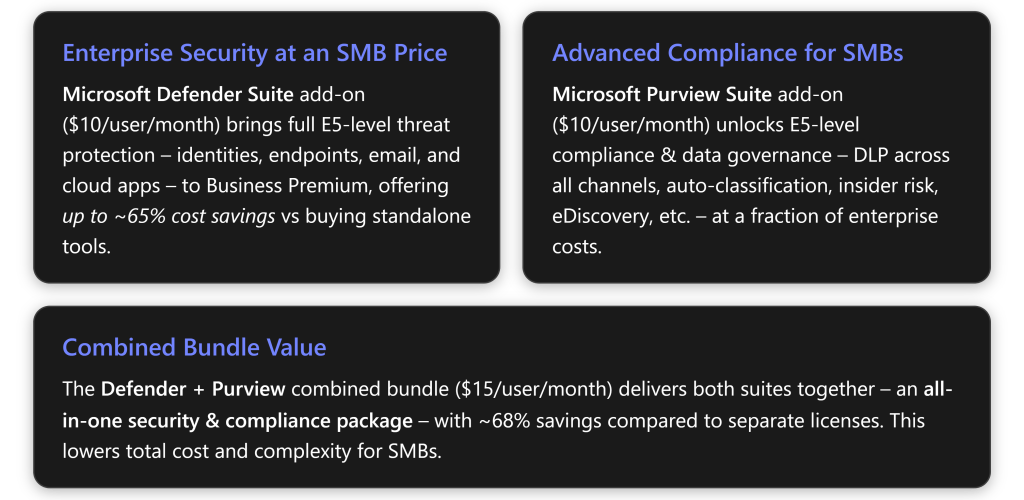
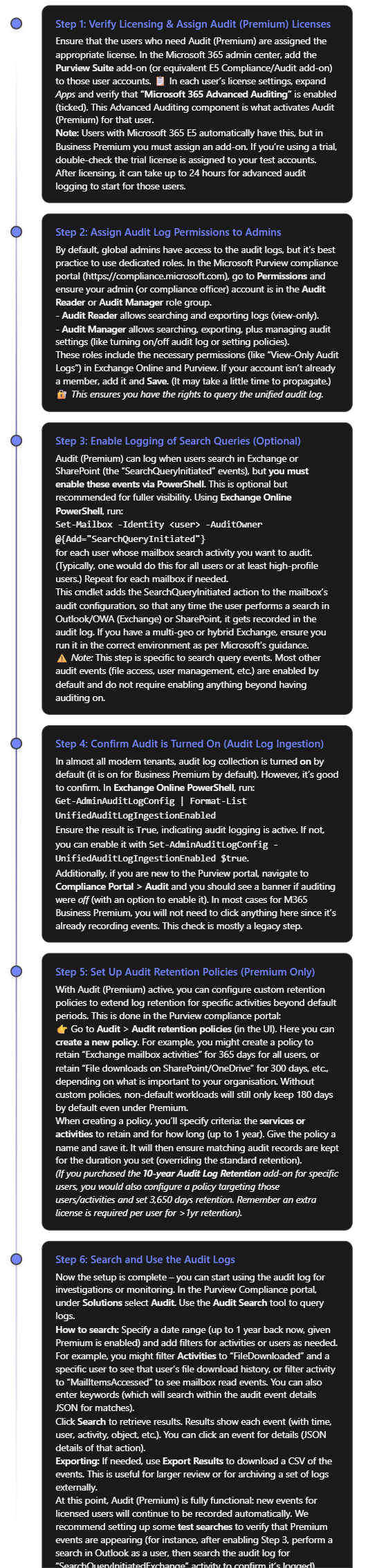
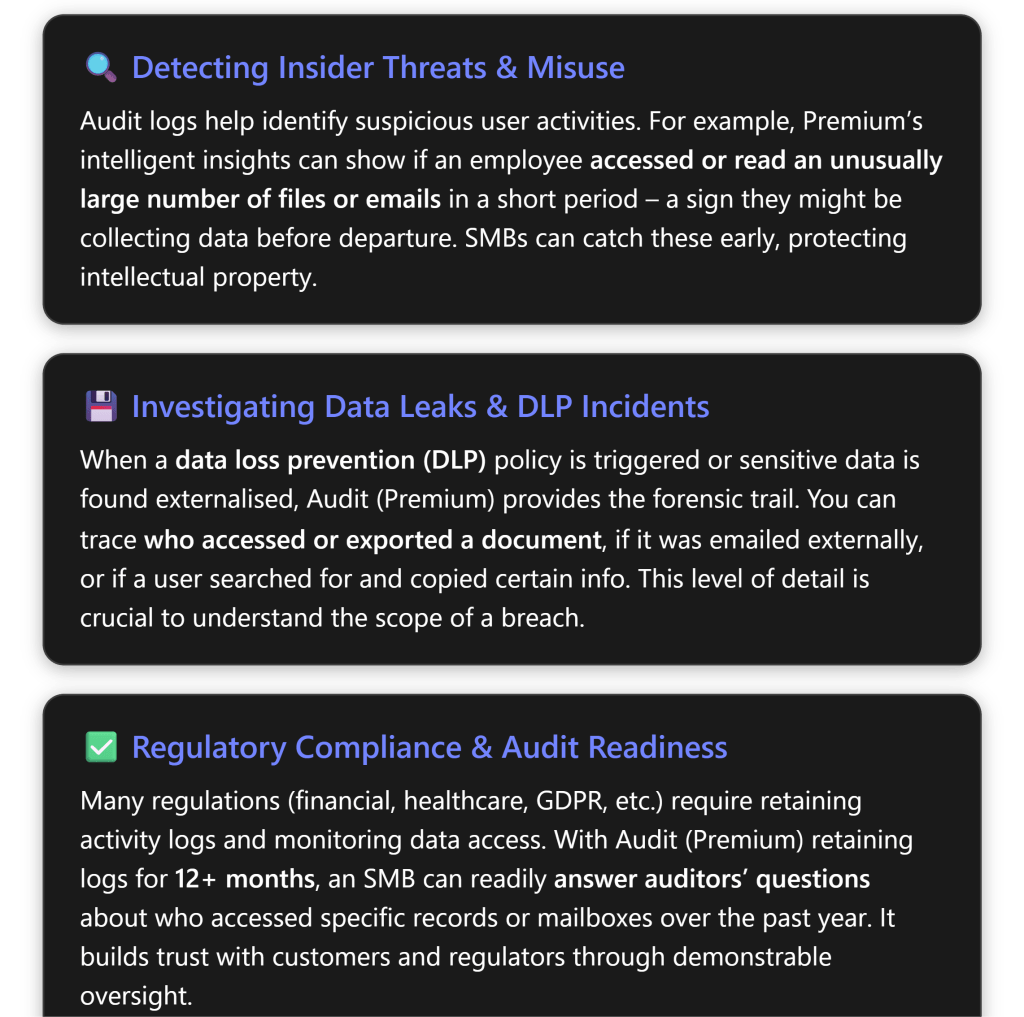


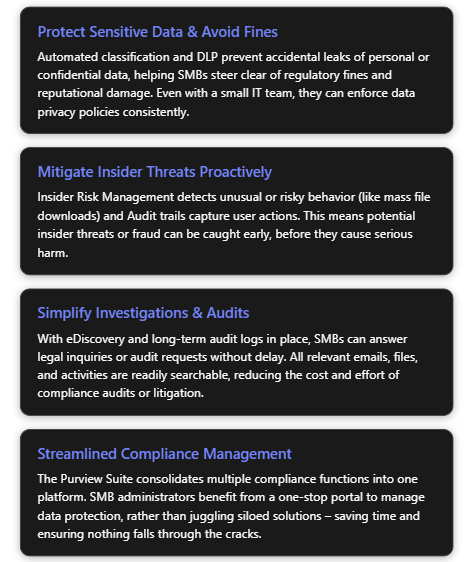
 CIAOPS