
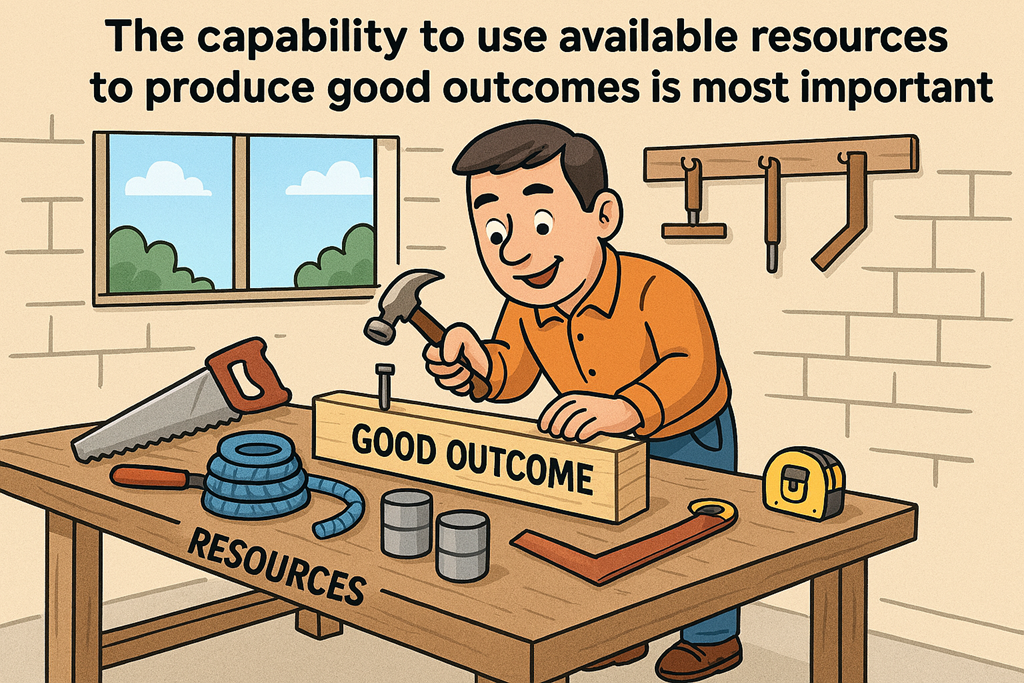
Most organisations don’t fail because they lack tools, money or technology. They fail because they lack the capability to use what they already have to produce good outcomes.
That might sound blunt, but it’s one of the most consistent patterns I see across businesses, MSPs and IT teams.
They have Microsoft 365.
They have security products.
They have AI tools.
They have documentation, frameworks, policies and “best practice”.
And yet outcomes are poor.
Why? Because capability matters more than availability.
Having access is not the same as being capable
Modern business environments are stacked with resources. Cloud platforms, SaaS tools, automation, AI copilots, security dashboards — the list keeps growing.
But access to resources doesn’t magically translate into results.
Capability is what turns potential into performance.
Capability means:
- Knowing what to use
- Knowing when to use it
- Knowing why it matters
- And being able to apply it consistently under pressure
Without that, more tools just add more noise.
I’ve seen organisations buy premium licences, deploy advanced features, and still operate like nothing changed — because nobody actually knew how to use the capability to drive outcomes.
Outcomes don’t come from features — they come from execution
This is where many technology discussions go off the rails.
The focus shifts to:
- “What features do we have?”
- “What licence do we need?”
- “What tool should we buy next?”
Instead, the better question is: What outcome are we trying to achieve, and do we have the capability to get there?
Security is a perfect example.
Buying security tools doesn’t make you secure.
Configuring policies once doesn’t make you resilient.
Compliance frameworks don’t implement themselves.
Outcomes like reduced risk, faster recovery, safer users and better decision‑making only happen when people understand how to use the tools as part of a system, not as isolated checkboxes.
Capability is a multiplier
Resources on their own are static. Capability is a force multiplier.
Two organisations can have the same tools and budgets, yet one dramatically outperforms the other. The difference is rarely technology. It’s capability.
High‑capability teams:
- Adapt faster when things change
- Get more value from fewer tools
- Recover quicker when things go wrong
- Make better decisions with incomplete information
Low‑capability teams:
- Depend on vendors to think for them
- Struggle when documentation is outdated
- Freeze when incidents don’t follow the playbook
- Keep buying “solutions” to fix people problems
Capability compounds over time. Tools depreciate. Skills appreciate.
Capability is built, not installed
This is the uncomfortable truth many leaders avoid.
You can’t deploy capability with a script, a purchase order or a project plan.
Capability is built through:
- Repetition
- Context
- Practice
- Feedback
- Failure (and learning from it)
That’s why checklists alone don’t work.
That’s why “we sent them on a course” doesn’t stick.
That’s why shelfware exists.
People become capable when they use resources to solve real problems, not when they memorise features.
MSPs: this is your real value
For MSPs, this is where the opportunity — and responsibility — lies.
Clients don’t need more tools. They need better outcomes.
Your value isn’t:
- Installing another product
- Enabling another feature
- Sending another report nobody reads
Your value is helping clients build the capability to use what they already have to:
- Reduce risk
- Improve productivity
- Make better decisions
- Sleep better at night
That means shifting conversations away from tools and towards outcomes, behaviour and repeatable execution.
Ask better questions
If you want better outcomes, start asking better questions:
- What are we actually trying to improve?
- What decisions should this capability enable?
- Who needs to act differently as a result?
- What happens if this fails at 2am on a Sunday?
- Can this be repeated, not just demonstrated once?
These questions expose gaps in capability far faster than another product demo ever will.
The bottom line
Resources are everywhere. Capability is rare.
The organisations that win aren’t the ones with the biggest stacks — they’re the ones that can use what they have well, consistently, and under pressure.
If you care about outcomes, stop asking what else you need to buy.
Start asking whether you’re capable of using what you already have.
Because capability — not access — is what produces good outcomes.
 CIAOPS