
Most MSPs I talk to think their biggest problem is capacity.
Not enough hours. Too many tickets. Too much noise. Too many tools. Too many clients asking for “just one more thing”.
But after years of watching smart operators slowly grind themselves into the dirt, I’ve come to a different conclusion:
Most MSPs aren’t overloaded.
They’re mis‑aligned.
They’re doing work in ways that fight how their brain actually works.
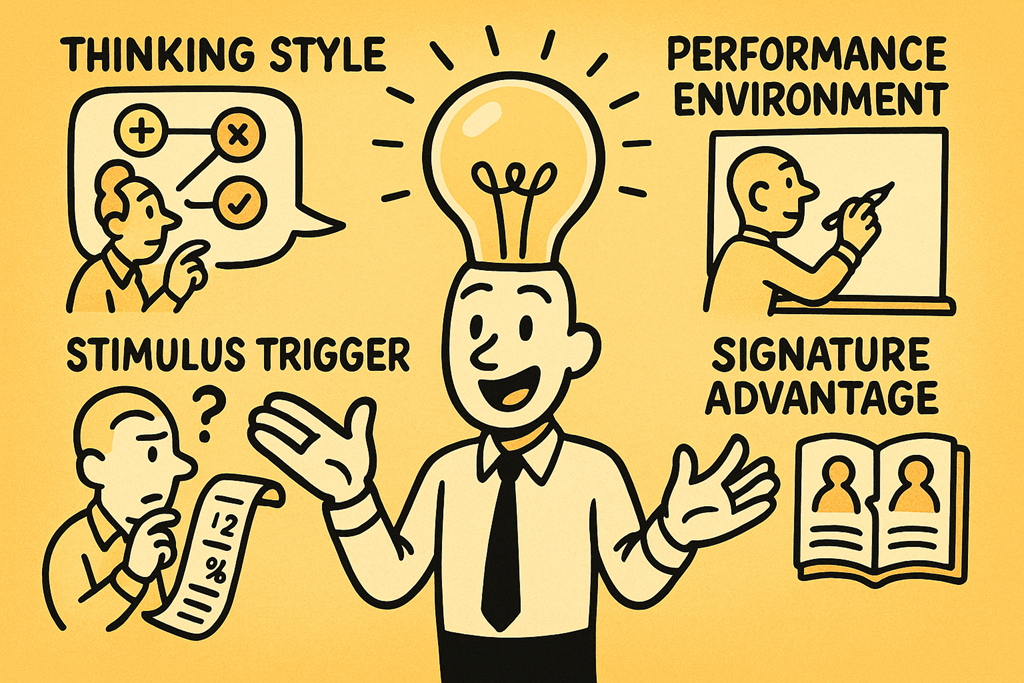
The people who seem “naturally productive” aren’t superhuman. They’ve just figured out four things about how they think and work — and they lean into them hard.
If you want a real unfair advantage, start here.
1. Thinking Style: How You’re Actually Useful When You’re On Fire
Think about the moments when you’re at your best with a client.
Not when you’re tired and reactive — but when you’re sharp.
Are you explaining a messy situation so it suddenly makes sense?
Diagnosing a problem everyone else missed?
Reframing a client’s panic into a solvable model?
Telling a story that makes the penny drop?
Turning chaos into a simple diagram on a whiteboard?
That’s your thinking style.
Some MSPs are natural explainers.
Others are diagnosticians.
Some are framers — they can take emotional noise and turn it into logic.
Others are builders of models, frameworks, and systems.
Here’s the trap: most MSPs ignore this and try to be “well‑rounded”.
That’s how you end up doing work that drains you — even if you’re good at it.
Your thinking style is where your value compounds. Everything else is just effort.
2. Performance Environment: Where Your Brain Actually Shows Up
Next question: where do you perform best?
Not where you think you should perform best — where you actually do.
Some people are lethal in conversation.
Others come alive on camera.
Some think best while writing.
Others need a whiteboard, a marker, and a messy problem.
Some are at their peak solving something live, under pressure.
Yet I see MSPs forcing themselves into environments that actively blunt their strengths.
The person who thinks best out loud hides behind email.
The great writer spends all day in meetings.
The visual thinker never gets near a whiteboard.
The live problem‑solver is buried in tickets.
This is madness.
Your performance environment isn’t a preference. It’s a productivity multiplier.
Design your work so you spend more time there — or accept that you’re choosing friction.
3. Stimulus Trigger: What Actually Switches You On
Here’s an uncomfortable truth: motivation is situational.
Some things light your brain up instantly.
A real‑world example.
A messy tenant.
A bad piece of advice on LinkedIn.
A client question that doesn’t quite add up.
Numbers that smell wrong.
A half‑baked “best practice”.
Other things? They leave you cold.
High performers know their stimulus triggers — and they use them deliberately.
They don’t start with blank pages.
They start with something concrete to react to.
If your brain wakes up when you see a broken setup, don’t start with theory.
If bad advice annoys you into clarity, use it.
If questions trigger insight, collect them.
If data drives you, lead with numbers.
Stop waiting to feel motivated. Start feeding your brain the inputs it responds to.
4. Signature Advantage: The Thing That Makes You You
Finally, the part most people under‑leverage: your signature advantage.
This is the thing people remember you for.
Maybe it’s frameworks.
Maybe it’s analogies.
Maybe it’s blunt honesty.
Maybe it’s storytelling.
Maybe it’s data.
Maybe it’s humour.
Maybe it’s big, relentless energy.
Whatever it is, it should be obvious in everything you do.
Your emails.
Your client calls.
Your documentation.
Your videos.
Your training.
Your AI prompts.
Too many MSPs sand this down to sound “professional”.
The result? Beige advice. Forgettable delivery. No differentiation.
Your signature advantage is not a liability. It’s your brand.
The Real Takeaway for MSPs
If you’re exhausted, stuck, or feeling behind, the answer probably isn’t another tool, cert, or process.
It’s alignment.
When your thinking style, performance environment, stimulus triggers, and signature advantage line up, work gets lighter — not heavier.
You move faster with less effort.
Clients get better outcomes.
You stop forcing productivity and start compounding it.
That’s the real unfair advantage.
And it has nothing to do with working harder.
 CIAOPS